You don’t need a warp drive to find an alien. Some of the most “extraterrestrial” beings on the planet are right here, hiding in plain sight. In my years as a biologist, I’ve spent countless hours buried in research and field guides, mesmerized by creatures that look like they were pulled straight from a movie storyboard like Avatar.
Whether it’s the prehistoric, trunk-nosed saiga antelope galloping across the dusty Eurasian steppes or the ethereal snow leopard haunting the mountain peaks, biology constantly proves that reality is weirder than fiction. I’ve written about the Sichuan takin and the tragic fate of the dodo, but there is one creature that feels less like an animal and more like a myth walking through the undergrowth: the bongo antelope.
After finishing my book, Animals of Africa: The Ecosystem Explorer, I realized that for most people, the bongo is a ghost. It’s the largest forest antelope on the planet, yet it remains one of the least known. It looks like a relic from another era, a vibrant, striped forest guardian that we are dangerously close to losing. Here is everything you need to know about the incredible bongo antelope.
What Animal is a Bongo Exactly?
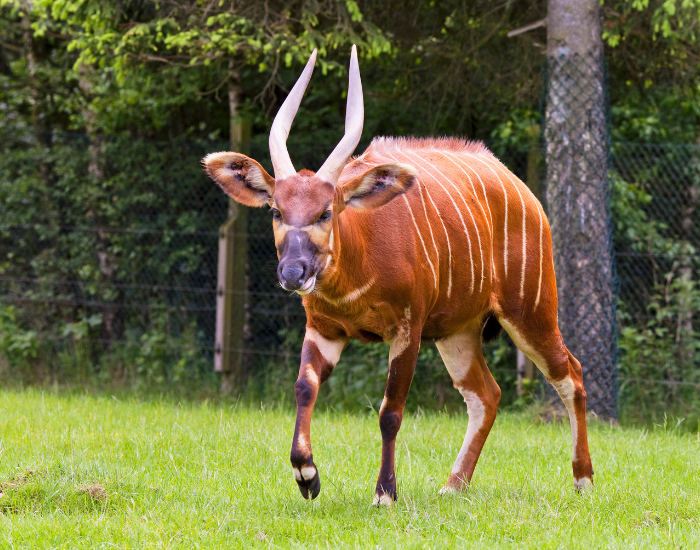
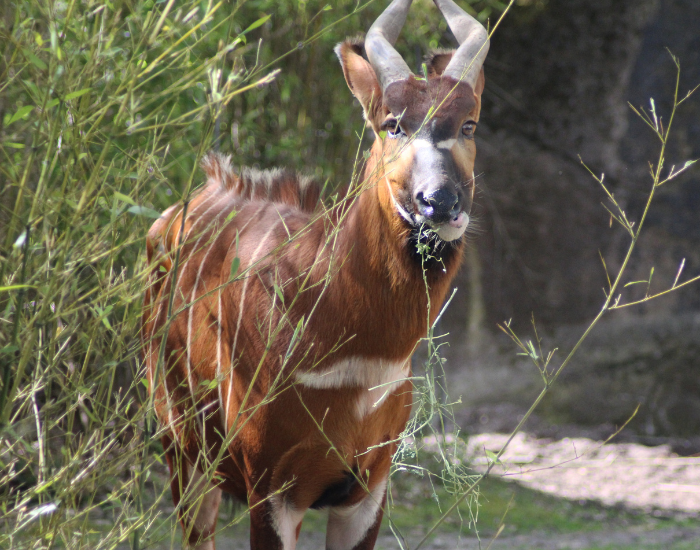
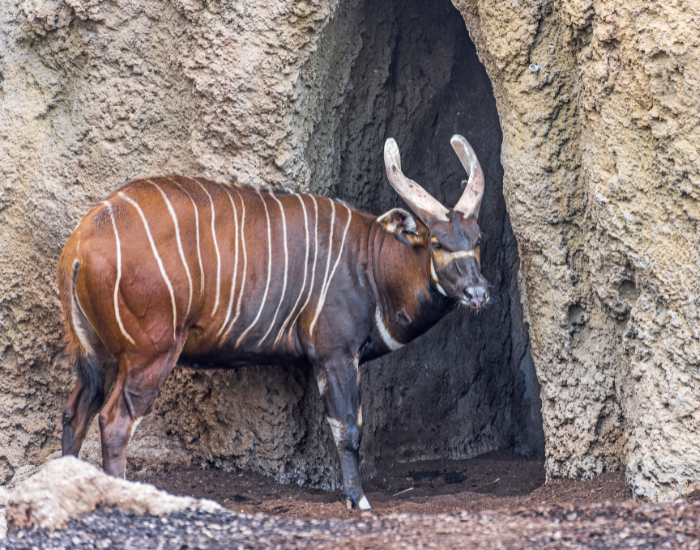
Maybe you are thinking about the drum but it is not quite what I am talking about here. If you saw one in a zoo, you’d think someone painted it for a film. They sport a deep, burnt-orange chestnut coat decorated with 10 to 15 vivid white-yellow vertical stripes. Another distinguishing feature is the bongo’s black muzzle, which stands out against its facial markings. Bongos also have large ears, which help them detect predators in dense forest habitats.
The bongo antelope belongs to the Bovidae family. These forest antelopes are among the most visually striking African mammals. For example, their unique striping pattern serves as natural camouflage in dense undergrowth.
Is a Bongo a Deer?
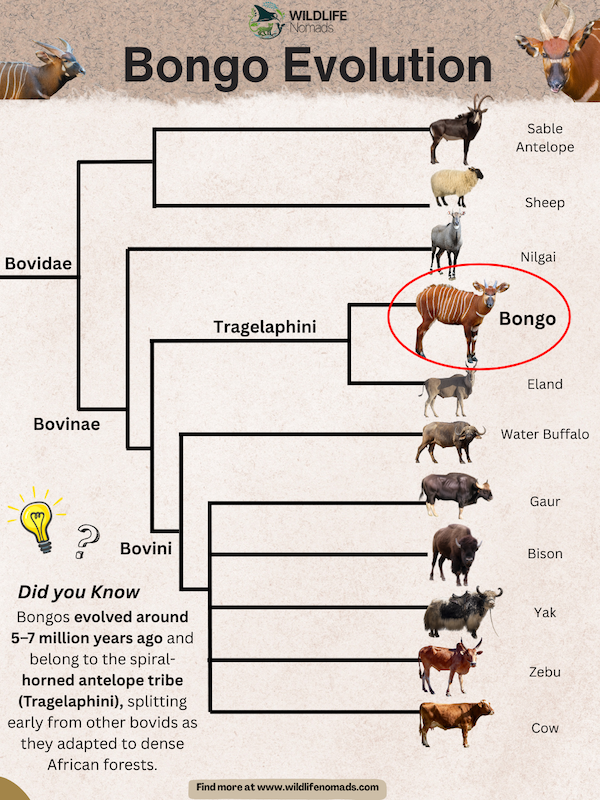
While they might look like a “fancy bongo deer,” bongo antelopes are firmly in the bovine family. They are more closely related to cows, buffalo, and elands than to any deer. The name Tragelaphus eurycerus actually derives from Greek words meaning “goat-stag” and “broad horns.”
They Are the Heavyweight Champions of the Forest
Bongo antelopes are the largest forest antelopes in the world. To give you an idea of their scale, adult males (bongo bulls) can weigh between 240-405 kg (up to 900 lbs). Female bongos are slightly smaller but still substantial, weighing between 210-253 kg. In addition, males bulge with muscle as they age.
These large animals stand approximately 1.3 meters (4.3 feet) at the shoulder. Their considerable size makes them the largest forest-dwelling antelopes on Earth. However, despite their size, they move through dense forest with remarkable agility.
Both Sexes Wear the Crown
In many antelope species, only the males have horns. Not the bongo. Both male and female bongos boast magnificent, lyre-shaped spiraling horns. The males’ horns are generally longer and more massive, but a female bongo antelope is just as formidable-looking in the brush.
The horns can reach lengths of 75-99 cm in males. Female bongos have slightly shorter horns. These impressive weapons help both sexes defend themselves against predators. In addition, the horns feature a distinctive spiral pattern that’s unique to each individual.

Where Do Bongos Live in Central Africa?
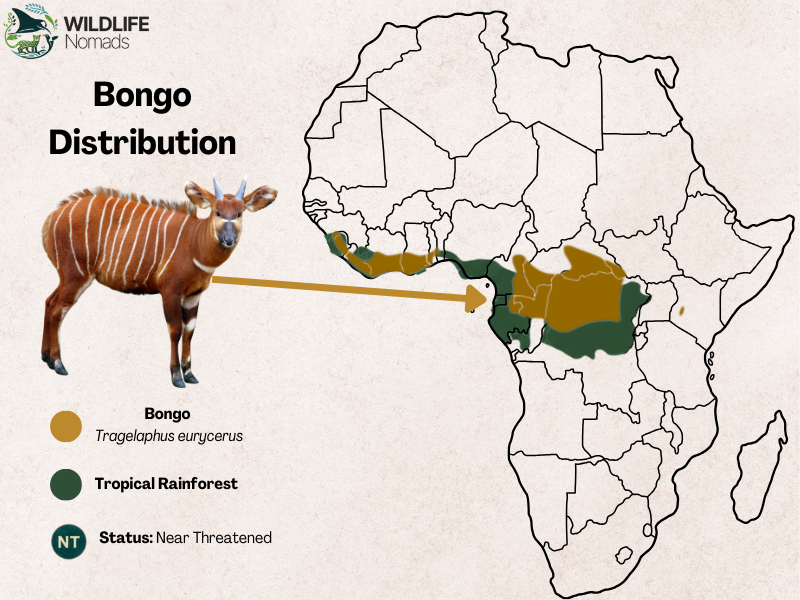
The bongo habitat is as specific as it is beautiful. They don’t want wide-open savannas; they want the “messy” parts of the forest. They inhabit dense undergrowth, bamboo forests, and montane forests up to 4,000 meters in altitude. You’ll find them in the “water towers” of Africa, forests that catch rain and feed the continent’s rivers.
Bongo populations are distributed across central Africa and west Africa. Specifically, they thrive in tropical Africa’s dense forest regions. The eastern bongo (mountain bongo) is found exclusively in Kenya’s Mount Kenya region. Meanwhile, the western bongo (lowland bongo) ranges across west and central Africa, including the Congo Basin.
These forest shadows provide perfect cover. Bongos seek cover in bamboo thickets during the day. They prefer areas with dense forest canopy and thick vegetation at ground level. In addition, they inhabit lowland forests and forest edge habitats.
There Are Two Distinct Subspecies: Including the Mountain Bongo
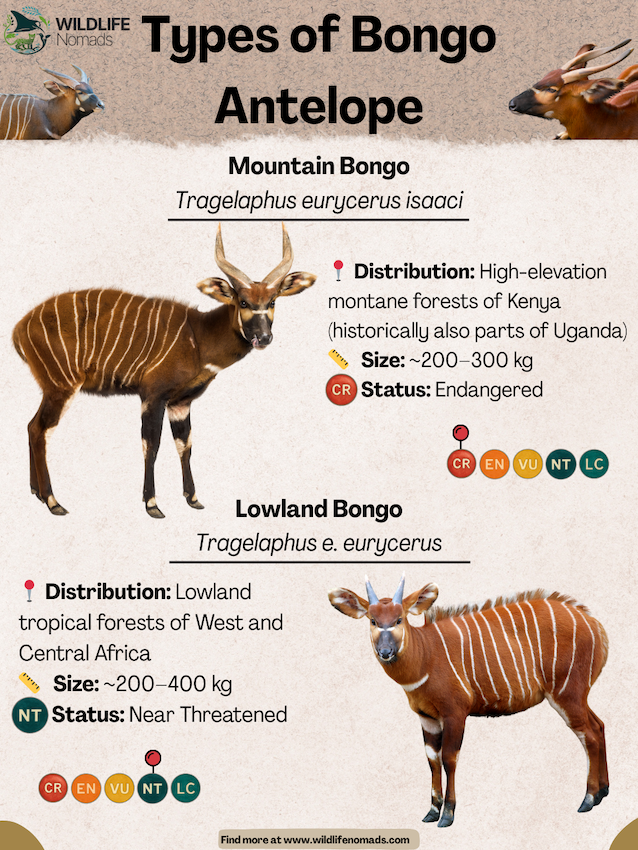
There isn’t just one type of bongo. We categorize them into two subspecies:
Lowland Bongo (Western Bongo): Inhabiting the rainforests of west and central Africa, the lowland or western bongo (Tragelaphus eurycerus eurycerus) has adapted to life in tropical forests. These bongos range from southern Sudan to Congo Basin regions.
Mountain Bongo (Eastern Bongo): Found only in isolated pockets of Kenya’s high-altitude forests, the mountain bongo or eastern bongo (Tragelaphus eurycerus isaaci) is critically endangered. This subspecies inhabits Mount Kenya and the Aberdare Mountains. Sadly, fewer than 100 individuals remain in their native ranges.
The distinction between these subspecies is crucial for conservation efforts. Therefore, understanding their separate populations helps target protection strategies.
The Ultimate “High-Vis” Camouflage
In the wild, those white stripes aren’t for show, they are high-tech camouflage. In the dappled light of a dense forest canopy, those vertical stripes break up their silhouette so perfectly that a 400 kg male can stand ten feet away from you and remain virtually invisible. It’s why we call them the “Ghosts of the Forest.”
The vertical position of the white chevron markings creates an optical illusion in forest shadows. As bongos slowly pace through bamboo forests, their striping pattern makes them disappear. This adaptation is essential for survival.

Bongos Have a Very Specific Diet
Bongos are herbivorous browsers. They use their long, prehensile tongues to grab leaves, vines, and even thistles. These diet bongos consume include bamboo shoots, garden produce (when available), and various forest plants. They feed primarily on young leaves and tender shoots. In addition, they seek mineral licks to obtain essential nutrients. Natural salt licks are critical to their survival.

They Are “Charcoal Eaters”
One of the weirdest things is how bongos eat burned wood after a lightning storm. They aren’t just hungry; they are looking for minerals. Consuming charcoal helps them obtain salts and can even help neutralize toxins from the various wild plants they consume.
This behavior of eating burned wood is fascinating. Therefore, after forest fires, bongos actively seek out charred vegetation. The charcoal acts as a detoxifying agent in their digestive system.
They Are Primarily Nocturnal
To avoid predators like leopards and spotted hyenas, the African bongo is mostly nocturnal. They are most active at dawn and dusk (crepuscular) or under the cover of night. This makes them incredibly difficult to track in the wild, often requiring the use of remote camera traps.
During the day, bongos remain solitary or in small groups. They seek cover in dense undergrowth to avoid detection. Therefore, spotting one requires patience and luck.
Social Butterflies vs. Solitary Bulls
Female bongos are the social ones, often forming “nursery herds” of 6 to 50 individuals to protect their calves. However, females with young typically live in groups of six to eight. Adult males, especially older males, are true loners and tend to be solitary. As they age, older males develop a darker chestnut coat that turns almost black. Adult males of similar size or age tend to avoid one another and may engage in ritualized sparring with other males, using visual displays such as neck bulging and horn positioning. Males only seek out females during mating time and do not restrict the movement of females in herds. Bongos lack special secretion glands, relying instead on visual displays and vocalizations for communication. Bongos emit a limited number of vocalizations, mostly grunts and snorts, and females have a weak mooing contact-call for their young.
Male bongos remain solitary for most of the year. However, during breeding season, they join female herds briefly. The gestation period for bongos lasts approximately nine months. Therefore, a single calf is born per breeding cycle. Calves grow rapidly and females weigh significantly less than males even at maturity.
How Many Bongo Antelopes Are Left?
The numbers are sobering. While the lowland bongo population is estimated at around 15,000 to 25,000, the mountain bongo is critically endangered. There are likely fewer than 100 individuals remaining in the wild in Kenya, though recent census data from 2025 shows approximately 176 mountain bongos. They are rarer than the mountain gorilla.
The mountain bongo antelope faces the most serious threat. African populations of eastern bongos have declined dramatically over past decades. However, recent conservation efforts show promise. Kenya’s 2025 census recorded 176 mountain bongos, up from 150 in 2021. In addition, habitat loss continues to reduce available territory. The western bongo fares slightly better but still faces pressure.
Why Are Bongos Endangered?
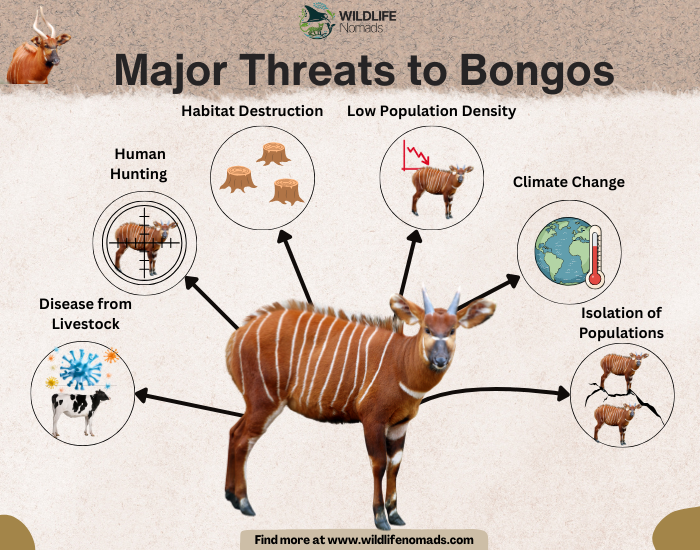
The threats are three-fold:
Habitat Loss: Logging and human encroachment are shrinking their world. Habitat destruction removes critical forest cover. As forests disappear, bongos lose both food sources and protection from predators.
Poaching: Illegal hunting threatens wild populations. They are hunted for their meat and their magnificent horns. However, some African cultures have taboos against eating bongo meat.
Disease: They are highly susceptible to bovine diseases like Rinderpest. These illnesses can be transmitted by local livestock. In addition, as human settlements expand into bongo habitat, disease transmission increases.
Climate change also affects their montane forest homes. Therefore, multiple factors combine to threaten their survival.
The “Bongo Surveillance Programme” is Saving Them
We aren’t giving up. Initiatives like the Bongo Surveillance Programme and the Mount Kenya Wildlife Conservancy are doing incredible work. They use DNA analysis and camera traps to monitor the last remaining wild groups. In addition, they manage “repatriation” programs—bringing bongos from captive breeding programs back to the wild in central Kenya.
The Kenya Wildlife Service plays a crucial role in conservation. Managed animal populations in zoos worldwide provide genetic diversity. Therefore, these captive populations serve as insurance against extinction.
Conservation efforts focus on three main areas. First, protecting existing habitat in Mount Kenya and other native ranges. Second, breeding programs maintain genetic diversity in captive populations. Third, reintroduction programs aim to establish new wild populations.
Similar antelopes face comparable threats. Therefore, lessons learned from bongo conservation inform broader wildlife protection strategies. The Bongo Surveillance Programme represents hope for other endangered species.
FAQ: What People Ask About Bongo Antelopes
They live in the dense tropical and montane forests of central Africa, west Africa, and east Africa. Specifically, the mountain bongo is found only in Kenya. The lowland bongo ranges across tropical Africa including the Congo Basin and southern Sudan.
Bongos are herbivorous browsers. They feed on leaves, bamboo shoots, vines, and various forest plants. In addition, they consume charcoal from burned wood to obtain minerals. They seek natural salt licks for essential nutrients.
Several other antelopes inhabit African forests. However, bongos are the largest forest antelopes. Similar antelopes include duikers and bushbucks. Nevertheless, none match the bongo’s impressive size.
Despite their considerable speed through dense vegetation, bongos don’t rely primarily on running. Instead, they use their excellent camouflage and knowledge of forest shadows to avoid predators. Their slowly pacing gait allows them to move silently through undergrowth.

Don’t Let the Ghost Fade
The bongo antelope is a reminder that there is still magic left in the deep, dark corners of our world. However, magic needs a space to live. If we continue to treat our forests as commodities rather than cathedrals, we will lose the bongo forever—just like we lost the dodo.
The mountain bongo stands at a critical juncture. While recent conservation efforts show promise, with numbers increasing from fewer than 100 historically to approximately 176 as of 2025, every animal still counts. Therefore, conservation efforts must continue intensifying.
I don’t want to write another post about an animal that “used to exist.” I want the next generation of biologists to feel that same heart-stopping moment I had—the flash of orange stripes in the bamboo, the silent proof that the King of the Forest is still there.
The bongo deserves better than extinction. These largest forest antelopes represent the wild heart of Africa. Therefore, we must act now to secure their future. The ghosts of the forest must continue haunting their ancestral homes for generations to come.