
Meet a Very Special “Goat”
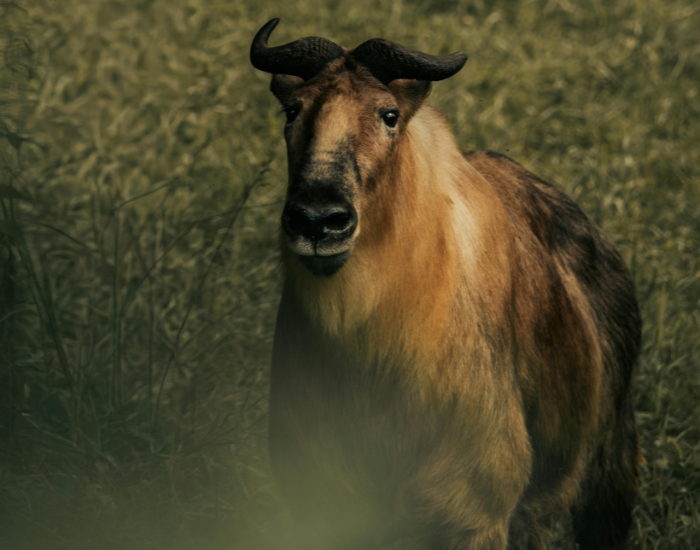
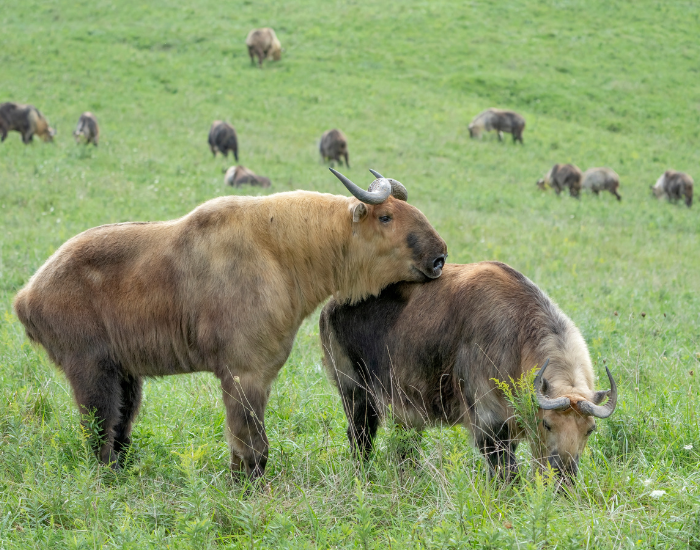
I’ve always been fascinated by strange-looking animals. The first that really caught my attention was the saiga antelope, with its oversized, trunk-like nose. Soon enoguh, that curiosity took me to learn more about the Sichuan takin, another animal that looks like it was pieced together from several species (alongside the platypus). With its massive head, crescent-shaped horns, and moose-like snout, the takin is one of the Himalayas’ most unusual creatures, and the more I learned about it, the more hooked I became.
This strange-looking takin animal has fascinated biologists for decades, not only because of its appearance but also its behavior, adaptations, and role in the ecosystem. Locals often call it a “national treasure,” protected under Chinese law, yet it remains Vulnerable due to habitat loss and hunting pressures.
Let’s explore 12 weird and wonderful facts about the Sichuan takin, from their “natural raincoat” to their intimidating roar.
1. What Is a Sichuan Takin?
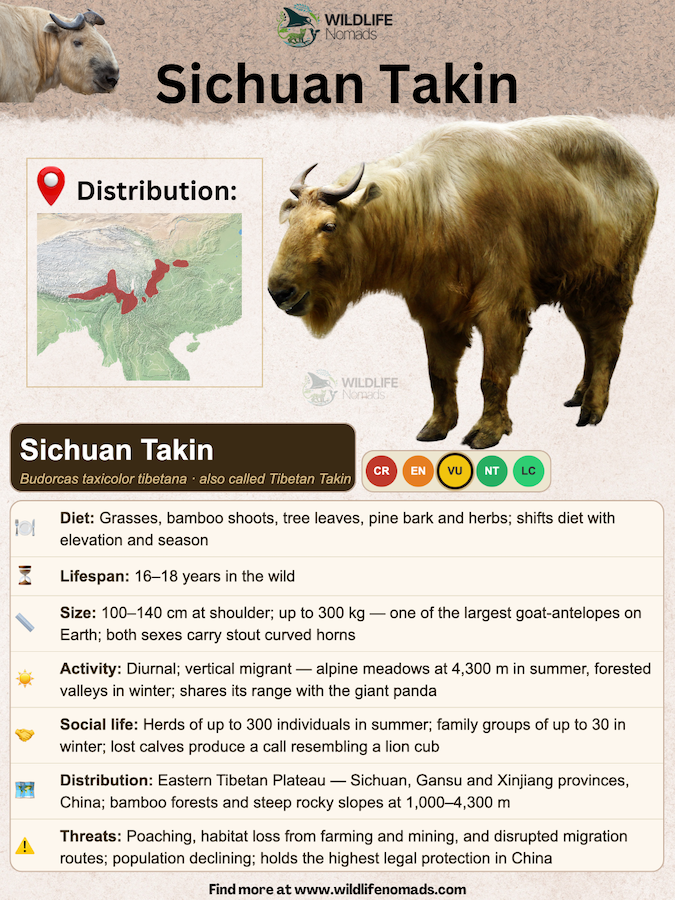
The Sichuan takin (Budorcas taxicolor tibetana) is a subspecies of takin, a rare goat-antelope found in the Eastern Himalayas. Taxonomically, they belong to the same family as goats and sheep, but their appearance of a takin is unlike any other hoofed mammal.
- Scientific name: Budorcas taxicolor tibetana
- Common name: Sichuan takin
- Animal class: Mammal, order Artiodactyla
- Relatives: Goats, sheep, musk ox
- Other takin subspecies: Bhutan takin, Mishmi takin, and Golden takin
So, is a takin goat? Not exactly, it’s an odd hybrid-looking species that shares traits with both goats and antelopes.
2. Where Do Takins Live?
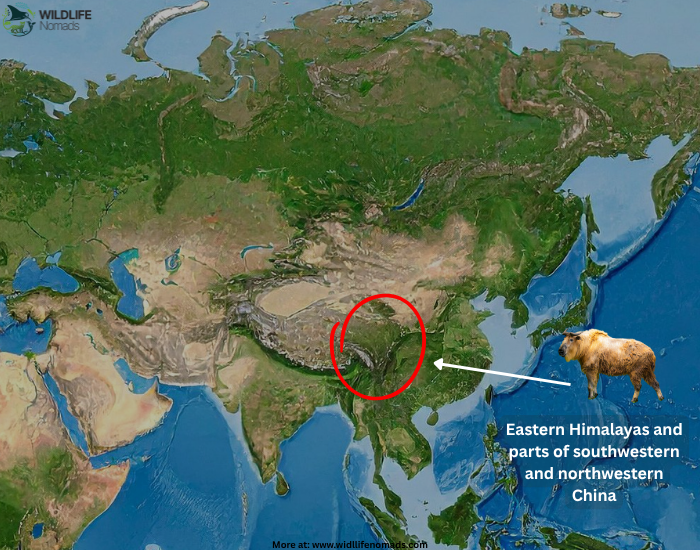
Sichuan takins live in remote mountainous terrain across western China, particularly primarily found in Sichuan, Gansu, and southern Shaanxi provinces, with some populations in the Qionglai and Minshan mountain ranges. Their takin habitat overlaps with giant pandas, especially in same dense bamboo forests.
- Found in forested valleys and rocky habitat.
- Range includes alpine and deciduous plants zones.
- Adapted to elevations between 1,200 and 4,500 meters, with some variation by season.
These wild takins shift elevation seasonally:
- In early summer, large herds climb higher into cooler pastures.
- As the cooler weather approaches, they descend into valleys for food.
This altitudinal migration helps them survive in a harsh landscape with extreme weather shifts.
3. Social Life: Takin Herds and Family Groups
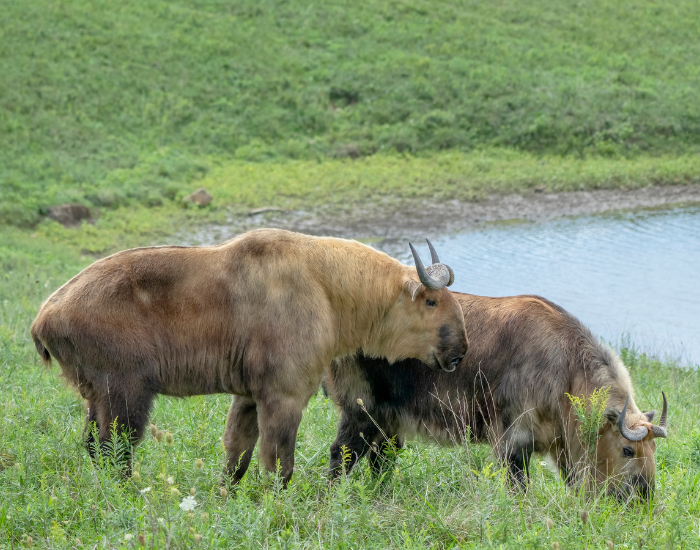
Sichuan takins are surprisingly social. They often form family groups or takin herds of up to 30 individuals.
- Herds are usually led by adult females (cows) with their takin kids.
- Older males (bulls) are generally solitary, joining herds only during the mating season.
- In early spring, herds can expand to larger groups, but in winter, they split into smaller groups to survive.
During seasonal movements, takins gather along well-worn paths through bamboo forests, reminding me of cattle trails.
4. Unique Adaptations: Nature’s Raincoat
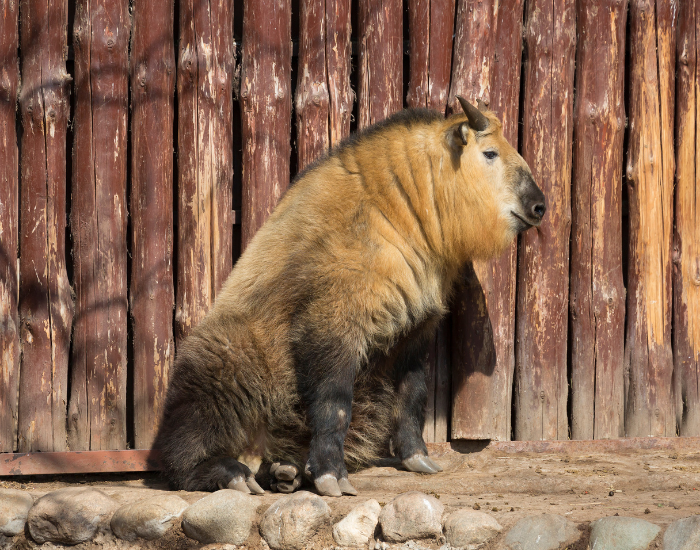
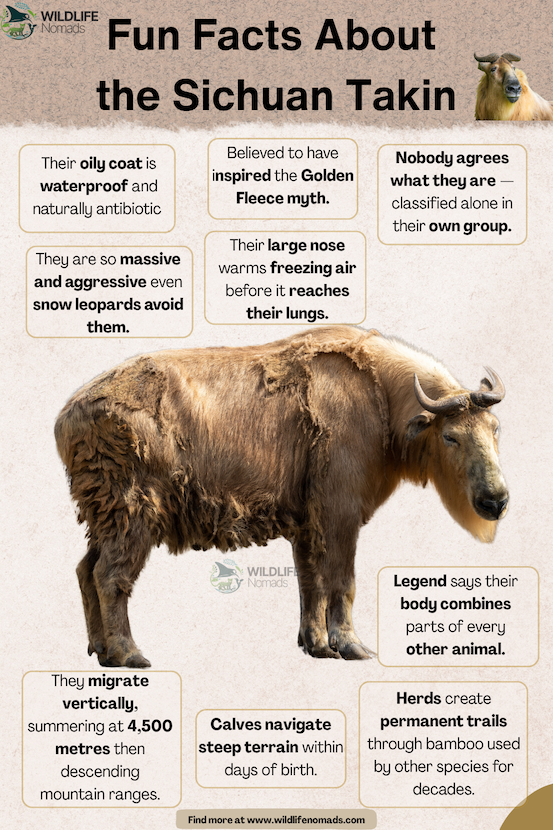
Perhaps the weirdest fact about this Sichuan animal is its oily skin secretion. Their skin glands produce an oily stuff that coats their thick secondary coat. Locals call this a “natural raincoat,” since it repels rain and snow.
- The secretion has a bitter-tasting substance, which may deter predators.
- Combined with their solid food diet of fibrous plants, these adaptations keep them thriving in tough weather.
5. What Do Takins Eat?
So, what do takins eat? These herbivores browse on:
- Bamboo shoots and bamboo leaves (shared with pandas).
- Deciduous plants like oak and maple.
- Pine bark stripped with their strong jaws.
- Alpine shrubs and rhododendrons.
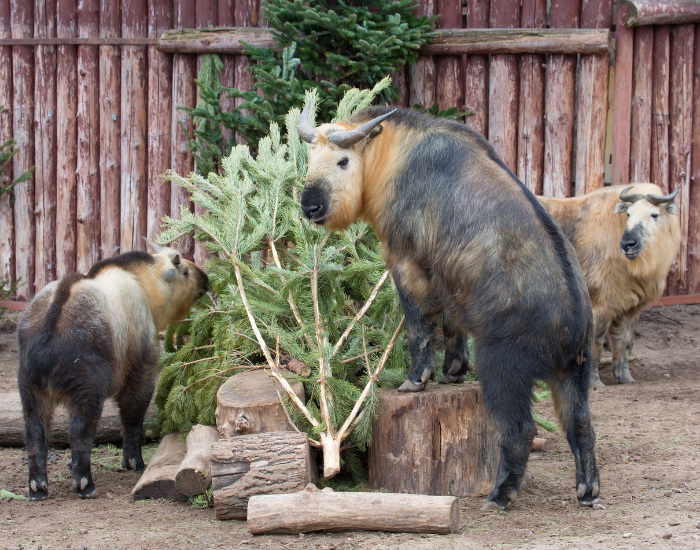
In the early morning and late afternoon, takins feed heavily, sometimes standing on their hind legs and propping their front legs on trees to reach leaves.
At zoos like the San Diego Zoo, their diet includes hay, grain, and leafy browse, far more varied than in the wild.

6. How Big Is a Sichuan Takin?
The Sichuan takin size is impressive. They rival some takin predators in sheer bulk. They are so massive and aggressive even snow leopards avoid them.
- Males (bulls): Up to 300–450 kg.
- Females (cows): Around 250–300 kg.
- Sichuan takin length: 1.7–2.2 meters.
- Height at shoulder: About 1.2 meters.
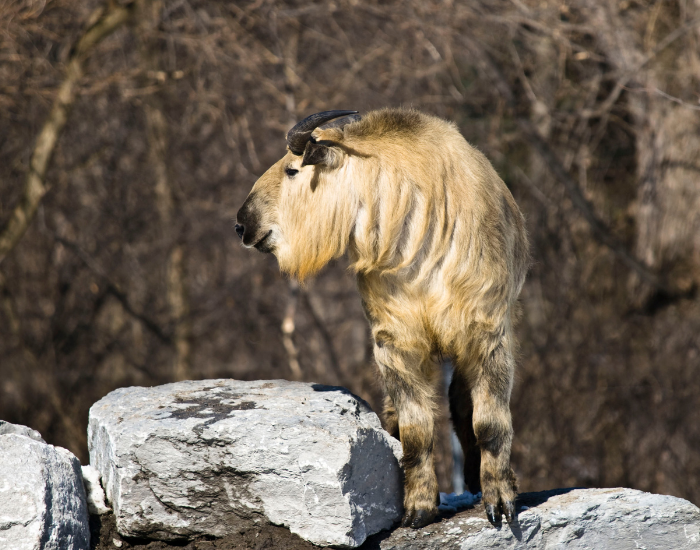
Their impressive horns, thick, ridged, and curving backward, make them look intimidating. Combined with their large head and stocky build, they are built for power, not speed.
7. Strange Looks: Why a Moose-Like Snout?
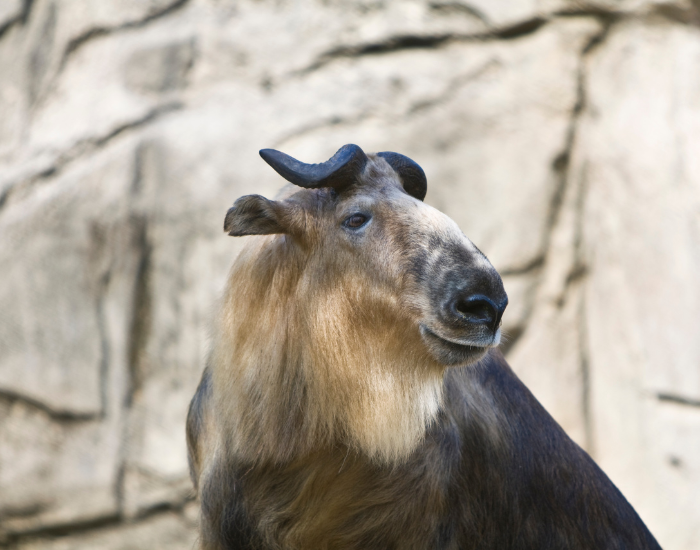
The moose-like snout is their most iconic feature. It’s not just for looks, it helps warm cold mountain air before it reaches their lungs. Their nasal passages act as a heat-conserving system, a crucial adaptation in freezing winters.
With their short legs, hunched body, and crescent-shaped horns, takins look like something drawn from myth. In fact, some suggest they may have inspired the legend of the golden fleece in Greek mythology, however this is speculative and there’s no definitive evidence linking takins to the Greek myth.
8. Takin Behavior: Intimidating Roars and Slow Moves
Though generally slow moving, takins aren’t to be underestimated.
- Bulls produce an intimidating roar during the mating season.
- They mark territory by takins rub, rubbing their scent glands on trees.
- When threatened, they can charge with surprising speed, using their front legs and horns like battering rams.
Despite their bulk, they are agile on steep slopes, capable of long distance climbs across rocky terrain.
9. Breeding: From Rut to Takin Kids
The mating season runs from late summer into early fall.
- Bulls compete by clashing horns and roaring.
- Adult females usually give birth to a single kid after a 7–8 month pregnancy.
- Newborns have a dark stripe for camouflage.
- Within days, they can walk and follow their mother.
Young males disperse to form smaller groups, while daughters often stay with the herd.
10. Predators and Natural Threats
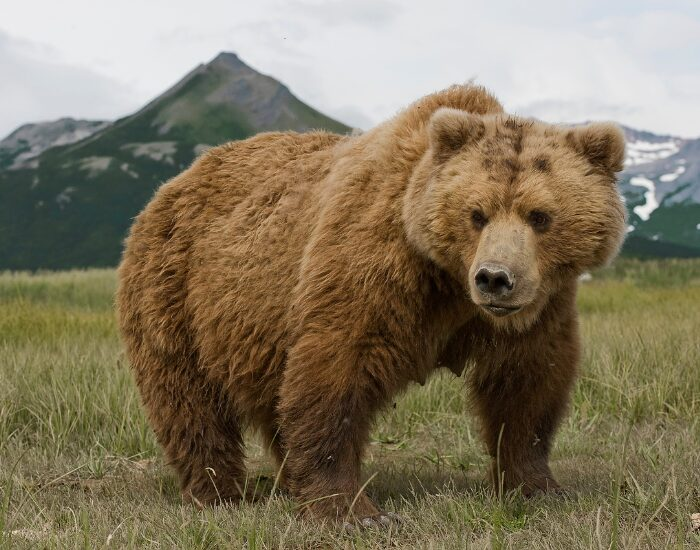
Sichuan takins have few natural predators thanks to their size and herds. However, takin predators include:
The bigger threat is humans. Habitat loss from deforestation and agriculture has fragmented their range. Poaching for meat and horns has also reduced numbers.
11. Conservation: National Treasure of China
The Sichuan takin is listed as Vulnerable by the IUCN. Conservation measures include:
- Chinese law protects takins as a national treasure.
- Nature reserves like Tangjiahe and Wolong safeguard takin habitat.
- International zoos like the San Diego Zoo run save species worldwide breeding programs.
Still, with their populations declining, urgent protection is needed to keep these animals from sliding toward endangerment.
12. Cousins Across the Himalayas
While this article focuses on the Sichuan takin, there are three other subspecies:
- Mishmi takin (Budorcas taxicolor taxicolor) – India and Myanmar.
- Bhutan takin (Budorcas taxicolor whitei) – Bhutan and Tibet.
- Golden takin (Budorcas taxicolor bedfordi) – Shaanxi province, China.
Together, these takins represent the Budorcas species, scattered across the Himalayan region. Each is adapted to different native habitats, yet all face similar threats of habitat loss and hunting.

Common FAQs about the Sichuan Takin
It is classified as Vulnerable due to habitat loss and poaching.
Their oily skin secretion works like a natural raincoat, and their moose-like snout helps conserve body heat.
Males can reach up to 500 kg, making them one of the largest goat-antelopes.
Yes, genetically they are closer to goats and sheep than to bison, despite their cow-like looks.
In the Eastern Himalayas, especially dense bamboo forests, forested valleys, and high-altitude meadows.
Recent Research & Conservation Insights
Recent scientific work has shed new light on how takins are doing in the wild—and what they need to survive. A 2024 review of habitat ecology for Sichuan and Golden takins shows that these two species are heavily dependent on protected reserves like Tangjiahe in Sichuan and Foping in Shaanxi. These studies highlight that in Sichuan, takins prefer areas with high herb cover, mixed bamboo forests, and gentle slopes, while golden takins exhibit seasonal altitude migration, moving up and down mountain slopes with the seasons to find food and shelter.
Another study from 2023-2024 looked at spatio-temporal variations in takin habitats, revealing that human disturbances, roads, livestock grazing, tourism, are increasingly fragmenting their range, especially in regions where habitat corridors are weak or absent. The research suggests urgent action in habitat restoration and the design of corridors that allow takins to move freely between seasonal ranges.
More than a Goat – Sichuan Takins are Ancient Animals
The Sichuan takin is one of the most unusual mammals I’ve ever studied, part goat, part cow, with the appearance of a moose and the behavior of a mountain survivor. Whether roaming dense bamboo forests alongside giant pandas or navigating rocky habitat above the tree line, these wild takins are perfectly adapted to their Himalayan home.
They may not have the fame of pandas, but in many ways, they are just as symbolic of China’s wild mountains. Protecting their takin habitat means protecting biodiversity across the Himalayas.
Next time you see an image of a shaggy, horned takin animal, remember, it’s not just weird-looking. It’s a living fossil, a national treasure, and a reminder of how much mystery still hides in the high mountain forests.
References:
Baskir, E., Callagy, C., Poelker, C., & Powell, D. M. (2025). Quantifying Use of Elevated Surfaces for Climbing Sichuan Takins (Budorcas taxicolor) in Human Care. Zoo biology, 44(4), 377–382. https://doi.org/10.1002/zoo.70006
Cui, X., Tang, J., Zhang, Q., Zhou, H., Hong, M., Wei, W., & Zhang, Z. (2023). Spatio-temporal variations in Takin (Budorcas tibetanus) habitats in the five mountains of Sichuan, China. Global Ecology and Conservation, 42, Article e02390. https://doi.org/10.1016/j.gecco.2023.e02390
Kang, D. (2024). A review of research advances and perspectives on the habitat ecology of Sichuan and golden takins: 2001 to 2022. Environmental Science and Pollution Research, 31(31), 43583–43590. https://doi.org/10.1007/s11356-024-34062-7
Song, Y.-L., Smith, A.T. & MacKinnon, J. (2008). Budorcas taxicolor. The IUCN Red List of Threatened Species 2008: e.T3160A9643719. https://dx.doi.org/10.2305/IUCN.UK.2008.RLTS.T3160A9643719.en.