Are narwhals real? Yes. Narwhals (Monodon monoceros) are real animals, often called “unicorns of the sea” because of their long, spiralled tusk.
I have never seen one. I have had a gray whale ease her calf towards our small boat in Baja, close enough to touch. But I still haven’t swum with a sperm whale, though the Azores are on my list. The narwhal sits further away than both. It lives in the remote Arctic seas, where very few people ever see one.
That distance is half the reason the myth lasted so long. Whales have fascinated me my whole life, and they are why I built our interactive whale tools. Here are 15 facts on the real animal, checked against the latest research.
What Exactly Are Narwhals?
Narwhals are small, toothed whales found in the Arctic Ocean. They belong to the beluga whale family, Monodontidae, which holds just two species: the narwhal and the beluga whale. The two are closely related and often share the same Arctic waters.
They have a robust body with a short, blunt snout and a small upturned mouth. Narwhals lack a dorsal fin. A low ridge runs along the back instead, which helps them swim under ice sheets and reduces heat loss.

1. Narwhals: Real “Unicorns of the Sea”
For centuries, Europeans bought narwhal tusks as unicorn horns. Narwhal tusks were historically believed to be unicorn horns. Medieval Europe prized them for their supposed power to cure poison.
Kings and queens received them as state gifts. A good tusk was often valued at many times its weight in gold. The Danish coronation throne, still on show at Rosenborg Castle in Copenhagen, is built largely from narwhal tusks.
For centuries, few buyers knew where the “horns” really came from. Then the rise of modern science killed off belief in the magic, and the prices fell with it. Narwhals have lived alongside circumpolar peoples for millennia, and the tusk has fascinated people throughout human history.
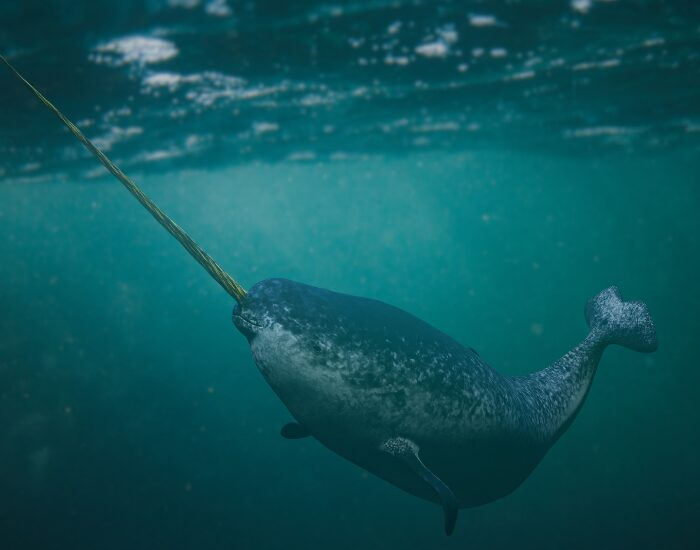
2. The Narwhal Tusk Is a Tooth, Not a Horn
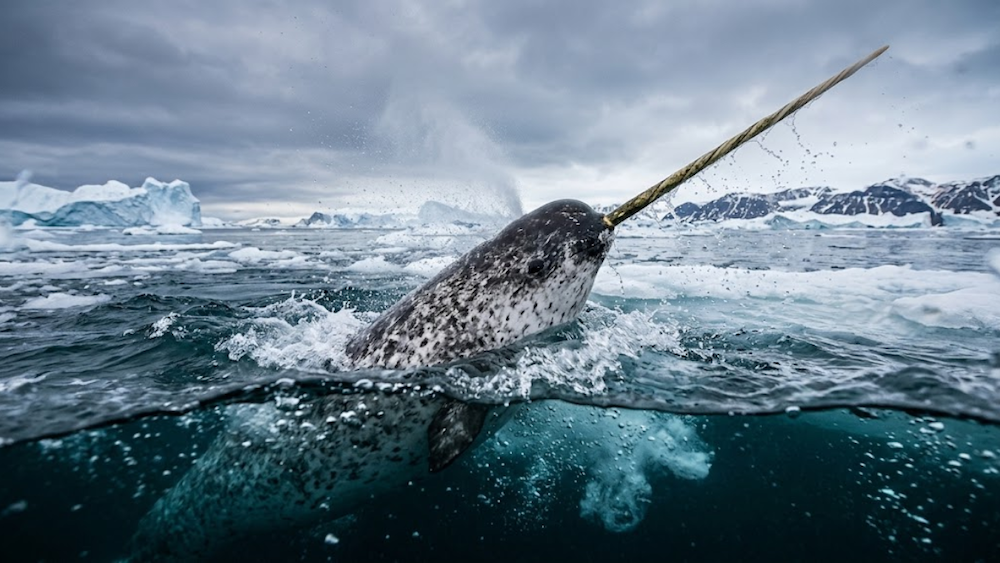
The narwhal tusk is actually a tooth. It is an enlarged front-left tooth that grows straight out through the upper lip, spiralling anticlockwise as it goes.
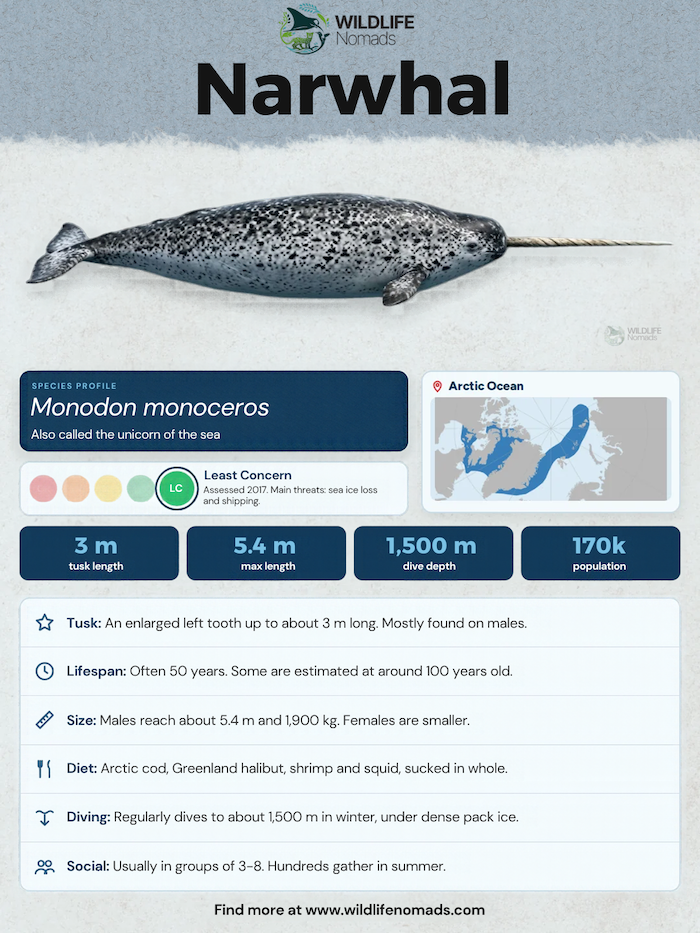
In adult males, it can grow up to about 3 m (10 ft) long. Male narwhals almost always have one. Female narwhals rarely do, and theirs tend to be shorter.
A few animals grow two tusks, when the right tooth erupts too. Usually, though, you see a single long tusk protruding from the left side. A large narwhal carries a tusk more than half its body length.
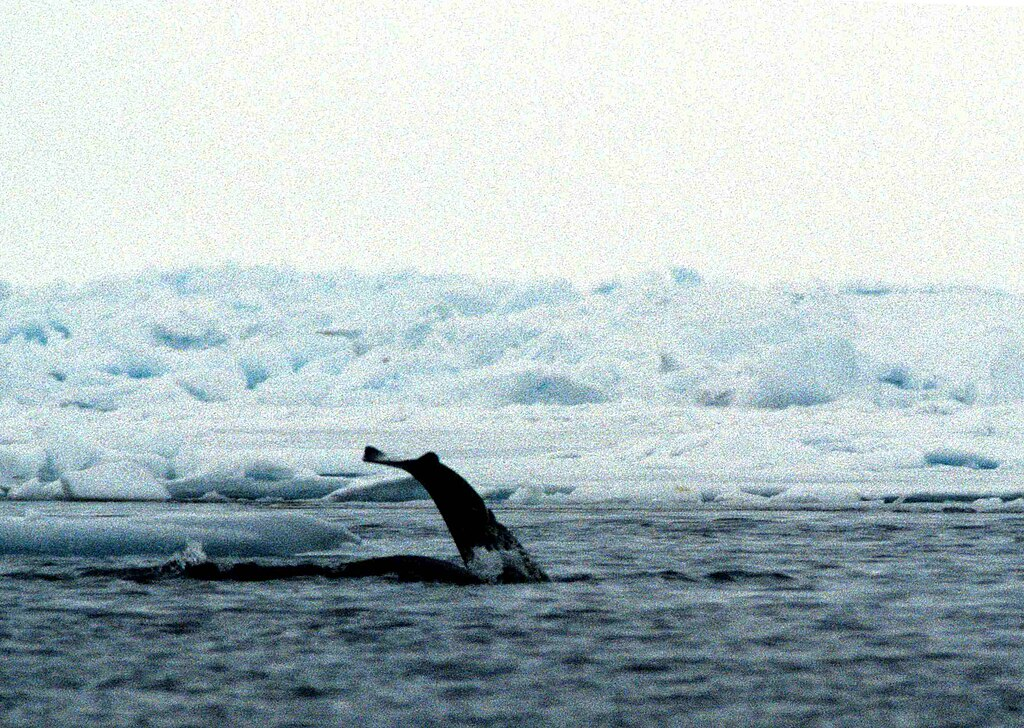
3. The Tusk Is a Living Sensor, and a Fishing Tool
Unlike our teeth, the tusk is built inside out. The hard enamel layer is missing, so the porous outside is exposed to the freezing Arctic water. Tiny canals run from the surface to nerves in the pulp.
According to Martin Nweeia’s team, the tusk contains up to 10 million nerve endings. Their 2014 study suggests it can detect changes in water salinity. Some scientists argue it may also sense pressure and temperature, though that is still debated.
When I studied marine biology, that detail stuck with me most. A tooth that works like a tongue, tasting the sea around it.
New research shows the tusk does more. In 2025, drone footage from Canada’s High Arctic showed narwhals using their tusks to probe and hit fish, including Arctic char. Some even used them in what looked like play.
Inuit legend tells a different story. A woman with a harpoon rope tied around her waist was dragged into the sea by a narwhal she had struck. She became a narwhal herself, and her twisted hair, or in some versions the harpoon rope, became the tusk.

4. Are Narwhals Endangered? No, But They Are Watched Closely
Narwhals are not endangered. The IUCN lists them as Least Concern, with an estimated population of around 123,000 mature individuals. Until 2017, the IUCN listed them as Near Threatened.
Canada has also changed its view. COSEWIC listed narwhals as a species of special concern in 2004. In May 2024, after a reassessment, it moved them to Not at Risk.
Some local groups are another story. The small East Greenland populations have declined sharply, and scientists have called for hunting there to stop. So narwhals are not endangered species overall, but they are still part of the Arctic’s watch list of endangered wildlife.
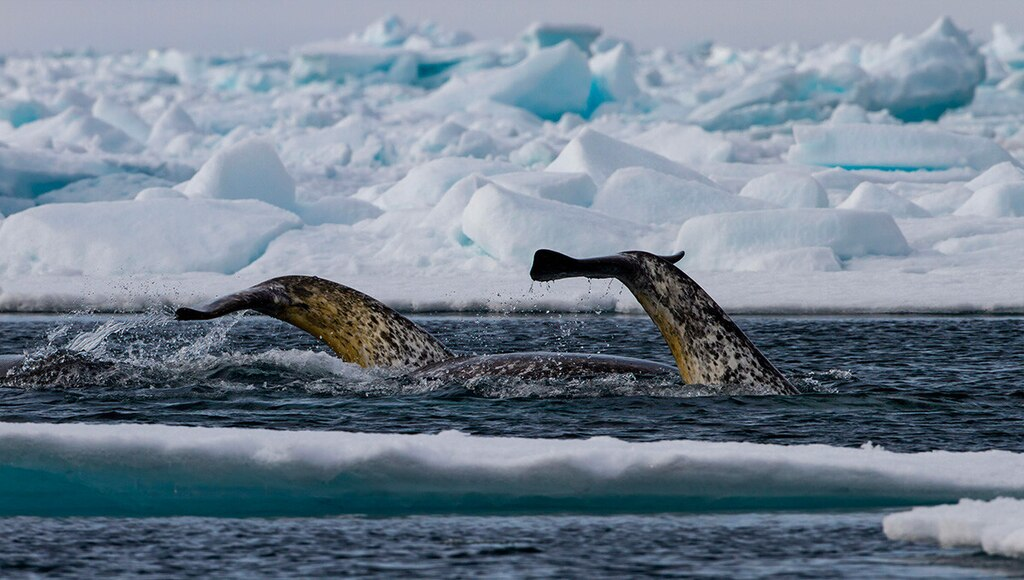
5. Are Narwhals Extinct? No, They Just Live Far Away
They are very much alive. You rarely hear of sightings because narwhals live in some of the most remote seas on Earth.
Narwhals inhabit the Arctic waters of Canada, Greenland, Norway and Russia. Most live in the Atlantic sector of the Arctic: Baffin Bay, northern Hudson Bay and the seas off East Greenland. In the Eurasian Arctic, they reach Svalbard (Norway) and Franz Josef Land (Russia).
They are rare in the Pacific sector. The occasional narwhal turns up off eastern Russia or Alaska, but that is a vagrant, not a population.
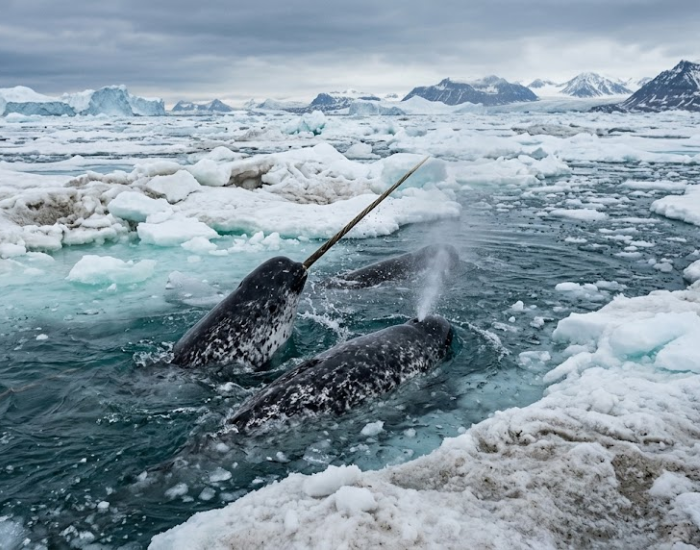
6. Narwhals Migrate With the Sea Ice
Narwhals spend their winters under thick Arctic ice in Baffin Bay, navigating cracks in the pack ice to breathe. A shift in the wind can close those cracks fast. When that happens, whales can get trapped in a small hole, called a savssat.
In spring, they follow the ice edge north and west. They migrate to ice-free summering grounds. These are usually shallow coastal waters and inshore waters, like the fjords of northern Canada.
Research shows that narwhals exhibit high site fidelity. They return to the same summering and wintering grounds every year. That loyalty is good for scientists and hunters, but it also makes them slow to move away from a disturbance.
You can follow other long journeys on our migration maps and in the longest animal migrations.
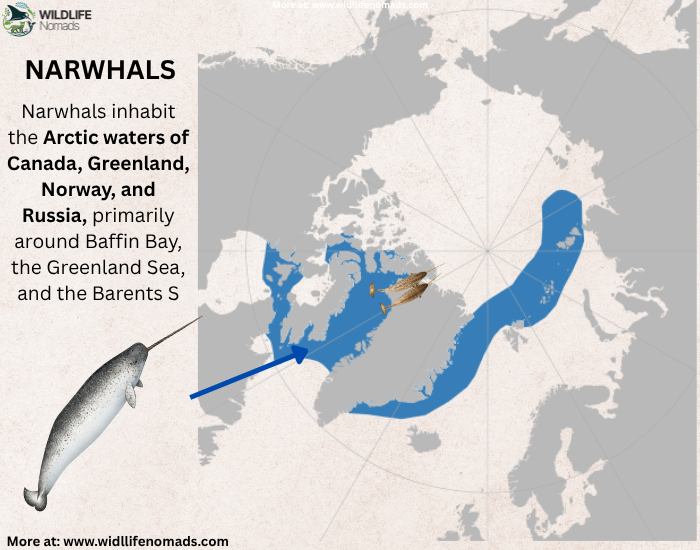
7. How Many Narwhals Are There? About 170,000
The global population of narwhals is estimated to be around 170,000 individuals. The IUCN figure of about 123,000 counts only mature adults.
Canada holds the biggest share. Fisheries and Oceans Canada and COSEWIC estimate around 161,000 narwhals in Canadian waters, about 90% of the world’s total. Most belong to the Baffin Bay population, shared across the Canada-Greenland border.
Counting them is hard. Surveys fly over huge areas of ice and open sea, and narwhals remain underwater most of the time. Every narwhal population estimate is a model built on that missing time.
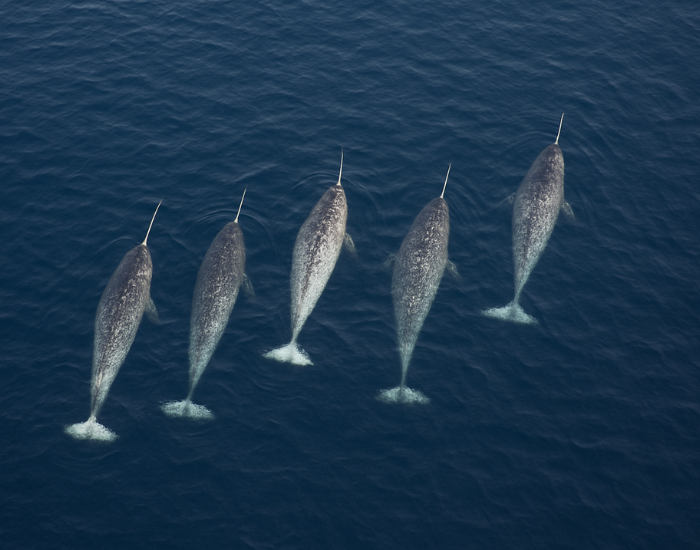
8. They Are Smaller Than You Might Think
Adult males reach about 5.4 m (18 ft) and up to 1,935 kg, not counting the tusk. Females are smaller, at up to 4.9 m (16 ft) and around 1,550 kg.
That makes them a similar size to the beluga, their closest relative. An orca male grows to over 9 m. Even a Bryde’s whale, a mid-sized baleen whale, is nearly three times longer. And a blue whale would dwarf them all.
Interactive · free Whale size comparison Fourteen whales at true scale, from a 4 m beluga to a 30 m blue whale, each beside a 2 m diver, with how deep each one dives. Pit any two head to head, or play the guessing game. Compare the whales →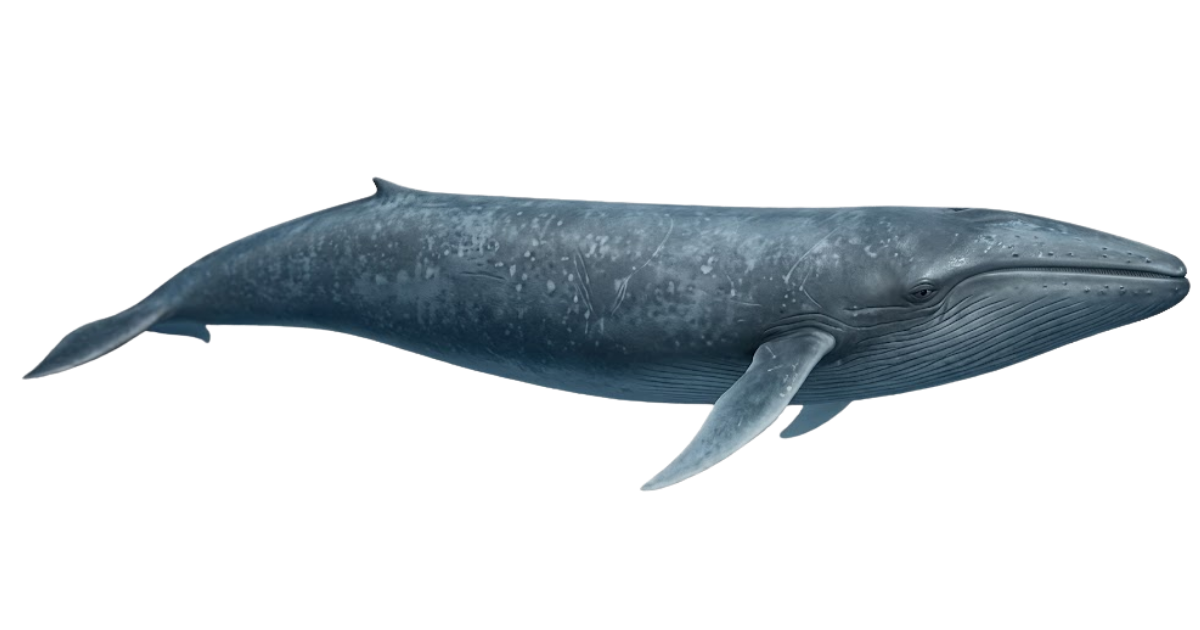
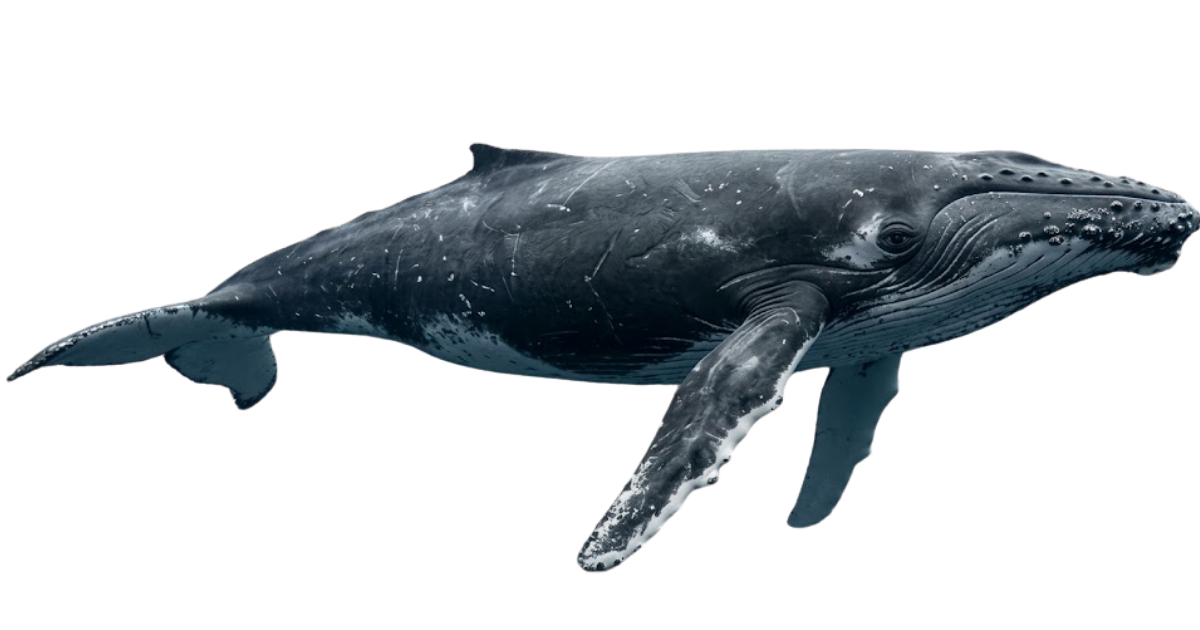

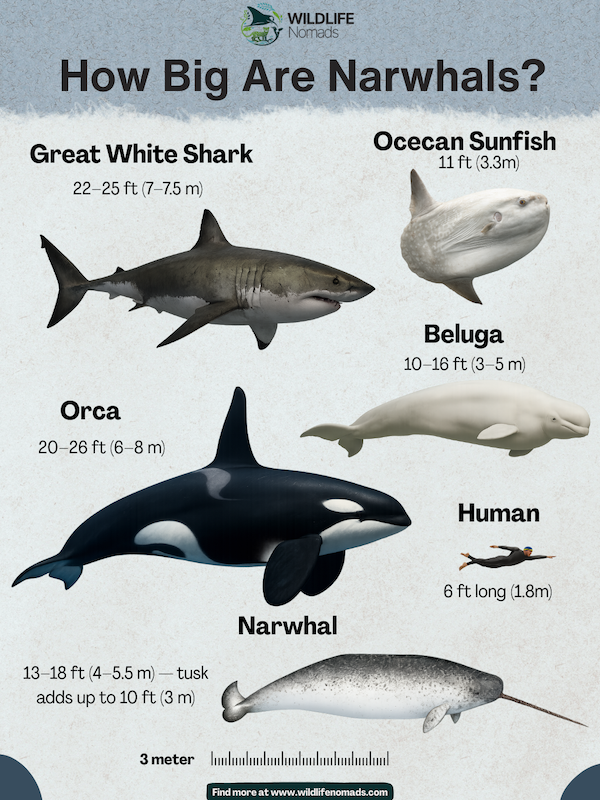
9. Their Colour Changes, and Their Name Means “Corpse Whale”
Narwhals change colour with age. They start as speckled blue-grey at birth, darken as young narwhals, then turn mottled. Old adults can be almost all white.
That pale, blotchy skin gave them their name. The word “narwhal” comes from the Old Norse nár, meaning corpse, and hvalr, meaning whale. Floating at the surface, a mottled narwhal can look like a drowned sailor. Not the most flattering nickname, but it stuck.
They also live a long time. Narwhals can live up to 50 years, and some individuals have been estimated at around 100 to 115 years old. Their Arctic neighbour, the bowhead whale, is one of the few mammals known to outlive them.
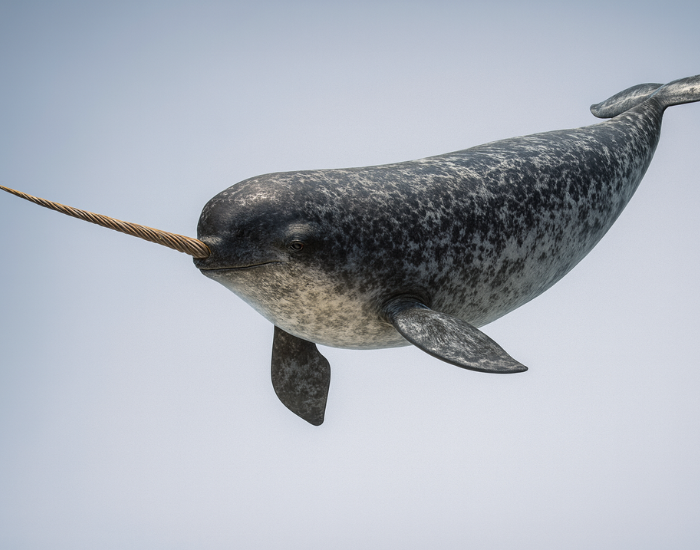
10. Narwhals Travel in Small Pods
Narwhals typically travel in groups of three to eight. Larger aggregations of hundreds, and up to 1,000 or more, can occur during summer months and migrations. Narwhals tend to sort themselves by age and sex, with some pods made up only of adult males.
Narwhals communicate using a variety of clicks, whistles and knocks. Like other toothed whales, and like bottlenose dolphins, they use echolocation clicks to find prey in the dark. Narwhals are known to use sound to communicate, navigate and hunt.
They are also shy. Unlike the curious gray whales I met in Baja, narwhals usually avoid boats. Research in East Greenland found that frightened narwhals both swim hard and drop their heart rate, a risky mix.
11. They Are Among the Deepest-Diving Whales
Narwhals are among the deepest-diving cetaceans. In winter, they regularly dive below 1,500 m, and some sources report dives to 2,370 m (7,780 ft). A deep dive lasts around 25 minutes.
That makes narwhals some of the deepest ocean explorers among marine mammals, alongside sperm whales and beaked whales. You can follow one down in our deep sea dive:
DEPTH1,460
m Interactive · Deep Sea Dive Dive 1,460 m down to meet the narwhal Scroll from the surface to the Mariana Trench and log 61 ocean animals on the way. →
12. You Won’t Find Narwhals in Zoos
No zoo or aquarium keeps narwhals today. In the 1960s and 70s, a handful were captured and shipped south. All died within months.
They need deep water, Arctic temperatures, sea ice and huge seasonal ranges. No tank can recreate the Arctic environment.
If you want to see one, you have to go north. The few places to see narwhals include the floe edge of Lancaster Sound and Baffin Bay in Canada’s High Arctic. Tours run from Pond Inlet and Arctic Bay at the northern reaches of Baffin Island, Nunavut, in May and June. Narwhal watching is one of the most sought-after experiences on trips above the Arctic Circle. For warmer options, see the best places to go whale watching.
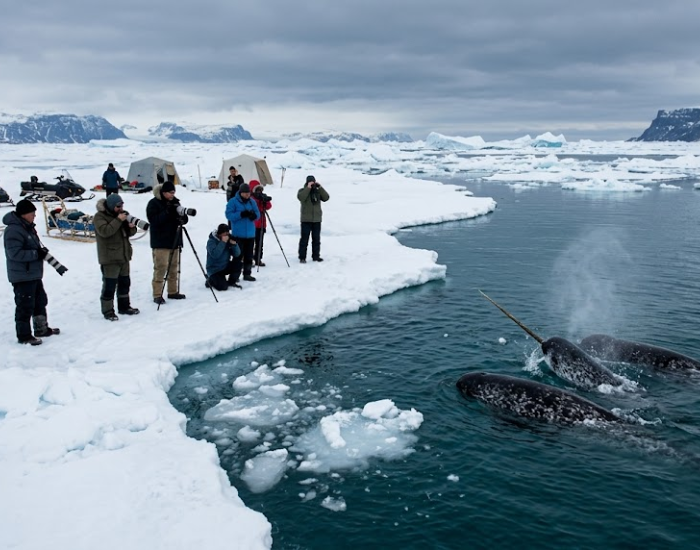
13. They Sit in the Middle of the Arctic Food Chain
Narwhals are mid-level predators in the Arctic food chain. They eat fish and squid, and bigger hunters eat them. You can see where they fit in our interactive food web.
Orcas are their main predator. With less sea ice, more orcas reach the Arctic each summer. Narwhals often hide in shallow water when they hear them. Read more on orcas and their future.
Polar bears take some too, mostly whales trapped at a savssat. They share the ice with walruses, seals and many other animals. Meet more in our guide to Arctic animals.

14. Sea Ice Decline and Ships Are Their Biggest Threats
Narwhals face threats from climate change, pollution and hunting. Of those, climate change worries scientists most.
Narwhals are vulnerable to sea ice decline due to climate change, which affects their migration and foraging patterns. A 2008 assessment ranked them among the Arctic marine mammals most sensitive to climate change. Less ice also means more ships and more orcas. See how climate change threatens animals more widely.
Human activity at sea is the newest problem. Near Pond Inlet, Eclipse Sound once held more than 20,000 narwhals in summer. Iron ore shipping from the Mary River mine grew, and by 2021 aerial surveys counted about 2,600. In 2023, a scientific working group report named shipping as by far the most likely cause.
Pollution reaches them too. Narwhals are affected by bioaccumulation of heavy metals, such as mercury. Other environmental contaminants build up in the Arctic food chain too, affecting marine wildlife from fish to polar bears. Read more on how ocean pollution affects sea animals.
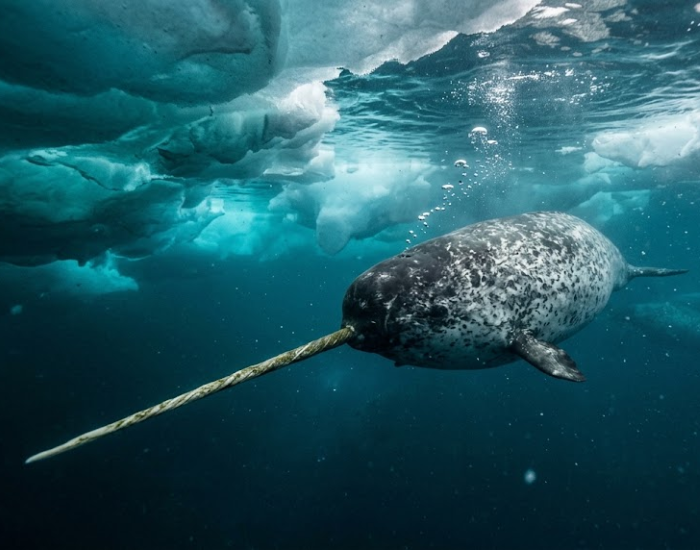
15. Inuit Hunt Them, and the Hunt Is Managed
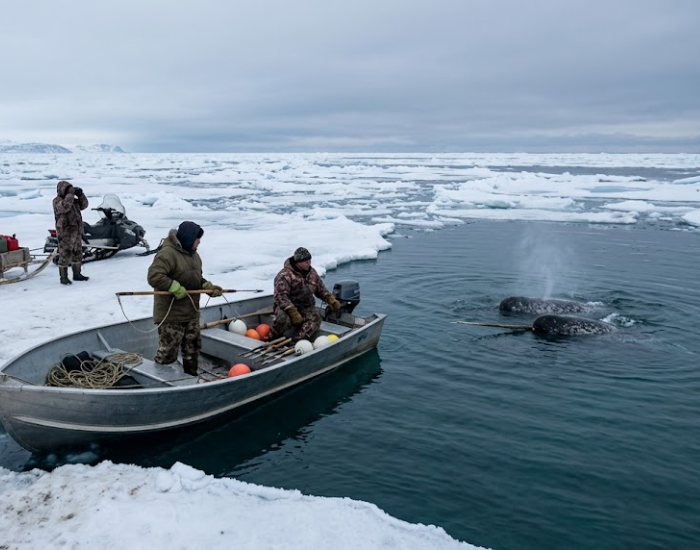
Narwhals have been hunted for thousands of years by Inuit in northern Canada and Greenland for meat and ivory. Regulated subsistence hunting continues today.
Almost all parts of the narwhal, the meat, skin, blubber and organs, are consumed by Inuit communities. Muktuk, the raw skin and attached blubber, is considered a delicacy and is rich in vitamin C.
Hunters take about 1,000 narwhals per year across Canada and Greenland. Co-management boards in Nunavut and Greenland’s government set the quotas for hunting narwhals. Narwhals are hunted for their skin, meat, teeth and tusks, and tusks and carved vertebrae are traded commercially. Commercial whaling never targeted narwhals the way it hit bowhead whales. See whether whale hunting still exists.
Protection is growing. In 2019, Canada created Tallurutiup Imanga, a national marine conservation area covering Lancaster Sound, one of the world’s richest narwhal areas. In 2023, expedition cruise operators agreed to keep their ships out of Eclipse Sound for the summer. Find out what marine protected areas are and why they matter.
Scientists keep learning, too. A 2025 satellite study in Baffin Bay showed how narwhals pick their winter prey. Another tracked East Greenland narwhals stroke by stroke as they hunted. This marine science helps decide which waters need protecting.
Frequently Asked Questions About Narwhals
Around 170,000, including about 123,000 mature adults. Roughly 90% live in Canadian waters.
Rarely. Most female narwhals have no tusk, and those that do usually have a shorter one. Male narwhals almost always grow one.
Yes, but it is rare. Two tusks grow when both upper teeth erupt instead of just the left one.

Narwhal: Fact or Fiction?
Ten statements about the unicorn of the sea — some are true, some sound true but aren’t. Can you tell the real narwhal from the myth?
Fact or Fiction?
Keep the Ice Quiet
They don’t need us to visit. They need the ice to stay and the ships to slow down.
If you go north to see them, go with a local Inuit-run tour from Pond Inlet or Arctic Bay. Stay back from the floe edge, keep engines quiet, and let them come up when they are ready.
References:
Hansen, R. G., Borchers, D. L., & Heide-Jørgensen, M. P. (2024). Abundance and distribution of narwhals (Monodon monoceros) on the summering grounds in Greenland between 2007–2019. Frontiers in Marine Science, 11. https://doi.org/10.3389/fmars.2024.1294262
Hornby, C. A., Togunov, R. R., McClintock, B. T., & Watt, C. A. (2025). Behavioural analysis of multi-year satellite telemetry data provides insight into narwhal (Monodon monoceros) winter prey selection in Baffin Bay. PLOS ONE. https://doi.org/10.1371/journal.pone.0330928
Jensen, F. H., Tervo, O. M., Heide-Jørgensen, M. P., & Ditlevsen, S. (2023). Detecting narwhal foraging behaviour from accelerometer and depth data using mixed-effects logistic regression. Animal Biotelemetry, 11, Article 14. https://doi.org/10.1186/s40317-023-00325-2
Laidre, K. L., Heide-Jørgensen, M. P., Dietz, R., Hobbs, R. C., & Jørgensen, O. A. (2003). Deep-diving by narwhals Monodon monoceros: Differences in foraging behavior between wintering areas? Marine Ecology Progress Series, 261, 269–281. https://doi.org/10.3354/meps261269
Nweeia, M. T., Eichmiller, F. C., Hauschka, P. V., Donahue, G. A., Orr, J. R., Ferguson, S. H., Watt, C. A., Mead, J. G., Potter, C. W., Dietz, R., Giuseppetti, A. A., Black, S. R., Trachtenberg, A. J., & Kuo, W. P. (2014). Sensory ability in the narwhal tooth organ system. The Anatomical Record, 297(4), 599–617. https://doi.org/10.1002/ar.22886
iReeves, R., Hobbs, R., Laidre, K., Heide-Jørgensen, M.P., Cow, A., & Westdal, K. (2017). Monodon monoceros (amended version of 2017 assessment). IUCN Red List of Threatened Species. https://www.iucnredlist.org/species/13704/50367651
Tervo, O. M., Ditlevsen, S., Ngô, M. C., Nielsen, N. H., Blackwell, S. B., Williams, T. M., & Heide-Jørgensen, M. P. (2021). Hunting by the stroke: How foraging drives diving behavior and locomotion of East-Greenland narwhals (Monodon monoceros). Frontiers in Marine Science, 7, Article 596469. https://doi.org/10.3389/fmars.2020.596469