Imagine a creature with a spiraled tusk stretching up to 10 feet long, swimming gracefully in the Arctic seas. No, it’s not a mythical unicorn, it’s the narwhal, often referred to as the “unicorns of the sea.” The narwhal’s tusk closely resembles a unicorn horn, which has contributed to their legendary status. But, are narwhals real? The answer is a resounding yes. These toothed whales are fascinating creatures that live in the cold waters of the Arctic Ocean, primarily off the coasts of Canada, Greenland, and Russia. Narwhals inhabit the Arctic Circle, which serves as their primary habitat.
While these animals do exist, they remain mysterious to many. In this post, we’ll dive into 12 amazing facts about narwhals, their behaviors, adaptations, and the conservation challenges they face.
But first,
What Exactly Are Narwhals?
Narwhals (Monodon monoceros) belong to the same family as beluga whales and are classified as toothed whales. The name “narwhal” comes from the Old Norse word “náhvalr,” which literally means “corpse whale” – a reference to their mottled gray and white coloration that can make them look like floating corpses from a distance. Not exactly the most flattering nickname, but it stuck.
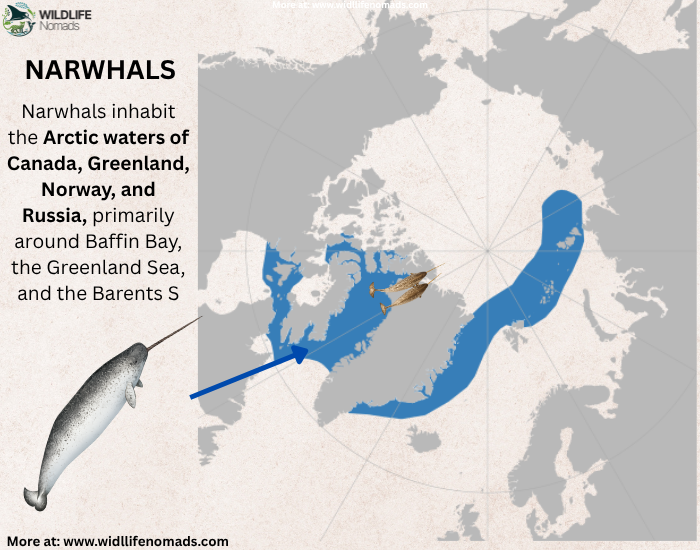
These incredible creatures live exclusively in Arctic waters, primarily around northern Canada, Greenland, and parts of Russia and Norway. They thrive in some of the harshest conditions on Earth, living in areas where most other marine mammals struggle to survive.

1. Narwhals: Real “Unicorns of the Sea”
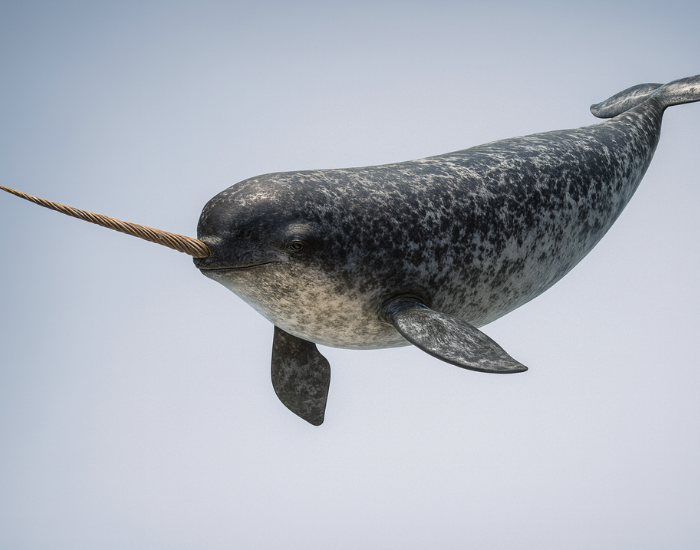
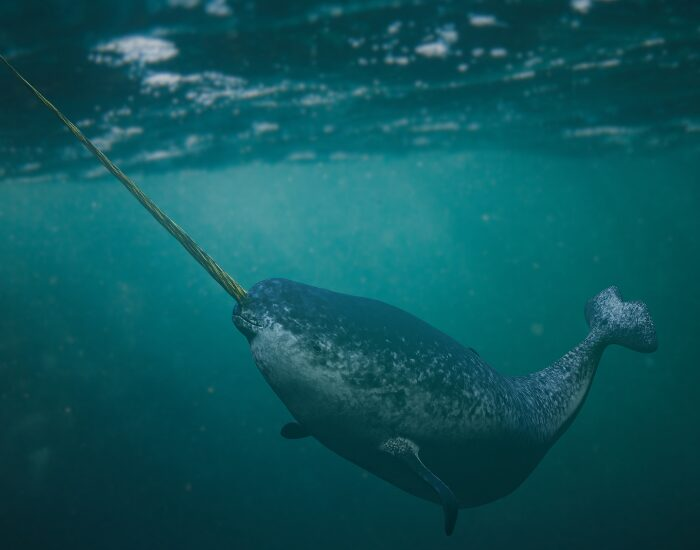
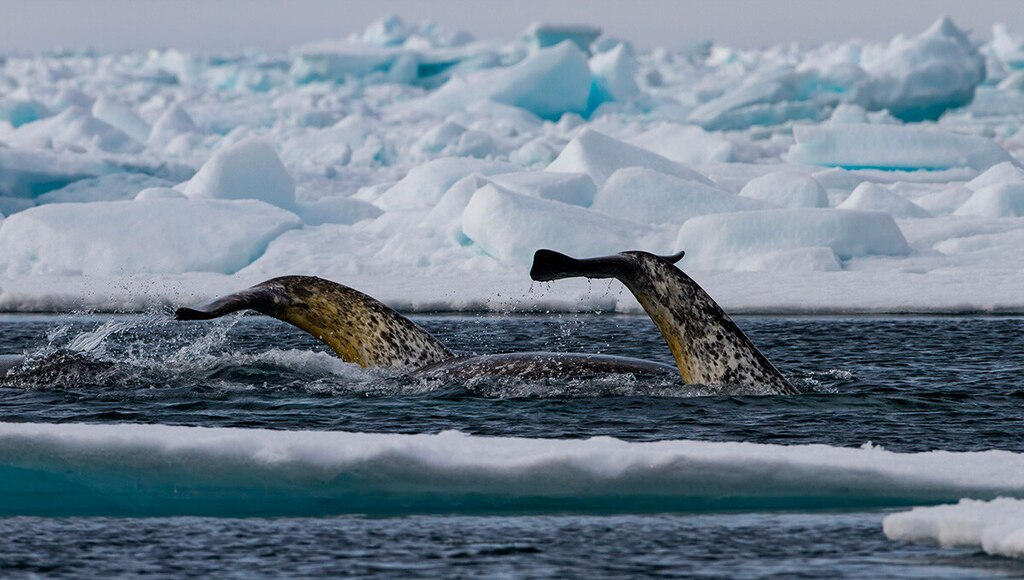
Narwhals are often compared to unicorns due to their iconic long, spiral tusks. However, contrary to popular belief, their tusks are not horns—they are actually modified teeth! Males typically have a tusk that can grow up to 10 feet long, while females usually have smaller or no tusks. While most narwhals have a single narwhal tusk, some rare individuals can develop two tusks. The narwhal’s tusk, which grows from the left side of the upper jaw, is thought to be used for social interaction, sensing the environment, and feeding. Narwhal tusks have been historically mistaken for unicorn horns, adding to their legendary status.
The narwhal’s tusk has around 10 million nerve endings, making it incredibly sensitive. The narwhal’s tusk is unique among marine mammals and is a defining feature of the species.
2. Are Narwhals Endangered?
Narwhals are currently classified as Least Concern by the International Union for Conservation of Nature (IUCN), though their populations remain vulnerable to climate change, habitat disturbance, and hunting pressures in parts of their range. Some regional populations, such as those in East Greenland, are still considered more at risk — listed as Near Threatened or Endangered, due to local declines and increased human activity.
Narwhals are not currently classified as endangered species, but are considered vulnerable and are part of the broader group of endangered wildlife in the Arctic. One of the biggest threats to their survival is climate change, which affects their ice-dependent habitats. As the ice melts due to rising temperatures, narwhals are forced to adapt to changing environments and face the loss of critical feeding and breeding grounds.
Although they are not yet extinct, narwhals are increasingly vulnerable to human activities, including pollution and shipping traffic. Conservation efforts for narwhals also help protect other endangered species in the region.
3. Are Narwhals Extinct? – No!
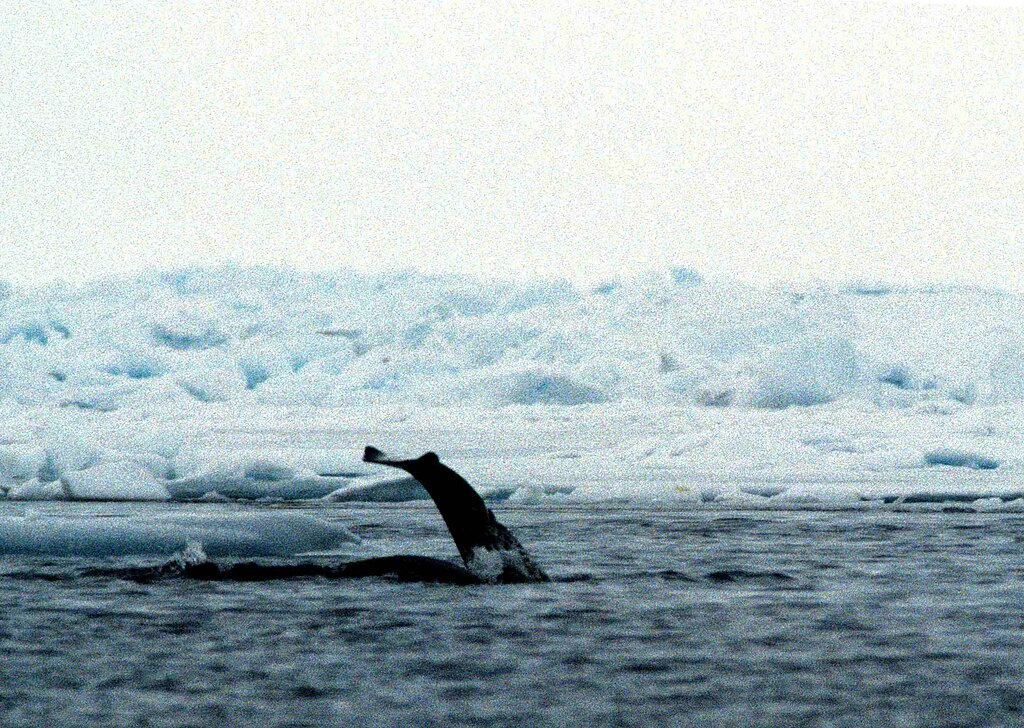
By now, you know that narwhals are not extinct. However, people rarely see them because they live in remote Arctic habitats. Narwhals once lived in the Atlantic Ocean, but they no longer inhabit the area, concentrating instead in the Arctic. Today, narwhals primarily inhabit the Atlantic sector of the Arctic Ocean, especially regions such as Baffin Bay and Hudson Bay, including northern Hudson Bay. Baffin Bay serves as a key summer feeding ground for narwhal populations. In the past, commercial whaling also heavily impacted narwhal populations, but thanks to protection efforts, the population has been slowly recovering.
Narwhals are often referred to as “corpse whales” due to their mottled gray and white skin, which can sometimes make them appear like a ghostly figure in the water.
4. The Unique Tusks of Narwhals
A Biologist’s Perspective: The Tusk as a Laboratory While most people see the tusk as a weapon or a decoration, scientists view it as a massive, living sensor. Unlike our teeth, which are covered in hard enamel, the narwhal’s tusk has an inside-out structure. The soft, sensitive part is on the outside, directly exposed to the freezing Arctic water. Scientists believe the tusk may serve several purposes:
- Sensory Tool: Scientists believe narwhals use their tusks to sense water pressure, temperature, and salinity.
- Social Significance: Scientists also think narwhals use their tusks for social interactions, similar to how elephants use theirs.
- Feeding: Some narwhals use their tusks to break through ice or help with hunting.
During my studies, I found the most fascinating aspect to be the 10 million nerve endings connecting the ocean directly to the whale’s brain. They aren’t just ‘feeling’ the water; they are likely tasting the salinity and sensing pressure changes that help them predict when the sea ice above is about to freeze over, a life-or-death calculation in the Arctic.”
In Inuit legend, the narwhal’s tusk holds deep cultural significance. One story describes a woman with a harpoon rope tied around her waist who the sea pulled in and transformed into a narwhal. According to the legend, the harpoon rope became the narwhal’s tusk, symbolizing the connection between traditional hunting methods, where a harpoon rope was essential, and the origin of the narwhal’s most iconic feature.

5. Where Do Narwhals Live?
Narwhals are Arctic marine mammals that primarily inhabit the cold waters of the Arctic Ocean. They live in northern Canada, Greenland, and the Chukchi Sea of Russia, and they also inhabit the Arctic waters off eastern Russia. Pack ice defines their habitat, where they find their main food sources and reproduce.
Narwhals migrate between coastal waters in the summer, where they feed, and offshore waters in the winter, where they breed. During these seasonal migrations, narwhals often move from pack ice to inshore waters.
6. Narwhal Population: How Many Are There?
Narwhals are among the most captivating marine mammals in the Arctic Ocean, instantly recognizable by their iconic spiralled tusk. But just how many narwhals are there in the wild? Current research estimates the global narwhal population at roughly 123,000 mature individuals, with the total population likely exceeding 160,000 when including juveniles and subadults, and with the vast majority found in the icy Arctic waters of Canada and Greenland. However, pinpointing the exact number of narwhals is challenging, as these elusive whales inhabit some of the most remote and inhospitable regions on the planet.
Male narwhals, famous for their long, spiralled tusks, are the most visible members of the species, but female narwhals, who rarely grow tusks—are just as vital to the health of narwhal populations.
Closely related to beluga whales, narwhals share many traits with their white cousins, and the two species often inhabit overlapping areas in the Arctic. However, narwhals are uniquely adapted to life beneath the sea ice. Instead of a dorsal fin, they have a low ridge along their back, allowing them to navigate easily under thick ice sheets. Their thick blubber provides insulation against the frigid waters, making them true Arctic survivors.
Despite these remarkable adaptations, narwhals face growing threats. The decline of sea ice due to climate change is a major concern, as narwhals depend on stable ice for feeding, shelter, and raising their young. Increased human activity, such as shipping, oil exploration, and hunting, also puts pressure on narwhal populations and their fragile habitats.
7. Narwhal Behavior: Social and Curious Creatures
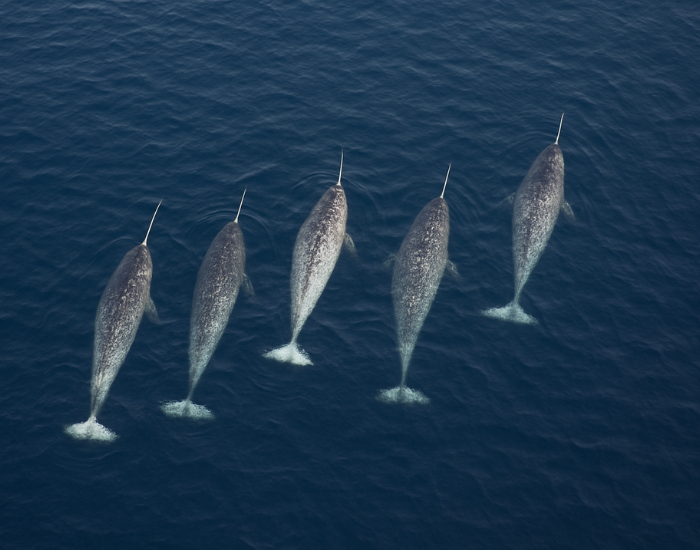
Narwhals are social animals, often seen in pods of up to 20 individuals, though larger groups of several hundred can also be observed during migrations. Narwhal pods may consist of only juveniles or adult males, and narwhals tend to form groups based on age and sex. Young narwhals differ in appearance from adults, being lighter in coloration and smaller in size. They are highly curious and have been known to interact with boats and human divers.
Narwhals communicate using clicks, whistles, and knocks, which are thought to help them navigate and coordinate behavior in their pods.
8. Narwhals’ Diet: Carnivores of the Arctic
Narwhals are carnivores and have a varied diet, feeding on a wide range of marine animals. Their diet consists mainly of:
- Arctic cod
- Greenland halibut
- Polar cod (especially during winter)
- Polar squid
Narwhals hunt by diving to depths of up to 1,500 meters in search of food. They perform many dives each day, often reaching great depths to find prey. Their long tusks may also assist in feeding, as they sometimes use them to scoop up prey from the ocean floor.
Narwhals often dive for long periods, sometimes staying submerged for up to 25 minutes.

9. Why Aren’t Narwhals in Zoos?
People rarely see narwhals in captivity, despite their iconic appearance. Their remote Arctic habitat makes them challenging to care for in zoos or aquariums. Captivity does not suit them because replicating their migration patterns, diet, and social behavior in artificial environments is difficult.
Whale watching excursions in locations such as Pond Inlet often offer chances to see narwhals in the wild during the ice melt season, but aquariums and zoos do not keep narwhals because maintaining their natural habitat is too difficult.
10. Narwhal’s Role in the Arctic Ecosystem
Narwhals play a significant role in maintaining the balance of the Arctic marine ecosystem. By feeding on small fish and invertebrates, they help regulate the populations of these species, which, in turn, impacts the health of the ocean’s ecosystem. Natural predators such as polar bears, which are also key members of the Arctic ecosystem, sometimes target large narwhals.
Scientists often consider narwhals a keystone species because their presence and behavior can influence the structure of the entire ecosystem.

Threats to Narwhals: Climate Change and Hunting
Narwhals face several threats to their survival, many of which are related to human activities. These include:
- Climate Change: Rising temperatures in the Arctic are causing sea ice to melt, threatening narwhals’ habitats and food sources. Sea ice decline increases narwhals’ vulnerability to predation and disrupts their traditional migration routes.
- Hunting: While commercial whaling has been banned, subsistence hunting still occurs in some regions, especially in Greenland and Canada.
- Pollution: Oil spills and noise pollution from ships disrupt narwhals’ natural behaviors, including their communication and migration patterns.
Narwhal Conservation: Ongoing Efforts
Efforts to protect narwhals are critical, as their population remains vulnerable. Some of the ongoing conservation initiatives include:
- Marine Protected Areas (MPAs): These are designated regions where human activity, such as shipping and fishing, is restricted to protect narwhal habitats.
- Climate Action: Reducing greenhouse gas emissions to slow down climate change and preserve the Arctic ecosystem.
- Monitoring Populations: Ongoing research using satellite tagging and acoustic monitoring to track narwhal movements, population health, and threats to their survival.
Newest Narwhal Research
Recent research is shedding new light on how narwhals use the Arctic and how best to protect them. A 2025 study using multi-year satellite telemetry showed that narwhals migrate over 1,700 km between summer and winter grounds, diving deeper and more frequently in the colder months — information that helps define critical habitats for Marine Protected Areas (PLOS ONE, 2025).
At the same time, new methods using accelerometer and depth sensors have made it possible to detect feeding behavior without invasive acoustic tagging, offering a more accurate picture of how narwhals hunt and how climate change might affect prey availability (Animal Biotelemetry, 2023). Together, these advances highlight the importance of combining cutting-edge science with traditional ecological knowledge to guide conservation strategies and safeguard narwhals in a rapidly changing Arctic.
Size Matters: How the Narwhal Measures Up
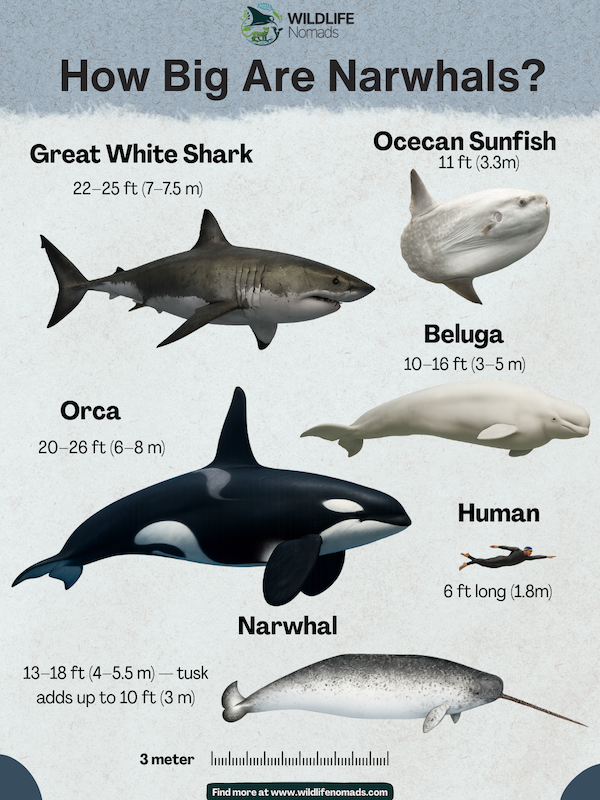
The enigmatic Narwhal ( Monodon monoceros ) may not match the massive proportions of blue whales, but it still commands attention. Adult males typically reach around 5.4 m (about 18 ft) in length and can weigh up to 1,900 kg (4,188 lb), while females tend to be slightly smaller—with lengths near 4.9 m (about 16 ft) and weights up to 1,550 kg (3,417 lb).
When placed alongside other well-known cetaceans, the size of the narwhal becomes even more meaningful. The Beluga Whale (Delphinapterus leucas), grows to roughly 4.5 m (15 ft) and weighs up to 1,600 kg (3,500 lb). Meanwhile the formidable Orca (Orcinus orca) extends much further, males reaching lengths over 9 m (30 ft) and weights exceeding 8,000 kg (8 t).
Protecting the Narwhal
Narwhals are real, and they are among the most unique and fascinating animals in the Arctic. As climate change continues to affect their habitats, it’s crucial that we focus on conservation efforts to ensure that these magnificent animals survive. Narwhals are not just a mythical legend; they are real, they are important, and their protection is essential for the health of the Arctic marine ecosystem.
By supporting research, conservation programs, and sustainable practices, we can help preserve the narwhal’s habitat and ensure their place in the Arctic for many years to come. If you’re interested in learning more or getting involved, visit organizations like WWF or Greenpeace to see how you can contribute to narwhal conservation efforts.
Narwhal: Fact or Fiction? 🦄
Ten statements about the unicorn of the sea — some are true, some sound true but aren’t. Can you tell the real narwhal from the myth?
Fact or Fiction?
References:
Hansen, R. G., Borchers, D. L., & Heide-Jørgensen, M. P. (2024). Abundance and distribution of narwhals (Monodon monoceros) on the summering grounds in Greenland between 2007–2019. Frontiers in Marine Science, 11. https://doi.org/10.3389/fmars.2024.1294262
Heide-Jørgensen, M. P., & Dietz, R. (1995). Some characteristics of narwhal, Monodon monoceros, diving behaviour in Baffin Bay. Canadian Journal of Zoology, 73(11), 2120–2132. https://doi.org/10.1139/z95-249
Hornby, C. A., Togunov, R. R., McClintock, B. T., & Watt, C. A. (2025). Behavioural analysis of multi-year satellite telemetry data provides insight into narwhal (Monodon monoceros) winter prey selection in Baffin Bay. PLOS ONE. https://doi.org/10.1371/journal.pone.0330928
Jensen, F. H., Tervo, O. M., Heide-Jørgensen, M. P., & Ditlevsen, S. (2023). Detecting narwhal foraging behaviour from accelerometer and depth data using mixed-effects logistic regression. Animal Biotelemetry, 11, Article 14. https://doi.org/10.1186/s40317-023-00325-2
Laidre, K. L., Heide-Jørgensen, M. P., Dietz, R., Hobbs, R. C., & Jørgensen, O. A. (2003). Deep-diving by narwhals Monodon monoceros: Differences in foraging behavior between wintering areas? Marine Ecology Progress Series, 261, 269–281. https://doi.org/10.3354/meps261269
Laidre, K. L., & Heide-Jørgensen, M. P. (2005). Arctic sea ice trends and narwhal vulnerability. Biological Conservation, 121(4), 509–517. https://doi.org/10.1016/j.biocon.2004.06.003
Nweeia, M. T., Eichmiller, F. C., Hauschka, P. V., Donahue, G. A., Orr, J. R., Ferguson, S. H., Watt, C. A., Mead, J. G., Potter, C. W., Dietz, R., Giuseppetti, A. A., Black, S. R., Trachtenberg, A. J., & Kuo, W. P. (2014). Sensory ability in the narwhal tooth organ system. The Anatomical Record, 297(4), 599–617. https://doi.org/10.1002/ar.22886
iReeves, R., Hobbs, R., Laidre, K., Heide-Jørgensen, M.P., Cow, A., & Westdal, K. (2017). Monodon monoceros (amended version of 2017 assessment). IUCN Red List of Threatened Species. https://www.iucnredlist.org/species/13704/50367651
Tervo, O. M., Ditlevsen, S., Ngô, M. C., Nielsen, N. H., Blackwell, S. B., Williams, T. M., & Heide-Jørgensen, M. P. (2021). Hunting by the stroke: How foraging drives diving behavior and locomotion of East-Greenland narwhals (Monodon monoceros). Frontiers in Marine Science, 7, Article 596469. https://doi.org/10.3389/fmars.2020.596469