
I was walking a canal in the Low Countries last spring, half-watching a group of ducks loaf on the bank. Green heads. Chestnut breasts. Obvious mallard ducks, I decided, and kept moving. A guide leading a walking tour stopped me. “Those aren’t mallards,” he said. “Those are Rouens.” A duck sitting three meters away had completely fooled me. That is the Rouen duck’s entire trick, and it works on almost everyone.
I had met the breed years earlier in Mexico, waddling around a farmyard outside Pátzcuaro. In that context nobody mistakes them for wild birds. On a European canal, though, the illusion holds until you look at the neck, the bill, and the sheer bulk of the bird.
Below are eleven things worth knowing about this massive duck: where the breed originated, how big it actually gets, why it can’t fly, what its eggs are really like, and what raising ducks of this size demands from you. Some of it will change how you look at every “mallard” you pass.
1. The Breed Originated in France, but the Name Came Later
French farmers were raising large mallard-like ducks several hundred years ago, long before anyone standardized them. Around 1800, those birds reached England. British keepers were variously called the newcomer “Rhone,” “Rohan,” and “Roan” before settling on Rouen, after the French city in Normandy.
So the Rouen duck breed name is a geographic accident twice over. The breed originated in French farmyards, got its identity in English show pens, and carries the name of a town most of its keepers have never visited.
2. English Breeders Doubled Its Size Through Selective Breeding
The French version was a useful farm bird. The English version became something else entirely. Through decades of selective breeding, breeders doubled the bird’s mass, replaced its sleek body with a thickset boat shape, and deepened the color pattern.
In 1850, D. W. Lincoln of Worcester brought Rouens to the United States. The American Poultry Association added the breed to its Standard of Perfection in 1874. Once the breed was recognized in the American Standard, Rouens spread fast as colorful, general purpose ducks on mixed farms.
3. Genetically, It Is Still a Mallard
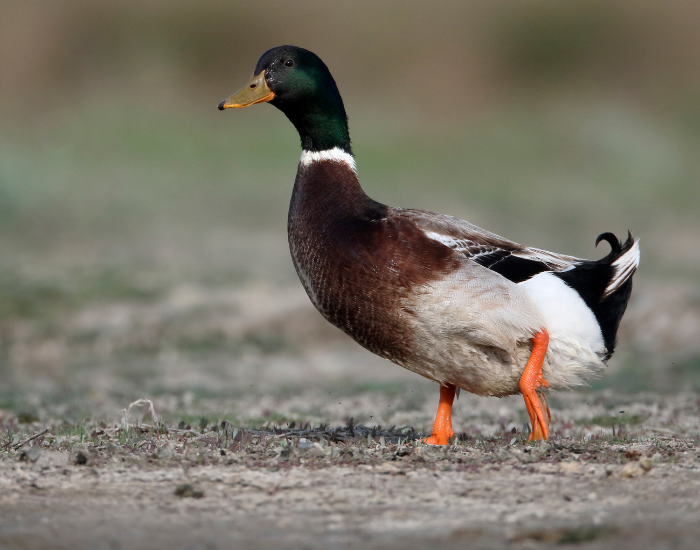
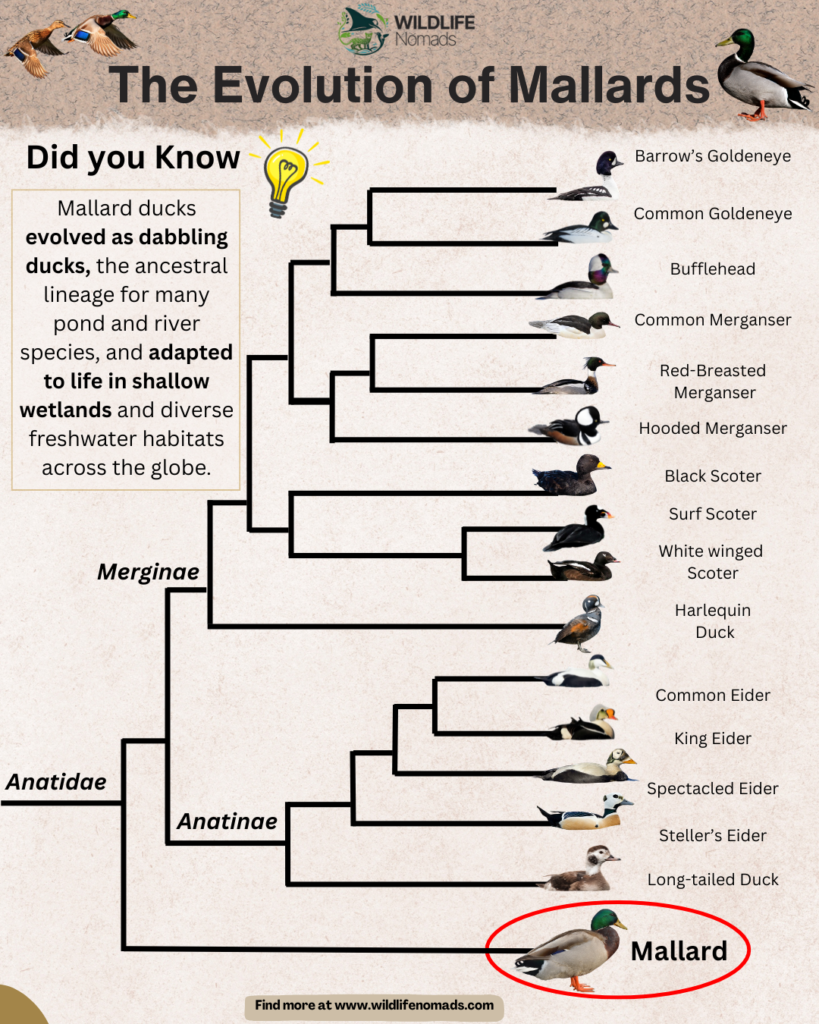
Here is the fact that reframes everything else. Domestic duck breeds descend from the wild mallard, Anas platyrhynchos, domesticated roughly 2,200 to 2,500 years ago. Genome work published in Nature Communications has mapped how artificial selection reshaped body size and plumage in exactly this lineage.
Therefore the resemblance isn’t convergence or mimicry. A Rouen looks like a mallard because it is a mallard, run through two centuries of human preference. Other breeds you meet on a farm — Pekin, Cayuga, Ancona, came out of the same wild stock.
4. Standardized Rouen Ducks Weigh 9 to 12 Pounds
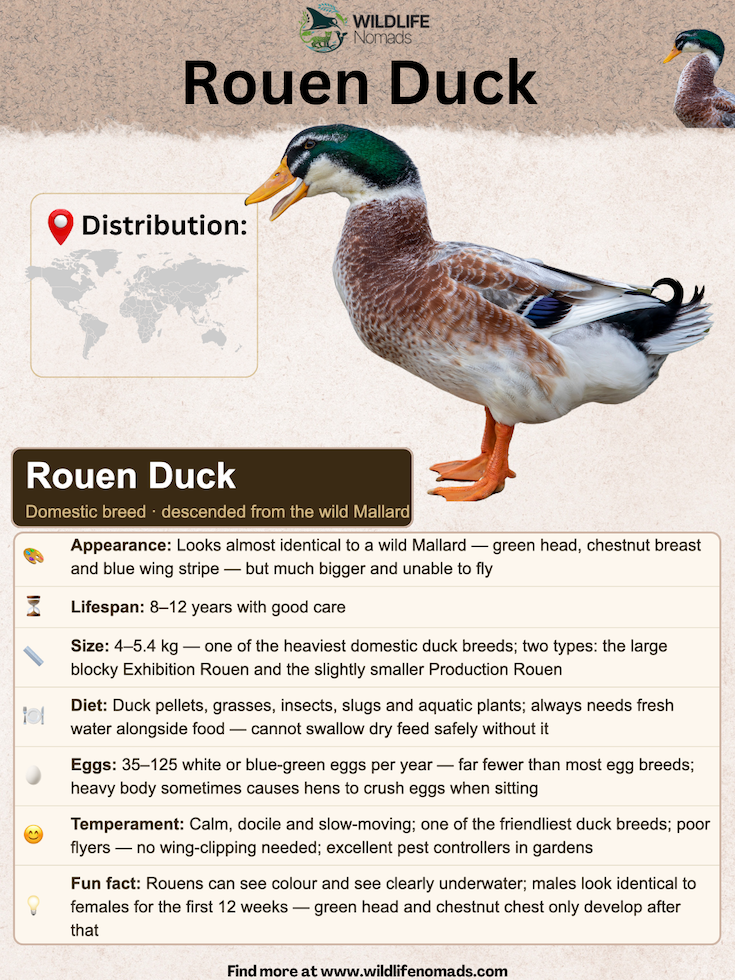
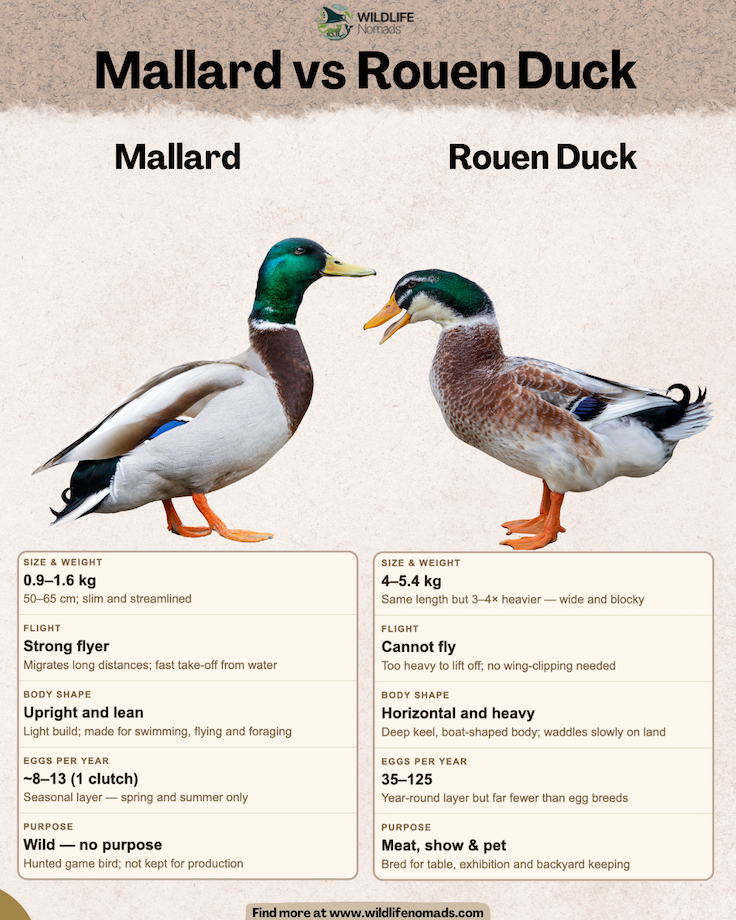
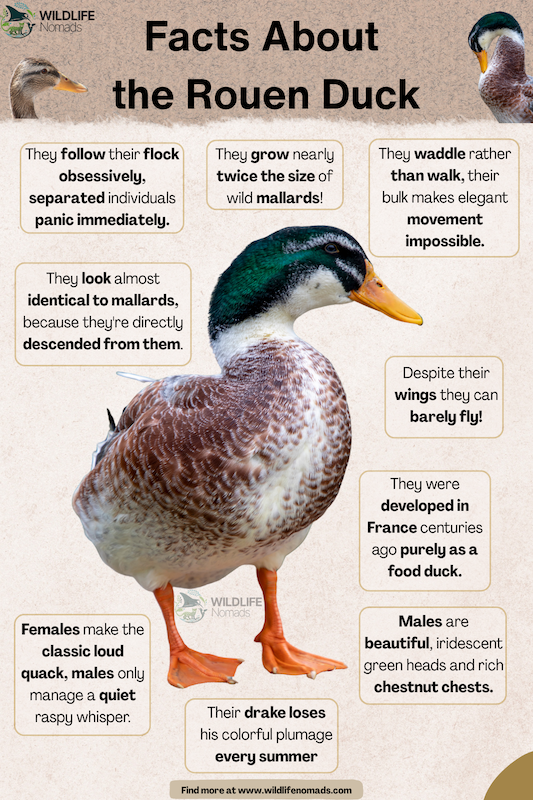
This is where the illusion breaks. A wild mallard weighs about 2.5 pounds. Standardized Rouen ducks weigh between 9 and 12 pounds, so a good show bird outweighs its wild ancestor at least three times over.
Confusingly, two versions exist with distinctly different weight profiles:
- Standard / Exhibition Rouens: Heavyweight show birds. Drakes reach 10–12 pounds and ducks weigh 9–10 pounds, featuring a blocky body and horizontal carriage.
- Production Rouens: The commercial, hatchery-bred strain most backyard keepers own. Drakes typically mature around 7–8 pounds, while ducks reach 5–7 pounds. They grow faster with a trimmer frame and a more upright carriage.
5. Rouen Ducks Cannot Fly
Their wings are proportionally normal. The body underneath them is not. All that keel and breast muscle simply exceeds what those wings can lift, so Rouen ducks fly nowhere.
For keepers, this is a feature and a liability. You will never chase your flock off a neighbor’s roof. You also cannot rely on the birds to escape a fox, which changes everything about how you build their pen.
6. Telling a Rouen Drake From a Rouen Hen Is Easy
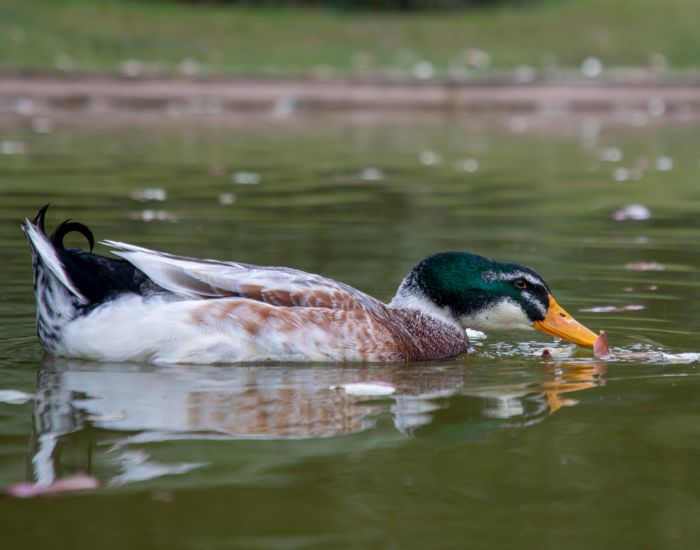
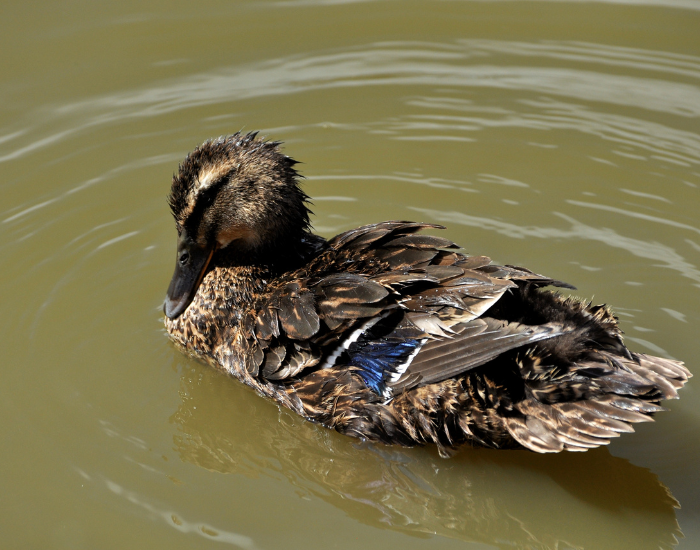
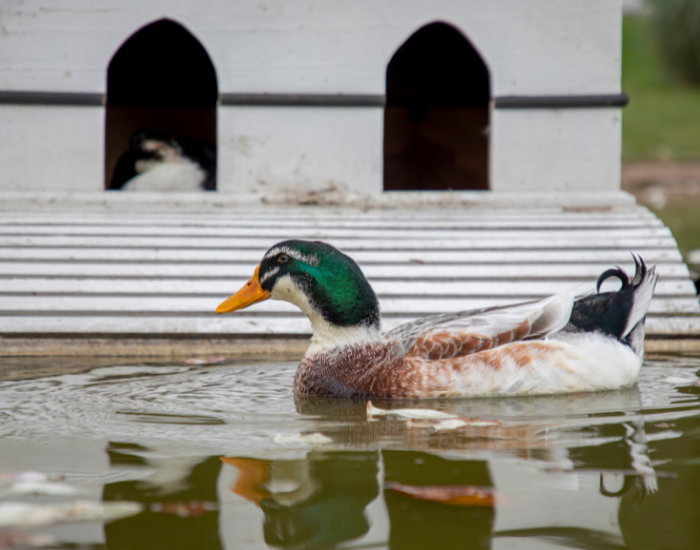
Rouen drakes carry lustrous green heads and necks, a dark yellow bill, and bright orange feet. Their white collars, a clean ring encircling the neck, separate them instantly from the hens. A diagonal white/blue/white line crosses each wing, that second stripe is the field mark I look for first. The blue speculum flashes when the bird stretches.
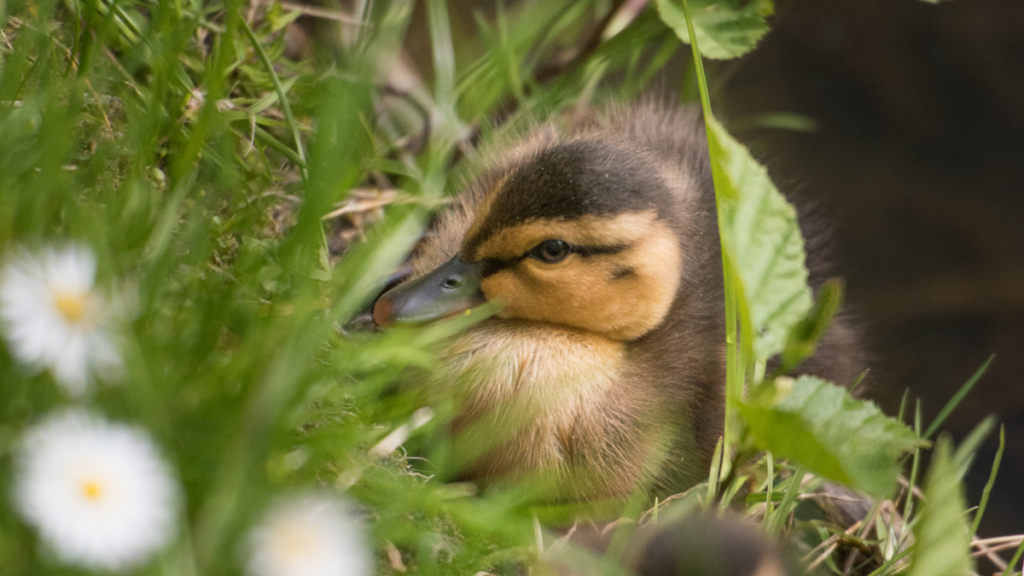
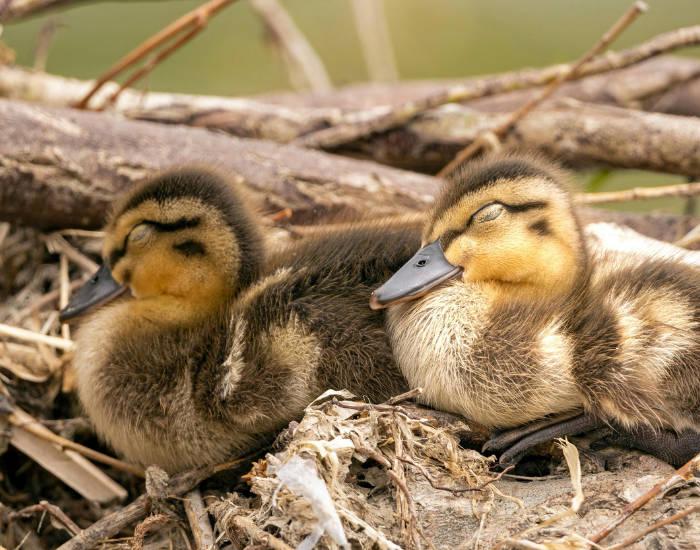
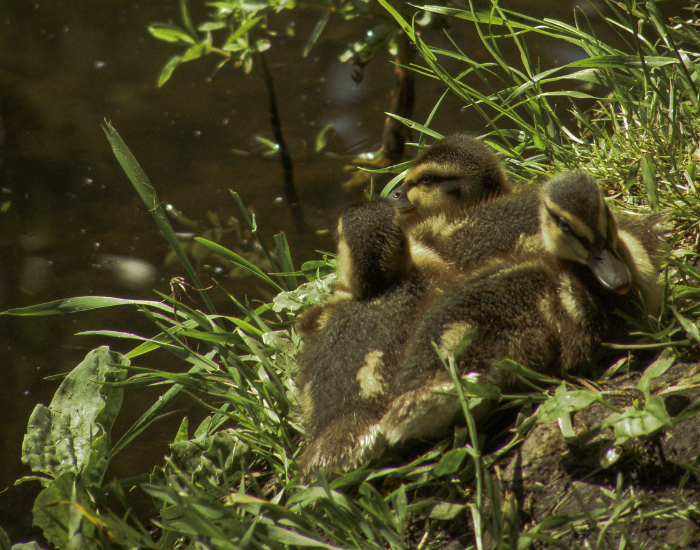
Rouen hens are mahogany brown with greenish black penciling, a brown bill, and the same wing bar. Compared to female mallards, a Rouen hen is usually much darker brown, heavier, and longer in the neck. Rouen ducklings hatch yellow with brown patches, looking almost identical to mallard ducklings for the first two weeks.
7. They Are Variable Layers, Not Prolific Egg Layers
Egg output depends entirely on which strain you raise. Standard exhibition hens are modest layers, producing anywhere from 35 to 125 eggs per year. Production strains bred for hatcheries perform considerably better, yielding 140 to 180 eggs annually. Still, if maximum egg production is your sole goal, breeds like the Khaki Campbell or Indian Runner will easily outpace them.
Exhibition egg color runs white, occasionally tinted blue or green. The eggs themselves are extra large and rich, bakers pay real money for them.
Nesting care matters more here than with most breeds. Standard Rouen hens are heavy enough that they may crush eggs while sitting, and Rouen ducks may accidentally break their eggs simply by settling wrong.
8. The Meat Is the Reason the Breed Survived
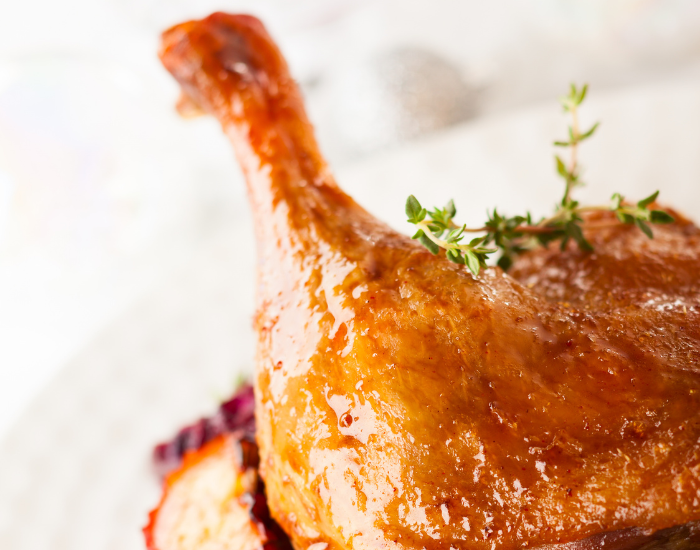
Rouens were raised primarily as meat ducks, and their production qualities are genuinely excellent. The flesh carries a high fat content, which keeps it tender through the long dry heat of an oven. Many chefs consider Rouen ducks more flavorful than Pekin, whose leaner meat cooks faster but tastes flatter.
The catch is time. Standard Rouens are not fast-growing birds; they take six to eight months to reach maturity. That timeline makes them impractical for industrial meat production but ideal on a small farm, where a slow-grown roasting bird is the whole point.
9. Their Temperament Makes Them Genuine Pets
Rouen ducks exhibit a docile temperament that surprises people expecting livestock indifference. They are very social and affectionate animals. Mine greet me by bobbing their heads and chattering, a display I have watched wild mallards use in courtship, redirected here toward the person carrying the feed bucket.
They preen each other regularly, and pairs will spend twenty minutes working through a partner’s neck feathers. They waddle slowly because of their large size, which makes them easy to handle and easy to photograph. Every individual duck has a personality; in my experience females do most of the talking, while drakes stay quiet unless guarding a nest.
Healthy Rouen ducks typically live between 6 and 12 years. That is a longer commitment than most people assume when they buy ducklings on impulse.
10. Housing Them Is Nothing Like Housing Chickens
Rouen ducks do not roost, so skip the roosting bars entirely. Your rooster’s perch means nothing to them; they sleep on the ground, and that single difference reshapes the whole coop.
They need clean water deep enough for swimming and feather maintenance, the same requirement that shapes most types of waterfowl. Peer-reviewed welfare research on ducks is unambiguous here, birds with full-body water access keep their eyes, nostrils, and plumage measurably cleaner than birds with drinker access alone. Wet preening distributes preen oil, and without it feather condition collapses.
Rouens also require soft bedding to prevent foot infections like bumblefoot, a real risk given their weight and inability to fly. The coop must protect them from predators, so bury pen fencing underground to deter diggers. Keep the housing draft free in cold weather; open it up for ventilation during hot weather. Do both and the breed handles climate extremes well.
11. They Are Excellent Foragers and Serious Insect Control
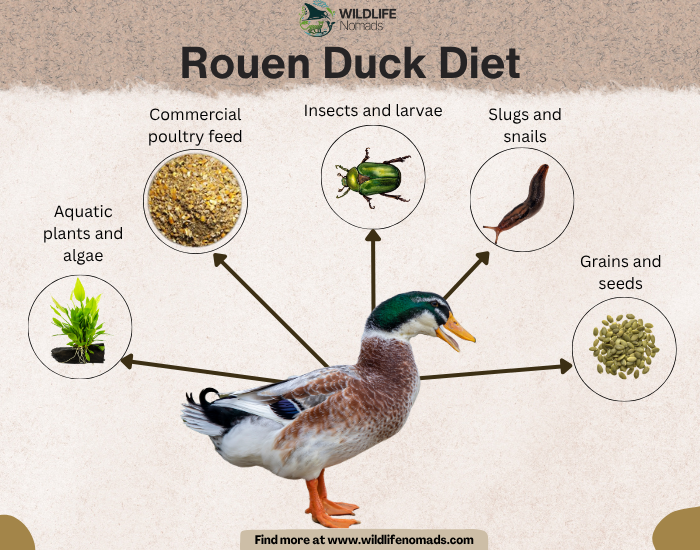
Turn Rouens out on grass and they work. Rouen ducks are excellent foragers and require foraging space to stay content, so give them room to forage across wet ground for slugs, snails, and larvae.
I have watched a flock of six clear a vegetable bed of slugs in an afternoon. As natural insect control they outperform most chickens, largely because that broad bill sifts mud far better than any beak.
Frequently Asked Questions
Standard Rouen ducks are uncommon. The Livestock Conservancy classifies them as “Watch,” meaning fewer than 2,500 annual US registrations and fewer than 10,000 globally. Production Rouens are far more common and are not considered endangered. Most birds sold through hatcheries belong to the production line rather than the exhibition standard.
Sometimes, though white is the norm. Rouen ducks lay white eggs that occasionally carry a blue or green tint, and the shade varies between individual hens and across a laying season. Blue tinting is not a defining trait of the breed. Depending on whether you have a standard strain (35–125 eggs/year) or a production strain (140–180 eggs/year), treat any blue-tinted egg as a welcome bonus.
Yes — this is one of the calmest domestic duck breeds available. Rouen ducks are docile, social, and affectionate, often following their keepers and chattering for attention. Drakes may become protective when a hen is nesting. Handle ducklings early and daily, and adult birds stay tame for life.
Give the Ducks a Second Look
The Rouen duck is proof that domestication doesn’t erase a wild template, it exaggerates one. Everything that makes this bird distinctive, from the green head to the blocky body, is mallard architecture pushed to a place natural selection would never allow.
That guide on the canal did me a favor. Now I check the neck length and body carriage on every “mallard” I pass, and I find Rouens in city parks two or three times a year (“reminder: domestic ducks in public parks are often dumped pets”). Try it yourself the next time you’re near water. If you’re deep in waterfowl already, I’ve written about the mallard duck that started this whole lineage, the other domestic duck breeds worth keeping, and the wild oddities, the ruddy duck, the wood duck, and the harlequin duck. Found a Rouen hiding in plain sight? Tell me where in the comments.
References:
Jones, T. A., Waitt, C. D., & Dawkins, M. S. (2009). Water off a duck’s back: Showers and troughs match ponds for improving duck welfare. Applied Animal Behaviour Science, 116(1), 52–57. https://doi.org/10.1016/j.applanim.2008.07.008
O’Driscoll, K. K. M., & Broom, D. M. (2012). Does access to open water affect the behaviour of Pekin ducks (Anas platyrhynchos)? Applied Animal Behaviour Science, 136(2–4), 156–165. https://www.sciencedirect.com/science/article/abs/pii/S0168159111003637
RSPCA. (2015). Watertight: The case for providing farmed ducks with full body access to water. Royal Society for the Prevention of Cruelty to Animals. https://science.rspca.org.uk/documents/1494935/9042554/RSPCA+duck+report_Watertight_March+2015.pdf
Zhou, Z., Li, M., Cheng, H., Fan, W., Yuan, Z., Gao, Q., Xu, Y., Guo, Z., Zhang, Y., Hu, J., Liu, H., Liu, D., Chen, W., Zheng, Z., Jiang, Y., Wen, Z., Liu, Y., Chen, H., Xie, M., Hou, S. (2018). An intercross population study reveals genes associated with body size and plumage color in ducks. Nature Communications, 9, 2648. https://doi.org/10.1038/s41467-018-04868-4
Zhu, F., et al., (2021). Three chromosome-level duck genome assemblies provide insights into genomic variation during domestication. Nature Communications, 12, 5932. https://doi.org/10.1038/s41467-021-26272-1