
Right now I’m anchored over a reef in the Red Sea, watching a cleaner wrasse pick parasites off a grouper like a tiny dental hygienist. In the last few years I’ve dived Palawan in the Philippines, Amed in Bali, Komodo, the reefs off Australia, the warm Mexican Caribbean, and the cool green water of Baja. The fish change at every site. The wrasses never stop surprising me.
I’ve written about puffer fish that balloon up like spiky party favors, parrot fish that crunch coral into sand, and angler fish that dangle a living lure. Add sea anemones, and you still see only a sliver of one reef. The diversity is staggering.
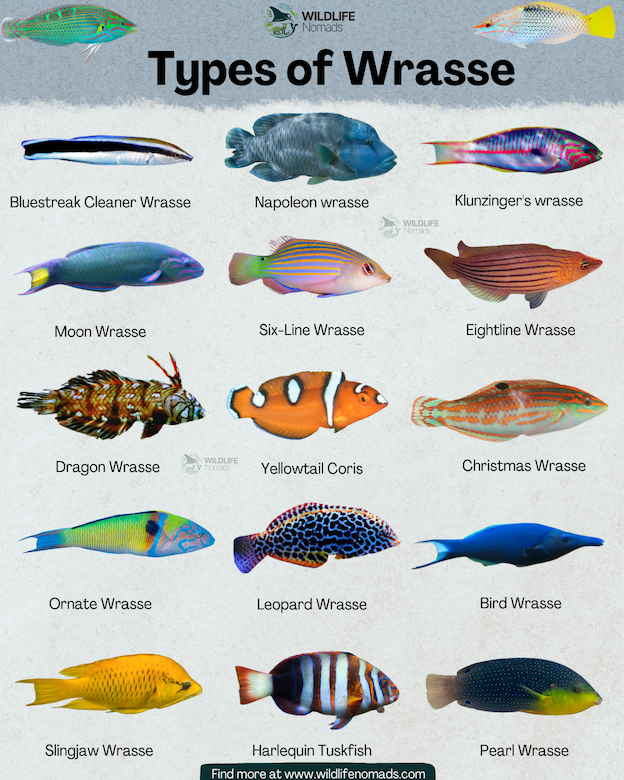
Wrasses alone comprise roughly 500 species across about 60 genera. They form the second largest family of marine fishes. Picking favorites among so many species is impossible, so this short guide covers 15 types of wrasses you’re most likely to meet face to face.
What Makes a Wrasse a Wrasse?
Wrasses belong to the family Labridae, a sprawling group of mostly tropical reef fish. These wrasses range in size from a 5 cm jewel to the 2 m Napoleon wrasse. Most species share thick lips, prominent canine teeth, and a rowing, pectoral-fin swimming style.
These fish display dazzling color, restless energy, and real intelligence. Many wrasse species inhabit tropical coral reefs, though some haunt tide pools, rocky reefs, and seagrass beds. Around 165 wrasse species live off Australia’s coasts alone, the family’s global hotspot. No two species look quite the same, and below are 15 of the most memorable.
1. Bluestreak Cleaner Wrasse
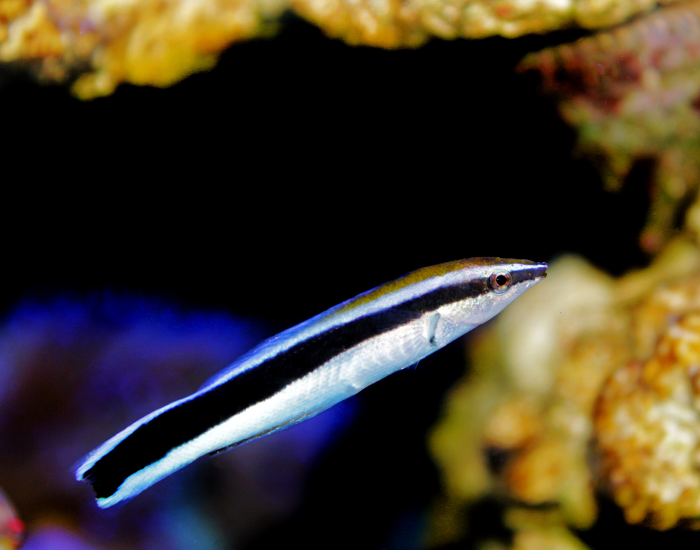
The bluestreak cleaner wrasse (Labroides dimidiatus) runs the reef’s most famous spa. This slender, blue-and-black fish sets up cleaning stations where bigger fish queue to have parasites and dead tissue removed. Cleaner wrasses feed almost entirely on what they pick off their clients.
I’ve hovered beside Red Sea stations and watched moray eels open their jaws so a cleaner could swim inside. That trust is no accident. Cleaner wrasses are essential for maintaining fish health on coral reefs, and researchers even argue this species recognizes itself in a mirror. For my money, no other reef fish species punches so far above its weight.
2. Napoleon (Humphead) Wrasse
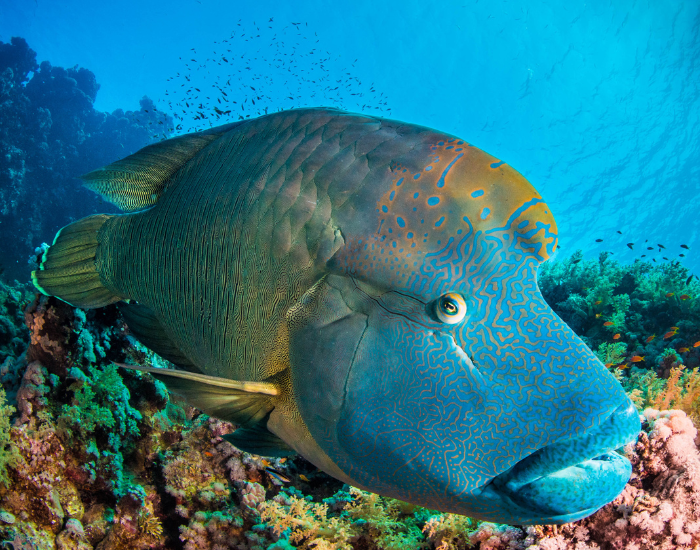
The Napoleon wrasse (Cheilinus undulatus) is the giant of the family. Some individuals reach lengths near 2 meters and weigh as much as a refrigerator. A bulbous forehead and maze-like green markings make them unmistakable.
I met my first one in Komodo, and the fish was the size of my dive buddy. Sadly, the IUCN lists this species as Endangered, hammered by the live reef-fish trade. Slow-growing and late to mature, this species recovers painfully slowly. Every sighting of these wrasses now feels like a small privilege.
3. Klunzinger’s Wrasse
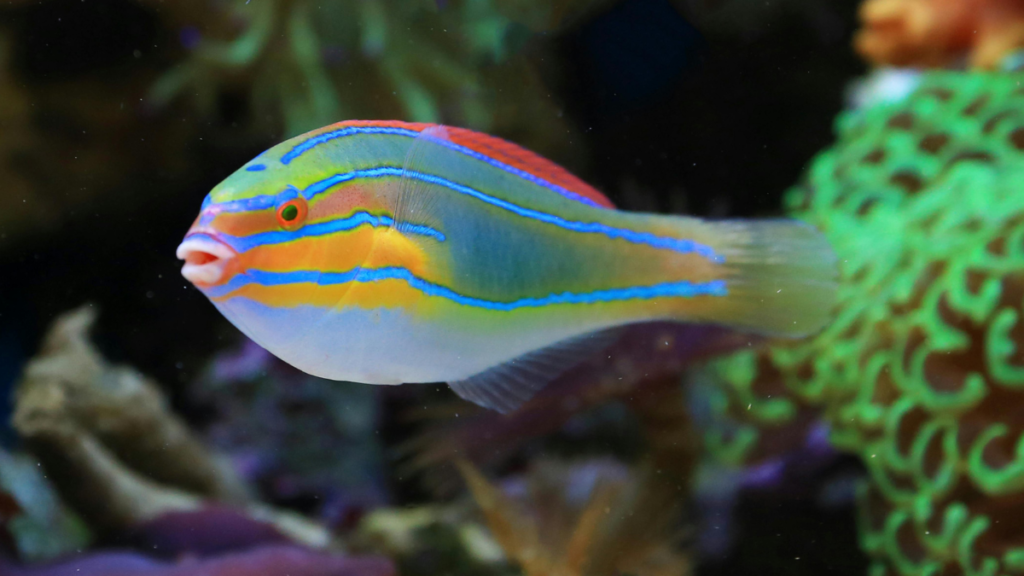
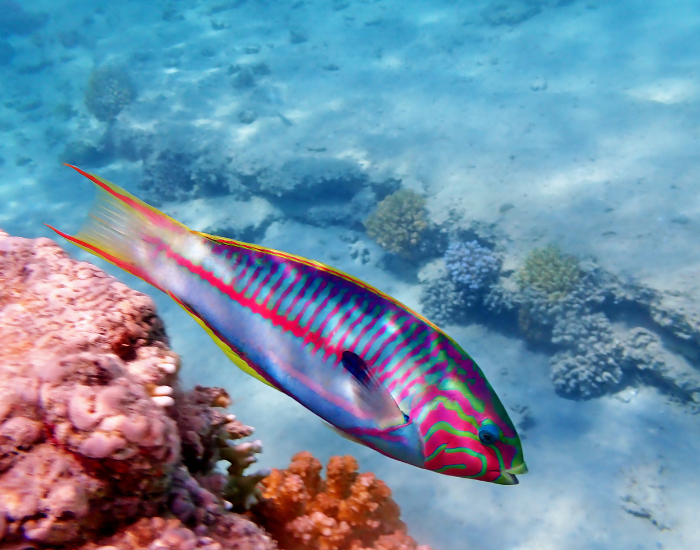
Klunzinger’s wrasse (Thalassoma rueppellii) is the fish I see most on this Red Sea trip. It’s a Red Sea endemic, splashed in pink, green, and turquoise like a swimming watercolor. Small and fast, this wrasse darts through coral heads chasing crustaceans.
These wrasses travel in loose groups, and a dominant male often shadows several females. Watch one feed and you’ll see the family’s signature move: a quick dart, a snatch, and back to cover. For divers in Egypt, this is the wrasse that defines the reef.
4. Moon Wrasse
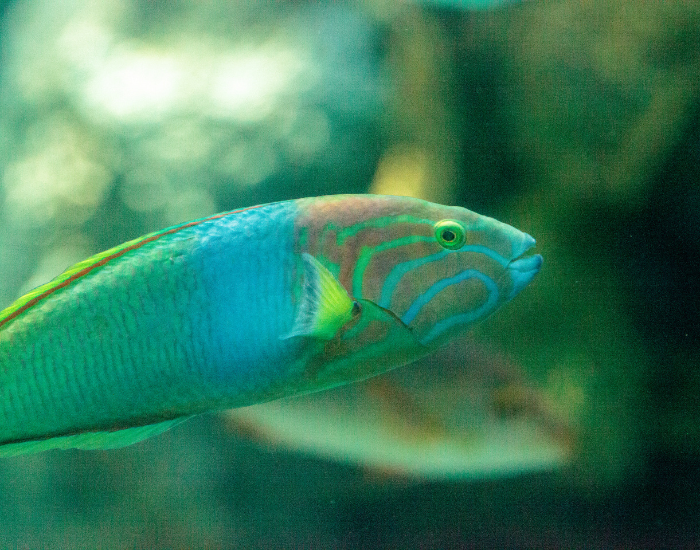
The moon wrasse (Thalassoma lunare) ranges widely across the Indo-Pacific, from the Red Sea to the western Pacific. A crescent-shaped tail and electric blue-green body give it its name. This wrasse grows to roughly 25 cm.
I’ve watched moon wrasses follow foraging goatfish, snapping up small animals the goatfish flush from the sand. That opportunism is classic wrasse behavior. These reef fish eat crustaceans, mollusks, and small fish with relentless appetite. The moon wrasse is bold, curious, and almost impossible to ignore.
5. Six-Line Wrasse
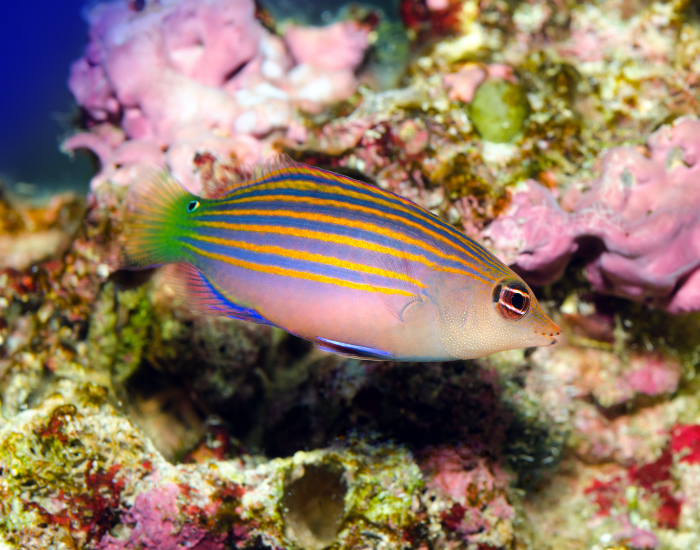
The six-line wrasse (Pseudocheilinus hexataenia) is a pocket-sized stunner. It grows to about 10 cm and wears six orange stripes over a violet body. This species hides deep in branching coral and rarely strays far.
Aquarists love six-line wrasses because they control pest invertebrates and pack huge personality into a small fish. On the reef, I find this species by its flicker of orange among the polyps. These wrasses are feisty, territorial, and far braver than their size suggests.
6. Eightline Wrasse
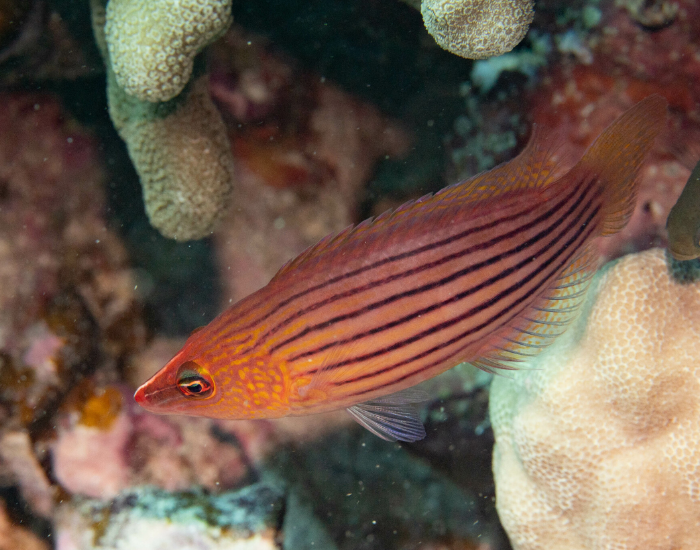
The eightline wrasse (Pseudocheilinus octotaenia) is the six-line’s larger, grumpier cousin. As the name promises, it carries eight fine lines along its flanks. It favors coral-rich slopes across the Indo-Pacific.
This wrasse is a serious predator of small invertebrates, including pyramid snails that plague corals. I’ve spent whole safety stops watching one patrol its patch, evicting anything that wandered in. Bold and solitary, the eightline wrasse rules its corner of the reef with attitude.
7. Dragon Wrasse (Rockmover)
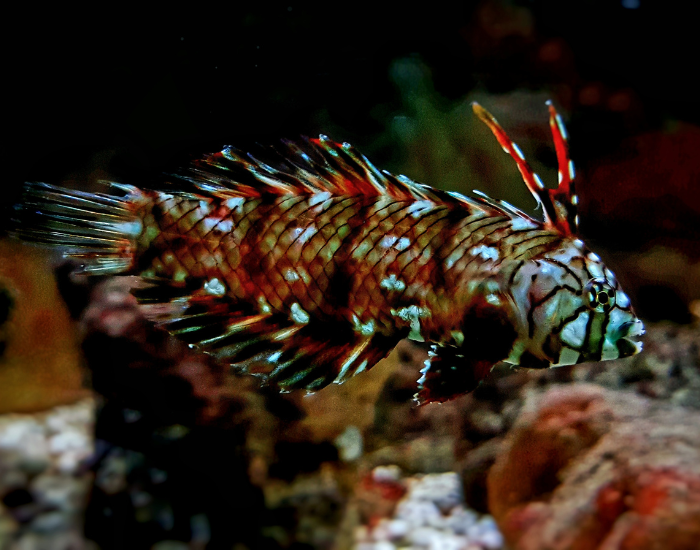
Few fish change as dramatically as the dragon wrasse (Novaculichthys taeniourus). Juveniles mimic drifting algae, swaying with mossy filaments to fool predators. Adults transform into stocky reef bulldozers that flip rubble to find prey.
The first dragon wrasse I filmed in Bali was a juvenile, and I genuinely mistook it for a torn leaf. Adults earn the nickname “rockmover” by tossing coral rubble far larger than their heads. This wrasse is pure theater, and watching one feed is one of diving’s quiet joys.
8. Yellowtail Coris
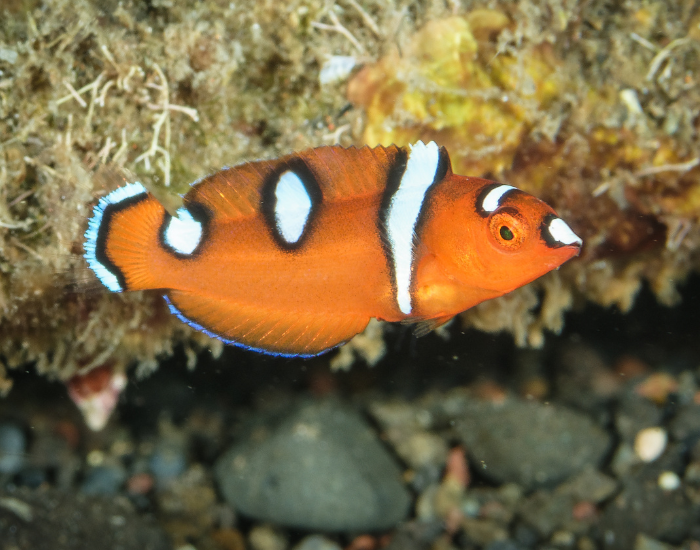
The yellowtail coris (Coris gaimard) belongs to the colorful Coris genus. Juveniles are bright orange with white, black-edged saddles, looking nothing like the deep blue-green adults. A juvenile can reach about 10 cm before it matures and shifts color entirely.
I once spent a Bali dive trying to photograph a juvenile wrasse that refused to hold still. Members of the Coris genus dig into sand to sleep and to escape danger. These wrasses hunt hard-shelled prey, crushing crabs and mollusks with strong pharyngeal teeth.
9. Christmas Wrasse
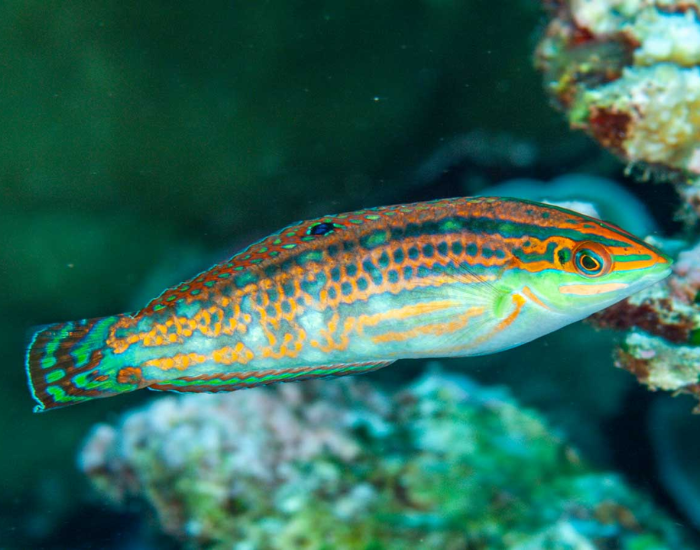
The Christmas wrasse (Halichoeres claudia) earns its festive name from red and green bands across a sleek body. It can reach a length of about 17 cm and prefers coral-rich areas in lagoons. The colors glow brightest in shallow, sunlit water.
I see relatives of this species throughout the Indo-Pacific, always busy, always foraging. These wrasses comb the substrate for small crustaceans and worms. Quick and shy, this wrasse will vanish into the reef the moment you point a camera. Patience is the only way to get the shot.
10. Ornate Wrasse
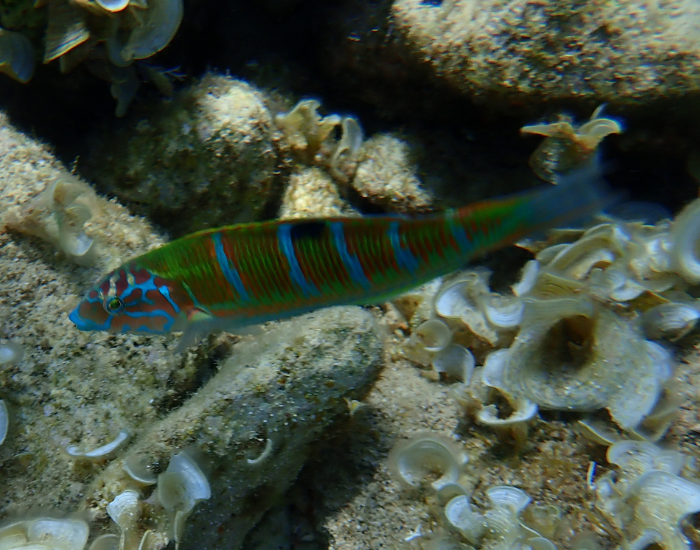
The ornate wrasse (Thalassoma pavo) brings an explosion of tropical color to the rocky reefs of the Mediterranean Sea and the eastern Atlantic Ocean. Growing up to 25 cm, it features a striking blend of bright green or turquoise bodies slashed with vertical orange and blue bars. Dominant males develop a vivid, deep blue band right behind their pectoral fins and a deeply forked, elegant tail.
Unlike many of its sand-burying relatives, this wrasse thrives around rocky substrates and lush seagrass meadows. They are famously curious, highly active swimmers that will fearlessly approach divers to check out the seabed rubble kicked up by fins. They use their sharp teeth to opportunisticly devour small mollusks, crabs, and sea urchins, acting as vital little predators in keeping reef invertebrates balanced.
11. Leopard Wrasse
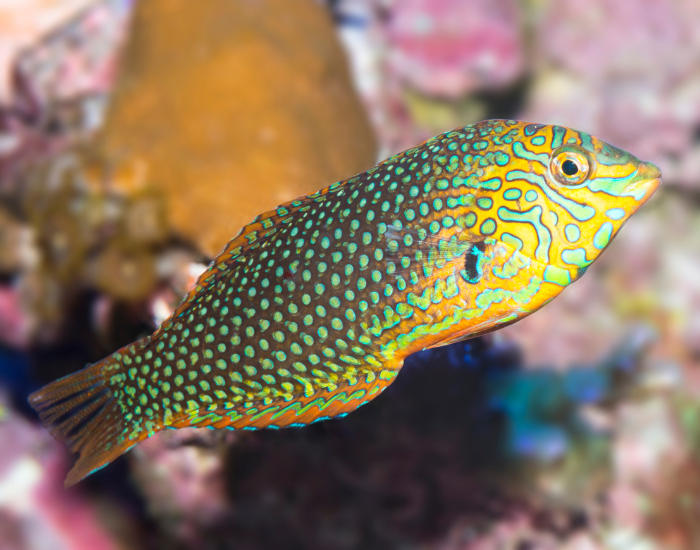
Leopard wrasses (genus Macropharyngodon) wear spotted coats that earn the name instantly. The Choati leopard wrasse (Macropharyngodon choati) lives in lagoons and sheltered reefs and prefers a temperature range of 23° to 26°C. These are delicate, deliberate fish.
I find leopard wrasses hard to spot because they drift low and feed on tiny crustaceans hidden in the sand. Juvenile wrasses often struggle to adapt to tank-fed foods, which makes them notoriously difficult aquarium fish. In the wild, though, this wrasse thrives on healthy reef habitat. Leopard wrasses reward a slow, careful diver.
12. Bird Wrasse
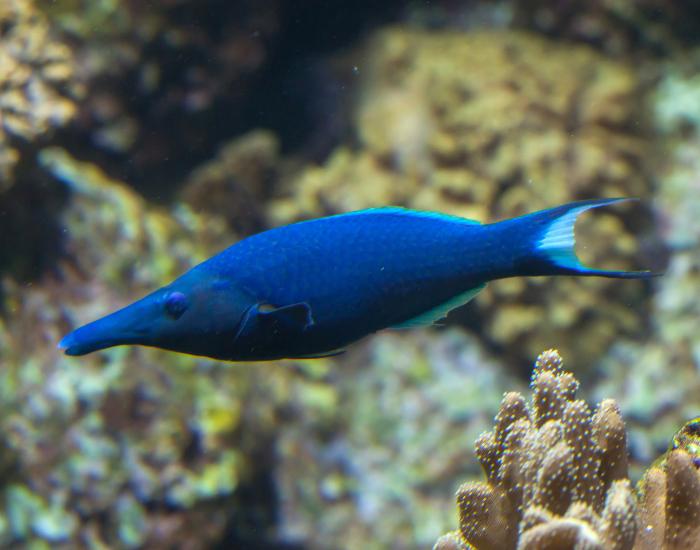
The bird wrasse (Gomphosus species) carries an unmistakable, beak-like snout. In the Red Sea I watch the green bird wrasse (Gomphosus caeruleus) probe coral crevices with that long mouth. The shape lets this wrasse reach prey other fish cannot.
Males and females look so different that early naturalists described them as separate species. Like most wrasses, bird wrasses are born female and some later become male, a theme explored in detail below. They swim with a fast, rowing motion that makes them easy to follow across a reef.
13. Slingjaw Wrasse
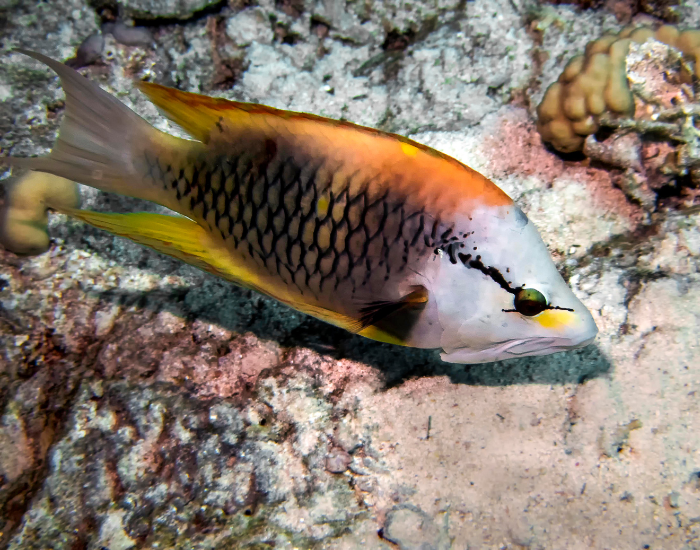
The slingjaw wrasse (Epibulus insidiator) hides one of the reef’s best party tricks. Its jaw shoots forward in a tube up to half its body length to vacuum up prey. The strike happens faster than my eye can follow.
I’ve tried for years to see a clean slingjaw strike, and I still mostly catch the aftermath. This wrasse ranges widely across the Indo-Pacific and comes in distinct color phases. Few predators on the reef hunt with such precise, almost surgical machinery. The slingjaw wrasse is engineering disguised as a fish.
14. Harlequin Tuskfish
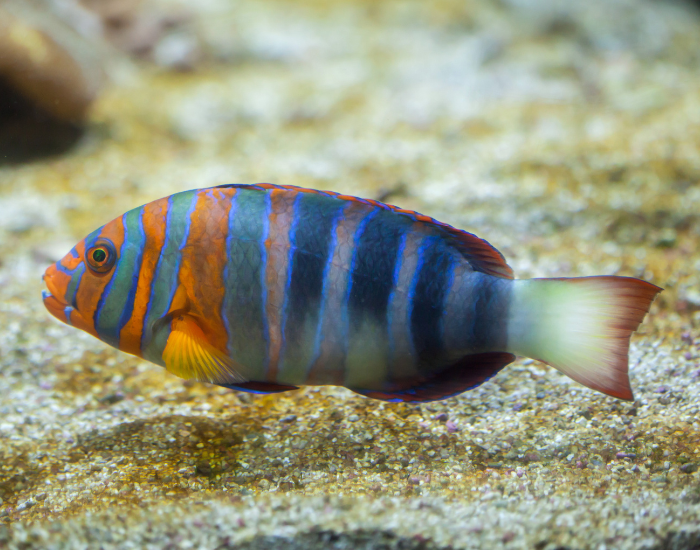
The harlequin tuskfish (Choerodon fasciatus) looks designed by committee, in the best way. Bold orange bands edged in blue wrap a stocky body, and bright blue teeth jut from its mouth. Those tusks crush crabs, urchins, and mollusks with ease.
This wrasse keeps populations of invertebrates in check, helping regulate the reef’s balance. I met one on the Great Barrier Reef that guarded its ledge like a tiny, fearless dragon. Striking and pricey, this species is prized by aquarists who can meet a tuskfish’s appetite for meaty foods.
15. Pearl Wrasse
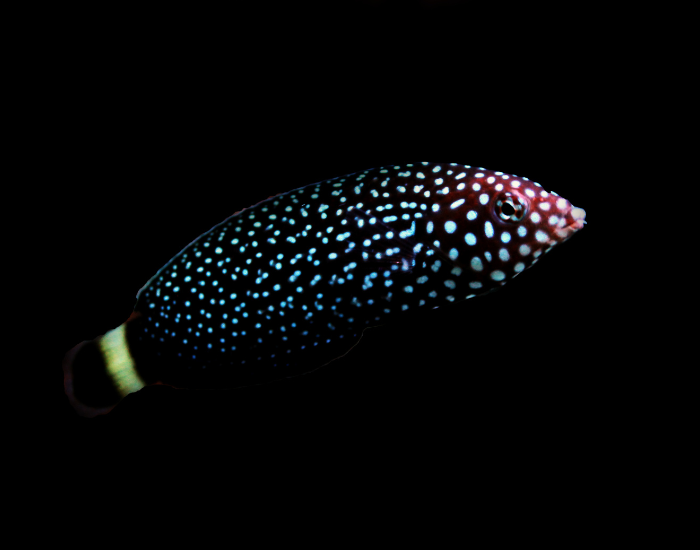
The pearl wrasse (genus Anampses) closes our list with subtle elegance. Dark bodies scattered with pale, pearly spots give the genus its name. These wrasses pick small invertebrates from rock and rubble with delicate, tweezer-like teeth.
Many Anampses species depend on healthy reef habitat and prove sensitive to environmental damage. That fragility makes these wrasses a quiet barometer of reef health.
Extra Fun Fact: How Wrasses Change Sex
Here’s the fact that hooks every diver I guide: most wrasses are born female, and many later become male. Biologists call this protogynous hermaphroditism, and the family Labridae shows it across countless species. Spawning typically occurs along outer reef edges, in pairs or as group spawning, depending on the species.
The trigger is social. When the dominant male of a harem dies, the largest female wrasse begins changing sex within days. Her body rewires hormones, behavior, and eventually her gonads until she becomes the new dominant male. Few reproductive systems in the sea are so flexible, and few wrasse species illustrate it better than the Kobudai (Asian sheepshead wrasse).
Frequently Asked Questions
A wrasse is a reef fish in the family Labridae, the second largest family of marine fishes with roughly 500 species. To define wrasse simply: a wrasse is a colorful, fin-rowing fish with thick lips and strong teeth. Most wrasses inhabit tropical coral reefs worldwide.
A wrasse fish is the same thing as a wrasse, the words are interchangeable. These fish range from 5 cm cleaners to the 2 m Napoleon wrasse. They eat invertebrates and small fish, and many famously change sex during their lives.
Many small wrasses, like the six-line, are considered reef safe and even helpful, since they eat pest invertebrates. Larger species that crush snails and crabs are less reef safe. Always match the wrasse to your tank and its inhabitants.
Yes. Most wrasse species are born female, and the death of a dominant male triggers a sex change in the largest female. The process reshapes the fish’s hormones and gonads over days to weeks. It is one of the most studied examples of sex change in fish.
A Reason to Look Closer
Fifteen wrasses barely scratch the surface of a family that holds about 500 species, yet each wrasse shows the same restless intelligence and color. The next time you snorkel a reef, slow down and find the cleaner station, you’ll watch a whole social world unfold. If reef life pulls you in, read more about coral fishes or the weirdest fish in the world, and tell me in the comments which wrasse you’ve met. I’m always hunting for the next one.
References:
Bshary, R. (2003). The cleaner wrasse, Labroides dimidiatus, is a key organism for reef fish diversity at Ras Mohammed National Park, Egypt. Journal of Animal Ecology, 72(1), 169–176. https://doi.org/10.1046/j.1365-2656.2003.00683.x
Grutter, A. S. (1999). Cleaner fish really do clean. Nature, 398(6729), 672–673. https://doi.org/10.1038/19443
Kohda, M., Hotta, T., Takeyama, T., Awata, S., Tanaka, H., Asai, J.-Y., & Jordan, A. L. (2019). If a fish can pass the mark test, what are the implications for consciousness and self-awareness testing in animals? PLOS Biology, 17(2), e3000021. https://doi.org/10.1371/journal.pbio.3000021
Kohda, M., Sogawa, S., Jordan, A. L., Kubo, N., Awata, S., Satoh, S., Kobayashi, T., Fujita, A., & Bshary, R. (2022). Further evidence for the capacity of mirror self-recognition in cleaner fish and the significance of ecologically relevant marks. PLOS Biology, 20(2), e3001529. https://doi.org/10.1371/journal.pbio.3001529
Todd, E. V., Ortega-Recalde, O., Liu, H., Lamm, M. S., Rutherford, K. M., Cross, H., Black, M. A., Kardailsky, O., Marshall Graves, J. A., Hore, T. A., Godwin, J. R., & Gemmell, N. J. (2019). Stress, novel sex genes, and epigenetic reprogramming orchestrate socially controlled sex change. Science Advances, 5(7), eaaw7006. https://doi.org/10.1126/sciadv.aaw7006
Westneat, M. W., & Alfaro, M. E. (2005). Phylogenetic relationships and evolutionary history of the reef fish family Labridae. Molecular Phylogenetics and Evolution, 36(2), 370–390. https://doi.org/10.1016/j.ympev.2005.02.001