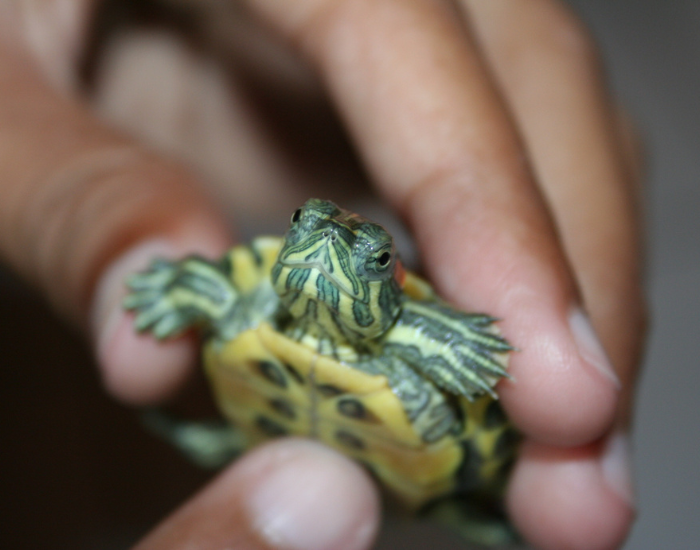
My cousin kept a pair of red-eared sliders in a cloudy tank on her windowsill, and as kids we thought they were the cutest things alive. We’d press our noses to the glass and watch them paddle. Those baby red eared sliders were no bigger than a cookie. Years later, on study breaks at my university lake, I met the same species again — basking on logs, sliding off rocks the second I stepped too close. Like most ponds near a campus, that water was full of them. Alongside the birds, herons, and waterfowl, these turtles were a constant presence.
That lake taught me something the pet store never did. Red-eared sliders are among the most successful, most misunderstood reptiles on Earth. People buy these turtles as palm-sized novelties, then panic when they hit dinner-plate size. So let’s clear the water. Here are ten things about red eared slider turtles that will change how you see the little guy sunbathing on that log.
1. The Red Stripe Is a Name Tag, Not a Warning
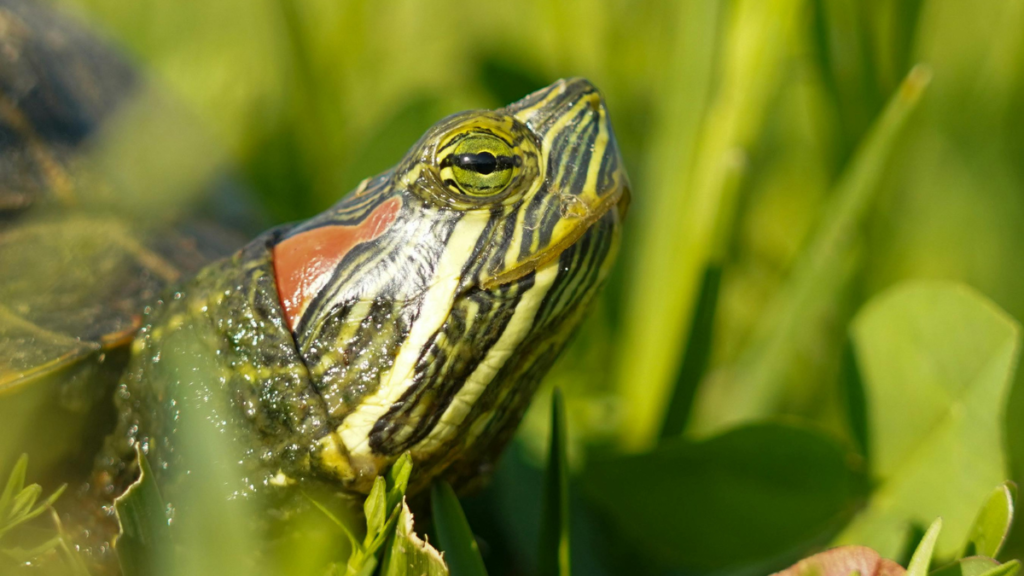
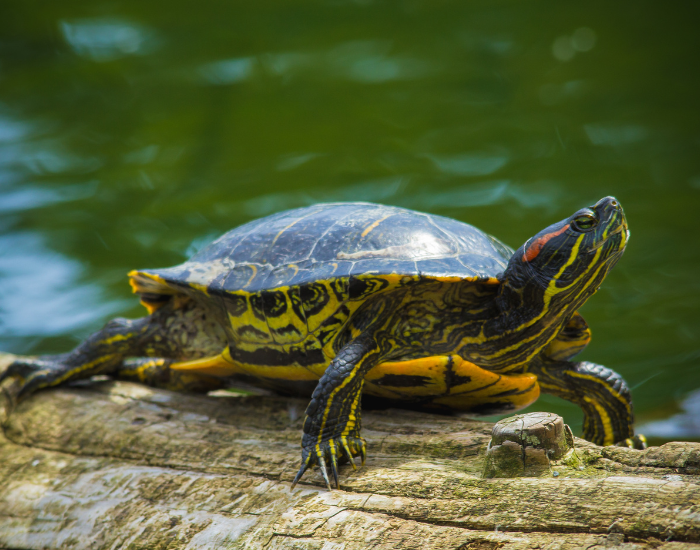
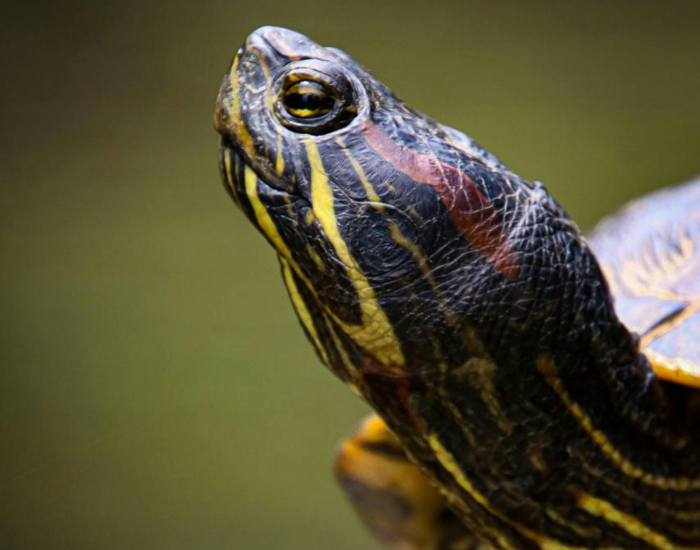
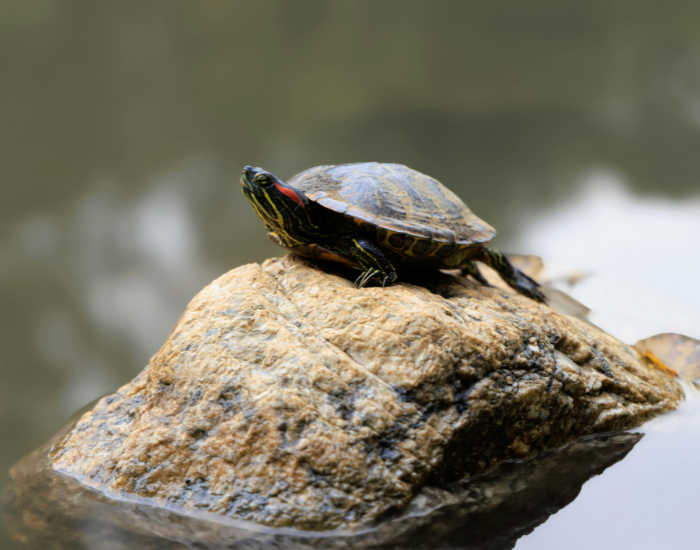
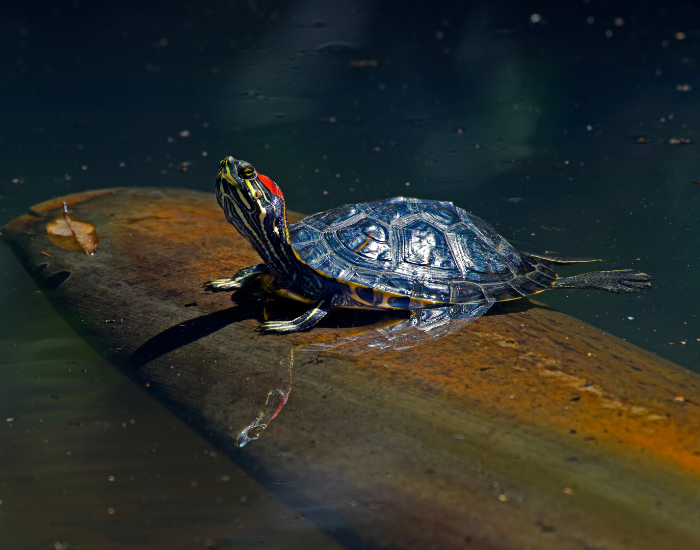
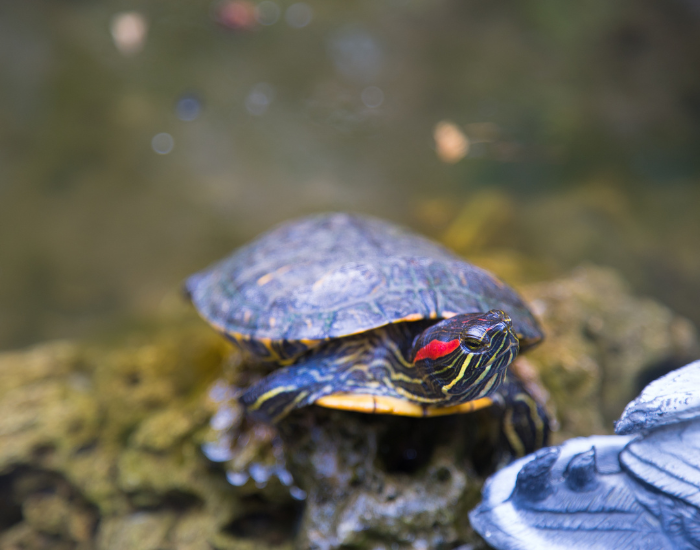
Look behind each eye and you’ll spot it: a bold red stripe, sometimes orange, painted right where an ear would be. That mark is why we call this species the red-eared slider. Turtles have no external ears, so the “ear” is pure branding.
The rest of the shell tells its own story. Young red eared slider turtles wear a brilliant dark green carapace laced with yellow lines and dark markings. As these turtles age, the yellow stripes fade and the whole animal darkens, sometimes to near-black. I’ve watched two sliders of the same age look like completely different species simply because one spent more time basking. Unlike sea turtles or tortoises, these turtles keep that vivid juvenile coloring only briefly.

2. “Slider” Describes Exactly What They Do
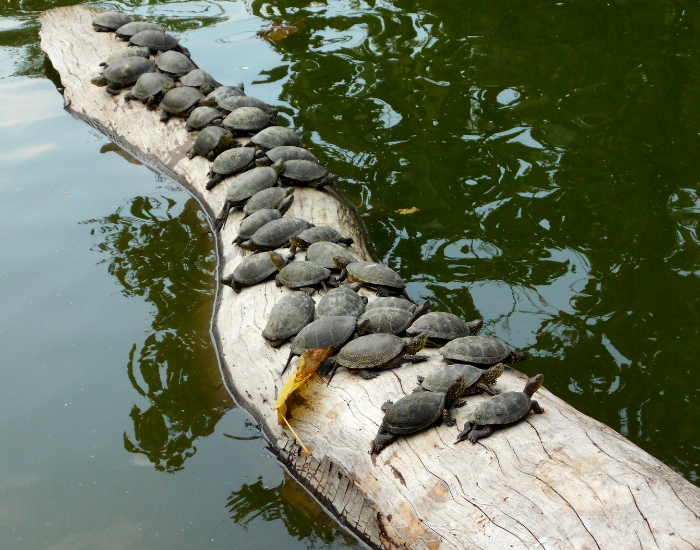
The name isn’t poetic. Spend an hour near any pond full of these reptiles and you’ll see it. They haul out onto rocks, logs, and the muddy bank to bask, then slide off the surface in a single splash the instant they sense a footstep.
That sliding habit is survival. Basking lets these cold-blooded turtles raise body temperature, fuel digestion, and soak up UVB for healthy bones. But the open shoreline is dangerous, so sliders evolved a hair-trigger escape. At my university lake, I could measure how close I was by how many turtles slid into the water at once. Even the boldest sliders rarely let me within arm’s reach.
3. They Start as Tiny Carnivores and Mellow With Age
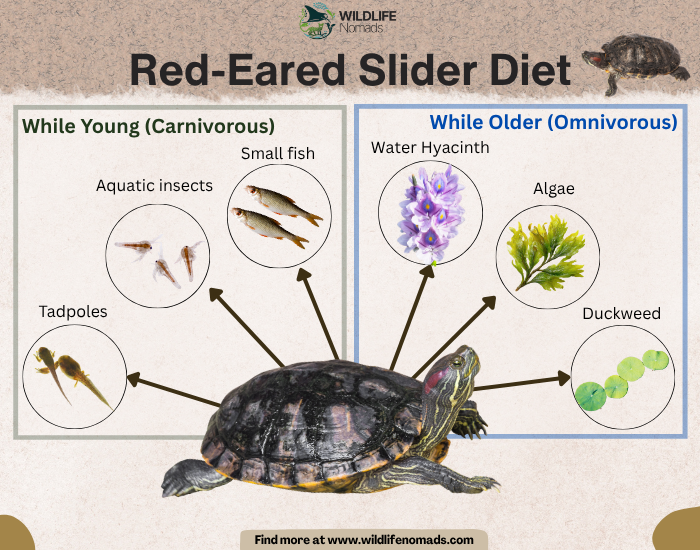
Here’s a fact that trips up most new keepers. Juvenile red-eared sliders are aggressively carnivorous. A baby’s diet leans heavily on protein: insects, small fish, tadpoles, and aquatic invertebrates. Because growing shells and muscle demand it.
As they mature, the turtle’s diet shifts. Adult sliders become true omnivores, grazing on aquatic vegetation and algae as much as they hunt. In a home tank, this means feeding young turtles a high-protein diet often, then transitioning adults toward dark leafy greens three to four times a week with protein every two to three days. Those diet shifts mirror exactly what wild turtles do, and they’re the reason feeding mistakes are so common with pet sliders.
4. Turtles Can’t Swallow on Dry Land
One of my favorite odd facts: turtles must eat in water. They can’t produce saliva the way we do, and they rely on water to move food down the throat. Try to feed a slider on land and it will struggle.
This single quirk explains a lot of their biology. It’s why sliders are so tightly bound to ponds, swamps, and slow rivers. It’s why a proper tank needs deep, clean water, not a shallow dish. Feeding happens at the water’s surface or below it, never on a basking rock. Watch wild turtles in a pond and you’ll see them snap at food, then duck under to swallow.
5. They Grow Far Bigger Than the Pet Store Implies
That cookie-sized hatchling is a temporary illusion. A full-grown red-eared slider can reach roughly 12 inches in shell length, and females routinely dwarf the males. Carapace length commonly runs about 5 to 8 inches in adult males and 8 to 11 inches in adult females.
The sex difference is striking once you know the cues. Adult males stay smaller but grow absurdly long front claws and thicker tails, which they use in courtship. Adult females are the heavyweights, built for carrying eggs. When people ask why their “small” turtle outgrew its tank, the answer is usually that they bought a female, and that nobody warned them how big a red eared slider gets.
6. A Single Female Can Lay Clutches All Spring
Reproduction is where these turtles really flex their success. Females in the wild reach sexual maturity at a carapace length of roughly 5 inches, often around five to eight years old. captive females or those in warmer climates frequently reach maturity much faster (three to five years), as sexual maturity in sliders is strictly determined by size. Once mature, a female red-eared slider turtle can produce multiple clutches of eggs in a single season, and prolific females are a big reason these turtles spread so fast.
Nesting peaks in late spring. Females leave the water, sometimes traveling surprising distances over land, to find sandy or soft nesting sites. There she digs, deposits her eggs, covers the nest, and returns to the pond. A clutch can hold a handful to well over a dozen eggs, and warmer temperatures during incubation tend to produce more females. That temperature-driven sex determination is one of the most fascinating tricks in reptile biology.
7. You Must Know: They Live for Decades
This is the fact I wish every parent heard before a birthday purchase. Similar to Painted turtles, Red-eared sliders typically live 20 to 30 years, and well-cared-for animals in captivity can pass 40. The turtles my cousin kept could have outlived our entire childhood friendship.
That longevity reframes the whole “starter pet” idea. A slider is a multi-decade commitment, closer to adopting a parrot than buying a goldfish. I’ve met sliders older than the students sitting beside the lake watching them.
8. Proper Care Means a Serious Aquatic Setup
People underestimate what these semi-aquatic freshwater turtles need. A healthy adult requires a large aquatic enclosure, many keepers and vets recommend 75 gallons or more for males while a fully-grown female reaching 11 to 12 inches strictly requires a 100 to 120-gallon enclosure, following a rough rule of 10 gallons of water per inch of shell length.
The environment has to be dialed in. Water temperature should sit around 75–80°F, with a basking spot reaching 90–95°F. Sliders need UVB lighting 10 to 12 hours daily to absorb calcium; without it, they develop metabolic bone disease, a painful, deforming condition I’ve seen in neglected pets. Change a good portion of the water weekly, because fouled water breeds illness fast. Get the temperature, lighting, and filtration right, and these animals are remarkably hardy.
9. They Carry Salmonella… and It Has Killed Children!
This is the uncomfortable part, and it matters. Red-eared sliders can carry salmonella bacteria on their skin and shells, even when the turtle looks perfectly healthy. Salmonella can cause serious infections in humans, and turtles can contaminate the water — and the hands that touch it.
The risk is not theoretical. Between 2006 and 2014, U.S. health officials documented multiple turtle-linked salmonella outbreaks sickening hundreds of people, mostly young children, with at least one infant death. This isn’t just history, either—the risk remains a very modern reality. Federal health officials continue to track major multi-state outbreaks linked to these small turtles, including severe spikes in recent years that hospitalized dozens of young children.
That’s exactly why a 1975 FDA regulation bans selling turtles with a shell under 4 inches — small enough for a toddler to put in their mouth. Wash your hands every single time, and keep these reptiles away from kitchens and very young kids.
10. One of the World’s Worst Invaders
Native to the southeastern United States and the Mississippi River valley, the red-eared slider now lives on six continents. Decades of the pet trade, millions of hatchlings shipped from pet stores worldwide — seeded populations far beyond their home range. Released into local ponds and lakes, the survivors thrive and breed.
The result is an ecological problem. The IUCN lists these sliders among the 100 worst invasive species on the planet. Released pets outcompete native turtles for basking sites, nesting sites, and food, and the sliders can spread disease to local wildlife. Where they invade, native turtles often lose the best basking logs first.
Australia bans importing or releasing them outright, treating the species as a genuine threat. It’s a hard truth about a charming animal: the same toughness that makes red-eared sliders easy to keep makes these turtles devastating when they escape. If you want the bigger picture on how this happens, I wrote an article on what makes a species invasive goes deeper.
Frequently Asked Questions
A full-grown red-eared slider reaches about 12 inches in carapace length. Females are the larger sex, commonly 8 to 11 inches, while males usually top out around 5 to 8 inches. Genetics, diet, and tank size all influence how big any individual turtle gets.
Yes. Studies on sliders and other turtles show these reptiles can learn mazes, remember feeding routines, and recognize the people who care for them. My lake sliders clearly learned which benches meant snacks. Red eared slider turtles are far smarter than their blank stare suggests.
No. Red-eared sliders are semi-aquatic, so these turtles need both deep water to swim and feed in and a dry basking spot to haul out and warm up. A tank with water but no basking area will make sliders sick. The balance of water and land is essential to proper care.
The turtle itself is cheap — often $10 to $40 at pet stores — which is exactly the trap. The real cost is the setup: a large tank, filter, heater, UVB lighting, and decades of food and vet care easily run several hundred dollars upfront. Budget for the habitat, not the animal.
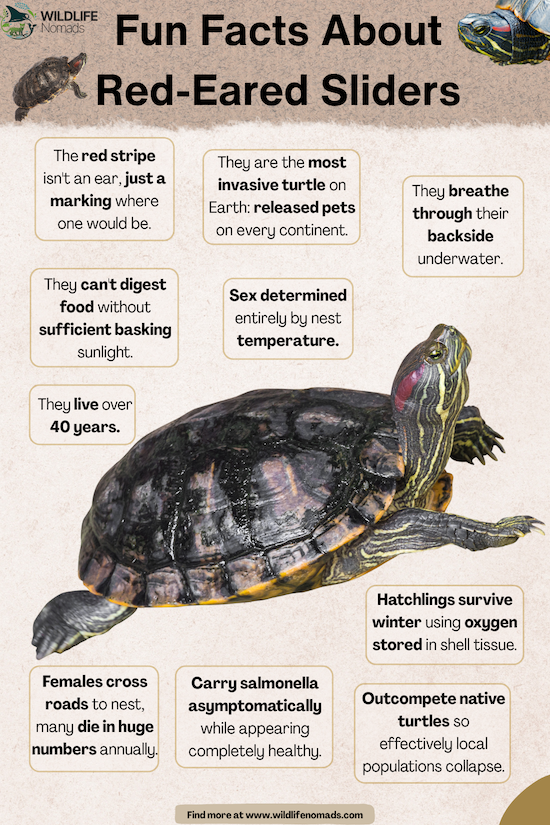
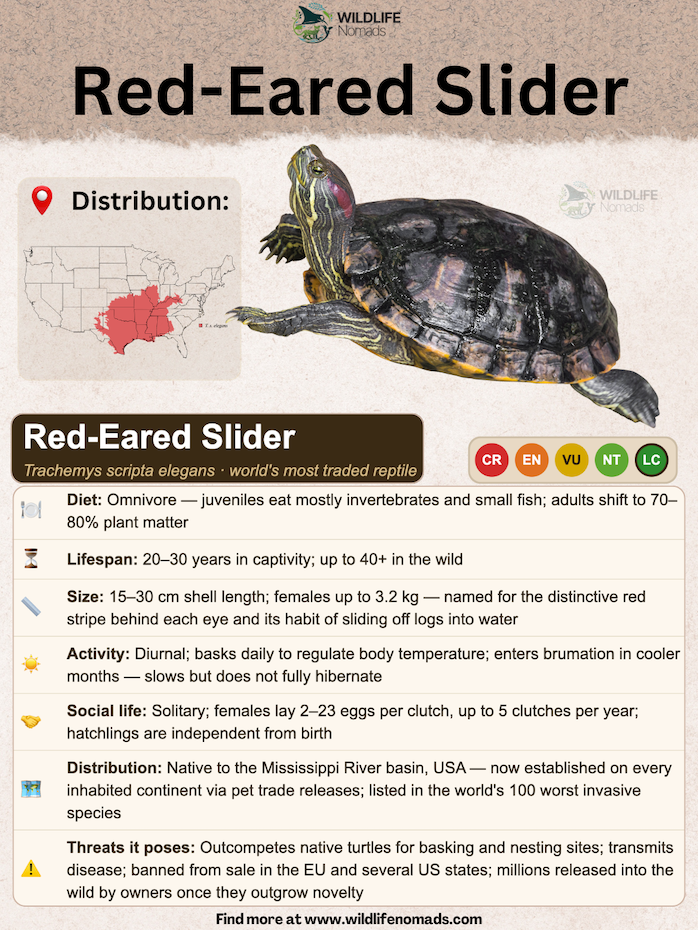
Red-Eared Sliders | Credit: Wildlife Nomads
A Charming Survivor That Deserves Respect
The red-eared slider is proof that “common” and “fascinating” aren’t opposites — this is a decades-living, continent-hopping omnivore with a memory and a hair-trigger dive reflex. Loved as a pet, feared as an invader, it rewards anyone willing to look past the cute hatchling and see the animal it becomes.
So next time you pass a pond, slow down and watch the log line. Count how many sliders bask before they slide, and notice how many of those turtles are bigger than you’d expect. If you keep one, commit to the full thirty years and the full-sized tank. And if you’re curious how sliders compare to their relatives, wander over to my guides on terrapins, tortoises, and sea turtles — or meet the herons and waterfowl that share their water. Seen something surprising at your local pond? Tell me in the comments.
References:
Lewis, C. H., Molloy, S. F., Chambers, R. M., & Davenport, J. (2018). Body size and growth in the red-eared slider (Trachemys scripta elegans) at the northern edge of its range. Herpetological Conservation and Biology, 13(3), 700–710. https://www.herpconbio.org/Volume_13/Issue_3/Lewis_etal_2018.pdf
Pérez-Santigosa, N., Díaz-Paniagua, C., & Hidalgo-Vila, J. (2008). The reproductive ecology of exotic Trachemys scripta elegans in an invaded area of southern Europe. Aquatic Conservation: Marine and Freshwater Ecosystems, 18(7), 1302–1310. https://doi.org/10.1002/aqc.974
Adamovicz, L., Allender, M. C., & Gibbons, P. M. (2024). Health assessment of non-native red-eared sliders (Trachemys scripta elegans) and their impact potential on native species. PLOS ONE, 19. https://doi.org/10.1371/journal.pone.0333786
Davy, C. M., Gilbert, A. J., & others. (2020). Environmental DNA detection and quantification of invasive red-eared sliders, Trachemys scripta elegans, in ponds and the influence of water quality. PeerJ, 8, e8155. https://doi.org/10.7717/peerj.8155
Bosch, S., Tytgat, T., & Backeljau, T. (2020). A review of the public health challenges of Salmonella and turtles. Veterinary Sciences, 7(2), 56. https://doi.org/10.3390/vetsci7020056
Bosch, S., Tauxe, R. V., & Behravesh, C. B. (2016). Turtle-associated salmonellosis, United States, 2006–2014. Emerging Infectious Diseases, 22(7), 1149–1155. https://doi.org/10.3201/eid2207.150685
Lowe, S., Browne, M., Boudjelas, S., & De Poorter, M. (2000). 100 of the world’s worst invasive alien species: A selection from the Global Invasive Species Database. IUCN Invasive Species Specialist Group. https://www.iucngisd.org/gisd/speciesname/Trachemys+scripta+elegans