
I have a confession. I have never seen a northern painted turtle in its native range. My first encounter happened in Mexico, of all places, in the ornamental ponds of a roadside restaurant. A handful of these little reptiles paddled around between water lilies, thousands of miles from home. They were pets, sold cheap and dumped in a tourist trap pond.
Here was a painted turtle far outside its range, a textbook example of how the pet trade moves turtles where they don’t belong. I later met the species again in my ecology courses, where this turtle shows up as a classic case study. So I know the painted turtle as both a beloved native and a potential problem abroad, a turtle worth understanding from both angles.
This post is my attempt to understand the painted turtle properly. You’ll learn how to tell a painted turtle male from a female, where this turtle lives, how long it survives, and the jaw-dropping trick its hatchlings use to survive being frozen alive.
What Exactly Is a Painted Turtle?
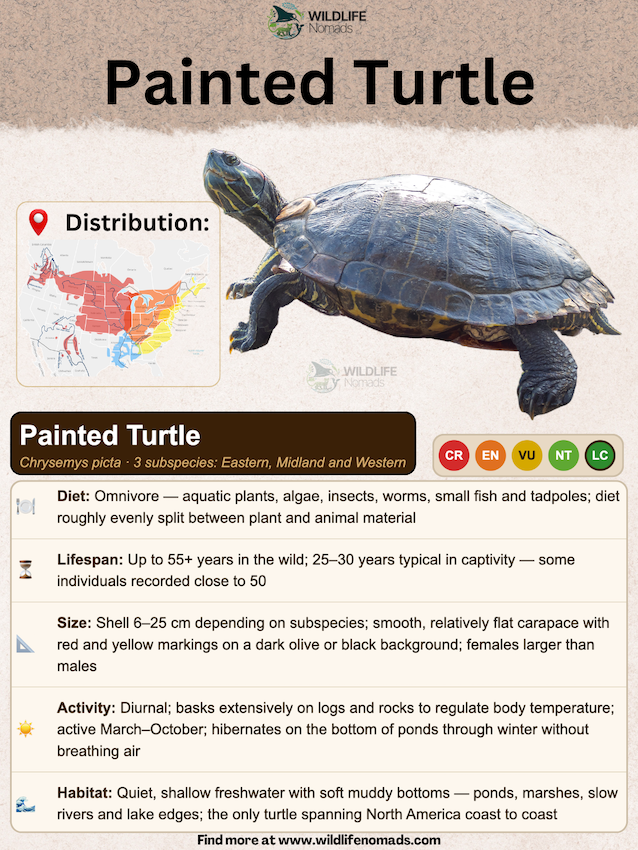
The painted turtle, Chrysemys picta, is the most widely distributed native turtle in North America. People often miscall this turtle a freshwater tortoise, but it is a true aquatic turtle. Tortoises live on land; the painted turtle rarely leaves the water for long.
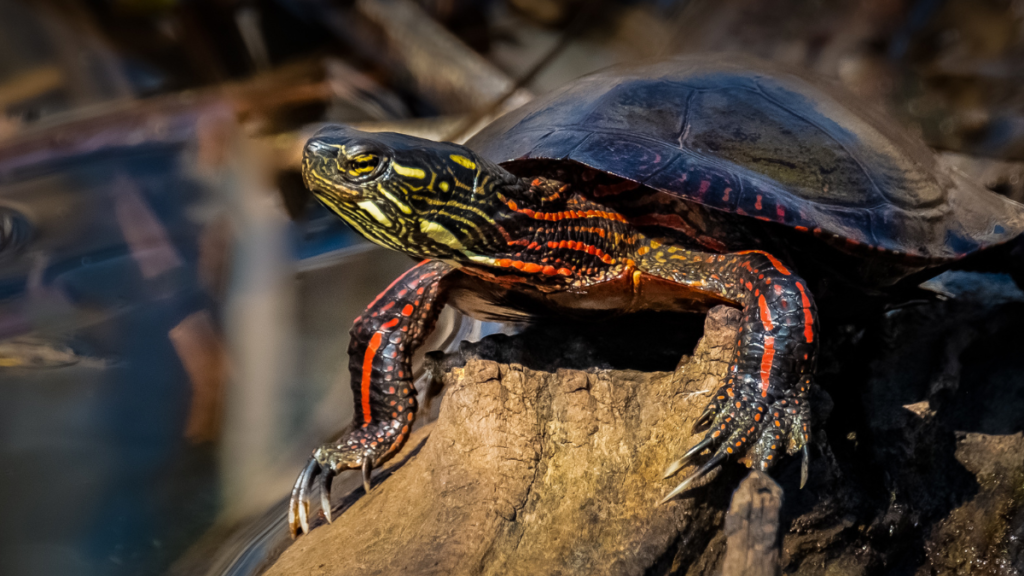
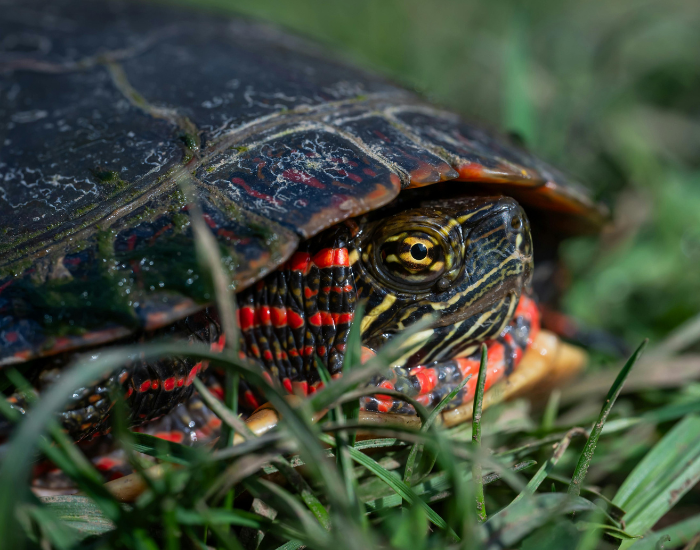
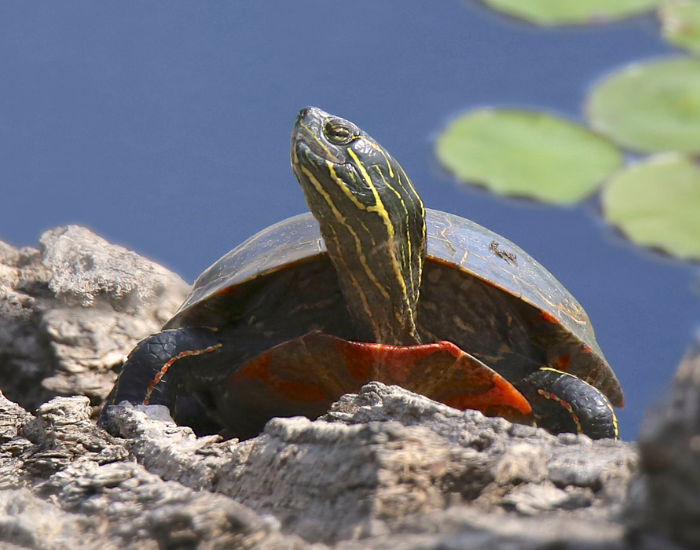
Its name fits. The smooth, dark upper shell, or carapace, is bordered with bright red markings along the edge. Vivid yellow stripes streak the head, neck, and legs. The bottom shell, or plastron, ranges from plain yellow to a busy yellow-and-black pattern, depending on the subspecies.
German naturalist Johann Gottlob Schneider first described the species in 1783 under the name Testudo picta. Today scientists place this turtle firmly in the genus Chrysemys. When you read “painted turtle Chrysemys picta” in a field guide, that’s our animal. As far as turtle identification goes, the red shell border plus yellow facial stripes seals it.
1. Females Outgrow the Males
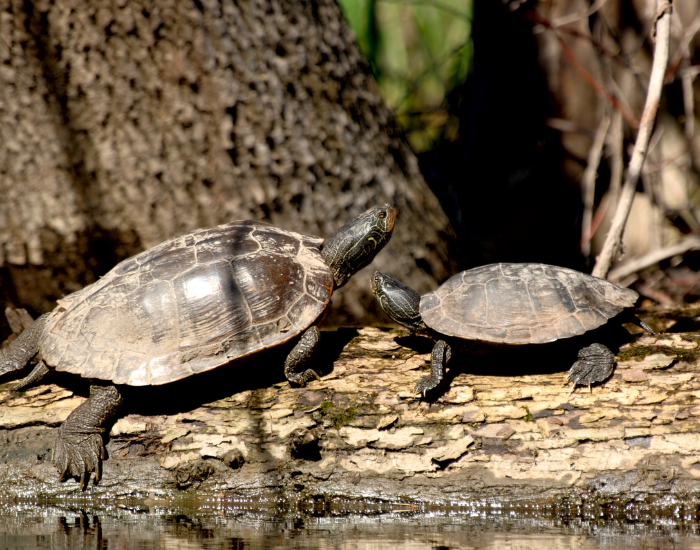
Here is a fact that surprises most people. Female painted turtles are bigger than males. Adult females reach up to 7.1 inches in shell length, while the male painted turtle stays noticeably smaller and slimmer.
Painted turtle size also varies by subspecies and region. Northern turtle populations tend to grow larger than southern ones, a common pattern among cold-climate reptiles. As painted turtles grow, the shell flattens and widens into that classic oval shape.
The clearest way to sex an adult painted turtle sits on the front feet. The male has distinctly long front claws, which he uses during courtship to stroke a female’s face. Females have short claws and a flatter shell. So if you ever observe a small turtle waving elongated nails at another, you are watching a male painted turtle flirt.
2. Three Subspecies, and One That Broke Away
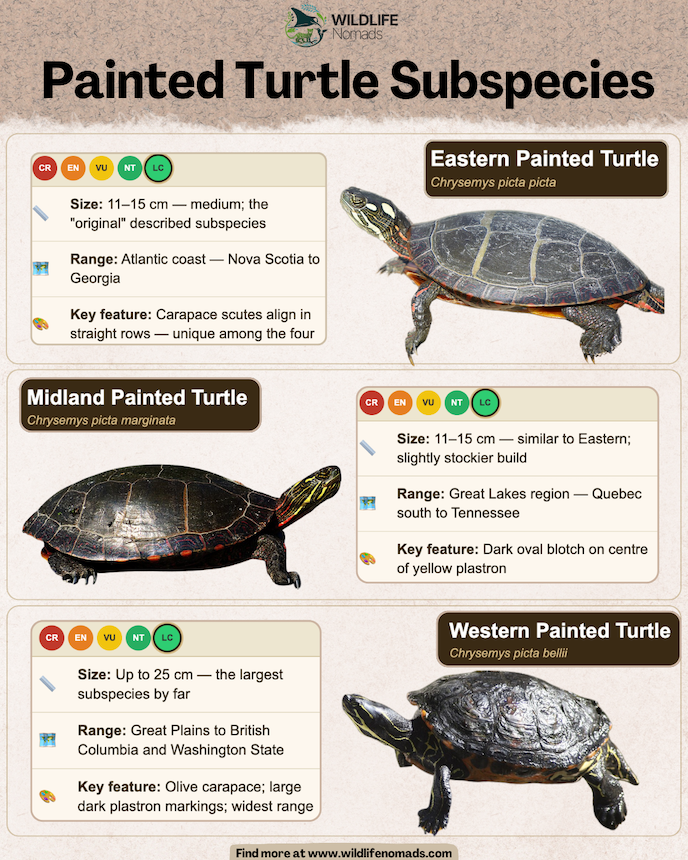
For decades, biologists recognized four subspecies of painted turtle. Three remain valid today: the eastern, the midland, and the western. The southern painted turtle, once the fourth, is now generally treated as a separate species, Chrysemys dorsalis.
The eastern painted turtle ranges from southeastern Canada down the coast through Virginia and West Virginia to Georgia. The midland painted turtle lives from southern Ontario to Kentucky. The western subspecies, the largest of the group, occupies southern Canada and much of the western United States. Each subspecies wears slightly different shell and yellow stripe patterns.
That taxonomic shuffle matters more than it sounds. A 2003 mitochondrial DNA study reorganized the whole Chrysemys picta complex and showed how Ice Age glaciation carved these turtle lineages apart. Two subspecies blend where their ranges meet, which keeps herpetologists arguing over the species question to this day.
3. They Live in Slow Water and Soft Mud
Painted turtle habitat is wonderfully unfussy. These reptiles thrive in shallow ponds, lakes, marshes, rivers, and slow-moving streams. They favors quiet water bodies with soft, muddy bottoms and plenty of aquatic vegetation to hide in and feed on.
Their range stretches from southern Canada all the way to the Gulf of Mexico, the widest spread of any North American turtle. Painted turtles even tolerate brackish tidal waters and salt marshes near the coast, a habitat few freshwater turtles manage.
I find this adaptability the key to their success. Give them still freshwater habitats, a muddy bottom, and a few logs, and painted turtle populations move in fast. Ponds, ditches, marshes, and lake edges all suit them. That same flexibility, however, is exactly why released pet turtles establish so easily where they shouldn’t.
4. They Are the Sunbathers of the Pond
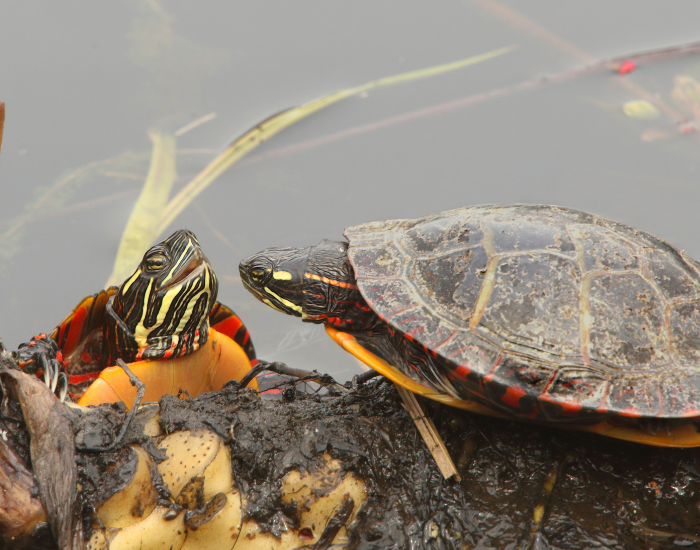
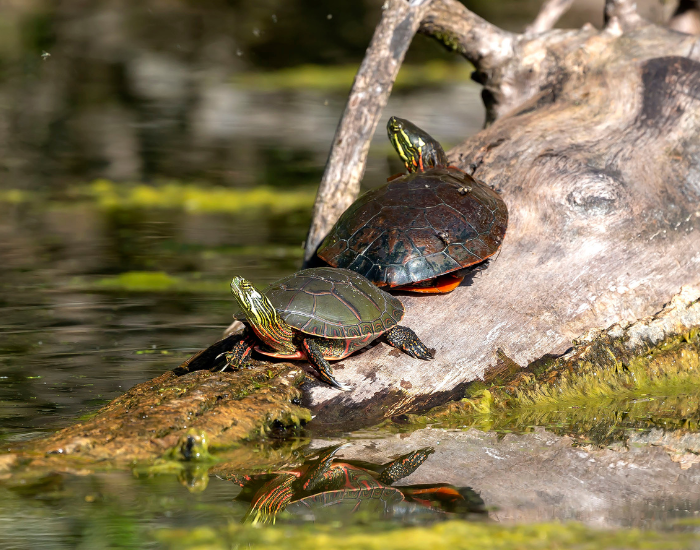
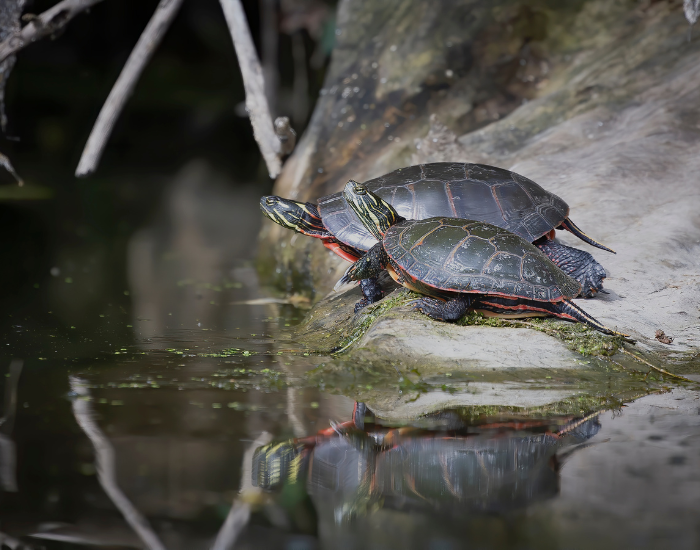
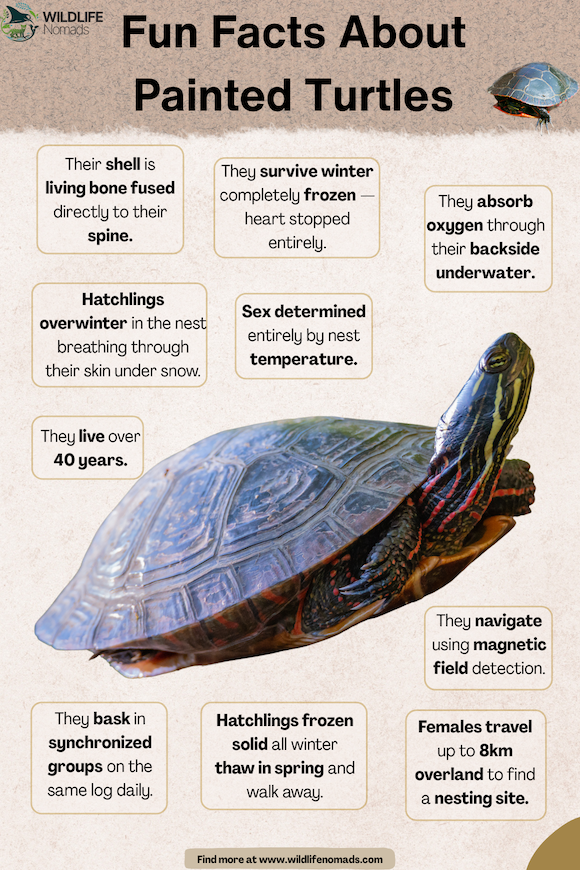
Spend a warm morning beside any northern pond and you’ll spot them. Painted turtles are diurnal and famously social baskers, piling onto logs and rocks in the sun.
This is not laziness. As ectotherms, these turtles cannot generate their own heat, so they raise their body temperature by basking in sunlight. Basking warms the blood, speeds digestion, and helps fight off skin parasites and fungus on the shell.
Water temperature and air temperature dictate nearly everything a painted turtle does. On cool days the turtles crowd the best basking sites, jostling for prime logs and rocks. As a result, environmental temperatures rule both their daily rhythm and their yearly cycle, from spring emergence to winter dormancy. Logs near deep water make the safest basking sites, since a startled turtle can dive in an instant.
5. A Diet That Shifts With Age
Painted turtles eat underwater, and they have to. These turtles lack saliva to bind food, so they must swallow each mouthful submerged. Horny plates inside the jaws grip and tear prey, since the species has no teeth.
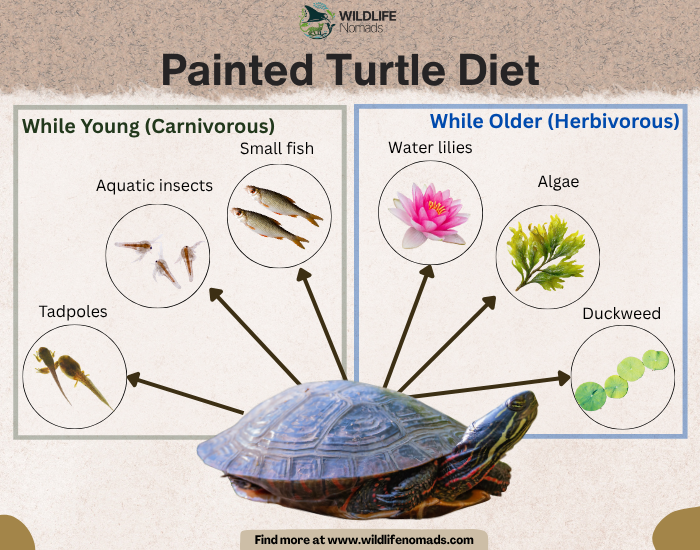
What’s on the menu changes as the turtle ages. Young painted turtles are mostly carnivorous, chasing aquatic insects, small fish, and crustaceans to fuel rapid growth. Adult painted turtles drift toward a herbivorous diet, grazing on aquatic plants and algae.
That said, no adult turtle turns down protein. Grown painted turtles still snap up small fish, snails, and carrion when the chance appears. These turtles forage along the muddy bottom, methodically working the shallows for anything edible.
6. Spring Courtship and Summer Nests
Painted turtles mate in spring and again in fall, in the open water of their home pond. After mating, female painted turtles haul out to find suitable nesting sites, often using sandy or soft soil far from the shore.
Females lay eggs between late May and mid-July, digging flask-shaped nests with their hind legs. Clutch sizes typically range from 5 to 11 eggs, though larger females in warmer regions sometimes lay more eggs. Incubation of those eggs lasts roughly 72 to 80 days in the wild before the young turtles hatch.
There is a twist worth knowing. Like many cold blooded reptiles, painted turtles have temperature-dependent sex determination. Warm nests produce females and cool nests produce males, which means a single hot summer can skew an entire generation of turtles.
7. Hatchlings That Survive Being Frozen
This is the fact I save for skeptical friends over coffee. In the north, tiny painted turtle hatchlings often do not emerge in autumn. Instead these turtles overwinter in the nest, just inches below the surface, through brutal subfreezing temperatures.
How the turtle survives borders on science fiction. Painted turtle hatchlings supercool, holding their body fluids liquid below the normal freezing point. If ice crystals do form, painted turtles tolerate a limited amount of freezing in their tissues, an ability that ranks among the best documented in any vertebrate.
That trick has limits. Research shows that ice nuclei in the surrounding soil can trigger lethal freezing, so the nest location is a matter of life and death for the hatchling. Snapping turtle hatchlings, Chelydra serpentina, share the same nesting grounds but handle the cold differently, which makes the painted turtle’s strategy even more striking by comparison.
8. How Long Painted Turtles Live
People always underestimate this one. Painted turtle life expectancy in the wild commonly reaches 20 to 30 years, and many painted turtles push well beyond. Western painted turtle lifespan can stretch past 40 years in healthy populations.
Growth rates are fastest in the early years, then slow once the turtle reaches sexual maturity. Males mature earlier and smaller, usually within a few years. Females take longer, because a female must grow large enough to carry a full clutch of eggs.
A long life is also a fragile one. A turtle that needs a decade to start breeding cannot bounce back quickly from losses. That math, slow maturity plus high adult survival, is exactly why road mortality among nesting females hits these populations so hard.
9. The Real Threats: Roads, Raccoons, and Released Pets
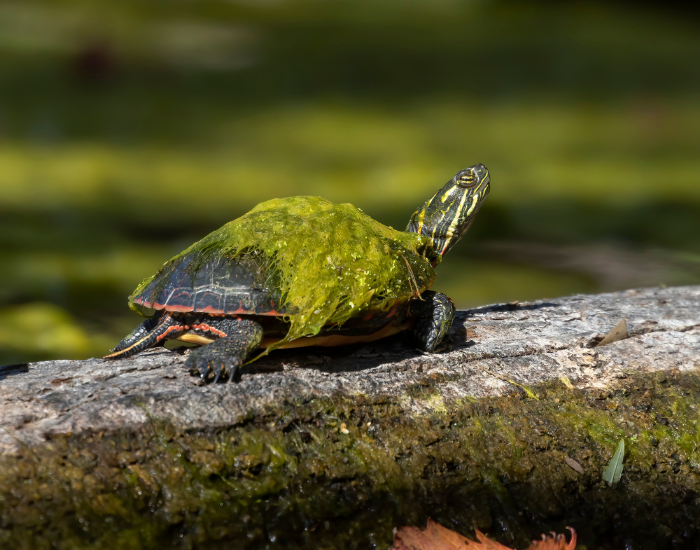
Painted turtles look secure, yet the threats are real and specific. Roadkill is a major mortality source, especially for female turtles crossing pavement to nest each summer. Habitat loss from drained wetlands chips away at suitable nesting sites year after year, squeezing local populations.
Nests face a gauntlet of potential predators. Raccoons, foxes, skunks, and snakes dig up the eggs, and in some areas raccoons and other predators destroy 90% or more of turtle nests in a single season. The few hatchlings that emerge still run a predator gauntlet on their crawl to the pond.
Then there is competition from non-native red-eared sliders, dumped from the pet trade into ponds worldwide. These sliders crowd painted turtles off basking logs and out-compete them for food. The very turtles I saw in that Mexican restaurant pond show how a beloved native becomes someone else’s invasive species.
10. Conservation Status: Common, but Not Everywhere
Globally, the painted turtle is classified as Least Concern by the IUCN, reflecting its huge range and large overall numbers. That headline, however, hides real regional decline in some painted turtle populations.
In Oregon, the painted turtle is designated S2, meaning imperiled within the state. In British Columbia, certain western painted turtle populations are listed as threatened. Local conservation efforts there focus on protecting nesting sites and building wildlife crossings under busy roads.
This split tells the whole story. An abundant turtle across the continent can still vanish from a single watershed. Smart conservation means watching the local picture, not just the comfortable global label. Protecting healthy turtle populations comes down to safe nesting habitat and roads that turtles can survive, and the painted turtle is the perfect reminder of that nuance.
Frequently Asked Questions
A painted turtle hatchling needs clean, dechlorinated water shallow enough to stand in, plus a dry basking platform under a UVB light. Keep the water around 75°F and the basking spot near 90°F, since these turtles depend on basking to stay healthy. Feed a protein-rich diet of commercial pellets, small fish, and aquatic insects, because young painted turtles are mostly carnivorous. Always check your local laws first, as keeping native turtles is restricted in many areas.
Legally, it depends on where you live, and many regions ban taking turtles from the wild. Ethically, a wild hatchling almost always does better left in its native habitat. If you want a pet, buy a captive-bred animal from a licensed source and commit for the long haul, because painted turtle life expectancy can exceed 30 years.
You cannot read a turtle’s exact age, but the shell offers clues. Young painted turtles show growth rings, called annuli, on each scute of the shell, and counting them gives a rough estimate in the early years. Those rings blur and wear smooth as the turtle matures, so the method fails on older adults. With females especially, size and shell wear become better guides over time than ring counts.
Why the Painted Turtle Deserves a Second Look
Strip away the assumptions and the northern painted turtle becomes one of the most quietly remarkable reptiles on the continent: a sunbather that freezes solid, a native treasure that turns invasive abroad, and a survivor whose biggest enemy is a summer road. Few animals pack that much contradiction into a seven-inch shell.
So the next time you pass a still pond on a warm afternoon, slow down and look at the logs. Count the baskers, watch a male painted turtle flash his long front claws, and you’ll never see these turtles as background scenery again. If this sparked your curiosity, meet their close cousins the terrapins, compare them with land-dwelling tortoises, or dive into the world of sea turtles. Then drop a comment and tell me where you’ve spotted your own painted turtles.
References:
Costanzo, J. P., & Lee, R. E. (2000). Ice nuclei in soil compromise cold hardiness of hatchling painted turtles (Chrysemys picta). Ecology, 81(1), 346–360. https://doi.org/10.1890/0012-9658(2000)081[0346:INISCC]2.0.CO;2
Packard, G. C., & Packard, M. J. (2003). Natural freeze-tolerance in hatchling painted turtles? Comparative Biochemistry and Physiology Part A: Molecular & Integrative Physiology, 134(2), 233–246. https://doi.org/10.1016/S1095-6433(02)00264-7
Starkey, D. E., Shaffer, H. B., Burke, R. L., Forstner, M. R. J., Iverson, J. B., Janzen, F. J., Rhodin, A. G. J., & Ultsch, G. R. (2003). Molecular systematics, phylogeography, and the effects of Pleistocene glaciation in the painted turtle (Chrysemys picta) complex. Evolution, 57(1), 119–128. https://doi.org/10.1111/j.0014-3820.2003.tb00220.x
Schwanz, L. E., & Janzen, F. J. (2008). Climate change and temperature-dependent sex determination: Can individual plasticity in nesting phenology prevent extreme sex ratios? Physiological and Biochemical Zoology, 81(6), 826–834. https://doi.org/10.1086/590220
Murphy, M. O., Price, S. J., Hime, P. M., Drayer, A. N., & Weisrock, D. W. (2022). Reduced predation on roadside nests can compensate for road mortality in road-adjacent turtle populations. Ecosphere, 13(2), e3946. https://doi.org/10.1002/ecs2.3946