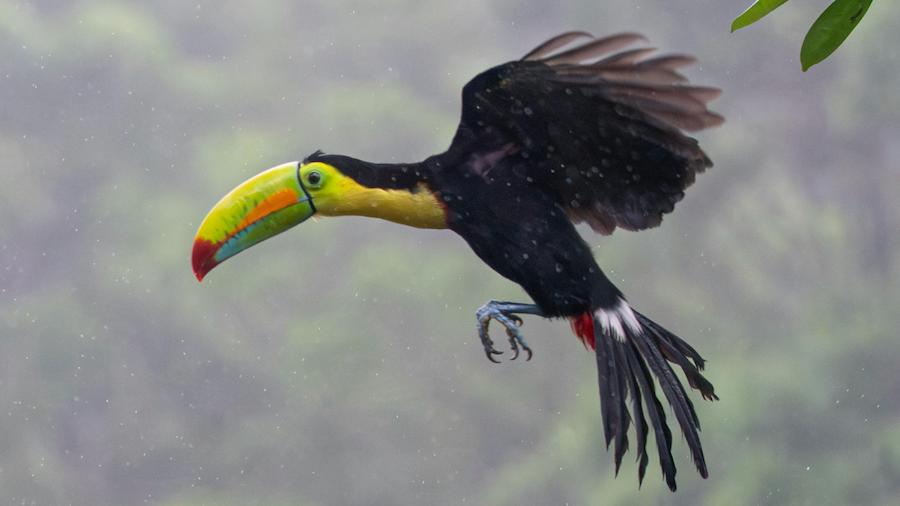
A few years ago, I was walking past a themed park near the Mexican Caribbean when a flash of orange cut across the canopy. A toucan landed on a branch above me, and time slowed down. Its bill looked impossibly large, its colors almost cartoonish against the green. I had spent years writing about jungle birds — macaws, quetzals, hornbills across Asia, but seeing this toucan in the wild for the first time captivated me in a way I didn’t expect.
Toucans are one of those species that everyone recognizes, but almost no one really understands. Behind that comical bill sits a sophisticated piece of biology, and behind the cereal-box image sits a complicated story about rainforest canopies, tree cavities, and the slow shrinking of tropical forests across the Neotropics. After that brief sighting, I went back to the science, and the answers I found were stranger and more fascinating than I expected. Here are ten things about toucans that surprised me, and that will probably surprise you too.
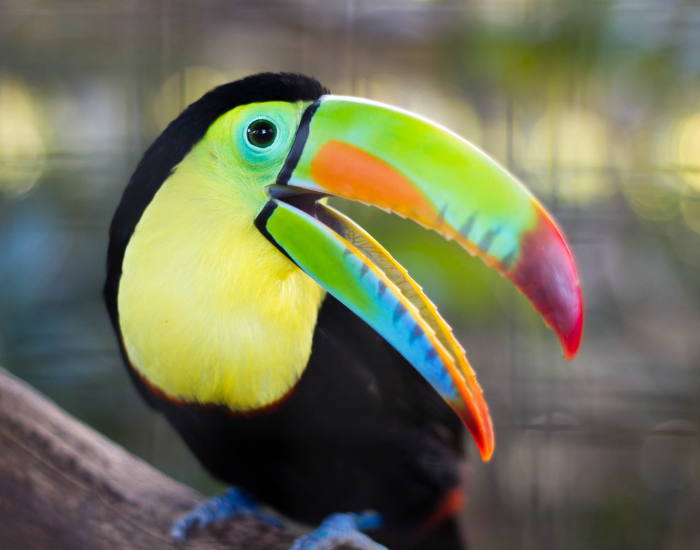
1. That Enormous Bill Is a Radiator, Not a Weapon
Walk into any tropical souvenir shop and you’ll see a stuffed toy with one of those colorful bills, oversized, unmistakable, and a little ridiculous. The toucan’s bill looks comical because it is enormous, sometimes a third of the bird’s total body length. For decades, scientists argued over its purpose. Defense? Mating? Fruit handling?
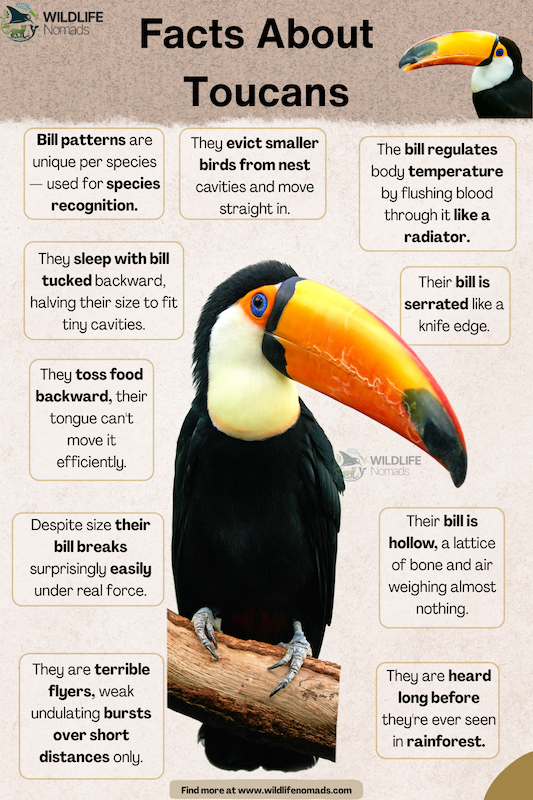
In 2009, a study settled it. The toucan’s bill is, above all, a thermoregulation organ. The beak is lightweight, riddled with hollow chambers, and laced with blood vessels close to the surface. When the toucan overheats in the humid rainforest canopies of South America, it pumps warm blood into the bill and dumps the heat into the air. When the toucan turns cooler, blood flow drops. The bill works like a giant radiator, much like an elephant’s ears.
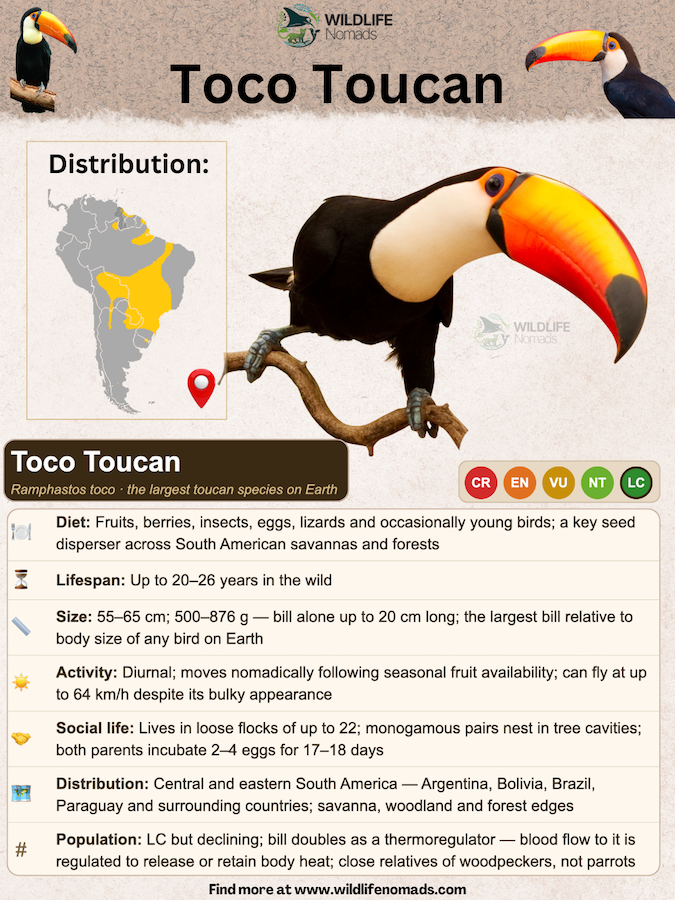
This explains why the biggest member of the toucan family — the toco toucan, or Ramphastos toco — lives in the hotter, drier habitats of South America and carries the most enormous bill among all toucans. Toco toucan beaks are simply the most extreme version of a thermoregulation system that all toucans rely on.
2. Toucans Are Not Closely Related to Hornbills
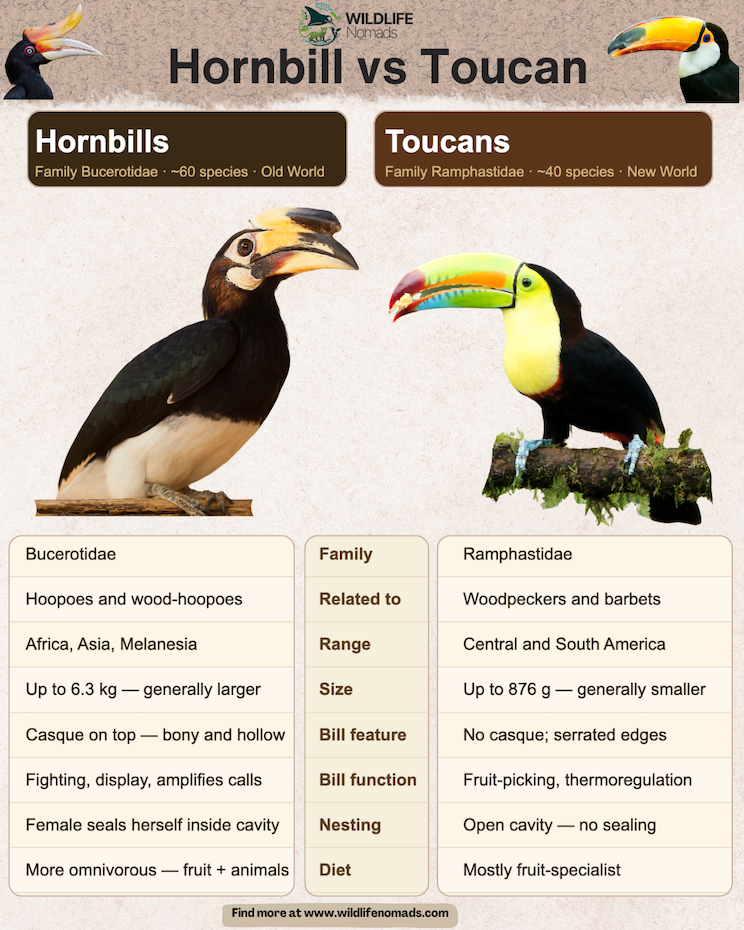
I’ve spent three months in Malaysia and the Philippines looking for hornbills through dense rainforests. Their oversized bills made me assume, lazily, that toucans and hornbills must be cousins. They are not. They’re a textbook example of convergent evolution.
Hornbills belong to the order Bucerotiformes and live across Africa and Asia. Toucans belong to Piciformes — the same order as woodpeckers. Their closest relatives are barbets. Two unrelated lineages, on opposite sides of the planet, independently evolved giant colorful bills to handle similar tropical niches. Evolution solved the same problem twice, with different toolkits.
If you’ve ever read my hornbill facts article, you’ll know how easy it is to mistake one for the other. Even seasoned birders get it wrong.
3. There Are Far More Toucan Species Than People Realize
When most people picture a toucan, they picture one specific bird: the toco toucan, with its bright orange bill and crisp black-and-white plumage. In reality, the toucan family (Ramphastidae) contains roughly forty species, depending on which taxonomist you ask.
Among the most striking are the mountain toucans of the Andes, smaller and stockier than their lowland cousins. Mountain toucans live at higher elevations than any of the other toucans and survive cold mornings that would shock a toco toucan. The white throated toucan, the keel-billed toucan, and the channel-billed toucan all occupy different forests across the Neotropics. Each carries thex family’s signature large bill, though sizes differ wildly. Several species are essentially unknown outside ornithological circles.
Compare that with my work on parrots and macaws, where everyone has heard of the hyacinth macaw but few can name a second species. Toucans face the same recognition gap. The toco toucan dominates the postcards, while the rest of the toucan species quietly do most of the ecological work.

4. Toucans Sleep Folded Up Inside Tree Cavities
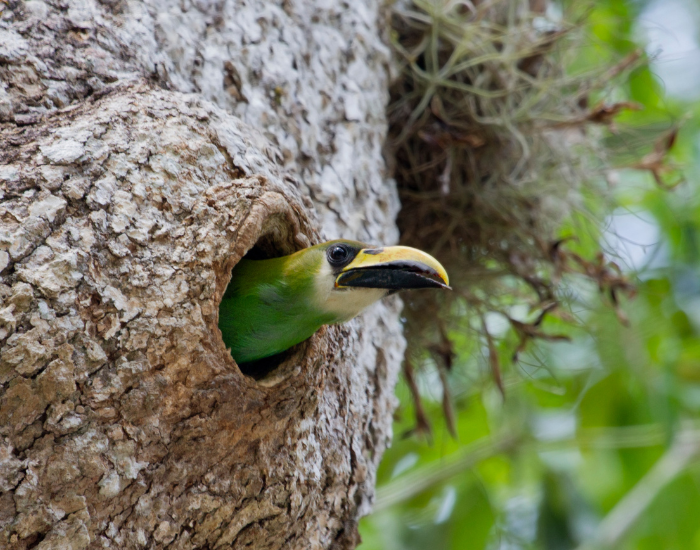
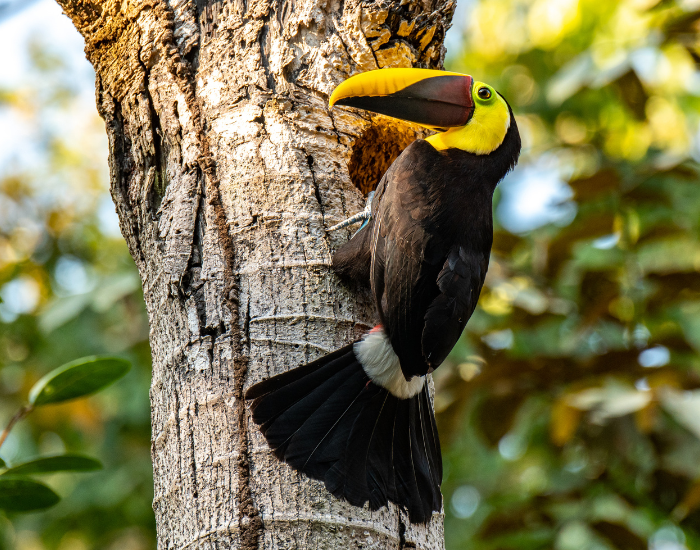
Most toucans nest in tree cavities, often a hollowed out tree cavity left behind by a woodpecker or a branch that rotted out on its own. Toucans cannot excavate their own holes, which makes nesting cavities a limiting resource, and a quiet conservation issue across Central America.
What surprised me, though, is how toucans sleep. To fit inside a small cavity, the toucan folds its tail forward over its back, lays its enormous bill across its shoulder, and curls into a tight ball. Multiple toucans sometimes share a single cavity, packed together like puzzle pieces, gregarious birds even when sleeping. Where toucans nest, you’ll often find the same family group returning year after year.
I’ve watched parrots, macaws, and other birds compete furiously for tree cavities along the Riviera Maya. Add toucans into that competition and the canopy is genuinely crowded, there are only so many holes in any given stretch of the canopy.
To see the toco toucan at true scale, up in the canopy, try my climb through the layers of the rainforest.
5. They Are Not the Pure Fruit-Eaters People Think
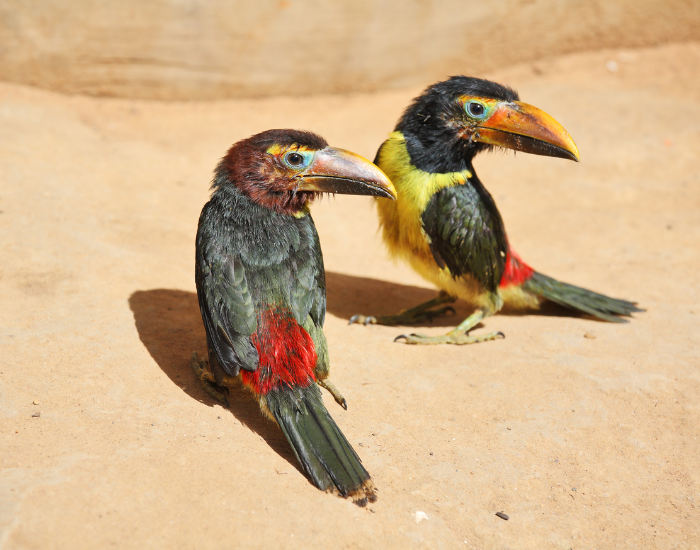
Toucans are often described as primarily frugivores, and on most days the label fits. Fruiting trees draw small flocks of toucans at dawn, and those early morning visits to fruit sites are one of the easiest ways to spot them. The toucan’s bill works almost like tweezers at the tip, peeling fruit and tossing it down the throat. Watching a toco toucan peeling fruit in the canopy is a small masterclass in dexterity.
But many toucans also catch insects, raid bird eggs, and occasionally take small reptiles and even small birds from nearby nests. Other birds in the canopy know this, smaller species will mob a toucan the way they mob a predator. So are toucans carnivores? Not strictly, but they aren’t strict vegetarians either. Insects and the occasional egg supplement a diet built on fruit. Across the Neotropics, toucans behave more like opportunistic omnivores than strict fruit-eaters.
Many toucans help disperse seeds across vast stretches of rainforest. As a result, when toucans disappear from a forest, the trees they once spread struggle to colonize new fruit sites elsewhere.

6. Their Voices Carry Across the Forest
If you’ve spent time in tropical rainforests, you’ve probably heard toucans before you’ve seen them. Toucans are known for their loud voices, which carry surprisingly far through dense vegetation. Different toucan species have different signatures. The toco toucan produces a series of grunting, croaking notes. Other toucans make clattering sounds with their bills, a percussive snap that travels through the trees.
Some species emit deep growling sounds that, honestly, are easy to mistake for a frog. Toucans live noisy lives, and that vocal repertoire has real work to do. They use calls to coordinate small flocks, warn of forest eagles, and defend feeding territories. Researchers have also documented sounds used to attract potential mates.
You can, with patience, mimic toucan calls and draw a curious bird in close. I tried this once and felt very silly until a toco toucan actually appeared, heavy-billed, side-eyed, and clearly unimpressed.
7. Breeding Season Is a Patient, Cooperative Affair
The breeding season for most toucans tracks the wet months, when fruit is abundant and the canopy is humming with life. These birds breed slowly, even by tropical standards. A pair finds a hollowed out tree cavity, often reusing it year after year. Female toucans, slightly smaller than males in many species, lay two to four eggs on the bare floor of the hollow. There is no real lining — just bark dust and old fruit pits.
Male and female toucans share the work. Both male and female take turns to incubate the eggs together. Eggs and nestlings remain in the cavity for weeks under careful watch, with the parents trading shifts over the eggs and nestlings around the clock. Once the chicks hatch, they emerge naked, blind, and pink — no different from baby parrots. Feathers begin to appear slowly. Young toucans stay in the nest for six to eight weeks, which is unusually long for a bird this size. That six to eight weeks of patient parenting matters, and young birds still depend on their parents for weeks after fledging.
The courtship ritual is charming and practical at once: the pair tosses fruit back and forth, a literal sharing of food, before mating. It’s one of those behaviors that makes you understand, on a gut level, why people fall in love with these animals.
8. The Bill Is Also a Bluff Against Predators
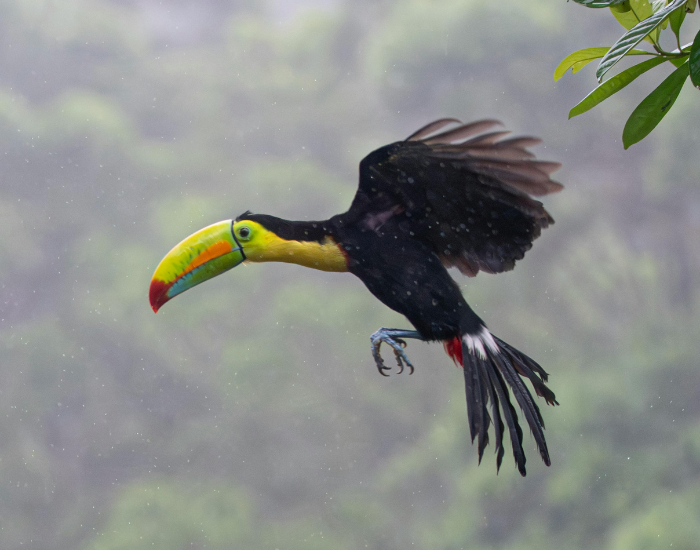
Toucans use that comical bill for more than cooling. They use it to deter predators, and a great deal of the time, bluff is enough. Forest eagles, hawks, and arboreal snakes hunt the canopy hard, but a brightly colored bill snapped open with a clattering sound can startle an attacker long enough for the toucan to escape.
The toucan’s beak is mostly hollow, a weapon in theory only. I’ve seen the same dynamic play out with hornbills in Borneo. A bird perched on tree trunks with a “weapon” it cannot really swing still scares off intruders. Display behavior costs less than fighting, and most toucans flee at the first real sign of danger. When pressed, a toucan turns to flight rather than combat. Their large bill, lightweight as it is, is mostly theater.

9. The Pet Trade and Habitat Loss Are the Biggest Threats
Toucans, like macaws and parrots, have suffered from the pet trade for decades. Their personalities make them popular birds in captivity, but they almost never thrive outside the forest. Many species of toucan are still traded illegally across borders, and even when they survive transport, captive toucans spend most of their lives confined in cages built for far smaller birds.
Habitat loss is the deeper problem. Coca growers, cattle ranching, soy expansion, and selective logging have cleared huge swaths of Central and South America. Toucans depend on mature trees for nesting cavities and on the fruiting trees that follow seasonal cycles. When those forests disappear, so do the toucans.
The IUCN currently lists several toucan species as threatened or near threatened. Conservation efforts are ongoing across Brazil, Colombia, Ecuador, and elsewhere, often centered on protecting forest corridors that link fragmented patches. You can read more about regional conservation pressures in my piece on the birds of Mexico.
10. Cultural Status Doesn’t Equal Conservation Status
Toucans appear on cereal boxes, postcards, beer logos, and tourist shirts — their colorful bills have become marketing icons. They are so iconic that many people assume these birds are common — the same trap that protects the quetzal in popular imagination while wild populations slip quietly. Visibility on a label is not the same as abundance in a forest.
Other tropical icons follow the same trajectory, and the same risk applies to many of the most photogenic toucans. Captive breeding programs at institutions like the San Diego Zoo have helped vulnerable species hold on, and good rehabilitation centers across the Neotropics rescue young birds confiscated from the pet trade. But these programs cannot replace functioning forests.
If you ever travel to the Neotropics, look for wild toucans in protected reserves. Their presence is one of the clearest signs that the forest itself is intact.
Frequently Asked Questions About Toucans
There is no single global figure across every toucan family member. Population estimates vary widely by species. The toco toucan likely numbers in the hundreds of thousands. Several rarer toucan species number only in the low thousands and continue to decline, mostly because of habitat loss and the pet trade. Conservationists worry that toucans, like macaws before them, will quietly slip into trouble while everyone is looking elsewhere.
Toucans are native to the Neotropics — the warm forests of Central and South America. The toco toucan, Ramphastos toco and the largest species in the family, ranges across Brazil, Bolivia, Paraguay, and northern Argentina. Other toucans live throughout Mexico, Costa Rica, Panama, Colombia, Peru, and the entire Amazon basin.
A toco toucan can reach about 25 inches from bill tip to tail, with the bill alone making up roughly seven to eight of those inches. Smaller toucans, like aracaris and toucanets, measure closer to twelve inches. In the wild, toucans live around fifteen to twenty years; under good care in captivity, these birds can live a bit longer.
Many toucans appear to form long-term pair bonds, returning to the same nest holes and feeding territories together year after year. They are social birds and often move through the forest in loose flocks of three to six during the non-breeding months. Whether every individual stays with the same partner for life is harder to verify in the field, but the pattern looks closer to monogamy than to casual mating.
Beyond the Cartoon Image
Toucans are a study in evolutionary surprise. Behind that comical bill sits a sophisticated cooling system, a deterrent against predators, and a tool finely shaped by life in the rainforest canopies. Behind the cartoon image sits a social species of birds that nest carefully, raise chicks slowly, and depend on forest patches that are vanishing faster than people realize. Toucans are known across the Americas, but few people grasp how much shaping these birds actually do.
The next time you see a toucan — on a label, in a zoo, or, if you’re lucky, in the wild — pay attention. You’re looking at one of the most studied yet still mysterious birds in the Americas. If you want to keep exploring the canopy, dig into my pieces on macaws, the resplendent quetzal, or the deeper world of hornbills, there’s a lifetime of stories in the rain forests waiting for a curious eye.
Have you ever spotted a wild toucan? Drop a comment below and tell me where — I read every one.
Where to See Toucans in the Wild?
Here is a list of 3 tours where you can have see them in the wild in Central and South America. As a biologist, I only recommend tours that follow strict ethical guidelines to ensure we don’t disturb wildlife. These are the three tours/ partners I trust most based on their conservation records:
This website is reader-supported. When you buy experiences through links listed on this site, we may earn an affiliate commission.
References:
Galetti, M., Donatti, C. I., Pires, A. S., Guimarães, P. R., & Jordano, P. (2006). Seed survival and dispersal of an endemic Atlantic forest palm: the combined effects of defaunation and forest fragmentation. Botanical Journal of the Linnean Society, 151(1), 141–149. https://doi.org/10.1111/j.1095-8339.2006.00529.x
Holbrook, K. M. (2011). Home range and movement patterns of toco toucans: implications for seed dispersal. Biotropica, 43(3), 357–364. https://doi.org/10.1111/j.1744-7429.2010.00710.x
Patané, J. S., Weckstein, J. D., Aleixo, A., & Bates, J. M. (2009). Evolutionary history of Ramphastos toucans: molecular phylogenetics, temporal diversification, and biogeography. Molecular Phylogenetics and Evolution, 53(3), 923–934. https://doi.org/10.1016/j.ympev.2009.08.017
Tattersall, G. J., Andrade, D. V., & Abe, A. S. (2009). Heat exchange from the toucan bill reveals a controllable vascular thermal radiator. Science (New York, N.Y.), 325(5939), 468–470. https://doi.org/10.1126/science.1175553
Ragusa-Netto, J. (2006). Dry fruits and the abundance of the Toco Toucan (Ramphastos toco) at a cerrado remnant in western Brazil. Ornitología Neotropical, 17, 491–500. https://sora.unm.edu/node/133376
Weckstein, J. D. (2005). Molecular phylogenetics of the Ramphastos toucans: implications for the evolution of morphology, vocalizations, and coloration. The Auk, 122(4), 1191–1209. https://doi.org/10.1642/0004-8038(2005)122[1191:MPOTRT]2.0.CO;2
Wright, T. F., Toft, C. A., Enkerlin-Hoeflich, E., Gonzalez-Elizondo, J., Albornoz, M., Rodríguez-Ferraro, A., & Wiley, J. W. (2001). Nest poaching in Neotropical parrots and related canopy birds. Conservation Biology, 15(3), 710–720. https://doi.org/10.1046/j.1523-1739.2001.015003710.x
Winkler, D. W., S. M. Billerman, and I. J. Lovette. (2020). Toucans (Ramphastidae), version 1.0. In Birds of the World (S. M. Billerman, B. K. Keeney, P. G. Rodewald, and T. S. Schulenberg, Editors). Cornell Lab of Ornithology, Ithaca, NY, USA. https://doi.org/10.2173/bow.rampha1.01