During my undergraduate years, I had a professor who was obsessed with dragonflies. He was an evolutionary biologist, and practically every lecture, whether on sexual selection or carboniferous fossils, circled back to the order Odonata.
At the time, I didn’t get it. I was busy dreaming of lions in the Savanna or exotic animals of the rainforest. To me, they were just pretty winged insects hovering over ponds. Eventually, though, his enthusiasm became infectious.
Today, as a field biologist who has worked visited multiple continents, I’ve realized he was absolutely right. Dragonflies are not just bugs. They are highly calibrated, ancient killing machines with biology that puts most other species to shame.
Here are ten facts about dragonflies that permanently changed how I look at the sky.
1. They Are Ancient Survivors (Older Than Dinosaurs)
When we talk about ancient insects, dragonflies are the gold standard. Dragonflies are considered an ancient group with a lineage tracing back to the first winged insects. The fossil record shows that the ancestors of modern dragonflies (Protodonata) were buzzing around roughly 300 million years ago. These early dragonflies were among the first winged insects, appearing during the Paleozoic era.
Back then, the high oxygen levels in the atmosphere allowed for large species like Meganeura, which had a wingspan of nearly two and a half feet. While Meganeura and other ancient relatives were impressive, true dragonflies (Anisoptera) are distinguished from these prehistoric giants by their evolved characteristics. While they’ve shrunk since then, the basic blueprint of dragonflies has remained largely unchanged for hundreds of millions of years. They found a design that worked and stuck with it.
2. Their Larvae Have Jet-Propelled Butts
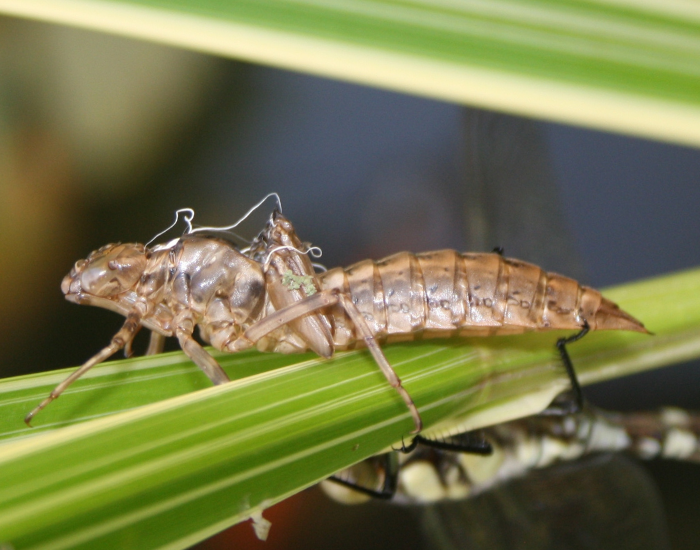
Before they become the shimmering winged insects we see in summer, they start as insect larvae known as dragonfly nymphs (or naiads). These nymphs spend most of their early life living underwater and are the terrors of the wetland habitats.
The coolest info about dragonflies at this stage? They breathe through gills located inside their rectum. By forcefully expelling water from their anus, they create a literal jet-propulsion system to shoot forward and capture prey. Dragonfly nymphs use a hinged, serrated lower jaw to grab and consume their prey with remarkable efficiency. I remember sitting by a stream in Australia, watching a nymph take out a small tadpole; the speed was terrifyingly efficient.
3. They Are the World’s Most Successful Hunters
We often think of lions or sharks as the ultimate predators, but their success rate is abysmal (around 20-30%). Even birds such as owls and hawks, known for their hunting skills, have lower success rates than dragonflies. Dragonflies, however, are the snipers of the insect world. Research suggests they catch their prey in mid-air with a staggering 95% success rate in controlled experimental settings.
They don’t just “chase” food; they use complex physiology to calculate interception trajectories. They see where a fly is going to be and meet it there. Basically they are essentially living missiles.

4. The Famous “Mating Wheel” and the Heart Shape
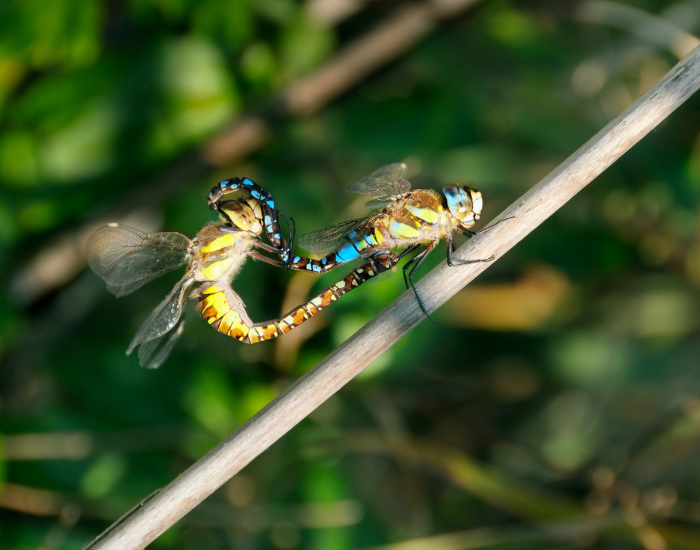
If you’ve ever seen two dragonflies linked together in the air, you’ve witnessed the mating wheel. The male grips the female by the back of her head using special appendages, and the female curls her abdomen forward to meet his secondary genitalia.
During this process, male dragonflies often defend their territories and guard females from other males, engaging in aerial fights and complex mating rituals to secure copulation. Mating dragonflies can form a perfect heart shape while in the wheel position, which humans find poetic, but in the world of dragonfly species, it’s a high-stakes battle of sexual selection. Males will often use their appendages to “scoop out” the sperm of a previous rival before depositing their own. It’s a ruthless reproductive strategy hidden behind a lovely silhouette.
5. They Can Fly Backward (and Upside Down)
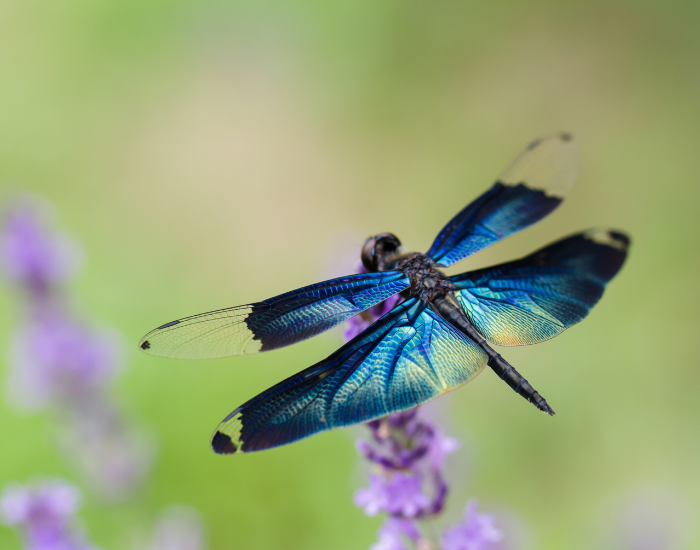
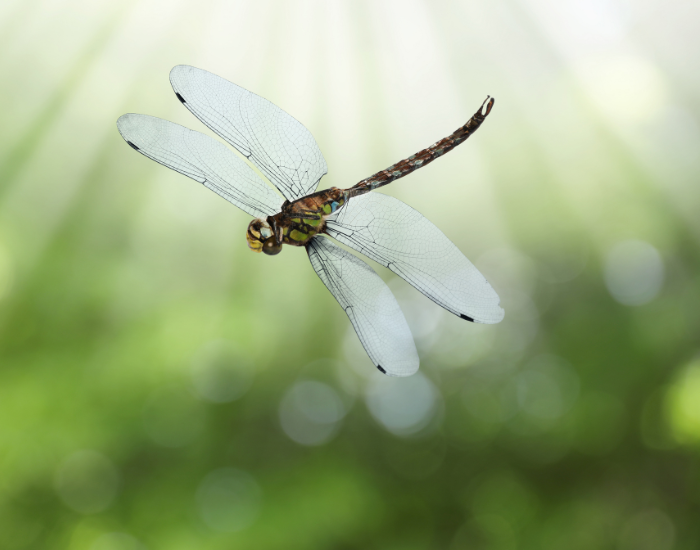
One of the most cool facts about dragonflies is their flight mechanics. Unlike other insects that move all four wings in simple synchrony, dragonflies can move each of their wings independently. The microstructure of dragonfly wings features nano-pillars, tiny spikes on the wing surface, that provide antibacterial properties by trapping bacteria and damaging their cell walls.
This allows for dragonfly flight maneuvers that defy physics: hovering, flying backward, and even flying upside down. Dragonflies can also fly straight up and down, move forward and backward, hover like a helicopter, and even mate in midair. I’ve spent hours trying to photograph them in dry meadows, only to have them zip backward the moment I clicked the shutter. Their compound eyes and wing control make them nearly impossible to surprise.
6. The Globe Skimmer: An 11,000-Mile Commute
Most people think of dragonflies as local pond-dwellers, but there is a dragonfly called the Globe Skimmer (Pantala flavescens) that laughs at borders. There are species called dragonflies with extraordinary migration patterns, and the globe skimmer is a prime example. This one species holds the record for the longest insect migration, traveling across the Indian Ocean from India to Africa and back. Some dragonfly species, like the globe skimmer, can migrate up to 11,000 miles across oceans.
It’s a multi-generational trek covering over 11,000 miles. They follow the rains to find fresh wetland habitats to lay eggs. To think that a creature weighing less than a gram can cross an ocean is, frankly, mind-blowing.
7. They See the World in Ultra-HD
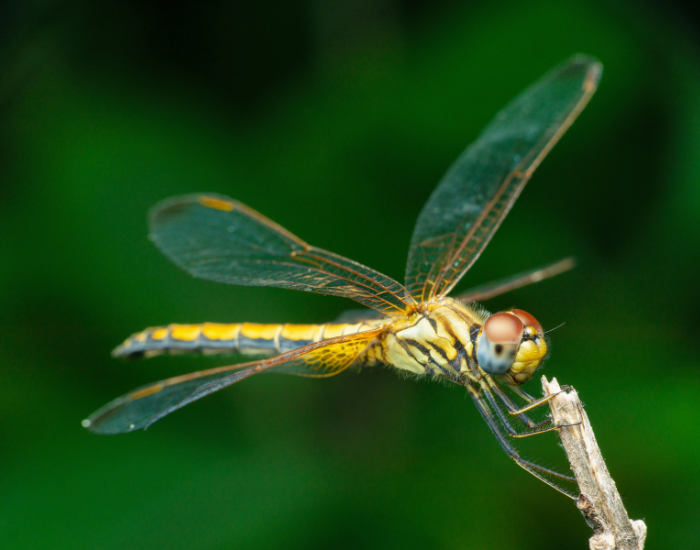
Humans have tri-chromatic vision (we see red, green, and blue). Most dragonflies have up to 30 different visual proteins (opsins), allowing them to see a spectrum of colors and ultraviolet light that we can’t even imagine.
Their compound eyes take up nearly their entire head, containing up to 30,000 individual facets (ommatidia). This gives them a 360-degree field of vision. They are essentially a pair of giant flying eyeballs.
8. “Baby Dragonflies” Live Underwater for Years
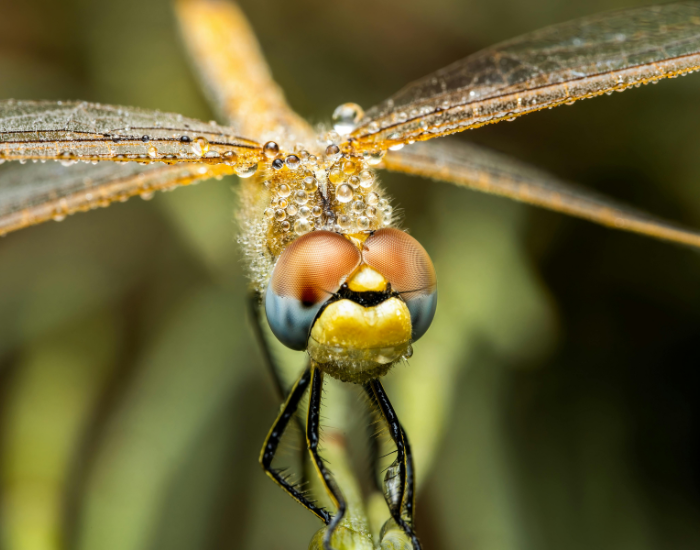
We love the adults, but dragonflies live the majority of their lives as dragonfly nymphs underwater. Depending on the species, they can stay in the larvae stage for up to five years.
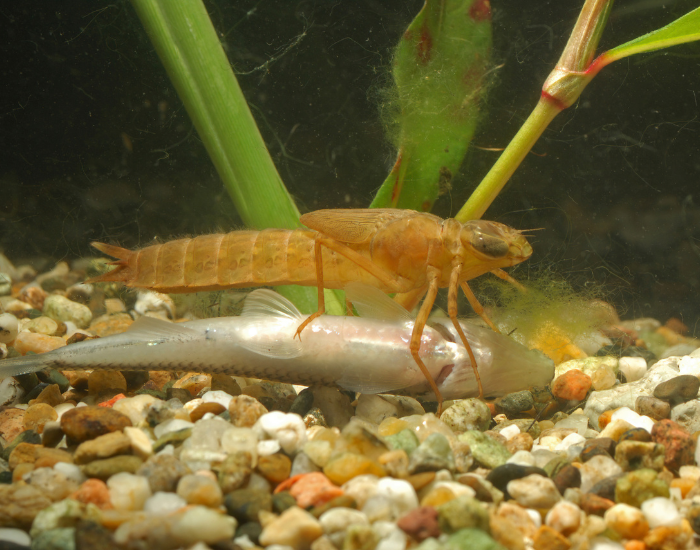
During this time, they are voracious predators, eating small fish, tadpoles, some amphibians like frogs, and other insect larvae. The “adult” phase—the beautiful part we see—often only lasts about a week to a few months. It’s a short, glorious finale to a long, murky life.
9. They Are Essential for Pest Control
If you hate mosquitoes, you should love dragonflies. An adult dragonfly can eat hundreds of mosquitoes in a single day. They are often called “mosquito hawks” for a reason. Dragonflies help control pest insects, especially those that threaten humans, such as mosquitoes and biting flies. In fact, dragonflies serve as a great control on the mosquito population and can eat between 30 to 100 mosquitoes per day, making them highly effective pest controllers.
By maintaining healthy dragonfly populations, we naturally regulate pest insects without needing harmful chemicals.

10. Do Dragonflies Have Teeth?
One of the most common facts about dragonflies people search for is: do dragonflies have teeth? Technically, no. They don’t have “teeth” like mammals do. However, they belong to the order Odonata, which comes from the Greek word for “toothed ones.” They have massive, serrated mandibles (jaws) that they use to crush their prey into a pulp.
Dragonflies are also notable for their impressive size, with a typical body length ranging from 2 to 5 inches and a wingspan that can reach up to 6 inches, making them one of the larger insects you might encounter. So, while they won’t bite humans unless you provoke them (and even then, it’s just a tiny pinch), they are definitely “toothed” in the insect sense.
There Are Over 6,000 Species
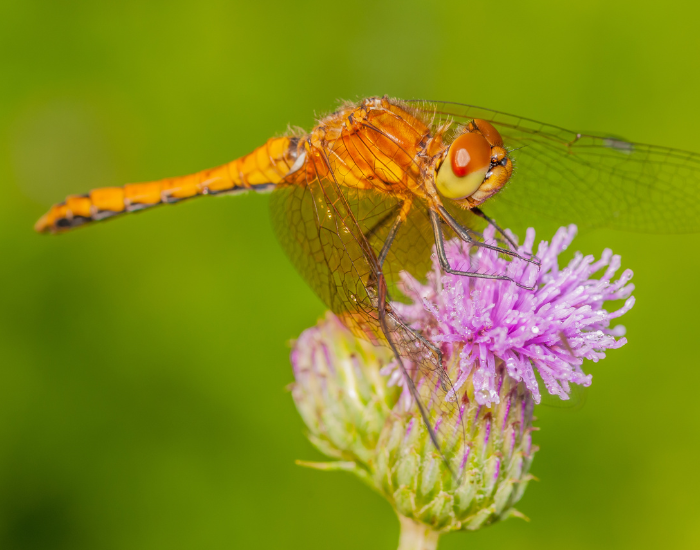
Dragonflies are one of the most diverse insect orders on Earth. Scientists have identified more than 6,000 known species across every continent except Antarctica, from tiny jewel-sized damselfly relatives to large, powerful hawkers with wingspans exceeding 16 cm.
That diversity goes far beyond size. The Scarlet Dwarf (Nannophya pygmaea) of Southeast Asia is one of the smallest dragonflies in the world, stretching barely 2 cm. Meanwhile, the Giant Petaltail (Petalura ingentissima) of Australia rivals the prehistoric giants of the Carboniferous in sheer presence. Colour varies just as wildly, electric blues, fiery reds, metallic greens, and chalky whites, often used for territorial signalling or mate attraction.
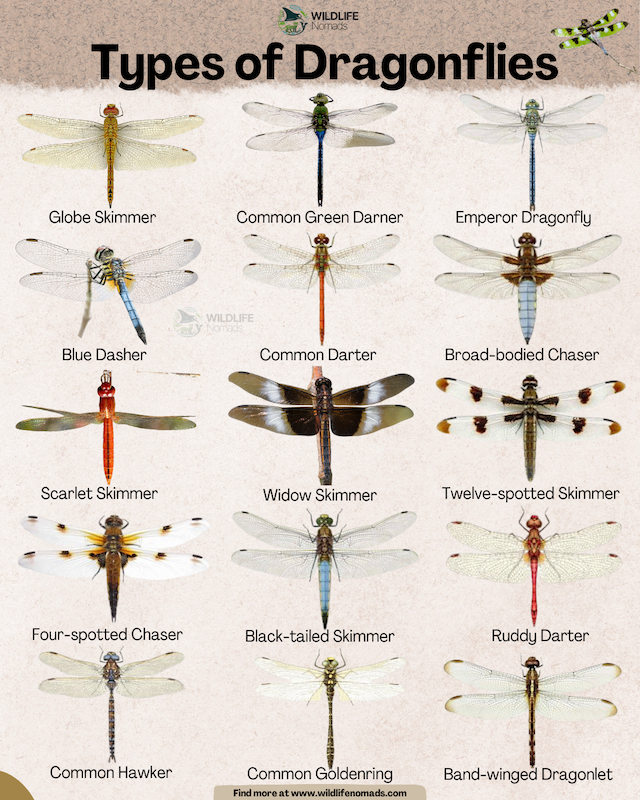
Dragonfly Species: A Quick Comparison
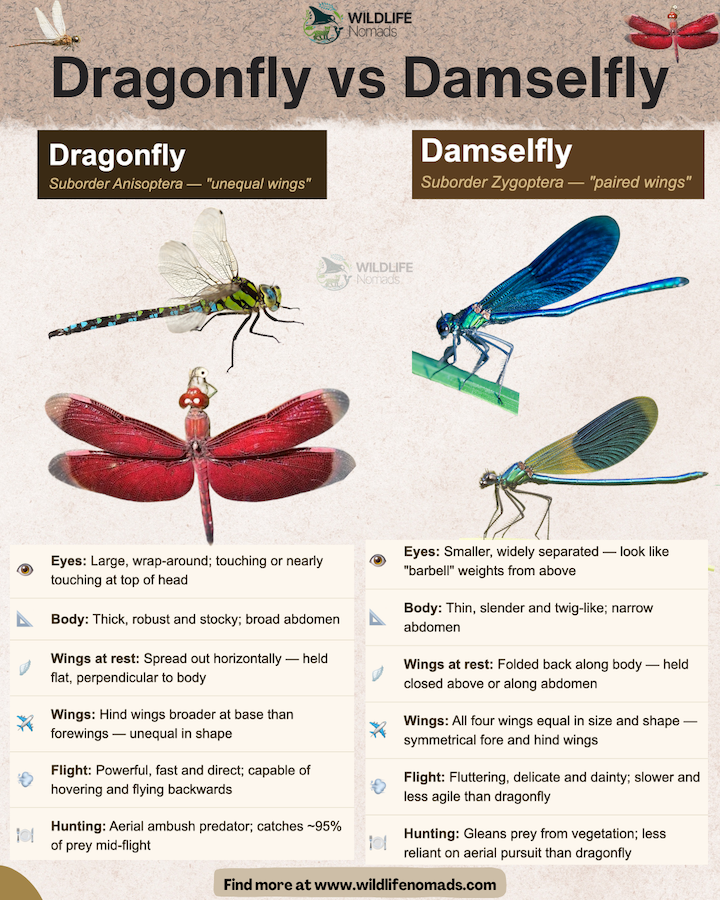
Dragonflies and damselflies are closely related insects, sharing many similarities in body plan, but they also have key differences in their appearance and behavior. The table below highlights these distinctions:
| Feature | Dragonfly | Damselfly |
|---|---|---|
| Eyes | Large, touching or very close | Separated, like “barbell” weights |
| Body | Thick, robust | Thin, twig-like |
| Wings at Rest | Spread out horizontally | Folded back over the body |
| Flight Style | Powerful, direct | Fluttering, dainty |
Habitat Degradation: Why They Need Our Help
Despite being around for a long time, dragonflies are facing a modern crisis. Habitat loss due to the draining of wetlands, pollution, and the clearing of forests in Central America has contributed to significant population declines.
There are more than 3,000 known species of dragonflies worldwide. In some regions, only a few species are found due to specialized habitats or environmental pressures.
As a biologist, I’ve seen once-thriving ponds go silent because of runoff. To find dragonflies in the future, we must protect our freshwater systems. The International Union for Conservation of Nature (IUCN) has flagged several species as endangered, particularly those with highly specialized wetland habitats.
FAQ: Everything Else You Wanted to Know
Their combination of 360-degree vision, independent wing control, and an ancient lineage makes them one of the most evolutionarily “perfect” creatures on Earth.
While the total life cycle can be several years (mostly underwater), the flying adult stage is usually just a few weeks.
Not to humans! They don’t sting, and while they have strong jaws for catching prey, they aren’t interested in biting you. They are actually a sign of a healthy ecosystem.
As adults, they eat insects like flies, mosquitoes, and butterflies. As larvae, they eat small fish, tadpoles, and other insect larvae.
Most species die off, leaving their eggs or larvae to overwinter underwater. Some, like the Globe Skimmer, migrate to warmer climates.

Go Find a Dragonfly (Seriously)
My old professor was right to be obsessed. Dragonflies are a bridge to our planet’s deepest past and a vital part of our ecological future. Next time you see a Globe Skimmer or a Migrant Hawker zipping over a pond, take a second to appreciate the hundreds of millions of years of engineering behind that flight.
If you enjoyed this deep dive, check out our posts on how the most common types of blue butterflies and Incredible Facts About the Velvet Ant.
References:
Anderson, R. C. (2009). Do dragonflies migrate across the western Indian Ocean? Journal of Tropical Ecology, 25(4), 347–358. https://doi.org/10.1017/S0266467409006087
Combes, S. A., Salcedo, M. K., Pandit, M. M., & Iwasaki, J. M. (2013). Capture success and efficiency of dragonflies pursuing different types of prey. Integrative and Comparative Biology, 53(5), 787–798. https://doi.org/10.1093/icb/ict072
Futahashi, R., Kawahara-Miki, R., Kinoshita, M., Yoshitake, K., Yajima, S., Arikawa, K., & Fukatsu, T. (2015). Extraordinary diversity of visual opsin genes in dragonflies. Proceedings of the National Academy of Sciences of the United States of America, 112(11), E1247–E1256. https://doi.org/10.1073/pnas.1424670112
Hedlund, J. S. U., Lv, H., Lehmann, P., Hu, G., Nilsson-Örtman, V., & Chapman, J. W. (2021). Unraveling the world’s longest non-stop migration: The Indian Ocean crossing of the globe skimmer dragonfly. Frontiers in Ecology and Evolution, 9, 698128. https://doi.org/10.3389/fevo.2021.698128
Hobson, K. A., Anderson, R. C., Soto, D. X., & Wassenaar, L. I. (2012). Isotopic evidence that dragonflies (Pantala flavescens) migrating through the Maldives come from the northern Indian subcontinent. PLOS ONE, 7(12), e52594. https://doi.org/10.1371/journal.pone.0052594
Kohli, M., Letsch, H., Greve, C., Béthoux, O., Deregnaucourt, I., Liu, S., Zhou, X., Donath, A., Mayer, C., Podsiadlowski, L., Gunkel, S., Machida, R., Niehuis, O., Rust, J., Wappler, T., Yu, X., Misof, B., & Ware, J. (2021). Evolutionary history and divergence times of Odonata (dragonflies and damselflies) revealed through transcriptomics. iScience, 24(12), Article 103324. https://doi.org/10.1016/j.isci.2021.103324
Misof, B., Liu, S., Meusemann, K., Peters, R. S., Donath, A., Mayer, C., … & Zhou, X. (2014). Phylogenomics resolves the timing and pattern of insect evolution. Science, 346(6210), 763–767. https://doi.org/10.1126/science.1257570