
The sky fractured without warning. A dark silhouette appeared from nowhere, wings tucked into a tight diamond, vanishing toward the valley floor. The sound followed moments later, a literal rip through the air. You are experiencing the majesty of peregrine falcons.
As a biologist, you learn that data on paper differs vastly from witnessing a 200 mph stoop in person. Nothing compares to watching these fastest animals showcase nature’s most impressive engineering.
Below are 12 incredible facts about these remarkable birds of prey.
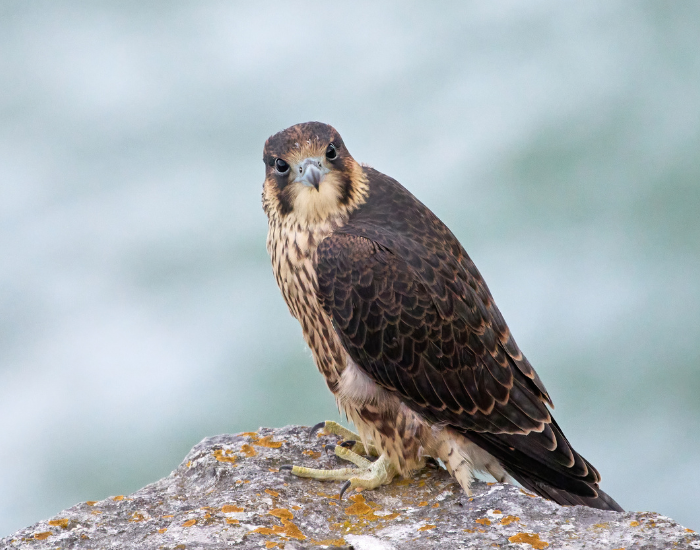
1. Peregrine Falcons Are the Fastest Animals on Earth
Peregrine falcons are the fastest bird in the world. Yes, they are, though context matters!
During level flight, adult peregrine falcons travel at average reaching speeds of 40-60 mph. In direct pursuit, they achieve 69 mph. However, when entering their hunting stoop, a high-speed diving attack, their velocity becomes unmatched.
The fastest recorded speed of a peregrine falcon is 242 mph (389 km/h). This record was documented during National Geographic’s project in 1999. Falconer Ken Franklin’s falcon “Frightful” was released from a Cessna at 17,000 feet and tracked using computer chips.
Most hunting dives exceed 200 mph. Therefore, when comparing peregrine vs cheetah speed, the falcon triples the cheetah’s 70 mph maximum. Peregrine falcons are definitively the world’s fastest animals.

2. They Have Jet Engine Nostrils for Fast Flying
At 200 mph, normal air pressure would catastrophically damage bird lungs. The force would prove fatal for ordinary birds.
Peregrines solved this through remarkable evolution. They possess small bony tubercles, cone-shaped structures inside their nostrils acting like jet engine baffles. These tubercles slow incoming air during high-speed dives, allowing peregrines to breathe normally while reaching speeds other birds cannot match.
This adaptation separates them from other birds of prey. Without it, their record-breaking stoops would be impossible.

3. The Falcon Punch Is Their Signature Hunting Method
Peregrine falcons don’t grab prey with talons like hawks. At speeds exceeding 200 mph, impact would break their legs.
Instead, they evolved a different technique. Peregrines ball their feet into fists and strike prey mid-air with devastating force. The sheer kinetic energy from this “falcon punch” typically kills targets instantly.
After striking, they circle back to catch falling birds before they hit the ground. This hunting technique showcases both incredible speed and precision. In my years observing these fastest animals, I’ve rarely seen this method fail.
4. Their Diet Consists Almost Entirely of Other Birds
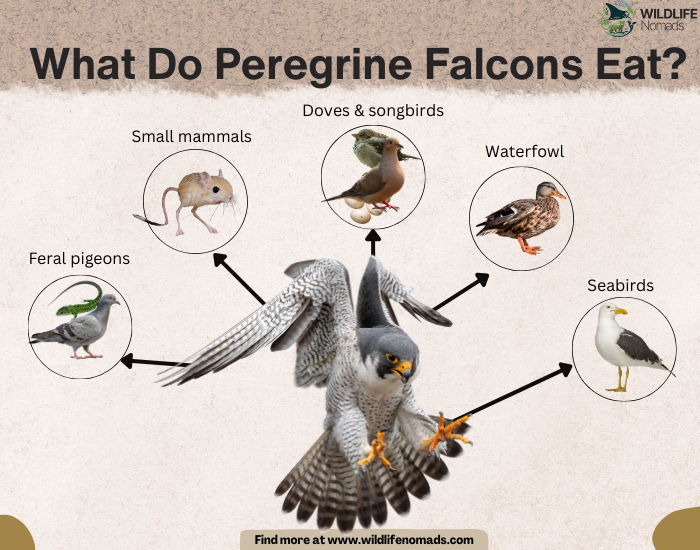
Peregrine falcons are specialist bird species hunters, meaning they primarily hunt other birds. The peregrine falcon’s diet consists mainly of medium sized birds captured mid-air during spectacular diving stoops.
In urban areas, feral pigeons and collared doves comprise most meals. Pigeons represent significant portions of their food supply based on seasonal availability. Peregrine falcons share these urban environments with pigeons, and their hunting relationship is especially evident in cities where they have adapted to prey on rock doves (pigeons) using their incredible speed and aerial hunting techniques. In coastal areas, waterfowl, seabirds, and waders become primary targets.
Researchers estimate peregrines prey on between 1,500 and 2,000 bird species globally—roughly one-fifth of all species worldwide. From smaller birds to game birds, if it flies, peregrines hunt it.
When bird prey becomes scarce, adult peregrine falcons occasionally take small mammals. However, they strongly prefer aerial intercepts over ground hunting.
5. You Can Identify Them by Their Moustache Markings
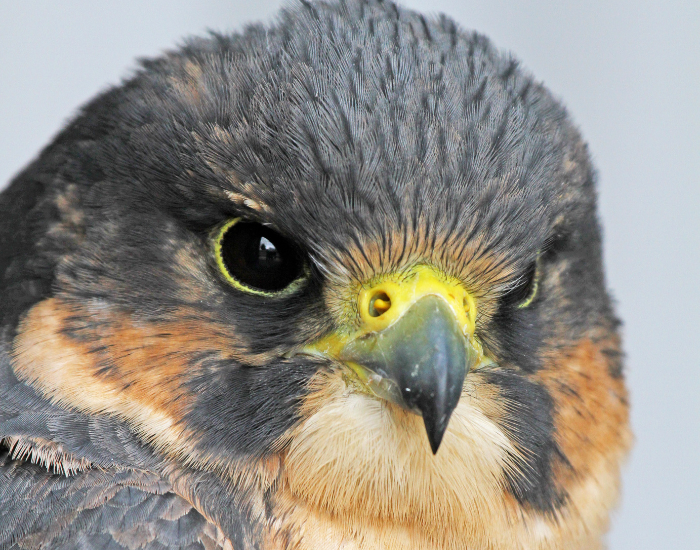
Identifying peregrine falcons requires observing several distinctive features. However, the easiest identifier is their facial markings.
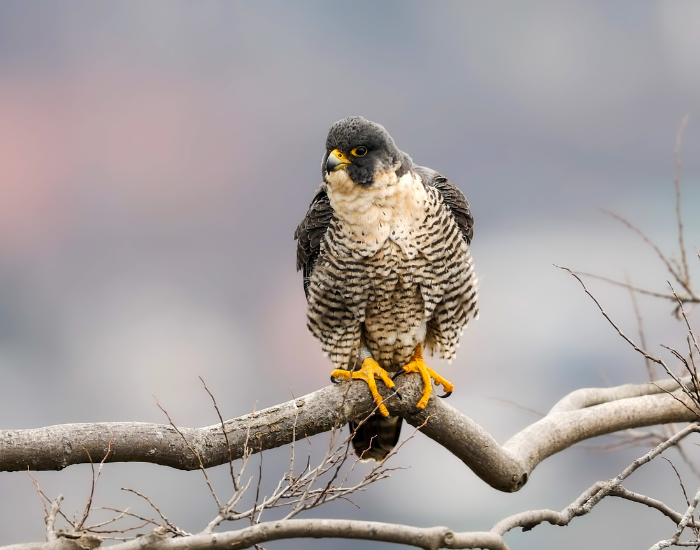
The malar stripe is their most recognizable feature. They display distinct dark “mustache” or sideburn stripes against white cheeks. This marking resembles natural sideburns and remains visible from considerable distances.
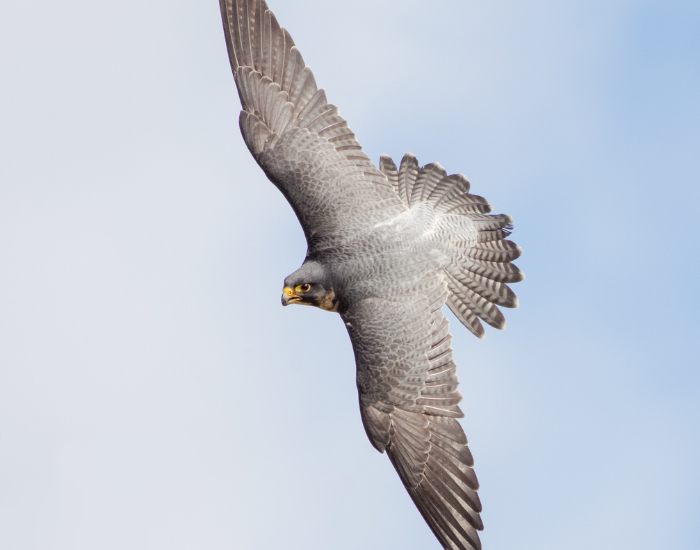
Adult peregrine falcons display blue grey to slate grey backs with dark brown or black barring on their upperparts and wingtips. Their underparts are white to rusty with thin, dark brown barring. The breast is a distinguishing white breast, with females often showing flecking and males having a plain white breast. They also have a prominent white throat and white cheeks. Their long pointed wings are built for high-speed aerodynamics—swept back and perfectly designed for diving.
How big are peregrines? They measure 36-50 cm in length, roughly crow-sized. The peregrine falcon has a body length of 34 to 58 cm and a wingspan from 74 to 120 cm. While lacking the massive wingspan of golden eagles, they’re more muscular and compact. This build optimizes entirely for speed.
6. Females Are Significantly Larger Than Males
Like most birds of prey, peregrines exhibit reverse sexual dimorphism. This means females significantly exceed males in size.
Females weigh up to 1,500 grams (3.3 pounds). Males typically weigh 500-700 grams. That’s a difference approaching 30 percent.
This size difference is common across raptor species. Larger females better handle producing and incubating eggs. Meanwhile, smaller, more agile males excel at hunting to feed mates and young during breeding season.
7. Peregrine Populations Nearly Vanished in the UK
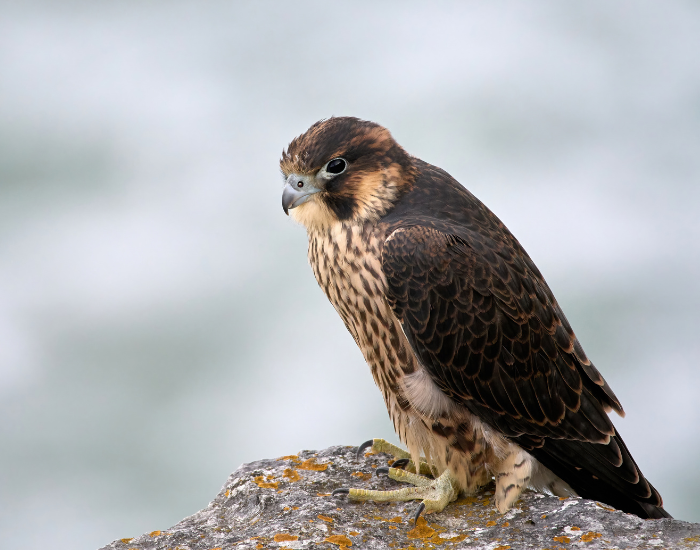
They nearly disappeared entirely. During the 1960s, peregrine numbers in Britain dropped to just 385 breeding pairs due to DDT pesticide poisoning. By the 1970s, England retained only 47 pairs. The species teetered on extinction’s edge.
DDT accumulated through the food chain. Peregrines, being apex predators, ingested concentrated amounts through prey. This caused eggshells to thin dramatically, breaking before young could develop.
In 1972, the U.S. Environmental Protection Agency banned the use of DDT, which made recovery of the species possible. The DDT ban proved the turning point. Combined with captive breeding programs, habitat protection, and reduced human persecution, peregrine falcon populations rebounded spectacularly.
In the UK, peregrine falcon populations have made a remarkable recovery since the crash of the 1960s, with an estimated 1,769 breeding pairs recorded in 2014. Today, their conservation status is classified as “Green,” meaning populations are stable and widespread. From sea cliffs in Wales to cathedral towers in London, peregrines have become one of the most thrilling birds to spot among the many birds of the UK.
As apex predators, they also represent a powerful example of how top species fit into the broader web of animals of the UK — from coastal seabirds to upland mammals — all interconnected within the same recovering ecosystems.
8. They’ve Successfully Colonized Urban Areas
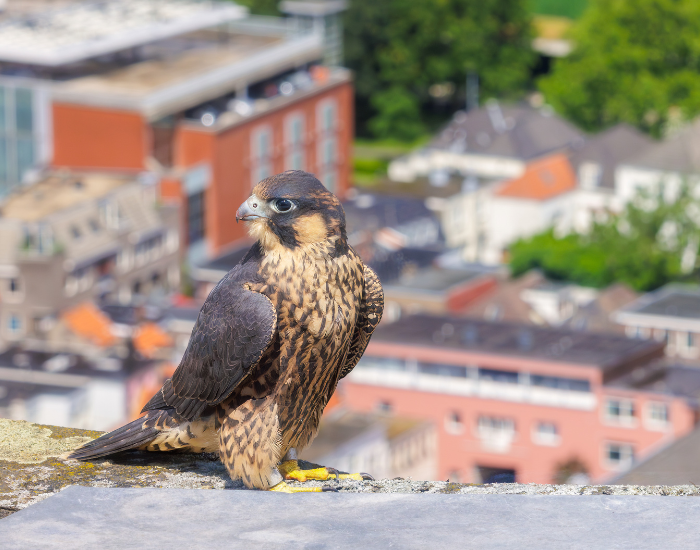
One fascinating shift I’ve observed is peregrines moving to cities. They view tall buildings as concrete cliffs, similar to their natural cliff ledge nesting sites.
Peregrine falcons traditionally nest on tall cliffs, often choosing a cliff ledge in coastal areas and mountainous regions. However, they’ve increasingly colonized urban areas over recent decades. Buildings, cathedrals, bridges, power stations, and communication towers now serve as substitute cliff ledges where peregrines breed.
London alone supports 30 breeding pairs, making it the world’s second-highest urban peregrine population after New York. This shift happened because cities provide abundant food supply, breeding feral pigeons everywhere.
The Wildlife and Countryside Act protects breeding pairs. In 2013, Vodafone engineers in Southampton couldn’t repair a faulty transmitter mast for months because peregrines nested there. Disturbing nests before young fledge risks prison sentences.
9. Their Breeding Season Requires Massive Commitment
Peregrine populations mate for life. During nesting season, running March through July in the UK, breeding pairs perform elaborate courtship displays.
These aerial acrobatics include mid-air food transfers. Males demonstrate hunting prowess by catching prey and passing it to females during flight. It’s nature’s most spectacular show.
Females lay eggs (typically 3-4) in simple scrapes on cliff ledges or building edges. Both parents incubate for approximately 33 days. Young birds hatch in late spring, remaining in nests 35-42 days before fledging.
Peregrines reach sexual maturity at one to three years. They return to identical nest sites annually, showing remarkable fidelity. Unfortunately, approximately 60 percent of juvenile birds die within their first year. However, those reaching adulthood show high survival rates, often living 12-15 years.
10. Conservation Success Shows What’s Achievable
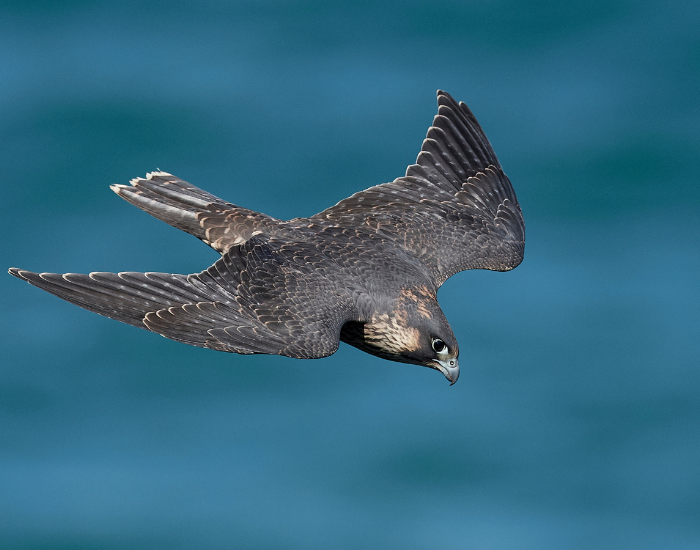
The peregrine falcon Falco peregrinus was saved from extinction thanks to the efforts of The Peregrine Fund and conservation organizations, marking one of conservation’s greatest triumphs. The Peregrine Fund pioneered many techniques for successfully breeding the birds in captivity and releasing them into the wild.
During the 1960s, organochlorine pesticides like DDT caused catastrophic global declines. North American eastern populations were completely eradicated. Western populations declined 90 percent.
Captive breeding programs proved essential for recovery. Falconers and scientists collaborated, using specialized techniques to breed and raise young. Peregrine falcon recovery teams breed the species in captivity and release them into the wild through a technique called hacking. These birds were then released into protected habitats.
Worldwide recovery efforts for peregrine falcons have been remarkably successful, leading to their removal from the U.S. Endangered Species list on 25 August 1999. Results exceeded expectations. By the 1990s, peregrines were rebounding dramatically. Today, populations worldwide are secure, though regional monitoring continues. From near-extinction to thriving on both remote cliffs and urban skyscrapers, peregrines embody conservation hope.
11. Ongoing Threats Despite Population Recovery
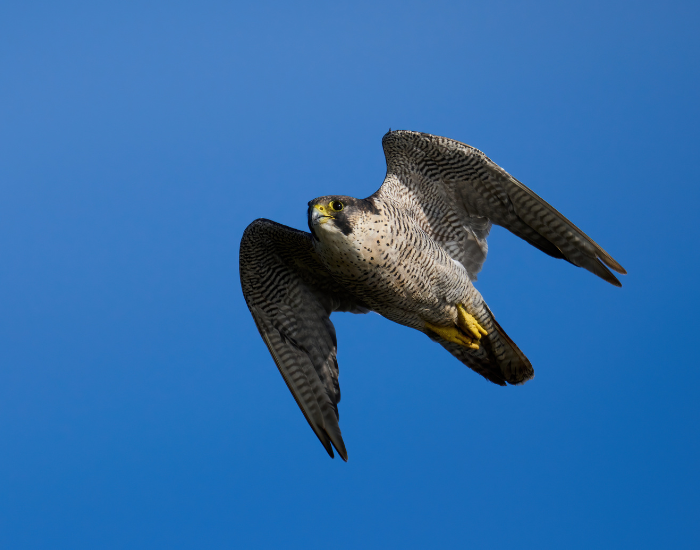
Despite overall population growth, peregrine falcon populations face continuing threats.
Illegal persecution remains a conservation concern, particularly on grouse moors in upland areas. Studies show breeding productivity on grouse moors is 50 percent lower than other habitats. Adult peregrines are sometimes illegally killed to protect game birds and racing pigeons, despite legal protection.
Human persecution through egg collecting, though less common historically, still occurs. During breeding season, disturbance can cause nest abandonment. Collision risks with structures pose threats, especially for juvenile birds learning flight.
However, urban areas paradoxically provide safer havens. City-dwelling peregrines experience less direct persecution than countryside populations. They’ve proven remarkably adaptable to spreading south and colonizing new regions.
12. Peregrine Falconry Has Ancient Roots
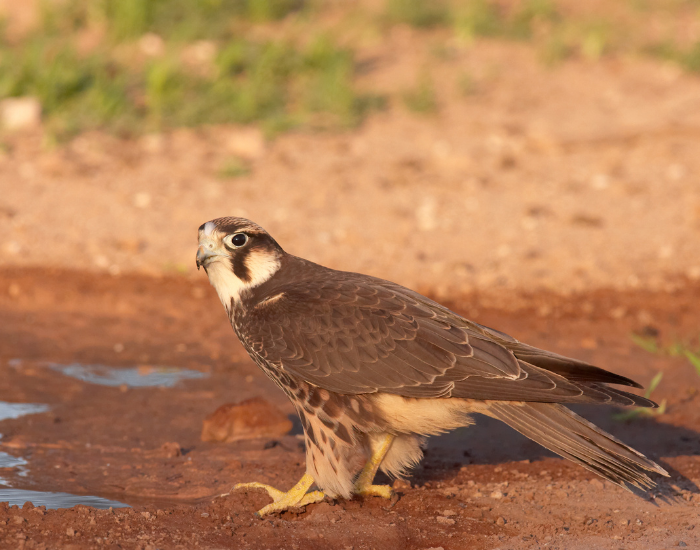
Peregrine falconry dates back thousands of years. Historically, these birds were reserved for royalty.
Medieval Europeans called them “The King of Birds” due to intelligence, speed, and hunting prowess. Falconry manuals from the 13th century detail elaborate training methods. Their high-speed hunting style made them the most prized falconry partners globally.
Today, peregrines remain valued in falconry circles. Modern captive breeding programs provide birds for legitimate falconry, eliminating needs to take wild specimens. Falcon folds (training falcons) contributed significantly to conservation. Captive breeding techniques developed by falconers proved essential during DDT-era recovery.
Peregrine Falcon vs Other Raptors
When compared to bald eagles, kestrels, and other birds of prey, peregrines occupy unique niches.
Caracaras take a completely different approach. Rather than diving at extreme speeds, they often walk across open ground, scavenging carrion or stealing food from other birds. Their opportunistic behaviour places them among the most adaptable scavengers in the raptor world.
Harpy eagles rely on immense strength instead of speed. With some of the largest talons of any eagle, they ambush monkeys and sloths high in rainforest canopies, overpowering prey through crushing force rather than aerial velocity.
Owls represent the opposite extreme of peregrines. Built for silent flight rather than speed, they hunt at night using exceptional hearing and glide soundlessly before striking small mammals with precision.
Peregrines dominate through sheer speed, specializing in aerial acrobatics to catch medium sized birds. They nest on cliffs and increasingly on buildings. No other raptor approaches their diving speed.

FAQs about Peregrine Falcons
The fastest recorded speed is 242 mph (389 km/h), documented in 1999 during National Geographic’s project.
Peregrines inhabit every continent except Antarctica. They prefer coastal areas, mountains, and increasingly, urban centers. In the UK, find them on sea cliffs, mountains, and cities like London. The Barbary falcon, a subspecies of the peregrine falcon, is found in North Africa and the Canary Islands, where it has a unique status due to its distinct characteristics and habitat preferences.
They primarily eat other birds, ranging from pigeons to ducks. Urban populations heavily target feral pigeons and collared doves.
No longer. While endangered mid-20th century due to pesticide poisoning, current populations have recovered dramatically. UK conservation status is now “Green.”
Visit coastal areas, mountains, or urban centers. Many cities operate nest cameras during breeding seasons. In the UK, the RSPB maintains viewing sites.

From Extinction’s Edge to Urban Skies
The peregrine falcon represents far more than Earth’s fastest animal. These birds embody conservation’s greatest triumphs.
From near-extinction in the 1960s to thriving populations today, their recovery demonstrates what’s achievable when humans commit to protecting wildlife. Today’s peregrine populations nest on both remote cliffs and city skyscrapers. They hunt everything from racing pigeons to wild ducks. They’ve colonized every continent except Antarctica, proving remarkable adaptability.
As a biologist, I’ve observed countless species. Yet nothing matches watching a peregrine stoop overhead. That moment when a dark silhouette becomes a living missile, slicing through air at speeds exceeding 200 mph, it’s evolution perfected.