When you first hear the word “dugong,” you might imagine mermaids or mysterious sea creatures. But dugongs are remarkably real, and deeply fascinating marine animals. These gentle sea cows are the only exclusively marine mammals that survive entirely on underwater vegetation.
Unlike whales or dolphins, dugongs don’t hunt. They graze seagrass beds with the same patience as cattle on land. I’ve spent years surveying seagrass meadows across the Indo-Pacific, and these animals still surprise me. Here are 12 essential facts about dugongs, their ecology, conservation status, and why they deserve our protection.
Taxonomy and Etymology: The Origins of the Dugong’s Name and Family Tree
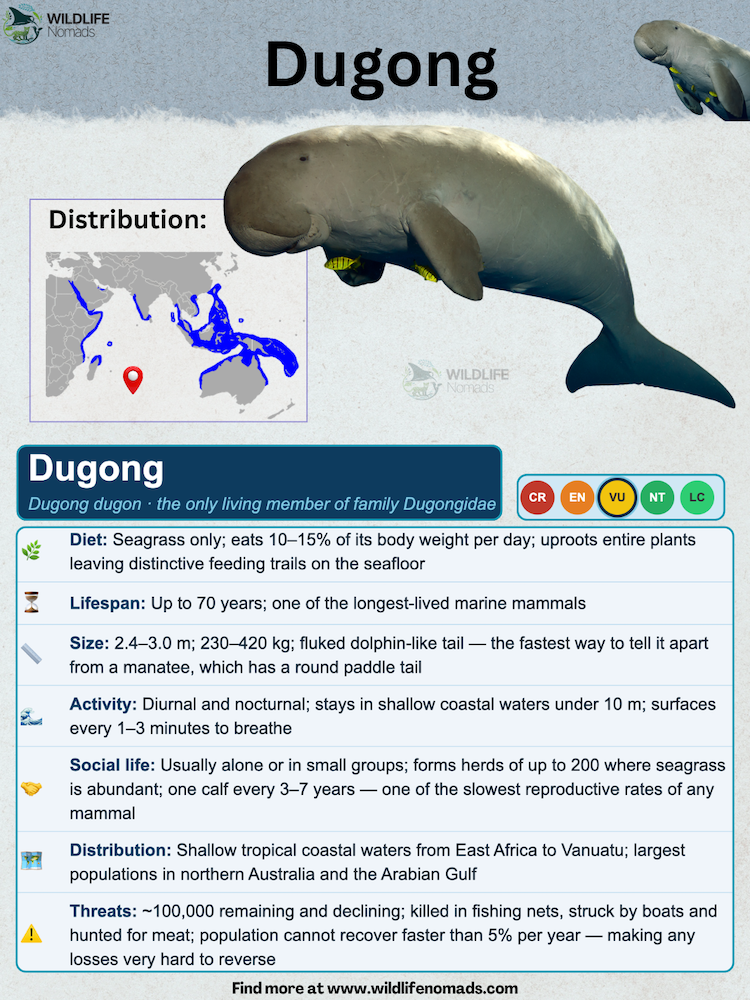
The dugong (Dugong dugon) holds a unique place in the animal kingdom as the only living representative of the family Dugongidae. The name traces to the Visayan word “dugung,” used by coastal communities in the Philippines. That etymology reflects a long relationship between people and this gentle marine mammal.
Dugongs belong to the order Sirenia, a group of aquatic mammals that also includes manatees. Dugongs are closely related to elephants: both sit within the clade Paenungulata and share a common ancestor from roughly 50 million years ago. You can see the legacy in their thick skin and unusual tooth structure.
Their closest relative was Steller’s sea cow (Hydrodamalis gigas), hunted to extinction in the 18th century. Only four living species of sirenian remain — the dugong and three manatees. The University of Michigan’s Animal Diversity Web still lists Dugongidae with a single surviving member.

1. What Exactly Is a Dugong? The Ocean’s True Sea Cow
A dugong is a marine mammal in the order Sirenia, and the only extant member of the Dugongidae family. Scientists call dugongs “sea cows” because they are strict herbivores that graze seagrass beds underwater.
That makes the dugong unique. Most large sea creatures hunt fish or other prey. Dugongs alone survive entirely on underwater meadows, making them the only exclusively marine mammal herbivores in the world’s oceans.
2. Dugong Anatomy: Built for Seagrass Grazing
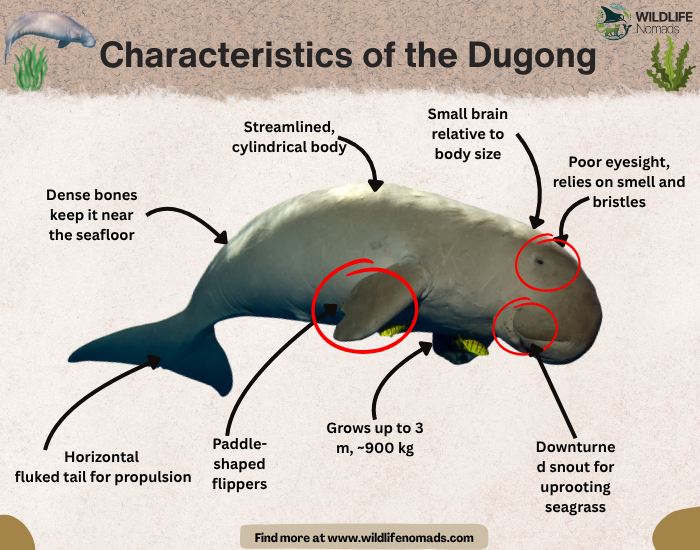
Size and weight: Dugongs reach 2.5 to 3 metres and weigh 250 kg to 900 kg. The largest recorded dugong measured 4.06 metres and weighed 1,016 kg.
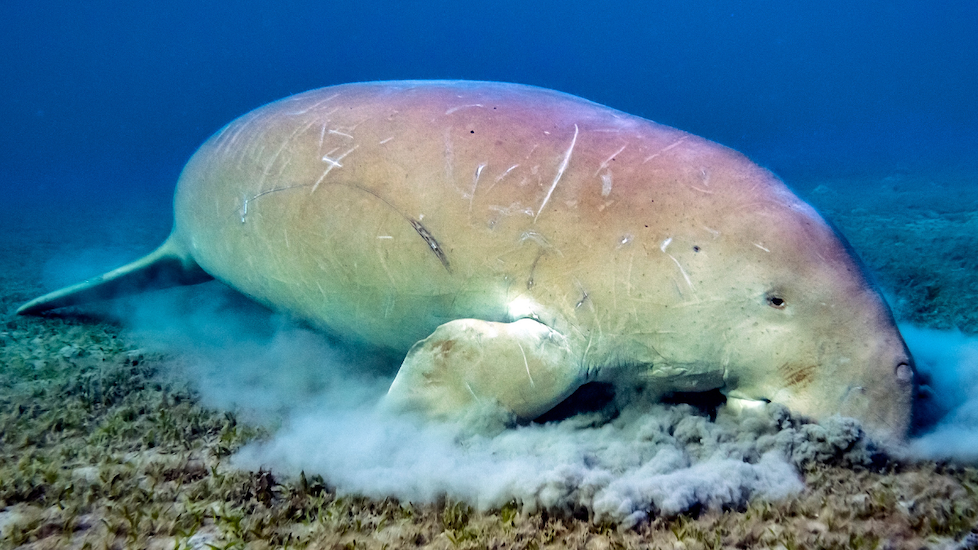
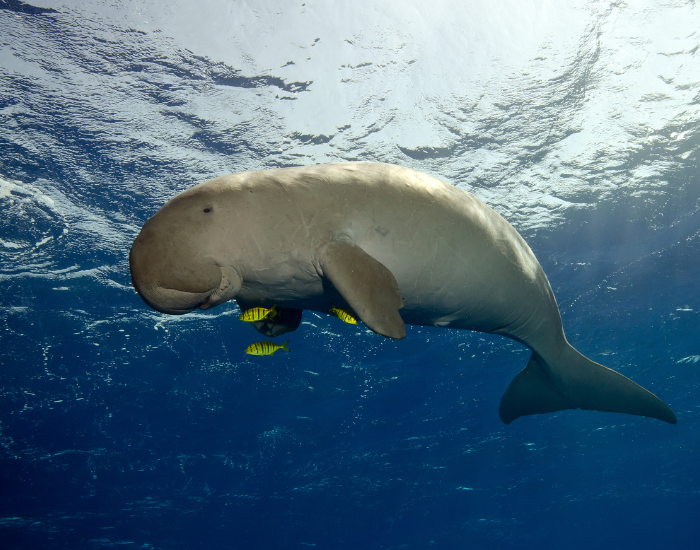
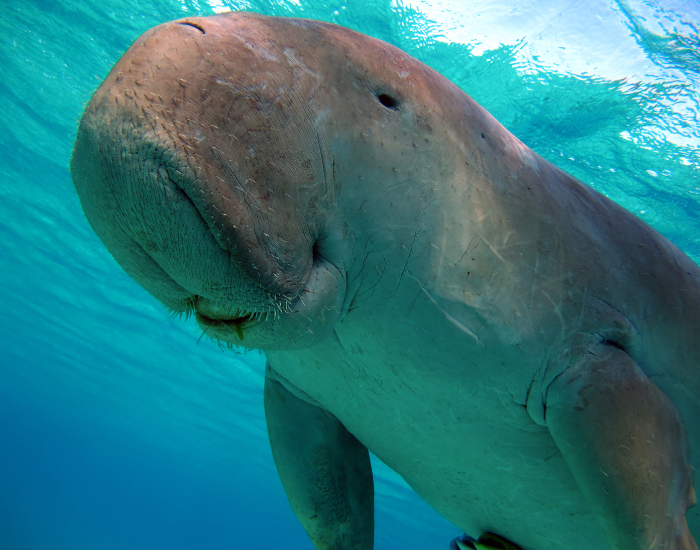
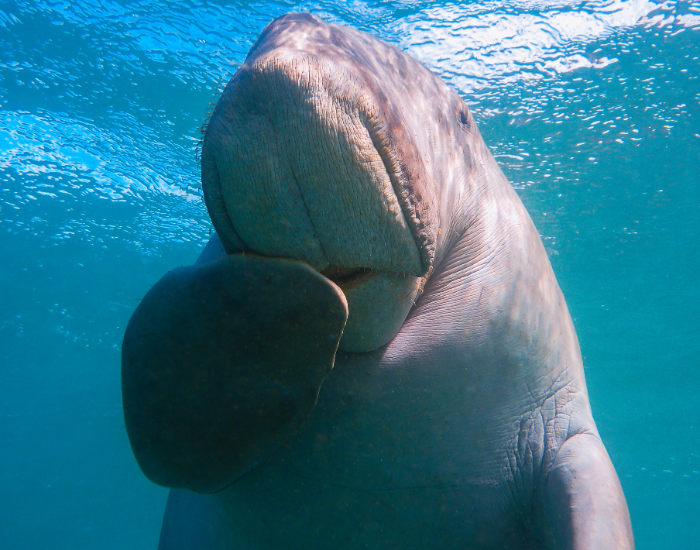
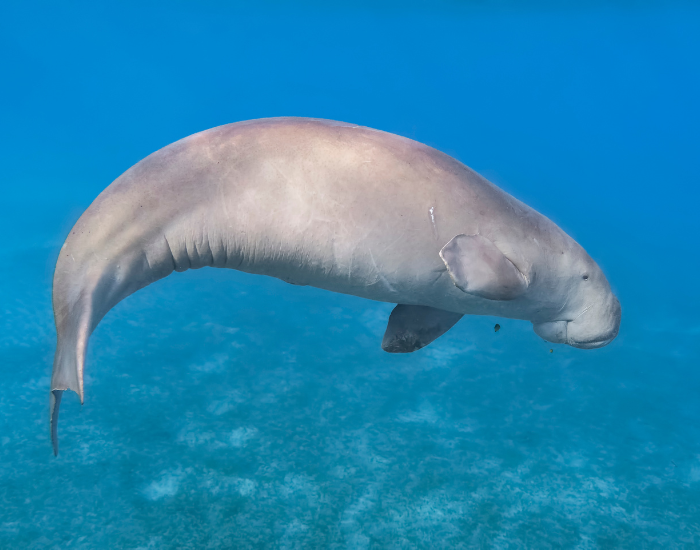
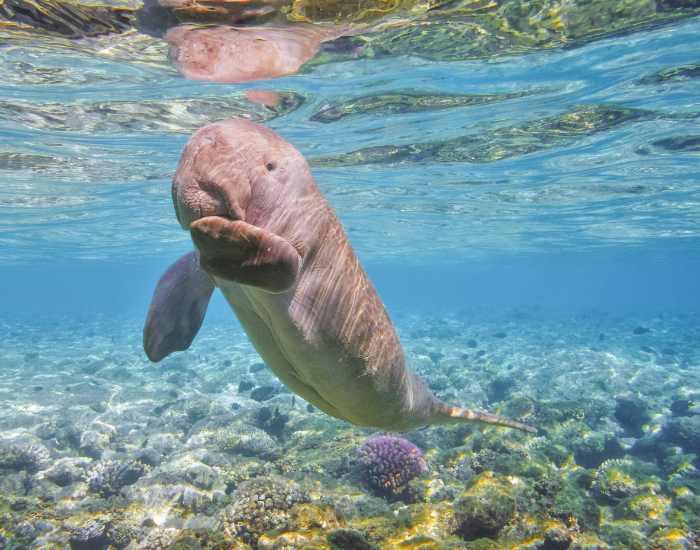
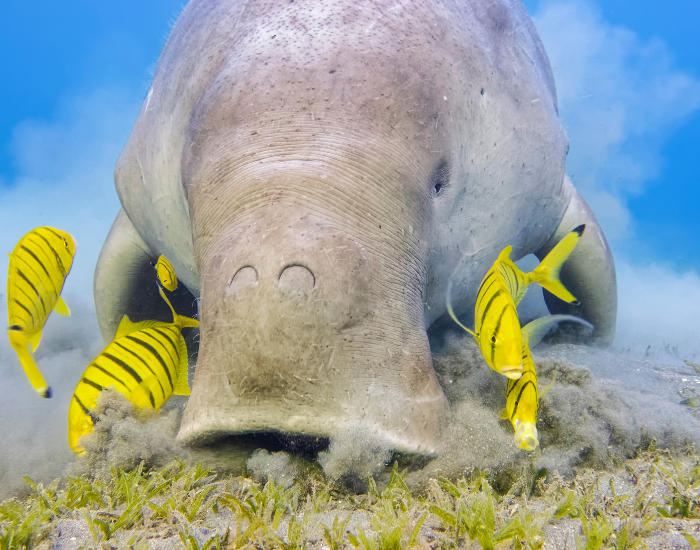
Physical features: The dugong’s body is large and cylindrical, streamlined for aquatic life. Their smooth skin often hosts algae patches, which camouflages them in murky coastal waters. Muscular, downturned upper lips are built for rooting seagrass from the seabed.
Flippers and tail: Dugongs have paddle-shaped flippers and horizontal fluked tails. That single feature separates them from every other marine mammal you’ll meet.
Sensory adaptations: Dugongs have poor eyesight, so they rely on smell and on tactile bristles (vibrissae) near the mouth to find plants. The dugong’s brain is small relative to the animal’s body weight. Dense bones keep them submerged while feeding, the anatomy of a professional underwater gardener.
3. The Dugong’s Diet: Nature’s Ecosystem Engineers
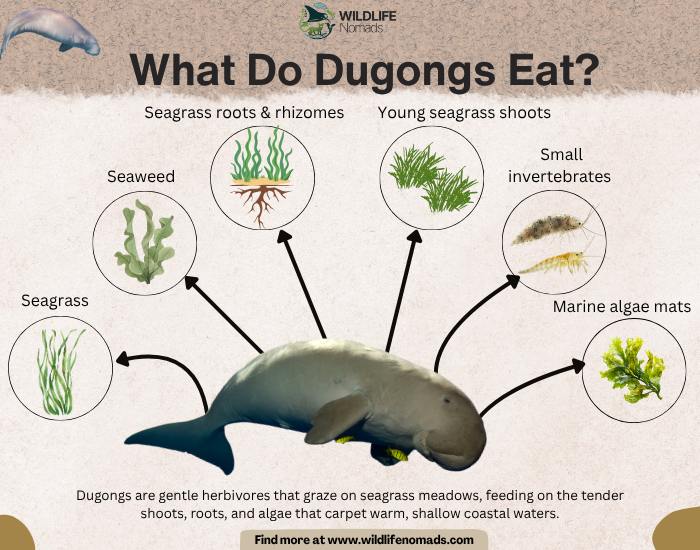
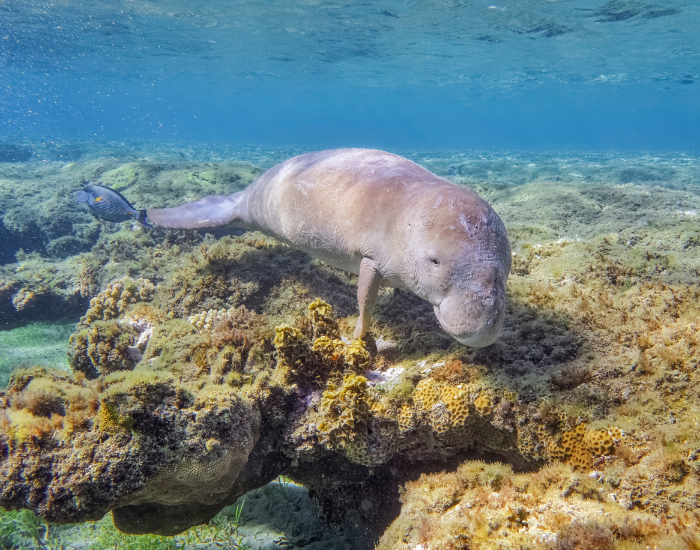
The diet dugongs follow centres on consuming massive amounts of seagrass daily, tens of kilograms in a single session. Dugongs eat seagrasses almost exclusively, making them highly specialised feeders. When seagrass is scarce, they supplement with marine algae.
Their grazing does more than fill a stomach. As dugongs feed on sea grasses, they uproot plants along the sea floor and leave furrows behind. Those gaps let younger, faster-growing species flourish. Ecologists call this “cultivation grazing,” and I’ve watched the trails cut across a meadow like mowing stripes on a lawn.
Dugongs prefer low-fibre, high-nitrogen seagrasses such as Halophila and Halodule, avoiding mature fibrous species. Feeding usually happens in shallow water, but dugongs can dive to depths of 39 metres to reach food. As herbivores, they help regulate coastal ecosystems by shaping which seagrass species dominate.
4. Where Do Dugongs Live? Their Global Range and Habitats
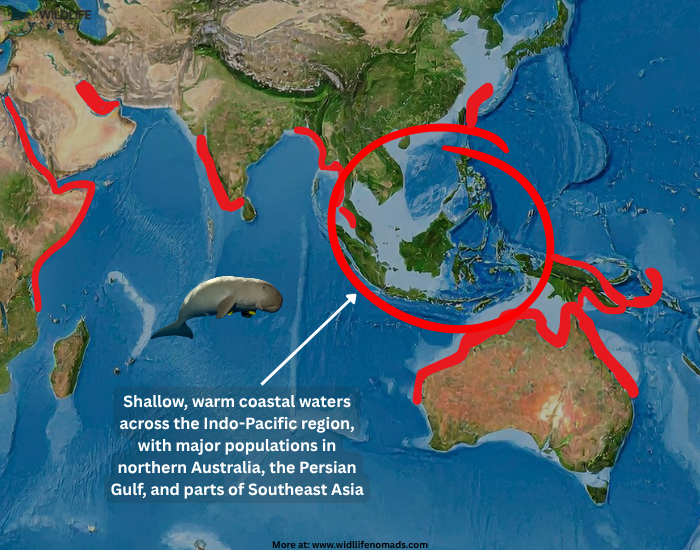
The dugong range spans warm coastal waters of the Indo-Pacific across roughly 37 countries, including Australia, East Africa, South Asia, Southeast Asia and the Pacific islands. Dugongs are found in waters between 26° north and 26° south of the equator, tracking the tropical and subtropical belt where seagrass grows.
They prefer calm, shallow, protected areas, bays, lagoons and channels where seagrass establishes best. Those same seagrass meadows provide vital habitats for other marine species, from juvenile fish to sea turtles.
Key dugong hotspots: Australia’s coastal waters support the largest population of dugongs on Earth. Shark Bay and Moreton Bay remain major centres, and on the eastern coast the Great Barrier Reef sustains an important feeding and migration corridor. Warm tropical waters and large inshore islands make both regions ideal.
The Persian Gulf holds the second largest dugong population in the world, with an estimated 5,800 to 7,300 animals. Southeast Asia, the Red Sea, and parts of India, the Gulf of Mannar and the Andaman & Nicobar Islands — support smaller groups. The southern coast and west coast of Qatar, plus the Western Pacific Ocean around Japan and the Philippines, complete the picture.
The fragmentation problem: Many prime habitats sit outside protected marine areas. Because the dugong’s range is dictated by seagrass availability, habitat destruction shrinks their range directly. Dugongs live at particular risk in subtropical waters where seagrass beds are declining.
5. Dugong Life History: Slow Growth, Low Reproduction
Female dugongs reach sexual maturity between 8 and 18 years. Pregnancy lasts 13 to 15 months, one of the longest gestation periods among marine mammals. Dugongs birth calves weighing around 30 kilograms, and those dugong calves nurse for 14 to 18 months.
Birth intervals run 2 to 7 years. In good conditions, dugongs approach 70 years of age. Male dugongs erupt tusks as they mature, and researchers read growth layers in those tusks the way you’d read tree rings, one of the few reliable ways to age a wild animal.
That slow pace is the whole conservation problem in a sentence. Losses cannot be replaced quickly.
6. Major Threats to Dugongs: Multiple Pressures Converge
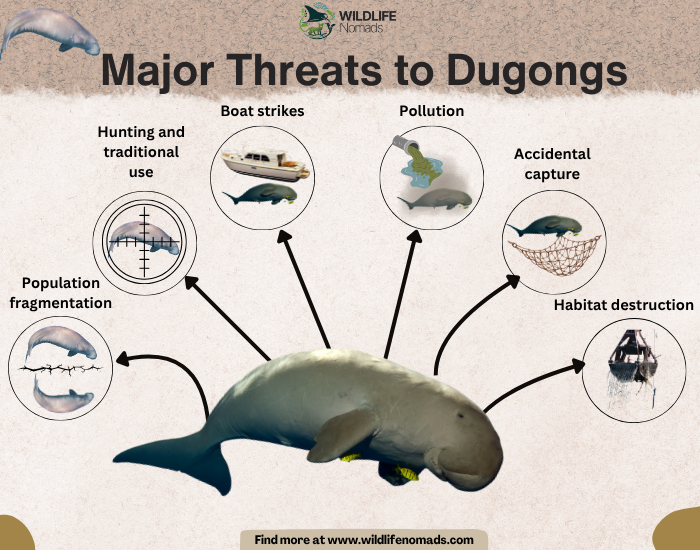
Major threats to dugongs include habitat degradation and boat strikes, and the pressures rarely arrive one at a time.
Habitat destruction is the primary threat. Coastal development, dredging, sedimentation and pollution destroy seagrass beds. Seagrass loss poses a major threat to dugong populations, and climate change compounds it through warming waters and extreme weather.
Accidental capture in fishing nets kills dugongs regularly. Gillnets and trawls entangle them, and they drown.
Boat strikes are a real danger in shallow water near reefs and harbours. Many dugongs carry propeller scars.
Pollution and runoff trigger eutrophication, smothering seagrass under algae blooms.
Hunting persists in some regions. Australia permits regulated traditional hunting by Indigenous peoples; unregulated hunting in parts of Southeast Asia remains a concern.
Fragmentation creates genetic bottlenecks in small, isolated populations. Adult dugongs have few natural predators, but calves fall to sharks, crocodiles and killer whales.
7. Conservation Status: Fighting Uphill Against Decline
The IUCN lists the dugong as a Vulnerable species with a declining trend. Dugong populations have declined by roughly 20% in 90 years, and the species is now considered vulnerable to extinction across much of its range. Several regional populations qualify as endangered species outright.
Dugongs are protected under CITES Appendix I, which bans international commercial trade, alongside national laws and the CMS Dugong MOU. Protection on paper still leaves gaps: only 5 to 37 percent of high-risk dugong habitat in parts of India falls inside marine protected areas.
Active efforts include expanding marine protected areas over critical seagrass beds, boat speed limits, fishing gear restrictions, seagrass restoration, and community-led monitoring. In my experience, the citizen-science sighting logs kept by fishers are often better than the survey data, they cover more days, in more weather, than any research budget allows. Because reproduction is so slow, protecting existing animals beats trying to boost breeding.
8. Dugongs are Introverts: Quiet and Solitary
Dugongs are generally solitary or found in twos and threes. Big herds are rare, though a prime seagrass patch will pull a temporary crowd together.
They communicate with low-frequency chirps, whistles and barks, behaviour still poorly studied. An orphaned calf is occasionally rescued and raised in captivity, but that’s uncommon.
Dugongs move calmly, reaching around 10 kilometres per hour when pushed. Poor vision and sharp hearing make them jumpy around propeller noise, which is exactly why boat disturbance matters.
9. Migration and Movement: Long-Distance Travelers
Many dugongs stay put in one seagrass system. Others don’t. Some dugongs migrate long distances hunting for suitable meadows, especially when local food collapses. Australian dugongs show clear seasonal movement patterns.
Individuals have been tracked travelling tens to hundreds of kilometres across warm coastal waters, responding to food availability and water temperature. As seagrass corridors disappear, that movement becomes restricted and isolated populations lose genetic connection.
10. Dugong vs. Manatee: Why These Marine Mammals Differ
People confuse dugongs with manatees constantly. Both are sirenians. They are not the same animal.
Dugongs are exclusively marine. Florida manatees regularly enter freshwater springs and brackish rivers. Dugongs have horizontal fluked tails; manatees have paddle-shaped tails. Dugongs occupy the Indo-Pacific only, while manatees inhabit the Americas, West Africa and the Amazon: both species appear on any list of animals that start with M worth reading.
Diets differ too. Dugongs graze seagrass in warm coastal waters. Manatees eat a broader range of aquatic vegetation. Manatees grow to about 3 to 4 metres and 590 kilograms, so dugongs are generally the smaller animal. Both female manatees and female dugongs breed slowly, every two to three years, which is why both are threatened species today.

11. Cultural Significance: Dugongs in History and Legend
Dugongs have shaped human imagination for centuries. In ancient seafaring tales, sailors mistook dugongs and manatees for mermaids, the likely origin of mermaid and siren myths.
In the Philippines, the word “duyong” translates directly to “mermaid.” For the Indigenous Australian culture, dugongs carry deep spiritual significance, and some groups maintain regulated traditional hunting.
Today dugongs anchor marine ecotourism in Australia, the Philippines and Indonesia. Divers travel a long way to see them. Managed well, that human environment of boats, guides and paying visitors becomes an argument for protecting seagrass rather than dredging it.
12. Why Dugongs Matter: The Bigger Conservation Picture
Dugongs are the only exclusively marine mammal herbivores on Earth. Unlike dolphins and orcas, which develop complex hunting strategies to capture prey, dugongs simply graze. Nothing else fills that niche.
As ecosystem engineers, they shape seagrass structure, productivity and biodiversity. Healthy meadows shelter juvenile fish, lock away carbon and cycle nutrients. Dugong health mirrors coastal ecosystem health.
Experimental marine biology (acoustic monitoring, satellite tagging, behavioural studies) now drives most conservation planning. Their slow growth means protection must span decades, not funding cycles.
Frequently Asked Questions About Dugongs
No. Dugongs are marine mammals in the order Sirenia, not cetaceans. They graze seagrass instead of hunting fish.
Dugongs are exclusively marine with fluked tails. Manatees often use freshwater and have paddle-shaped tails. Their ranges and diets differ too.
Dugongs feed mostly in shallow water but can dive to depths of 39 metres to reach seagrass.
No—touching or harassing dugongs is harmful and illegal in most jurisdictions. They’re wild marine animals. While some may habituate to calm boats, all interactions must respect their space and natural behavior.
Shark Bay in Western Australia and Moreton Bay in Queensland are strongholds, along with the Great Barrier Reef and northern Australia’s warm coastal waters.
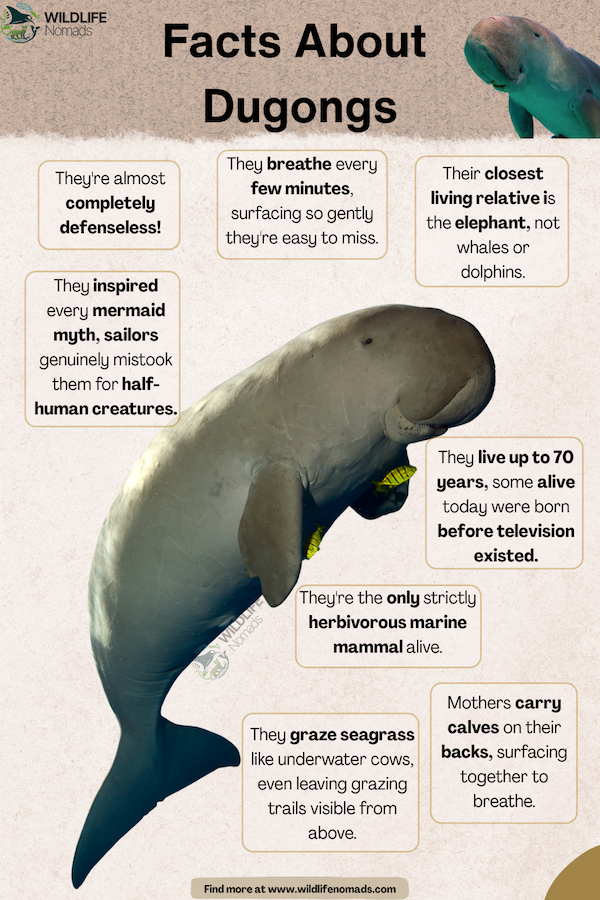
The Gentle Giants of Seagrass Meadows
Dugongs are fragile, strange and ecologically irreplaceable. As the only exclusively marine herbivores, they hold seagrass ecosystems together. Their survival depends on how we manage coastal development, boat traffic and fishing gear.
Expanded marine protected areas, community monitoring and steady research can shift the odds. Because dugongs live long and breed slowly, protection compounds over decades.
If you arrived here curious, leave with more than facts. Leave with a sense of responsibility for these gentle giants of the Indo-Pacific.
Dugong: Test Yourself 🦭
Eight multiple-choice questions on the ocean’s only plant-eating mammal. Go back and change any answer before you score.
References:
Chilvers, B. L., Delean, S., Gales, N. J., Holley, D. K., Lawler, I. R., Marsh, H., & Preen, A. R. (2004). Diving behaviour of dugongs, Dugong dugon. Journal of Experimental Marine Biology and Ecology, 304(2), 203–224. https://doi.org/10.1016/j.jembe.2003.12.010
Mannocci, L., Derville, S., Seguin, R., & Mouillot, D. (2024). Aerial video surveys and spatial prioritization reveal conservation opportunities for endangered dugongs in New Caledonia. Aquatic Conservation: Marine and Freshwater Ecosystems, 34(5), e4237. https://doi.org/10.1002/aqc.4237
Marsh, H., & Sobtzick, S. (2019). Dugong dugon (amended version of 2015 assessment). The IUCN Red List of Threatened Species 2019, e.T6909A160756767. https://doi.org/10.2305/IUCN.UK.2015-4.RLTS.T6909A160756767.en
Matsuda, H. (2022). Trajectory to local extinction of an isolated dugong population near Okinawa Island, Japan. Scientific Reports, 12, 6151. https://doi.org/10.1038/s41598-022-09992-2
Preen, A. (2004). Distribution, abundance and conservation status of dugongs and dolphins in the southern and western Arabian Gulf. Biological Conservation, 118(2), 205–218. https://doi.org/10.1016/j.biocon.2003.08.014
Seal, S., Bayyana, S., Pande, A., Ghanekar, C., Hatkar, P. S., Pathan, S., Johnson, J. A. (2024). Spatial prioritization of dugong habitats in India can contribute towards achieving the 30 × 30 global biodiversity target. Scientific Reports, 14, 13984. https://doi.org/10.1038/s41598-024-64760-8
Tol, S. J., Jarvis, J. C., York, P. H., Grech, A., Congdon, B. C., & Coles, R. G. (2017). Long distance biotic dispersal of tropical seagrass seeds by marine mega-herbivores. Scientific Reports, 7, 4458. https://doi.org/10.1038/s41598-017-04421-1
Find Incredible Dugongs Experiences!
This blog is reader-supported. When you buy experiences through links listed on this site, we may earn an affiliate commission.