
Meeting the Black Cockatoos
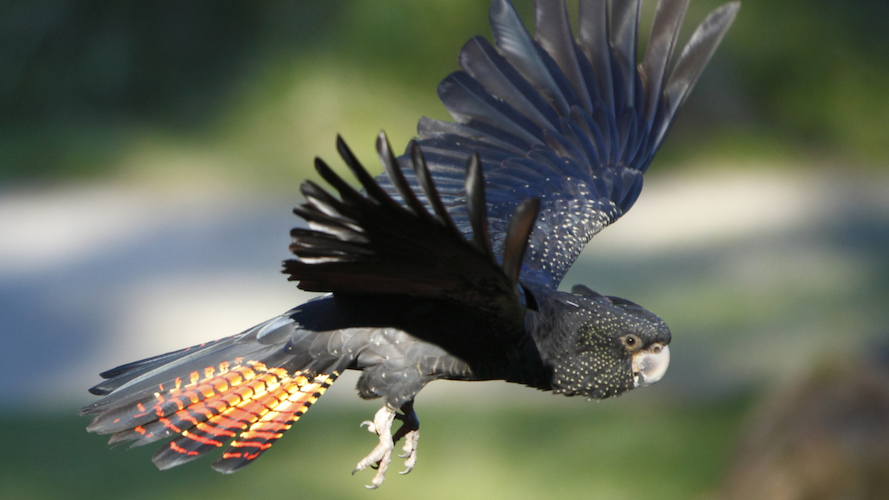
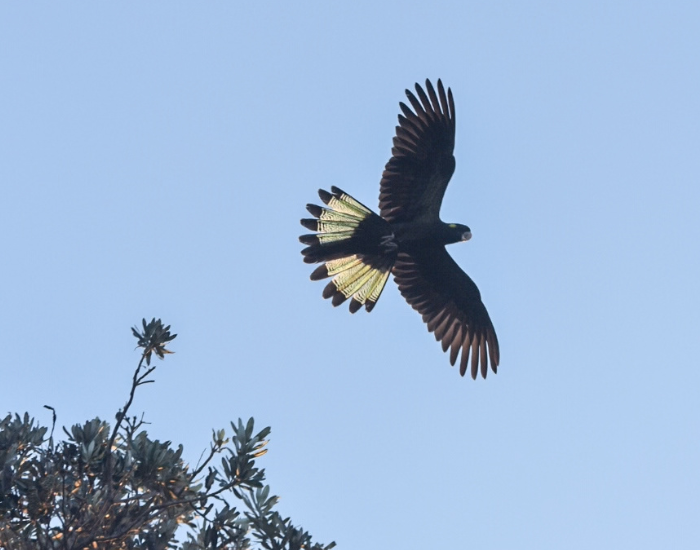
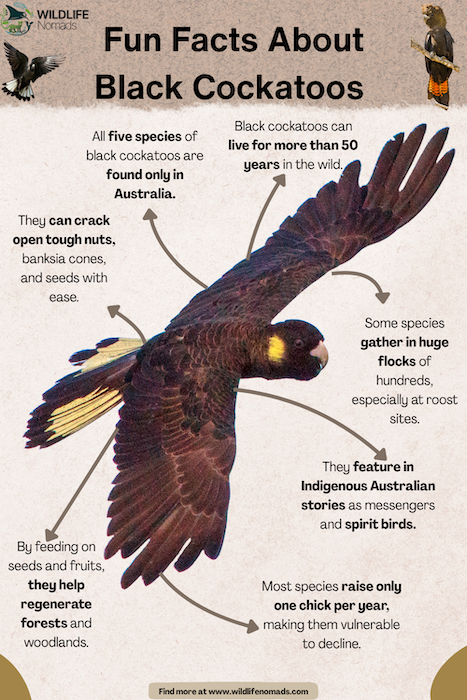
My first encounter was in 2022, northwest of Sydney on a field job, after a year in the city and one memorable echidna. Dozens of them came over calling, and the sound carried further than the birds. A coworker told me Aboriginal culture reads a black cockatoo sighting as a good omen. I watched their slow wingbeats flash orange red and pale yellow against the sky and understood why.
Later I spent three months in Western Australia, where flocks of Carnaby’s black cockatoo were an ordinary part of walking through the suburbs, feeding noisily in banksia woodlands and pine plantations.
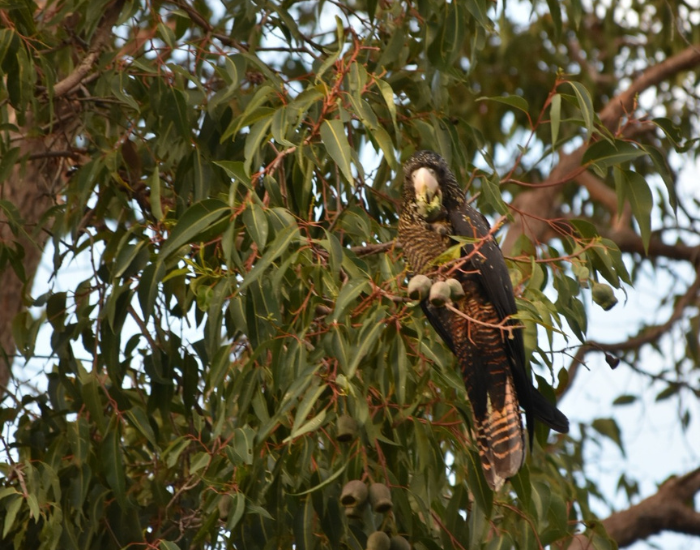
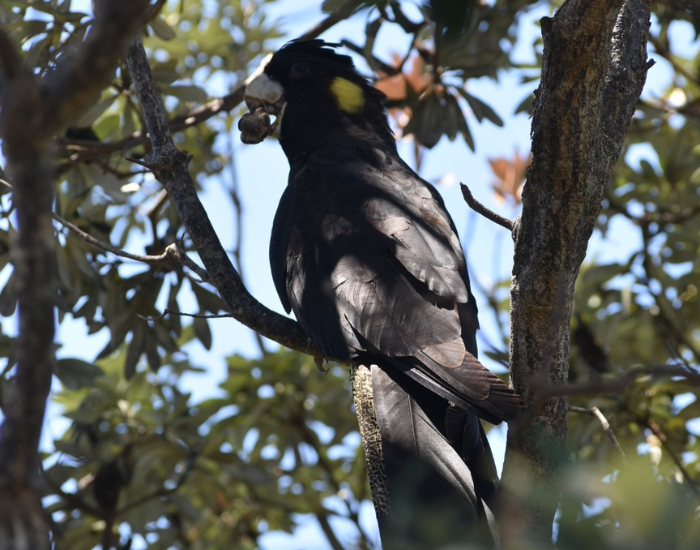
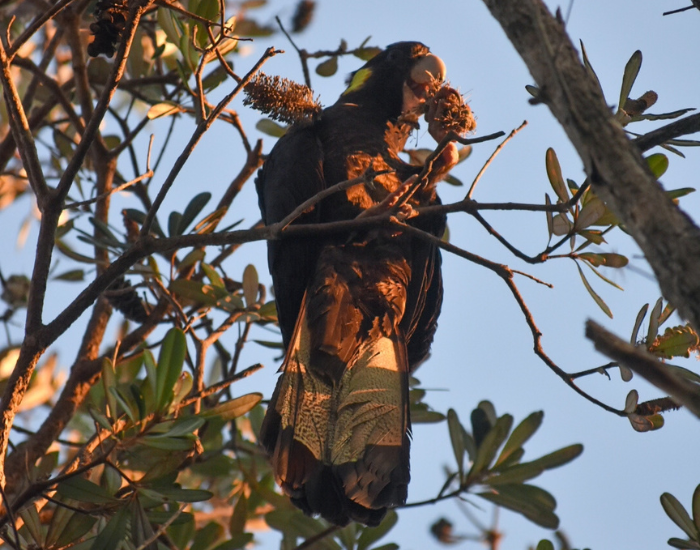
The most recent sighting was a few weeks ago on my lap around Australia. At Red Cliff and Lake Arragan campground a pair was sitting in the trees directly outside the toilet block, unbothered, at eye level. Then at Illaroo campground further north there were dozens of them, flying and calling all afternoon and working over the banksias. Yellow tailed black cockatoos, on that coast, feeding the way the field guides say they do.
1. Australia Has Five Black Cockatoo Species, Split Across Two Genera
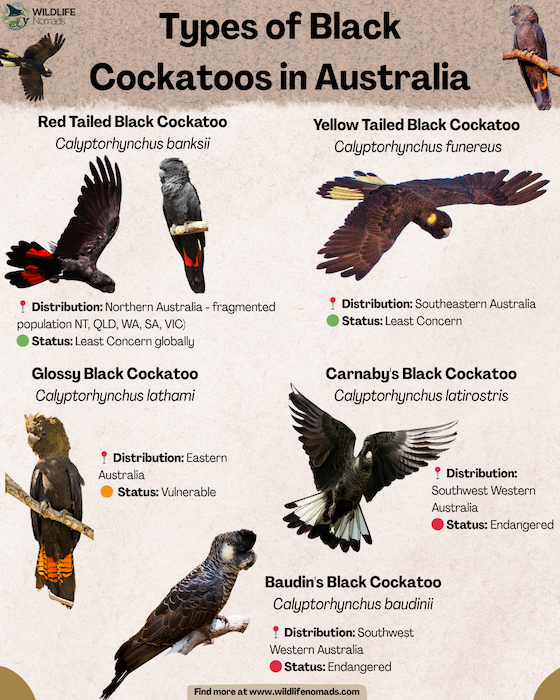
Australia has five species of black cockatoo. They are large parrots with black feathers, offset by colour on the tail or cheeks that flashes only in flight. The large bill cracks seed pods nothing else can open, it is dark grey in some species, and their harsh nasal wheezing announces them before you see them. Adult females and young birds are easy to confuse, since female colouration and juvenile markings overlap.
The old habit of putting all five in the genus Calyptorhynchus no longer holds. Genetic work by White and colleagues split the group: the red tailed and glossy stayed in Calyptorhynchus, while the three species with white or yellow tail panels moved to Zanda. Bird size separates them too, from the compact glossy to the heavy red tailed. For the wider family, see my guide to the types of parrots, and the pink galah at the opposite end of the colour range.
2. The Red Tailed Black Cockatoo Is the Most Widespread of All
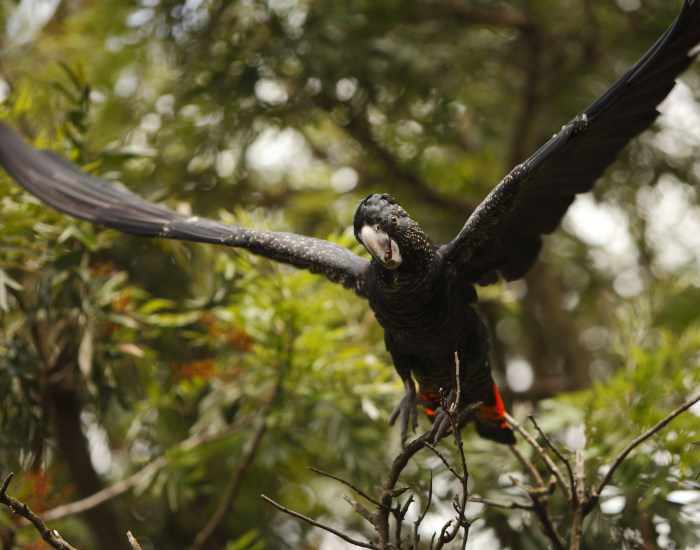
The red tailed black cockatoo (Calyptorhynchus banksii) covers more ground than any of them, across northern Australia, central Australia, western New South Wales, southwestern Queensland and Western Australia, along inland river courses and through eucalypt forests and semi-arid country.
Male birds carry a bright orange red band across the tail. Adult females show pale yellow spots across their black feathers and a barred, paler yellow tail, with some subspecies showing orange yellow rather than clean red. A pink eye ring makes close identification easy, and they feed holding seed pods in one foot. Five subspecies are recognised, and a 2020 genomic study by Ewart and colleagues found the genetic units do not line up neatly with them. The forest red tailed black in southwest Western Australia is a threatened species, and the south eastern subspecies of southeastern South Australia is in worse shape still.
3. The Yellow Tailed Black Cockatoo Calls Before the Rain
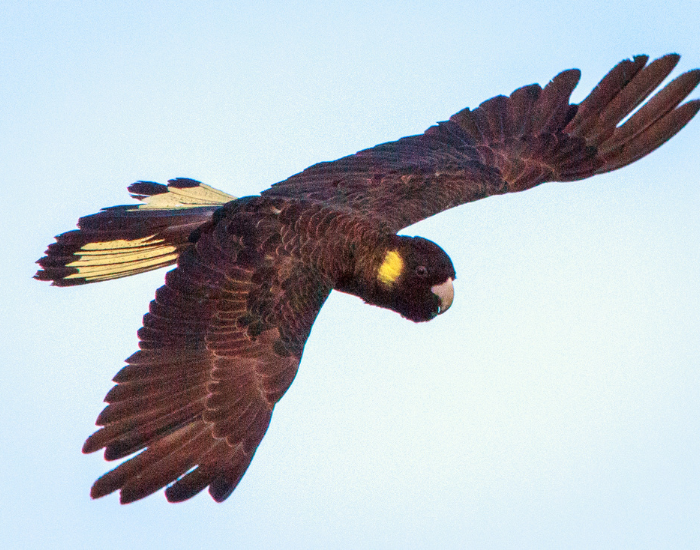
The yellow tailed black cockatoo (Zanda funerea) has a yellow tail band and yellow cheek patches, and it is the one most Australians on the east coast know. Its range runs from northern New South Wales through the Australian Capital Territory to Victoria, South Australia and Tasmania, in two subspecies. Their mournful calls have been read as a sign of coming rain for as long as anyone has been listening, and the male breeding call is different again, softer and more drawn out.
Large flocks strip pine cones in pine plantations and work through introduced cape lilac in town, and on the coast they turn to banksias, which is what I watched at Illaroo. They are the most adaptable of the five, and the least worried about people.
4. The Glossy Black Cockatoo Eats Almost Nothing Else
The glossy black cockatoo (Calyptorhynchus lathami) is smaller than the other black cockatoos, with shiny plumage and dull yellow patches behind the eye, and travels in small flocks rarely more than a dozen strong. Its range takes in northern New South Wales, southeastern Queensland and parts of South Australia.
Its diet is the problem. It feeds on the cone-shaped seeds of casuarina and sheoak and little else, which makes every hectare of casuarina woodland load-bearing. The Kangaroo Island subspecies lost much of its habitat in the 2019–20 fires, and a 2026 study by Mooney and colleagues found the birds shifted how they forage rather than abandoning the island. It is vulnerable nationally and endangered in some states.
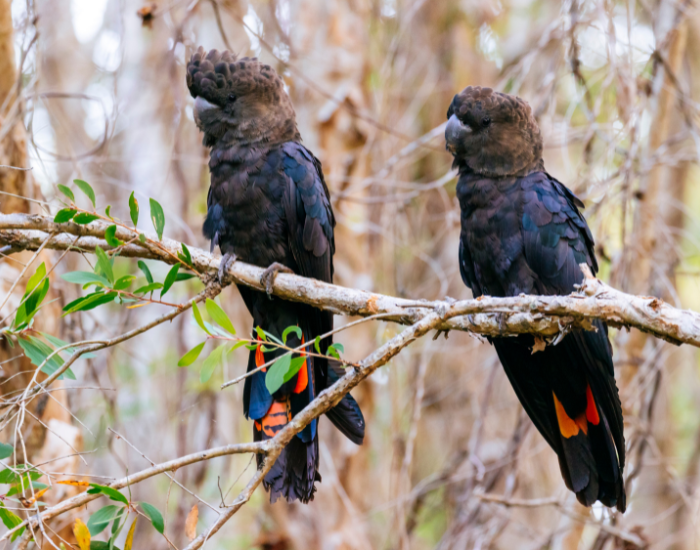
5. Carnaby’s Black Cockatoo Is Disappearing From Around Perth
Carnaby’s black cockatoo (Zanda latirostris) lives only in the southwest corner of Western Australia, from central coastal Western Australia down to the coast below Perth. This is the short billed black cockatoo, with white tail panels, and it was once ordinary across the whole south west.
The decline is documented rather than estimated. The Great Cocky Count, a volunteer roost survey running since 2009, gave Williams and colleagues five years of data across roughly 150 sites, and they measured roosting numbers falling about 14% a year. Urban development and the clearing of banksia woodlands are the cause. Large flocks still appear around Perth, feeding in ornamental eucalypts and nesting in remnant patches, but the trend underneath is going one way. Carnaby’s cockatoo is listed as an endangered species under federal environmental protection law.
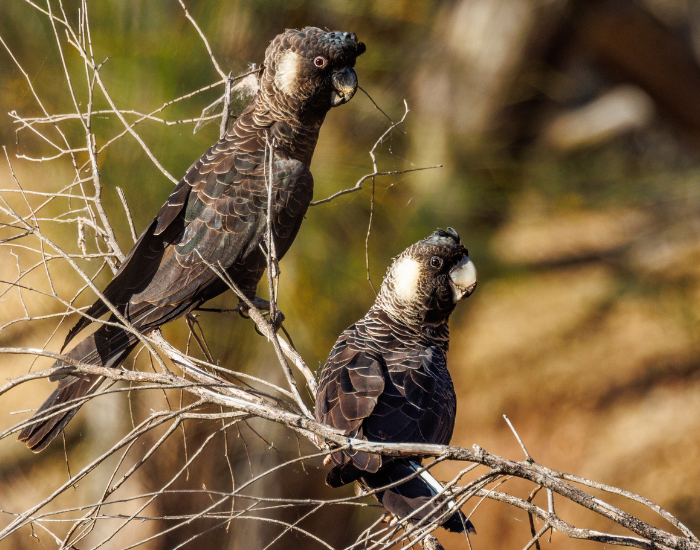
6. Baudin’s Black Cockatoo Needs Trees Older Than Australia Itself
Baudin’s black cockatoo (Zanda baudinii) is the long billed black cockatoo, closely related to Carnaby’s and routinely mistaken for it. Its large beak is the giveaway, evolved to lever seeds out of marri nuts, and it holds to the jarrah and marri forests of south western WA.
It nests in trees more than 200 years old, which means hollows that were forming before Europeans arrived. Baudin’s cockatoo was listed as endangered in 2018, up from vulnerable, and it faces the same pressures as Carnaby’s: habitat loss and the steady destruction of nesting sites. Orchardists shooting them for damage to apples and pears did not help.
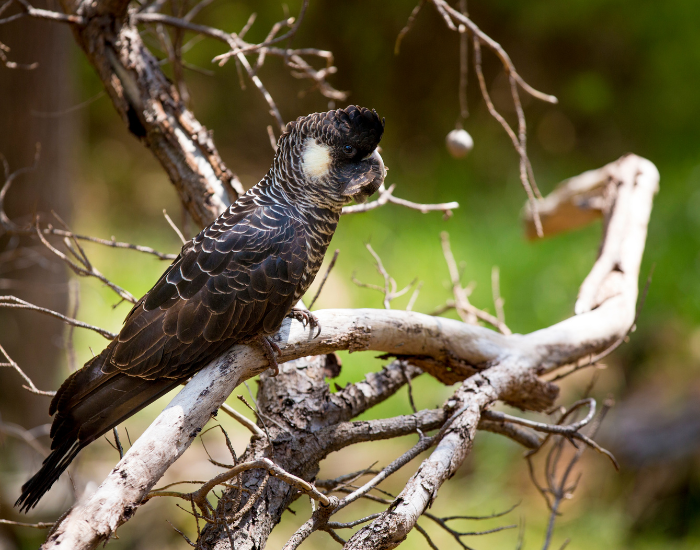
7. They Depend on Hollows That Take Centuries to Form
Every one of these species breeds in large tree hollows, and a hollow wide enough for a cockatoo takes a century or more to develop in a living eucalypt. That is the bottleneck. Clear the old trees and no amount of replanting fixes it inside a human lifetime.
The best long-run data comes from Coomallo Creek in Western Australia, where Saunders, Dawson and Mawson tracked Carnaby’s nesting hollows from 1969 to 2020: 188 natural hollows at the start, 43 left at the end. Artificial hollows work and the birds take to them readily, but the same study found both kinds need repair every three to four years. Breeding season runs roughly July to December in the west, with an incubation period of about 29 days and usually one chick raised from two eggs. Slow reproduction on a shrinking number of nesting sites is the whole conservation problem in one sentence.
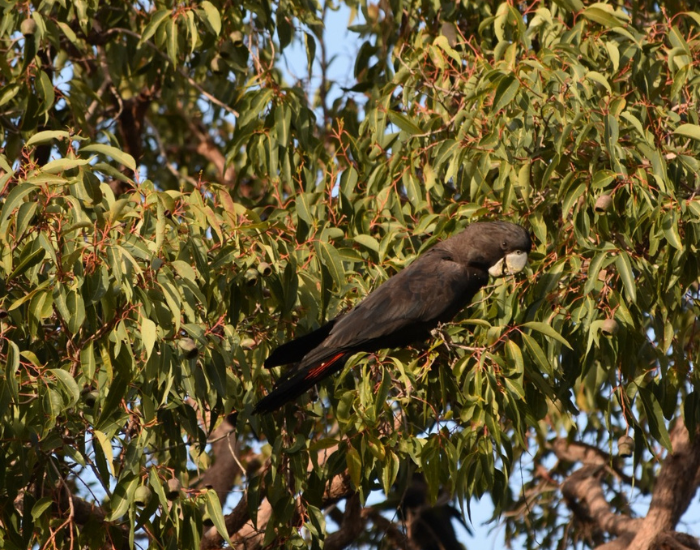
8. Their Bills Open Food Nothing Else Can Reach
These are specialised feeders, and the bill is the tool. Each species has its own lane:
- Red tailed black cockatoo — eucalypt seeds, plus acacia and hakea
- Yellow tailed black cockatoo — pine cones, cape lilac seeds, banksias, and insect larvae chiselled out of infested wood
- Glossy black cockatoo — casuarina cones, almost exclusively
- Carnaby’s black cockatoo — banksia woodlands, jarrah forests, pine trees and nectar
- Baudin’s black cockatoo — marri nuts, and orchard apples and pears when given the chance
All take seeds and nectar from native trees and also some ornamental eucalypts in town, and all will strip bark to get at grubs, which few other species bother with. Yellow tailed birds in particular leave a trail of shredded branches under a pine. More on what birds eat across different groups.
9. You Hear Them Long Before You See Them
Their loud, wailing calls are the reason people notice them at all. The yellow tailed wail carries a kilometre on a still day, Carnaby’s has a shorter grating note, and at close range all of them produce a harsh nasal wheezing that sounds more like machinery than a bird. At Illaroo the calls were the first thing I registered, well before anything appeared over the treeline.
This is also the easiest way to find them. Learn the call and you stop missing them, which is the single most useful habit in birding for beginners and works across most Australian native birds.
10. Aboriginal Cultures Read Them as Omens
Many Aboriginal cultures treat black cockatoos as signs of change or good fortune, and their appearance before rain or at a seasonal turn sits inside much older bodies of knowledge than any field guide. That reading has carried into general Australian habit: plenty of people still look up when they hear them.
Europeans met them later and mostly on paper. John Gould painted them for The Birds of Australia in the 1840s, and for a long time those plates were how the rest of the world saw these birds. They remain among the most striking animals of Australia.
11. Nearly Every Species Is Under Pressure
Of the five, only the yellow tailed black cockatoo is holding up well. Carnaby’s is endangered, Baudin’s is endangered, the glossy is a vulnerable species nationally, and two red tailed subspecies are listed separately. Some species carry different status in different states, so the same bird can be secure in one jurisdiction and threatened in another.
The causes repeat: land clearing, urban development around Perth and the east coast, fire at the wrong intervals, and the loss of old hollow-bearing trees that no policy can accelerate. They sit alongside the rest of the most threatened animals in Australia, and the mechanism is plain habitat destruction.
12. GPS Trackers Are Changing What We Know
The most useful recent work has come from putting transmitters on the birds. Rycken and colleagues fitted GPS and satellite tags to forest red tailed black cockatoos across forest, peri-urban and urban landscapes in Western Australia, and found something nobody expected: urbanisation did not shrink their movements. Daily distances ran from 5 to 16 km and home ranges from 6 to 53 square kilometres, with roadside vegetation doing far more work as a foraging and movement corridor than anyone had credited.
Their conclusion was that cities should be managed as critical habitat rather than written off. With health screening and disease monitoring in Carnaby’s nestlings, this is the kind of evidence that lets people intervene before a population crashes instead of afterwards
.
FAQs About Black Cockatoos
It depends entirely on the species. The yellow tailed black cockatoo is still common across the east. Carnaby’s and Baudin’s are both endangered, and the glossy is vulnerable.
Red tailed, yellow tailed, glossy, Carnaby’s and Baudin’s. The last three now sit in the genus Zanda rather than Calyptorhynchus.
Many Aboriginal cultures read them as good omens or signs of change, often rain. It is one of the few bird beliefs most Australians still know.
Across Western Australia, South Australia, New South Wales, the Australian Capital Territory, Queensland, Victoria and Tasmania, with each species holding its own distribution.
Seeds, mainly. Eucalypt, acacia, banksia, hakea and casuarina, plus pine cones, cape lilac and insect larvae depending on the species.
The Spirit of Australia’s Forests
From the orange red tail panels of the red tailed cockatoo to the banksia woodlands Carnaby’s cockatoo depends on, these birds are the ones that make you stop walking. Watching them at Illaroo, dozens of them working through the banksias all afternoon, was the best hour of that leg of the trip, and the pair outside the toilet block at Red Cliff was the funniest.
What they really are is a measure of how the country is doing. They need old trees, intact woodland and time, and those are exactly the things we are shortest of. When you hear them overhead, look up. You are hearing one of the best wildlife encounters Australia has left, and one that is not guaranteed.
Black Cockatoo Science & Identification Quiz
Ten fun True/False and Multiple Choice questions testing your knowledge of Australia’s 5 black cockatoo species, taxonomic splits, diet specializations, and conservation facts!
Multiple Choice
References:
Ewart, K. M., Lo, N., Ogden, R., Joseph, L., Ho, S. Y. W., Frankham, G. J., Eldridge, M. D. B., Schodde, R., & Johnson, R. N. (2020). Phylogeography of the iconic Australian red-tailed black-cockatoo (Calyptorhynchus banksii) and implications for its conservation. Heredity, 125(3), 85–100. https://doi.org/10.1038/s41437-020-0315-y
Mooney, P., Berris, K. K., Kaestli, M., & Garnett, S. T. (2026). Threatened cockatoo adapts foraging strategy to survive habitat loss from fire. Ibis, 168(4), 1664–1680. https://doi.org/10.1111/ibi.70052
Rycken, S. J. E., Warren, K. S., Yeap, L., Donaldson, R., Mawson, P., Dawson, R., & Shephard, J. M. (2022). Forest specialist species in the urban landscape: Do different levels of urbanization affect the movements of Forest Red-tailed Black Cockatoos (Calyptorhynchus banksii naso)? Avian Conservation and Ecology, 17(1), 11. https://doi.org/10.5751/ACE-02061-170111
Saunders, D. A., Dawson, R., & Mawson, P. R. (2023). Artificial nesting hollows for the conservation of Carnaby’s cockatoo Calyptorhynchus latirostris: Definitely not a case of erect and forget. Pacific Conservation Biology, 29(2), 119–129. https://doi.org/10.1071/PC21061
White, N. E., Phillips, M. J., Gilbert, M. T. P., Alfaro-Núñez, A., Willerslev, E., Mawson, P. R., Spencer, P. B. S., & Bunce, M. (2011). The evolutionary history of cockatoos (Aves: Psittaciformes: Cacatuidae). Molecular Phylogenetics and Evolution, 59(3), 615–622. https://doi.org/10.1016/j.ympev.2011.03.011
Williams, M. R., Yates, C. J., Stock, W. D., Barrett, G. W., & Finn, H. C. (2016). Citizen science monitoring reveals a significant, ongoing decline of the Endangered Carnaby’s black-cockatoo Calyptorhynchus latirostris. Oryx, 50(4), 626–635. https://doi.org/10.1017/S0030605315000320