
Hiking through the scrub and forested trails in Mexico during my university days, I locked eyes with a bird that felt entirely surreal. Me and friends used to head out on field trips and weekend hikes, and during the late spring migration, catching them just before they headed north was always a highlight. I remember a flash of impossibly saturated blue darting between the low branches—a male indigo bunting molting into his vibrant breeding plumage against the foliage. I was fortunate enough to spot them a few times back then, but those early encounters left a permanent mark. Years of field work later, that striking, deep blue remains the entire reason I keep coming back to indigo buntings.
The indigo bunting, sometimes called a blue bunting, an indigo blue bird, or even a “blue canary bird” in older field guides — is a study in contradictions. Adult males look soaked in pigment, yet that blue is a trick of physics. Females wear plain brown so well that most hikers walk right past them. These tiny birds migrate by reading the night sky, sing in dueling neighborhood dialects, and thrive in the scruffy weedy habitat we usually dismiss as wasteland. Here are ten things about indigo buntings that genuinely surprised me, both in the field and in the lab.
1. His Brilliant Blue Isn’t a Real Color
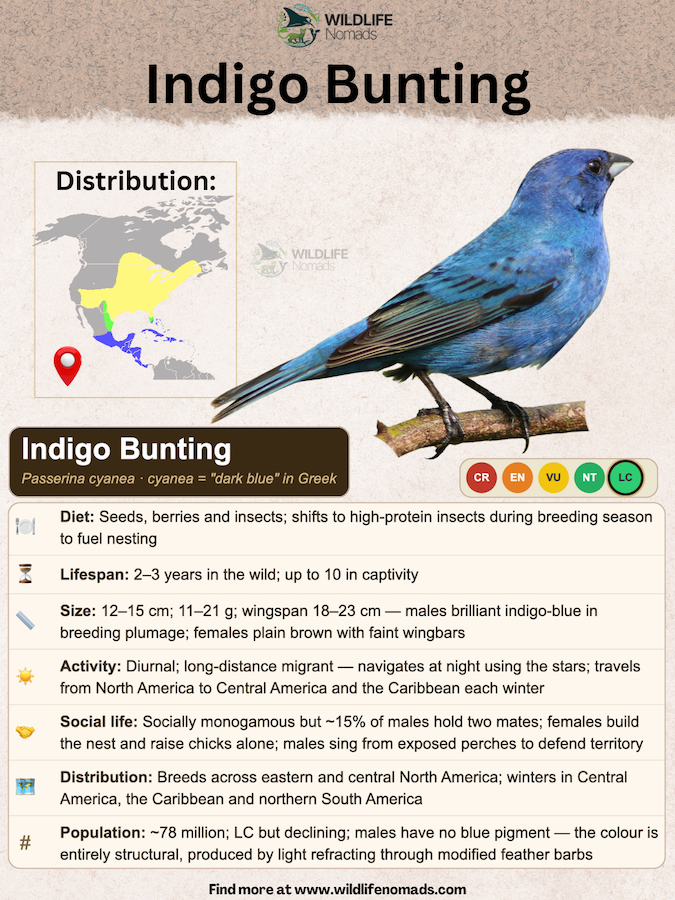
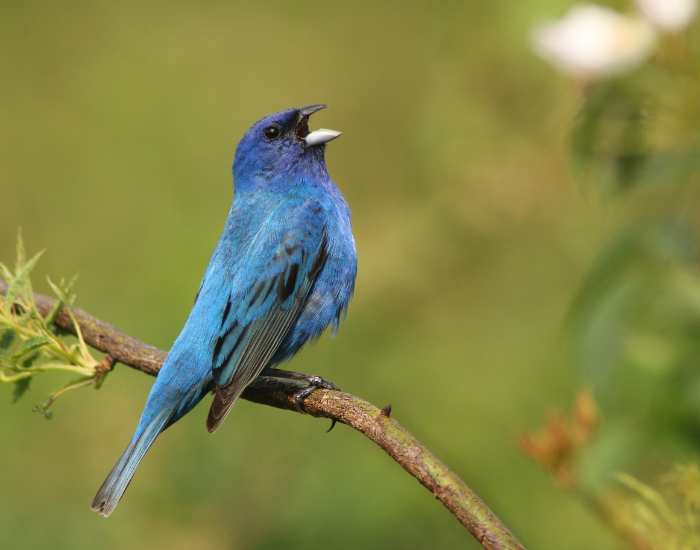
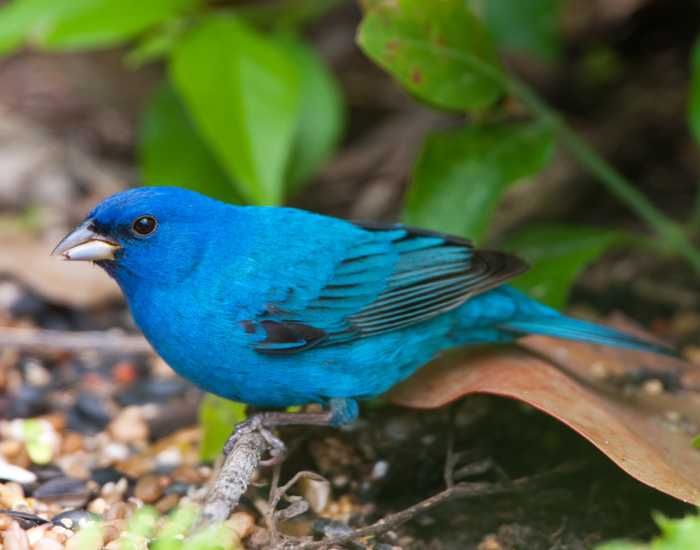
If you ground up a male indigo bunting’s feathers into dust, the powder would come out a dull brown. There is no blue pigment in his plumage at all. The jewel like color comes from microscopic structures inside each feather barb that scatter and reflect blue light back to your eye. Biologists call this structural coloration, and it works the same way the sky does.
As a result, the same adult male can look near-black in shadow, gray under cloud cover, electric blue at noon, and turquoise at dusk. Other blue birds, including the closely related lazuli bunting and the blue grosbeak, use this same trick of physics. Pigment fades over decades in a museum drawer. Structure does not. That indigo bunting color is essentially a living prism on the wing, and indigo buntings showcase the effect at every angle of incoming light.
2. They Navigate Using the Stars
In the 1960s, Cornell Lab biologist Stephen Emlen ran a now-famous experiment. He placed young indigo buntings inside a planetarium and rotated the projected night sky around different artificial stars. The young buntings reoriented their hopping to match the new sky.
Indigo buntings migrate at night, and males and females alike read the rotation of the stars near Polaris like a compass. This is not just an internal clock at work. The birds calibrate that stellar compass while still in the nest, watching the night sky overhead before they ever leave home. Pull the stars away with cloud cover or city glow, and the indigo buntings get lost. A sparrow sized songbird uses celestial navigation that humans needed centuries of seafaring to master.
3. Each Male Sings His Neighborhood’s Dialect
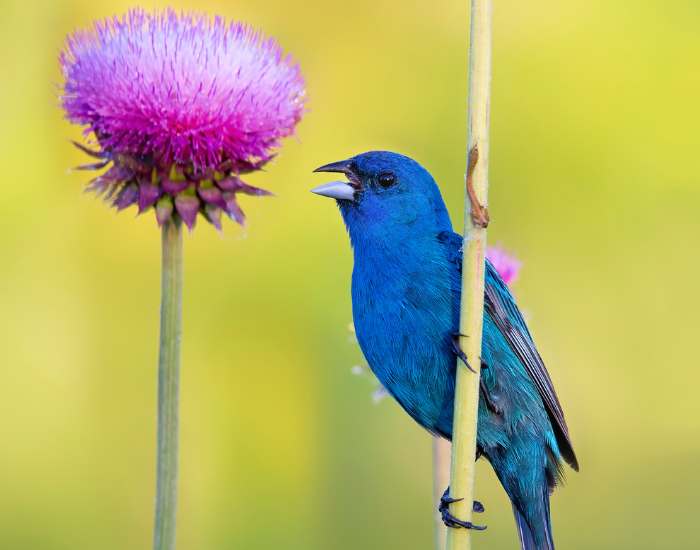
The indigo bunting’s song is a chipper string of paired notes that birders transcribe as “sweet sweet chew chew sweet sweet.” The phrasing changes from valley to valley. Young males do not inherit their song from their father. Instead they learn it from older adult males singing nearby, often a close relative or a rival defending the next territory over.
Researchers call these clusters “song neighborhoods,” and the local dialect can persist for twenty years even as individual males turn over. Walk one ridge in Kentucky and you hear one song. Walk to the next ridge and the song shifts noticeably. I have field recordings of singing males from Tennessee and Ohio, and the difference is audible without any spectrogram analysis. Females, by contrast, do not sing at all.
4. The Female Looks Like a Different Bird Entirely
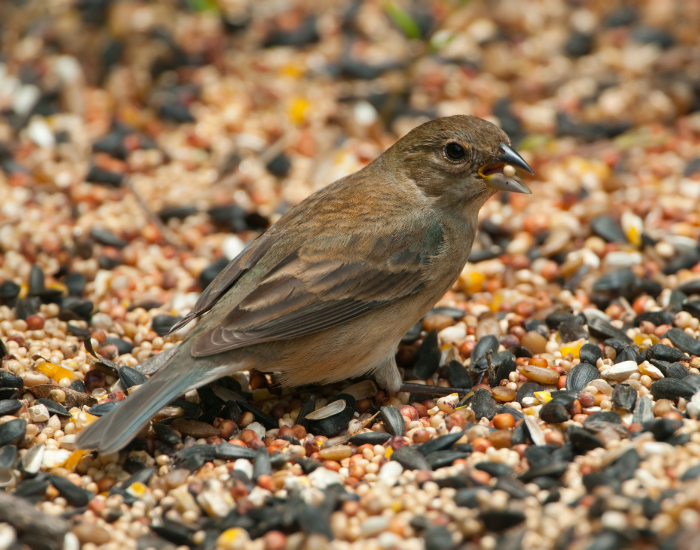
Flush a female indigo bunting from a low tree and you would probably call her a sparrow. The adult female is a soft warm brown above with a pale white belly and faint brown streaking. There is no blue on her at all. This dramatic sexual dimorphism trips up beginning birders constantly. Even juvenile males look mostly brown, with only a few blue feathers hinting at what is coming.
The female indigo bunting carries the same genes for blue feathers, but only adult males express them. Why? Females do nearly all the incubation and feed the young alone, so a brightly colored bird sitting on the nest attracts predators from the ground and the sky. Camouflage is survival. Color is advertisement.
5. They Hybridize With Their Western Cousin
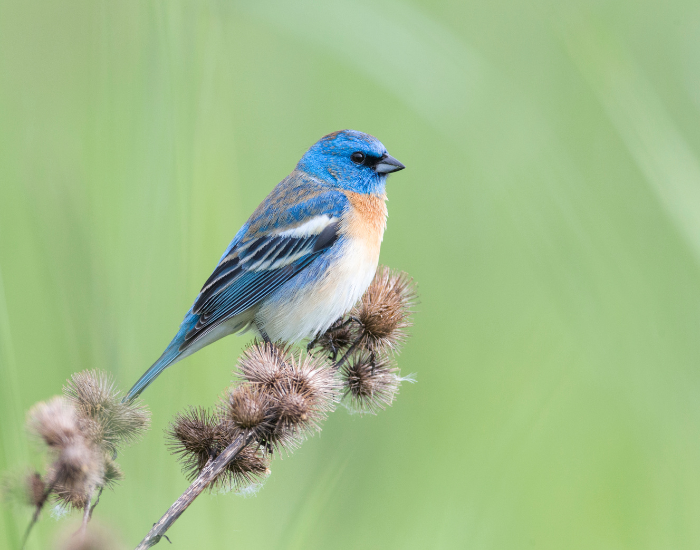
Where eastern North America meets the western plains, the indigo bunting’s range bumps right into the lazuli bunting’s range. The two are close enough genetically that they regularly produce hybrid adult males. The hybrids sing a confused mash of both songs, and the females from either species will sometimes accept them as mates.
A single cluster of trees could hold an indigo, a lazuli, and a mixed male all defending tangled territories from neighboring trees. Hybrid zones like this are evolution happening in real time. Speciation is rarely a clean line drawn on a field guide map.
6. An Indigo Bunting Forages on Both Insects and Seeds
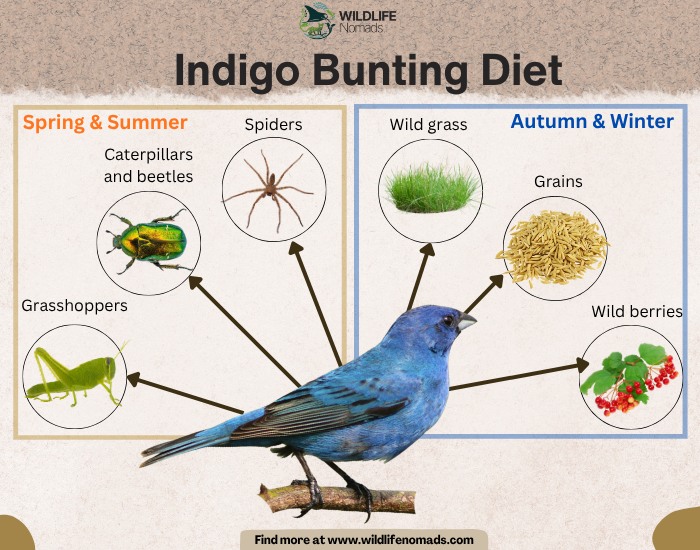
The indigo bunting forages low and almost constantly. During breeding season both males and females hunt small insects, beetles, spiders, and caterpillars to feed their young high-protein food. After hatching, nestlings need a steady stream of insects to grow flight muscles fast enough to fledge. By August, the diet pivots hard from insects toward seeds.
Adult indigo buntings switch to small seeds from coarse grasses, ragweed, and dandelions, plus berries from low shrubs and the occasional flying insect snatched midair. This dietary flexibility lets indigo buntings exploit weedy fields, brushy areas, and recently logged forest where pickier songbirds cannot survive. On their tropical wintering grounds, the indigo buntings lean heavily on seeds and berries again. The bird is built to follow the food.
7. A Single Pair Can Raise Two Broods in One Breeding Season
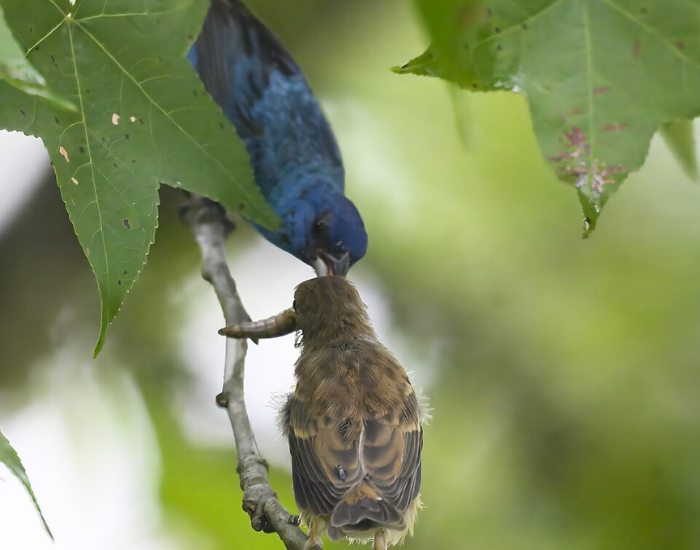
In the southern parts of their range, a successful pair will raise two complete families between late spring and August. The female builds the nest and lays each egg, a pale blue-white, one per day until the clutch holds three or four. She incubates every egg through hatching, then feeds the young largely on her own. The male sings from a high perch in the trees all summer, defending the territory and chasing off rival males with that endless song.
As soon as the first brood fledges, she starts another nest just a few meters away. Each second-clutch egg hatches after about twelve days of patient incubation. By the end of the breeding season, one weedy hedgerow can hold a dozen young indigo buntings tumbling through the grasses and shrubs, wings still half-formed and short flying hops in every direction. Those fledglings leave the nest with adult wings barely tested.
8. Her Nest Is an Engineered Open Cup of Spider Webs and Bark
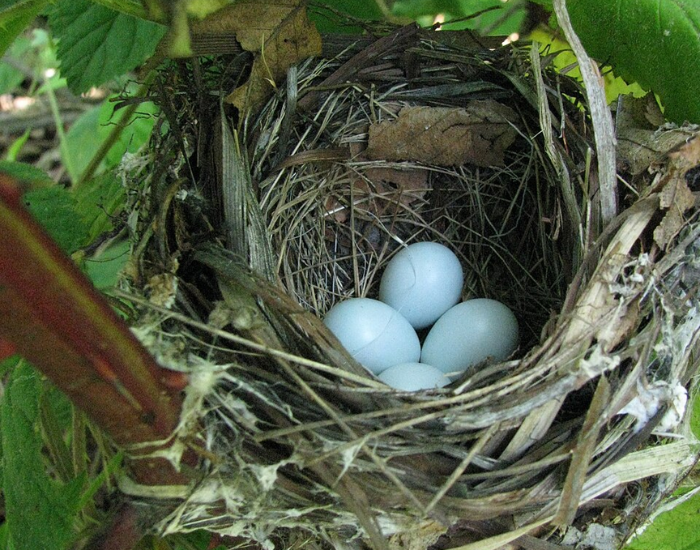
The female indigo bunting weaves an open cup nest about a meter off the ground, usually deep inside a dense low shrub or sapling at the edge of taller trees. The outside is built from coarse grasses, dead leaves, and bark strips. The inside is lined with finer materials — hair, rootlets, and fine grass stems lined so tightly the cup feels almost felted.
She uses a spider web as a kind of structural glue to bind the rim together. Each nest site is chosen for cover, not view. I have crawled on my belly along the ground through blackberry tangles to find active indigo bunting nests, and even at arm’s length I have almost stepped on them twice. Each egg sits cradled in those finer materials, and an egg this small can vanish into a single leaf shadow.
9. They Spend Half the Year in the Tropics
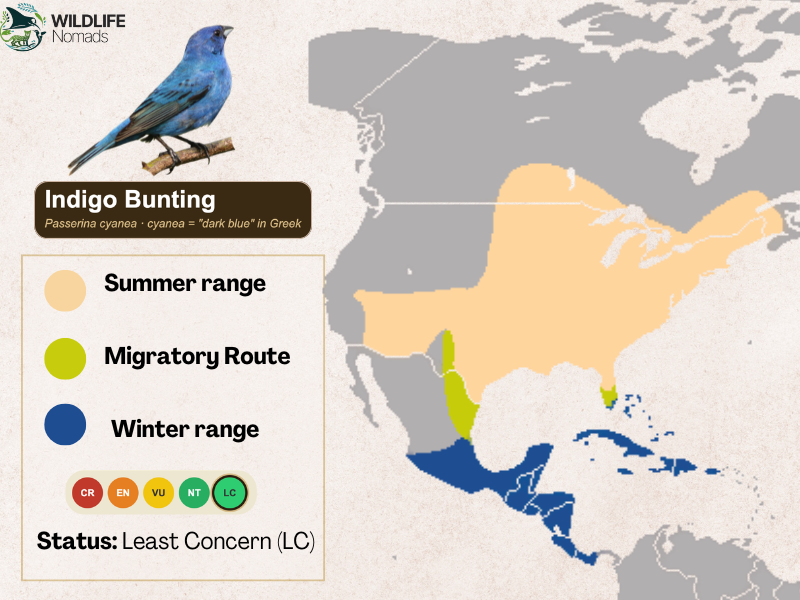
Most birders meet indigo buntings in eastern North America during summer. But these birds spend roughly half the year somewhere else entirely. Indigo buntings migrate from breeding grounds across the eastern United States and southern Canada all the way down through southern Mexico, the Caribbean, and into Central America. A few even drift into northern South America.
The migration is long and overwhelmingly nocturnal. The buntings cross the Gulf of Mexico in single overnight flights flying nonstop. Airborne particles from city light pollution wash out the stars they steer by, and skyscraper windows kill staggering numbers of migrating birds each spring and fall. The little bird hopping at your feeder is a transcontinental athlete.
10. They Are Thriving, But Predators and Glass Take a Heavy Toll
Unlike many North American songbirds, the indigo bunting population is stable and even expanding slightly. The birds benefit from human disturbance. Powerline cuts, abandoned pastures, and roadside weedy habitat all create the open brushy areas indigo buntings prefer for nesting.
That said, the indigo bunting faces real pressure. Free-roaming domestic cats kill billions of small songbirds across North America each year, indigo buntings included. Birds of prey take the adults from the air, while snakes and opossums raid the low nests for eggs and hatchlings before they can grow flying wings. The indigo bunting is common today partly because we have, almost by accident, built the scruffy patchwork world it wants.
Frequently Asked Questions
Indigo buntings are common across eastern North America during breeding season but genuinely rare on the west coast. Partners in Flight estimates the global population at around 78 million breeding adults. You will see indigo buntings most easily in summer along weedy fields and tree-lined brushy hedgerows in the eastern United States and southern Canada. Outside that core range, a single sighting can make a birder’s year — mine certainly did.
Plant native shrubs and grasses, and leave a scruffy corner unmowed. Indigo buntings prefer the brushy edge between woodland and meadow, not manicured lawn. They will visit feeders for small seeds, especially nyjer thistle and white millet, and they love a shallow water source. If your yard sits near eastern north american deciduous forest, your odds rise quickly during late spring migration.
Indigo buntings head south every fall to southern Mexico, the Caribbean, and the forests of Central American countries from Belize through Panama, with a few overshooting into northern South America. A small wintering population also persists in southern Florida. Their winter habitat looks similar to their breeding habitat — weedy second growth, scrubby fields lined with shrubs, and forest edges. The buntings tend to flock together at this time of year, which is unusual for a species that defends solo territories all warm season.
Your Blue Neighbour
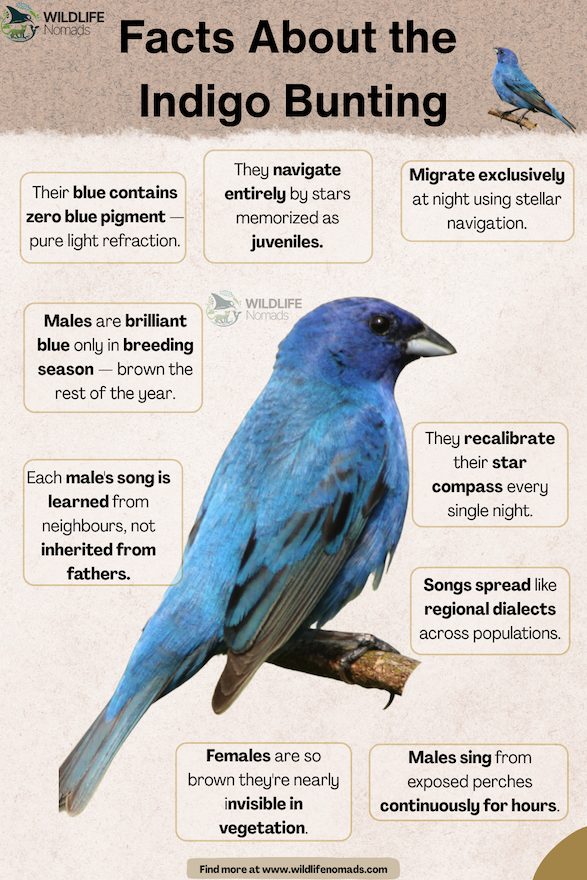
The indigo bunting is a creature most birders walk past in their own backyard, yet his feathers cheat physics, his brain reads the stars, and his song carries the genetic memory of his neighborhood. Pay attention to the small dark blue shapes flickering through your hedgerow this spring. You may be watching a transcontinental migrator that learned the sky as a chick.
If you want to keep going, read my deep dive on the woodpecker family or my field guide to wrens — both birds I encountered on that same Vancouver Island trail. Drop a comment below if you have ever spotted a male bird far outside his expected range. The best field stories almost always start that way.
References:
Emlen, S. T. (1975). The stellar-orientation system of a migratory bird. Scientific American, 233(2), 102–111. https://doi.org/10.1038/scientificamerican0875-102
Payne, R. B. (2020). Indigo Bunting (Passerina cyanea), version 1.0. In Birds of the World (P. G. Rodewald, Editor). Cornell Lab of Ornithology, Ithaca, NY. https://doi.org/10.2173/bow.indbun.01
Prum, R. O., & Torres, R. (2003). Structural colouration of avian skin: convergent evolution of coherently scattering dermal collagen arrays. Journal of Experimental Biology, 206(14), 2409–2429. https://doi.org/10.1242/jeb.00431
Loss, S. R., Will, T., & Marra, P. P. (2013). The impact of free-ranging domestic cats on wildlife of the United States. Nature Communications, 4, 1396. https://doi.org/10.1038/ncomms2380
Carling, M. D., & Brumfield, R. T. (2008). Integrating phylogenetic and population genetic analyses of multiple loci to test species divergence hypotheses in Passerina buntings. Genetics, 178(1), 363–377. https://doi.org/10.1534/genetics.107.076422
Loss, S. R., Will, T., Loss, S. S., & Marra, P. P. (2014). Bird-building collisions in the United States: Estimates of annual mortality and species vulnerability. The Condor, 116(1), 8–23. https://doi.org/10.1650/CONDOR-13-090.1
Rosenberg, K. V., Dokter, A. M., Blancher, P. J., Sauer, J. R., Smith, A. C., Smith, P. A., Stanton, J. C., Panjabi, A., Helft, L., Parr, M., & Marra, P. P. (2019). Decline of the North American avifauna. Science, 366(6461), 120–124. https://doi.org/10.1126/science.aaw1313