
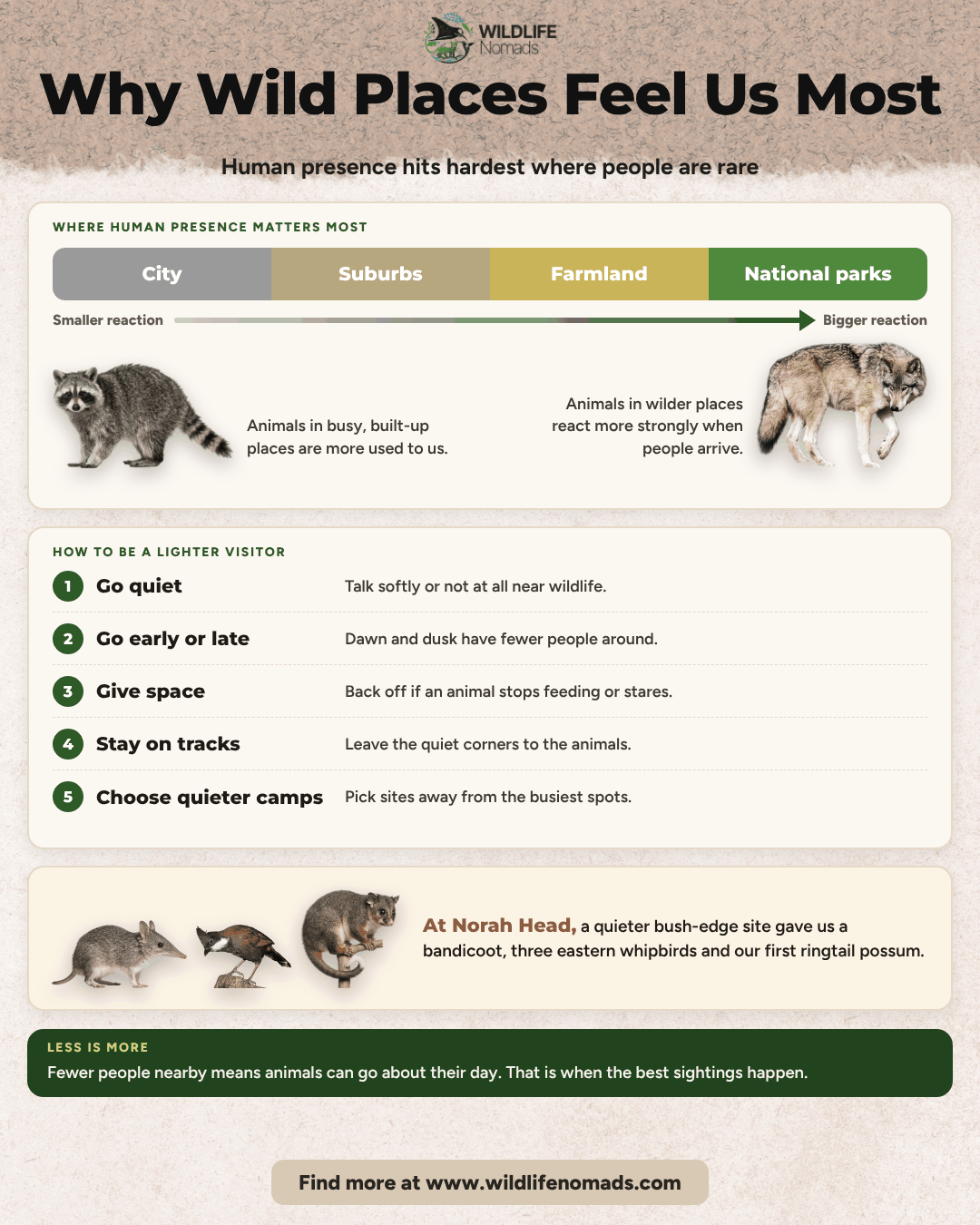
At Norah Head, on the NSW Central Coast, we spent our first nights on a crowded, hot campsite. Then strong winds pushed us to a quiet site at the edge of the bush. That move paid off. We got a bandicoot at our dish scraps, three eastern whipbirds and our first ringtail possum of the lap.
I had a hunch that fewer people meant more wildlife. Now a big 2026 study in Science backs that hunch with numbers. It shows that human presence changes animal behaviour, not just the roads and buildings we leave behind.
Even better, the study shows our presence matters most in the wildest places. That has real lessons for anyone who loves watching wildlife.
How Human Presence Affects Wildlife: The Short Version
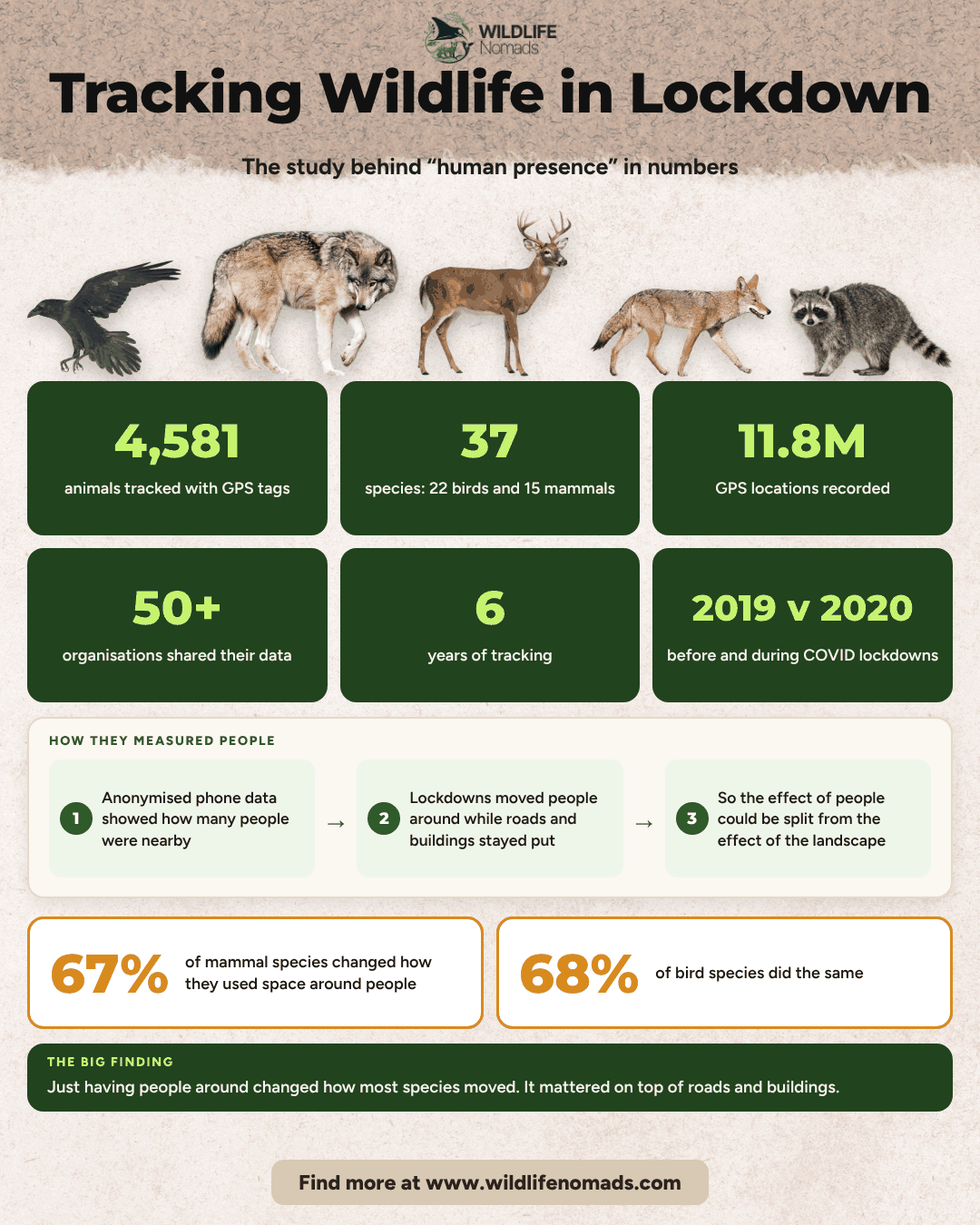
- The study: GPS data from more than 4,500 animals of 37 bird and mammal species across the United States.
- The trick: anonymised mobile phone data showed where people actually were, week by week.
- The headline: human presence changed how more than 65% of species used space.
- The twist: animals reacted most strongly to people in less developed, more natural places.
- The lesson: there is no single rule; each species responds in its own way.
A Pandemic Experiment Nobody Planned
Scientists have long struggled to separate two things. One is how we change landscapes, with farms, roads and towns. The other is the simple fact of people being there, walking, driving and talking.
The COVID-19 lockdowns gave researchers a rare chance. In 2020, people suddenly moved very differently than in 2019, while the landscape stayed the same. Comparing the two years let the team pull those effects apart.
The project ran for six years and involved more than 50 organisations. It was led by Ruth Oliver, now at UC Santa Barbara, and Scott Yanco of the Smithsonian’s National Zoo. They combined about 11.8 million animal locations with anonymised phone data at neighbourhood scale.
Winners, Losers and Opportunists
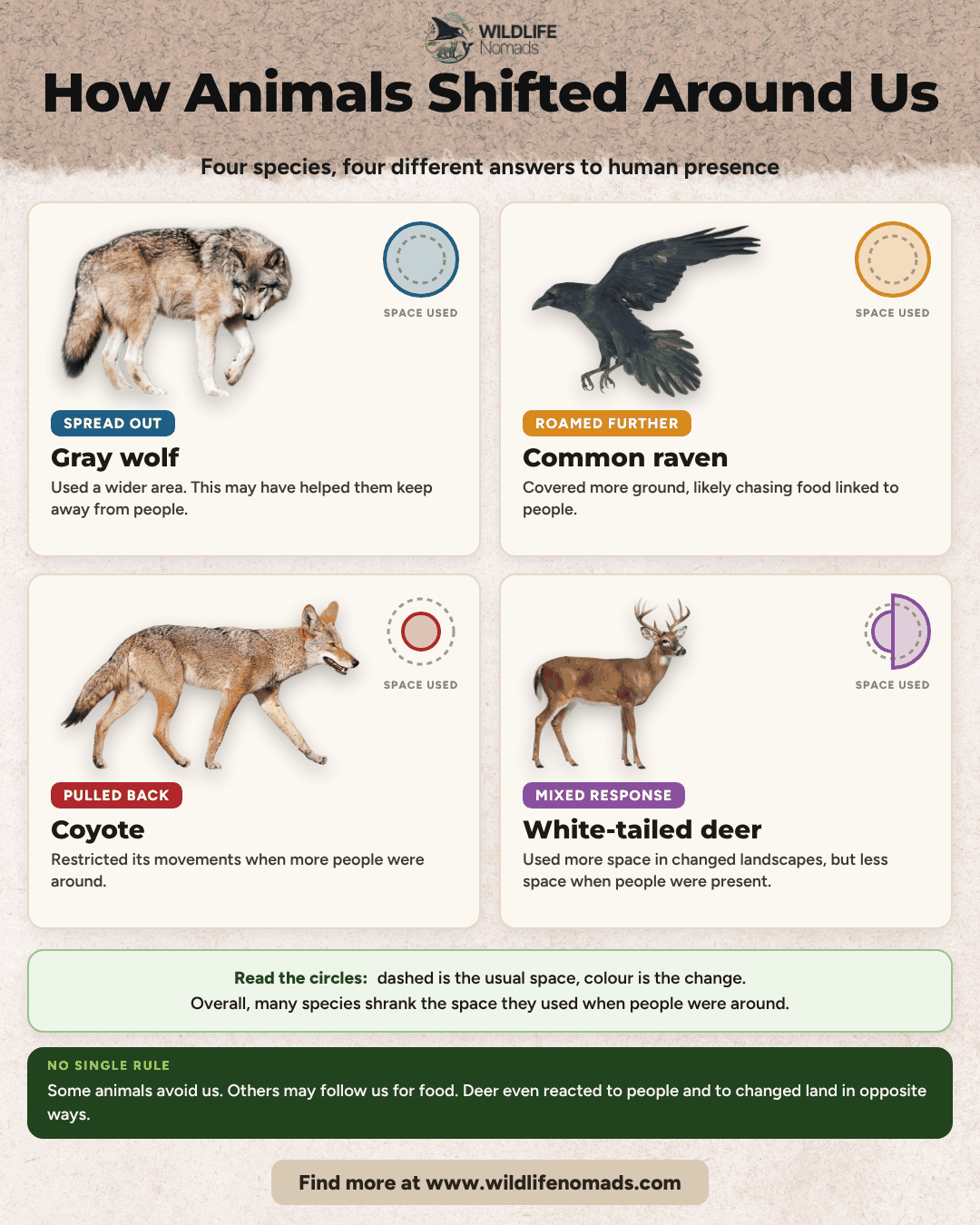
The responses were wonderfully varied. Many species shrank the area they used, probably to avoid people. Others did the opposite.
| Animal | What changed | Likely reason |
|---|---|---|
| Gray wolf | Expanded its range | Possibly moving further to avoid humans |
| Common raven | Covered more ground | Likely using food linked to people |
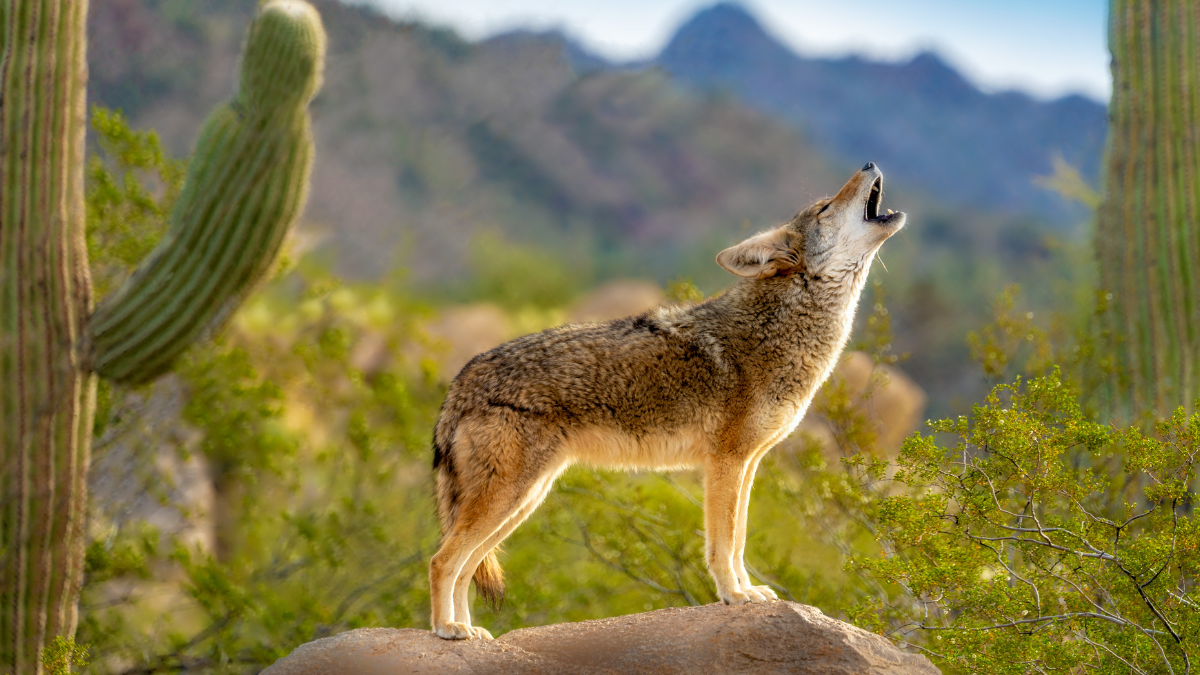
| Coyote | Restricted its movements | Avoiding busy areas |
| Many other species | Used a smaller area | Probably avoiding people |
The tracked animals also included white-tailed deer, raccoons, skunks, vultures, hawks, ducks, cranes and storks. Individual animals could even change their behaviour from one year to the next.
Why Wild Places Feel Us the Most
This was the finding that made me stop and reread. For about 60% of the species that responded, the effects of people and landscape were linked. Animals reacted more strongly to human presence in less modified habitats.
That makes sense when you think about it. A raccoon in a suburb sees people every night, so one more walker barely matters. In remote country, a single hiker may be a rare and alarming event.
Animals Fear Us More Than Lions
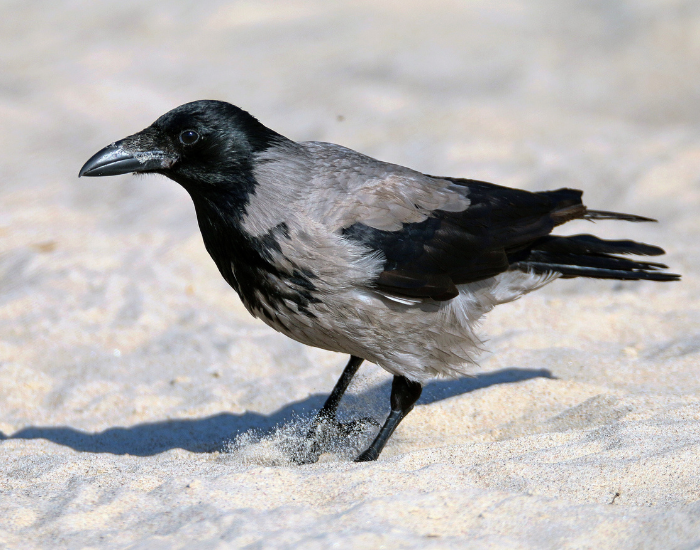
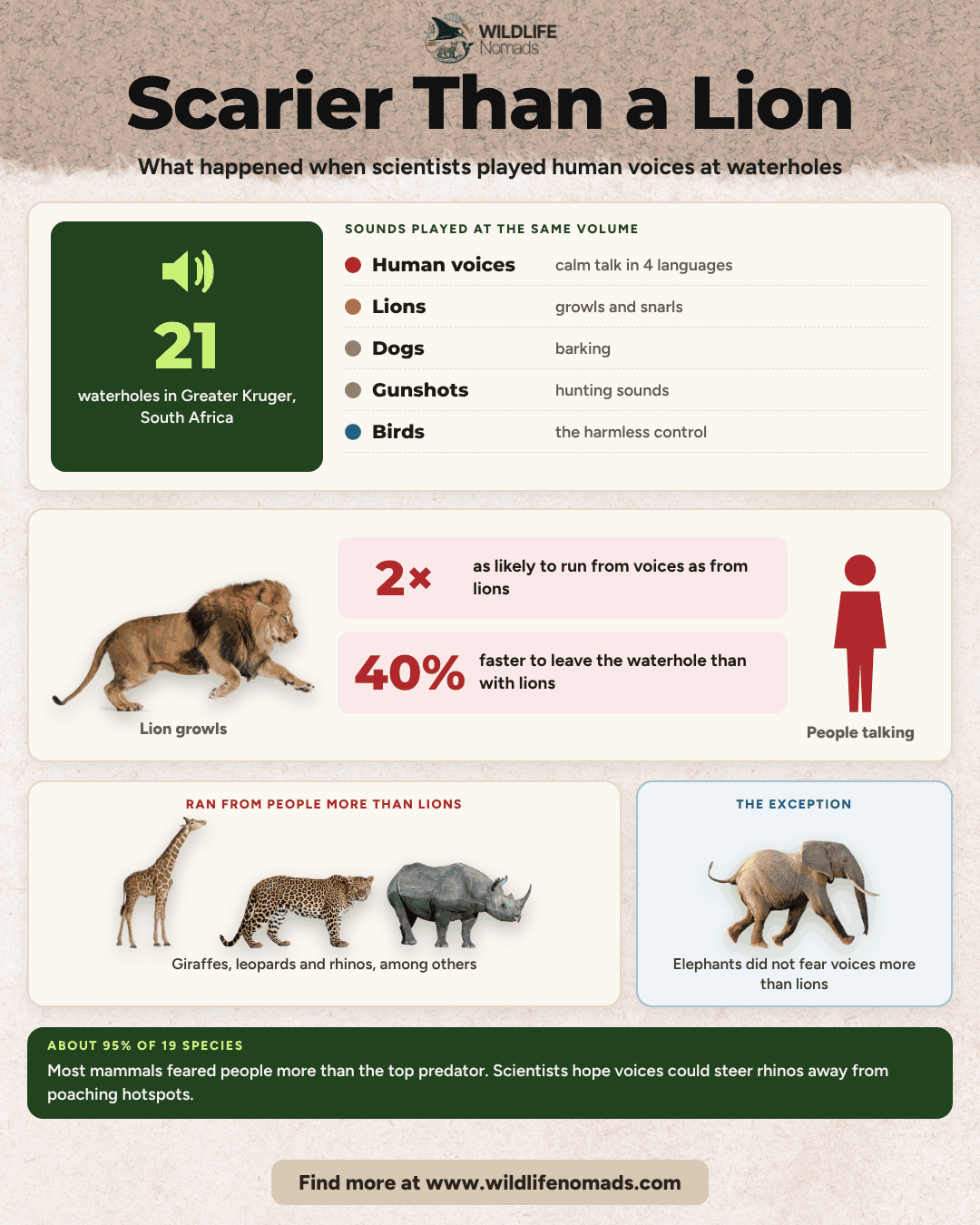
Another study shows just how strongly wildlife can react to us. In 2023, Liana Zanette and colleagues played sounds at waterholes in South Africa’s Greater Kruger National Park.
They played calm human conversation, lion growls, barking dogs and gunshots. About 95% of the 19 mammal species ran or left the waterhole faster when they heard people talking. Giraffes, leopards, elephants and rhinos all feared human voices more than lions.
The team is now testing whether human voices could steer rhinos away from poaching hotspots. For species like the rhino, that fear could become a conservation tool.
What I Have Seen on the Road
On my lap of Australia, quieter places have usually given me more wildlife. Evans Head was our first caravan park. Its busy first day gave me less wildlife than the national park campground at Woody Head.
At Red Cliff, I expected blue-faced honeyeaters everywhere. I saw one just once, darting into the open and straight back to cover. Animals constantly weigh food against danger, and we are part of that danger.
I once tested that trade-off myself. During my exchange at Uppsala University, classmates and I placed stuffed predators near feeding birds. Our small experiment found no significant result, which taught me how hard this research really is.
I have also seen the extreme version. In Sumatra, about 15 tourists crowded around a wild orangutan and her baby. I wrote about that day in where wildlife tourism crosses the line.
How to Watch Wildlife Without Pushing It Away
The researchers say conservation needs targeted strategies, not one-size-fits-all rules. They suggest managing when and how intensely people use sensitive places. As visitors, we can apply the same idea.
- Go quiet: keep voices low, since many animals react to talking.
- Go early or late: visit wild spots outside the busiest hours.
- Give space: use binoculars or a zoom lens instead of walking closer.
- Stay on tracks: fewer trampled edges mean less disturbance in sensitive habitat.
- Choose quieter camps: a site at the bush edge can beat a busy central spot.
FAQs About How Humans Affect Wildlife
A 2026 study in Science tracked 37 bird and mammal species. Human presence changed how more than 65% of them used space. Some species avoided people, while others, like ravens, roamed further, likely for human-linked food.
Animals in remote places meet people less often, so a visitor may seem more threatening. The 2026 study found reactions to human presence were stronger in less modified habitats.
The team used anonymised mobile phone location data at neighbourhood scale. They compared 2019 with the 2020 COVID-19 lockdowns, when people moved very differently.
In South Africa’s Greater Kruger National Park, scientists played sounds at waterholes. About 95% of mammal species reacted more strongly to calm human voices than to lions. The study appeared in Current Biology in 2023.
Keep your voice low, visit outside busy hours and keep your distance with binoculars. Stay on tracks, especially in remote, natural places where animals react most.
Be the Quietest Animal in the Forest
Human presence affects wildlife far more than our footprints suggest. Animals notice us, and they notice us most where nature is wildest.
Next time you head out, try being the quietest animal on the track. Then check which species need the most space in our endangered animals explorer, and take the quiz below.
References:
Oliver, R. Y., Yanco, S. W., et al. (2026). Interacting effects of human presence and landscape modification on birds and mammals. Science, 392(6800), 879–884. https://doi.org/10.1126/science.adq3396
Zanette, L. Y., Frizzelle, N. R., Clinchy, M., Peel, M. J. S., Keller, C. B., Huebner, S. E., & Packer, C. (2023). Fear of the human “super predator” pervades the South African savanna. Current Biology, 33(21), 4689–4696. https://doi.org/10.1016/j.cub.2023.08.089
Yale University. (2026, May 21). Wildlife is watching us, too — and changing their behavior in response. news.yale.edu