I recently stood in Hintze Hall at London’s Natural History Museum with my neck craned back like a kid. For many biologists, that building is a pilgrimage. Hope, the 25-metre blue whale, dives from the ceiling above you. Further in, a giant ground sloth skeleton reminds you how strange the last Ice Age really was.
Walking among those bones, my mind kept drifting to mammoths. Like most people, I met them through a screen first. For me, it was Manny, the grumpy, loyal woolly mammoth from the Ice Age films.
The real animals turned out to be stranger, more varied and far more recent than any cartoon suggests. They’re back in the news too, with startups promising to “de-extinct” them. So I went back to the papers and the books. These are the 12 facts about mammoths I think everyone should know, digested simply.
Would you survive the Ice Age? Twelve facts, twelve questions. Read on, then take the mammoth quiz at the end and find out if you’re a woolly expert or still thawing out. Jump to the quiz ↓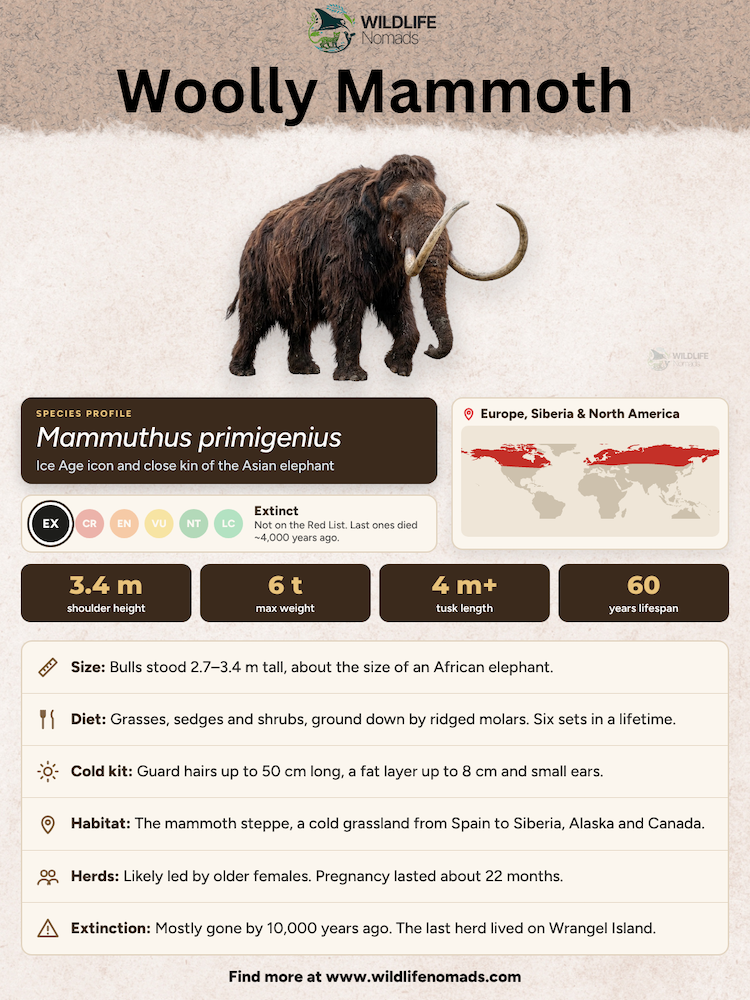
1. What Is a Mammoth? An Elephant, Not a Distant Cousin
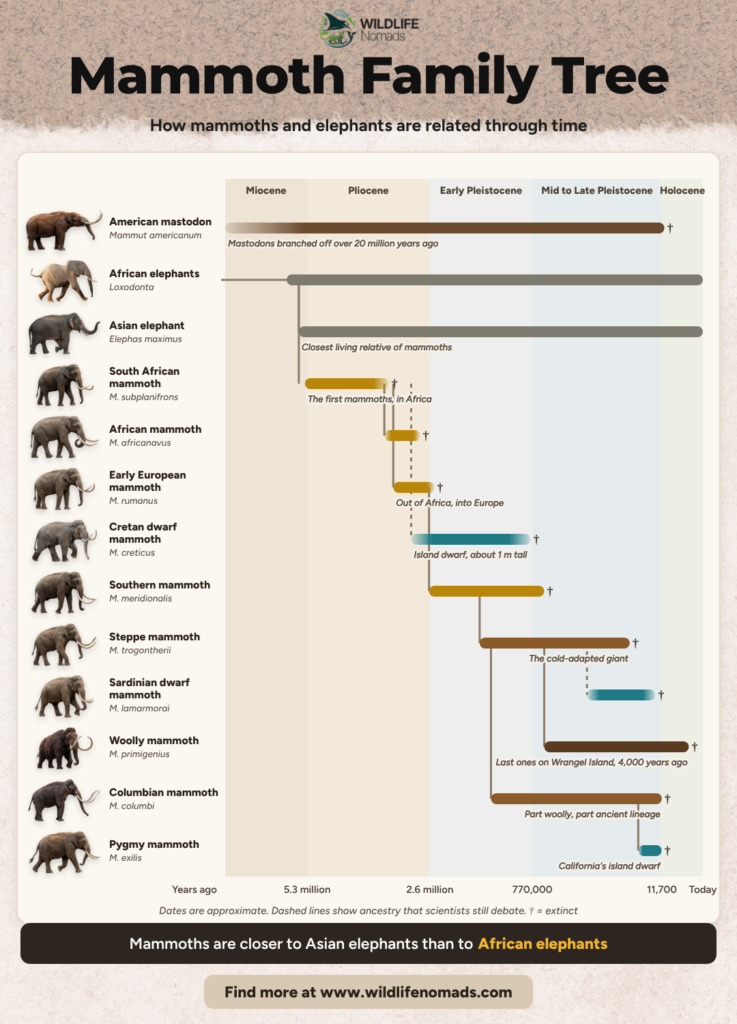
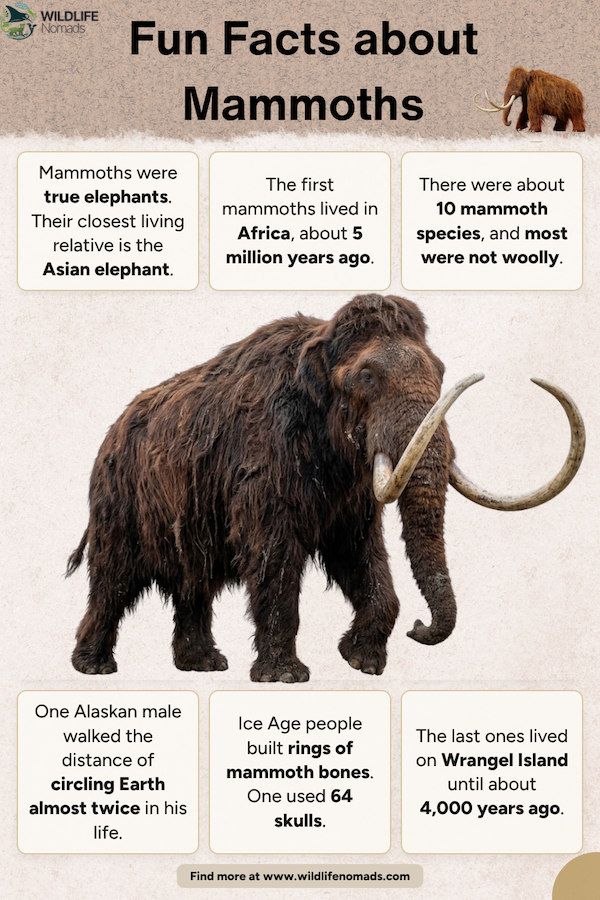
A mammoth is not an elephant ancestor. It is an elephant. Mammoths belong to the elephant family, Elephantidae, in their own genus, Mammuthus.
Their closest living relatives are Asian elephants, not African elephants. Genetic studies place the split between the mammoth and Asian elephant lineages around 5 to 6 million years ago. That makes mammoths more closely related to today’s elephants in India than to the elephants of the African savanna.
People often mix mammoths up with mastodons. However, mastodons sit in a separate family that branched off much earlier. The giveaway is in the teeth. Mastodon molars carry cone-shaped cusps for crushing leaves and twigs, while mammoth molars are flat, ridged grinders built for grasses.
2. The First Mammoths Lived in Africa
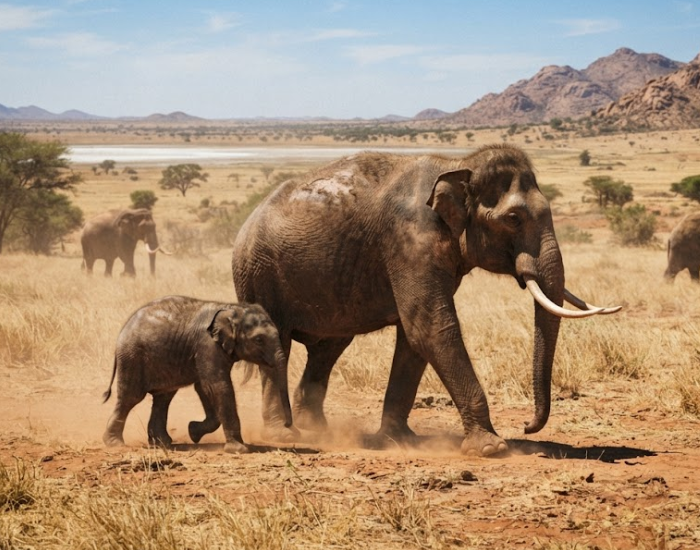
Here’s the twist that surprised me most: the icon of the frozen north began in Africa. The earliest mammoth species appeared there roughly 5 million years ago. Palaeontologists sometimes call these early forms “African mammoths,” and one of them, Mammuthus africanavus, carries the name.
According to the Natural History Museum’s mammoth expert, Professor Adrian Lister, mammoths broke out of Africa around 3.5 million years ago. They moved through the Middle East and spread rapidly across Europe and Asia. Cold adaptation came much later. For most of their history, mammoths were not built for snow.
3. Not All Mammoths Were Woolly: There Were About Ten Species
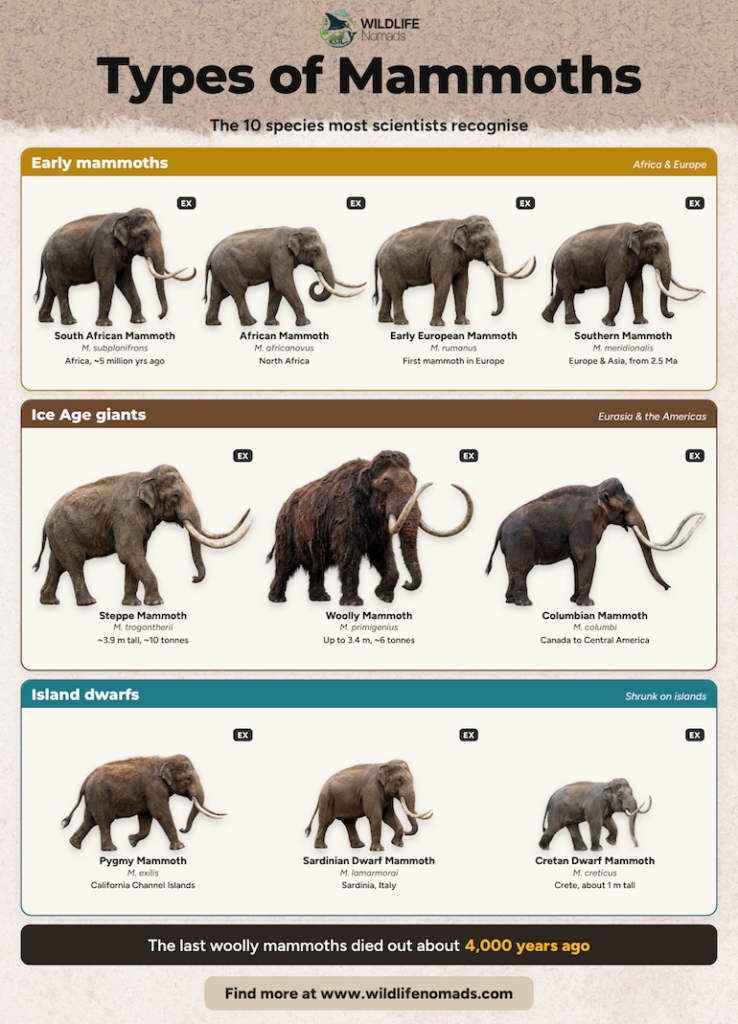
Scientists currently recognise around ten mammoth species, although experts still debate a few names. Here’s the commonly accepted list:
- Mammuthus subplanifrons – Africa, the oldest and most debated
- Mammuthus africanavus – North Africa
- Mammuthus rumanus – the first mammoth in Europe
- Mammuthus meridionalis – the southern mammoth
- Mammuthus trogontherii – the steppe mammoth
- Mammuthus primigenius – the woolly mammoth
- Mammuthus columbi – the Columbian mammoth of North America
- Mammuthus exilis – the pygmy mammoth of California’s Channel Islands
- Mammuthus lamarmorai – a dwarf mammoth from Sardinia
- Mammuthus creticus – a tiny mammoth from Crete
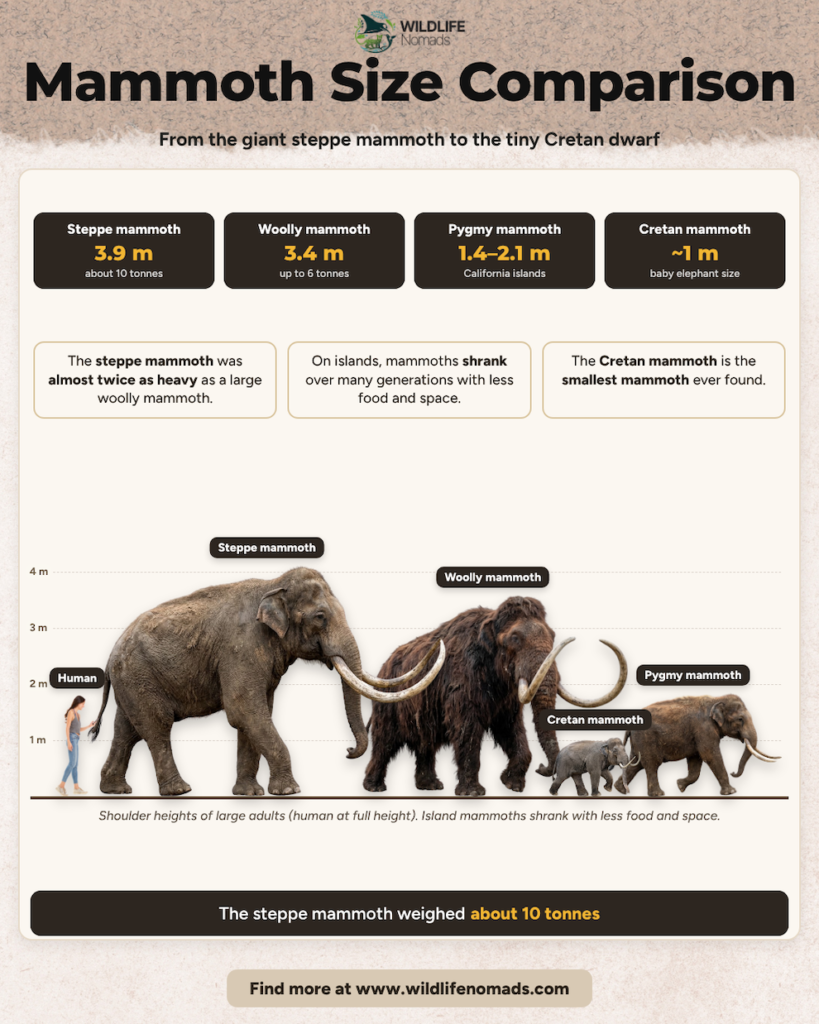
You might also see “imperial mammoths” (M. imperator) in older books. Most researchers now fold them into the Columbian mammoth. Island species shrank dramatically. The Cretan mammoth stood only about a metre tall, roughly the size of a baby elephant.
4. The Southern Mammoth Shared the Land With Early Humans
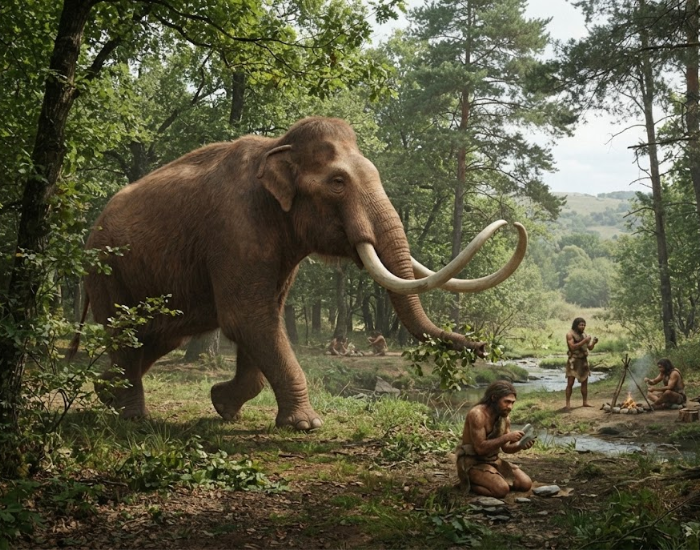
Mammuthus meridionalis, the southern mammoth, appeared in Europe around 2.5 million years ago. It lived in milder, wooded landscapes and ate a mix of leaves and grasses. Interestingly, it had little in common with the shaggy giant we imagine.
At Dmanisi in Georgia, early human fossils around 1.8 million years old sit in deposits alongside southern mammoth remains. So the relationship between humans and mammoths is ancient. It started long before anyone built a spear point designed for big game.
5. The Steppe Mammoth Was the Real Giant
Forget Manny. The heavyweight of the family was the steppe mammoth, Mammuthus trogontherii. A nearly complete skeleton from Inner Mongolia suggests a living shoulder height near 3.9 metres. Volumetric modelling put its weight around 10.4 tonnes.
That’s roughly twice the mass of a large woolly mammoth. Steppe mammoths also mark the start of cold adaptation in the lineage, and they probably carried a coat of fur. They crossed the Bering Land Bridge into North America about 1.5 million years ago. As a result, they became the root of the American mammoth story.
If yu wanna see how animals compare in size, do not forget to visit our Animal size interactive tool.
6. Woolly Mammoths Were About the Size of African Elephants
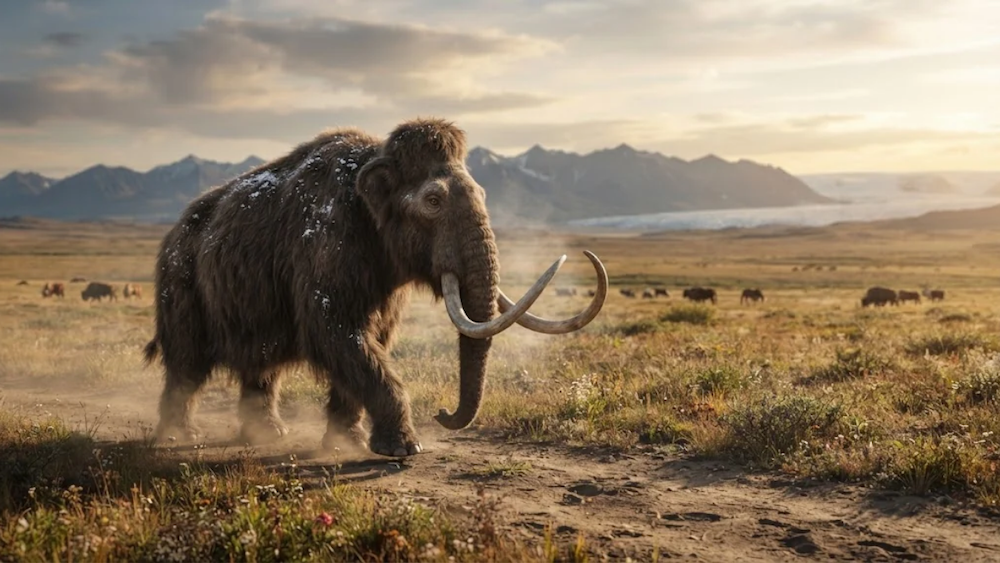
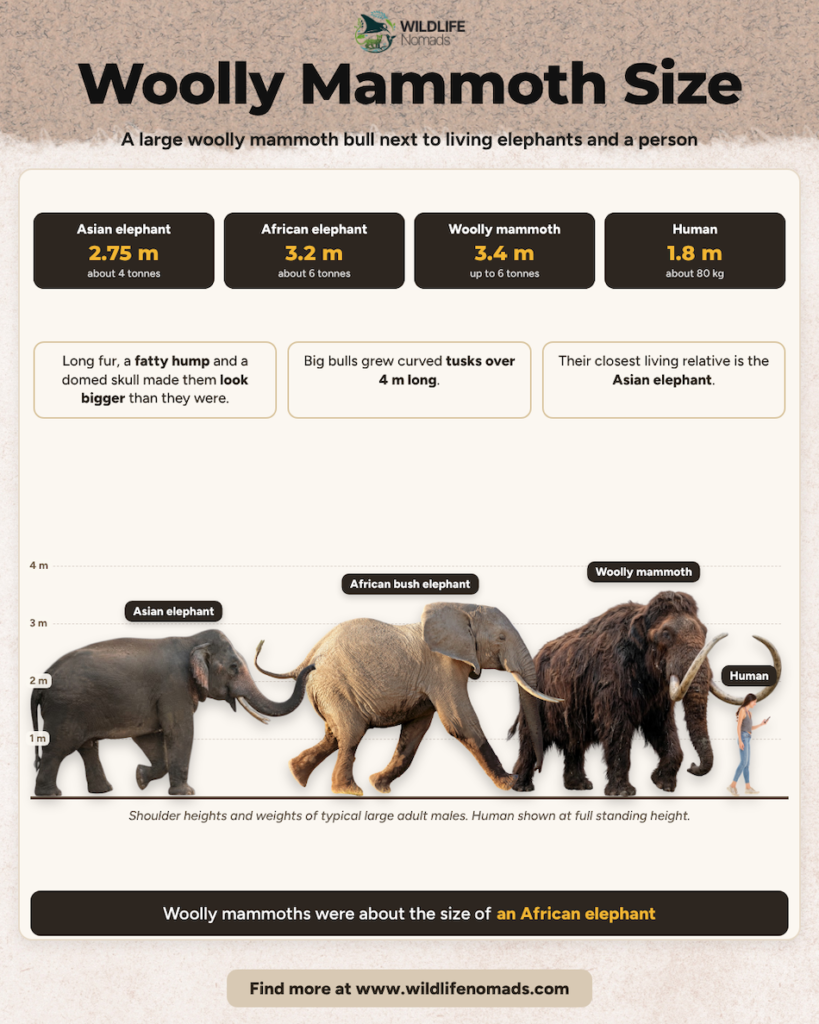
The woolly mammoth, Mammuthus primigenius, evolved in northeastern Siberia between roughly 800,000 and 600,000 years ago. Large bulls stood around 2.7 to 3.4 metres at the shoulder and weighed up to about 6 tonnes. In other words, they matched a big African elephant rather than towering over it.
What set them apart was their cold-weather kit. They had long guard hairs over a dense underwool, a thick fat layer, small ears and a short tail. A fatty hump sat behind a high, domed skull, giving them that sloping back. Their curved tusks could exceed 4 metres in big bulls.
Ancient DNA shows these traits sharpened over time. A 2023 study compared a 700,000-year-old genome with younger ones. The earliest woolly mammoths already carried the core genes, but fur, fat and small ears became more pronounced over hundreds of thousands of years. Every time I’m near a living elephant, I feel genuine awe. I can only imagine a hairy one walking out of a Siberian blizzard.
7. Columbian Mammoths Were Hybrids
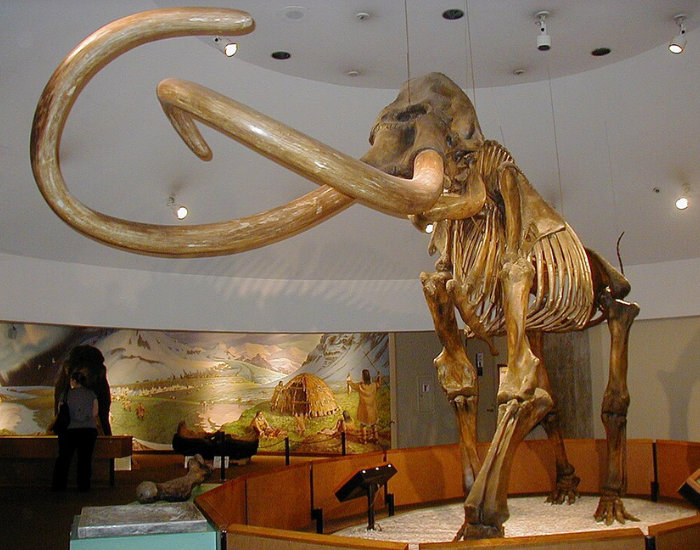
The Columbian mammoth roamed North America from Canada down to Central America. It was bigger than the woolly mammoth and mostly lived further south, where grasslands stayed open. For decades, scientists assumed it evolved earlier than its woolly cousin.
Then came genetics. In 2021, a team including Adrian Lister sequenced DNA from Siberian permafrost teeth more than a million years old. The results showed a previously unknown lineage that interbred with woolly mammoths. Therefore, Columbian and woolly mammoths are more entangled than anyone expected: Columbians carried roughly half their ancestry from each.
This one is personal for me. Mexico is full of Columbian mammoth remains. Construction of the new airport north of Mexico City uncovered hundreds of them. Columbian mammoths disappeared around 12,500 years ago, near the end of the late Pleistocene.
8. Mammoths Engineered Their Own Ecosystem
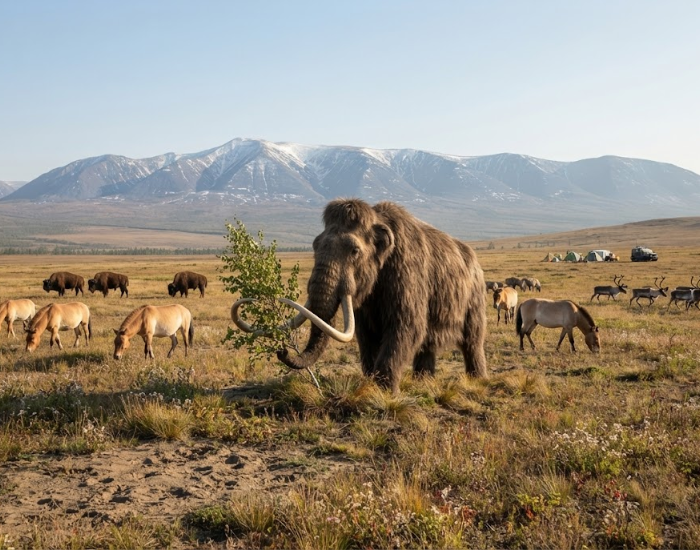
Mammoths lived across the “mammoth steppe,” a vast cold grassland that stretched from Europe through Siberia and Alaska into Canada. Today nothing quite like it exists. It was dry, productive and full of grazers, including bison, horses and reindeer.
Mammoths helped keep it that way as key animals within the food web. They grazed grasses, trampled and knocked down shrubs and young trees, and spread nutrients in their dung. That kept the land open and fertile. I’ve watched semi-domesticated reindeer herds in Sweden, and they gave me a small taste of that world.
This idea isn’t just history. In Siberia, scientists at Pleistocene Park are testing whether horses, bison and other large herbivores can recreate steppe-like grasslands. It’s a bold experiment in rewilding, and its results matter for permafrost too.
9. Mammoth Calves and a Nearly Two-Year Pregnancy
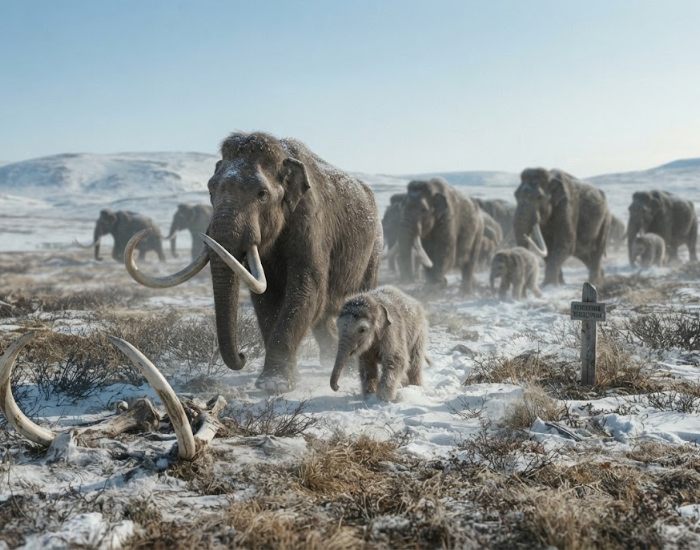
Elephants carry their calves for about 22 months, the longest pregnancy of any living land mammal. Mammoths most likely did the same, although no fossil can confirm it directly. Herds were probably led by older females, as they are in living elephants.
We know a surprising amount about mammoth calves thanks to the permafrost. In 2007, reindeer herders on Russia’s Yamal Peninsula found Lyuba, a baby mammoth about a month old. She is one of the best-preserved mammoths ever discovered. In St Petersburg, the Zoological Museum still displays the Berezovka mammoth, found frozen in Siberia in 1900.
Tusks act like diaries. They grow in layers, like tree rings, and chemical isotopes in each layer record diet and location. In 2021, researchers traced one male Alaskan mammoth across his 28-year life. He walked a distance equal to circling the Earth almost twice. Like elephants, mammoths also replaced their molars in sequence, using six sets in a lifetime.
10. Humans Hunted Mammoths and Built With Their Bones
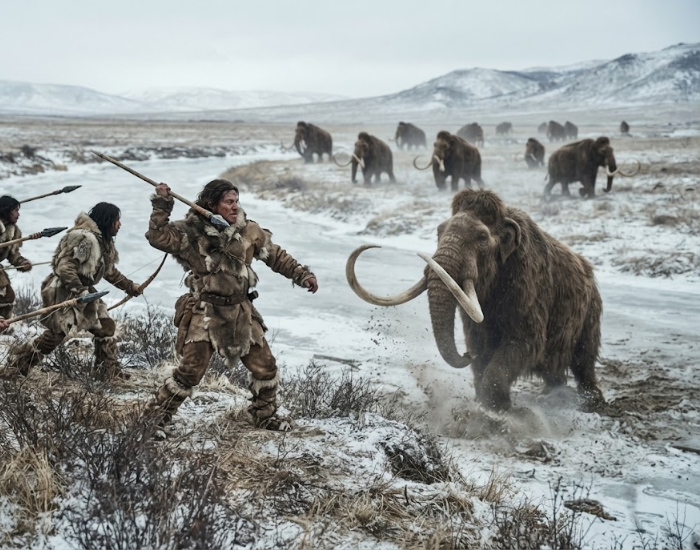
Modern humans hunted woolly mammoths across Europe and Asia during the last glacial period. In North America, Paleoindian hunters killed Columbian mammoths, and archaeologists have found spear points among their bones. People also carved mammoth ivory into tools, beads and some of the world’s oldest art.
The most striking remains are the bone circles. Around 70 of these structures are known from Ukraine and the western Russian Plain. At Kostenki 11, builders used 51 lower jaws and 64 skulls in a ring over 12 metres across. Archaeologists long called these “mammoth bone huts.” However, the Kostenki 11 study suggests some weren’t permanent homes and may have served for food storage or seasonal camps.
11. The Last Woolly Mammoths Survived Until the Pyramids
Most mammoths disappeared at the end of the Pleistocene. Woolly mammoths vanished from much of Europe by around 14,000 years ago. On mainland Siberia and Alaska, they were mostly gone by roughly 10,000 years ago.
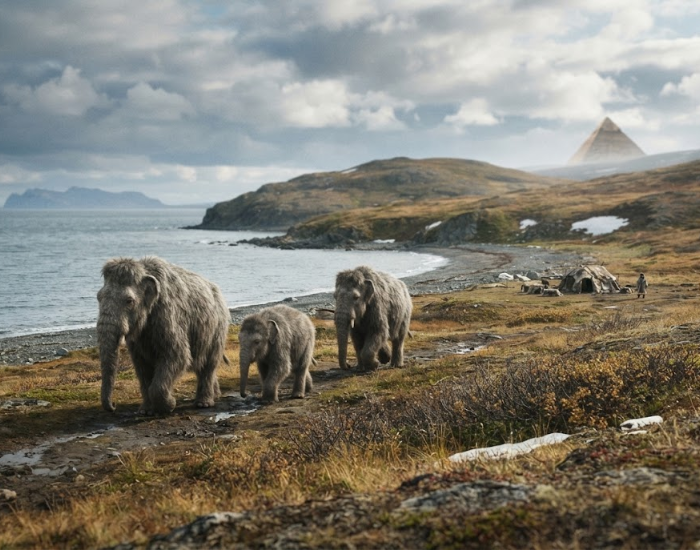
Two island populations held on. On St Paul Island in Alaska, mammoths survived until about 5,600 years ago, likely until freshwater ran out. On Wrangel Island in the Arctic Ocean, woolly mammoths survived until roughly 4,000 years ago. By then, Egyptians had already built the Great Pyramid.
The Wrangel population was small and genetically impoverished. A 2019 study in Quaternary Science Reviews found the island’s habitat stayed suitable to the end. The authors suggested a sudden crisis, such as extreme weather, finished them off. Humans reached the island only a few centuries later. On the mainland, scientists still debate the balance between rapid climate change and human hunting. Most now think both played a role, which echoes what happened to many other Ice Age animals.
12. “Bringing Back” the Mammoth Means Editing an Elephant
In 2025, Colossal Biosciences unveiled “woolly mice” with mammoth-style hair. A few weeks later, they announced “dire wolves,” which were really grey wolves carrying edited genes. Their mammoth plan works the same way: edit Asian elephant cells to carry mammoth traits.
The timeline has already slipped. In September 2026, the company pushed its first mammoth-like calf from 2028 to the early 2030s. It now expects to need more than 150 gene edits. Even if it works, the result will be a cold-tolerant Asian elephant, not a mammoth that learned from a mammoth mother.
I’m genuinely curious about the science, and the elephant herpes vaccine work could help living elephants. Still, Asian elephants are endangered and deeply social. I’d want hard answers on surrogacy, welfare and habitat before cheering. The mammoth steppe these animals depended on no longer exists.
Frequently Asked Questions
It depends on the species. A woolly mammoth weighed up to about 6 tonnes, lighter than an adult Tyrannosaurus rex at roughly 8 tonnes. However, the steppe mammoth reached around 10 tonnes and stood nearly 4 metres at the shoulder, outweighing T. rex. The two never met: T. rex died out about 66 million years before the first mammoths appeared.
Probably close to it. Living elephants carry calves for about 22 months, and mammoths, as close relatives, most likely had a similar pregnancy. No fossil records gestation directly, so scientists infer it from modern elephants. Colossal’s de-extinction plans also assume a 22-month pregnancy.
The woolly mammoth is famous as the symbol of the Ice Age. People know it for its shaggy fur, huge curved tusks and fatty hump. Frozen carcasses from the Siberian permafrost, cave paintings and mammoth bone structures built by early humans add to that fame.
None. Every mammoth species is extinct. The last known population lived on Wrangel Island in the Arctic Ocean and died out around 4,000 years ago. Gene-editing projects aim to create mammoth-like elephants, but these would be modified elephants rather than true mammoths.
Most mammoths disappeared between about 14,000 and 10,000 years ago, at the end of the Pleistocene. Columbian mammoths vanished around 12,500 years ago. Isolated woolly mammoths survived on St Paul Island until about 5,600 years ago and on Wrangel Island until roughly 4,000 years ago.
Should We Bring them Back?
Mammoths weren’t one frozen species frozen in time. They were a family of elephants that left Africa, conquered three continents and adapted to everything from Mediterranean islands to Arctic steppe. That’s the real story the London bones started for me, and it beats any cartoon.
If you’ve ever stood next to a living elephant, you already know a small part of what our ancestors felt. Go see one, ethically, and picture it covered in fur. Then tell me in the comments: should we bring mammoths back, or protect today’s elephants first?
If you enjoy prehistoric giants, read my posts on the saber-tooth tiger, the American cave lion and the megalodon. You can also compare real animal sizes with the animal size comparison tool.
The Mammoth Quiz
One question for every fact in this post. Pick an answer and you’ll see straight away whether you got it, plus a little extra I couldn’t fit above.
Hungry for more giants? Meet the saber-tooth tiger, the giant ground sloth or the rest of the Ice Age animals.
References:
Arppe, L., Karhu, J. A., Vartanyan, S., Etu-Sihvola, H., Drucker, D. G., & Bocherens, H. (2019). The isotopic record of the Wrangel Island woolly mammoth population. Quaternary Science Reviews, 222, 105884. https://doi.org/10.1016/j.quascirev.2019.105884
Díez-del-Molino, D., Dehasque, M., Chacón-Duque, J. C., Pečnerová, P., Tikhonov, A., Protopopov, A., Plotnikov, V., Kanellidou, F., Nikolskiy, P., Mortensen, P., Danilov, G. K., Vartanyan, S., Gilbert, M. T. P., Lister, A. M., Heintzman, P. D., van der Valk, T., & Dalén, L. (2023). Genomics of adaptive evolution in the woolly mammoth. Current Biology, 33(9), 1753–1764. https://doi.org/10.1016/j.cub.2023.03.084
Graham, R. W., Belmecheri, S., Choy, K., Culleton, B. J., Davies, L. J., Froese, D., Heintzman, P. D., Hritz, C., Kapp, J. D., Newsom, L. A., Rawcliffe, R., Saulnier-Talbot, É., Shapiro, B., Wang, Y., Williams, J. W., & Wooller, M. J. (2016). Timing and causes of mid-Holocene mammoth extinction on St. Paul Island, Alaska. Proceedings of the National Academy of Sciences, 113(33), 9310–9314. https://doi.org/10.1073/pnas.1604903113
Larramendi, A. (2016). Shoulder height, body mass, and shape of proboscideans. Acta Palaeontologica Polonica, 61(3), 537–574. https://doi.org/10.4202/app.00136.2014
Pryor, A. J. E., Beresford-Jones, D. G., Dudin, A. E., Ikonnikova, E. M., Hoffecker, J. F., & Gamble, C. (2020). The chronology and function of a new circular mammoth-bone structure at Kostenki 11. Antiquity, 94(374), 323–341. https://doi.org/10.15184/aqy.2020.7
van der Valk, T., Pečnerová, P., Díez-del-Molino, D., Bergström, A., Oppenheimer, J., Hartmann, S., … Dalén, L. (2021). Million-year-old DNA sheds light on the genomic history of mammoths. Nature, 591(7849), 265–269. https://doi.org/10.1038/s41586-021-03224-9
Wooller, M. J., Bataille, C., Druckenmiller, P., Erickson, G. M., Groves, P., Haubenstock, N., … Willis, A. D. (2021). Lifetime mobility of an Arctic woolly mammoth. Science, 373(6556), 806–808. https://doi.org/10.1126/science.abg1134
Further reading: Lister, A., & Bahn, P. Mammoths: Giants of the Ice Age. University of California Press (2007 revised edition); Frances Lincoln (2015 third edition).