
I knew about black swans years before I moved to Australia. Knowing did not help much.
We grow up on white swans. Ballet, cartoons, storybooks, the mute swans I once watched drifting through the canals of Bruges. All white, all serene. Then you stand on a Queensland foreshore and something the colour of wet charcoal slides past with a glowing red bill.
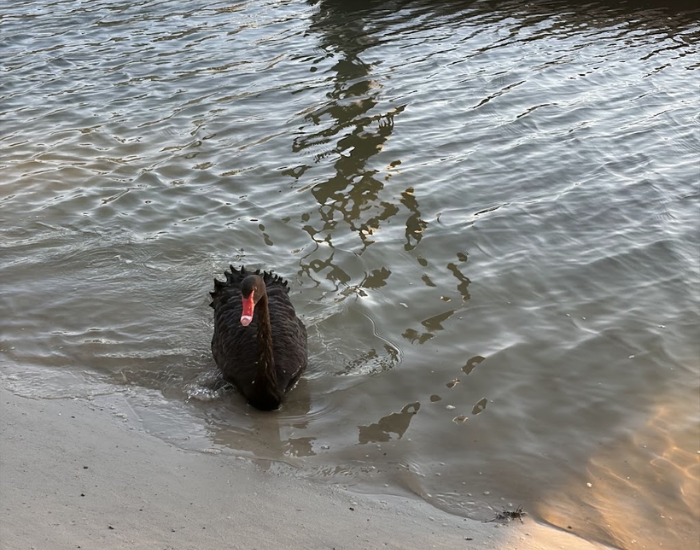
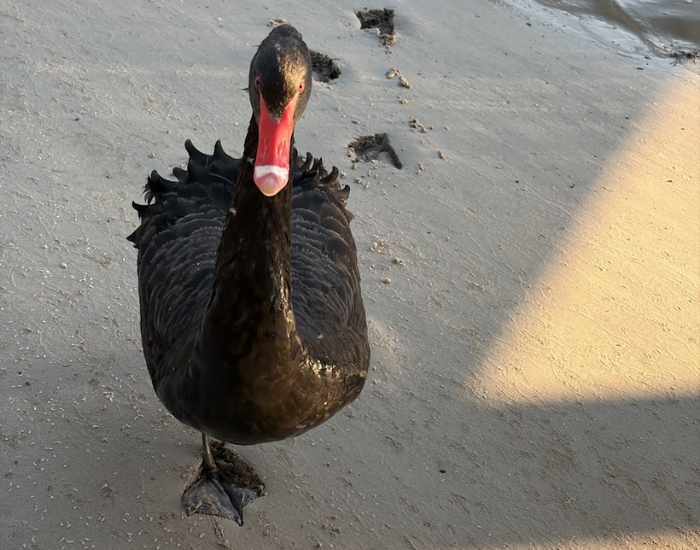
I live on the Gold Coast now, where this bird is ordinary. Black swans line the Broadwater at Labrador and Southport. They ignore joggers and prams. One walked straight up to my hand and demanded food.
What follows are twelve things worth knowing about Cygnus atratus. Some are field marks you can use. Some are biology that surprised me, including during a job identifying these birds from satellite imagery. And some explain how one Australian bird rewrote a European figure of speech.
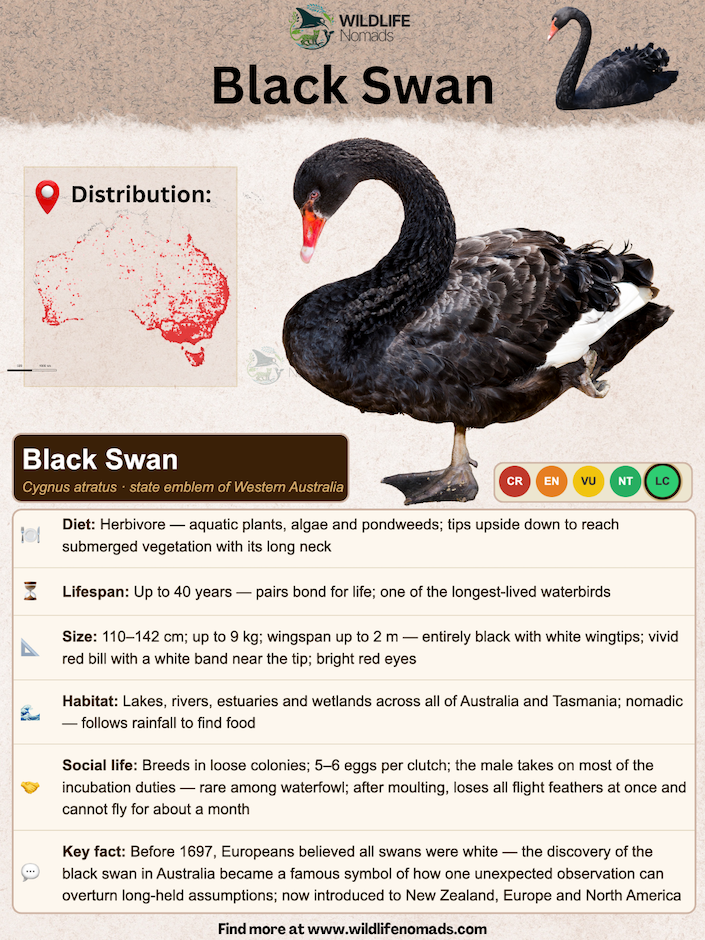
1. Europe Had the Phrase Long Before It Had the Bird
The Roman poet Juvenal wrote it first, in Satire VI. He described something as rara avis in terris nigroque simillima cygno — a bird as rare on earth as a black swan.
He meant it as a joke about impossibility, and the line held for roughly fifteen centuries. By the 16th century, Londoners used “black swan” the way we might say “when pigs fly”.
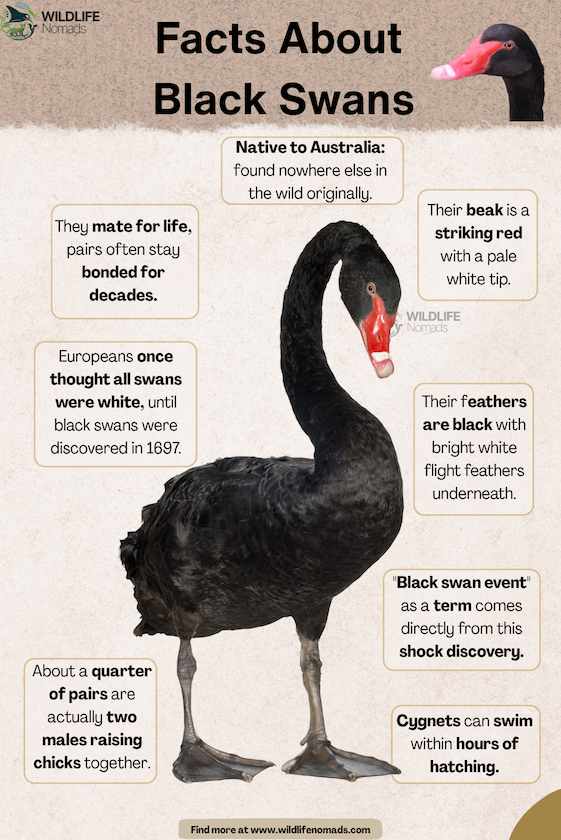
Then in 1697 the Dutch navigator Willem de Vlamingh sailed up a river in Western Australia and saw them. He named the river after the birds. The Swan River still carries that name, and those European explorers gave science its first written description of the species.
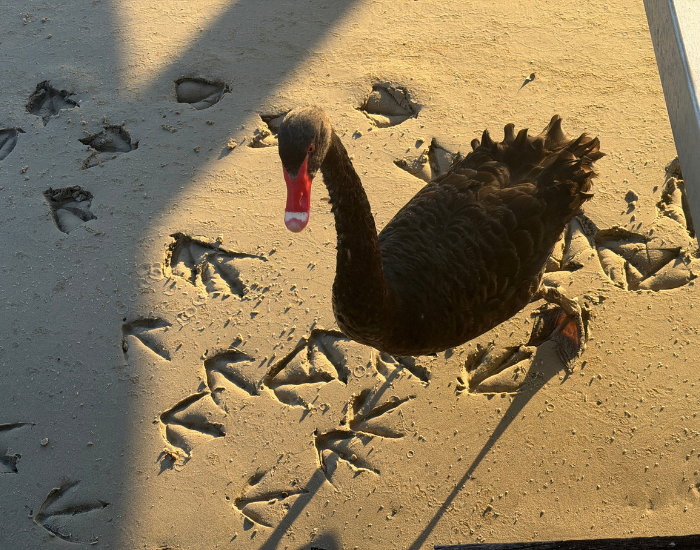
2. No Other Swan Carries a Neck Like This
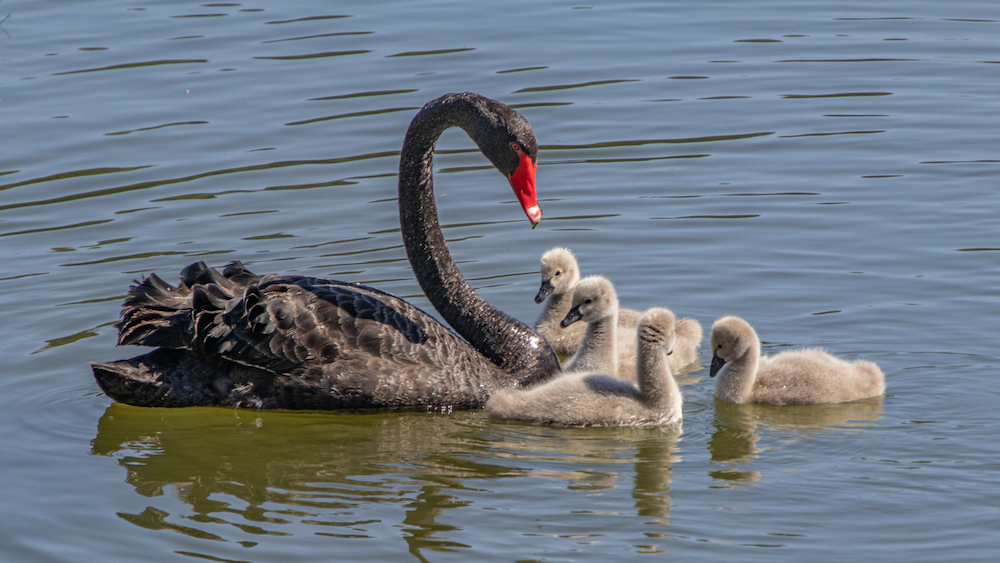
The black swan has relatively the longest neck of any swan, held in a deep S-curve. Against other swans it looks stretched. That much longer neck is a feeding tool, and I will come back to why.
This is a genuinely large waterbird. Adults run 110 to 142 centimetres long, with a wingspan of 1.6 to 2 metres. Weight ranges from 3.7 to 9 kilograms. The Broadwater birds are bigger up close than photographs suggest.
In flight they cross the sky with a slower wing beat than ducks, in a line or a loose V. No other Australian bird produces that silhouette. A magpie goose shares the wetland but not the outline. At long range the neck alone identifies the bird.
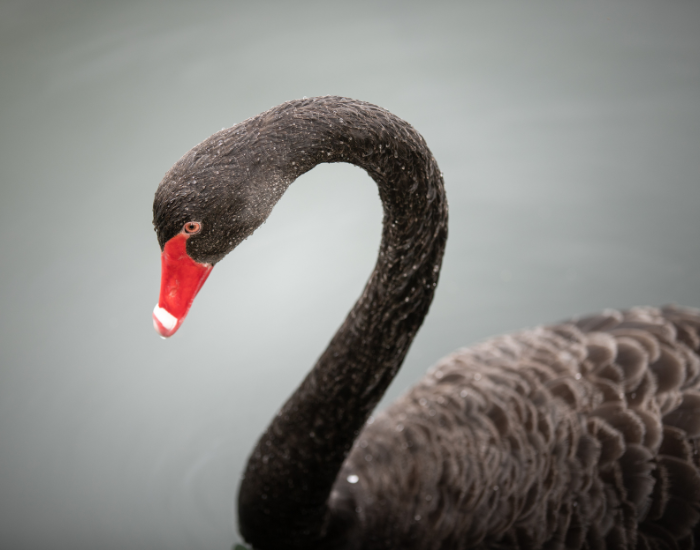
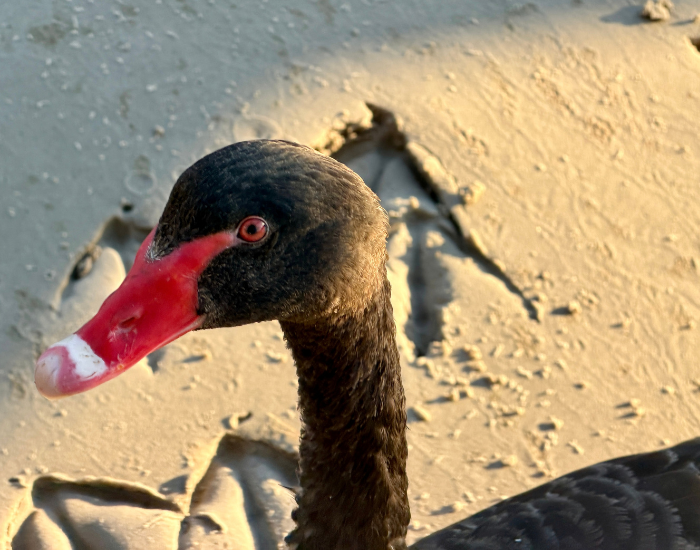
3. The Red Bill Is a Field Mark, and Sometimes a Sex Clue
The bill is bright red, with a pale bar near the tip. That red bill is the first thing most people notice and the easiest feature to check.
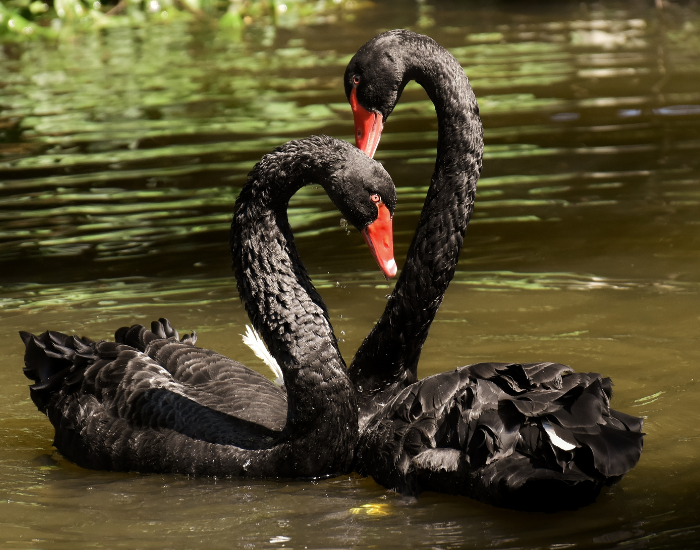
Males average slightly larger than females and carry a longer and straighter bill. The difference is subtle. On a pair standing side by side at the water’s edge, though, the straighter bill on the male is usually visible.
The legs and feet are greyish black. That is part of why the bird reads as one dark shape from a distance.
4. The White Flight Feathers Only Show When the Wings Open
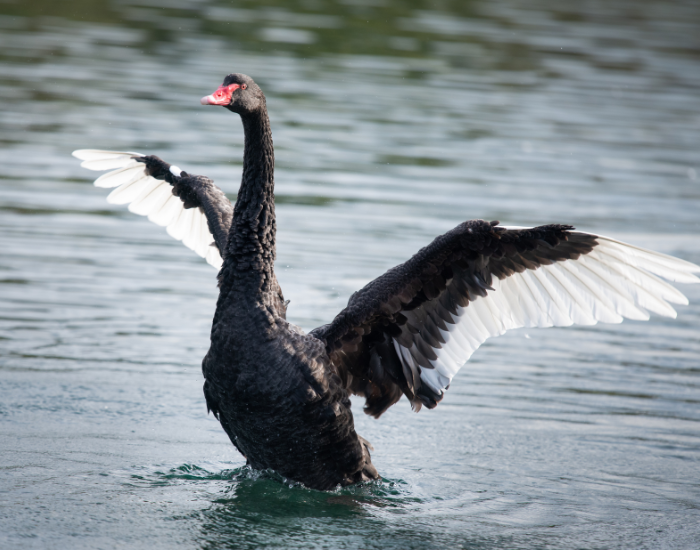
A black swan on calm water looks entirely black. Open the wings and a broad band of white flight feathers appears along the trailing edge.
Birds use this in threat displays, raising the wings to flash white at a rival. It is the most dramatic thing they do, and it lasts seconds. In poor light the white vanishes and the bird returns to being a floating shadow.
To separate adult black swans from other dark waterbirds in flight, watch for that white. Nothing else on an Australian wetland flashes the same way.
5. Immature Birds Are Grey Right Down to the Bill
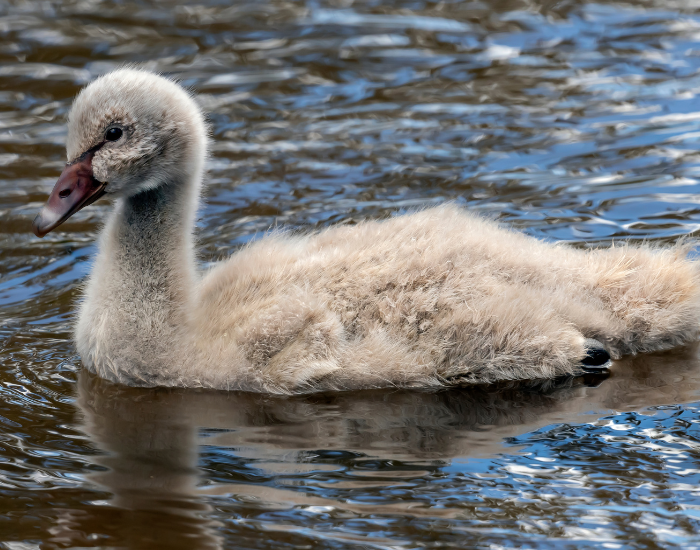
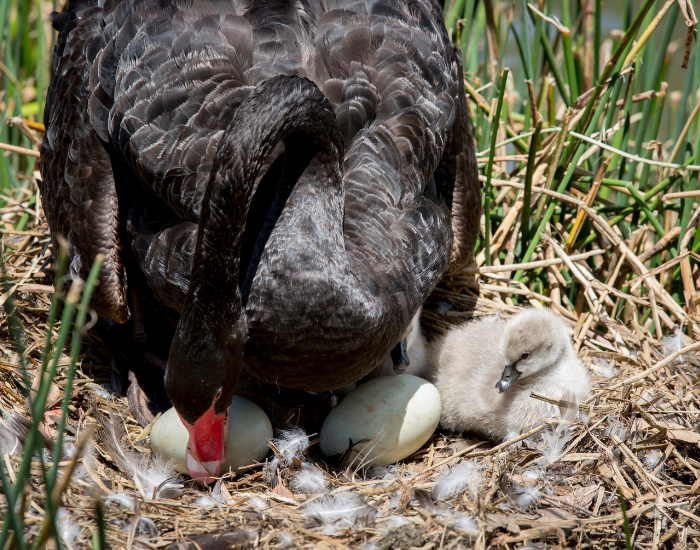
Baby swans hatch covered in grey down and can swim within hours. Their bills start dull, not scarlet.
Immature birds then spend months in greyish brown plumage with pale edged feathers, which gives them a scalloped look. Braithwaite found young birds moulting into adult plumage between 8 and 26 months of age. So a grey swan in a flock is not a different species. It is a teenager.
That matters if you are counting. Surveys that lump grey birds in with adults overestimate the breeding population.
6. Black Swans Eat Almost Nothing but Plants
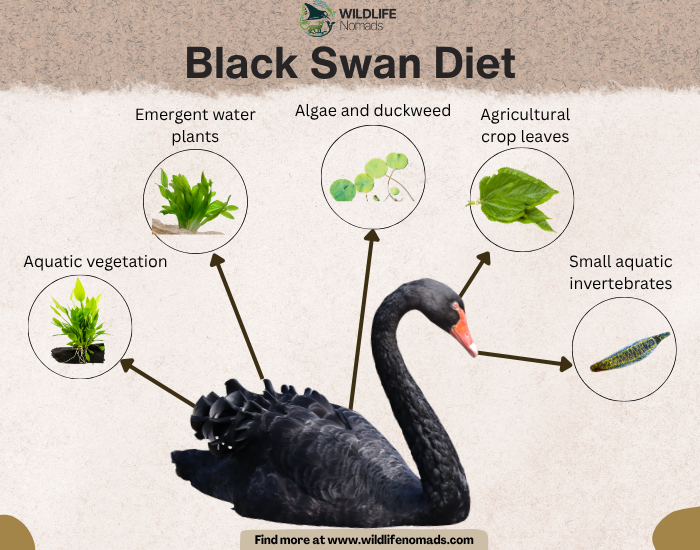
These are almost exclusively herbivorous birds. Algae, water weeds, aquatic vegetation, submerged plants: that is the menu. What black swans eat barely changes across their range, though the dominant species does.
In New South Wales, reedmace leaf dominates. Queensland birds lean more on pondweeds and stoneworts. In shallow water they dip the head and neck under, keeping the body flat. In deeper water they up-end like a dabbling duck, reaching food up to a metre down. They also filter feed at the water’s surface, skimming as they go.
Black swans do graze on land near the water’s edge, especially after floods. Watching them do it is slightly painful. They are clumsy walkers, and the food black swans find ashore is a fallback rather than a preference.
7. They Bugle, They Croon, and Their Wings Whistle
The black swan utters a far reaching bugle like sound that carries over open water. Those trumpeting calls are the ones people remember.
Up close the repertoire softens. Pairs exchange softer crooning notes at the nest, almost conversational. Sitting birds will hiss or whistle if you come too near.
In flight, listen instead of looking. Black swan wings produce a distinct whistling sound. Flocks also move at night, so you often hear them pass before you see anything.
8. Where Black Swans Live Depends Entirely on the Rain
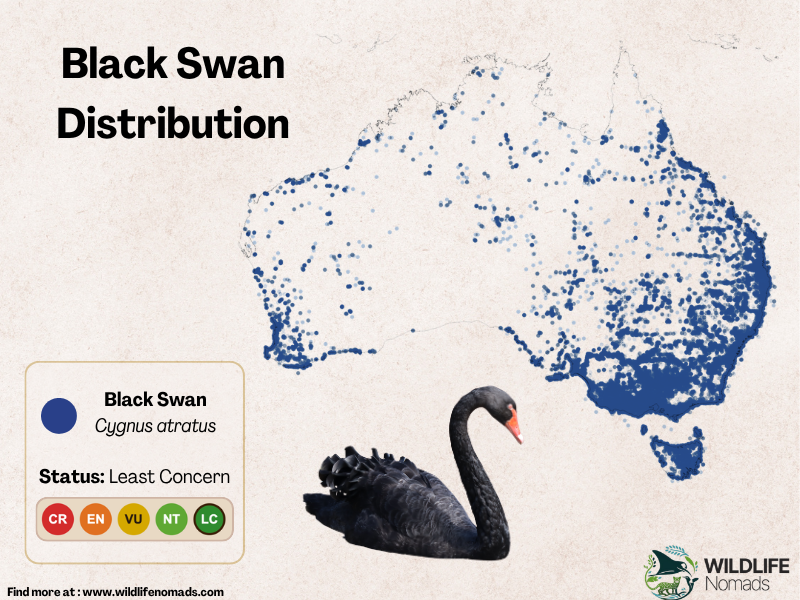
Black swans live across the wetlands of the southeast and southwest regions of Australia. The Murray–Darling basin holds very large numbers, and the bird is common on coastal estuaries, bays and inland lakes. Fresh, brackish and saltwater all work.
The habitat black swans favour is not fixed, because Australian water is not fixed. These birds are opportunists. They arrive after flooding, breed hard, and disperse when things dry out. I have counted good numbers at Coombabah Lakelands on one visit and found the same reach nearly empty on another.
One constraint shapes everything. BirdLife Australia notes they need at least 40 metres of clear water to take off. That is a long runway, and it helps explain why they stay uncommon across northern Australia. After breeding they moult every flight feather at once and cannot fly for about a month.
9. New Zealand’s Black Swans Have a Complicated Passport
Black swans were released in New Zealand in 1864 as ornamental birds. Today they are common on large coastal and inland lakes across both islands.
The tidy version says an endemic New Zealand swan went extinct, and Australian imports filled the gap. Montano and colleagues tested that in 2018 using microsatellite data from seven populations. Their answer came back mixed. Some indigenous birds may have survived and interbred with the newcomers, making the famous population boom a genetic rescue rather than a straight colonisation.
I like this study because it resists a clean headline. Introduction histories are usually messier than the plaque on the wall.
10. Two Males Can Pair Up and Raise Cygnets
Same-sex pairing in this species is real and well documented. Two males will hold a territory together, obtain eggs, and rear the young successfully.
You will often read that a quarter of all pairings are male-male. Treat that figure carefully, because it traces back to older observational work rather than a modern survey. What Braithwaite established in 1981 is more useful: a high degree of flexibility and individualism in black swan social relationships. These birds are not running a rigid social script.
11. Breeding Is a Job Both Parents Share
The nest is a serious construction. Pairs build a mound of reeds, grasses and weeds up to 1.5 metres across, on a small island or floated in shallow water. They rebuild and reuse it across seasons.
Clutches run from four to eight greenish-white eggs, and incubation takes roughly 35 to 45 days. Both parents share the sitting, with the female generally taking the night shift. Cygnets swim and feed themselves from the day they hatch. Even so, the parents stay with them for about nine months.
Braithwaite recorded sexual maturity at 18 to 24 or 33 to 36 months. Most black swans are therefore two or three years old before they breed. Breeding pairs are commonly described as mating for life, though genetic work shows the social bond and the actual parentage do not always match.
12. Least Concern Does Not Mean Out of Danger
BirdLife International assesses Cygnus atratus as Least Concern. The species holds an extremely large range and a global population estimated at up to 500,000 individuals. Assessors identified no substantial threats at a continental scale, and the bird is fully protected across Australia.
So it is not a threatened species, and I am not going to pretend otherwise. Two pressures still deserve attention. Habitat destruction and climate-driven changes to flooding hit a bird whose whole strategy depends on water arriving.
A third one worries me more. A 2023 genome study led by Karawita found that black swans lack an expanded immune gene repertoire. They also fail to express TLR7, a key viral sensor, in the cells that avian influenza attacks. Infected birds died within two to three days. Compared with other swans, this species is unusually defenceless against H5 bird flu.
The Bird That Became a Metaphor for the Impossible
Western Australia adopted the swan early and never let go. It appeared on the colony’s only postage stamp from 1854 to 1902 and featured prominently on the state flag from 1870. It remains the official bird of Western Australia. In Noongar country the bird is kuljak or kooldjak, and gooldjak along the south coast. Those names are far older than any flag.
The other legacy is stranger. In 2007 Nassim Nicholas Taleb published The Black Swan, borrowing Juvenal’s impossible bird for a theory about rare events. A black swan event lies outside regular expectations, carries extreme impact, and gets explained away as predictable only after the fact. The 2008 financial crisis is the example most people reach for.
Taleb’s point is that one Australian sighting destroyed centuries of European certainty. Which is, roughly, what happens the first time you see one.
FAQs About Black Swans
Black swans symbolise the impossible becoming real. For centuries the phrase described something that could not exist. The 1697 sighting then turned the bird into a symbol of transformation and a challenge to certainty. In Australia the meaning is more concrete: the black swan symbolises Western Australian identity, appearing on the state flag and coat of arms.
Bold rather than aggressive, in my experience. Gold Coast birds show no fear of people, and a fed swan will stand at your hand waiting. I have never seen one attack. Nesting birds are the exception. They hiss, whistle and raise their wings to show the white flight feathers.
No. BirdLife International lists the black swan as Least Concern, with an extremely large range and a global population of up to 500,000 birds. The species is legally protected throughout Australia. Avian influenza is the emerging concern, because recent genomic work shows unusual vulnerability to H5 infection.
Go and Stand Next to One
Black swans mean two completely different things depending on where you are standing. In Europe the bird was proof that certainty is fragile. On the Gold Coast it is the animal begging for bread outside somebody’s canal house.
Both readings are correct, and only one requires you to leave the house. Find a wetland with 40 metres of clear water and sit for an hour. Watch the necks arched over the shallows, wait for a pair to open their wings, and listen for that whistle at dusk.
If you want more birds to chase, start with these Australian native birds. The birds of New Zealand show what happened after 1864. And wildlife citizen science is how most swan survey data gets collected.
Seen one demand food the way mine did? Tell me in the comments.
Black Swan True or False Challenge
Eight questions to test your knowledge on Black Swan biology, history, and behavior. Can you get a perfect score?
True / False
References:
Braithwaite, L. W. (1981). Ecological studies of the black swan III. Behaviour and social organisation. Wildlife Research, 8(1), 135–146. https://doi.org/10.1071/WR9810135
BirdLife International. (2018). Cygnus atratus. The IUCN Red List of Threatened Species 2018: e.T22679843A131907524. https://doi.org/10.2305/IUCN.UK.2018-2.RLTS.T22679843A131907524.en
Karawita, A. C., Cheng, Y., Chew, K. Y., Challagulla, A., Kraus, R., Mueller, R. C., … Short, K. R. (2023). The swan genome and transcriptome, it is not all black and white. Genome Biology, 24(1), Article 13. https://doi.org/10.1186/s13059-022-02838-0
Kraaijeveld, K., Gregurke, J., Hall, C., Komdeur, J., & Mulder, R. A. (2004). Mutual ornamentation, sexual selection, and social dominance in the black swan. Behavioral Ecology, 15(3), 380–389. https://doi.org/10.1093/beheco/arh023
Montano, V., van Dongen, W. F. D., Weston, M. A., Mulder, R. A., Robinson, R. W., Cowling, M., & Guay, P.-J. (2018). A genetic assessment of the human-facilitated colonization history of black swans in Australia and New Zealand. Evolutionary Applications, 11(3), 364–375. https://doi.org/10.1111/eva.12535