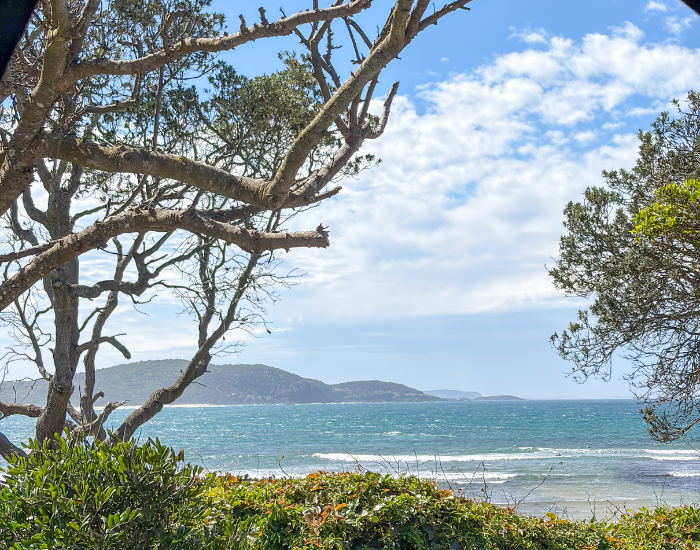
December 2018. My sister and I were road-tripping up the east coast. We pulled into Burleigh Heads to walk the headland track. An eastern water dragon froze on the path first. Two minutes later a scrub turkey strolled out of the leaf litter like it owned the hill.
I stopped dead. A turkey, just walking around, in a national park, in a town.
Nobody who grew up here cares. Australians treat these birds the way they treat the white ibis: background noise with legs. Five years of living here later, I know exactly how ordinary they are. They are everywhere.
And I still stop and watch every single one.
The reason is that pile of rotting vegetation in the corner of the yard. Once you know what the male is doing with it, the bird stops being scenery. Below are 12 things about the Australian brush turkey that turned it into one of my favourite animals here.
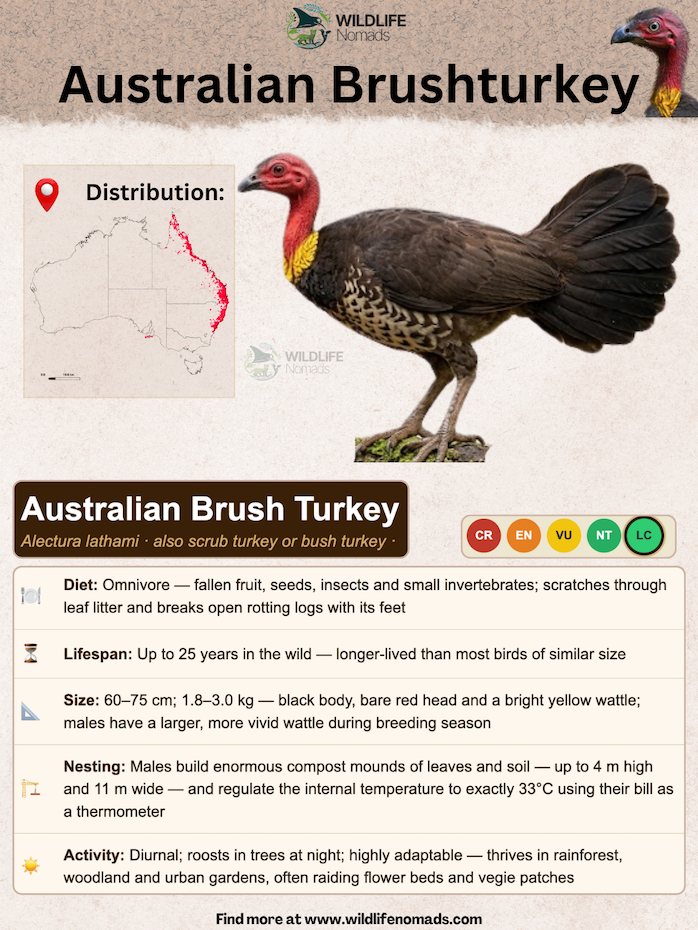
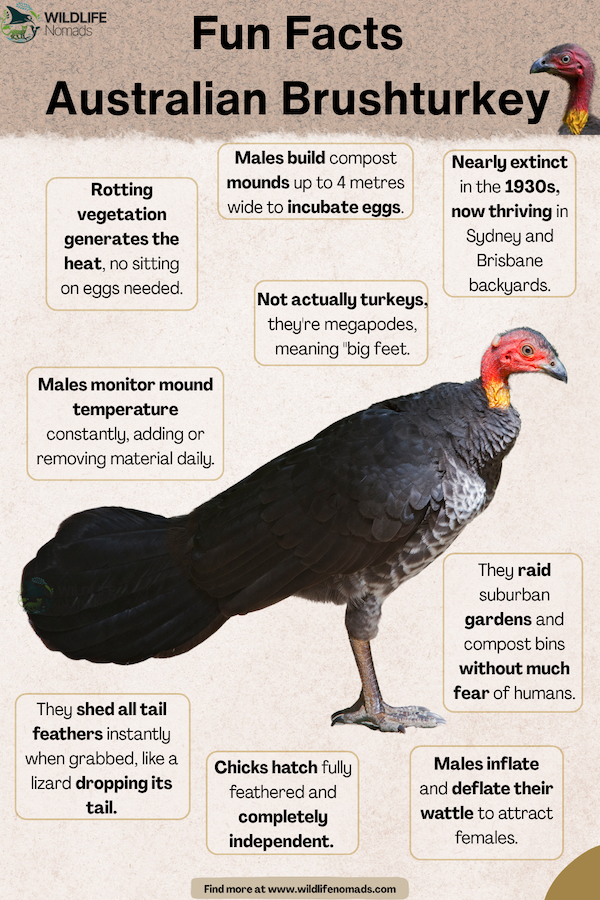
1. It Is Not a Turkey. It Is a Megapode
Alectura lathami sits in the family Megapodiidae, a group of fowl-like birds named for their enormous feet. American turkeys are a completely different lineage. The resemblance is pure coincidence, driven by a shared job description: big, dark, ground-dwelling birds that scratch for a living.
Megapodes are the only birds on Earth that never sit on their eggs. That single fact explains almost everything strange about this species. Australia has three of them, and the scrub turkey is the largest.
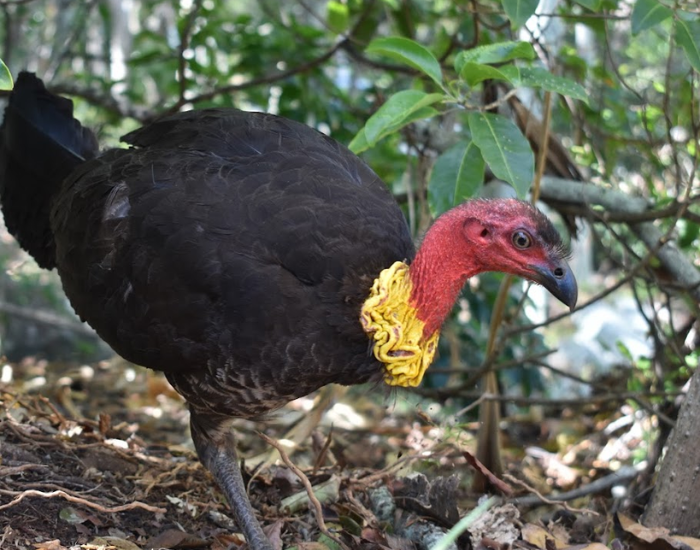
2. That Bald Red Head Is Doing a Job
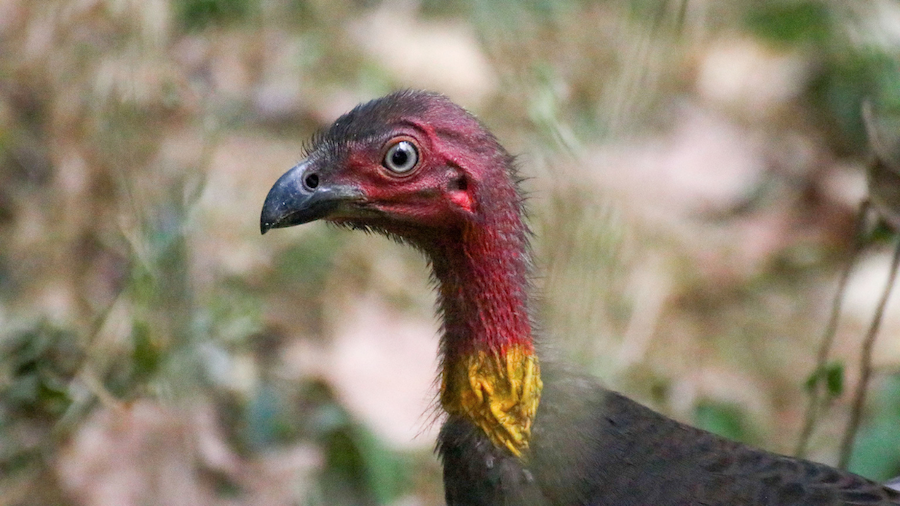
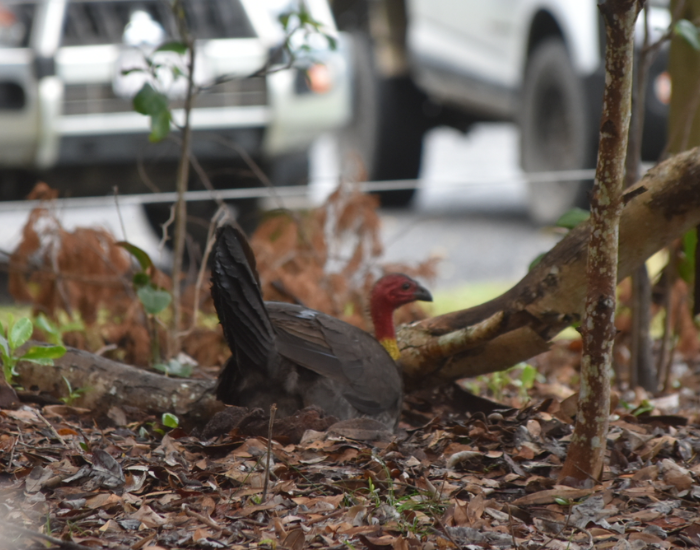
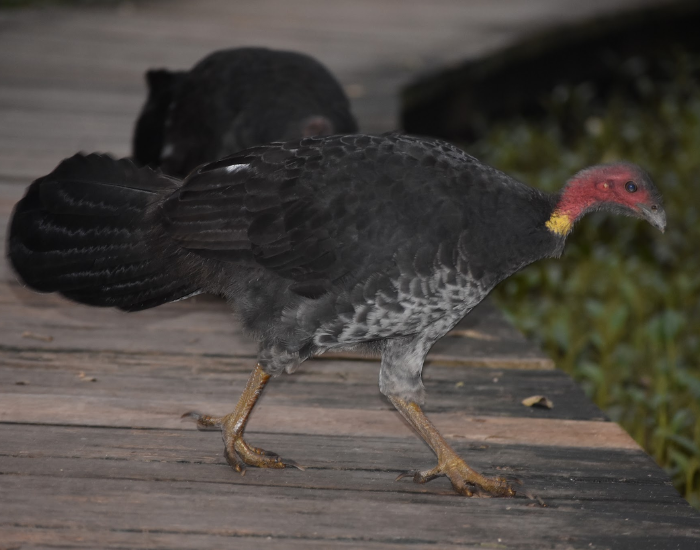
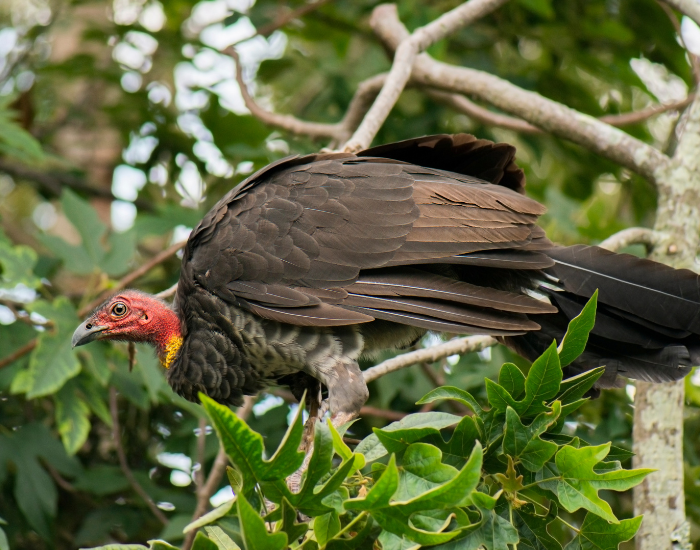
Adults carry a mainly black body plumage and a bare red head and neck. They also hold a laterally flattened tail upright, like a rudder. The Australian Museum puts them at 60 to 75 centimetres long. Most adults weigh around 2.5 kilograms, and heavy males push closer to 3 kilograms.
The bald red head is not ugly design. Bare skin sheds heat fast, which matters for a bird that spends its day shovelling hot compost. Older birds also show scattered white feathers on the underside. Up close, the black feathers are less uniform than they first appear.
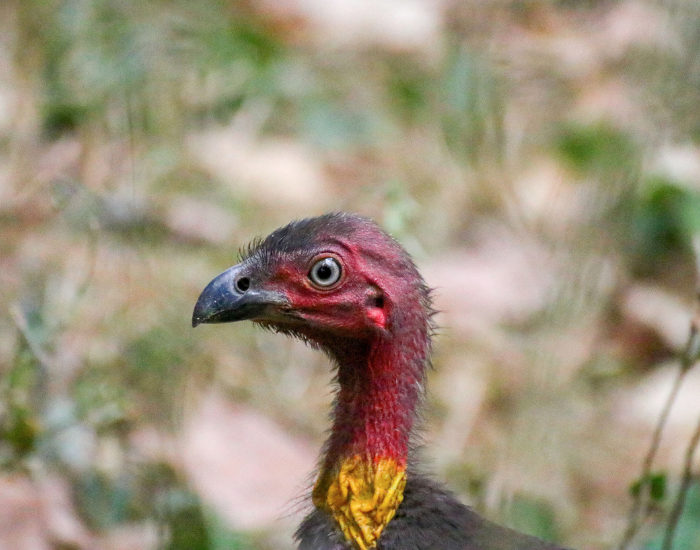
3. The Male’s Wattle Is a Billboard
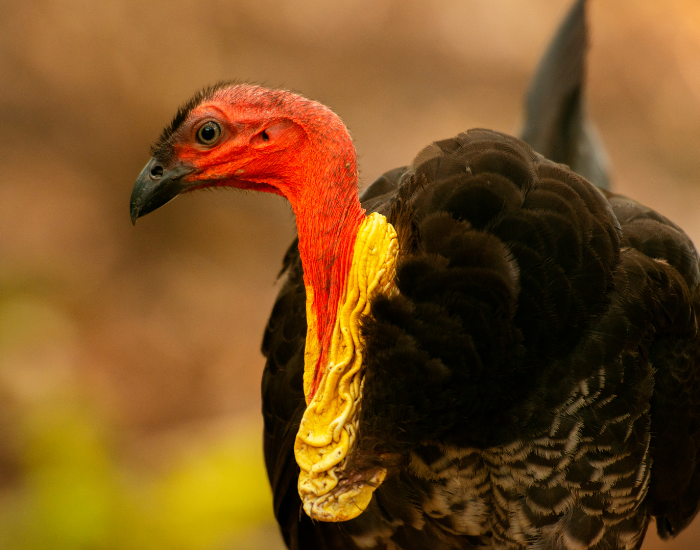
During the breeding season, the male brush turkey inflates a bright yellow throat wattle. It swings from side to side as he runs. The effect is one of the more ridiculous sights in Australian wildlife, and it works. Females read the male’s wattle as an honest signal of condition.
Northern birds on Cape York belong to a separate subspecies. Their wattles run pale blue to purple rather than yellow. If you are birding around Cape York Peninsula, look for that colour shift. The female brush turkey keeps a much smaller, duller yellow wattle year-round. Once you know that, an Australian brush turkey female is easy to pick out.
4. He Builds a Compost Heap the Size of a Small Car
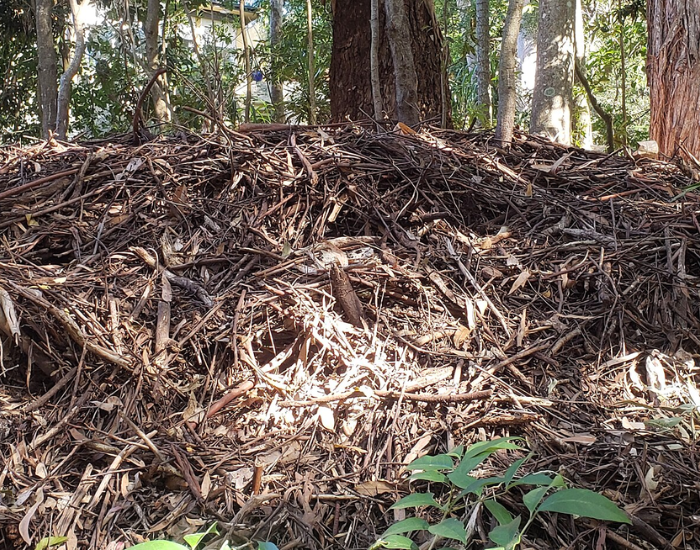
Male brush turkeys are mound builders on a scale no other Australian bird attempts. A single large mound reaches roughly 4 metres in diameter and a metre high. He builds it from soil and leaf litter, raked backwards with those huge feet.
That represents multiple tonnes of organic matter, moved one clawful at a time. I have watched a male working a mound in a Brisbane backyard for twenty minutes without pausing. Researching brush turkey behaviour for this post, I kept coming back to the same number: tonnes. Not kilos.
5. He Runs the Mound Like a Thermostat, Using His Beak
Here is the part that genuinely impresses me. The male does not warm the eggs with his body. Instead, the Australian brush turkey incubates using heat released by rotting vegetation as it decomposes.
He holds the mound temperature between roughly 33 and 38°C for months. To check it, he plunges his bill deep into the pile and reads the heat directly. Too hot, and he starts digging holes and removing vegetable matter to vent it. Too cool, and he piles fresh material back on.
6. Several Females Lay Eggs Inside One Mound
The mating system is not what most people assume. Several females visit a successful male and lay eggs inside his single mound. One pile can hold up to 50 eggs across a season. Each female may also visit more than one mound, spreading her eggs across several males.
Eggs sit around 60 to 80 centimetres down, spaced apart, always large end up. Incubation runs about 49 days. The male defends and maintains the pile the entire time, without ever knowing which eggs are his.
7. Chicks Hatch Underground and Dig Their Way Out Alone
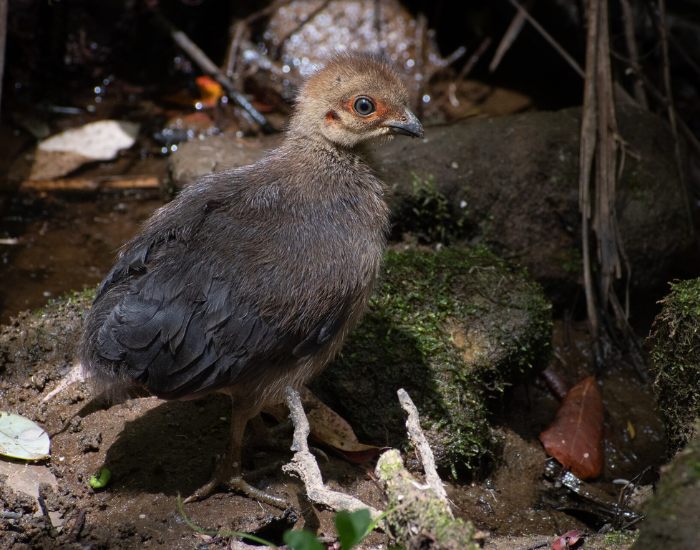
When the eggs hatch, the chicks burrow upward through half a metre of compost. It can take them most of a day. They emerge fully feathered, and they can run and fly within a few hours of reaching the surface.
Then they walk away. Brush turkey chicks receive no parental care whatsoever, and the male shows no interest in them at all. No other Australian bird starts life this independently, and none starts it this alone.
8. Independence Comes at a Brutal Price
That self-sufficiency sounds like a superpower. In practice, most chicks fall prey to something within their first few weeks. Goannas, snakes, foxes, cats and currawongs all take them.
Burrowing predators such as goannas also raid the mounds themselves, digging down for eggs. The male’s constant presence is part of the defence. Adults roost in tree branches at night for the same reason, with birds occasionally observed feeding up there too. Mostly, though, they are ground birds.
9. Mound Temperature Skews the Sex Ratio, But Not How People Say
This one deserves a careful read, because the internet gets it wrong. A study found that cooler mounds produced more males and warmer mounds more females. The split came out even near 34°C. Plenty of blogs turned that into “brush turkeys have temperature-dependent sex determination, like reptiles”
They do not. Studies confirmed that brush turkeys carry standard avian ZZ/ZW sex chromosomes, so sex is fixed at fertilisation. The temperature effect comes from sex-biased embryo mortality instead. Female embryos die more often in cool mounds, male embryos in hot ones. The outcome looks identical from outside the mound. The mechanism is completely different.
10. They Are Ecosystem Engineers, and the Data Backs It
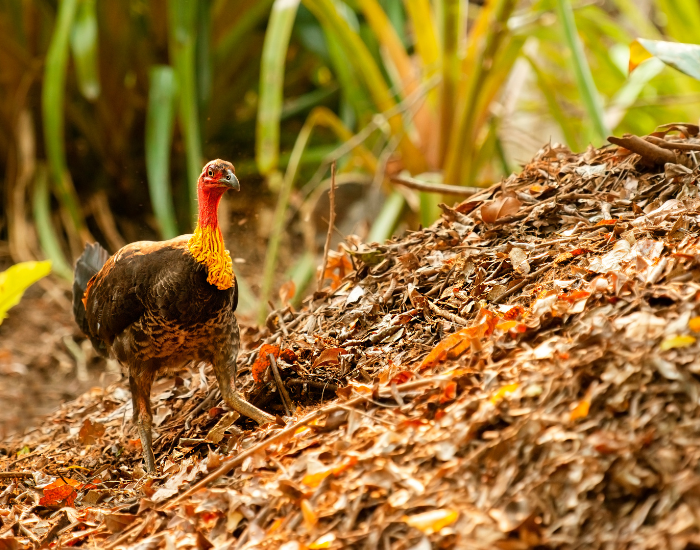
A study measured leaf litter decomposition around brush turkey mounds in Sydney reserves. Litter near mounds broke down faster than the seasonal average. In a companion experiment, plots fenced off from the birds accumulated litter. Plots the turkeys could reach stayed close to bare.
That is bioturbation on a landscape scale. They aerate soil, accelerate nutrient cycling, disperse seeds through their droppings, and eat a serious volume of insects. In urban areas, they are arguably the most productive gardener on the block, even when the block disagrees.
11. Their Menu Is Whatever the Leaf Litter Is Hiding
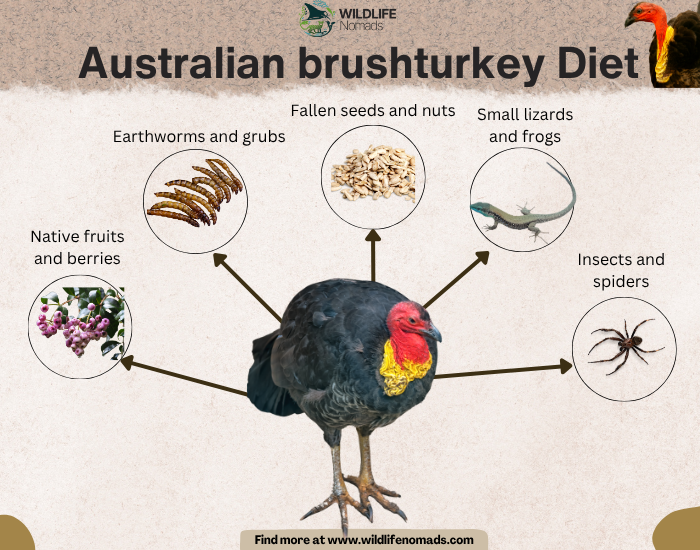
Brush turkeys are omnivores that feed mainly on the ground. They rake through leaf litter with those powerful feet to expose insects, seeds and fallen fruits. Rotten logs get the same treatment, and breaking open rotten logs is how they reach grubs and termites underneath.
Watch one work and the rhythm is obvious: scratch, scratch, step back, inspect. In suburban gardens they add compost scraps, pet food and fallen mango to the list. Open rotten logs and turned mulch are the two clearest signs a bird has been through.
12. From Nearly Gone to Your Suburban Backyard
By the 1930s, hunting had pushed the species close to local extinction across much of its southern range. Legal protection changed the trajectory completely. Brush turkeys are now common in suburban gardens in Sydney and Brisbane. Urban environments suit them far better than anyone predicted, and the range is still expanding.
The Australian brush turkey’s range now runs from Cape York down through eastern Australia. It reaches past Sydney and down through Wollongong/Illawarra in the south. They occupy Australian rainforests and other wet forests, especially wet schlerophyll forests, plus drier scrubs and open country. In the northern part of the range they are most common at higher altitudes, dropping to lowlands in winter. Southern populations use mountain and lowland regions year-round.
Frequently Asked Questions
Australians call them brush turkeys, bush turkeys or scrub turkeys, depending on the state. All three names refer to the same species, Alectura lathami. Queenslanders lean towards scrub turkey, while Sydneysiders usually say brush turkey. Ornithologists and field guides use Australian brush-turkey as the formal common name. Australian turkey, Australian bush turkey and Australian wild turkey all describe the same species.
They damage gardens, and that frustration is real. A male building a mound can clear an entire garden bed of mulch in a day. However, the same behaviour drives leaf litter breakdown, soil turnover and insect control across urban and suburban areas. Most councils treat them as a protected native species to be managed, not removed.
Both are correct in everyday speech, and neither is wrong. Brush turkey is the standard name in field guides and scientific writing. Bush turkey is the more common spoken form in Queensland. Australia turkey bird, australian wild turkey and scrub turkey Australia all circulate online for the same species.
This Bird Deserves Better
Seven years after Burleigh Heads, the thing that stays with me is the mound. A scrub turkey regulates a compost heap to within a few degrees for two months. It manages that using only its beak and its feet. No other bird on the planet does this.
That is the trade the scrub turkey made. No nest-sitting, no chick-rearing, no pair bond. Just engineering, and offspring that hit the ground running.
Next time one wanders across your path, give it thirty seconds. Watch the feet. Watch the wattle swing. Then go looking for the mound, because there is almost always one nearby.
If you want more of this, I have a full guide to Australian native birds. I have also covered the eastern water dragon that beat the turkey to my list that day. The monitor lizards that raid their mounds get their own post too. For the bigger picture, start with animals native to Australia, my kangaroo facts post, or the guide to magpies worldwide.
Seen a mound in your own yard? Tell me in the comments how big it got.
Brush Turkey Challenge
Six quick multiple-choice questions on Australia’s strangest backyard bird. How many can you get?
References:
Eiby, Y. A., Wilmer, J. W., & Booth, D. T. (2008). Temperature-dependent sex-biased embryo mortality in a bird. Proceedings of the Royal Society B: Biological Sciences, 275(1652), 2703–2706. https://doi.org/10.1098/rspb.2008.0954
Göth, A., & Booth, D. T. (2005). Temperature-dependent sex ratio in a bird. Biology Letters, 1(1), 31–33. https://doi.org/10.1098/rsbl.2004.0247
Hall, M. J., Martin, J. M., Burns, A. L., & Hochuli, D. F. (2023). Mound-building behaviour of a keystone bioturbator alters rates of leaf litter decomposition and movement in urban reserves. Austral Ecology, 48(7), 1426–1439. https://doi.org/10.1111/aec.13409
Hall, M. J., Burns, A. L., Martin, J. M., & Hochuli, D. F. (2022). Unexpected dispersal of Australian brush-turkeys (Alectura lathami) in an urban landscape. Austral Ecology, 47(5), 1039–1050. https://doi.org/10.1111/aec.13224
Ortega, M. T., Foote, D. J., Nees, N., Erdmann, J. F., Bangs, C. D., Rosenthal, N. F., … Bhattacharya, S. (2017). Karyotype analysis and sex determination in Australian brush-turkeys (Alectura lathami). PLOS ONE, 12(9), e0185014. https://doi.org/10.1371/journal.pone.0185014