I was standing in a paddock west of Sydney, squinting at a shape circling on a thermal. “Eagle,” I said, confident. My colleague barely looked up. “Brown falcon,” he replied, and went back to his data sheet.
He was right, of course. The bird was too high for a photo, and I never got the shot. That correction was useful and it helped me to look at the Australian sky. Every falcon I have seen since carries a little of that embarrassment with it.
Australia holds six falcon species, and they are far easier to separate than people assume. Some hover. Some hunt at dusk. One is arguably the rarest bird of prey on the continent.
This guide walks through all six. You get the field marks that work at distance, plus the biology behind them. By the end you should be able to name the falcon on the fencepost without asking a colleague.
But First… What Makes a Falcon a Falcon
Falcons belong to the genus Falco, in the family Falconidae. That family encompasses around 40 species worldwide, spread across every continent except Antarctica. Falcons thrive in almost every terrestrial biome on Earth, from arctic tundra to tropical north Queensland.
Ornithologists find the genus roughly divisible into three or four groups. Kestrels feed chiefly on terrestrial vertebrates and insects, hunting from an exposed perch. Hobbies are slightly larger, with strongly patterned plumage and a taste for small birds. Peregrines and the hierofalcons form the heavyweight end, taking medium sized birds in flight.
The anatomy is where things get interesting. Falcons possess a notch in the upper beak called a tomial tooth. They use it to sever a prey animal’s spine. Hawk species kill with their large feet instead.
Falcons also carry small bony tubercles inside their nostrils. Those baffles are widely thought to slow airflow during a high-speed dive, letting the bird keep breathing. Their eyesight is extraordinary too, estimated at up to eight times sharper than ours.
Most falcons primarily eat birds, although small mammals, reptiles and insects can matter enormously depending on the season. Critically, falcons capture prey mid-air rather than ambushing it from cover. That single behavioural difference explains the long pointed wings you see on every species below.
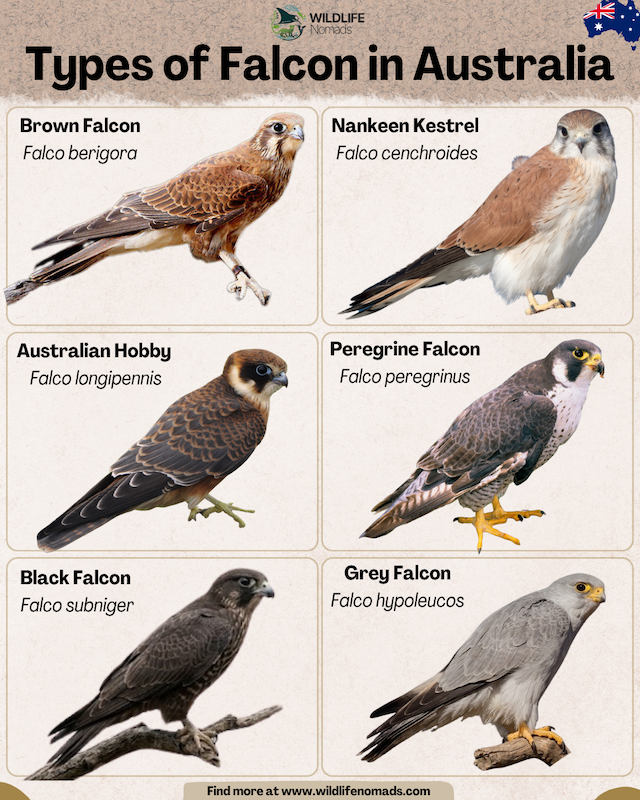
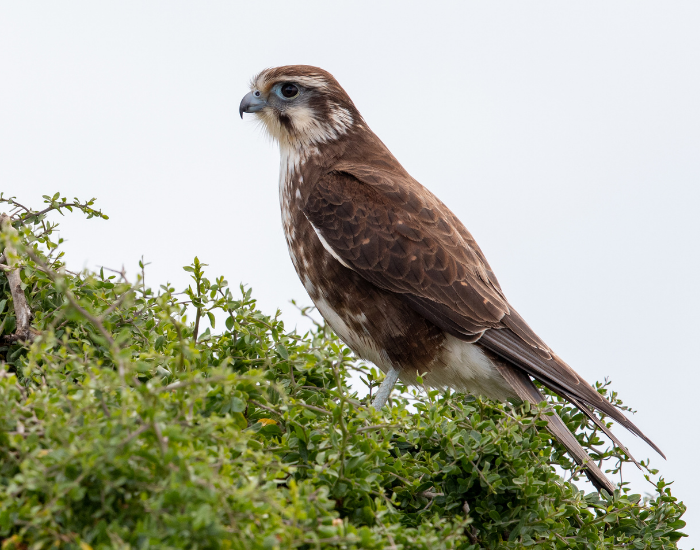
1. Brown Falcon (Falco berigora)
Start here, because the brown falcon is the one you will see first. It is the most widespread falcon bird in Australia. Look on fenceposts, dead limbs and roadside wires right across the continent.
Identification frustrates beginners. Plumage ranges from near-black to pale cream, with lighter or brownish colours dominating in the arid interior. Look instead at the shape: long legs, a loose flapping flight, and a habit of dangling its feet.
Adults run 40–50 cm long. They take small mammals, ground birds, lizards, snakes and vast quantities of grasshoppers and caterpillars. Insects dominate the winter diet, which is why you often see one walking about on burnt ground.
The call gives it away in the dark. Brown falcons produce a raucous cackle, like an indignant hen, and they are noisy through the breeding season. Bonta and colleagues also documented Indigenous and firefighter accounts of brown falcons carrying burning sticks to flush prey. Those reports remain observational rather than experimental, so treat the “firehawk” story as compelling but unresolved.
2. Nankeen Kestrel (Falco cenchroides)
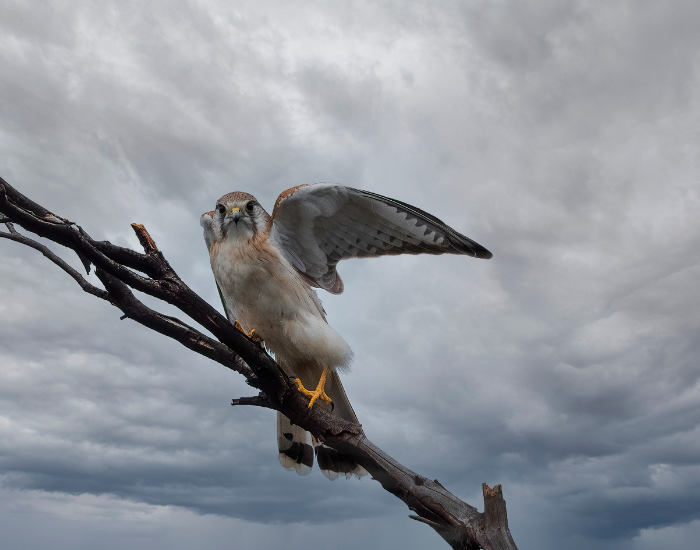
If a small falcon hangs motionless above a grassy verge, you are watching a nankeen kestrel. That hover is the single most reliable field mark of any Australian raptor.
At 28–35 cm, this is our smallest falcon. Rufous upperparts meet black flight feathers, with delicately patterned underparts finely streaked below. Males show a pale grey crown and tail; females and young birds stay rufous throughout. The cere, eye-ring and legs are yellow.
Kestrels feed chiefly on small rodents, insects, small reptiles and the occasional small bird. Females lay three to seven eggs in late winter, usually four, in a tree hollow, cliff recess or building cavity. Incubation takes 26–28 days.
The species colonised Australia relatively recently. Ancestral kestrels reached the continent during the Middle Pleistocene, less than a million years ago. That makes the nankeen kestrel a relative newcomer.
3. Australian Hobby (Falco longipennis)
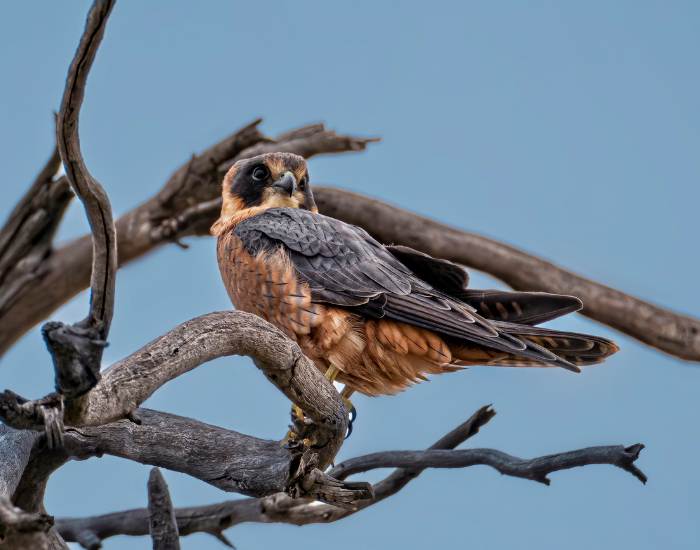
The Australian hobby is the falcon most people mistake for something else entirely. It is small, dark and impossibly fast, and it hunts hardest in the last twenty minutes of light.
Look for a black cap and mask, plus a whitish forehead and half-collar. Below, a rusty wash carries dark lengthwise streaking. Birds from humid regions look darker; arid-zone individuals show lighter or brownish colours. Females reach 34–35.5 cm, males a touch under.
Hunting is pure aerial acrobatics. Hobbies fly low, fast and zig-zagging, then attack fleeing birds in a series of short shallow stoops. Starlings, sparrows and rosellas feature heavily, and so do insectivorous bats leaving their roosts at dusk.
4. Peregrine Falcon (Falco peregrinus)
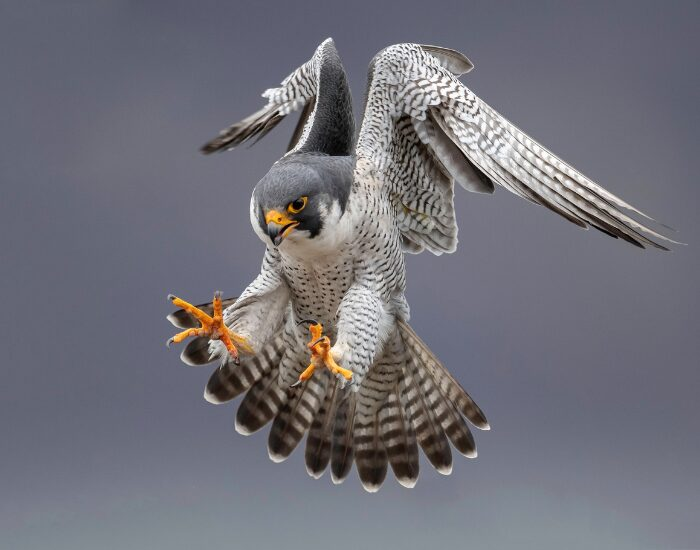
The peregrine falcon is the fastest animal on Earth. Our subspecies macropus is a stocky, dark, powerful version of it. Adults measure 38–48 cm and carry a full black hood, blue-black upperparts and crisp horizontal barring across creamy underparts.
That barring is the giveaway. Brown falcons streak lengthwise; peregrines bar sideways. Once you see it, the two never look alike again.
Peregrines hunt by stooping, folding into a teardrop and dropping onto prey from height. Recorded dives exceed 320 km/h, or over 200 mph, and birds reportedly detect prey from more than three kilometres away. They take chiefly medium sized birds such as pigeons, doves, parrots and waders, with occasional mammals, reptiles and insects.
Nesting is minimalist. Falcons do not build elaborate stick nests. Peregrines simply scrape a hollow on a cliff ledge, in a tree hollow, or on high-rise window ledges. Nesting occurs between August and November. Australian clutches hold two to three eggs, northern hemisphere birds three to five. Incubation runs 29 to 34 days, and young falcons fledge after 5 to 6 weeks.
5. Black Falcon (Falco subniger)
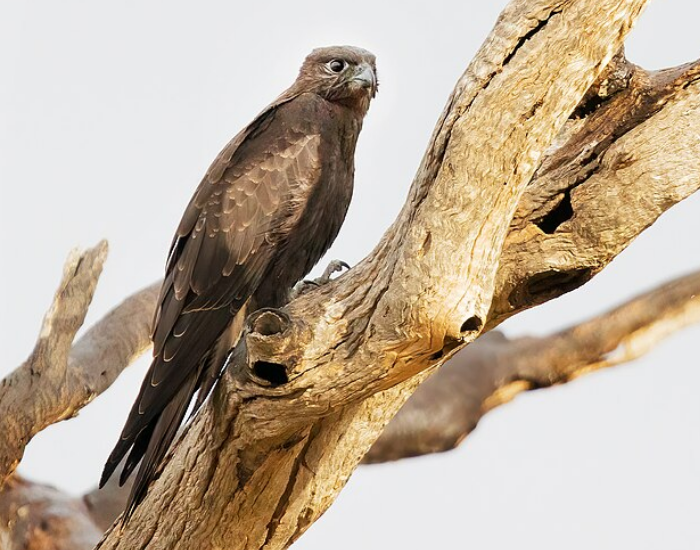
Black falcons are endemic to Australia. They are the species I most want on my own list. Nothing else looks quite like one. Picture sooty brown-black plumage, a small head, pale chin, short legs and a long tail.
By length this is our largest falcon, though a heavy female peregrine outweighs it. In flight the wings look long and pointed, held slightly below the horizontal on a glide. Unlike the brown falcon, black falcons rarely perch on wires, which is a genuinely useful separation for similar species.
Diet spans small birds, parrots, small mammals and insects. Interestingly, they also practise kleptoparasitism, harassing other raptors until they drop a meal. Old stick nests in large trees serve as nest sites from May to November. Incubation takes near five weeks, fledging six or seven.
Numbers concern me. The national population sits somewhere between 1,000 and 10,000 birds, and reported declines run to 30–50% since the 1980s. Victoria lists the species as critically endangered, although no federal listing yet applies.
6. Grey Falcon (Falco hypoleucos)
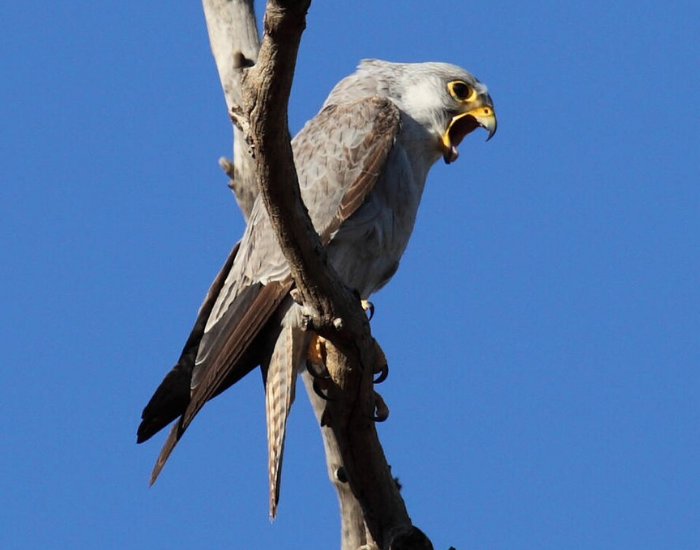
Few Australian birders ever see this one. The grey falcon is another endemic, and possibly the rarest falcon in the world. Roughly less than 500 breeding pairs remain.
Adults are chiefly medium grey above, white below, with black wingtips and startling yellow cere, eye-ring and legs. Body length runs 30–45 cm. Against a pale inland sky, that combination of soft grey and bright yellow is unmistakable.
Grey falcons live in arid country receiving under 500 mm of rain a year. Preferred habitat means triodia grassland, acacia shrubland and lightly timbered woodland. Birds make up 88% of the diet, with small mammals, reptiles and invertebrates filling the rest. Breeding uses abandoned raptor nests in tall trees along inland watercourses.
Australia lists the species as Endangered under the EPBC Act. Genetic work by Mullin and colleagues found no population structuring at all. Managers can therefore treat every grey falcon as one continuous population. That finding matters more than it sounds, because it simplifies where recovery effort should go.
How Australia’s Falcons Fit the Global Picture
Our six species represent taxa found on nearly every continent. The gyrfalcon of northern Canada and the arctic tundra is the largest of all falcon species. The American kestrel is North America’s smallest, ranging south to central Mexico and beyond into South America.
Elsewhere, the common kestrel (Falco tinnunculus) hovers over European farmland much as ours does over Queensland pasture. The merlin (Falco columbarius) is a compact hunter of small birds. Saker falcons inhabit open steppes and semi-deserts across central Asia. Prairie falcons excel at low-contour hunting flights, and Eurasian hobbies catch large flying insects mid-air.
The pattern repeats worldwide. Falcons prefer habitat that gives them room to hunt, then adapt to whatever prey that space provides.
FAQs about Australian Falcons
Falcons are among the most specialised aerial predators alive. They catch prey in flight rather than ambushing it from a perch. A notched tomial tooth does the killing, not the feet. Their vision is estimated at up to eight times sharper than ours. The peregrine falcon dives faster than any other animal, exceeding 320 km/h.
Yes, and six species live here. Two of them, the black falcon and the grey falcon, occur nowhere else on Earth. The peregrine falcon, by contrast, lives on every continent except Antarctica. Few birds of prey are so widely distributed.
Falcons belong to Falconidae; hawks belong to the unrelated family Accipitridae. Falcons have long pointed wings, hunt in open flight, and dispatch prey with the beak. Hawk species carry broader rounded wings, large feet, and kill by gripping. Despite the resemblance, hawk-falcons and true hawks sit on separate branches of the raptor family tree.
Go Find One!
Six species, one continent, one genus that solved high-speed flight better than anything else with feathers. Learn the barring on a peregrine and the hover of a kestrel, and half the work is done.
I still have not photographed a brown falcon properly, which is faintly ridiculous given how many I have watched. That gap is the reason I am driving the country to document every raptor I can find. You can follow the whole project at Australia Lap.
If you want more, read up on birds of prey and raptors, the types of eagles you might confuse them with, and the wider world of Australian native birds. Falcons sit near the top of the food chain, above the marsupials and possums that fill the layer below.
Tell me in the comments which falcon you have seen. Better yet, go stand in an open field at dusk and wait.
Can You Name That Australian Falcon?
A quick 6-photo identification challenge across all of Australia’s falcons — the wrong answers are the other five species. Go back and change any answer before you score.
Which falcon is this?
References:
Bonta, M., Gosford, R., Eussen, D., Ferguson, N., Loveless, E., & Witwer, M. (2017). Intentional fire-spreading by “firehawk” raptors in northern Australia. Journal of Ethnobiology, 37(4), 700–718. https://doi.org/10.2993/0278-0771-37.4.700
Brighton, C. H., Thomas, A. L. R., & Taylor, G. K. (2017). Terminal attack trajectories of peregrine falcons are described by the proportional navigation guidance law of missiles. Proceedings of the National Academy of Sciences, 114(51), 13495–13500. https://doi.org/10.1073/pnas.1714532114
Mullin, D. W., McCulloch, G. A., Schoenjahn, J., & Walter, G. H. (2020). Phylogeography of the rare Australian endemic Grey Falcon Falco hypoleucos: Implications for conservation. Bird Conservation International, 30(3), 447–455. https://doi.org/10.1017/S0959270920000106
Oli, M. K., Ratcliffe, N., & Mearns, R. (2023). Reproductive performance of Peregrine Falcons relative to the use of organochlorine pesticides, 1946–2021. Journal of Animal Ecology, 92(12), 2318–2330. https://doi.org/10.1111/1365-2656.14006
Schoenjahn, J., Pavey, C. R., & Walter, G. H. (2020). Ecology of the Grey Falcon Falco hypoleucos — current and required knowledge. Emu — Austral Ornithology, 120(1), 1–12. https://doi.org/10.1080/01584197.2019.1654393