I once stood knee-deep in an Alberta peat bog, holding what my guide swore was a woolly mammoth tooth the size of a brick. That moment rewired how I think about ice age animals. The last ice age was not a frozen wasteland populated by a few shaggy elephants. It was a living, breathing world packed with creatures so strange they read like fantasy.
Most people picture only woolly mammoths and a saber toothed cat or two. The reality is far richer. This guide walks through 12 ice age real animals you probably never knew existed, the ones that shaped north america, South America, and europe before vanishing. Some inspired Hollywood. Others left no cultural footprint at all. All of them deserve a closer look.

1. Woolly Mammoth (Mammuthus primigenius)
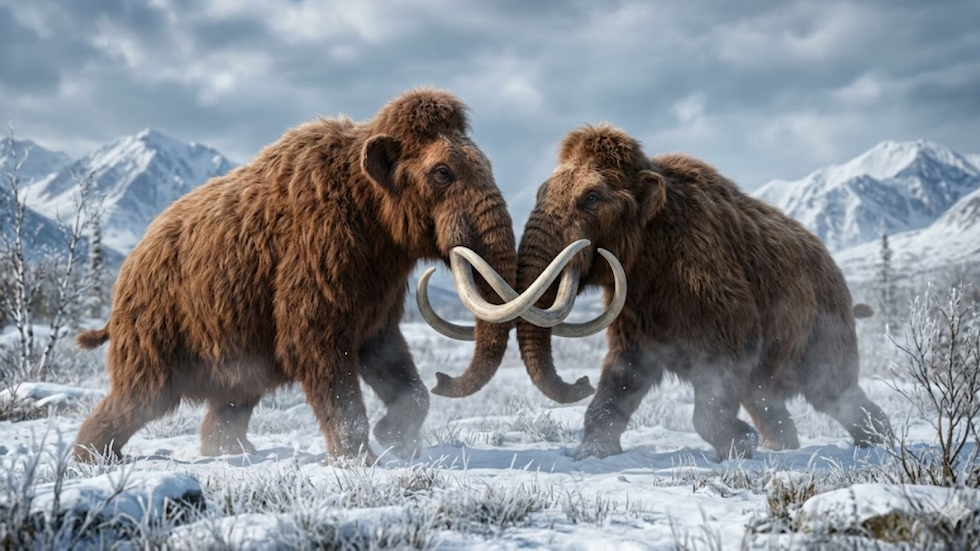
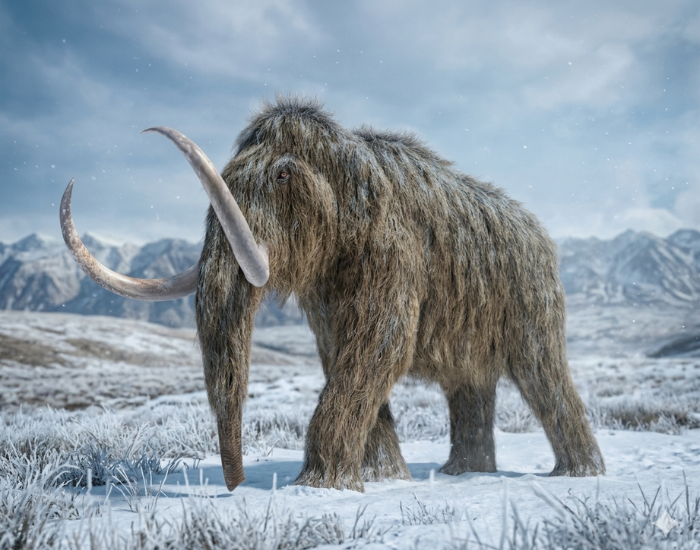
The woolly mammoth is the poster child of the ice age, and for good reason. These shaggy elephants roamed across North America, Northern Europe, and Siberia for hundreds of thousand years before disappearing. They stood up to 11 feet tall at the shoulder, with curved tusks and thick fur that trapped body heat against brutal cold.
I have held a mammoth molar in my hand, it weighed more than a hardcover book. The grinding surface looks like stacked plates, perfect for processing the tough vegetation of the mammoth steppe. Most Woolly Mammoths went extinct around 10,000 years ago, but a relict population survived on Wrangel Island until roughly 4,000 years ago. That means mammoths walked the earth while the Egyptians built the pyramids.
Modern day elephants are their closest living relatives. Other mammoths: like the Columbian mammoth (Mammuthus columbi) of North America, were larger but less hairy, adapted for warmer grasslands rather than frozen tundra.
2. Giant Ground Sloth (Megatherium americanum)
If I could time-travel to meet any extinct ice age animals, the giant ground sloth would top my list. Megatherium stood taller than a modern giraffe when reared on its hind legs, weighed up to four tons, and stripped trees of leaves with claws as long as kitchen knives.
Giant sloths were a south america story first. They evolved there, then crossed into north america during the Great American Biotic Interchange after the Panama land bridge formed. By the last glacial period, ground sloths inhabited both north and south america in remarkable diversity. I have walked through caves in Patagonia where their dung deposits, preserved for millennia by dry, cold air — still hold fragments of the plants they ate.
For the full backstory on these incredible creatures, I unpacked their biology in my earlier post on prehistoric ground sloth facts.

3. Saber-Toothed Cat (Smilodon fatalis)
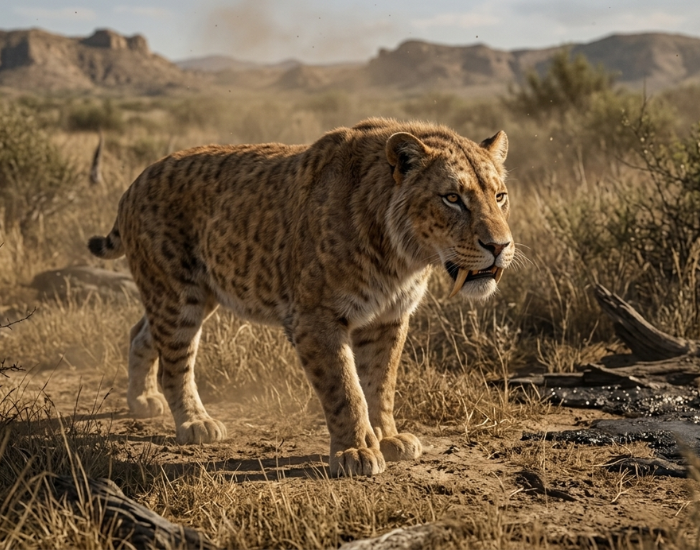
No ice age predators capture the imagination like saber toothed cats. Smilodon was not actually a tiger, it belonged to a separate lineage of cats called Machairodontinae. Its canines reached up to seven inches (usually 4-5 though) and worked like steak knives, designed to deliver a precise killing bite to the throat of large prey.
The saber toothed cat hunted bison, horses, and young mammoths across north america and south america. These cats had short tails and stocky, ambush-predator bodies — closer in build to a bear than a modern lion. From the La Brea Tar Pits in Los Angeles, scientists have recovered thousands of Smilodon skeletons, painting a vivid picture of pack-hunting behavior and high social tolerance among these animals.
4. Scimitar-Toothed Cat (Homotherium latidens)
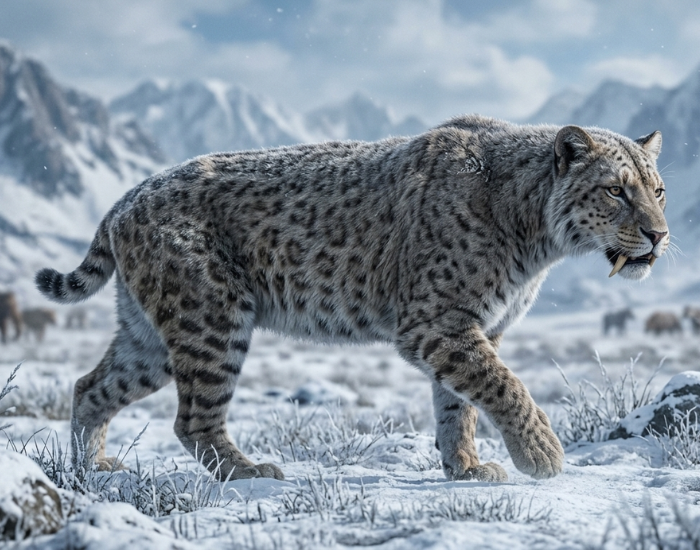
The scimitar toothed cat is the unfamous cousin of Smilodon. Homotherium had shorter, more serrated canines and longer legs, built for running down prey on open vegetation rather than ambushing it. This scimitar toothed cat ranged across north America, South America, europe, and Africa, making it one of the most successful ice age cats of all.
I find Homotherium fascinating because its body plan resembled a cross between a lion and a hyena. Fossil evidence shows these cats hunted in groups and may have specialized in young mammoths and other large herbivores.Our understanding of them shifted entirely when researchers published details on a 37,000-year-old mummified Homotherium cub pulled from the Siberian permafrost. The specimen was so perfectly preserved it still had its paws, fur, and whiskers intact, confirming that these scimitar-toothed cats thrived deep into the last Ice Age.
5. Cave Bear (Ursus spelaeus)
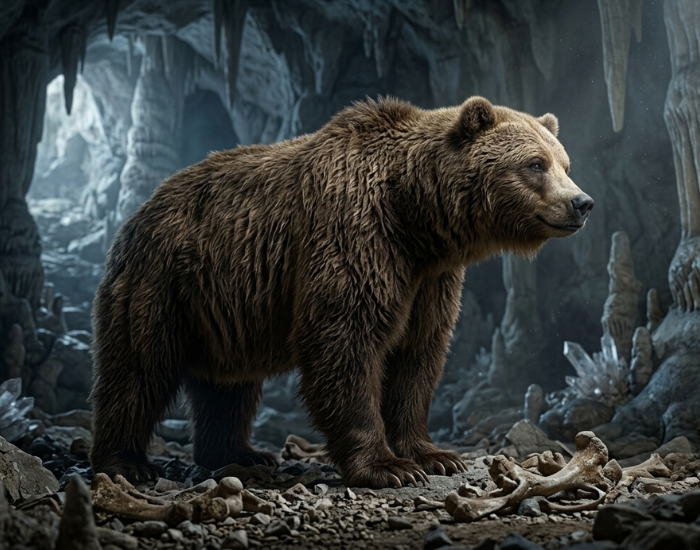
The cave bear was a true giant. Males weighed up to 1,500 pounds and stood taller than modern brown bears when on all fours. Despite the fearsome size, isotopic studies of cave bear bones show these animals were largely vegetarian, they crunched plants, roots, and the occasional unlucky carcass.
The cave bear inhabited Europe during the last ice age, sheltering in deep caves across what is now Germany, Romania, and the Balkans. Early humans and archaic humans like Neanderthals shared those caves with these bears, sometimes painting them on the walls. Cave bears went extinct around 24,000 years ago, well before most ice age mammals, likely a victim of climate change and direct human hunting for prime cave real estate.
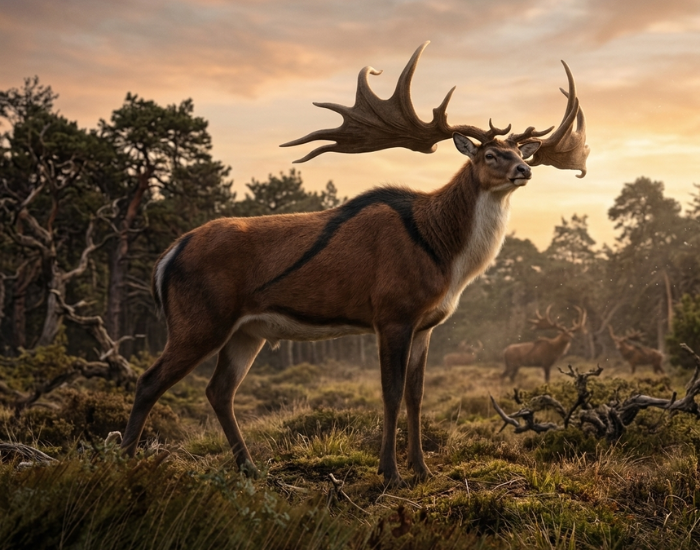
6. Irish Elk (Megaloceros giganteus)
Despite the name, the irish elk was not exclusively Irish, nor was it an elk. Megaloceros was a giant deer that inhabited europe, north Africa, and parts of Asia. Its antlers spanned up to 12 feet, the largest of any deer that ever lived.
They weighed nearly 90 pounds and were shed and regrown every year, an enormous metabolic burden. The irish elk survived in pockets until about 7,700 years ago. Human activity and shrinking habitat as climate warmed are the most likely drivers of their extinction.
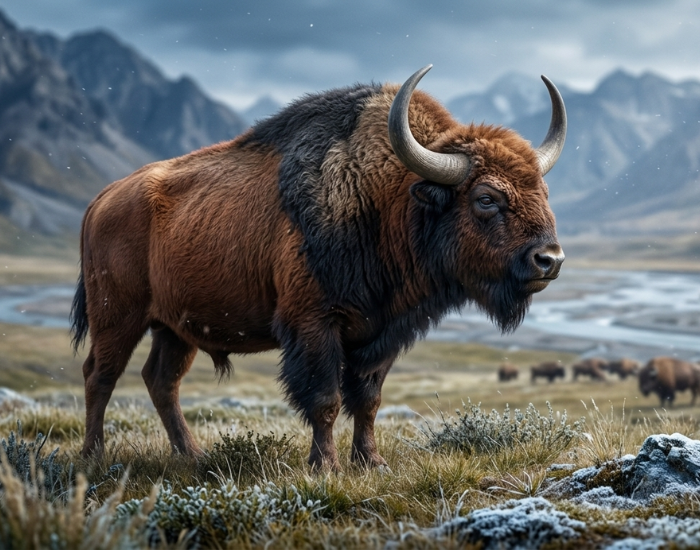
7. Steppe Bison (Bison priscus)
Modern bison have a celebrated ancestor: the steppe bison. This species ranged across the mammoth steppe from europe through Siberia and into north america via the Bering land bridge. The steppe bison was larger than modern bison, with broader horns The steppe bison did not fully die out.
Modern bison descended directly from these animals, making this one ice age mammal whose lineage actually survived. The 36,000-year-old “Blue Babe” mummy unearthed in Alaska is one of the most complete ice age animal fossils ever found.
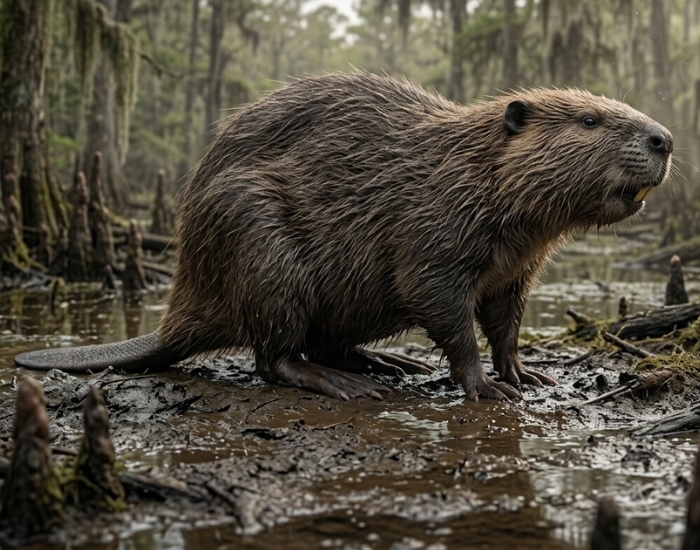
8. Giant Beaver (Castoroides ohioensis)
When I tell people the giant beaver of the ice age reached the size of a black bear, they assume I am exaggerating. I am not. Castoroides weighed up to 220 pounds and stretched seven feet long, with chisel-like incisors as long as my hand.
Unlike modern beavers, the giant beaver did not build dams, its teeth were not shaped for felling trees. It likely fed on aquatic plants in the wetlands of north america. The giant beaver went extinct around 10,000 years ago, possibly because the warming climate dried up the marshes it depended on for survival. Indigenous oral traditions from the Great Lakes region preserve memories of these enormous creatures, which I find one of the most haunting examples of cultural memory stretching deep into the past.
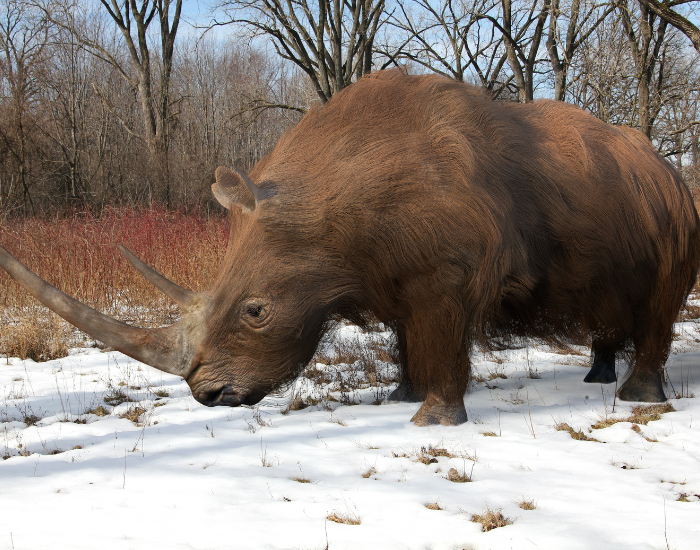
9. Woolly Rhinoceros (Coelodonta antiquitatis)
The woolly rhinoceros patrolled the mammoth steppe alongside woolly mammoths and steppe bison. Coated in thick fur with two massive horns, it used its broad front horn like a snowplow to clear vegetation buried under ice and snow. Adults weighed up to two tons.
Cave paintings in Chauvet, France, show woolly rhinos in remarkable detail, proof that early humans observed them closely. The woolly rhinoceros inhabited europe and northern Asia but never crossed into north america, a quirk of biogeography that still puzzles scientists. Recent DNA evidence suggests human hunting was less responsible for their extinction than climate change.
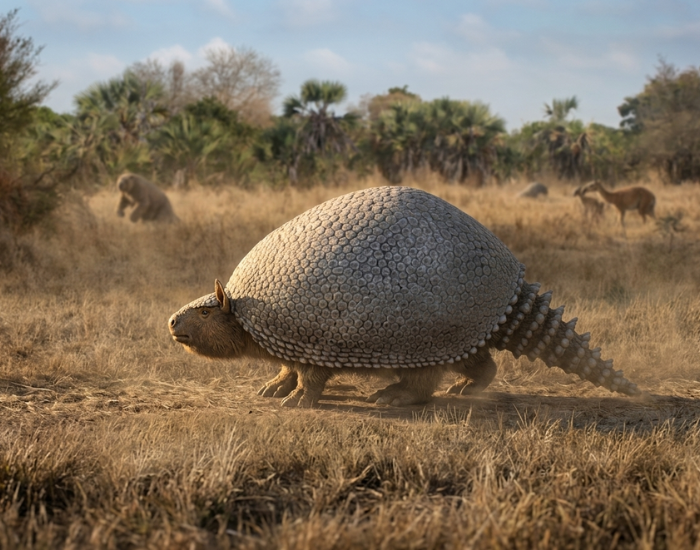
10. Glyptodon (Glyptodon clavipes)
The glyptodon looked like a Volkswagen Beetle with legs. A giant armored mammal closely related to modern armadillos, it weighed up to two tons and wore a domed shell of bony plates. Some species even had armored tail clubs that resembled medieval weapons.
Glyptodons evolved in South America and expanded into the Southern United States during the last ice age. The shells were so durable that early humans in Patagonia reportedly used them as shelters during storms, there is archaeological evidence of fire pits dug inside upturned glyptodon carapaces. These ice age creatures vanished around 10,000 years ago, around the same time as the giant sloths they shared habitat with.
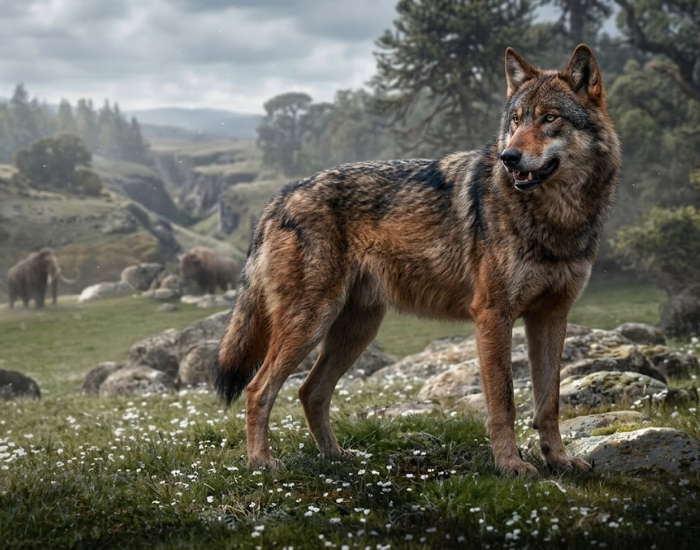
11. Dire Wolf (Aenocyon dirus)
Made famous by Game of Thrones, the dire wolf was a real ice age predator. Larger and more muscular than the modern gray wolf, it had a stronger bite force adapted for crushing the bones of large prey. Genetic research showed dire wolves were not closely related to gray wolves at all, they diverged from a separate North American lineage millions of years ago.
Dire wolves hunted bison, horses, and young mammoths across north america. La Brea has yielded more dire wolf skeletons than any other large mammal species, over 4,000 individuals trapped in asphalt seeps. They went extinct around 13,000 years ago, alongside many of their prey species.
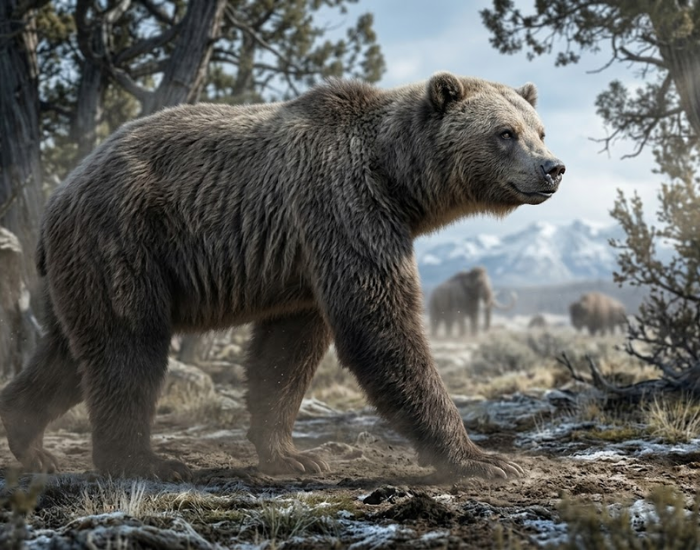
12. Short-Faced Bear (Arctodus simus)
If the cave bear was Europe’s bear giant, the short-faced bear was north america’s. Arctodus stood up to 11 feet tall on its hind legs and may have weighed over a ton, making it one of the largest land predators ever to exist. Its long legs suggest it could cover ground quickly, perhaps to steal kills from saber toothed cats and dire wolves.
Some scientists argue Arctodus was mostly a scavenger; others see it as an active predator. Either way, it dominated the food chain among ice age era animals. The short-faced bear went extinct around 11,000 years ago, another casualty of the Pleistocene extinction event.
Frequently Asked Questions
The animals during the ice age included woolly mammoths, giant ground sloths, saber toothed cats, scimitar toothed cats, cave bears, dire wolves, steppe bison, giant beavers, woolly rhinos, glyptodons, irish elk, and short-faced bears, among many others. The world supported diverse large mammal species across every continent except Antarctica. The pleistocene epoch was one of the most biologically rich periods in mammal history.
Yes — several ice age animals still walk the earth. Modern day elephants, brown bears, modern bison, horses, and gray wolves all share direct ancestry with ice age mammal species. Even animals like musk oxen and reindeer are essentially unchanged from their pleistocene epoch forms. The collared peccary and the American pronghorn survived alongside extinct ice age animals like Smilodon.
Two main factors are responsible for the ice age animals that went extinct: climate change at the end of the last glacial period, and human hunting pressure. As temperatures rose roughly 11,000 years ago, vegetation shifted dramatically — the mammoth steppe broke up into wetter forests and tundra that could not support large herbivores. At the same time, modern humans spread across north america and other landmasses, hunting large animals for food. Most scientists now see the extinction as a combined result of climate and human impact.
What These Vanished Giants Leave Behind
The ice age was not a single event — it was a sprawling chapter of life on earth that lasted nearly three million years and ended only a heartbeat ago in geologic time. What strikes me most as a field biologist is how recently these creatures roamed. My grandfather’s grandfather’s grandfather, traced back enough generations, could have walked alongside a woolly mammoth.
If this list left you curious about the strangest of them all, head over to my deep dive on prehistoric ground sloths — they remain my favorite vanished giants. Better yet, visit your nearest natural history museum and stand beneath one of these reconstructed skeletons. There is no substitute for witnessing the scale of these ice age animals firsthand. Drop a comment below and let me know which species surprised you most.
References:
Barnett, R., et al. (2020). Genomic adaptations and evolutionary history of the extinct scimitar-toothed cat, Homotherium latidens. Current Biology, 30(24), 5018–5025. https://doi.org/10.1016/j.cub.2020.09.051
Cooper, A., Turney, C., Hughen, K. A., Brook, B. W., McDonald, H. G., & Bradshaw, C. J. A. (2015). Abrupt warming events drove Late Pleistocene Holarctic megafaunal turnover. Science, 349(6248), 602–606. https://doi.org/10.1126/science.aac4315
Karpinski, E., Hackenberger, D., Zazula, G., Widga, C., Duggan, A. T., Golding, G. B., Kuch, M., Klunk, J., Jass, C. N., Groves, P., Druckenmiller, P., Schubert, B. W., Arroyo-Cabrales, J., Simpson, W. F., Hoganson, J. W., Fisher, D. C., Ho, S. Y. W., MacPhee, R. D. E., & Poinar, H. N. (2020). American mastodon mitochondrial genomes suggest multiple dispersal events in response to Pleistocene climate oscillations. Nature Communications, 11, 4048. https://doi.org/10.1038/s41467-020-17893-z
Perri, A. R., Mitchell, K. J., Mouton, A., Álvarez-Carretero, S., Hulme-Beaman, A., Haile, J., Jamieson, A., Meachen, J., Lin, A. T., Schubert, B. W., Ameen, C., Antipina, E. E., Bover, P., Brace, S., Carmagnini, A., Carøe, C., Samaniego Castruita, J. A., Chatters, J. C., Dobney, K., Frantz, L. A. F. (2021). Dire wolves were the last of an ancient New World canid lineage. Nature, 591, 87–91. https://doi.org/10.1038/s41586-020-03082-x
Stewart, M., Carleton, W. C., & Groucutt, H. S. (2021). Climate change, not human population growth, correlates with Late Quaternary megafauna declines in North America. Nature Communications, 12, 965. https://doi.org/10.1038/s41467-021-21201-8
Stuart, A. J., & Lister, A. M. (2012). Extinction chronology of the woolly rhinoceros Coelodonta antiquitatis in the context of late Quaternary megafaunal extinctions in northern Eurasia. Quaternary Science Reviews, 51, 1–17. https://doi.org/10.1016/j.quascirev.2012.06.007