When I lived in Mexico, hummingbirds turned up everywhere, even in the middle of Mexico City. Between towers and traffic, tiny flashes of colour darted from flower to flower.
Still, my favourite memories come from San José del Pacífico, in the mountains of Oaxaca. There, I sat in the mist among wildflowers and watched hummingbirds feed a few metres away.
Today I live in Australia, where there are no hummingbirds at all. That absence made me curious about how many hummingbird types exist, and where they live.
Honestly, the answer surprised me. Science recognises 366 hummingbird species, all found only in the Americas. Below, I cover 15 of the most remarkable, from the smallest bird on Earth to the largest hummingbird.
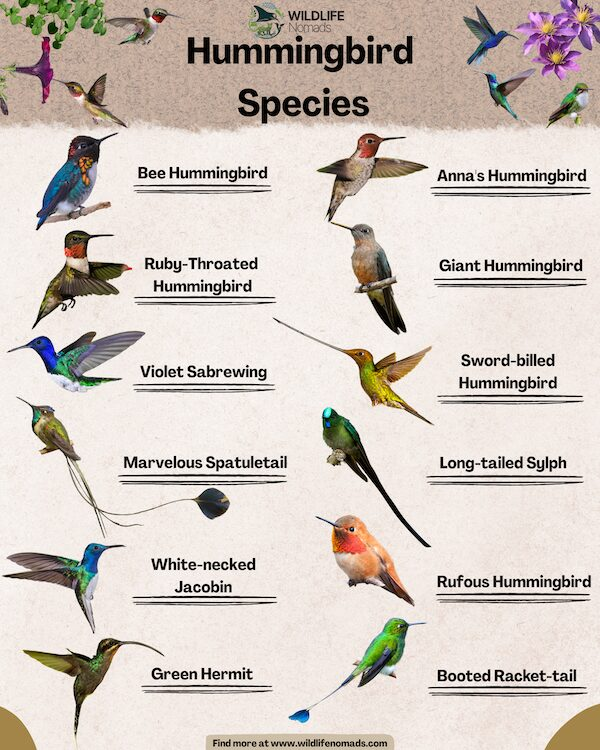
🌺 Can you identify these hummingbirds?
Twelve photos, twelve species from this guide. Read on, then test your eye at the end.
Jump to the ID quiz ↓How Many Hummingbird Species Are There?
All hummingbirds belong to the family Trochilidae. The IOC World Bird List recognised 366 species in 2025. For the complete list, check the IOC website. That makes them one of the largest bird families in the New World. A 2014 family tree showed they have been diversifying for about 22 million years, and are still adding species.
The number keeps changing, though. Even now, scientists still describe new species, like the Blue-throated Hillstar, found in the Andes of Ecuador in 2017. Meanwhile, DNA studies split old species into new ones.
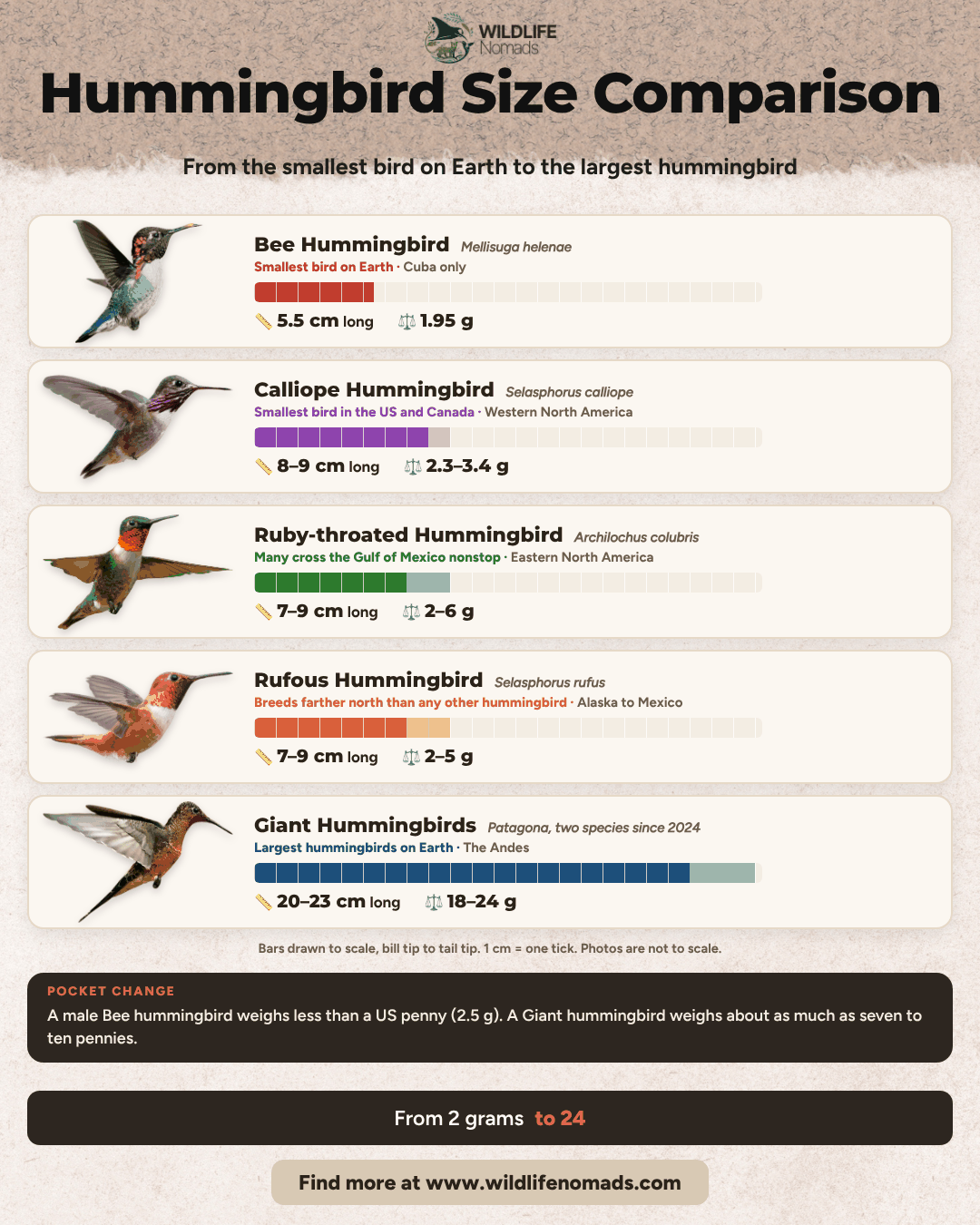
Size also varies hugely. The smallest weigh less than 2 g, about the weight of a large insect. By contrast, the biggest weighs roughly as much as a small sparrow. See how they compare in our animal size comparison tool.
Where Do Hummingbird Species Live?
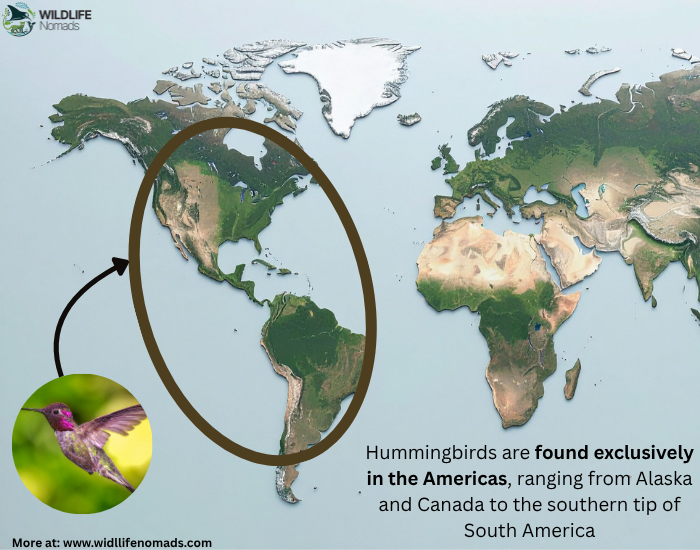
Overall, hummingbirds live only in the Western Hemisphere, from southern Alaska to the tip of Chile. Still, most hummingbird species live in Central and South America. In fact, Ecuador alone has more than 130 hummingbird species found within its borders.
However, north of Mexico, the list shrinks fast. Only about 14 species are common in the United States and Canada. Most of them are migratory birds that migrate north each spring to their breeding grounds.
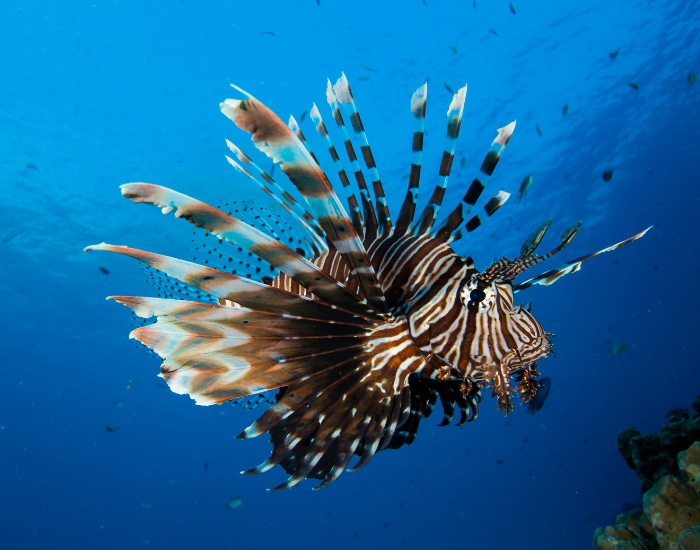
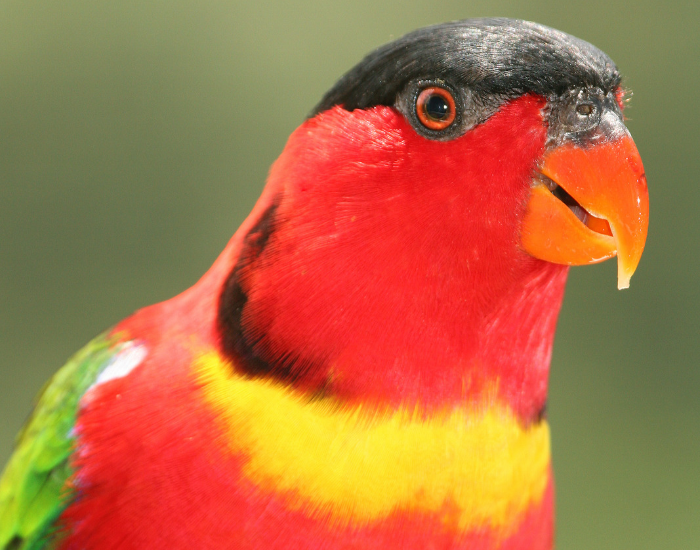
So, are there hummingbirds in Australia? No. Here, honeyeaters and lorikeets fill the nectar-feeding role instead. At Woody Head, a blue-faced honeyeater perched on my car awning every day for four days.
What Makes Hummingbirds Different From Other Birds?
Unlike other bird species, hummingbirds can hover for long periods and truly fly backwards. Their wings rotate at the shoulder and trace a figure eight pattern. Many small species beat them 50 to 80 times per second.
Meanwhile, their iridescent feathers work like prisms. Tiny structures in each feather bend light, so a throat can flash red, then turn black as the bird moves. As a result, hummingbirds show such dazzling colors.
Of course, all that power needs fuel. Hummingbirds drink nectar and also eat small insects for protein. On cold nights, many drop into torpor and lower their body temperature. In the Andes, a Black Metaltail cooled to 3.3 °C, a record for any bird.
Besides, as they feed, they carry pollen from flower to flower. Many plants have co evolved with them, as you can see in our Pollination Lab.
15 Types of Hummingbirds You Should Know
1. Ruby-throated Hummingbird (Archilochus colubris)
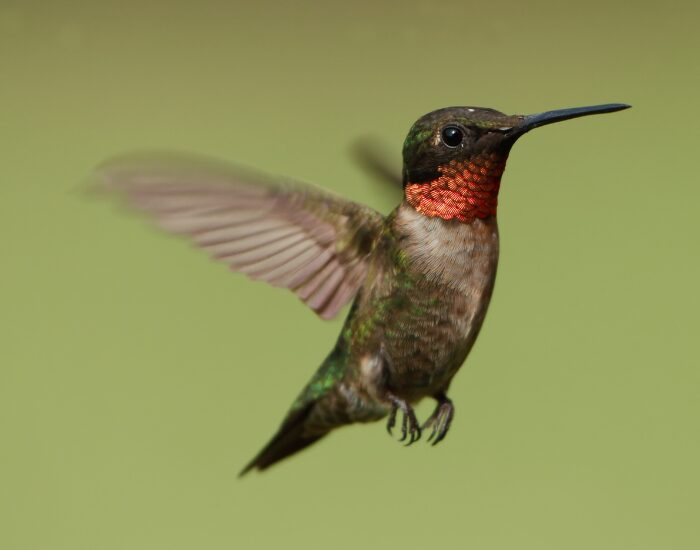
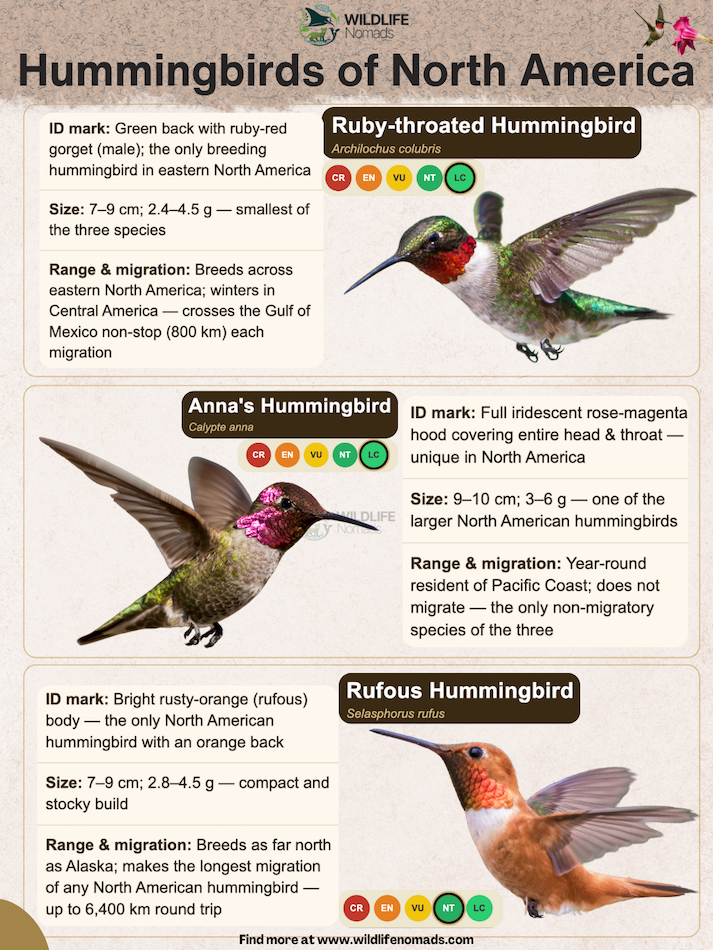
Ruby throated hummingbirds are the only species that regularly breed in eastern North America. Males flash a red throat, while females have pale throats. Read my full ruby-throated hummingbird facts.
Above all, their migration stuns me. Remarkably, weighing about 3 g, some cross the Gulf of Mexico nonstop. That trip covers more than 500 miles and takes about 18 hours. The oldest known wild bird lived to at least 9 years.
2. Anna’s Hummingbird (Calypte anna)
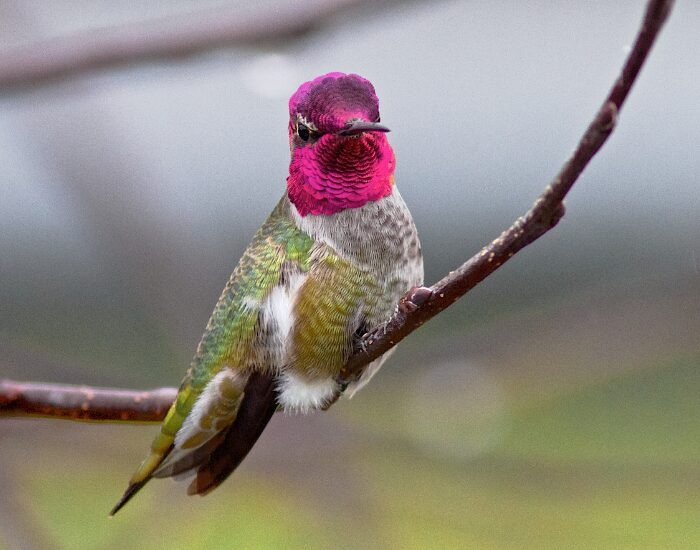
Anna’s hummingbird lives year-round along the Pacific coast of western North America. Gardens and feeders helped it spread north into Canada. Males have rose-pink heads and throats. Read my Anna’s hummingbird facts.
Males also sing scratchy songs and perform steep courtship dives. During those dives, they reach about 385 body lengths per second. Moreover, females can start nest building and egg laying as early as December.
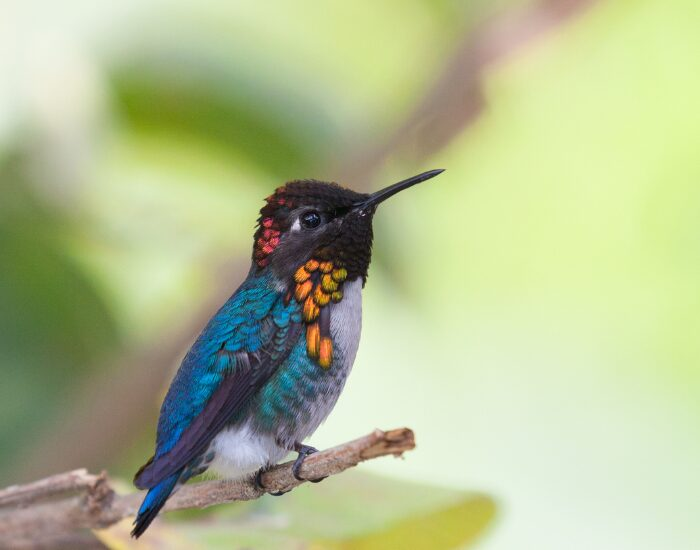
3. Bee Hummingbird (Mellisuga helenae)
The Bee Hummingbird lives only in Cuba and is the smallest bird on Earth. Males weigh about 1.95 g and measure roughly 5.5 cm. Females are slightly larger. Meet more tiny species in our smallest birds in the world.
In addition, breeding males glow with fiery red heads and throats. Sadly, habitat loss has made the species Near Threatened on the IUCN Red List.
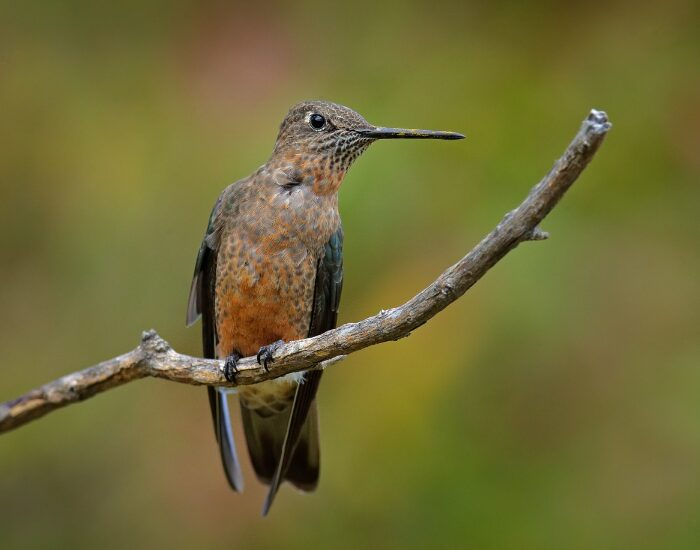
4. Giant Hummingbird (Patagona gigas)
At about 20 cm long, the Giant Hummingbird is the biggest member of the family. It is roughly eight times the weight of a Ruby-throated Hummingbird. By comparison, its wingbeats are much slower than those of small hummingbirds.
In 2024, scientists found it was actually two species. The Northern Giant Hummingbird, Patagona chaski, stays in the high Andes. By contrast, the southern one breeds near the Chilean coast. It then climbs above 4,000 m into Peru for the winter.
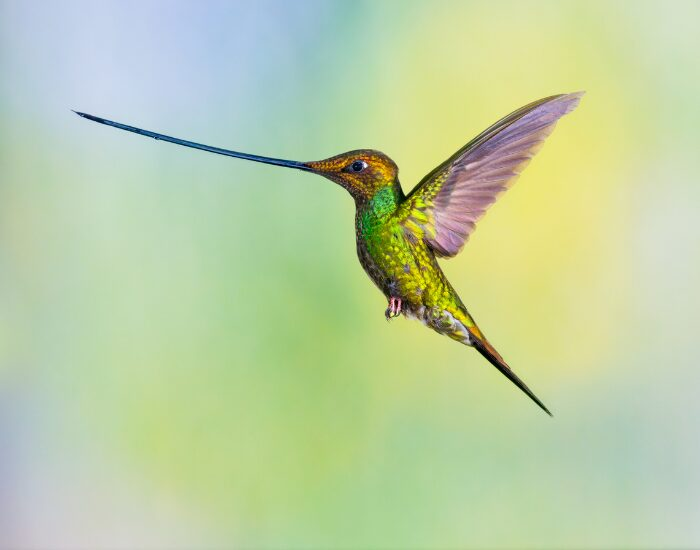
5. Sword-billed Hummingbird (Ensifera ensifera)
This Andean bird is the only bird with a bill longer than its body, excluding the tail. The bill measures 8 to 12 cm. As a result, it preens with its feet instead.
In fact, its bill fits passionflowers like Passiflora mixta, whose long tubes few other birds can reach. It lives from Venezuela to Bolivia, mostly between 1,700 and 3,500 m.
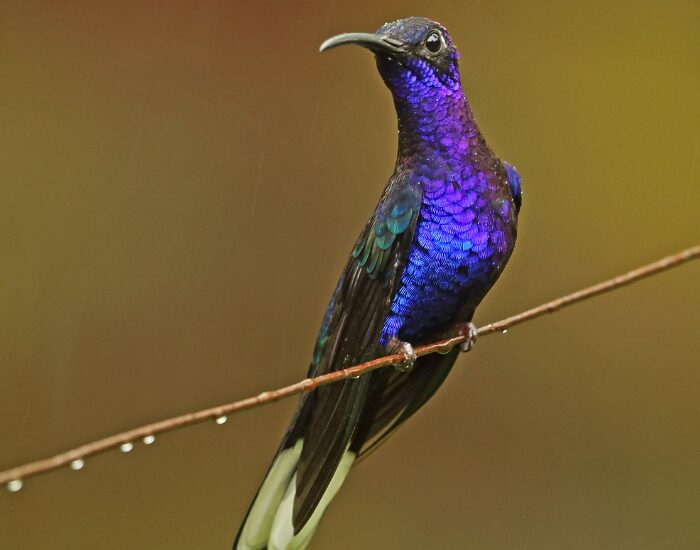
6. Violet Sabrewing (Campylopterus hemileucurus)
The Violet Sabrewing is one of the largest hummingbirds in Central America. Males glow deep violet, with white corners on the tail. It lives from southern Mexico to Panama.
I’d call it one of the most beautiful hummingbirds. Males sing together at leks, and the species dominates flowers in cloud forests. Look for it in Costa Rica’s birds.
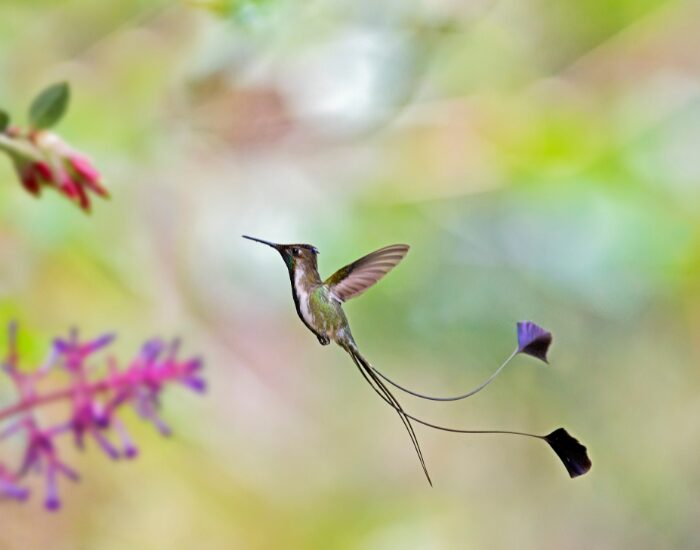
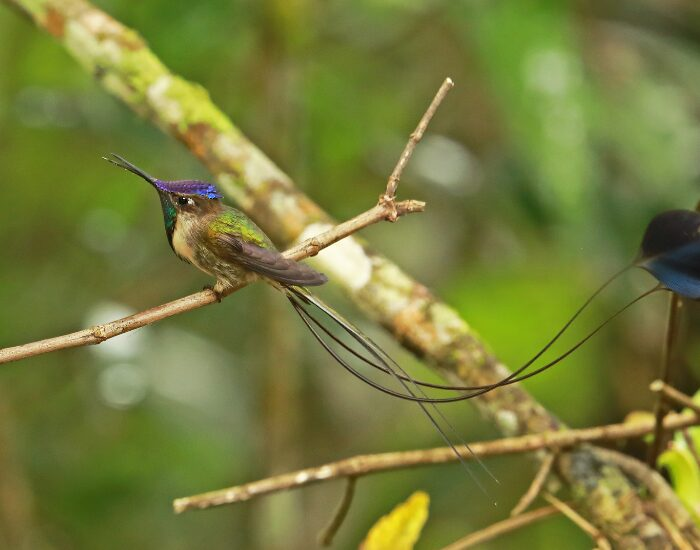
7. Marvelous Spatuletail (Loddigesia mirabilis)
This jewel lives only in a small area of northern Peru, mainly in the Utcubamba valley. Males have two long outer tail feathers that end in violet-blue discs, or spatules.
During courtship, males wave these spatules while hovering. Today, fewer than 1,000 mature birds survive. Even so, the IUCN moved it from Endangered to Near Threatened in 2023.
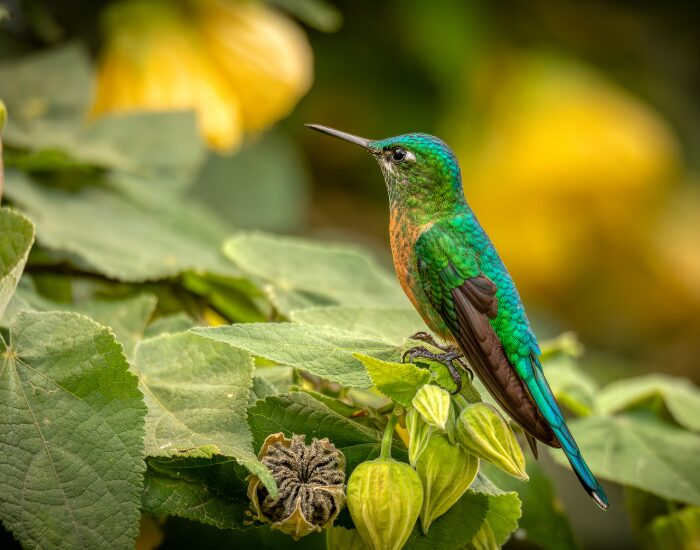
8. Long-tailed Sylph (Aglaiocercus kingii)
Similarly, Long-tailed Sylphs live in Andean cloud forests from Venezuela to Bolivia. Notably, males have emerald bodies and a long, forked, blue-green tail. Females look plainer, with cinnamon-coloured underparts.
That contrast between adult males and adult females is common among hummingbirds. Generally, the flashier sex is the male.
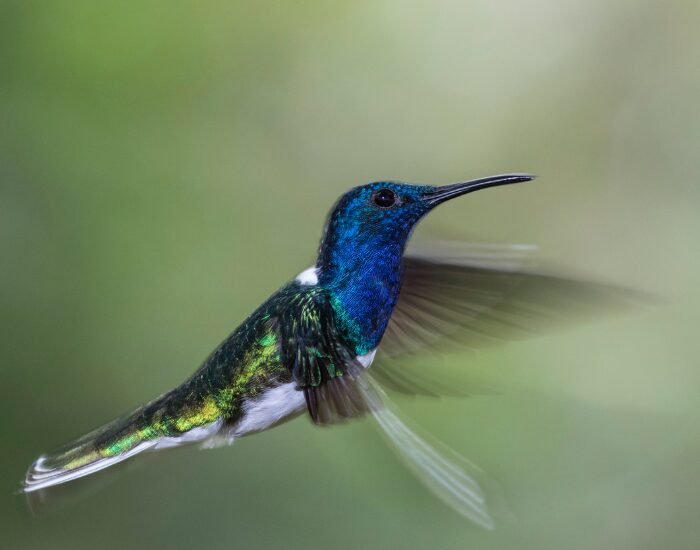
9. White-necked Jacobin (Florisuga mellivora)
Meanwhile, jacobins range from Mexico to Brazil. Males have deep blue heads, white bellies and a white collar. Yet nearly 20% of adult females in one Panama population look like males.
In 2021, however, researchers explained why. Male-like females faced less aggression and fed about 35% longer at rich feeders. All juveniles also start with male-like plumage.
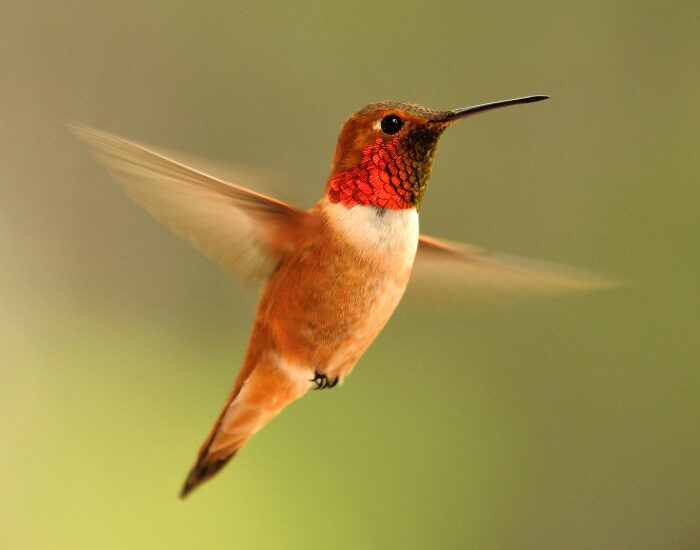
10. Rufous Hummingbird (Selasphorus rufus)
The rufous hummingbird breeds farther north than any other hummingbird, up to south-central Alaska. It then flies about 4,000 miles to Mexico, one of the longest migration routes for a bird its size. Read my rufous hummingbird facts.
Typically, males are orange-brown with a copper-red throat. They chase away much bigger birds and even chipmunks. Sadly, numbers have fallen, and the IUCN lists the species as Near Threatened.
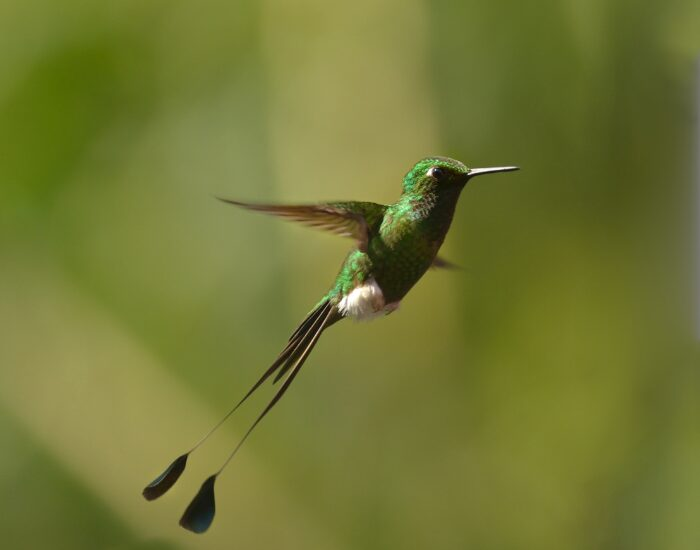
11. Booted Racket-tail (Ocreatus underwoodii)
Interestingly, this cloud forest bird wears puffy white leg feathers that look like boots. Males also have two long tail feathers ending in rackets.
However, taxonomists disagree on how many species this is. The IOC list now splits it into three: White-booted, Rufous-booted and Peruvian Racket-tails. It is a good reminder that hummingbird lists keep evolving.
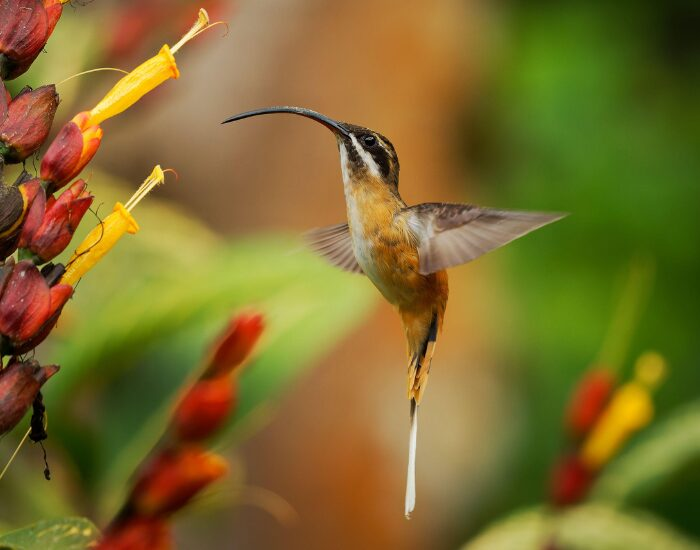
12. Green Hermit (Phaethornis guy)
By contrast, hermits are a dull-coloured branch of the family. Green Hermits live in the understory of humid forests from Costa Rica to Peru. Their long, curved bills fit curved flowers like heliconias.
Unlike most species, males don’t guard territories. Instead, they gather at leks and sing for females. They also follow regular feeding routes, visiting the same flowers in order.
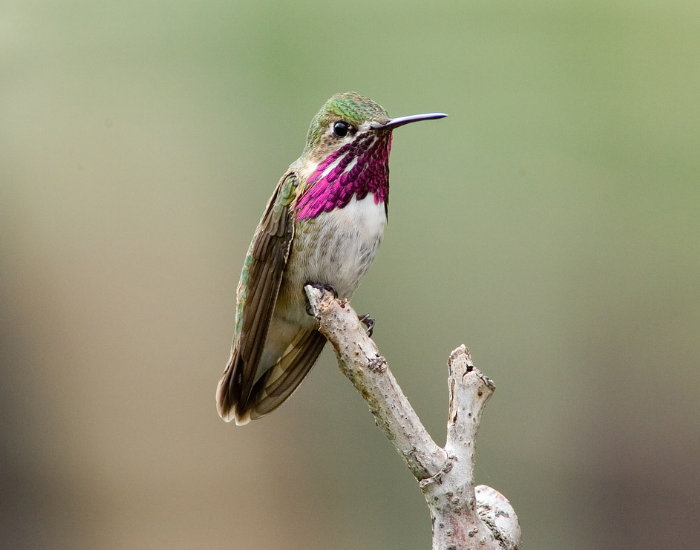
13. Calliope Hummingbird (Selasphorus calliope)
Further north, the calliope hummingbird is the smallest bird in the U.S. and Canada, at about 3 inches long. Males have a streaky magenta throat that looks like rays.
In summer, they breed in mountain meadows and forest edges of the Northwest. Then they migrate more than 2,000 miles each way to pine-oak forests in Mexico.
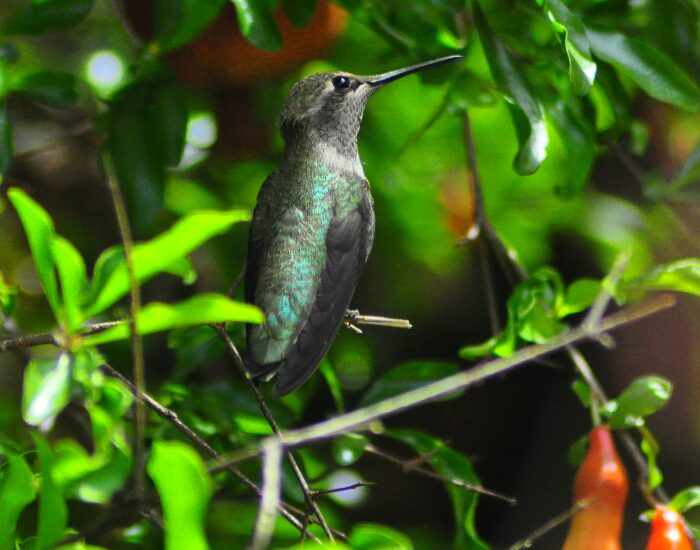
14. Rivoli’s Hummingbird (Eugenes fulgens)
You may know it as the magnificent hummingbird. In 2017, ornithologists split that species in two: Rivoli’s Hummingbird and the Talamanca Hummingbird of Costa Rica and Panama.
Today, Rivoli’s is one of the larger hummingbirds in the United States. It visits mountain canyons in southern Arizona and New Mexico. Males show a purple crown and a turquoise throat.
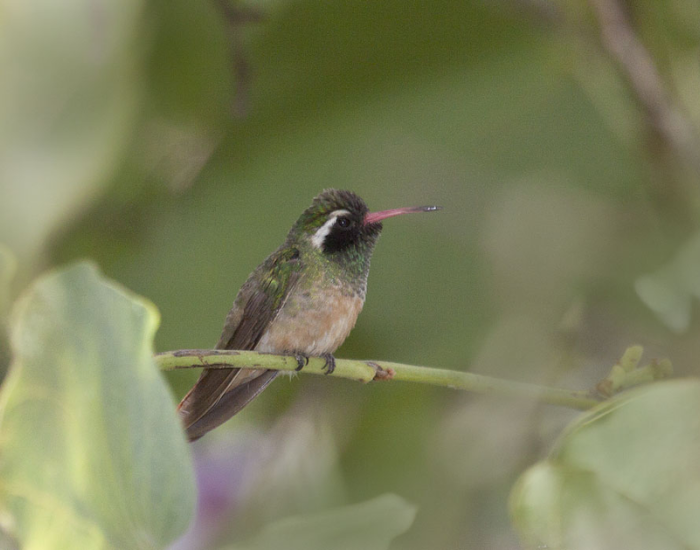
15. Xantus’s Hummingbird (Basilinna xantusii)
Xantus’s hummingbird lives only on the Baja California peninsula of Mexico. Look for a bold white stripe behind the eye and a red bill with a black tip.
It has strayed north to California and British Columbia only a handful of times. Its population is stable, at about 20,000 to 50,000 adults.
Other North American Hummingbird Species
Beyond the species above, North America hosts many more. In the west, the Sonoran and Mojave deserts and the Gulf Coast are hotspots. Here is a quick guide for beginner birders.
| Species | Where to look | Field mark |
|---|---|---|
| Black chinned Hummingbird | Deserts to mountain forests, from California to Texas | Black chin with a thin purple band |
| Costa’s hummingbird | Sonoran and Mojave deserts | Violet crown and long violet throat corners |
| Broad tailed hummingbird | Rocky Mountain meadows and open woodland | Male wings make a loud, metallic trill |
| Allen’s hummingbirds | Coastal California and southern Oregon | Like a Rufous, but with a green back |
| Buff bellied hummingbird | South Texas and the Gulf Coast | Red bill and buffy belly |
| Lucifer hummingbird | Chihuahuan Desert of west Texas | Long, curved bill |
| Blue-throated Mountain-gem | Southern Arizona canyons | Blue throat on males; very large |
Rare vagrant hummingbird species add extra excitement, too. Several species of vagrant hummingbirds wander north from Mexico. They include the Berylline Hummingbird and Cinnamon Hummingbird. The Green Breasted Mango and Plain Capped Starthroat occasionally reach Arizona or Texas, too.
How to Attract Hummingbirds and Help Them
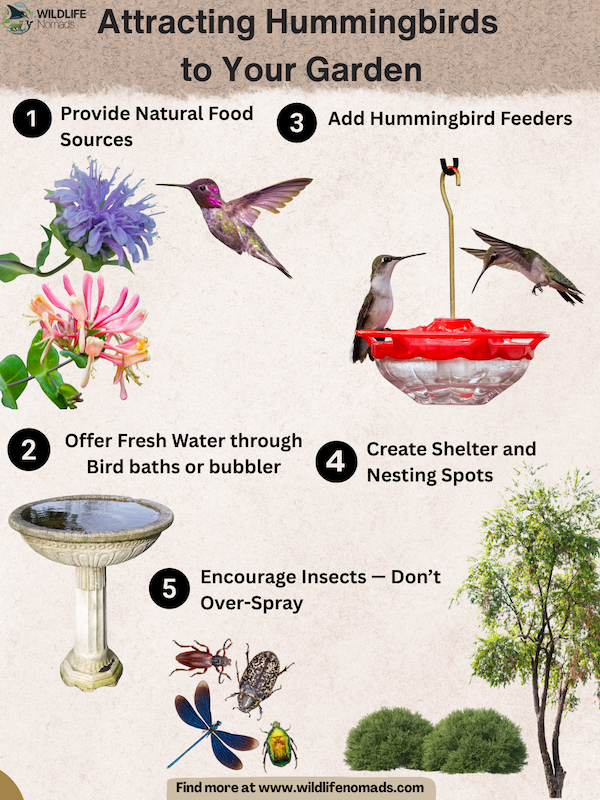
First of all, native, tube-shaped flowers are the best start. Plant species that bloom at different times. Then add a feeder with a 4:1 mix of water and white sugar. See our guide to building a wildlife-friendly garden.
Next, change feeder water every few days, and more often in heat. Never use honey or red dye. Some people also leave overripe fruit out to draw fruit flies, an easy protein snack.
Beyond the garden, hummingbirds face real threats. Habitat loss, climate change and invasive species hit mountain species hardest. Cats and window collisions also kill many birds. Read how cats contribute to bird extinction.
So keep cats indoors and put decals on large windows. Finally, log your sightings on eBird to help scientists track populations.
FAQs About Hummingbird Species
The IOC World Bird List recognised 366 hummingbird species in 2025. All of them live in the Americas, and most live in Central and South America. The number changes as scientists describe new species and split old ones using DNA.
Several hummingbirds are Critically Endangered. They include the Blue-throated Hillstar of Ecuador, discovered in 2017, and the Gorgeted Puffleg of Colombia. Both survive in tiny mountain areas threatened by habitat loss.
Yes, but rarely. Hybrids between closely related species, such as Anna’s and Costa’s hummingbirds, have been documented in the wild. Hybrids can confuse birders because they mix the field marks of both parents.
In North America, an orange-brown hummingbird is usually a male Rufous Hummingbird. Further south, the Brown Violetear and many hermits look mostly brown. Females and young of many species also look duller than adult males.
A group of hummingbirds is often called a charm. Other playful names include a glittering, a shimmer, a hover and a bouquet. In reality, hummingbirds rarely travel in groups, because most defend their own flowers.
Some people wrap feeders in foil to keep sugar water cool or to deter insects. It is not necessary. Shade, an ant moat and fresh water every few days work better.
No. Hummingbirds live only in the Americas. In Australia, honeyeaters and lorikeets fill a similar role as nectar-feeding birds.
Follow the Flash of Colour
These 15 hummingbird types are only a glimpse of 366 species. From Cuba’s tiny Bee Hummingbird to the Giant of the Andes, each one solved flight in its own way.
So next time you visit Mexico, Costa Rica or even your own garden, slow down. Watch the flowers, listen for wing trills and track their journeys on our migration maps. Which hummingbird would you most love to see? Tell me in the comments.
References:
Abrahamczyk, S., Souto-Vilarós, D., & Renner, S. S. (2014). Escape from extreme specialization: Passionflowers, bats and the sword-billed hummingbird. Proceedings of the Royal Society B, 281(1795), 20140888. https://doi.org/10.1098/rspb.2014.0888
Clark, C. J. (2009). Courtship dives of Anna’s hummingbird offer insights into flight performance limits. Proceedings of the Royal Society B, 276(1670), 3047–3052. https://doi.org/10.1098/rspb.2009.0508
Falk, J. J., Webster, M. S., & Rubenstein, D. R. (2021). Male-like ornamentation in female hummingbirds results from social harassment rather than sexual selection. Current Biology, 31(19), 4381–4387. https://doi.org/10.1016/j.cub.2021.07.043
McGuire, J. A., Witt, C. C., Remsen, J. V., Corl, A., Rabosky, D. L., Altshuler, D. L., & Dudley, R. (2014). Molecular phylogenetics and the diversification of hummingbirds. Current Biology, 24(8), 910–916. https://doi.org/10.1016/j.cub.2014.03.016
Williamson, J. L., Gyllenhaal, E. F., Bauernfeind, S. M., Bautista, E., Baumann, M. J., Gadek, C. R., Marra, P. P., Ricote, N., Valqui, T., Bozinovic, F., Singh, N. D., & Witt, C. C. (2024). Extreme elevational migration spurred cryptic speciation in giant hummingbirds. Proceedings of the National Academy of Sciences, 121(21), e2313599121. https://doi.org/10.1073/pnas.2313599121
Wolf, B. O., McKechnie, A. E., Schmitt, C. J., Czenze, Z. J., Johnson, A. B., & Witt, C. C. (2020). Extreme and variable torpor among high-elevation Andean hummingbird species. Biology Letters, 16(9), 20200428. https://doi.org/10.1098/rsbl.2020.0428