
A Jungle Enigma Wrapped in Popcorn
The arctictis binturong, commonly called a “bearcat,” is one of Southeast Asia’s most charismatic yet least understood arboreal mammals. Instantly recognizable by its long, muscular prehensile tail, this species is one of only two carnivorous species in the world to have such an adaptation. This species forces you to abandon all tidy classification boxes. Is it a type of bear or maybe a cat? Neither. It’s a viverrid, making it a close relative to civets and genets. The word ‘binturong’ itself comes from a local language, but the original language is now extinct. Moreover, it’s the only species in its genus, Arctictis.
This ecological marvel possesses a prehensile tailand a distinctive scent that captivates everyone who encounters it. In addition, the binturong plays a vital role in tropical forests as a seed disperser.
This blog post is a deep dive into the strange, wonderful world of binturongs. We’re going to unpack their unique biology, their crucial ecosystem role, and the urgent conservation work needed to protect this popcorn-scented wonder.
What Type of Species is a Binturong? Debunking the “Bearcat” Myth
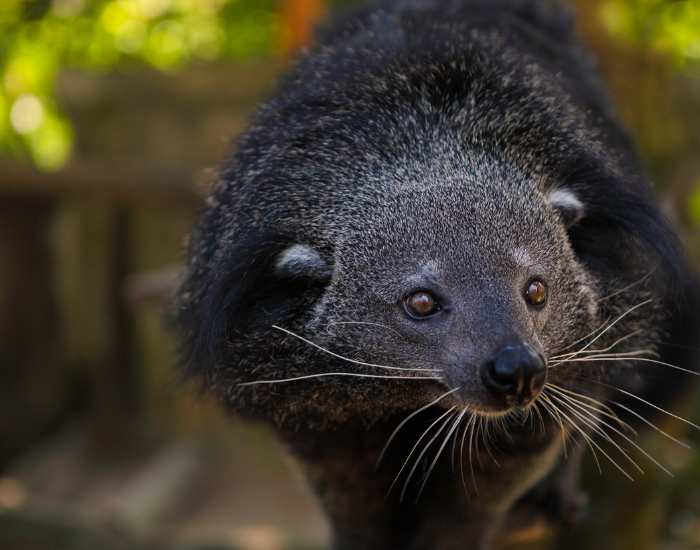
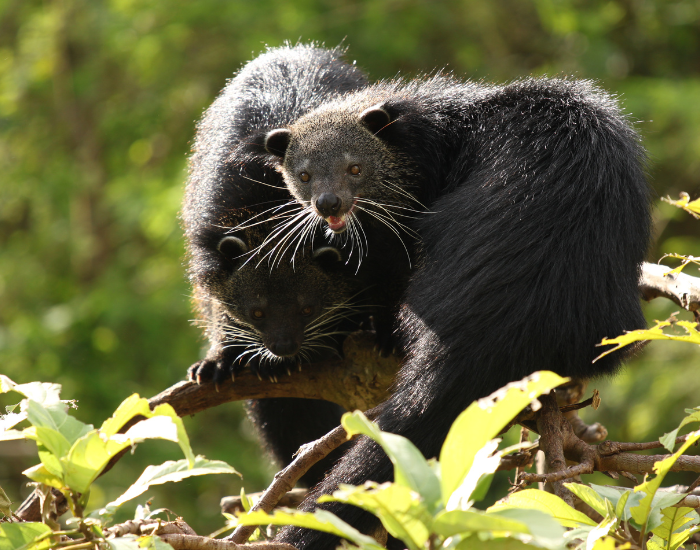
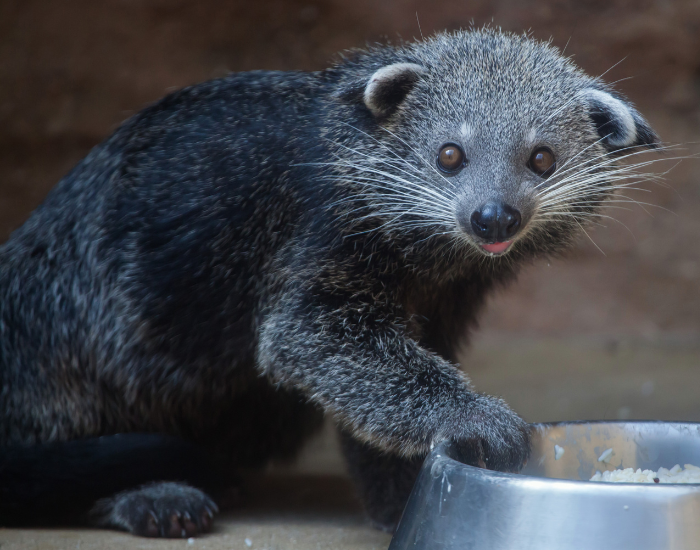
Let’s address the confusion right away: Is a binturong a bear or cat? It is neither. The nickname “bearcat” is a classic case of mistaken identity based purely on appearance. Its thick, shaggy black hair gives it a bear-like stockiness. However, its face appears somewhat cat-like. The bear cat, or Arctictis binturong, is a large, arboreal carnivore found in Southeast Asian rainforests, uniquely classified due to its combination of physical features and behaviors that resemble both bears and cats.
The binturong belongs to family Viverridae, which is part of the order Carnivora. This family includes civets and genets. Nevertheless, arctictis binturong stands alone as the sole member of its genus. It’s a prime example of evolutionary divergence, boasting unique traits that set it apart from closely related species.
Binturong Classification:
- Kingdom: Animalia
- Phylum: Chordata
- Class: Mammalia
- Order: Carnivora
- Family: Viverridae
- Genus: Arctictis
- Species: Arctictis binturong
What is the closest relative to a binturong? Its nearest kin are palm civets (Paradoxurus genus). However, binturongs are by far the largest animals in the Viverridae family, with a distinct, lengthy, muscular body.

Life in the Canopy: Binturong Habitat and Adaptations
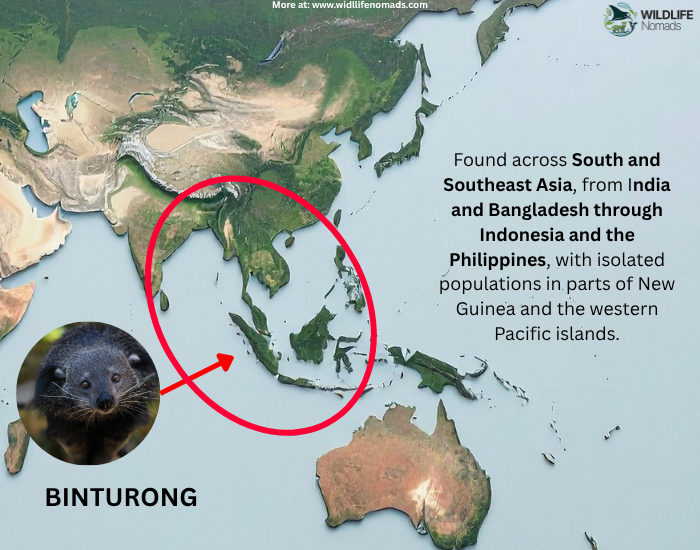
The binturong habitat consists of dense tropical forests and secondary evergreen forests throughout South and Southeast Asia. The binturong range covers a wide geographic area, including both mainland Asia and the islands of Southeast Asia. Where do binturongs live? Their geographical range spans from India, Nepal, and Bangladesh through mainland Southeast Asia, including Thailand, Malaysia, and Vietnam. Furthermore, the binturong range extends to the islands of Sumatra, Java, Borneo, and Palawan in the northern Philippines. Genetic studies have identified a northern clade of binturongs in mainland Asia, which is distinct from populations found in the Sundaic region.
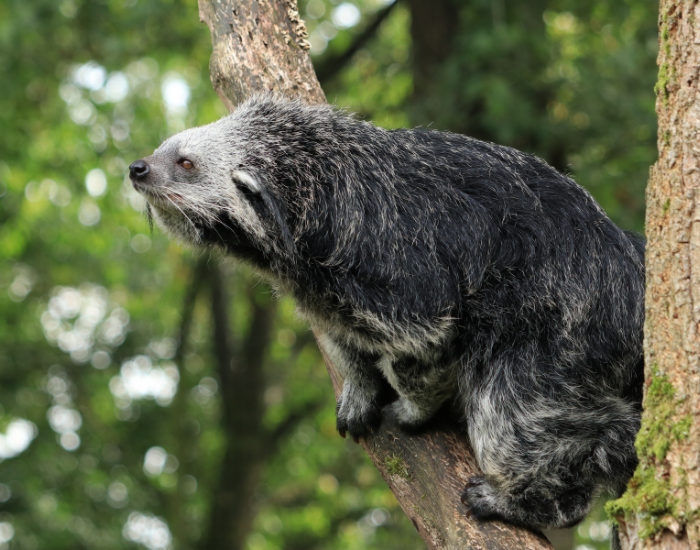
Binturongs are primarily arboreal mammals, meaning they are tree-dwelling creatures. They move with slow, deliberate caution through the forest canopy. In contrast to acrobatic primates, binturongs use remarkable physical adaptations to navigate dizzying heights.
The Fifth Limb and the Flexible Ankle
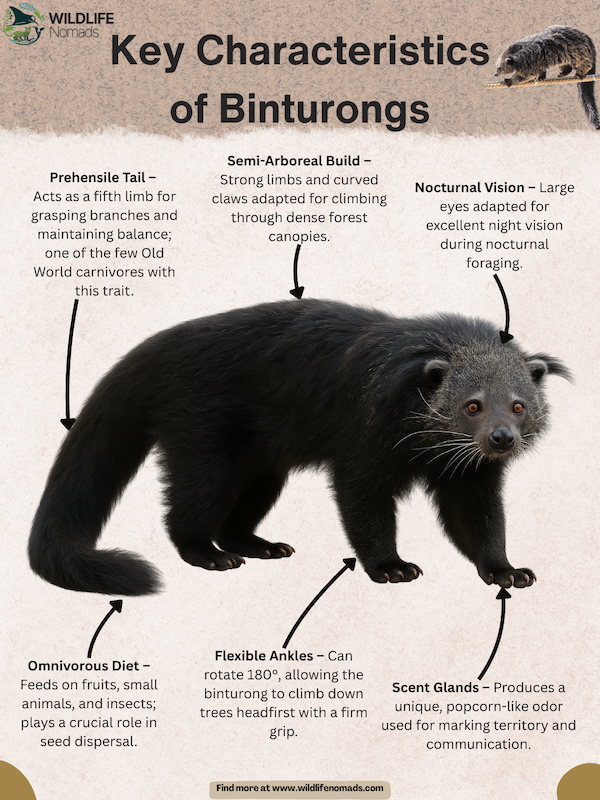
Two physical features enable the binturong’s life in trees:
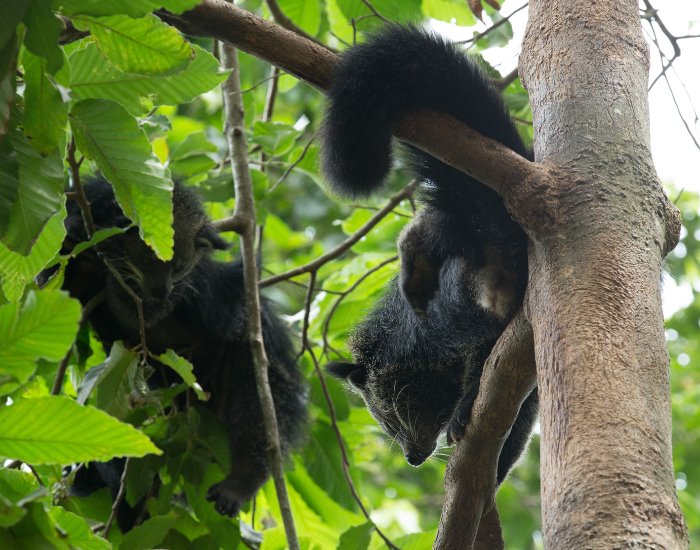
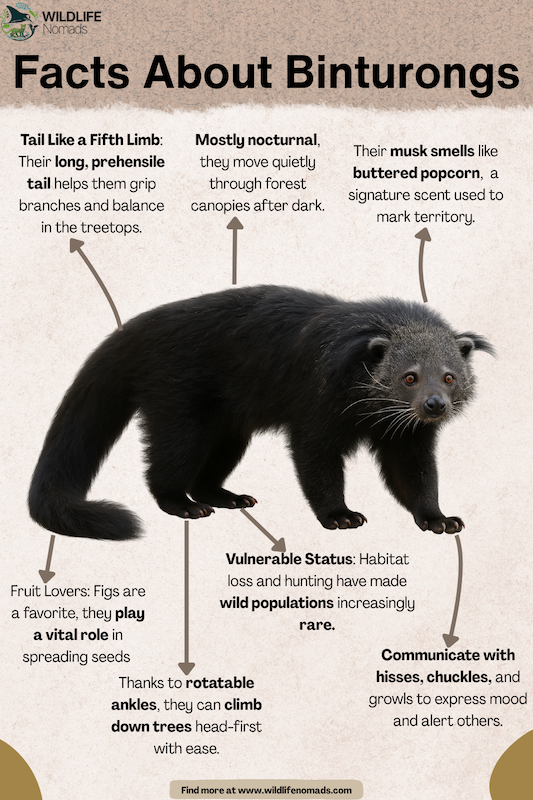
The Long Prehensile Tail: This is arguably the binturong’s most famous feature. The tail is thick, muscular, and nearly as long as its body. It acts as a fifth limb, capable of grasping branches. This is an incredibly rare trait among Old World carnivores. In fact, only the kinkajou of Central and South America shares this adaptation. When sleeping, binturongs often wrap their tail around branches as a natural safety device. A leathery patch at the tail’s tip provides extra grip.
Rotatable Ankles: Binturongs are among the few mammals capable of descending trees head-first. They achieve this through incredibly flexible ankles that rotate 180 degrees backward. This allows them to maintain a firm, downward-facing grip with their sharp teeth and claws.
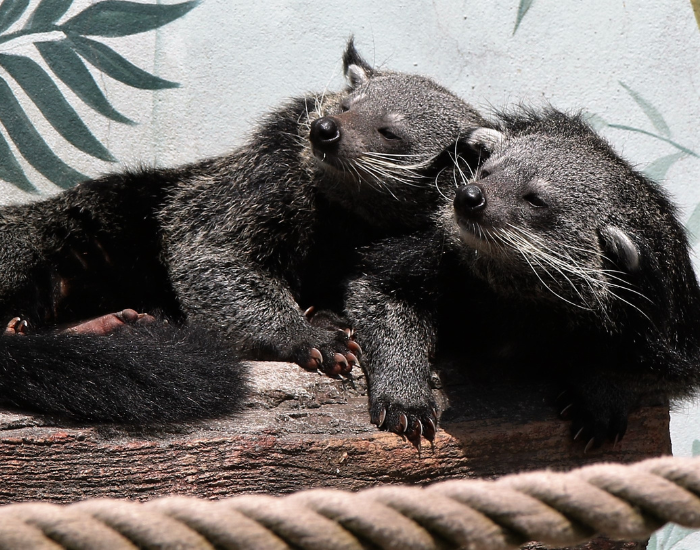
Binturongs also have long ear tufts protruding from their small, rounded ears, which may enhance their endearing appearance or serve important sensory functions.
Binturongs are mostly nocturnal, spending days resting in tree hollows or high branches. They often bask in the sun before becoming active after dark to forage.
Binturong Size, Lifespan, and Appearance
How big are arctictis binturongs? The binturong is the largest member of its family. They possess a long, shaggy coat that is typically black, often grizzled with white whiskers or silver tips.
| Characteristic | Measurement | Notes |
|---|---|---|
| Body Length | 2 to 3 feet (60-95 cm) | Excluding the tail |
| Tail Length | Up to 3 feet (89 cm) | Nearly the length of the body |
| Weight | 20 to 50 pounds (9-23 kg) | Females are generally larger animals than males |
| Size Comparison | Medium-sized dog | Roughly the size of a Beagle |
Binturong lifespan in the wild ranges from 10 to 18 years. In captivity, however, they have lived for over 25 years. This demonstrates the benefits of good care and veterinary science.
Scent, Communication, and Behavior
If you’ve been near a binturong, the first thing you’ll notice is the smell. Binturongs possess scent glands located beneath their tail. The chemical compound 2-acetyl-1-pyrroline (2-AP) creates their distinctive aroma. This same chemical compound is responsible for the smell of cooked rice and popcorn.
Both males and females use this unique scent to mark territory. They rub the gland onto tree trunks and branches. It’s a highly effective, aromatic communication tool. Therefore, it tells other binturongs about their presence, reproductive status, and territorial boundaries.
Binturongs are generally solitary animals. They come together primarily for mating. When they communicate, they produce a range of vocalizations. These include chuckles and purrs when content. In addition, they make high-pitched wails, hisses, and low grunts when distressed or aggressive. Young binturongs (baby binturongs) produce loud howls to communicate with their mothers.
Diet and the Unsung Role of the Binturong
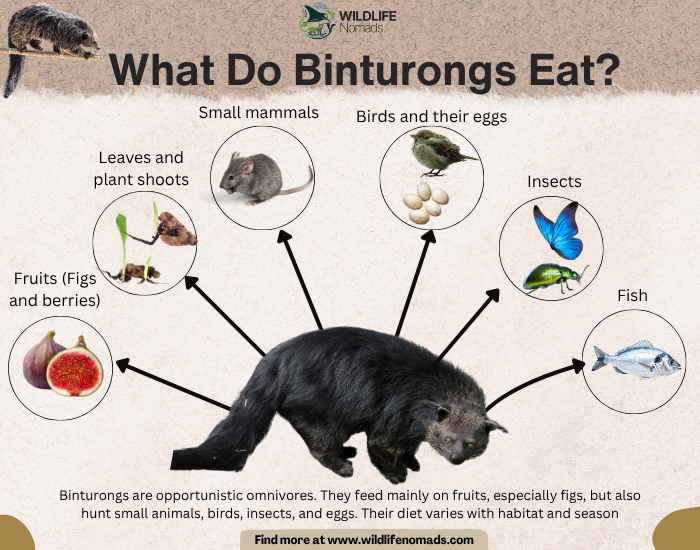
Despite being classified in order Carnivora, the binturong diet leans heavily toward fruits. They are primarily frugivorous, with figs being favorite foods. However, they are opportunistic omnivores.
What Binturongs Eat:
- Fruits (especially figs and berries)
- Leaves and plant shoots
- Small mammals (rodents, squirrels)
- Birds and their eggs
- Insects, fish, and they eat carrion
- Small animals when available
An Essential Forest Gardener and Seed Disperser
The binturong’s dietary habits give it a crucial role in its ecosystem: seed dispersal. Because they swallow many seeds whole—especially from fig species—these seeds pass through their gut quickly. A 2013 study in the Journal of Tropical Ecology showed that gut passage enhanced germination time for certain fruit seeds. Binturongs possess specific digestive enzymes that help soften the seed coat of strangler fig seeds, making them especially effective seed dispersers. This increases seedling survival once deposited in their scat.
Therefore, the binturong isn’t just a quirky resident. It’s a vital “forest gardener” that helps regenerate diverse flora in tropical forests. The health of these dense forests, particularly for trees like the strangler fig, is intrinsically linked to binturong populations.
Conservation Status and Threats: Why Are Binturongs Critically Endangered?
The story of arctictis binturong is unfortunately common in Southeast Asia. This magnificent, specialized creature struggles against relentless human activity pressure.
Binturong populations have declined by at least 30% over the last three decades. The biggest threats facing binturongs are habitat loss and hunting, which have significantly contributed to their decline. Consequently, the International Union for Conservation of Nature (IUCN) classifies the species as Vulnerable on its Red List. Some experts consider them critically endangered in certain regions.
How many binturongs are left in the wild? A precise number is difficult to determine. They are naturally uncommon, shy, and live in dense, remote habitats. However, the downward trend is clear.
Major Threats to Wild Binturongs
1. Habitat Loss: This is the single biggest threat. Tropical forests—the binturong’s natural habitat—are being cleared at alarming rates. Commercial agriculture (primarily oil palm plantations), logging, and human settlement drive this destruction. When the forest canopy fragments, these slow arboreal mammals struggle to cross ground-level gaps. This isolates populations and reduces genetic diversity.
2. Hunting and Poaching: Binturongs are hunted for their meat (a delicacy in some areas) and their thick fur. In addition, they’re killed for use in traditional medicine across parts of their range.
3. Illegal Pet Trade: Are binturongs good pets? The answer is an unequivocal no. Despite this, the illegal pet trade poses a significant threat. Cute baby binturongs are sometimes poached from the wild. As large, semi-wild animals, they are challenging to care for. They’re often territorial and require a specialized diet. This makes them wholly unsuitable for domestic settings. Can you have a binturong as a pet? In many regions, including the US, it’s illegal without specific permits. Moreover, the pet trade severely impacts wild populations.

The Secret Life Cycle: Reproduction and Development
Binturongs have a fascinating reproductive process that sets them apart from many other mammals. Females experience embryonic diapause, a phenomenon where the fertilized egg does not immediately implant in the uterine wall. This delay allows the mother to time the birth of her young for when environmental conditions are most favorable, giving her offspring the best chance of survival.
After a gestation period of about 90 to 92 days, the mother gives birth to a litter of two to six baby binturongs. These newborns are born blind and completely dependent, relying on their mother’s thick fur and nourishing milk for warmth and protection. As they grow, the young binturongs begin to eat solid food at around six to eight weeks old. During this time, they learn essential skills such as climbing and foraging by observing and following their mother. Eventually, these young binturongs become independent, ready to explore the treetops and continue the cycle of life in the tropical forests.
FAQ: Binturongs and Humans
In the wild, binturongs are typically shy and avoid human contact. When cornered or trapped, however, they become defensive and fiercely aggressive. They can cause serious harm with their sharp teeth and claws. They are wild animals, not easily domesticated pets.
It is both. The binturong is an opportunistic predator of small mammals like rodents and birds. It’s also prey to larger animals such as pythons and raptors (birds of prey mainly target baby binturongs). Great cats like the clouded leopard and tiger are potential predators as well.
No. Binturongs are mammals in order Carnivora, family Viverridae. Monkeys belong to order Primates. The only similarity is that binturongs have a prehensile tail—a characteristic often associated with New World monkeys.
Arctictis binturong is native only to South and Southeast Asia. They don’t live in the wild in the US. Any found in the US are typically in accredited zoos like the San Diego Zoo or with licensed exotic animal handlers.
Mainly large constrictor snakes (like pythons), birds of prey (for young binturongs), and larger felids such as clouded leopards. Young binturong are especially vulnerable to predators and may rely on scent marking or defensive sprays for protection. Bears or cats in their range may also pose threats.
Binturongs have a unique reproductive biology. Females experience delayed implantation of fertilized eggs. The embryonic diapause allows them to time births with food availability. After mating, a fertilized egg may not implant immediately. Instead, it pauses development until conditions are favorable.
The Call to Action: Conservation Insights
Seeing a wild arctictis binturong is a privilege becoming rarer every year. The good news is that proactive conservation initiatives are underway. Wildlife biology research is essential for understanding binturong behavior, ecology, and conservation needs. Organizations like ABConservation (Arctictis Binturong Conservation) and major zoos participate in breeding programs.
Actionable Strategies for Conservation
Support Habitat Protection: Since habitat loss is the primary threat, supporting organizations like WWF or local Southeast Asian land trusts is crucial. These groups focus on preventing deforestation and establishing wildlife corridors. Binturongs can persist in somewhat degraded forests as long as sufficient canopy remains. Therefore, these corridors are vital for connecting fragmented populations.
Raise Awareness: The binturong is often overlooked in favor of charismatic megafauna. Sharing the unique story of the popcorn-scented forest gardener generates interest and funding for protection.
Oppose the Illegal Wildlife Trade: Never purchase an exotic pet like a binturong. Report any suspicious activity related to illegal wildlife trade.
Did You Know? Fascinating Binturong Facts
- Binturongs are generally solitary animals, but mothers often form small groups with their offspring, creating tight-knit family units in the treetops.
- As arboreal mammals, binturongs are expert climbers, using their prehensile tail and strong hind legs to grasp branches and move effortlessly through the trees.
- These mammals are not just skilled climbers—they are also capable swimmers and have been observed eating carrion and hunting small animals, making them important contributors to their ecosystem.
- One of the binturong’s most unusual features is its scent glands, located near the base of the tail. These glands produce a chemical compound that smells remarkably like corn chips, which binturongs use to mark their territory and communicate with other binturongs.
- Binturongs play a crucial role in tropical forests as seed dispersers, helping to maintain the health and diversity of their habitat.
- Unfortunately, binturongs are now considered critically endangered due to habitat loss, hunting, and the pet trade. Conservation organizations, including the San Diego Zoo, are working to protect these unique animals and their natural habitats for future generations.
The Future of the Forest’s Fifth-Limbed Marvel
The arctictis binturong is more than just a bizarre mix with an olfactory surprise. It’s a keystone species, a unique evolutionary success, and a vital part of Southeast Asia’s tropical forest ecology. The knowledge we’ve gathered on its diet, its crucial role as seed dispersers, and its specialized adaptations underscores its importance.
The experience of catching that unique popcorn scent in the jungle is a reminder that nature still holds wonderful secrets. However, those secrets are fragile. As deforestation continues and illegal trade pressures wild populations, the fate of binturong species hangs in the balance.