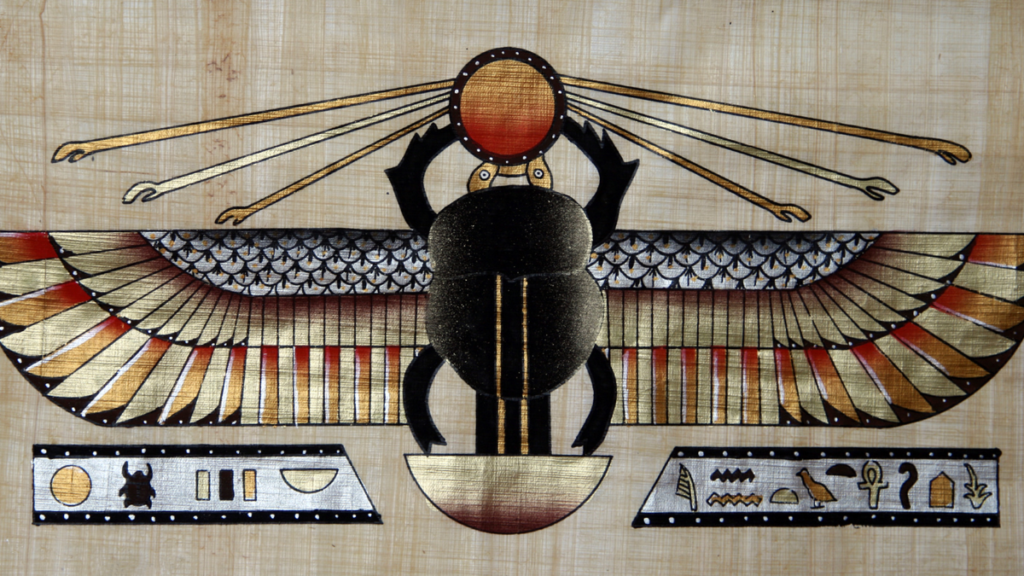
Last month I spent four weeks in Egypt, and I went for the temples. I stayed for the beetles. Between Karnak’s towering columns and the painted ceilings of Luxor, one little carving kept following me. It was the scarab, etched into nearly every wall I passed. I had just finished writing about types of beetle and the mighty Hercules beetle, yet somehow I had skipped this whole family. That oversight bugged me, so here we are.
Egypt taught me how deeply people once read the natural world. The ancient Egyptians revered the ibis, the baboon, the Egyptian goose, and many snakes. But scarab beetles outshone them all as a symbol of the sun and rebirth. These scarab beetles belong to the family Scarabaeidae, one of countless families inside the giant insect order Coleoptera. This guide covers the top 12 most iconic scarab beetles, blending biology with what I have seen in the field.

What Are Scarabs, Anyway?
Before the species list, a quick orientation helps. So what are scarabs, and what is a scarab beetle? Each is a member of the family Scarabaeidae, a sprawling branch of the beetle world with a rich history. The scientific name of the family, Scarabaeidae, covers an astonishing range of forms. Scientists have described roughly 32,000 scarab species worldwide, and many experts think up to 50,000 species actually exist. About 1,700 scarab species live in North America, and Canada alone has recorded 290.
These insects show the greatest diversity in tropical regions, though scarab beetles appear on every continent except Antarctica. Researchers still describe roughly 200 new scarab species every year. Size varies wildly across the family. The smallest scarab beetles measure barely 2 millimeters, while tropical giants stretch beyond 160 millimeters.
Like all beetles, scarabs undergo complete metamorphosis through egg, larva, pupa, and adult stages. After females lay eggs, pale C-shaped grubs hatch, live underground, and feed on roots, waste, or rotting wood. Adults later emerge from the soil to mate and start the cycle again. As a result, scarab beetles function as cleanup crews in some cases and as agricultural pests in others. Now, the scarab beetles themselves.
1. Sacred Scarab (Scarabaeus sacer)
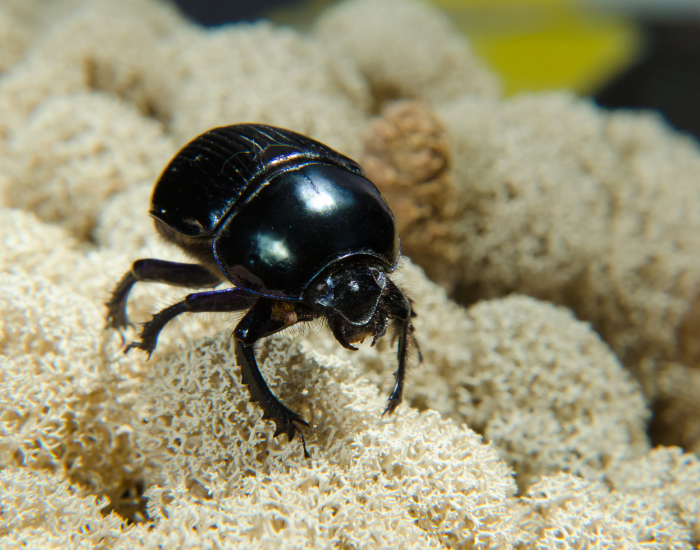
The sacred scarab is the dung beetle that started a religion. Across ancient Egypt, this beetle became the living symbol of Khepri, the rising-dawn aspect of the great sun god Ra. Ancient Egyptians watched it roll dung balls across the sand and saw the solar disk being pushed across the sky.
That daily ritual made these scarab beetles a symbol of the cycle of life, death, and rebirth. Scarab beetle amulets were carved by the thousands to ensure the deceased’s safe passage into the afterlife. Such amulets were depicted on tombs and worn in life, and the famous Scarab of Hatshepsut, made of gold and precious stones, shows how revered the insect became. I held a faience scarab beetle amulet in a Luxor shop and felt that whole history in my palm.
2. Rainbow Scarab (Phanaeus vindex)
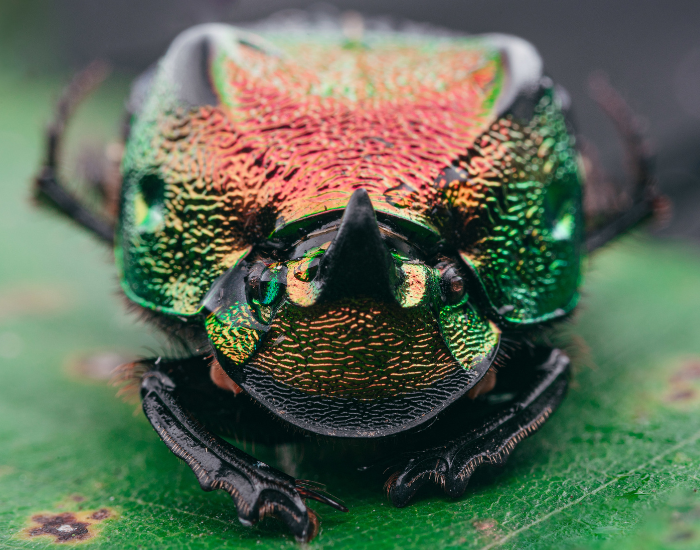
The rainbow scarab proves dung beetles can be gorgeous. Native across the eastern United States, this scarab gleams in metallic green, copper, and gold. Males carry a curved horn that would look at home on a tiny rhinoceros.
I first met one in a Georgia pasture while flipping cow pies, an unglamorous but reliable way to find dung beetles. This species shapes a ball and buries it in tunnels beneath the pat, digging with strong front legs. That constant tunneling improves soil aeration, and by relocating waste underground, it recycles nutrients in dung straight into the plant root zone.
3. Goliath Beetle (Goliathus goliatus)
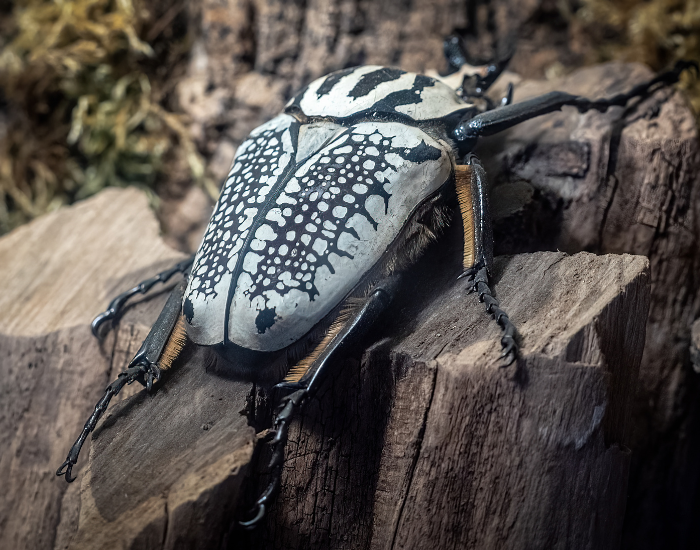
Few insects command attention like a Goliath beetle. Native to Africa’s tropical forests, it ranks among the heaviest beetles in nature, a true contender for the biggest bugs on Earth. Adults can weigh as much as a small bird, yet they fly with a helicopter-like drone.
Adult beetles feed mainly on tree sap and fruit, while the large grubs devour decaying plant matter and need protein-rich food to grow. I watched one cling to a dripping fig in Cameroon, utterly indifferent to my camera. That confidence comes from size, since few predators tackle a beetle this large.
4. Atlas Beetle (Chalcosoma atlas)
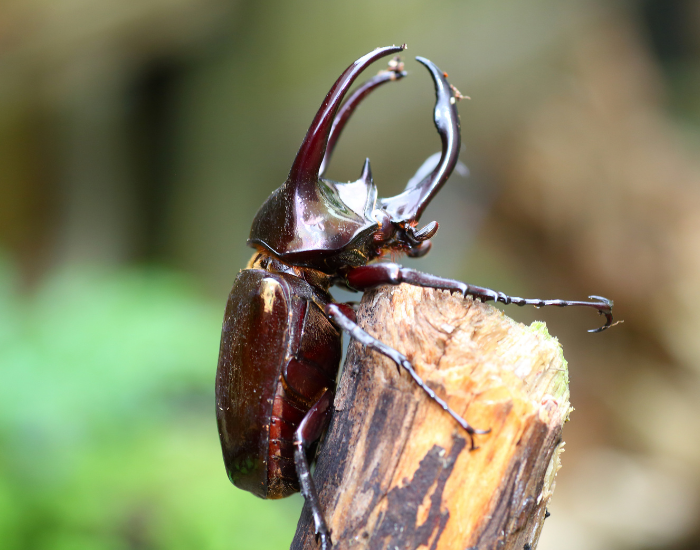
The Atlas beetle belongs to the rhinoceros beetle group within the scarab family. Found across Southeast Asia, males sport three enormous horns used to wrestle rivals. People sometimes confuse these horns with the greatly enlarged mandibles of stag beetles, but they are different structures entirely.
These scarab beetles live underground as grubs for months, feeding on rotting wood and rich earth. Insect collectors prize the glossy adults, which has fueled a busy hobby trade across the region. Interestingly, the grubs can be surprisingly aggressive, biting if disturbed in their tunnels.
5. Elephant Beetle (Megasoma elephas)
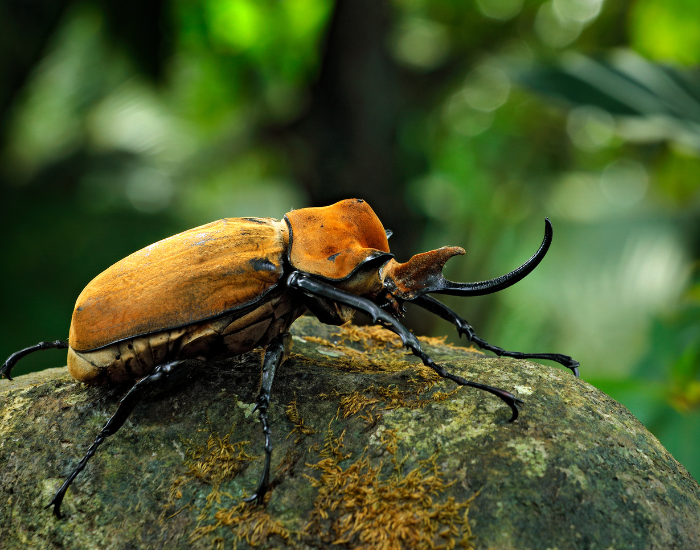
Travel to Central and South America and you may meet the elephant beetle. This hefty scarab wears a coat of fine yellowish hairs over a black body. Males carry a long thoracic horn that gives the species its name.
Adults are attracted to fermenting fruit and tree sap, especially in humid lowland forest. During a night survey in Costa Rica, one was attracted to my headlamp and thudded in like a flung stone. The white grubs grow huge inside rotting logs, recycling dead wood back into the forest floor.
6. Jewel Scarab (Chrysina species)
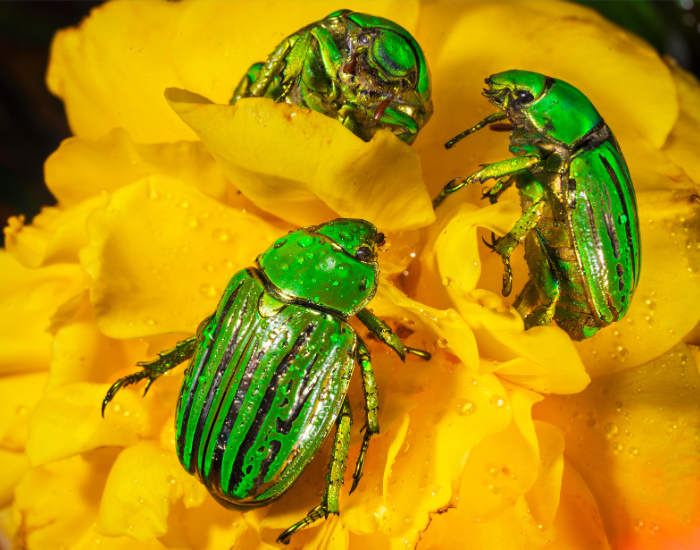
If beetles made jewelry, jewel scarabs would be the showroom. These Central American scarabs shine like polished gold or living emeralds. Their metallic shells reflect light through microscopic layers, not pigment, which keeps the color forever bright.
I chased one species through a Honduran cloud forest at 2 a.m., and the beetle glowed under my flashlight like a coin. Adults feed on foliage, while the grubs develop in decaying oak and pine wood. Their shells look like living jewelry, so collectors covet them, and habitat loss plus overcollection both threaten several species.
7. Japanese Beetle (Popillia japonica)
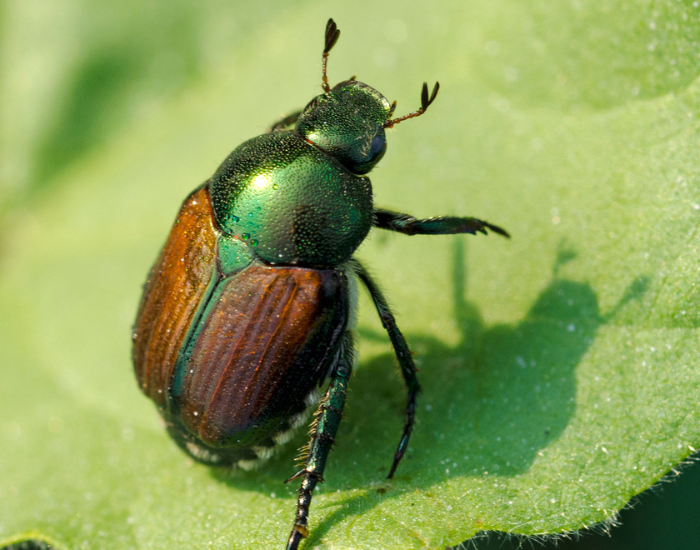
Not every scarab earns reverence. Japanese beetles arrived in North America around 1916 and became some of the continent’s most damaging pests. Adult Japanese beetles skeletonize leaves on roses, grapes, and hundreds of other plants.
The real trouble happens below ground. Their white grubs chew grass roots, browning lawns across entire neighborhoods. I have dug up sod that peeled back like carpet, swarming with these C-shaped grubs. Because the grubs attack turf and the adults strip foliage, these pests frustrate gardeners on two fronts at once.
8. Green June Beetle (Cotinis nitida)
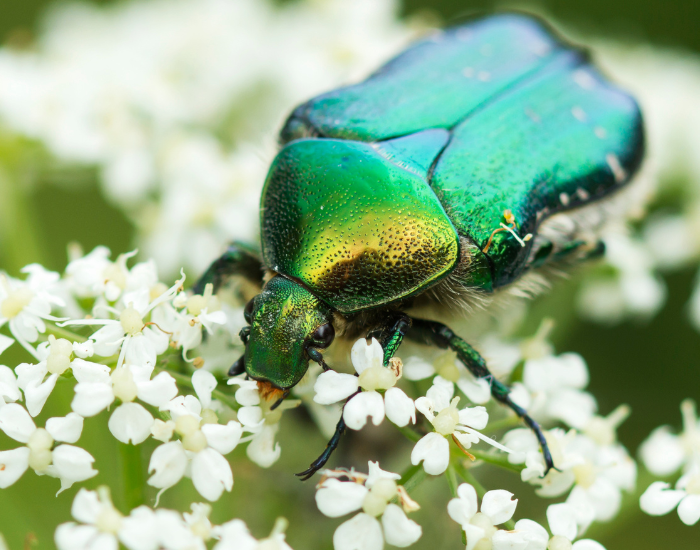
The green June beetle is a familiar summer sight across the southeastern United States. Adults are velvety green and noisy fliers, often bumping into people near ripe fruit. They love figs, peaches, and anything sweet and fermenting.
Females lay eggs in rich, organic soil, often near compost or manure. The grubs are odd creatures that crawl on their backs instead of using their legs. While the grubs sometimes damage lawns, healthy soil usually shrugs off their feeding.
9. Rose Chafer (Cetonia aurata)
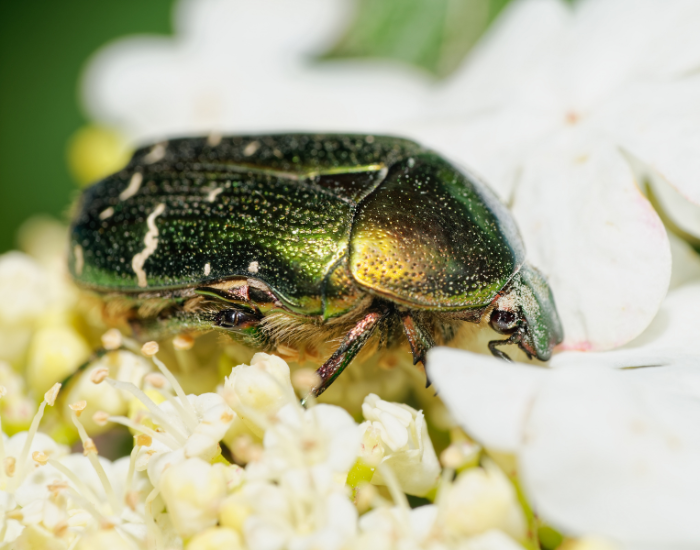
European rose chafers are flower beetles with a taste for petals and pollen. Their iridescent green bodies catch the light as they bumble between blooms. Across Europe, you will spot these scarab beetles on roses, elderflower, and hawthorn on warm days.
Rose chafers double as pollinators, carrying pollen between the flowers where they feed. The grubs live in compost and decaying leaf litter, helping break down organic matter. I keep a patch of wild brambles in my garden partly to host these flower-loving beetles each June.
10. Christmas Beetle (Anoplognathus species)
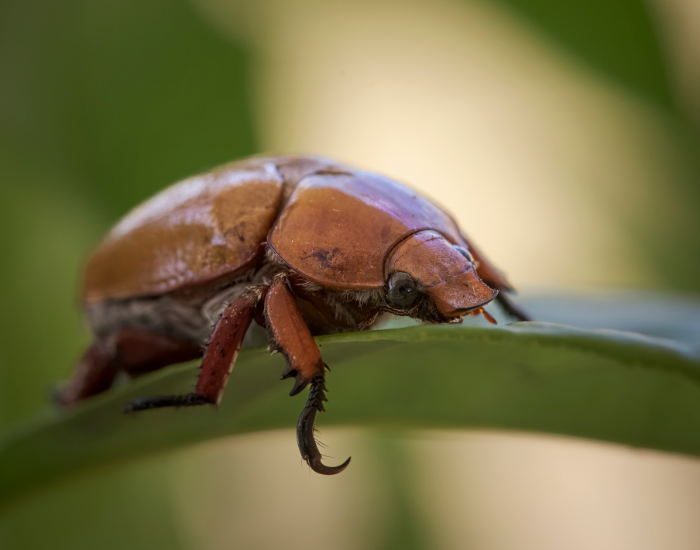
Down in Australia, Christmas beetles emerge right around the holidays, hence the name. These chunky scarab beetles shimmer in gold, bronze, and green, and they once swarmed streetlights in huge numbers. Many older Australians remember nights thick with them.
Adults feed on eucalyptus leaves, sometimes stripping whole branches bare. The young are white grubs that eat grass roots in pasture and woodland soil. Sadly, recent surveys suggest their numbers have dropped, likely from habitat loss and land clearing.
11. Ten-Lined June Beetle (Polyphylla decemlineata)
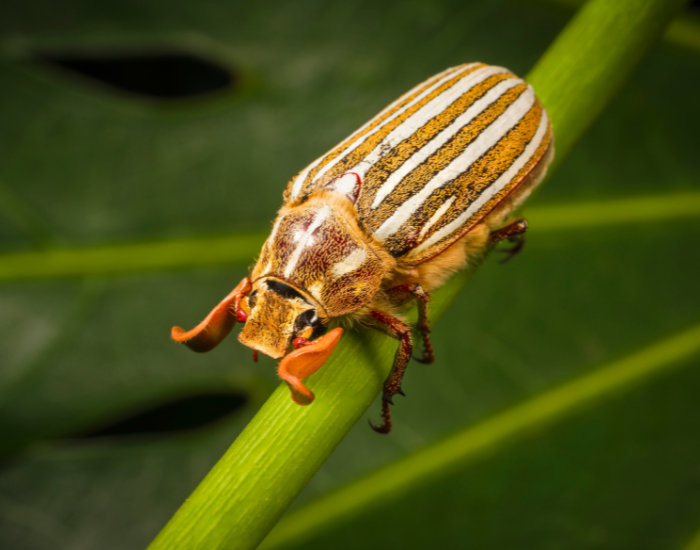
The ten-lined June beetle wears crisp white stripes down its brown wing covers. Found across western North America, the males have spectacular feathery antennae for tracking females by scent. Pick one up and it may hiss by rubbing its wings against its abdomen.
These scarab beetles live underground for two to three years as grubs. They feed on the plant roots of trees, crops, and ornamental shrubs. As a result, large populations can stunt young orchards and stress garden plants.
12. Flower Beetle (Eudicella and relatives)

African flower beetles close out the list in style. These tropical scarabs blaze with patterns of green, yellow, and orange. They gather on flowers and oozing sap, lapping up nectar and pollen with brushy mouthparts.
Their flower visits make them genuine pollinators for a wide range of plant species. The grubs recycle leaf litter and dead wood, feeding decomposition deep in the forest floor. Many flower beetles breed easily in captivity, so they have become favorites among insect keepers worldwide.
Why Scarabs Matter Beyond the Beauty
Scarab beetles are vital nutrient recyclers, and their work holds ecosystems together. Dung beetles remove waste from the surface by rolling and consuming feces. By burying that organic matter, they aid nutrient cycling and pull fertility back into the soil for nearby plants.
Their tunneling also boosts soil aeration, which helps water and air reach plant roots. Beyond manure, scarab beetles facilitate the decomposition of dead wood and dead animals. Many species act as vital pollinators of flowers and crops, and almost all serve as a major food source for birds, reptiles, and mammals. Nature, in other words, leans hard on these unassuming insects.
Take a Closer Look Yourself
Scarab beetles connect dung pats, gardens, rainforests, and 4,000-year-old tombs into one shining family. Few groups of animals reveal so much about both ecology and human imagination. The next time you flip a log or spot a beetle on a flower, crouch down and look closer.
You may be watching a relative of the very insect that ancient Egyptians carved into gold. If you enjoyed this, meet the family’s heavyweight champion in my guide to the Hercules beetle, or explore the sacred animals I met in Egypt, from the ibis to the baboon. Then drop a comment and tell me which scarab you would most love to find in the wild.
References:
Dietz, L., Seidel, M., Eberle, J., Misof, B., Pacheco, T. L., Podsiadlowski, L., Ranasinghe, S., Gunter, N. L., Niehuis, O., Mayer, C., & Ahrens, D. (2023). A transcriptome-based phylogeny of Scarabaeoidea confirms the sister group relationship of dung beetles and phytophagous pleurostict scarabs (Coleoptera). Systematic Entomology, 48(4), 672–688. https://doi.org/10.1111/syen.12602
García, C. C. V., Dubeux, J. C. B., Jr., Martini, X., Conover, D., Santos, E. R. S., Homem, B. G. C., Ruiz-Moreno, M., da Silva, I. A. G., Abreu, D. S., Queiroz, L. M. D., van Cleef, F. O. S., Santos, M. V. F., & Fracetto, G. G. M. (2023). The role of dung beetle species in nitrous oxide emission, ammonia volatilization, and nutrient cycling. Scientific Reports, 13, 3572. https://doi.org/10.1038/s41598-023-30523-0
Hajji, H., Janati-Idrissi, A., Taybi, A. F., Lumaret, J.-P., & Mabrouki, Y. (2024). Contribution of dung beetles to the enrichment of soil with organic matter and nutrients under controlled conditions. Diversity, 16(8), 462. https://doi.org/10.3390/d16080462
Torabian, S., Leffler, A. J., & Perkins, L. (2024). Importance of restoration of dung beetles in the maintenance of ecosystem services. Ecological Solutions and Evidence, 5(1), e12297. https://doi.org/10.1002/2688-8319.12297
de Medeiros, B. A. S., & Peris, D. (2026). The evolution of flower beetles as visitors and pollinators. Annual Review of Entomology, 71, 557–575. https://doi.org/10.1146/annurev-ento-121423-013404
Potter, D. A., & Held, D. W. (2002). Biology and management of the Japanese beetle. Annual Review of Entomology, 47, 175–205. https://doi.org/10.1146/annurev.ento.47.091201.145153
Frequently Asked Questions
For the ancient Egyptians, the scarab symbolized the sun god Ra and the daily rebirth of the sun. It also represented the cycle of life, death, and rebirth. Ancient Egyptians wore scarab beetle amulets and placed them in tombs to guarantee the deceased’s safe passage into the afterlife.
Target the white grubs in late summer when they feed near the surface of lawns. Beneficial nematodes and milky spore offer effective biological control without harsh chemicals. Keeping grass slightly taller and well-watered also helps turf outgrow minor grub damage.
It depends on the species. Many scarab larvae harmlessly recycle manure and rotting wood, but turf-feeding grubs chew grass and the roots of garden plants. Japanese beetle and ten-lined June beetle larvae are the ones that damage lawns, plants, and crops.
Beetles avoid strong scents like garlic, neem oil, and cedar, plus the presence of predators. Removing fallen fruit and overripe blooms cuts the smells that attract them. For flower beetles and chafers, simple physical barriers like row covers work surprisingly well.
The Australian tiger beetle holds the record, sprinting so fast it briefly goes blind. Scarabs are no speed demons, but many are powerful, determined fliers. A charging dung beetle rolling its ball in a straight line is impressive in its own stubborn way.
Can You Name That Scarab? 🔍
A quick 12-photo identification challenge. Pick the beetle you think it is — you can go back and change any answer before you score.
Which scarab is this?