The first time I held a Hercules beetle, I was crouched in a Costa Rican cloud forest at 2 a.m., headlamp fogging in the mist. It crawled onto my glove and gripped down with a strength that genuinely startled me. A creature the length of my palm, pushing back against my fingers like a tiny tractor.
That night taught me that almost everything people “know” about this beetle is half right. The internet blends two different insects into one mythic bug. It exaggerates some traits and ignores stranger, truer ones. So here are ten things worth knowing, the science, the field stories, and the misconceptions I’d love to retire. By the end, you’ll know how to find one, whether it can hurt you, and why materials scientists keep this beetle in their labs.
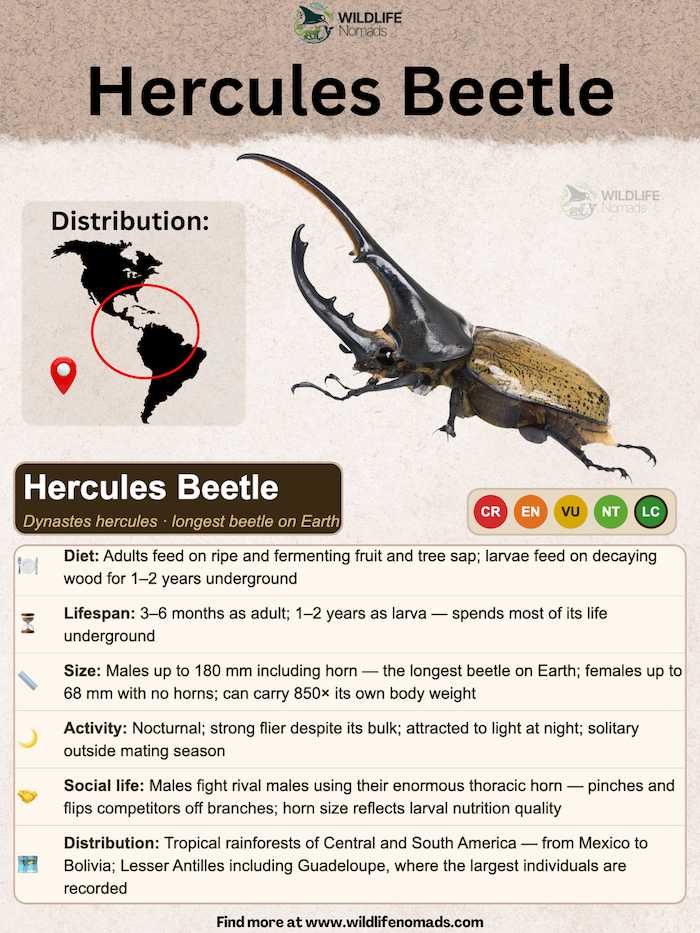
1. There Are Actually Two “Hercules” Beetles, and People Mix Them Up
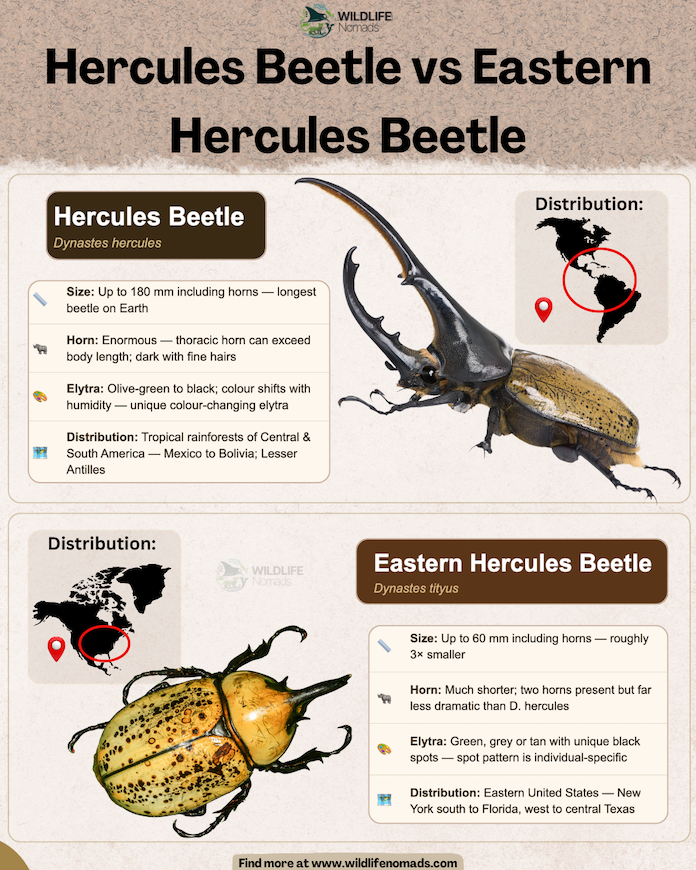
Here’s the confusion I run into constantly. The true Hercules, Dynastes hercules, lives in the tropical rainforests of Central and South America. Its smaller cousin, the eastern Hercules beetle (Dynastes tityus), lives across the eastern United States. Both belong to the rhinoceros beetles, a group within the scarab beetles, the same broad family of scarab beetles that includes dung beetles and June bugs.
Both are scarab beetles in the order Coleoptera, and that shared ancestry shows in their shape. People photograph a beetle in Tennessee and call it the giant from the Amazon. Understandable, but wrong. Throughout this article I’ll separate the two, because their differences are half the fun. When I say “eastern Hercules beetle,” picture a backyard in Kentucky. When I say Dynastes hercules, picture a humid Panamanian ridge.
2. These Are Some of the Largest Beetles on Earth
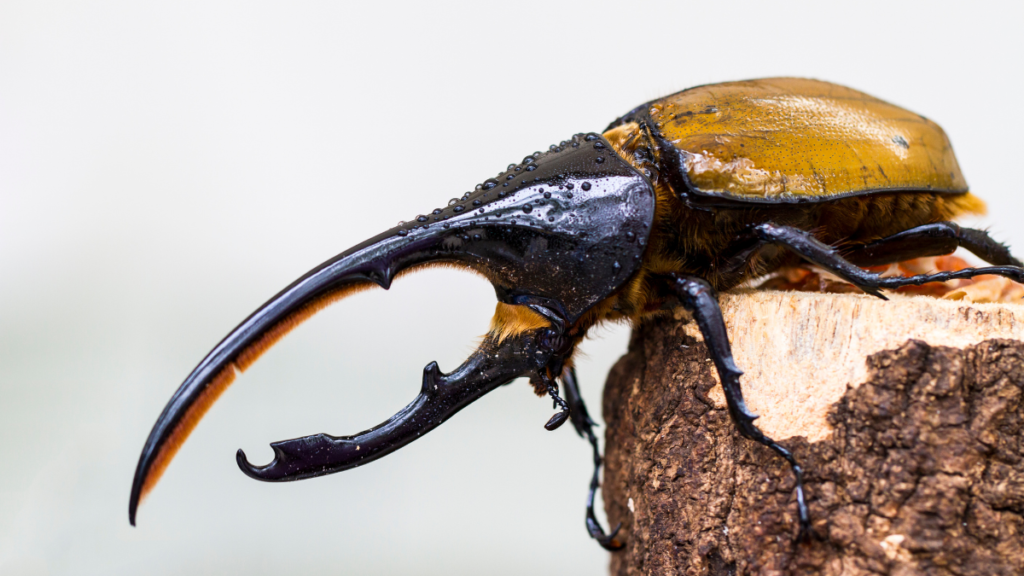
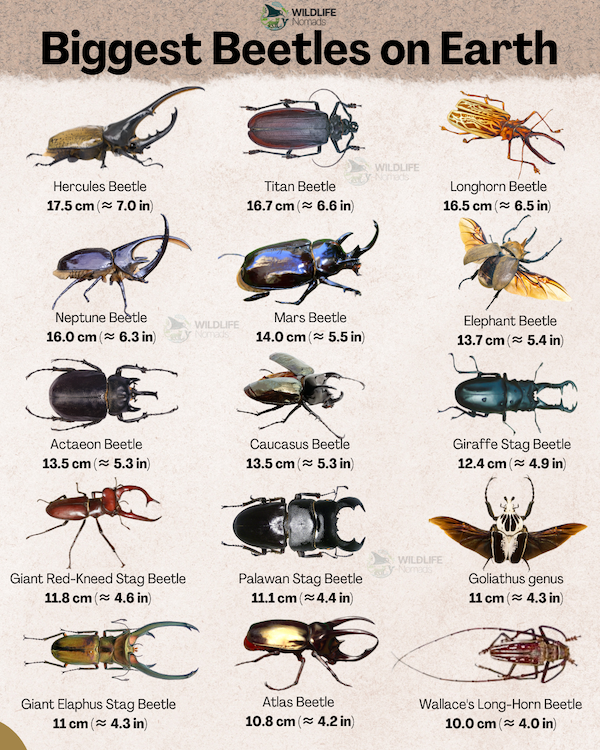
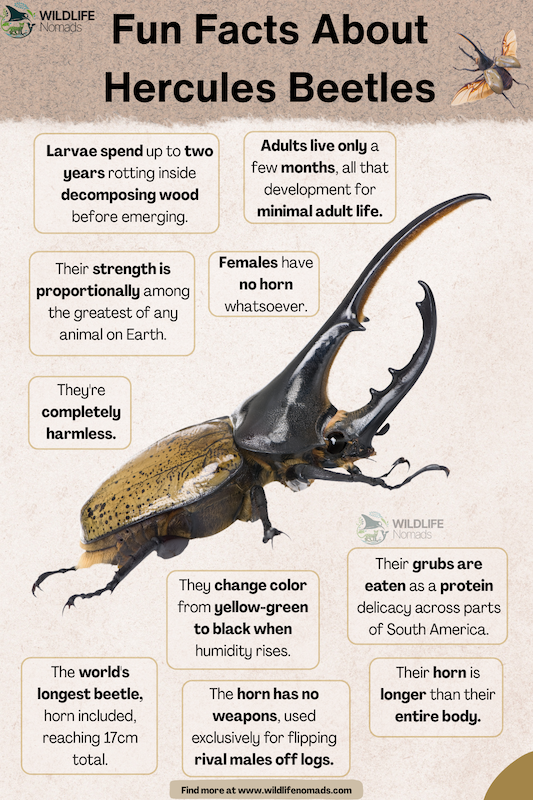
Dynastes hercules holds the record for total length among insects, stretching up to roughly 17 centimeters when you measure that long front horn. No other beetle is longer. Among the largest beetles alive, it shares the podium with the elephant beetle (Megasoma elephas) and a few hulking African species like the Goliath beetle (Goliathus goliatus). Collectors prize all three of these beetles for exactly that reason.
The eastern Hercules beetle male runs smaller, around 40 to 60 millimeters including the horn. Still, it’s one of the heaviest insects in the United States by mass. For an arthropod, that heft is remarkable, these beetles feel less like bugs and more like small machines in the hand.
3. Only the Males Wear the Horns
This is the trait that launches a thousand questions. The male’s horns are the showpiece, a long pronotal horn curving from the thorax and a smaller clypeal horn rising from the head. A female Hercules beetle has none. She’s smooth-bodied and, frankly, easy to overlook beside her flamboyant mate. Tell the two sexes apart by the head: horns mean male, a plain head means female.
Biologists call this extreme sexual dimorphism, and the horns aren’t decoration. Males use them as pry bars, wedging beneath rivals during mating disputes and flipping them off branches. Females, by contrast, invest their energy in eggs, burrowing into rich substrate to lay them near a good food supply.
That said, bigger horns aren’t infinitely better. A clever 2014 study on a related rhinoceros beetle found that oversized horns become structurally fragile, past a point, they’d snap mid-fight. Evolution, it turns out, has a built-in ceiling.

4.The Strength Numbers Are Almost Unbelievable
You’ve probably seen the claim: a rhinoceros beetle can carry up to 850 times its own body weight. Scaled up, that’s a human deadlifting a couple of loaded school buses. The figure gets repeated everywhere, and while exact lab measurements vary, the underlying truth holds, these are absurdly strong animals for their size.
The secret lives inside the exoskeleton. That armor plating gives muscles enormous surface area to anchor to, and beetle muscle is built for force over speed. Males put this power to work in combat, while females use it to dig and to shift heavy wood while laying eggs. Pound for pound, almost nothing in the animal world out-pulls these rhinoceros beetles.
5. They Spend Years as Giant Grubs Underground
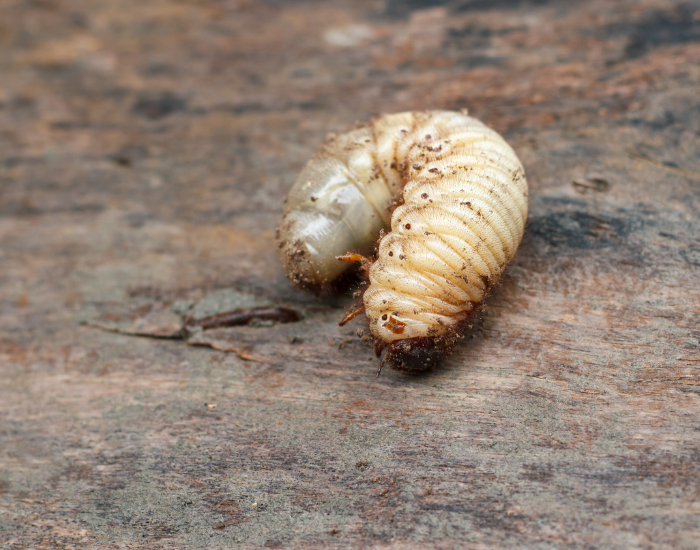
The adult you admire is the short final chapter. These beetles spend up to two years as larvae — large C-shaped grubs, pale and wrinkled, with chewing mouthparts built to demolish wood. The larvae live inside rotten logs and decaying wood, tunneling through the soft pulp of dead trees and aging into fat, finger-thick grubs over many months.
When I’m searching for an eastern Hercules beetle, I don’t look up first. I break open rotten wood on the forest floor and check the dead wood at the base of old trees. The larvae feed on this decaying material through summer and winter alike, and their distinctive rectangular fecal pellets are a dead giveaway that something big is growing inside that log. As the grubs mature, they sink deeper into the soft soil and wood beneath the trees.
Eventually the larvae pupate, usually in late summer, and the adults emerge to live just three to ten months. All that patient underground growth, spent for one brief season of flight, sap, and competition.
6. Adults Are Harmless Vegetarians
Let me settle the most common worry I get: no, they won’t hurt you. Hercules beetles are completely harmless to humans. Those fearsome horns can’t pinch your skin meaningfully, and the beetle has no venom, no sting, no interest in you at all. At worst, a startled adult might grip your finger with its legs.
Adults feed on rotting fruit and tree sap, occasionally chewing into soft bark to start a sap flow. They’re not predators, and they don’t bite in any way that matters. When kids at my talks ask whether eastern Hercules beetles are dangerous, I let one walk across their palm. The nervous giggles always turn into wonder.
7. Their Armor Changes Color With Humidity
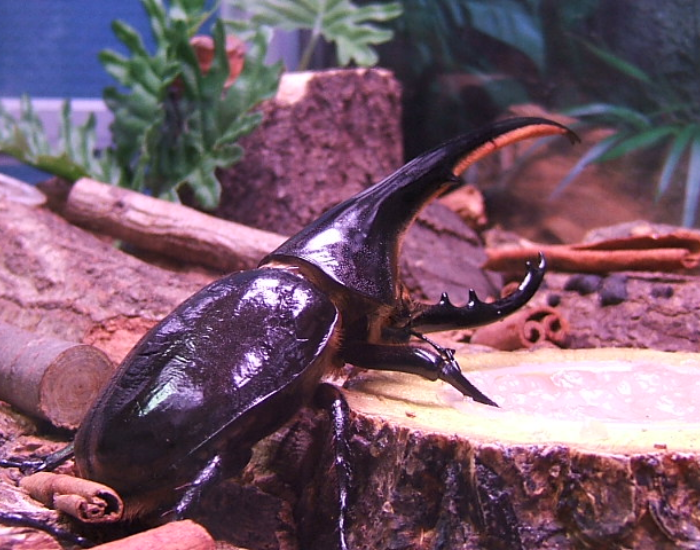
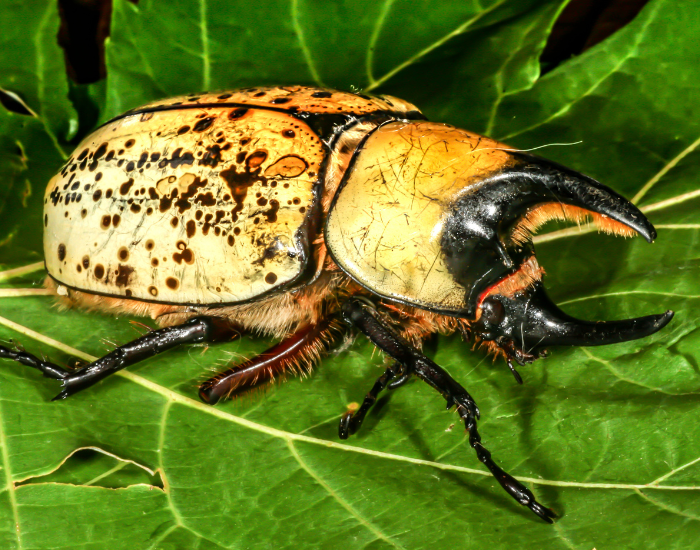
This is my favorite fact, and it’s genuinely strange. The elytra, the hard wing covers that form the beetle’s shell, shift color depending on moisture. In dry air they glow a soft yellow-green, olive-tan, or muted brown, often dappled with black markings. As humidity climbs, that shell darkens toward deep brown or near-black.
The mechanism is pure physics. The elytra contain a spongy layer of laminated chitin fibers and a protein matrix, riddled with tiny air spaces. When dry, those spaces hold air; when wet, water seeps in and changes how light bounces through the structure. The result is a living humidity gauge. I’ve watched a captive eastern Hercules beetle male go from gray-green to chocolate brown overnight as a storm rolled in, no pigment change required.
8. Materials Scientists Are Copying This Beetle
Because that color trick is structural rather than chemical, engineers are paying attention. Research on Dynastes tityus (Coleoptera: Scarabaeidae) has used the elytra as a blueprint for light, strong, bio-inspired materials. The layered chitin-and-protein composite is both featherweight and tough, exactly what you’d want in aerospace panels or responsive coatings.
In addition, the reversible color change hints at sensors that report moisture without electronics or batteries. It’s a humbling reminder I return to often in the field: evolution solved problems in a beetle’s wing case that our best labs are still reverse-engineering.
9. Where to Find an Eastern Hercules Beetle
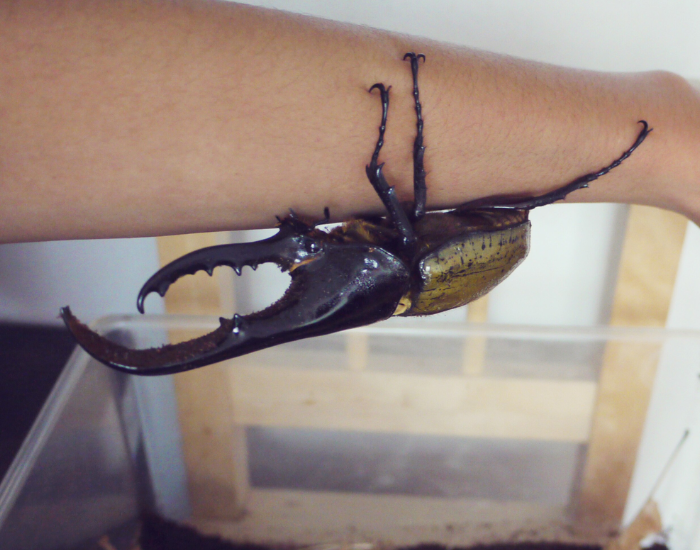
If you live in the eastern United States, you have a real shot at seeing one. Dynastes tityus ranges from New York and Indiana south to Florida and the Gulf, with eastern Texas as its western edge. The species favors mature hardwood forest, where the larvae work through rotten logs and the adults visit sap and decaying fruit.
My best tip: check porch lights and gas-station lamps on humid summer nights. Males especially are strongly attracted to lights, and that’s how most people stumble onto their first one. Decaying ash trees and other dying hardwood trees are larval hotspots — when I survey ash trees killed by emerald ash borer, the soft, rotting wood often hides these grubs alongside other arthropods. Look at night, look near light, and look low.
10. The Whole Family Is Worth Knowing
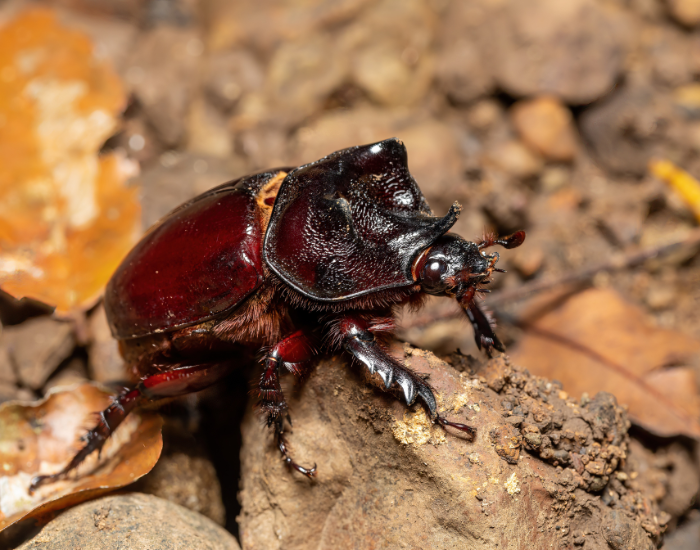
This species is the celebrity, but its relatives among the rhinoceros beetles deserve a nod. In the eastern United States you’ll also meet the ox beetle (Strategus), a stocky beetle whose males carry three short horns. The ox beetle is smaller, yet just as charming once you find one. Farther into the tropics, the elephant beetle rivals the Hercules in sheer bulk, and dozens more horned beetles round out the group. All of these beetles sit within Coleoptera, the most species-rich order of animals on Earth, holding more named beetles than any other kind of creature.
I find this context grounding. Dynastes tityus isn’t a one-off freak of nature. Once you start noticing rhinoceros beetles and scarab beetles in your own woods, the forest changes. Get to know these beetles, and you’ve got a doorway into thousands of species worth a closer look.
Frequently Asked Questions
Keep adults in a ventilated container with a few inches of moist substrate and pieces of bark to climb. House one male with a couple of females if you hope to breed them, since the females will lay eggs in the substrate. Feed them beetle jelly, banana, apple, or a little sugar water, refreshed often. Mist lightly to maintain humidity and keep them out of direct sun. For the larvae, provide deep, rich substrate of decaying wood and leaf litter so the grubs can feed and grow.
They’re good — ecologically valuable and harmless to people. As larvae they break down rotten wood and dead trees, recycling nutrients back into the soil. Adults pose no threat to gardens, pets, or humans. The only “damage” they do is help decompose wood that’s already dead.
The eastern Hercules beetle isn’t formally endangered, but it’s uncommon to spot because adults live only a few months and stay hidden by day. Healthy populations need mature forest with plenty of rotting logs. The giant tropical Dynastes hercules is harder to see in the wild, though both are widely bred by hobbyists.
“Friendly” is a stretch for any insect, but they’re gentle and easy to handle. It won’t bite or sting, and even battling males save their horns for each other. Held calmly, one will simply walk across your hand. That docility is exactly why they’re such beloved display animals worldwide.
No. They lack venom and can’t deliver a harmful bite. The horns are tools for male-versus-male shoving matches, not weapons against people. You can handle one safely with bare hands.
Hercules Beetles
A Beetle Worth Meeting
Strip away the myths and the Hercules beetle is more impressive than the hype, a years-in-the-making giant that lifts the unthinkable, fights with engineered horns, and wears armor that shifts color with the weather. Science is still learning from it, and so am I.
So this summer, leave your porch light on and actually look. If you turn over a rotten log and find a fat C-shaped grub, you’ve met the next generation. While you’re here, wander through my guide to the wild types of beetles, the surprising world of ant types, or the ranking of the biggest bug on Earth.
References:
Liu, F., Dong, B. Q., & Liu, X. H. (2021). Investigation of the selective color-changing mechanism of Dynastes tityus beetle (Coleoptera: Scarabaeidae). Scientific Reports, 11, 1135. https://doi.org/10.1038/s41598-020-80699-y
Sun, J., Wu, W., Liu, C., Tong, J., & Bhushan, B. (2017). Investigating the nanomechanical properties and reversible color change properties of the beetle Dynastes tityus. Journal of Materials Science, 52(11), 6685–6696. https://doi.org/10.1007/s10853-017-0895-y
McCullough, E. L. (2014). Mechanical limits to maximum weapon size in a giant rhinoceros beetle. Proceedings of the Royal Society B: Biological Sciences, 281(1786), 20140696. https://doi.org/10.1098/rspb.2014.0696
McCullough, E. L., Ledger, K. J., O’Brien, D. M., & Emlen, D. J. (2015). Variation in the allometry of exaggerated rhinoceros beetle horns. Animal Behaviour, 109, 133–140. https://doi.org/10.1016/j.anbehav.2015.08.013
McCullough, E. L., Weingarden, P. R., & Emlen, D. J. (2019). Variation in an extreme weapon: Horn performance differences across rhinoceros beetle (Trypoxylus dichotomus) populations. Insects, 10(10), 346. https://doi.org/10.3390/insects10100346