There is a specific kind of magic that happens when you’re standing in a silent, frozen forest, breath hitching in the crisp air, waiting for a sign of life. Years ago, while traveling through Sweden with a friend, we spent a grueling but beautiful afternoon trekking through deep snow. We saw a few foxes darting through the treeline and tracked the intricate prints of various animals. However, the highlight came when a flash of tawny brown leaped between the pine branches.
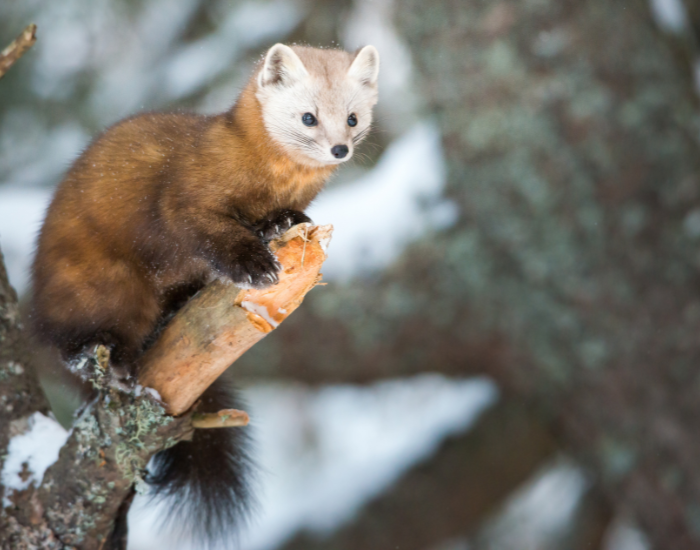
It was a pine marten. It paused for just a second, staring at us with those dark, inquisitive eyes before vanishing into the canopy. Later, during my trip in Canada, in the way to Banff National Park, I had the luck of seeing them again. If you’ve ever seen one, you know they look like a cross between a kitten and a very elegant, elongated ferret. They are undeniably cute, but don’t let the “teddy bear” ears fool you. These are some of the most capable predators in the weasel family.
The American marten (as we call them here in North America) is one of those species that bridges the gap between “adorable” and “apex predator” in a way few other animals do.
Let’s dive into the research and get to know the Martes americana, the wild marten, a bit better.
1. What Exactly is a Pine Marten? Understanding the Species
Before we get into the nitty-gritty, let’s clear up the names. The term “pine marten” generally causes confusion because it’s used locally across different species and regions. People often ask, “Are pine martens and American martens the same?”
Here’s the truth: technically, the pine marten (Martes martes) refers specifically to the European species. However, the name “pine marten” is commonly applied to several related species depending on where you are in the world.
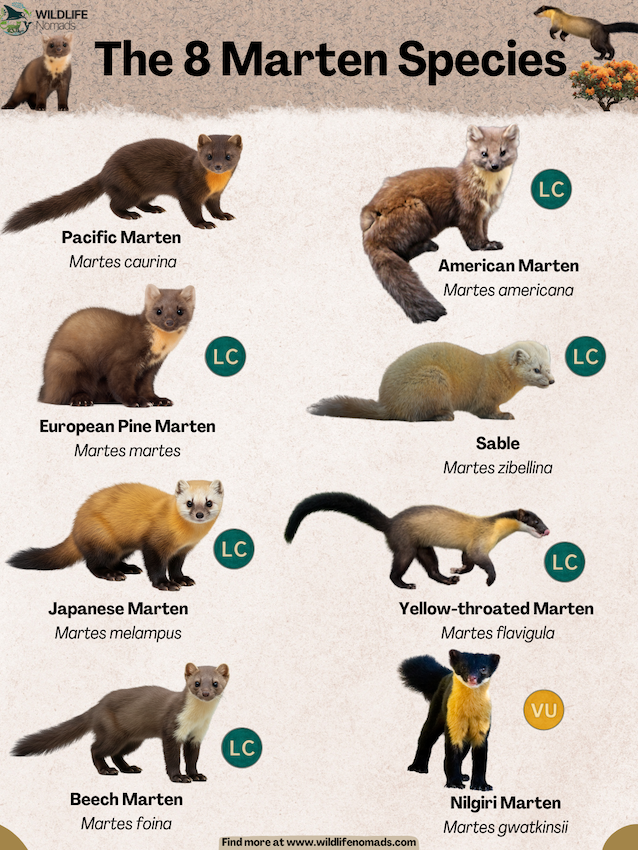
The 8 Marten Species in the Genus Martes
So all martens belong to the genus Martes within the Mustelidae family. While the Fisher was traditionally included in this group, it has been reclassified into its own genus, Pekania. Current scientific consensus recognizes 8 distinct species within the Martes genus:
- European Pine Marten (Martes martes) – Found across Europe and parts of Asia.
- American Marten (Martes americana) – Found across northern North America, including Canada, Alaska, and the northern United States.
- Pacific Marten (Martes caurina) – Found along the West Coast of North America; recently recognized as a distinct species from the American marten.
- Japanese Marten (Martes melampus) – Native to Japan.
- Sable (Martes zibellina) – Found in Russia and parts of Asia, prized for its luxurious fur.
- Yellow-throated Marten (Martes flavigula) – Found across South and Southeast Asia.
- Beech Marten/Stone Marten (Martes foina) – Found in Europe and Central Asia.
- Nilgiri Marten (Martes gwatkinsii) – Endemic to southern India.
2. Master of the “Mixed Wardrobe”: Pine Marten Fur and Features
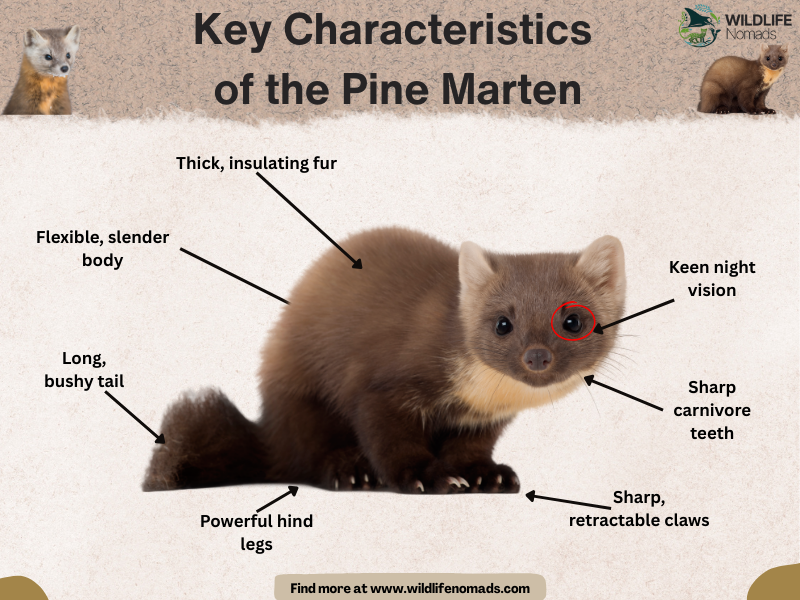
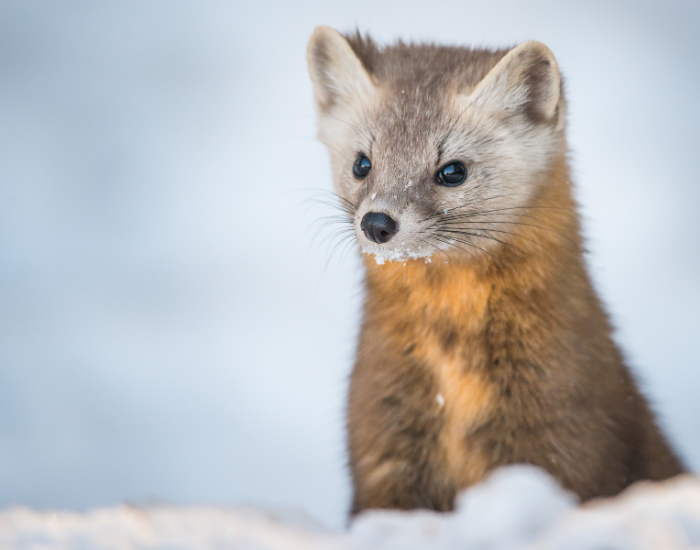
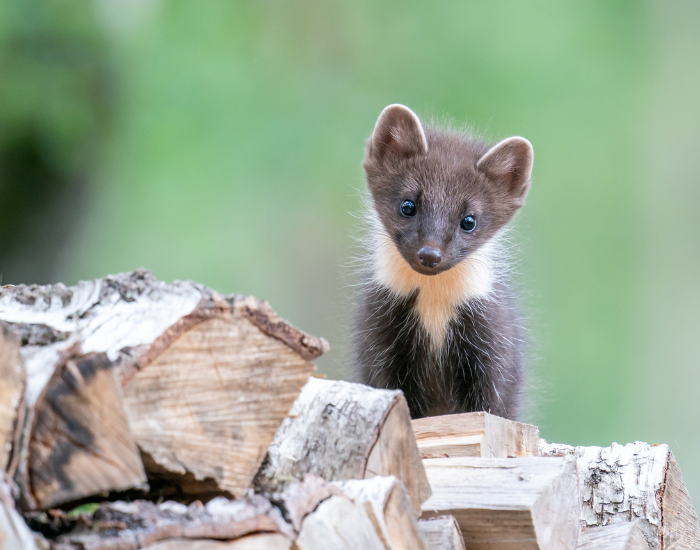
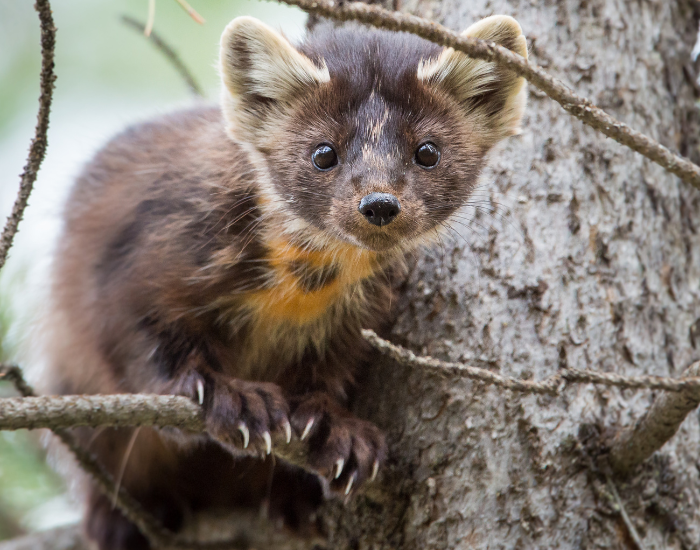
One of the most striking pine marten features is their coat. Their fur ranges from pale straw to a rich dark brown. However, the real “wow” factor is the throat patch. This patch is usually a vivid orange or pale straw color, making them look like they’ve tucked a bright silk scarf under their chin.
Physical Characteristics
Males are significantly larger than females in the marten world. In addition, they have slender bodies, rounded ears, and a spectacularly bushy tail that helps them balance. This tail is essential for sprinting along narrow branches high in the forest canopy.
The marten fur changes slightly with the seasons. For example, in winter, they grow a much thicker coat to handle deep snow and sub-zero temperatures. Their light brown to dark brown coloring provides excellent camouflage among tree trunks and forest floor debris.
Their physical adaptations include short legs that are perfect for navigating both ground and tree environments. Moreover, their sharp nose helps them detect prey from considerable distances.
3. The Ultimate Snow Athlete: Adaptations for Winter
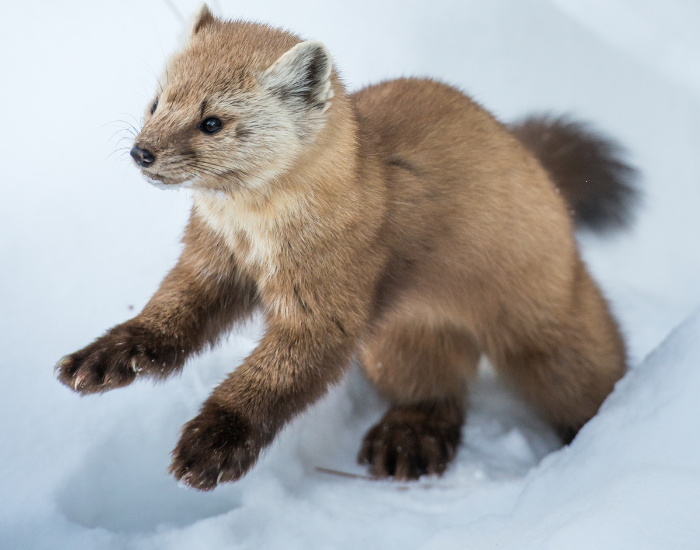
If you’ve ever tried to walk through deep snow without snowshoes, you know the struggle. The American pine marten doesn’t have that problem. They have relatively large, furry paws that act as natural snowshoes. Therefore, they can hunt even when the winter landscape is buried.
They also have curved claws that are semi-retractable. This makes them one of the few members of the mustelid family that can climb trees with the agility of a red squirrel. Whether they are on the forest floor or 50 feet up in the air, they are in their element.
During winter months, martens travel extensively across their home ranges. In addition, they often use the same trails repeatedly, creating packed pathways through the snow. These trails connect important hunting areas and den sites.
4. They are Opportunistic Feeders: Diet and Hunting Behavior
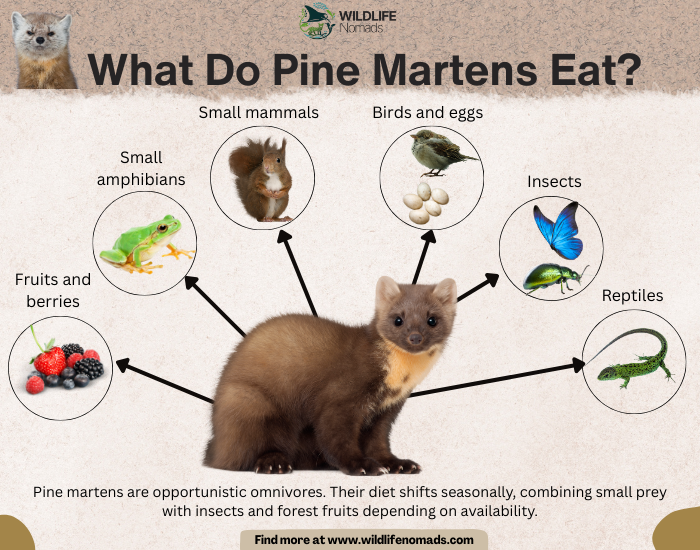
What does a wild marten eat? Just about anything it can get its paws on. As an opportunistic feeder, their diet shifts with the seasons and prey availability.
Winter Diet
The winter diet consists mostly of small mammals. For example, they hunt voles, red-backed voles, and snowshoe hare. Also, they will scavenge larger prey when available. Their hunting strategy involves traveling long distances each night to patrol their territories.
Summer Diet
During summer months, they branch out into insects, birds, small birds, and even berries. The varied summer diet provides essential nutrients during the mating season and helps females prepare for reproduction.
The Squirrel Hunter
They are one of the few predators (alongside wolverines) fast enough to catch a red squirrel in a high-stakes chase through the canopy. This hunting ability demonstrates their incredible agility among tree trunks and branches. Moreover, they can pursue squirrels through complex three-dimensional spaces where larger predators cannot follow.
Interestingly, while they are fierce hunters, they aren’t above scavenging. If they find a carcass left over by larger prey or another predator, they’ll happily take a free meal. This opportunistic behavior helps them survive harsh winter conditions when hunting is difficult.
5. A Home Among the Giants: Habitat Requirements
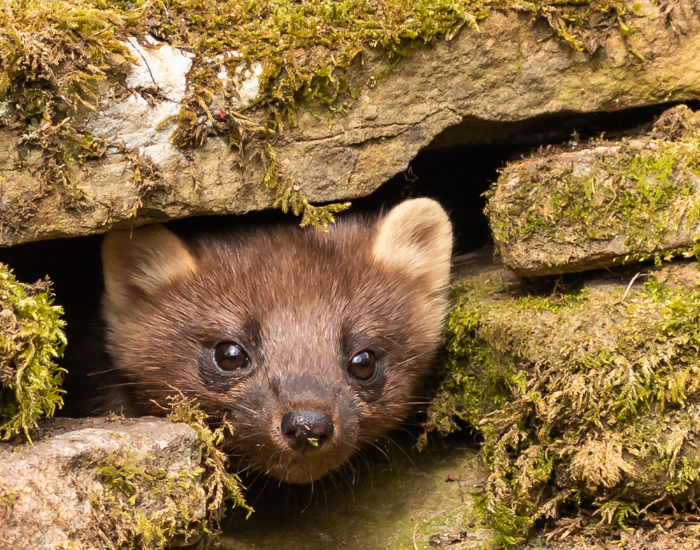
The habitat of the American marten is very specific. They are old-growth specialists who prefer mixed deciduous and coniferous forests. In particular, they need forests with a lot of complex structure. For example, fallen logs, hollow logs, and rock crevices are essential.
These structures are vital for maternal dens and natal dens. Without these hiding spots, they are vulnerable to predators like owls, coyotes, and even their larger cousin, the fisher. This is why habitat loss due to poor forest management practices is the biggest threat to marten populations.
Forest Management and Conservation
Forest management practices have evolved to support marten populations. In addition, wildlife managers now understand the importance of leaving dead standing trees and fallen logs. These features provide denning sites and hunting opportunities.
Western Alaska and Canada maintain some of the healthiest marten populations because of extensive old-growth forests. However, in the lower 48 states, habitat fragmentation remains a significant challenge.
6. The Solitary Socialite: Social Behavior and Territory
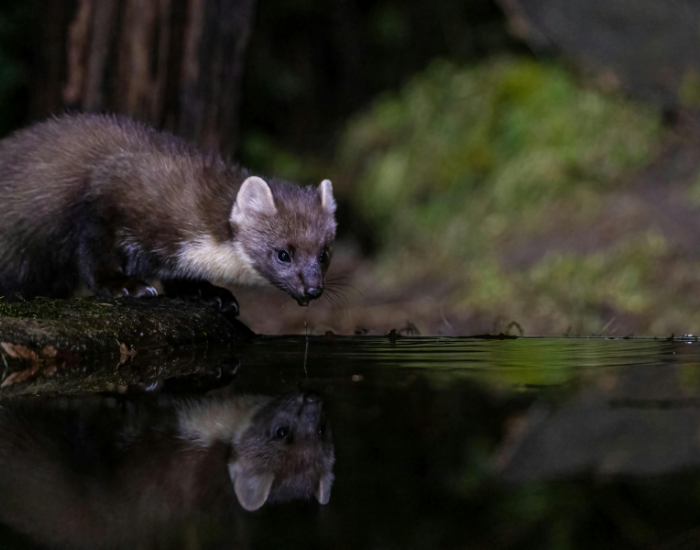
Except for the mating season, which occurs in July and August, martens are strictly solitary. They are territorial and use scent marks to tell other martens to stay away. In addition, they produce various vocalizations during the breeding season and territorial disputes.
A male’s home ranges are typically much larger than a female’s range. He might overlap with several females, but he won’t tolerate another male in his space. They are capable of traveling long distances—sometimes miles in a single night, just to patrol their boundaries.
Larger home ranges are necessary in areas where prey populations are sparse. Therefore, males in northern regions may maintain territories several times larger than those in more productive forests.
7. The Mystery of Delayed Implantation: Reproduction
This is one of my favorite science facts about them. Even though mating occurs during the breeding season in summer, the female doesn’t actually become pregnant right away.
The fertilized egg stays in a state of dormancy (diapause) for nearly 7 or 8 months. The embryo finally implants in the uterus in late winter. Therefore, the kits are born in March or April when the weather is starting to turn and food is more available. This delayed implantation ensures the young have the best chance of survival.
This reproductive strategy is common among mustelids. However, the timing is perfectly adapted to northern climates where food availability varies dramatically between seasons.
8. Raising the Next Generation: Litter and Development
A litter usually consists of 1 to 6 kits, with 3 to 4 being most common. When they are born, they are tiny, blind, and covered in fine white hair.
- Rapid Growth
By 6 to 8 weeks, young martens are weaned and beginning to explore outside the natal den. In addition, females teach their kits essential hunting skills during this critical period.
- Independence
They reach their adult size quickly and are usually out on their own by the time they are 3 to 4 months old. However, females sometimes allow their daughters to remain in adjacent territories.
- Lifespan
In the wild, they can live up to 12 years. However, most don’t make it past 5 or 6 years due to the harsh realities of the northern wilderness. Predation, starvation during harsh winters, and competition all take their toll.
9. Are They Endangered? Conservation Status
The conservation status of the pine marten is a mixed bag. In many parts of Canada and Alaska, populations are healthy and stable. However, in some regions, they face significant challenges.
Current Status
The species is not currently listed as endangered globally. However, certain populations have experienced declines due to habitat loss and trapping pressure. In addition, some areas have implemented reintroduction efforts to restore extirpated populations.
Conservation Efforts
In places like western Alaska and the Pacific Northwest, forest management practices are being adjusted. Wildlife managers ensure martens have the messy, old-growth forests they need to thrive. There have also been incredible reintroduction efforts in places like Michigan.
For example, the European species (Martes martes) has been successfully reintroduced in parts of the United Kingdom. These programs demonstrate that with proper habitat protection, marten populations can recover.
10. Marten vs. Fisher: Knowing the Difference
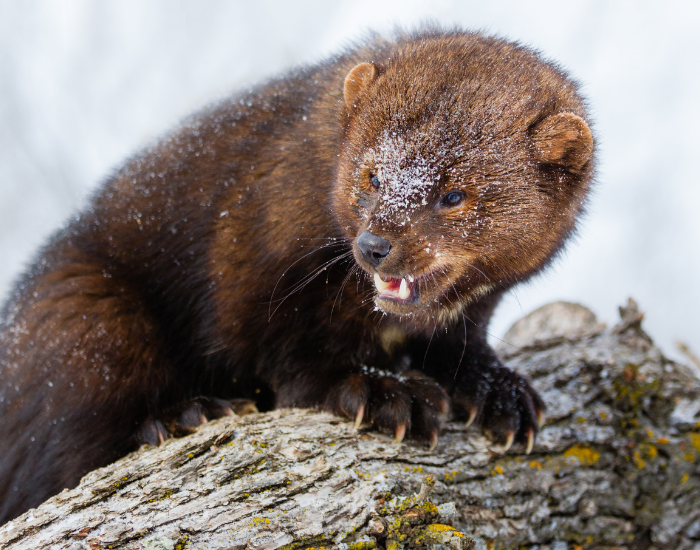
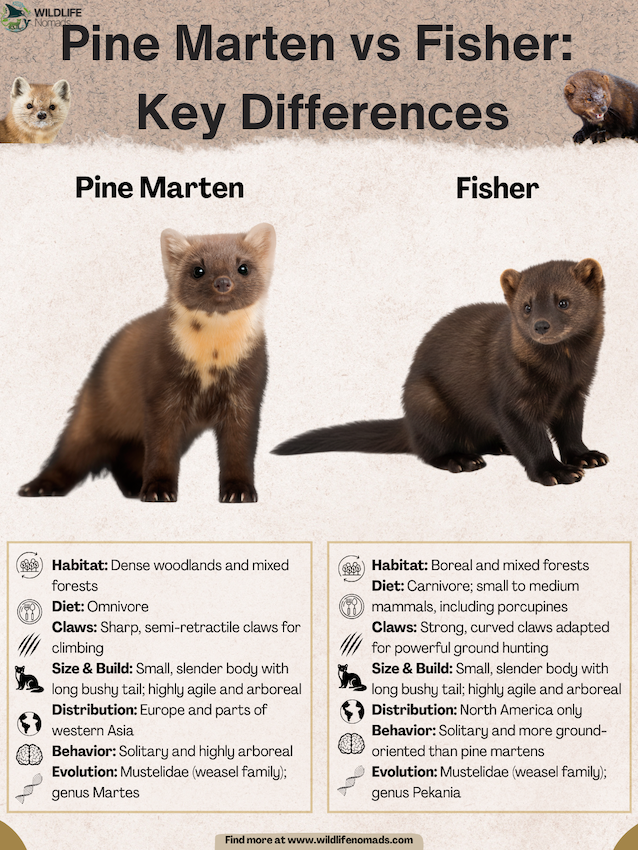
People often confuse the two closely related species. While they are both mustelids, a fisher is much larger than a female or male marten. A fisher has darker fur and lacks the bright vivid orange throat patch that martens display.
Key Differences
The fisher also has a different hunting strategy. For instance, fishers are known for their ability to prey on porcupines. In addition, despite the name “fisher,” neither species spends much time fishing. They are both land-based hunters that excel in forested environments.
Martens are more arboreal, spending more time in trees. Meanwhile, fishers hunt primarily on the forest floor, though they can climb when necessary. Understanding these differences helps wildlife enthusiasts properly identify these fascinating predators.
11. They Don’t Turn White: Winter Coat Changes
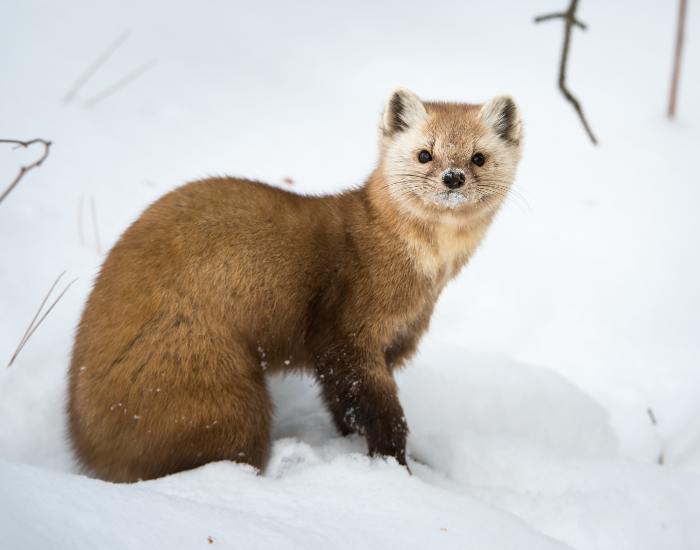
A common question is: “Does a pine marten turn white in winter?” The answer is no. Unlike their cousins the ermine or the long-tailed weasel, the pine marten keeps its tawny brown or dark brown coat year-round.
However, they might grow a much thicker, fluffier layer of marten fur to handle the sub-zero temperatures. This winter coat is denser and provides excellent insulation. In addition, the paler straw-colored throat patch often becomes more prominent against the darker winter fur.
The bushy tail also becomes even more luxurious in winter. This helps them balance during acrobatic pursuits through snow-laden branches.
12. The Curious Personality: Behavior and Intelligence
In reintroduction efforts, scientists often find martens investigating their equipment. In addition, they sometimes peer into the windows of cabins, displaying remarkable boldness.
They have a highly developed sense of smell and hearing. Therefore, they are very aware of everything happening in their home ranges. This acute sensory awareness helps them locate prey hidden beneath deep snow or inside hollow logs.
Their intelligence is evident in their hunting strategies. For example, they learn and remember productive hunting locations. Moreover, they adapt their behavior based on seasonal changes and prey availability.
FAQ: Your Top Pine Marten Questions Answered
Very rare indeed. They are primarily nocturnal or crepuscular, meaning they’re active at dawn and dusk. In addition, they are naturally elusive and avoid human contact. If you see one, consider yourself extremely lucky.
No, but they are in the same Mustelidae family. Think of them as the wild, tree-climbing cousins of the domestic ferret. However, their behavior and habitat needs are completely different.
“Vicious” is a human term that doesn’t apply well to wildlife. They are highly efficient, intense predators. While they are small mammals themselves, they are incredibly brave. For instance, they can take down larger prey like a snowshoe hare, which is much bigger than they are.
Absolutely not. They are wild animals with very specific habitat needs and a high prey drive. In addition, keeping them as pets is illegal in most jurisdictions. They are much better off in the wild than in a living room.
The American marten (Martes americana) and European pine marten (Martes martes) are separate species. However, they share many similar characteristics. The main differences lie in their geographic range and subtle physical variations.
Pine martens live across northern North America, including Canada, Alaska, and portions of the northern United States. They require old-growth or mature forests with complex structure. In addition, they prefer areas with abundant tree cover and minimal human disturbance.
Martens are well-adapted to winter conditions. Their furry paws act as snowshoes, allowing them to travel across deep snow. In addition, they grow thicker fur for insulation and continue hunting throughout the winter months using their excellent sense of smell to locate prey.
Why We Should Care About Pine Martens
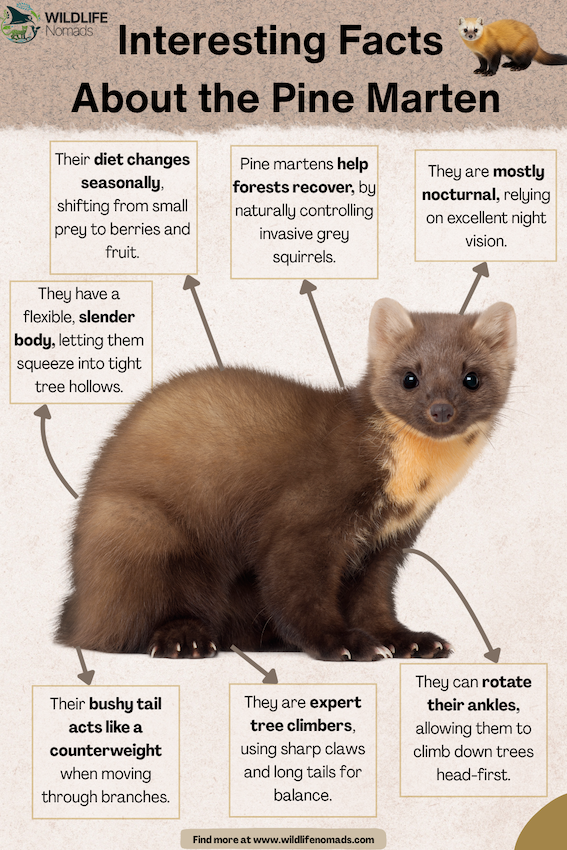
The American pine marten is a sentinel of the forest. When you find a healthy population of martens, it’s a sign that the forest is healthy, old, and diverse. These members of the weasel family play a crucial role in forest ecology. They help control small mammal populations and serve as indicators of habitat quality. Moreover, their presence indicates that the forest contains the structural complexity necessary for countless other species.
Conservation efforts must continue to protect old-growth forests and maintain the forest management practices that support marten populations. In addition, ongoing research helps us understand their ecological needs and how to coexist with these fascinating predators.
Next time you’re hiking in the deep woods of Canada, Alaska, or the Pacific Northwest, keep an eye on the tree trunks. You might just see a pair of rounded ears and a vivid orange patch looking back at you. That brief encounter with a pine marten would be a rare gift, a glimpse into the secret life of one of North America’s most elusive small mammals.