
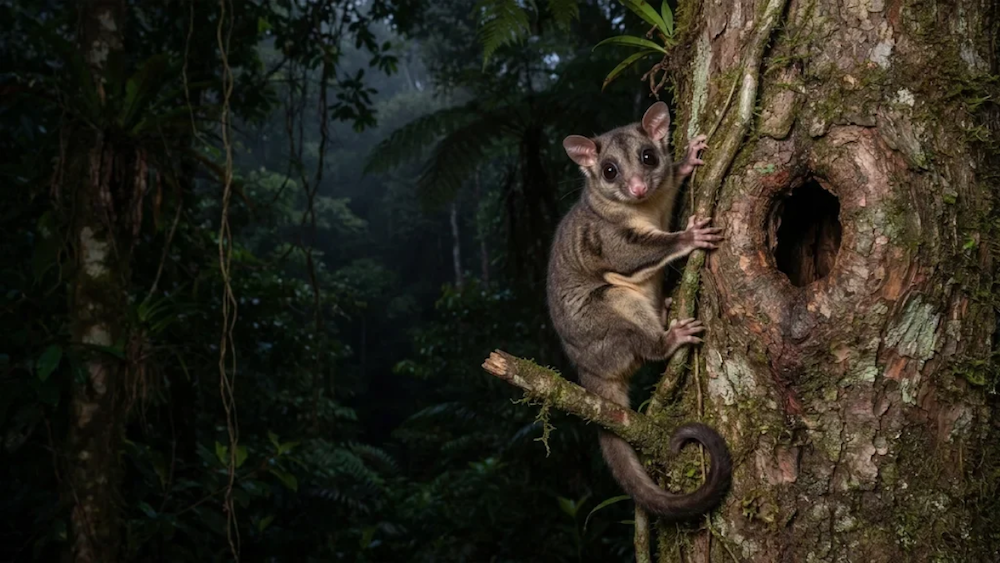
When I lived in Sydney for my master’s, I visited the Australian Museum, home to the scientists behind this story. Common ringtail possums lived near my home and at my field sites. So this story hit close. Two marsupials, known to science only from fossils, have been found alive in New Guinea.
Scientists thought both had died out more than 6,000 years ago. Then, on 6 March 2026, researchers confirmed both still live on the Vogelkop Peninsula, in Papuan Indonesia. These marsupials found alive in New Guinea are rare “Lazarus taxa”, and one even needed a brand new genus.
Below, I explain who they are and how the team pieced the evidence together. I also cover why local clans knew them all along.
Meet the two survivors
The pygmy long-fingered possum
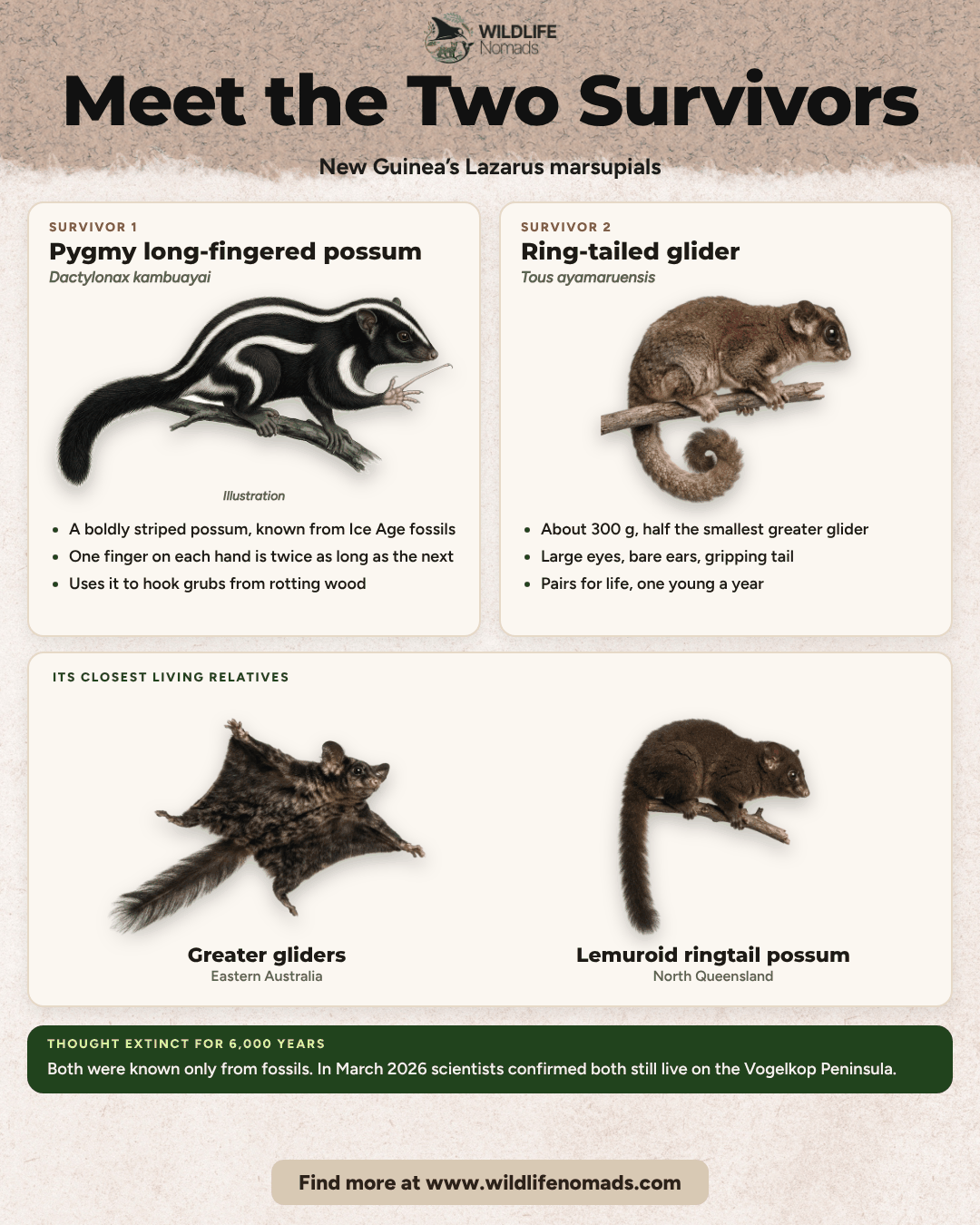
The pygmy long-fingered possum (Dactylonax kambuayai) is a boldly striped possum. On each hand, one finger is twice as long as the next longest. It is the smallest of the striped possums, a group in the family Petauridae.
Striped possums use that long finger to hook grubs out of rotting wood. As a result, the hand works a bit like a woodpecker‘s tongue. Before 2026, it was known only from fossils. These came from Ice Age Australia and from Pleistocene to early Holocene New Guinea.
It also has a close relative on the same peninsula. Between about 900 and 1,400 metres, the long-fingered possum (Dactylonax palpator) replaces it or lives beside it.
The ring-tailed glider
The ring-tailed glider (Tous ayamaruensis) is the closest living relative of Australia’s greater gliders. It weighs about 300 grams, roughly half the size of the smallest greater glider. It has large eyes, bare ears and a strongly gripping tail.
Pairs bond for life and raise just one young a year. Like greater gliders, it nests in hollows of the tallest forest trees. Its diet may include sap and some leaves, but little else is known yet.
Australian readers may know the greater glider from our list of the most threatened animals in Australia. Its New Guinea cousin now faces some of the same pressures.
What is a Lazarus taxon?
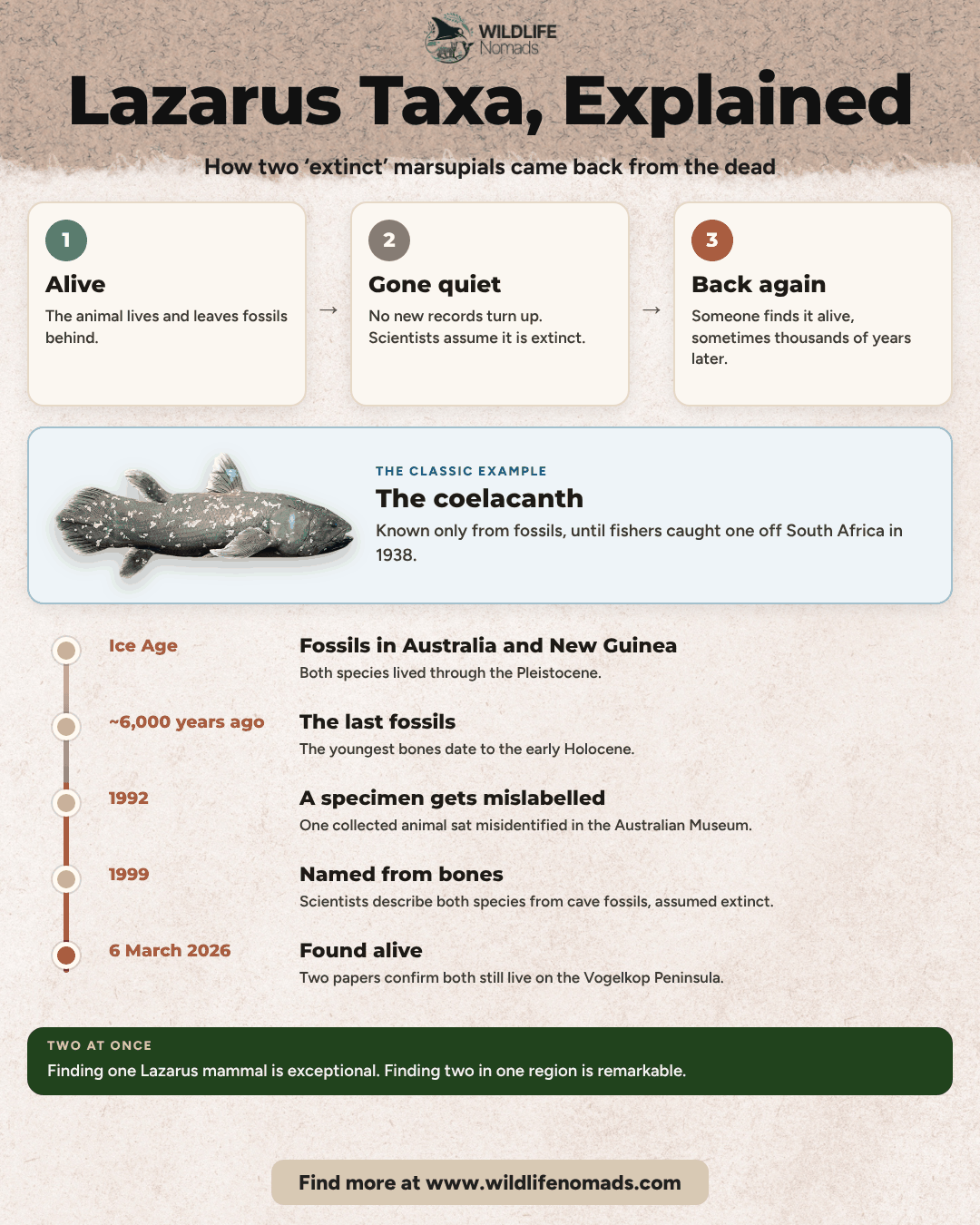
Scientists call animals like these Lazarus taxa. The name borrows from the biblical Lazarus, who returned from the dead. A Lazarus taxon vanishes from the fossil record, then turns up again, sometimes alive.
The most famous example is the coelacanth. Scientists knew it only from fossils until fishers caught one off South Africa in 1938. Finding one Lazarus mammal is exceptional. Finding two in one region, as the Australian Museum noted, is remarkable.
How scientists found them
Tim Flannery of the Australian Museum and Kristofer Helgen of Bishop Museum led the work. They published two papers on 6 March 2026 in the Records of the Australian Museum. The papers sit in a special issue on the mammals of New Guinea.
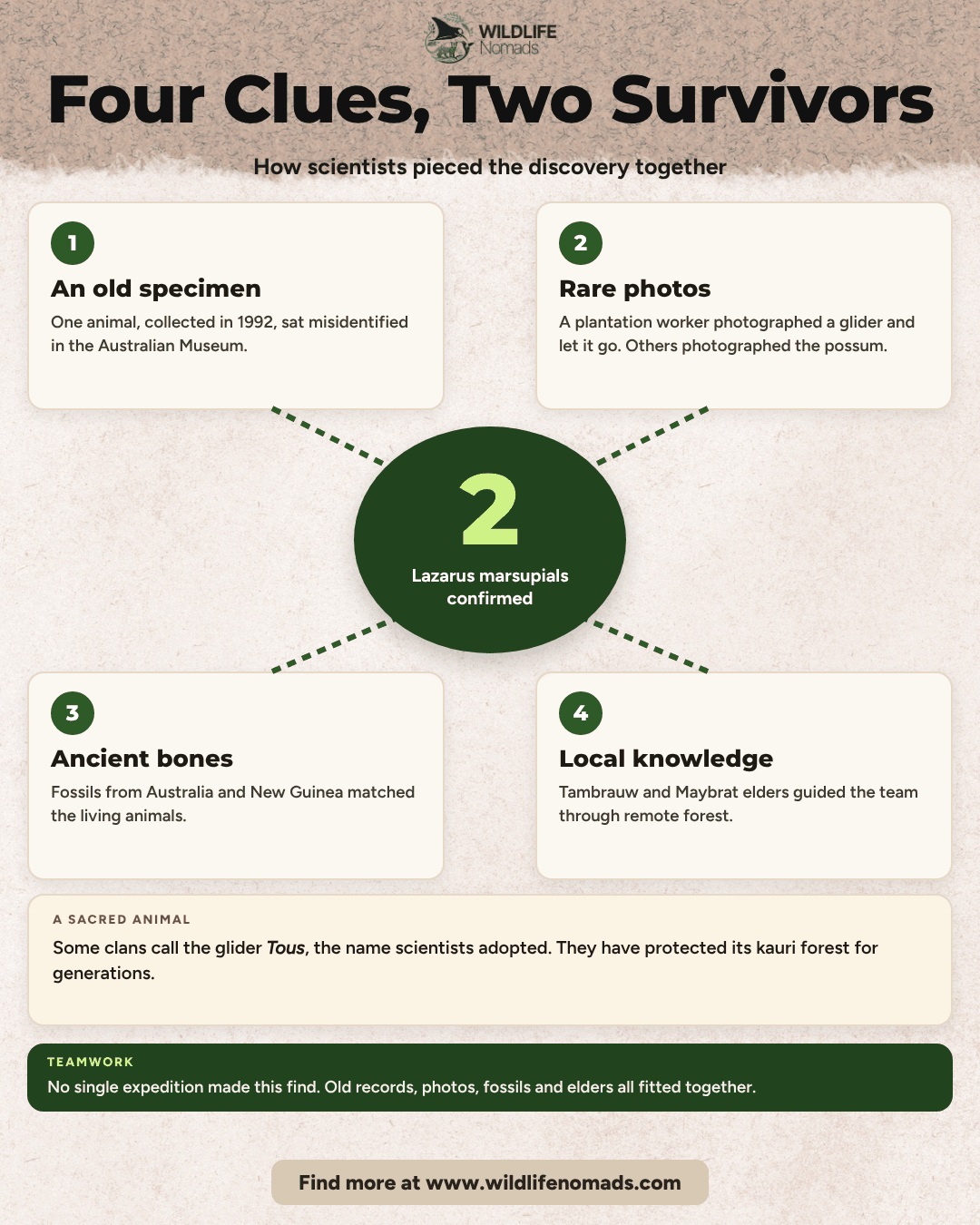
No single expedition made the discovery. Instead, the team pieced several threads together:
- A possum specimen collected in 1992 sat in the Australian Museum, misidentified when it came in.
- Local researchers had taken rare photographs of the living animals.
- Fossil fragments from Australia and New Guinea helped confirm their identity.
- Tambrauw and Maybrat elders guided the team through remote forest.
The fossils had a long history. In 1999, Kenneth Aplin and colleagues described both species from ancient cave and archaeological deposits on the Vogelkop. At the time, everyone assumed they were extinct.
The glider’s story began with a photograph. A plantation worker found one, photographed it and released it. When the team studied the images, the animal matched the fossil bones. As of March 2026, no museum specimen of the living glider existed.
The first new marsupial genus from New Guinea since 1937
The ring-tailed glider was first named Petauroides ayamaruensis, placing it among the greater gliders. Its full set of teeth, seen in modern animals, told a different story. So the team created a new genus, Tous.
It is the first new genus of New Guinean marsupial described since 1937. The genus also reaches back in time. A Pliocene fossil from Victoria and New South Wales, once called Pseudocheirus stirtoni, now sits in Tous too.
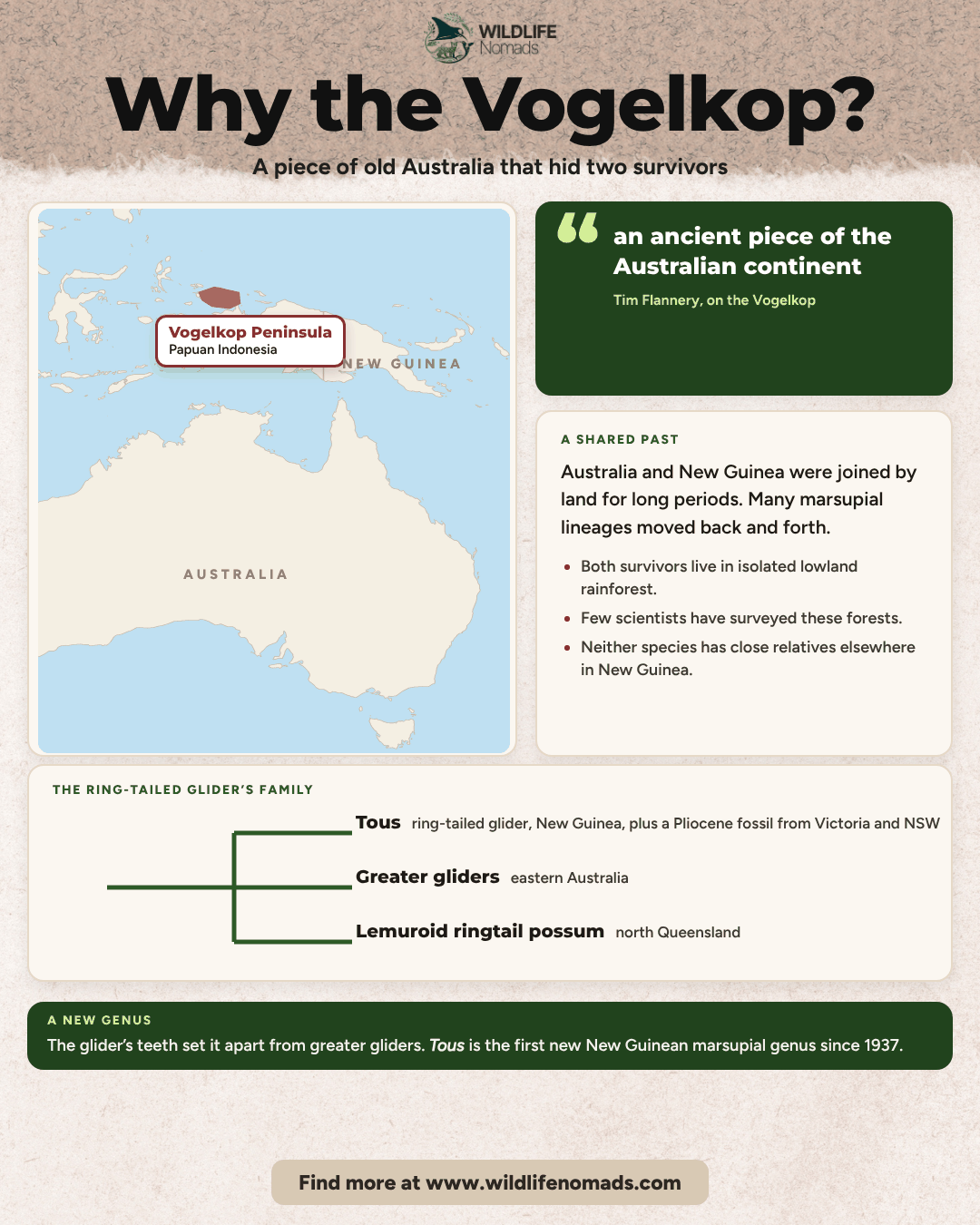
Its living relatives are the greater gliders and the lemuroid ringtail possum of eastern Australia. In other words, a branch of the Australian possum family tree has been hiding in Papua. You can explore how branches like this connect on our tree of life.
Why the Vogelkop?
Professor Flannery described the Vogelkop as “an ancient piece of the Australian continent”. Over millions of years, it became part of New Guinea. That helps explain why its animals echo Australia’s fossil past.
New Guinea is already famous for unique marsupials, including most of the world’s tree kangaroos. Yet neither species has close relatives elsewhere on the island. Both live in isolated lowland rainforest, which few scientists have surveyed. Flannery believes these forests may hold more relics of an older Australia.
That fits what we know about marsupials in general. Australia and New Guinea shared a land bridge for long periods, so many lineages moved back and forth.
A sacred animal
Some Tambrauw and Maybrat clans call the glider Tous, the name the scientists adopted. For some Vogelkop clans, it is sacred and linked to ancestral spirits and an initiation practice.
The clans have protected its forest for generations. At its heart stand giant kauri trees, which local people believe mark the birthplace of all animals and humans. As a result, the glider survived where outsiders never looked.
Rika Korain, a Maybrat co-author, stressed that the identification relied on cooperation with Traditional Owners. Researchers from the University of Papua also played a central role.
What happens next
Logging now threatens the tall trees the glider needs for nesting. The Vogelkop forests may be the last stronghold for both species. That makes them priorities for anyone studying rainforest animals in the region.
The Global Wildlife Fund, an Australian charity, supported the research with the Minderoo Foundation. It now works with local communities to protect these forests.
This discovery reminds me how much we still don’t know. Two mammals hid in plain sight, while local people knew them all along. Next time a possum stares back at my headlamp, I will remember that its cousins are still writing new chapters.
FAQs About the Rediscovered Marsupials
The pygmy long-fingered possum (Dactylonax kambuayai) and the ring-tailed glider (Tous ayamaruensis) were confirmed alive in March 2026. Both live in rainforest on the Vogelkop Peninsula of Papuan Indonesia.
Both were known only from fossils, the youngest from the early Holocene about 6,000 years ago. Nobody had documented living animals, so scientists assumed they had died out.
A Lazarus taxon is a species that disappears from the fossil record and later reappears, sometimes alive. The name refers to Lazarus, who returned from the dead in the Bible.
It is the closest living relative of Australia’s greater gliders and weighs about 300 grams. It needed a new genus, Tous, the first new New Guinean marsupial genus since 1937.
One finger on each hand is twice as long as the next. Striped possums use this finger to pull grubs out of rotting wood.
Listen to the People Who Knew
These marsupials found alive in New Guinea were never truly lost to the people who share their forest. Science caught up through old specimens, a few photos and the guidance of Tambrauw and Maybrat elders. That partnership is the real headline.
If this story fired you up, meet a relative in our sugar glider facts. Or climb through the rainforest layers. Then tell me in the comments which Lazarus animal you would most like to see found next.
12 questions, all drawn from the article above. Ready?
Your score
References:
Flannery, T. F., Aplin, K. P., Bocos, C., Koungoulos, L. G., & Helgen, K. M. (2026). Found alive after 6,000 years: Modern records of an 'extinct' Papuan marsupial, Dactylonax kambuayai (Marsupialia: Petauridae), with a revision of the systematics and zoogeography of the genus Dactylonax. Records of the Australian Museum, 78(1), 17–34.
Flannery, T. F., Koungoulos, L. G., Meijaard, E., Yohanita, A. M., Muharmansyah, A., AlZaqie, I., Aplin, K. P., Korain, F., Mjam, M., & Helgen, K. M. (2026). A new genus of hemibelideine possum (Marsupialia: Pseudocheiridae) from New Guinea and Australia, including a Lazarus taxon from the Vogelkop Peninsula. Records of the Australian Museum, 78(1), 35–52.
Aplin, K. P., Pasveer, J. M., & Boles, W. E. (1999). Late Quaternary vertebrates from the Bird's Head Peninsula, Irian Jaya, Indonesia, including descriptions of two previously unknown marsupial species. Records of the Western Australian Museum Supplement, 57, 351–387.
Australian Museum. (2026, March 6). Marsupials rediscovered in Vogelkop, Papua [Media release].
Meijaard, E., Helgen, K. M., & Flannery, T. (2026, March 9). Meet 'Tous': An entirely new genus of mammal we identified. Here's why it's so exciting. The Conversation (republished by RNZ).