The first time I crossed paths with a tapir, I was walking through a rescue sanctuary near the Riviera Maya coast in southern Mexico. Out from the undergrowth wandered something that looked assembled by committee. Part pig, part anteater, part something prehistoric. That was a Baird’s tapir, and I stood watching it for nearly an hour. Years later, in a sanctuary in Malaysia, I met a completely different creature. A Malayan tapir, half-black, half-white, looking like a panda that had wandered into the wrong continent. Two tapirs, two continents, two utterly distinct animals. Somehow, the same family.
That contrast is what makes tapirs so fascinating. There are only four extant species of tapir on the planet, and each one is stranger than the last. In this post, I want to share what I have pieced together about these gentle, ancient mammals, from their elephant-like noses to their role as the rainforest’s quietest gardeners.
1. There Are Four Tapir Species, and Each One Looks Completely Different
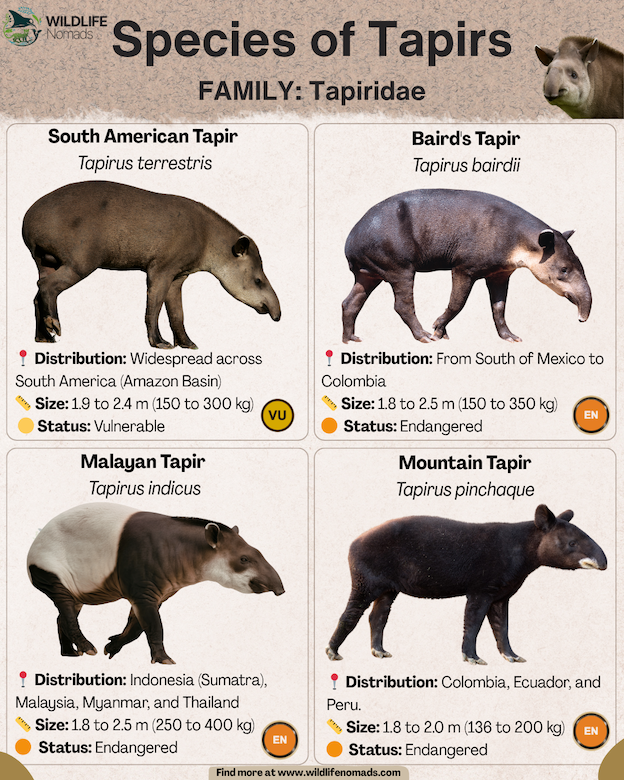
The four tapir species alive today belong to a family of mammals that has barely changed in 20 million years. Three of these tapirs live in Central and South America. Only one, the Malayan tapir, lives across Southeast Asia, in places like southern Thailand, Malaysia, and Sumatra. There is also a possible fifth, the kabomani tapir, described in 2013 from northern Colombia and the Western Amazon. Scientists still debate whether the kabomani tapir is its own animal or a smaller form of the lowland tapir.
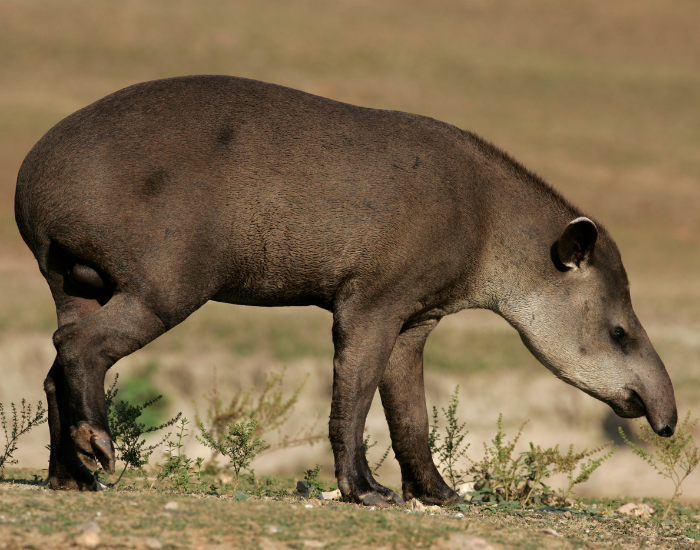
What surprised me most when I started reading about tapirs is how different they look across the genus Tapirus. Baird’s tapir is large and dark brown, like a barrel on legs. The lowland tapir — also called the Brazilian tapir or South American tapir — is reddish brown, with a low mane along its neck. The Mountain apir, or tapir pinchaque, has thick woolly fur to handle the cold of the Andes mountains. The Malayan tapir wears that famous black-and-white coat that looks painted on. Side by side, these tapirs barely look related.
2. The Tapir’s Nose Is Practically a Miniature Trunk
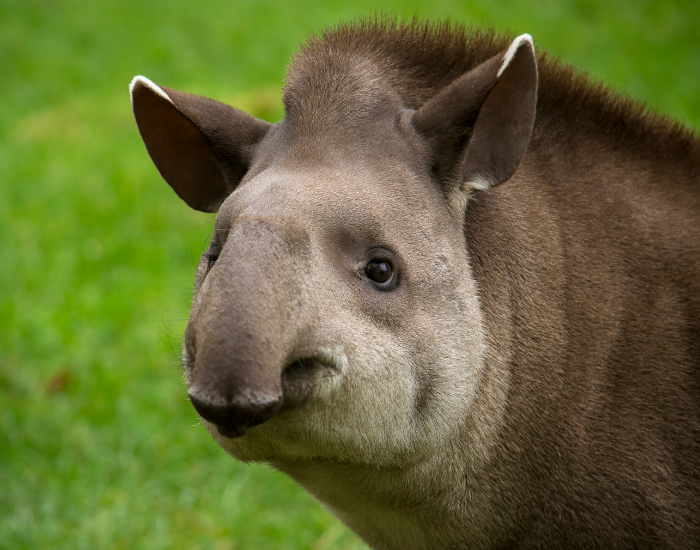
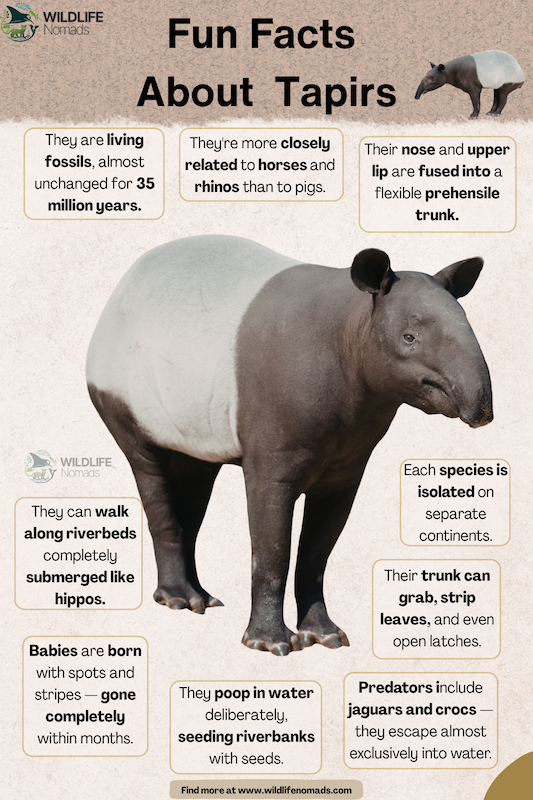
The first thing you notice about tapirs is the nose. The tapir’s nose is short, fleshy, and remarkably mobile, a prehensile snout formed by the upper lip and nostrils fused into a flexible little proboscis. Watching that impressive nose at work in Mexico, I saw a tapir wrap its snout around fallen fruit, pull tree branches closer, and even sniff curiously at my boot when the snout poked through the leaf litter near my feet.
Biologically, the flexible snout works like a miniature elephant’s trunk. Tapirs use it to grasp leaves, strip bark, and pluck aquatic plants from rivers and ponds. It is also a fantastic smell-detector. Most tapirs are crepuscular, so their waking hours foraging happen at dawn and dusk, and a powerful nose matters far more than sharp eyes in dim forest light. Among the physical characteristics that define the tapir tapirus genus, that mobile nose is the most obvious.
3. Tapirs Are Not Pigs… They’re Cousins of Horses and Rhinos
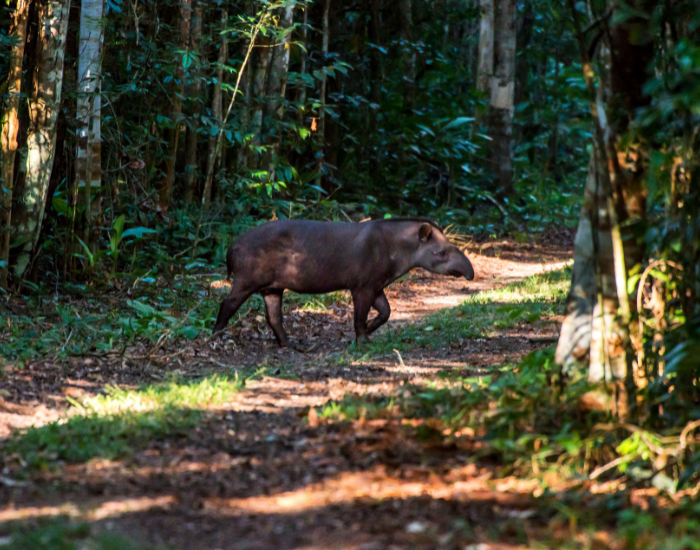
People constantly assume tapirs are some kind of pig. I can see why. The body shape is round and stocky, the snout is piggy at a glance, and tapirs grunt through the forest like nothing else. But tapirs are not pigs. Tapirs are odd-toed ungulates, in the order Perissodactyla, which makes them more closely related to horses and rhinos than to anything in the pig family.
That detail blew my mind the first time a colleague mentioned it. Tapirs have four toes on the front feet but only three toes on the hind feet, while pigs carry an even number on every foot. That single anatomical feature places the tapir tapirus lineage in an entirely different evolutionary branch. One that split from horses around 50 million years ago. Of all the large mammals alive today, only tapirs, horses, and rhinos still carry that ancient odd-toed body plan.
4. The Malayan Tapir Is Unlike Any Mammal on Earth
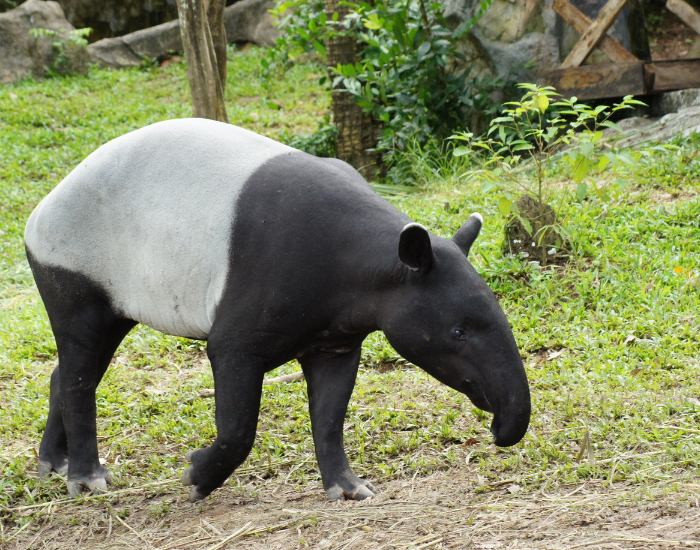
The Malayan tapir—also called the Asian tapir, the Malay tapir, or the Indian tapir in older literature—is the only species found outside the Americas. It is also the heavyweight of the family, with adults occasionally tipping the scales at over 700 pounds. Its scientific name, Tapirus indicus, hints at its historical range. These incredible animals once roamed as far west as India before severe habitat loss pushed them exclusively into the dense rainforests of southern Thailand, peninsular Malaysia, and Sumatra.
The stark, blocky black-and-white coat is what makes the Malayan tapir truly unforgettable. While it looks cartoonishly bold in broad daylight, it serves a brilliant evolutionary purpose: disruptive coloration. In the dappled, shifting moonlight of a thick jungle canopy, that harsh pattern completely breaks up the animal’s physical outline. Instead of seeing a massive, solid silhouette, a stalking predator sees two unrelated, ambiguous shapes. When you see one up close, the contrast feels like a trick of nature; in the dense forest after dark, it transforms a 700-pound mammal into a silent ghost.
5. Baird’s Tapir Is the Largest Native Land Mammal in Central America
Most travelers visiting Central America never realize this, but Baird’s tapir — also called the Central American tapir, is the largest native land mammal between Mexico and Colombia. Bigger than the jaguars that occasionally hunt them. Bigger than any deer or peccary. Adult tapirs of this species can weigh up to 880 pounds. That is a serious animal moving quietly through the forest.
I saw my first Baird’s tapir in a sanctuary on the Riviera Maya, where conservationists rehabilitate orphaned tapir calves and reintroduce them to protected habitat. In Costa Rica, Baird’s tapirs still roam Corcovado National Park. Costa Rica is one of the best places left in the world to see these tapirs in the wild. Their range stretches from southern Mexico down to northern Colombia, but cattle grazing and habitat destruction have fragmented Baird’s tapir territory badly. Across Central America, Baird’s tapir populations are now patchy and isolated.
6. Mountain Tapirs Live in Cloud Forests Above the Treeline
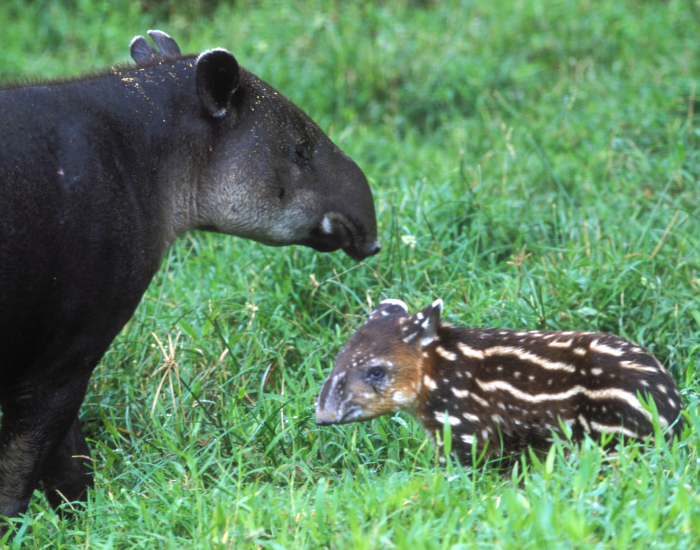
The Mountain tapir, or sometimes called the woolly tapir, the andean tapir, or by its scientific name Tapirus pinchaque, is the smallest of the four tapirs and the only one adapted to life at high elevation. These tapirs live in the cloud forests and páramo grasslands of the Andes mountains, at altitudes ranging from about 6,500 to over 14,000 feet. The range of Mountain tapirs covers Ecuador, southern Colombia, and northern Peru.
To survive that cold, Mountain tapirs grew a thick coat of dark, woolly fur, completely different from the smooth hides of other tapirs in the genus. I have never seen one in the wild, but biologists I have spoken with in Colombia describe Mountain tapirs as nearly silent ghosts of the high forest. Their numbers are perilously low. Most estimates suggest fewer than 2,500 adult mountain tapirs remain in the wild.
7. Tapirs Are the Rainforest’s Quiet Gardeners
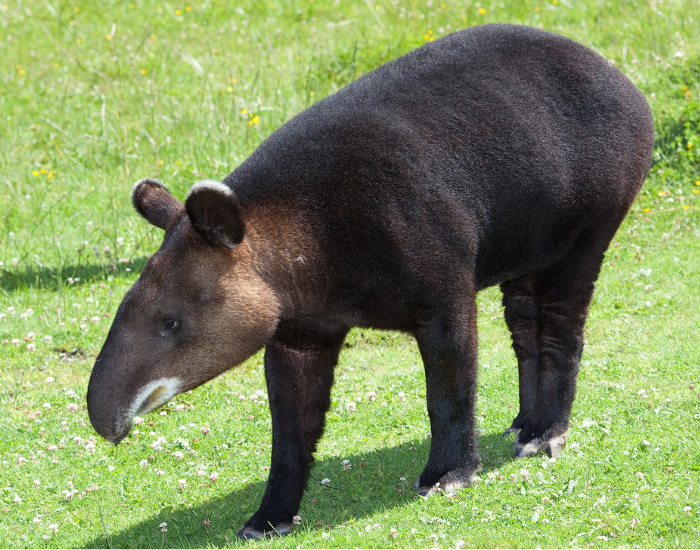
Here is a fact that does not get nearly enough attention. Tapirs are some of the most important seed dispersers in their entire ecosystem. Tapirs eat enormous quantities of fallen fruit, aquatic plants, leaves, and shoots. Because tapirs roam over wide territories, they carry seeds far from the parent tree before depositing them in nutrient-rich dung.
Research in various tropical ecology journals shows that some rainforest tree species depend almost exclusively on tapirs for dispersing seeds. Lose the tapirs, and you slowly lose those trees, and then the rainforest animals that depend on those trees. It is a chain reaction. The biological diversity of the Amazon and the forests of Central and South America rests, in part, on the slow, plodding work of these large mammals that most tourists never see.
8. Tapir Calves Look Like Tiny Living Watermelons
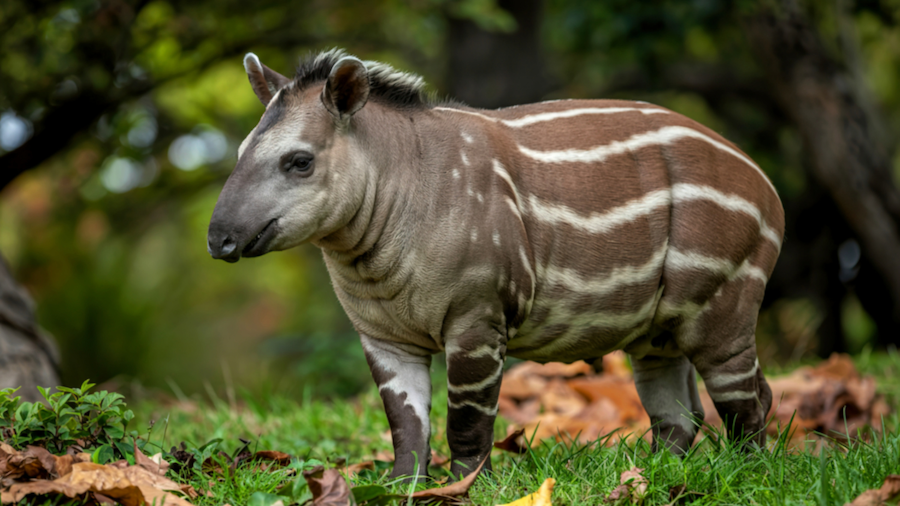
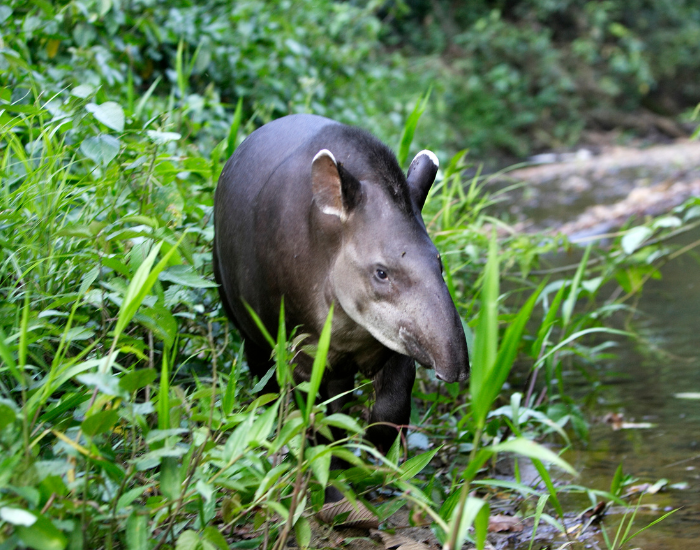
Newborn tapir calves and baby tapirs look almost nothing like their parents. Tapirs are born with chestnut-brown coats streaked with cream-colored stripes and spots — a camouflage pattern that helps the babies disappear into the dappled light of the forest floor. The pattern fades by about six months of age, and tapirs at that point look like miniature versions of the adults.
In the Malaysian sanctuary I visited, one of the keepers showed me a photo of a recently born tapir. The little animal looked, and I am not exaggerating, like a striped watermelon on legs. That bizarre coat is one of the few traits all tapirs share. From Tapirus terrestris in Brazil to Tapirus indicus in Southeast Asia, every calf wears the same uniform.
9. Their Natural Predators Are Few… But Real
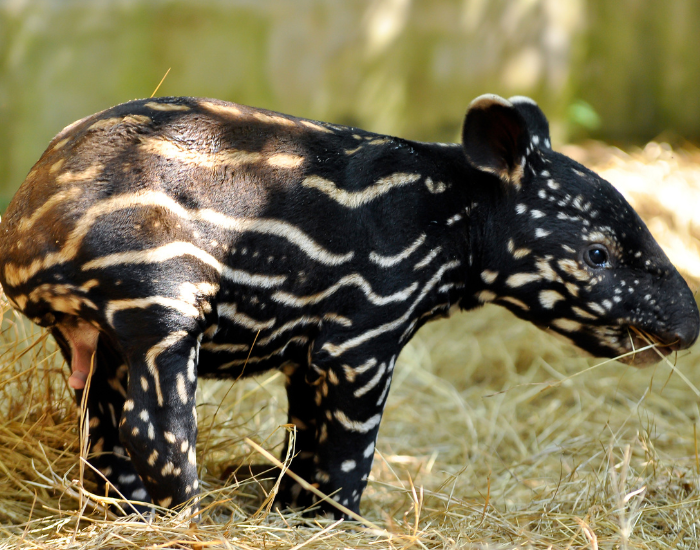
Adult tapirs are large, powerful, and surprisingly fast in short bursts. Tapirs can also dive into water and stay submerged for several minutes, a tactic many tapirs use to deter predators by simply disappearing below the surface. The natural predators of tapirs are limited to a handful of large cats: jaguars in the Americas and leopards and tigers in Asia. Occasionally, crocodiles and large snakes take a calf. Tapirs also roll in slippery mud, which both cools the skin and makes them harder for predators to grip.
Even so, predation is rarely the biggest threat. The real danger comes from humans. Every species of tapir is now listed as either vulnerable or endangered by the IUCN Red List, making the entire genus a threatened species group. Across both continents, tapir habitat has been carved up by roads, agriculture, and cattle grazing.
10. Tapir Conservation Is a Slow, Stubborn Fight
Tapir conservation is one of those quiet causes that rarely makes headlines. There are no charismatic mascots, no viral campaigns. Just biologists, park rangers, and a handful of NGOs working country by country to slow habitat loss. Habitat destruction from logging, palm oil expansion, and grazing pressure pushes many tapirs out of the forests they need. Mountain tapirs and Malayan tapirs are especially vulnerable, but no tapirs are doing well.
There are bright spots. Costa Rica’s national parks hold some of the densest populations of Baird’s tapir anywhere on the planet. Reintroduction programs in Brazil have helped restore lowland tapirs to former range. Sanctuaries along the Caribbean coast and in Southeast Asia rescue orphaned tapirs, like the ones I met, and give the species a fighting chance. Done well, tapir conservation also protects jaguars, peccaries, and the countless smaller animals that share the same forest habitat.

FAQs About Tapirs
Tapirs are odd toed ungulates closely related to horses and rhinos. There are four extant species of tapir: Baird’s tapir, the lowland tapir, the mountain tapir, and the Malayan tapir. Tapirs have a short prehensile snout used like a miniature trunk. Tapir calves are born with striped and spotted coats for camouflage. Tapirs are among the most important seed dispersers in tropical forests across Central and South America and Southeast Asia.
No. Tapirs are not a type of pig. Pigs are even-toed ungulates in the order Artiodactyla, while tapirs are odd toed ungulates in the order Perissodactyla. The two groups split evolutionarily more than 50 million years ago. Beyond a vaguely similar body shape, tapirs and pigs share almost no anatomy.
What I’ll Remember About the Tapir
The more time I spend studying mammals across continents, the more I appreciate how much weirdness still hides in plain sight. Tapirs are a perfect example. Quiet, ancient, oddly assembled creatures that help hold entire ecosystems together. From the rainforests of South America to the jungles of Southeast Asia, tapirs deserve a much bigger place in the conversation about wildlife conservation and the animals of Colombia and their neighbors.
If you ever get the chance to see tapirs — in a sanctuary or, if you are lucky, in the wild — take it. Watch the snout move. Notice how silently a 700-pound animal can walk. If you have spotted any tapirs on your own travels, drop a comment below and tell me where. I would love to hear about it.
References:
Cozzuol, M. A., Clozato, C. L., Holanda, E. C., Rodrigues, F. H. G., Nienow, S., de Thoisy, B., Redondo, R. A. F., & Santos, F. R. (2013). A new species of tapir from the Amazon. Journal of Mammalogy, 94(6), 1331–1345. https://doi.org/10.1644/12-MAMM-A-169.1
O’Farrill, G., Galetti, M., & Campos-Arceiz, A. (2013). Frugivory and seed dispersal by tapirs: An insight on their ecological role. Integrative Zoology, 8(1), 4–17. https://doi.org/10.1111/j.1749-4877.2012.00316.x
Garcia, M. J., Medici, E. P., Naranjo, E. J., Novarino, W., & Leonardo, R. S. (2012). Distribution, habitat and adaptability of the genus Tapirus. Integrative Zoology, 7(4), 346–355. https://doi.org/10.1111/j.1749-4877.2012.00317.x
Schank, C. J., Cove, M. V., Kelly, M. J., Mendoza, E., O’Farrill, G., Reyna-Hurtado, R., et al. (2017). Using a novel model approach to assess the distribution and conservation status of the endangered Baird’s tapir. Diversity and Distributions, 23(12), 1459–1471. https://doi.org/10.1111/ddi.12631
Naranjo, E. J. (2009). Ecology and conservation of Baird’s tapir in Mexico. Tropical Conservation Science, 2(2), 140–158. https://doi.org/10.1177/194008290900200203
Tobler, M. W., Carrillo-Percastegui, S. E., & Powell, G. (2009). Habitat use, activity patterns and use of mineral licks by five species of ungulate in southeastern Peru. Journal of Tropical Ecology, 25(3), 261–270. https://doi.org/10.1017/S0266467409005896