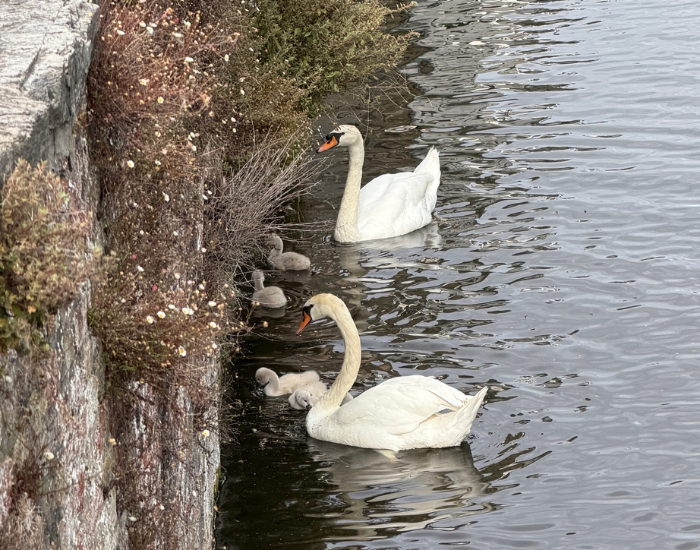
Bruges empties out slowly. The day-trippers drift back to the station, the shops shutter, and by nine the canals go still. That is when I saw them. A mute swan family slid out from under a stone bridge, two white swans leading four gray youngsters in a loose line.
I had walked those same canals all afternoon and seen nothing. Boats, bicycles, crowds. The birds had simply stepped aside and waited for the noise to stop.
Two weeks earlier, in Shoreham-by-Sea in England, I crouched at the edge of a coastal conservation area. A pair sat tight on a reed-pile nest. Two encounters, two countries, one bird everybody calls common, and I still had to work to see it properly.
So I went back to the literature. What I found is stranger than the postcard reputation suggests: one of the heaviest flying birds on Earth, a wetland grazer that can strip a pond to bare mud, and a bird that legally lost its protection in the United States. Most mute swan facts you meet online skip that last part. Here are twelve worth knowing before you next stand at the water’s edge.

1. The Mute Swan Is Not Actually Mute
The name is a comparison, not a description. Next to the bugling whooper and Bewick’s swans, the mute swan Cygnus olor sounds subdued. That is the entire origin of the label.
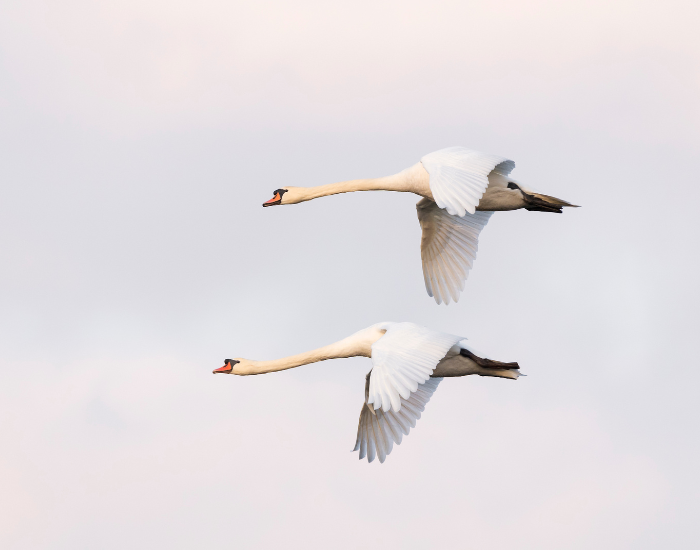
Get close, though, and the repertoire opens up. I have heard hisses, low grunts, snorts, and a strange puppy-like bark from birds guarding young. The most distinctive sound is not vocal at all. It is the rhythmic, throbbing whistle their wings make in flight, audible a kilometre away on still air.
2. One of the Heaviest Birds on Earth That Still Flies
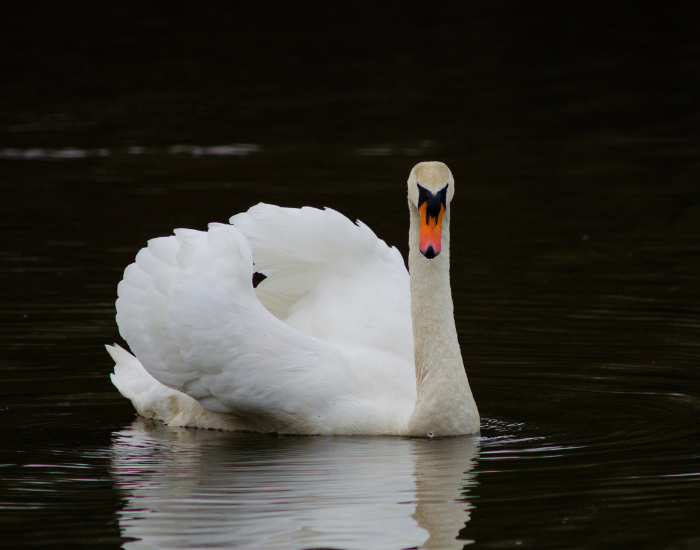
Adults measure roughly 55 to 63 inches from bill to tail. The wingspan stretches 7 to 8 feet, and large males can weigh close to 30 pounds. That makes it the largest waterfowl species across most of its range. It also ranks among the heaviest flying birds in the world.
An ostrich outweighs it several times over, but an ostrich never leaves the ground. Watching a swan take off explains the physics better than any textbook. The bird runs across open water, feet slapping hard, needing thirty metres of runway before the wings finally take the load.
3. That Orange Bill and Black Knob Tell You Almost Everything
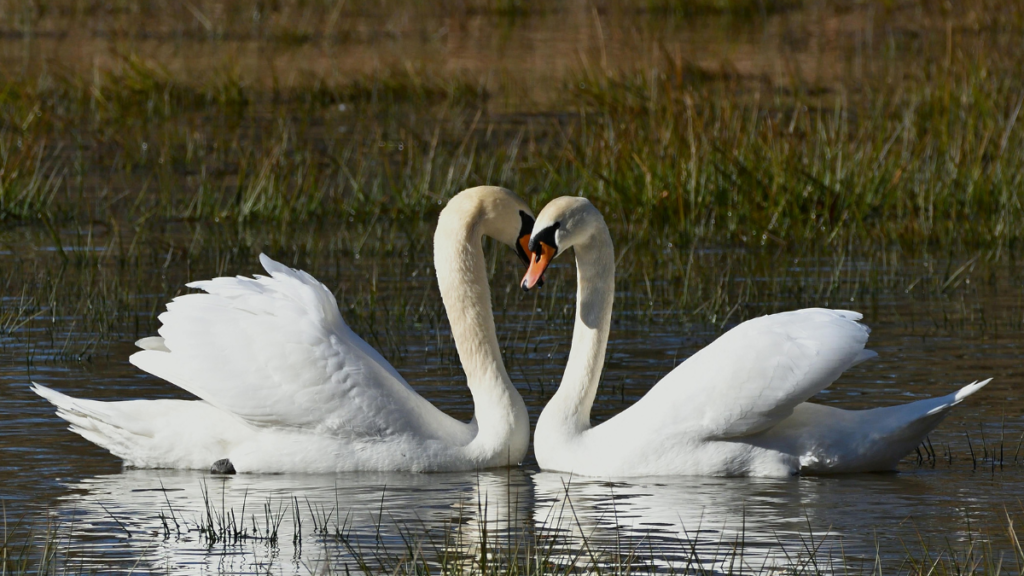
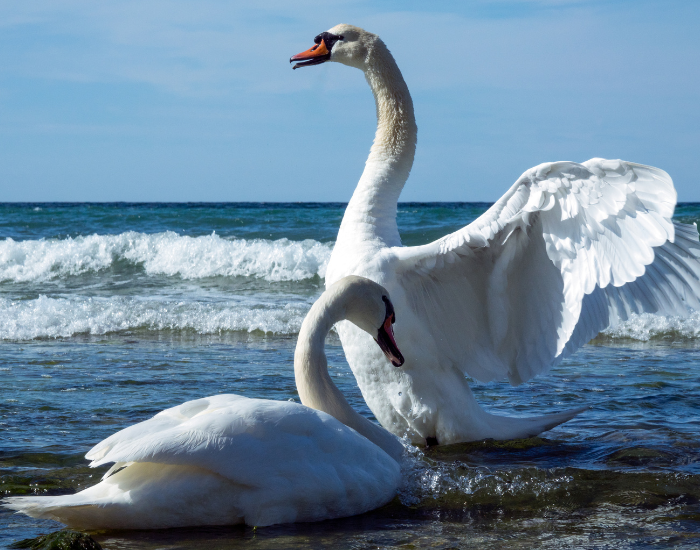
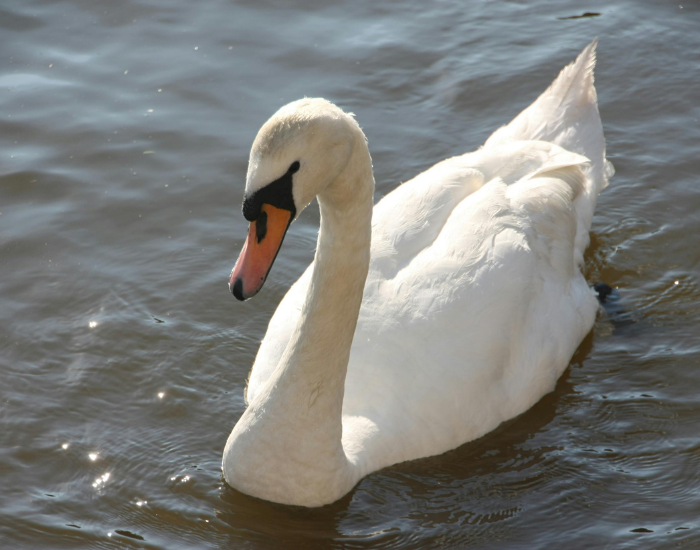
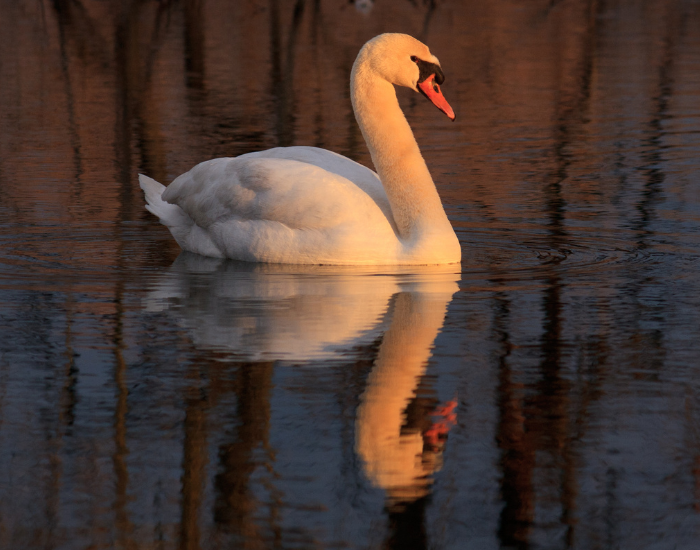
A swan with orange beak colouring is almost always this species. Trumpeter and tundra swans carry black bills instead. Mute swans have bright orange bills with a black knob at the base, plus that famously curved S-shaped neck.
Those mute swan characteristics do real work in the field. On a male mute swan the knob swells during the breeding season, sitting larger and higher than the female’s. Size overlaps between the sexes, so one bird alone is hard to call. Watch a pair together, though, and the difference in those heads shows up in seconds.
4. Cygnets Start Out Gray and Take Two Years to Turn White
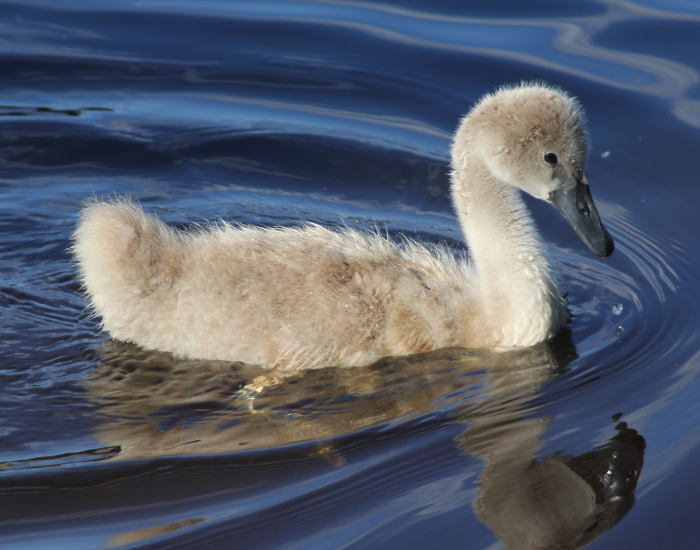
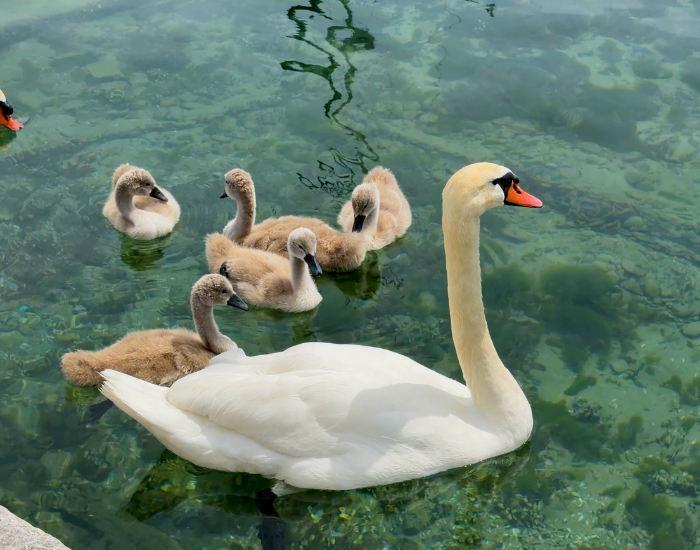
The young are called cygnets, and they hatch in soft gray-brown down. Their bills start dark, not orange. Juvenile mute swans keep that grayish-brown plumage for months. Full white adult plumage arrives gradually, usually completing in the second year.
The Bruges family gave me a perfect look at this. Four gray cygnets, one of them still small enough to climb onto its mother’s back and get carried through the water. Some European populations also produce a rare white-morph chick, the Polish swan, which skips the gray stage entirely.
5. An Adult Eats Up to Eight Pounds of Plants a Day
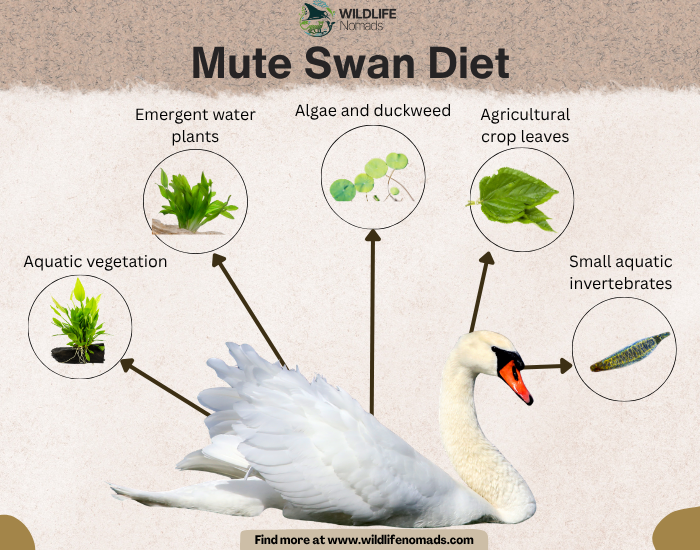
Mute swans primarily feed on submerged aquatic vegetation: pondweeds, eelgrass, stonewort, filamentous algae, and bankside grasses. An adult can consume 4 to 8 pounds of aquatic plants every single day. That neck is a tool: it lets the bird reach food nearly a metre down without diving.
The diet is not strictly vegetarian, though. Swans swallow insects, snails, worms and even tadpoles tangled in the greenery. Bailey and colleagues sampled birds in lower Great Lakes coastal marshes and found plants overwhelmingly dominant. The animal material is incidental, not deliberate hunting.
6. Their Native Range Is the Western Palearctic, Not America
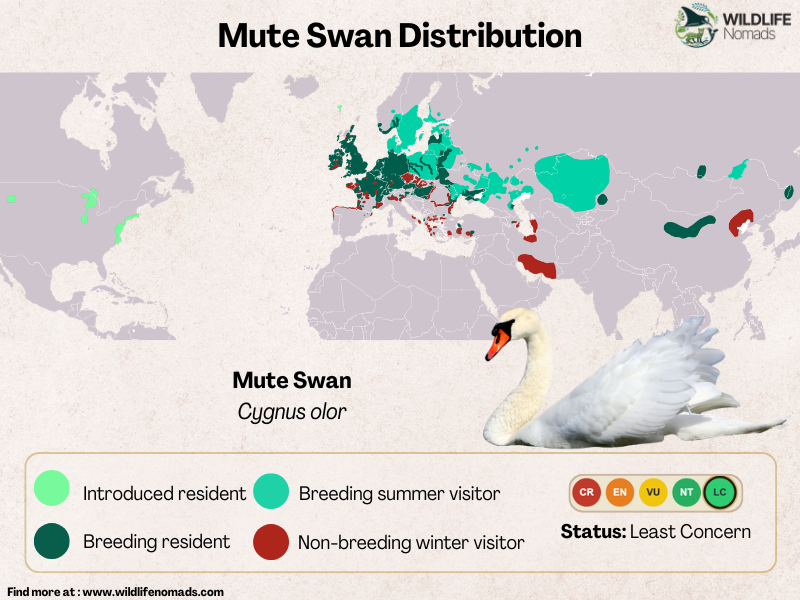
Mute swans are native to temperate Europe and across the western Palearctic into Central Asia. Their native range runs from Ireland and England east through the Baltic, the Black Sea steppes and Mongolia. BirdLife International puts the global population somewhere around 500,000 to 600,000 birds.
Britain holds a famous share of them. Historic censuses counted roughly 22,000 mute swans, and modern Wetland Bird Survey totals run higher across England, Scotland and Wales. However, localized drops in recent winter counts highlight how quickly conditions can shift. That wobble is why long-term monitoring beats any single headline number.
7. Mute Swan Habitat Comes Down to Shallow Water
Where do mute swans live? Anywhere calm enough to reach the bottom. They prefer shallow water, slow-moving freshwater and sheltered coastal bays. Lakes, ponds, marshes, flooded gravel pits and slow flowing rivers all qualify as mute swan habitat.
Which is exactly why a medieval Belgian canal works so well. It is engineered slow water, one to two metres deep, plant-lined and free of current. The Shoreham pair had chosen the opposite extreme, brackish coastal waters behind a shingle bar, sheltered from the swell.
8. Some Populations Migrate Thousands of Kilometres. Most Don’t.
Here is a nuance the field guides often flatten. Western European birds are largely resident. They shuffle as far as the nearest ice-free water, then gather into a winter flock of dozens or hundreds.
Eastern populations behave completely differently. Birds breeding in Russia, Kazakhstan and Mongolia migrate thousands of kilometres to wintering areas. They reach the Caspian, the Black Sea and the Aegean. Same species, opposite strategy, proof that “is it migratory?” is usually the wrong question.
9. Territorial, Yes, But Busking Is Mostly Theatre
Are swans territorial? Emphatically. During the breeding season a pair claims a stretch of bank and defends it against almost everything that floats. The display is called busking: wings arched high over the back, neck curled, head drawn in. Both feet paddle in unison, driving the bird forward in a threatening pose.
That said, most of this aggression points inward. Wood and colleagues analysed hours of webcam footage from wintering sites. Territorial mute swans can exhibit aggressive behaviour towards intruders, but they aim it mainly at other swans rather than at ducks, geese or other wildfowl. Adult males spend far more time guarding than females do. Serious incidents with humans stay rare, and usually involve a kayak entering a nesting territory.
10. They Pair for Life, and Defend the Nest Like a Fortress
Mute swans form lifelong monogamous pair bonds and fiercely defend territories. Roughly 97% of established pairs stay together season after season. Divorce and re-pairing still happen, usually after a failed breeding attempt. Courtship is quiet and symmetrical, two birds facing each other, heads dipping in near-mirror rhythm as they mate for the long haul.
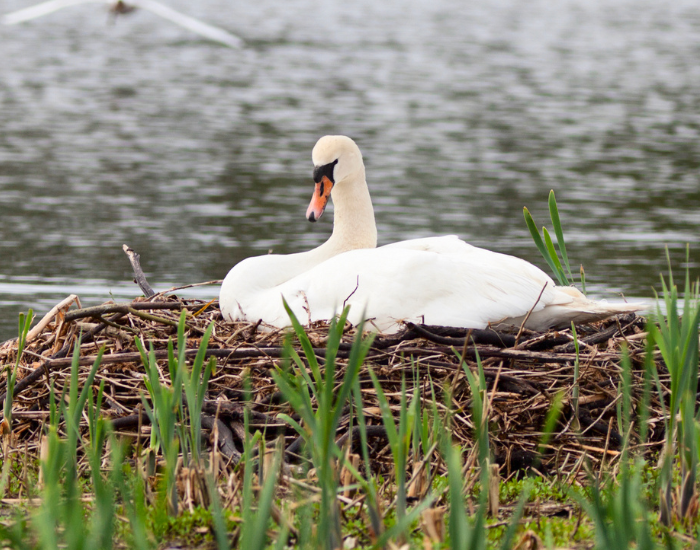
The Shoreham nest was a metre-wide mound of reeds, built well above the waterline. A typical clutch runs 4 to 8 eggs and takes about 36 days to hatch. Both parents share the work, with the male standing sentry nearby. He tracked my movement for twenty minutes without breaking position.
11. In North America, the Mute Swan Is Legally an Invasive Species
Estate owners shipped them over from Europe from the mid-1800s onward, as ornamental wildfowl for parks and ponds. Birds escaped and established themselves. By the late 19th century, free-living populations were breeding along the northeastern seaboard. Mute swans are now classified as an invasive species in many regions of North America.
The maths alarmed managers. Petrie and Francis documented lower Great Lakes numbers climbing at least 10% a year, meaning populations double every seven to eight years. Heavy mute swan populations can devastate local wetland ecosystems by overgrazing. Exclosure experiments in Rhode Island, Chesapeake Bay and the Illinois River valley all recorded less submerged vegetation where swans fed freely. Less vegetation means less food and cover for native waterfowl.
Management followed. In 2003 the U.S. Fish and Wildlife Service proposed a 67% population reduction in the Atlantic Flyway. Mute swans are not protected under U.S. federal law since 2005, when the Migratory Bird Treaty Act stopped covering them. Michigan issues permits to remove invasive mute swans and their nests, and several other states run similar control programmes.
I find this the hardest section to write without picking a side. The swan did not invite itself. Humans carried it across an ocean for decoration, and the bird did precisely what a large, adaptable herbivore does.
12. What Actually Kills Mute Swans, and What Is Coming Next
Lead poisoning remains a significant threat, particularly from swallowed fishing weights and spent shot. Grade and co-authors reviewed the evidence and found ingested fishing gear a persistent, avoidable cause of mortality in waterbirds. Collisions with power lines kill plenty of adults too, because a 12-kilo bird cannot change course quickly.
Eggs and cygnets face a different set of problems. Wild boars and corvids raid nests across Europe. Common snapping turtles are the main predators of cygnets in New York. In urban parks, out-of-control dogs frequently attack mute swans. Defending adults have been recorded holding large dogs under water, an argument for a leash, not for fearing the bird.
Climate change now threatens their habitats and food sources. Warming temperatures increase risks by shifting wetland hydrology, favouring different plant communities and intensifying competition with other species. Globally, BirdLife lists the mute swan as Least Concern — a status that describes numbers, not the quality of the water they depend on.
Mute Swan FAQ
Yes. The mute swan bird occurs along the Atlantic coast from New England to Virginia, around the lower Great Lakes, and in pockets of the Pacific Northwest and Midwest. All of them descend from stock imported from Europe in the 1800s and early 1900s. Estimates run into the tens of thousands, concentrated in Chesapeake Bay and the Great Lakes.
Because they are non-native, they multiply fast, and they eat a lot. Populations can double every seven to eight years without control, and each adult strips 4 to 8 pounds of submerged aquatic vegetation daily. That grazing reduces food and shelter for native waterfowl and fish. Their aggressive defence of territory also displaces nesting ducks, geese and other wetland birds.
Temperate Europe and the western Palearctic, extending east through Russia and Central Asia to Mongolia. Everything outside that native range — North America, Australia, New Zealand, South Africa, Japan — reflects deliberate human introduction. Standard references treat the mute swan species as introduced there rather than naturally expanding, including the Handbook of the Birds of the World from Lynx Edicions and the ornithology journals published by Oxford University Press.

Why This Bird Rewards a Second Look
The mute swan shows how badly the word “common” describes anything. Here is a 30-pound flying herbivore with a two-metre wingspan, a lifelong mate and a real courtship ritual. Its legal status flips from Crown-protected in England to permit-controlled pest in Michigan, depending on which side of an ocean it swims.
Go and watch one properly. Wait until the parks empty and the light drops, the way it worked for me in Bruges. Give it twenty minutes. Check whether the knob on the bill is swollen, whether the cygnets are still gray, whether the pair is upending or standing guard.
Our guide to types of waterfowl puts the swan alongside its relatives, and the types of birds guide covers the wider family tree. For size comparisons with something familiar, try the Rouen duck, the other domestic duck breeds, or the sea-going harlequin duck. Then tell me in the comments where you saw your first swan.
Mute Swan: Test Yourself 🦢
Eight multiple-choice questions on the world’s most misjudged “common” bird. Go back and change any answer before you score.
References:
Bailey, M., Petrie, S. A., & Badzinski, S. S. (2008). Diet of mute swans in lower Great Lakes coastal marshes. Journal of Wildlife Management, 72(3), 726–732. https://doi.org/10.2193/2007-133
Grade, T., Campbell, P., Cooley, T., Kneeland, M., Leslie, E., MacDonald, B., Melotti, J., Okoniewski, J., Parmley, E. J., Perry, C., Vogel, H., & Pokras, M. (2019). Lead poisoning from ingestion of fishing gear: A review. Ambio, 48(9), 1023–1038. https://doi.org/10.1007/s13280-019-01179-w
O’Hare, M. T., Stillman, R. A., McDonnell, J., & Wood, L. R. (2007). Effects of mute swan grazing on a keystone macrophyte. Freshwater Biology, 52(12), 2463–2475. https://doi.org/10.1111/j.1365-2427.2007.01841.x
Petrie, S. A., & Francis, C. M. (2003). Rapid increase in the lower Great Lakes population of feral mute swans: A review and a recommendation. Wildlife Society Bulletin, 31(2), 407–416. https://www.victorytownship.org/wp-content/uploads/2012/11/mutepetrieandfrancis.pdf
Stafford, J. D., Eichholz, M. W., & Phillips, A. C. (2012). Impacts of mute swans (Cygnus olor) on submerged aquatic vegetation in Illinois River valley backwaters. Wetlands, 32(5), 851–857. https://doi.org/10.1007/s13157-012-0316-6
Tatu, K. S., Anderson, J. T., Hindman, L. J., & Seidel, G. (2007). Mute swans’ impact on submerged aquatic vegetation in Chesapeake Bay. Journal of Wildlife Management, 71(5), 1431–1439. https://doi.org/10.2193/2006-130
Wood, K. A., Ham, P., Scales, J., Wyeth, E., & Rose, P. E. (2020). Aggressive behavioural interactions between swans (Cygnus spp.) and other waterbirds during winter: A webcam-based study. Avian Research, 11, 30. https://doi.org/10.1186/s40657-020-00216-7