I grew up going to the beach in Mexico, and the brown pelican ruined every other bird for me. Ostriches at the zoo were bigger, sure. But a wild bird that size, gliding two feet above the surface of the water? That was different.
Acapulco first, then the Oaxaca coast. I’d watch a line of them skim the swell. Then one would fold and hit the sea like a thrown stone. What stayed with me was the mouth. That pouch opened wide enough to swallow a fish I could barely lift.
I’ve since worked with pelican species in Australia and Southeast Asia. Different birds, different oceans. Yet Pelecanus occidentalis remains the one I measure the others against.
Here are 12 things about this seabird that surprise even experienced birders. The biology, the plunge dive, the breeding colonies nobody sees. Plus the conservation story that turned an endangered symbol into a real recovery.
1. The Brown Pelican Is the Smallest Pelican… and Still Enormous
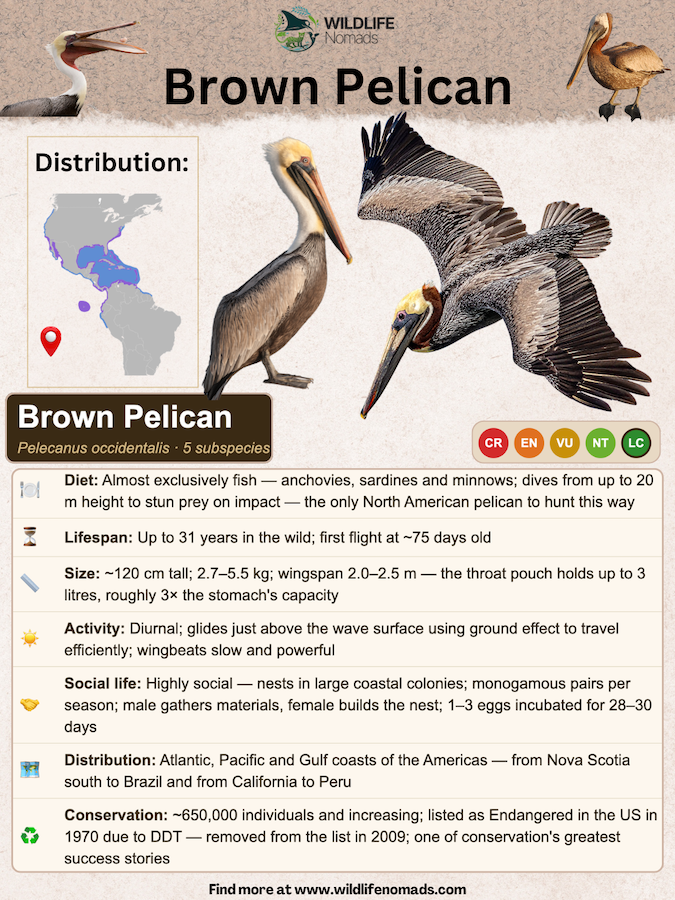
The scientific name for brown pelican is Pelecanus occidentalis. Eight pelican species exist worldwide, and this is the smallest of them. That word “smallest” does a lot of quiet lying.
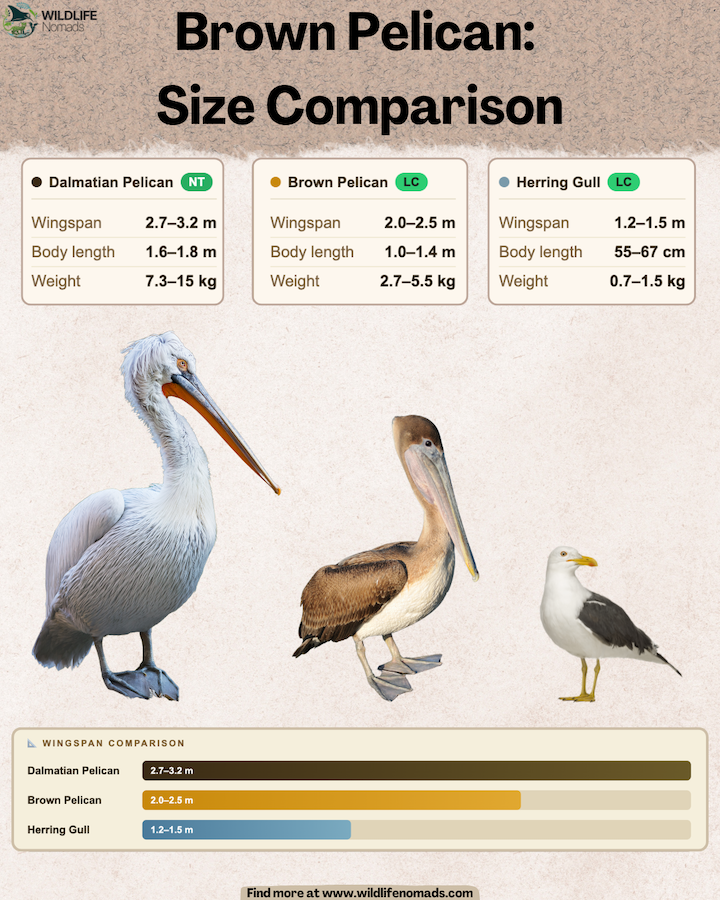
Adult brown pelicans weigh between 2,000 and 5,000 g, roughly 4.5 to 11 pounds. They stand about a meter tall. Compared with the American white pelican, which can top 10–20 lbs (4.5–9 kg), they are slightly smaller and far more compact. Males run about 15 to 20% heavier than females.
Stand one next to a gull and the scale lands. My first encounter as a kid felt like watching a pterodactyl clock out for lunch. If you enjoy that feeling, our roundup of the largest big birds covers the heavyweights.
2. That Wingspan Measures About Two Meters
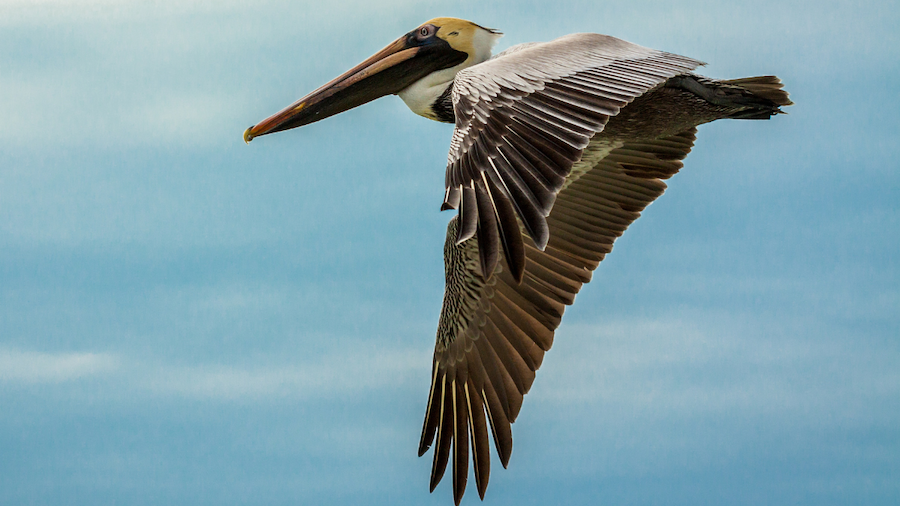
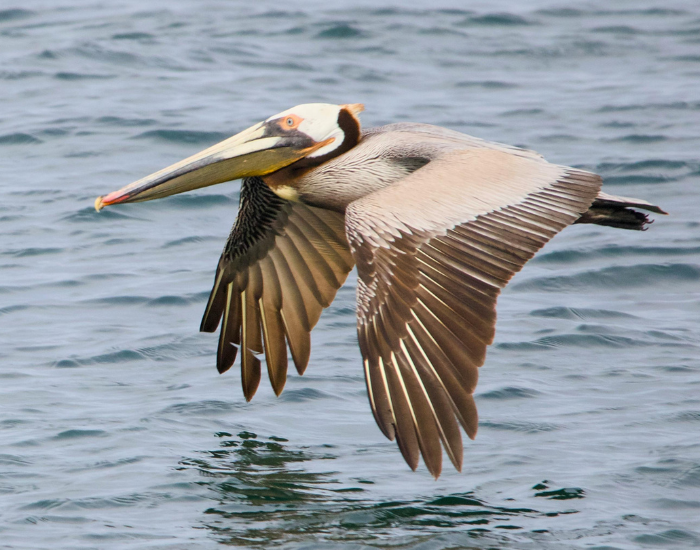
The brown pelican wingspan reaches roughly 2 meters, about 6.5 to 7.5 feet. Those broad wings are built for gliding, not flapping. Watch a brown pelican in flight and you’ll notice how rarely it beats them.
Pelicans often travel in a loose V formation, single file, inches off the sea. For years, birders assumed this was simple ground effect, a cushion of compressed air near the surface. Research published in Movement Ecology in 2021 showed something better.
Stokes and Lucas found that pelicans exploit updrafts from moving swell, a behavior they called wave-slope soaring. Under typical ocean conditions, the energy savings reach 60 to 70% over ground-effect flight alone. In good swell, the birds can offset nearly all their transport cost. They are, effectively, surfing air.
3. They Dive From Up to 21 Meters and Survive It
Here’s the fact that made me a pelican person. Brown pelicans dive headfirst. They launch from heights of 18 to 21 m, roughly 60 to 70 feet. Most dives happen much lower, between 3 and 10 meters. The high ones are spectacular.
The bird twists left just before impact, which likely protects its trachea and esophagus. Air sacs beneath the skin of the breast absorb the blow like packing foam. Then it pops back to the surface, cork-style, and drains.
Interestingly, this is essentially the only pelican that hunts this way. Other pelicans, including the American white pelican, herd fish cooperatively while swimming. The closely related Peruvian pelican of South America shares the plunge-diving technique, and, unsurprisingly, shares an ancestor.
4. The Throat Pouch Holds Water, Not Fish
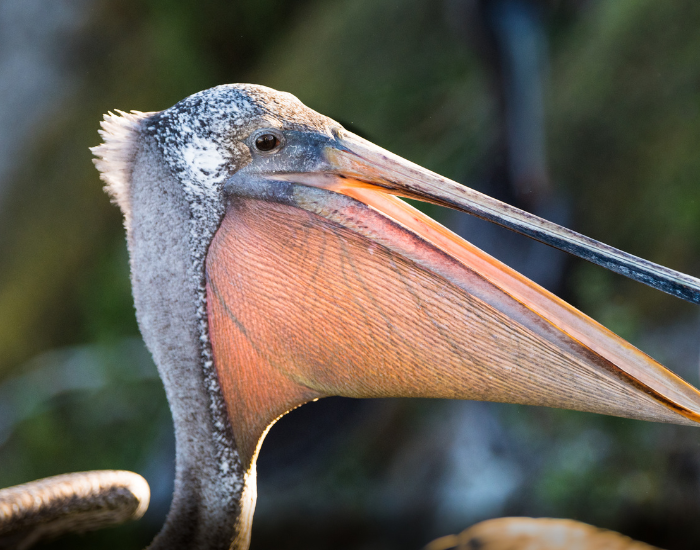
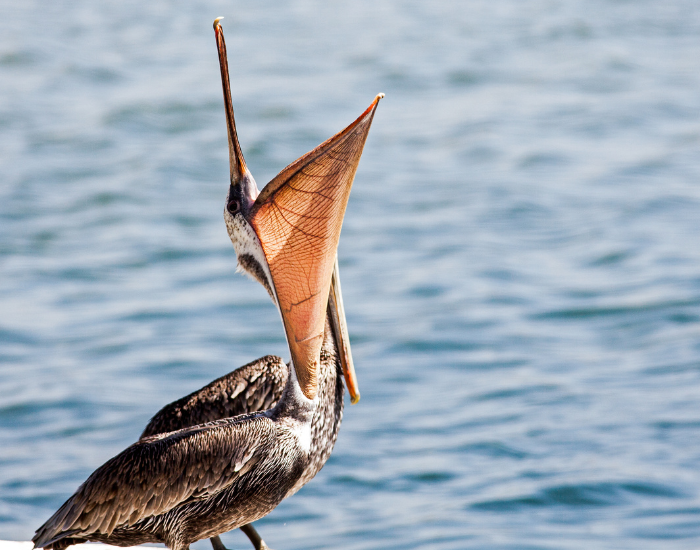
This is the misconception I correct most often. That expandable throat pouch is not a lunchbox. It’s a net.
The pouch scoops up to about 11 liters of seawater along with the catch. The pelican first drains that water out of the sides of its bill. Those few seconds leave the bird vulnerable. Laughing gulls have learned this exactly, they perch on a pelican’s head and steal fish mid-drain.
Only then does the bird swallow. Nothing gets stored in there. The long, dark bill and the pouch work as one filtering tool. Pelicans swallow fish whole and head-first.
5. Brown Pelican Food: About Four Pounds of Fish a Day
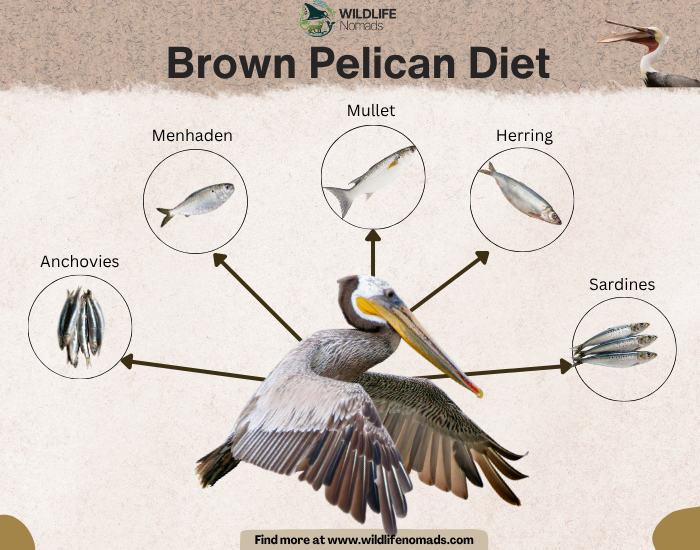
An adult brown pelican requires roughly four pounds of fish daily. That’s a serious grocery bill for a bird that hunts one dive at a time.
The seabird diet leans almost entirely on small schooling fish near the water’s surface. Northern anchovies and Pacific sardines dominate on the Pacific coast, with Pacific mackerel filling gaps. Menhaden and mullet do the same work on the Atlantic and Gulf coasts. Brown pelicans feed opportunistically, but they need density, scattered fish don’t pay for the dive.
That dependence matters enormously. Because food availability drives everything else, brown pelicans function as living indicators of ocean health. When the food supply thins, the colonies tell you first.
6. They Drink Seawater and Filter Out the Salt
Seabirds solved a problem mammals never did. Brown pelicans possess specialized salt glands above the eyes that filter excess salt out of seawater.
The concentrated brine runs down grooves on the bill and drips off the tip. I’ve watched it from a panga off Oaxaca. A slow, steady drip from a bird weeks removed from fresh water. It looks like a runny nose and works like a kidney.
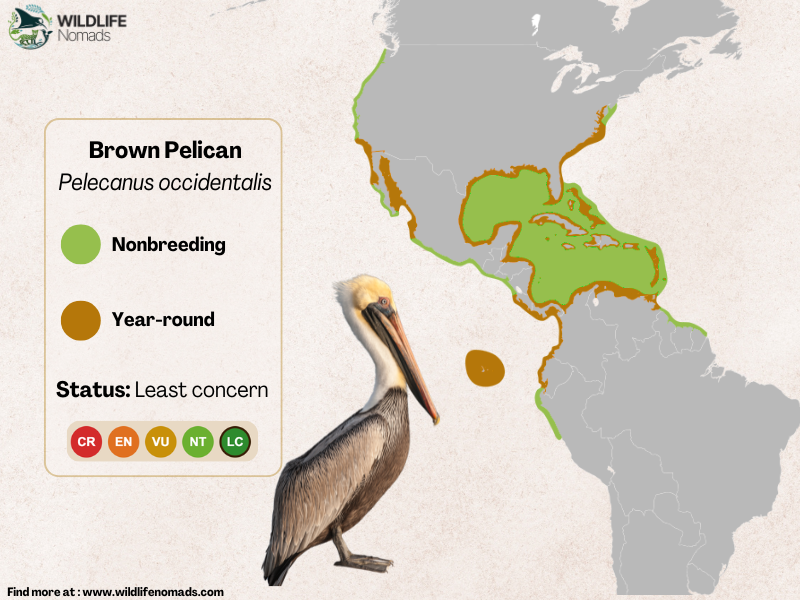
7. Brown Pelican Habitat Runs From New Jersey to the Amazon
Brown pelicans inhabit the Atlantic, Gulf, and Pacific coasts of the Americas. On the Atlantic coast, the breeding range stretches from roughly New Jersey and Maryland south through the Caribbean. On the Pacific side it runs from California to northern Peru. Southward, birds turn up near the mouth of the Amazon River.
They are typically found in shallow waters near salty bays, estuaries, and beaches. They roost on rocks, cliffs, piers, jetties, and sandy beaches. Unlike albatrosses, brown pelicans rarely venture more than 30 kilometers from the coast and almost never cross the open sea.
The non-breeding range shifts north in late summer and early fall. California brown pelicans disperse as far as British Columbia after nesting. Show up at a Pacific coast pier in September. You’ll find large groups loafing where none sat in April.
8. Breeding Plumage Turns the Head Into a Field Guide
Brown pelican characteristics change with the calendar, which makes ageing and dating a colony surprisingly easy. Adult brown pelicans carry gray-brown feathers, a pale yellow head, and a white neck for most of the year.
Then breeding season arrives. The white neck darkens to a rich dark brown or chestnut. Meanwhile the yellowish white crown brightens and the throat pouch flushes red or blackish. Eastern brown pelicans and California brown pelicans differ here. The California race shows a scarlet pouch, the eastern one a darker olive.
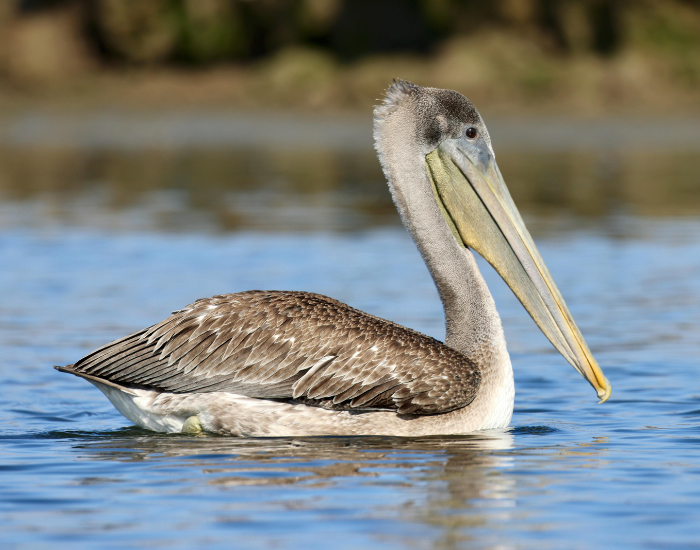
Immature birds skip the drama entirely. Young pelicans wear uniform brown above with a pale belly and no white head at all. They take three to five years to reach the adult look.
9. Nesting Colonies Sit on Islands You’ll Never Visit
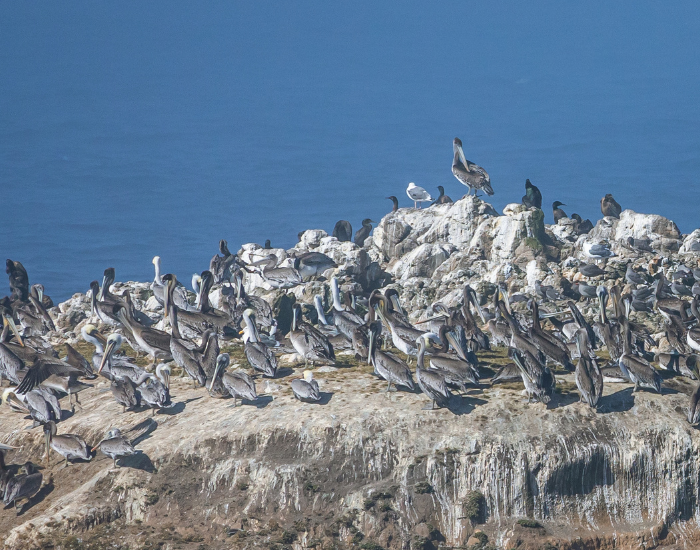
These are intensely social birds. They nest in large colonies on isolated coastal islands. Think Channel Islands National Park and the Santa Barbara islands, plus barrier islands across the Gulf coast.
Isolation is not aesthetic. It’s the whole strategy. Island nesting sites keep mammalian predators out, and pelicans abandon nest attempts readily when disturbed. Human disturbance ranks among the top causes of colony failure. Therefore access to most nesting colonies stays restricted.
Nesting season peaks during March and April in California. I’ve surveyed colonies from a boat at 200 meters with a scope, and that’s the correct distance. Getting closer gets chicks killed.
10. Brown Pelicans Incubate Eggs With Their Feet
Brown pelicans typically lay 2 to 3 chalky white eggs per clutch. They have no brood patch. Instead, both parents wrap their large webbed feet over the eggs. Blood vessels in that skin pump the heat through.
Incubation lasts 28 to 30 days. Chicks hatch naked and helpless, and both parents feed them regurgitated fish. Fledging occurs about 63 days after hatching for ground nests, and closer to 74 days for birds raised in mangroves.
That foot-incubation habit carries a grim historical footnote. DDE-thinned eggshells cracked under the parents’ own weight, which is how a pesticide turned normal parenting into nest failure.
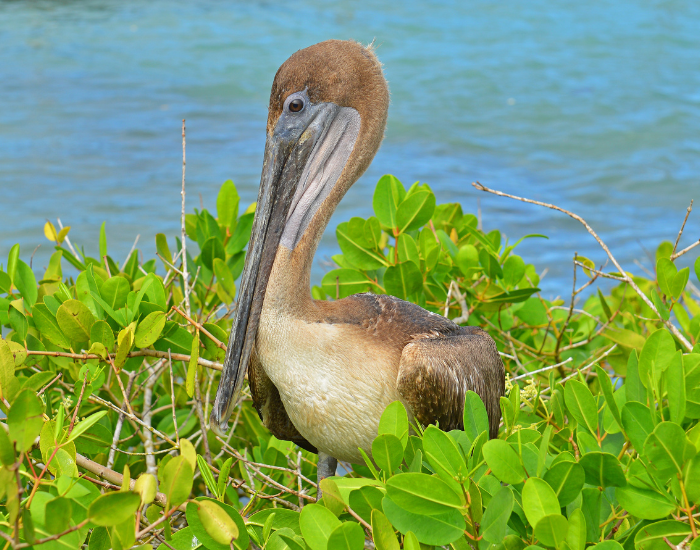
11. Their Guano Builds the Islands They Nest On
Seabird nesting habits drive nutrient cycling, and pelicans are prolific contributors. Colonies import nitrogen and phosphorus from the ocean and deposit them on land as guano. Those soils would otherwise stay nearly sterile.
The effect is measurable. A 2014 PLOS ONE study in northern Peru documented the result. Seabird nutrient subsidies altered tree recruitment and species composition in coastal dry forests. Marine nitrogen ends up in leaves, insects, and lizards. The colony fertilizes an entire terrestrial food web.
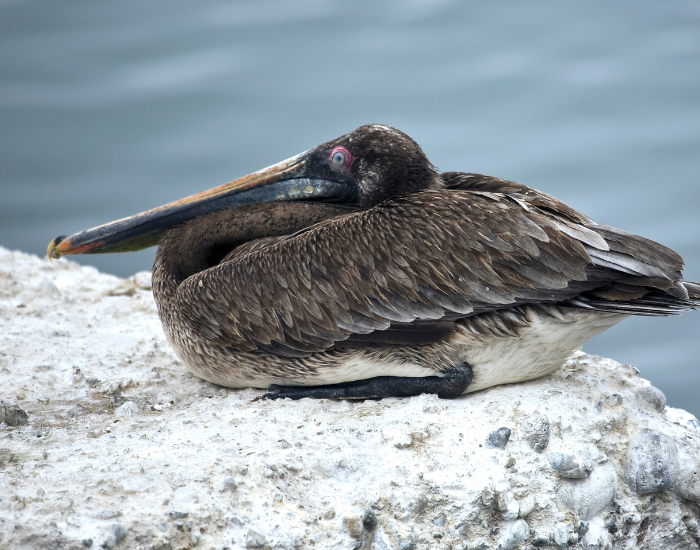
12. From the Endangered Species List to a Remarkable Recovery
The pesticide DDT nearly ended this species. Runoff concentrated up the seabird diet and DDE thinned eggshells. Louisiana (the Pelican State) lost its entire breeding population by the early 1960s. Blus and colleagues nailed the mechanism in BioScience in 1971.
Brown pelicans were listed as endangered from 1970 to 2009, most of that time under the Endangered Species Act. After the U.S. banned DDT in 1972, colonies rebounded steadily. Decades of colony counts, including classic surveys published in the Wilson Bulletin, tracked the climb. Long-term survey data indicate brown pelican populations increased by roughly 68% per decade.
At full delisting in 2009, the U.S. Fish and Wildlife Service put the global population near 650,000 birds. Partners in Flight currently estimates about 370,000 breeding individuals — a narrower measure of the same remarkable recovery. The IUCN now rates the species as least concern.
That said, threats haven’t vanished. Pollution and overfishing remain the main pressures. Warmer waters have repeatedly collapsed anchovy and sardine stocks off California. Channel Islands colonies then suffered near-total losses of breeding success between 2012 and 2014. Deepwater Horizon struck the Gulf coast five months after delisting. Recovery, it turns out, is a verb.
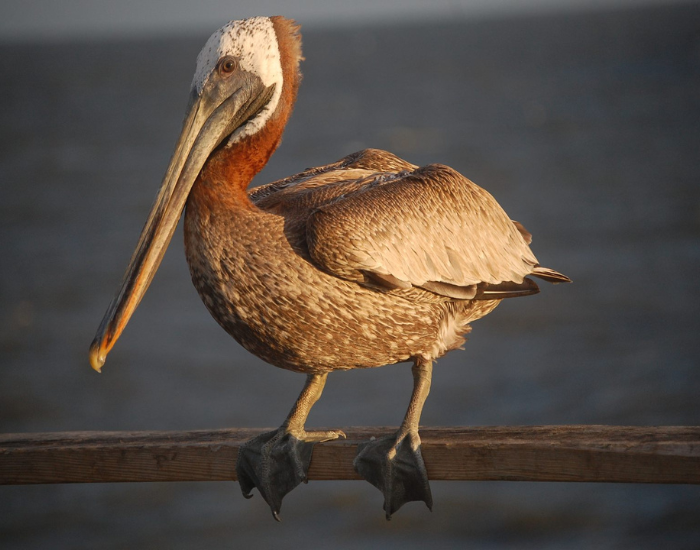
Frequently Asked Questions
Brown pelicans nest in colonies on isolated coastal islands that people rarely reach. Chicks never leave the nesting site until they can fly. By the time young pelicans appear on piers and beaches, they are full-sized immature birds in plain brown plumage. Most people assume they’re seeing small adults. They aren’t — they’re juveniles that simply haven’t grown their white head yet.
Pairs form each breeding season, with nesting peaking in March and April. Females lay 2 to 3 eggs, and both parents incubate them under their webbed feet for 28 to 30 days. Chicks fledge at roughly 63 days and depend on their parents for about two more weeks. Brown pelicans reach sexual maturity at 3 to 5 years old.
There’s no single official term, but four collective nouns are widely used and each describes a different behavior. A squadron flies in formation, a pod travels together, a pouch nests together, and a scoop feeds together. “Squadron” fits best when you watch pelicans in V formation along a coastline.
Brown pelican food consists almost entirely of small schooling fish taken near the surface. Northern anchovies, Pacific sardines, Pacific mackerel, menhaden, and mullet all qualify. An adult needs about four pounds of fish per day. They also take some crustaceans and, at fishing piers, human handouts. That last habit causes hook and line injuries, so please don’t feed them.
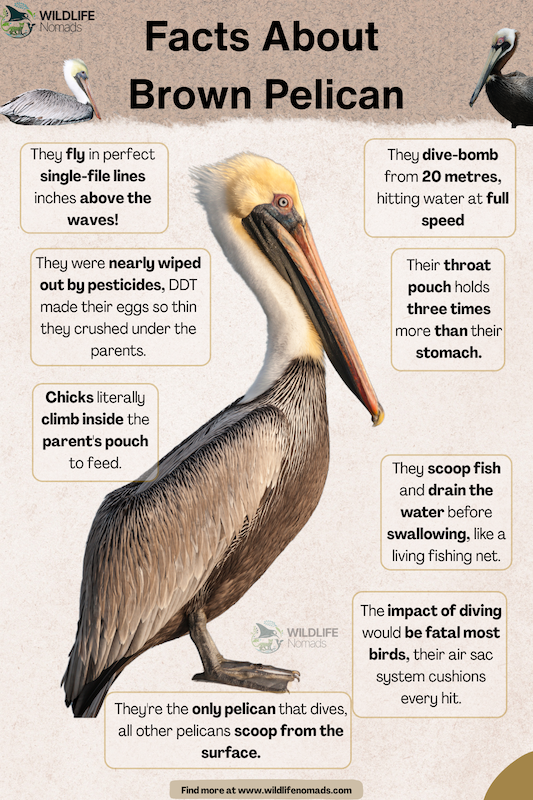
Watch the Dive Yourself
Strip away the guano and the taxonomy, and the brown pelican tells one clear story. Its fortunes rise and fall with the fish beneath it. Fix the ocean and the pelican fixes itself, the 1972 DDT ban proved that in under four decades.
So go watch one. Find a pier on the Atlantic, Gulf, or Pacific coast an hour before sunset. Then wait for the fold and the drop. It costs nothing and it never gets old.
If you want more coastal birds, our guide to seabirds you must know is the natural next stop. For scale, see how they compare with albatrosses, the true open-ocean specialists. Or with the types of seagulls that steal their fish.
Brown Pelican: Fact or Fiction? 🐦
Ten statements about the coast’s most spectacular diver — five true, five myths. Can you tell them apart?
Fact or Fiction?
References:
Anderson, D. W., et al., (2017). Brown Pelicans, Pelecanus occidentalis californicus (Aves: Pelecanidae): Five decades with ENSO, dynamic nesting, and contemporary breeding status in the Gulf of California. Ciencias Marinas, 43(1), 1–34. https://doi.org/10.7773/cm.v43i1.2710
Havik, G., Catenazzi, A., & Holmgren, M. (2014). Seabird nutrient subsidies benefit non-nitrogen fixing trees and alter species composition in South American coastal dry forests. PLOS ONE, 9(1), e86381. https://doi.org/10.1371/journal.pone.0086381
Jaques, D. L., Mills, K. L., Selby, B. G., Veit, R. R., & Ziccardi, M. H. (2019). Use of plumage and gular pouch color to evaluate condition of oil spill rehabilitated California brown pelicans (Pelecanus occidentalis californicus) post-release. PLOS ONE, 14(2), e0211932. https://doi.org/10.1371/journal.pone.0211932
Mignucci-Giannoni, A. A., Escobar-Torres, S. M., Cabrias-Contreras, L. J., Jiménez-Rivera, S., Pagán-Benítez, Y., Rafols-Segarra, R. R., Rivera-Marchand, B., Rivera-Pérez, C. I., & Richardson, D. L. (2025). Sexual dimorphism in Brown Pelicans (Pelecanus occidentalis) from Puerto Rico: Biometric evidence corroborated by molecular and necropsy techniques. Waterbirds, 48(2). https://doi.org/10.1675/063.048.0207
Stokes, I. A., & Lucas, A. J. (2021). Wave-slope soaring of the brown pelican. Movement Ecology, 9, 13. https://doi.org/10.1186/s40462-021-00247-9