During my bachelor’s degree, I had to build an entomology collection. My classmates and I spent long nights in the lab pinning and identifying insects. We sorted beetles, moths, the odd wasp, and drawer after drawer of common bees like the honeybee.
That lab doubled as a biological collection, and my professor was a bee specialist. Right beside the trays of shimmering green bees sat something even stranger to me: rows of blue bees, glinting like tiny chips of metal. I had no idea blue bees were real. Slowly, painfully, my friends and I learned to tell them apart while helping with their thesis work.
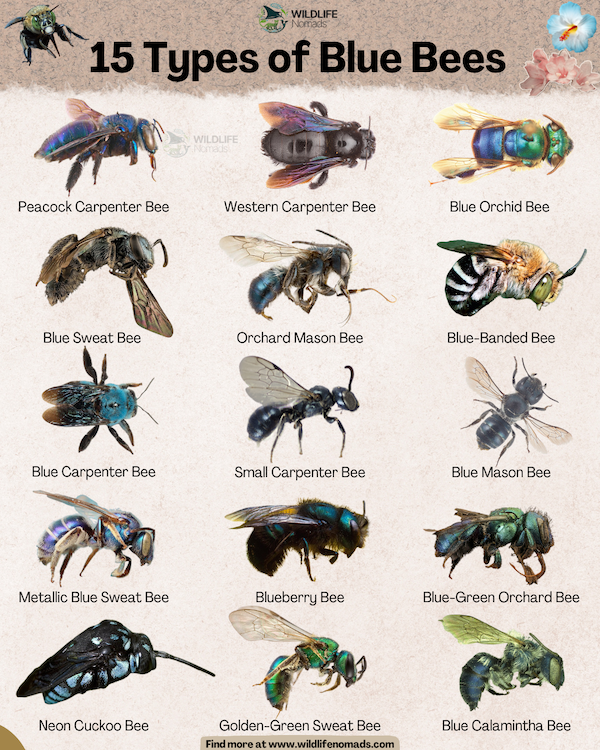
Blue bees are real, and they are everywhere. Most people walk right past these metallic pollinators without noticing. That said, once you learn the field marks, you cannot unsee them. Blue bees refer to several distinct species known for metallic blue coloration. Below are 12 blue bees you are most likely to meet, plus the iconic ones worth traveling for. You will learn how to identify each, where it lives, and how it behaves.
What Makes a Bee Blue?
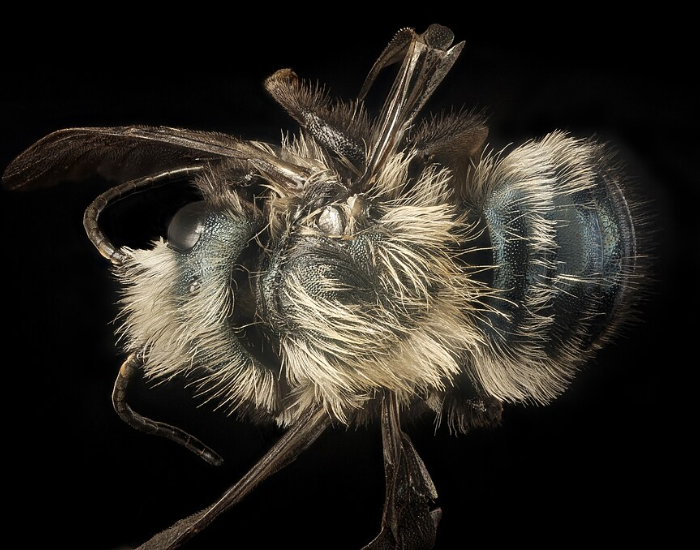
Here is the first thing I tell people: no bee makes a blue pigment. Their blue coloration results from structural coloration or blue-colored hairs. Microscopic ridges on the body scatter light and bounce back blue, the same trick a morpho butterfly uses.
Turn the bee a few degrees and the blue shifts to green or violet. That flicker is your best field mark. Interestingly, most blue bees are less aggressive compared to other native bees, so you can lean in close and watch without much drama.
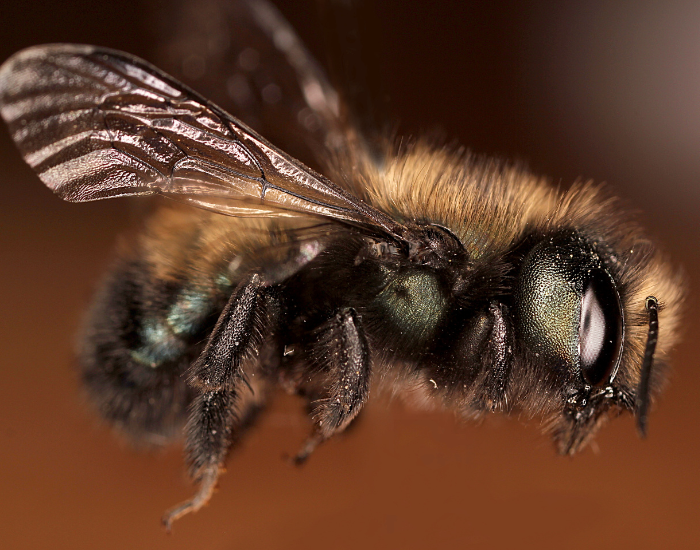
1. Blue Orchard Bee (Osmia lignaria)
If you meet one blue bee in your life, it will probably be this one. The blue orchard bee is a solitary, cavity-nesting mason bee native to North America, and it is a pollination powerhouse. I keep a block of nesting reeds by my garden, and watching the females seal each chamber with a tidy mud wall never gets old.
Blue orchard bees are proven pollinators of tart cherry, apple, and almond. They collect pollen dry under the abdomen rather than packing it wet on their legs like honey bees do. That messy, dusty belly is exactly why they move so much pollen between flower buds.
This species has one generation per year and forages roughly February through May. Remarkably, blue orchard bees can forage at temperatures as low as 54°F (12°C), long before honey bees leave the hive on a cold spring morning.
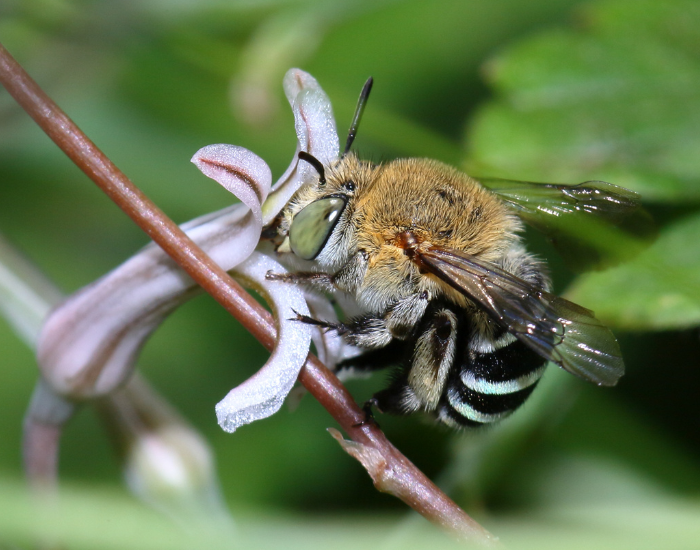
2. Blue-Banded Bee (Amegilla cingulata)
The blue-banded bee is Australia’s showstopper, and it earned Insect of the Year honors there for good reason. It is known for vibrant blue stripes across its black abdomen, with big green eyes and golden fluff. Males carry five bands; females wear four.
These are solitary ground-nesters, each female digging her own burrow in soil or soft rock. They perform buzz pollination, gripping a flower and vibrating their flight muscles to shake pollen loose. As a result, blue-banded bees can pollinate up to 30% of Australian crops, including greenhouse tomatoes, blueberries, and chillies.
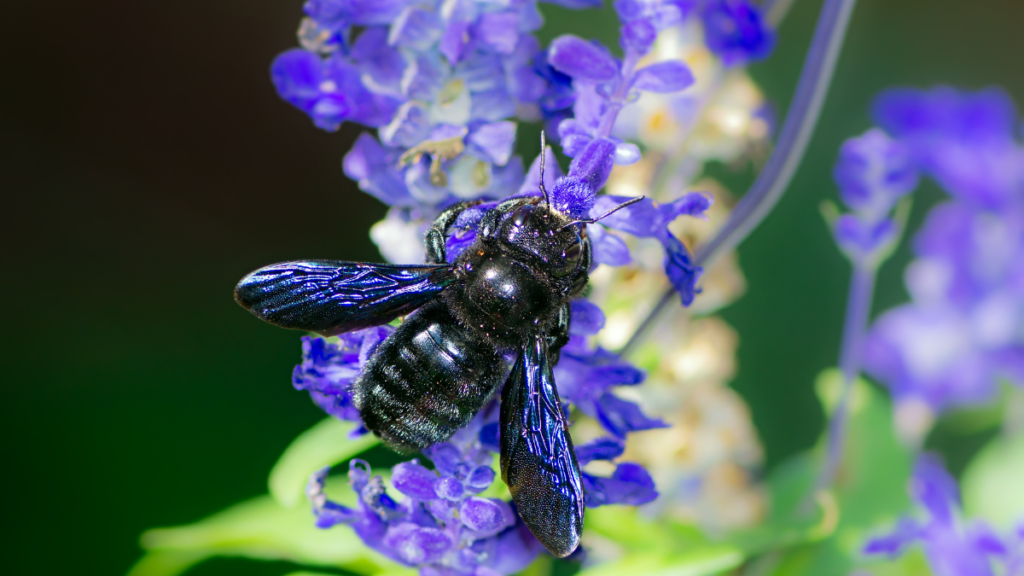
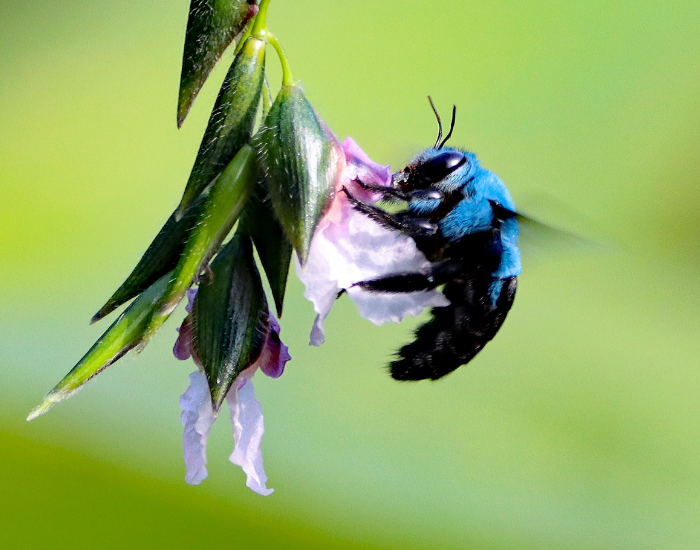
3. Blue Carpenter Bee (Xylocopa caerulea)
Now for something you travel for. The blue carpenter bee of Southeast Asia is huge, roughly an inch long, and dusted in powder-blue fuzz across the thorax. The first time one cruised past my head in Thailand, I mistook it for a beetle.
Females wear the striking blue; males look browner and greener. Despite the intimidating size, they are gentle and rarely sting. They chew narrow holes into dead wood to raise their brood, giving carpenter bees their common name.
4. Small Carpenter Bee (Ceratina)
By contrast, these are the blue bees hiding in plain sight in your own garden. Ceratina are tiny, nearly hairless, and shine dark metallic blue in the sun. Most people mistake them for flies until they land.
Instead of tunneling wood, they nest in the pith of broken stems. If you cut back a raspberry cane and see a bee peering out, that is likely a small carpenter bee guarding her eggs. Leaving a few hollow stems standing is the easiest way to host them.
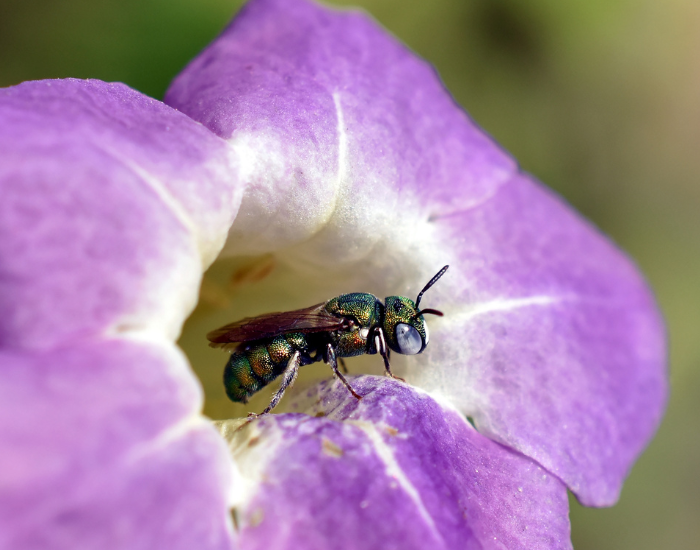
5. Blue Mason Bee (Osmia caerulescens)
The blue mason bee lives up to its name with a deep blue-black metallic sheen. Native to Europe and now established across parts of North America, it belongs to the same helpful group of mason bees as the blue orchard bee.
Like its cousins, it is solitary and builds brood cells with chewed leaf paste rather than mud. I find them most often on legumes and herbs, working steadily through the late spring and early summer bloom.
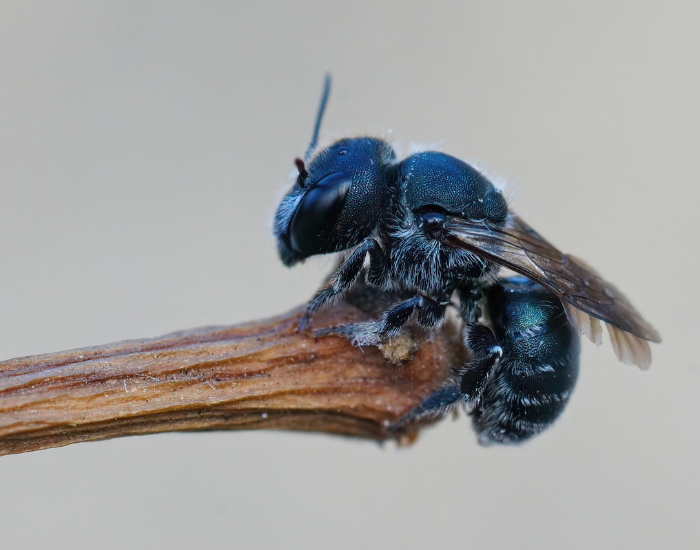
6. Metallic Blue Sweat Bee (Augochloropsis metallica)
Sweat bees get a bad rap, and yes, they land on your arm for the salt. But Augochloropsis metallica is a jewel, flashing brilliant blue-green in the right light. It measures under half an inch, so most people never look closely enough to notice.
These bees nest in the ground and visit an enormous range of wildflowers. Their robust presence signals a healthy, balanced local native environment, which is why I always note them when surveying a meadow.
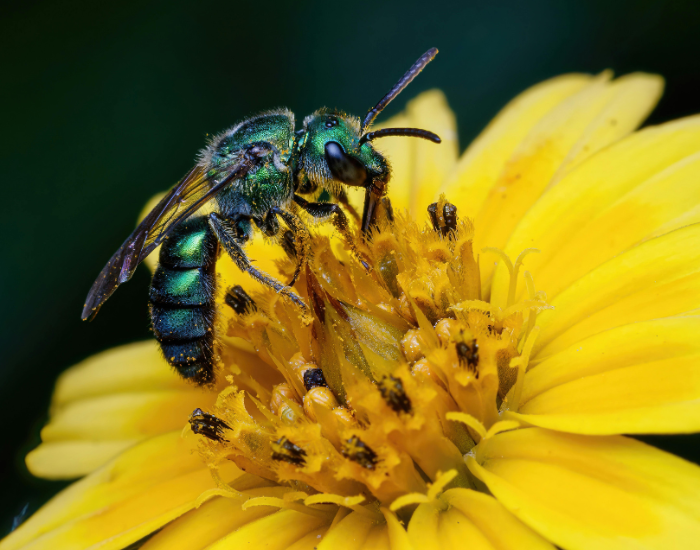
7. Mahonia Bee (Osmia ribifloris)
The blueberry bee is a blue-tinged mason bee native to western North America, from Oregon down into Mexico. It is sometimes managed commercially, and the reason is buzz pollination. Blueberry flowers hold their pollen inside tube-shaped anthers that only release under vibration.
Honey bees cannot do this. A blueberry bee can, sonicating each flower to spill the pollen. For blueberry growers, that skill turns a modest fruit set into a bumper crop.
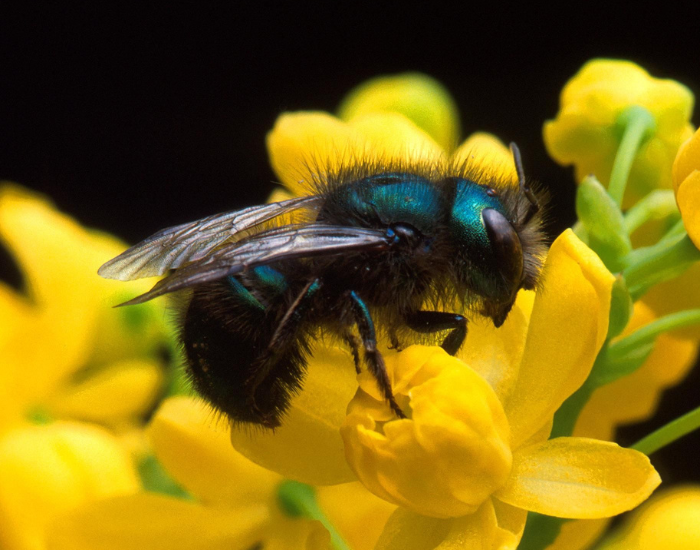
8. Blue-Green Orchard Bee (Osmia aglaia)
Head to the Pacific Northwest and you may find Osmia aglaia, a stunning blue-green mason bee that specializes in berries. Raspberry and blackberry growers love it. I spent a soggy Oregon afternoon watching one work a bramble patch, ignoring the drizzle entirely.
Like other mason bees, it is solitary and gentle, and it emerges to match the exact window when its favorite flowers bloom. That tight timing is a small miracle of evolution.
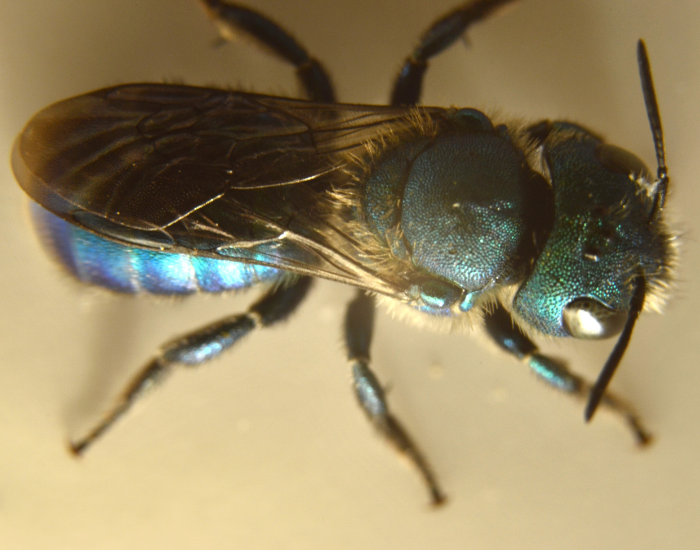
9. Neon Cuckoo Bee (Thyreus nitidulus)
Some blue bees cheat. The neon cuckoo bee wears dazzling electric-blue spots, but it never builds a nest or gathers pollen for its own young. Instead, it is a brood parasite of the blue-banded bee.
The female sneaks into a host burrow and lays her egg. When her larva hatches, it kills the host larva and eats the stored pollen. Cruel, yes, but a healthy population of cuckoo bees actually means the host bees are thriving too.
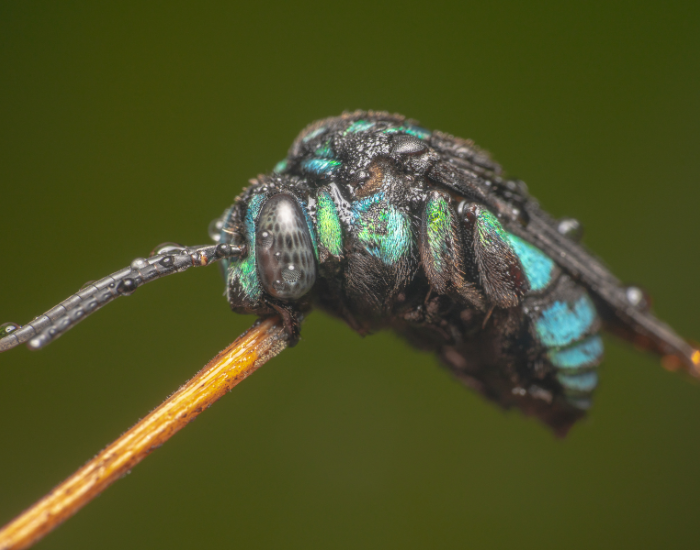
10. Deep-Blue Sweat Bee (Lasioglossum coeruleum)
Unlike sweat bees that only show blue in certain light, Lasioglossum coeruleum is a true metallic blue species native to eastern North America. So blue that it is frequently mistaken for a mason bee, these tiny pollinators nest in rotting wood and carry a deep cobalt-to-teal sheen across their entire body.
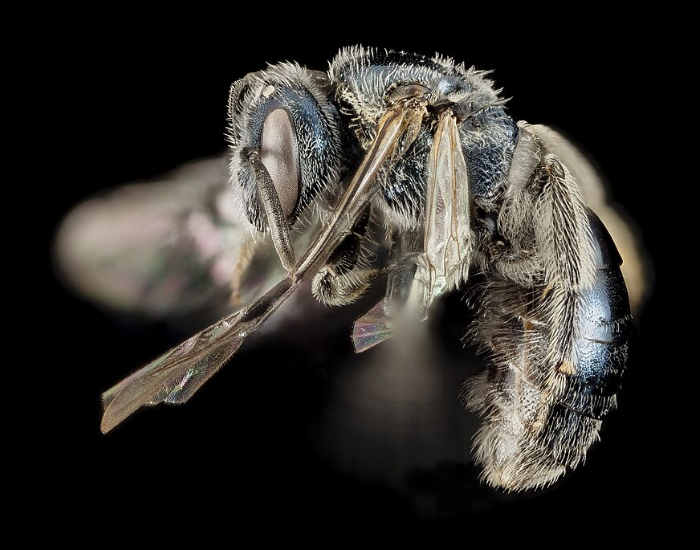
11. Blue Calamintha Bee (Osmia calaminthae)
Here is a blue bee genuinely worth a plane ticket. The blue calamintha bee is a rare mason bee known from just two small patches of Florida scrub. For years, scientists feared it was gone.
Then a 2020 survey rediscovered it, bobbing its head against the anthers of its host plant, Ashe’s calamint, to gather pollen in a bizarre bouncing motion. It is a reminder that even well-studied places still hide their secrets. If conservation work protects that scrub, this tiny blue bee may just hang on.
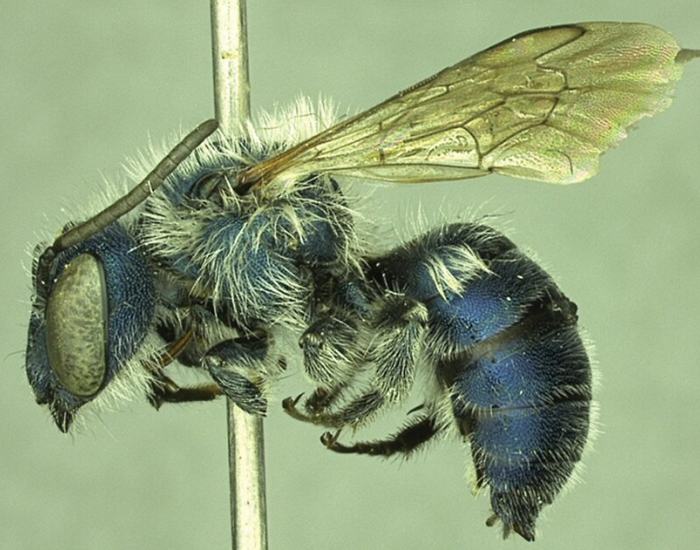
12. Blue-Black Mason Bee (Osmia texana group)
I will finish with a humbler species that fooled me for years. Several western mason bees, like those in the Osmia texana group, carry a bluish-black head and thorax that only reveals its color under strong sun. In the shade they look plain black.
The females pack dense pollen-collecting hairs on the underside of the abdomen, so a foraging female often looks like she is wearing a golden apron over a blue body. It is a perfect example of why you should never trust a quick glance in the field.
Plant Blue Bees Love: False Blue Indigo (Baptisia australis)
If you want blue bees in your yard, grow the plant that draws them. False blue indigo, also called blue false indigo, blue wild indigo, or Baptisia australis, is a tough native perennial that native bees adore. It throws up spikes of deep blue-violet flowers in late spring and early summer, then forms dramatic black seed pods that add winter interest.
Native Americans once used related true indigo species for dye, and the “false” name simply means it substituted for that trade plant. Give it full sun and it becomes almost unkillable. It is famously drought tolerant, self seeding once happy, and long-lived, forming a shrub-like mound that returns bigger every year. Because bumble bees and other native bees buzz pollinate its blooms, a single mature Baptisia can hum with activity all June.
FAQs about Blue Bees!
Most blue bees can sting but rarely do. They are solitary, so they have no hive to defend, which makes them far calmer than honey bees or wasps. Males cannot sting at all. I handle blue orchard bees regularly and have never been stung.
No. Unlike honey bees, blue bees do not produce surplus honey. Solitary species like mason and carpenter bees provision each brood cell with a pollen-and-nectar loaf for a single larva, then move on. Their value is pollination, not honey, and on that front they often beat honey bees flower for flower.
They are elite orchard pollinators. Blue orchard bees increase cherry fruit set by about 15%, and co-deploying them alongside honey bees can cut honey bee stocking needs roughly in half. They also reproduce well in cherry orchards, with more than 50% female return in good sites, so growers can build their own population over time.
Yes. Baptisia australis is a long-lived perennial that returns every spring for decades once established. Cut the dead stems back to the ground in late fall or early spring before new shoots emerge. To get more plants started from its hard seeds, nick or soak them in hot water and give them a cold period to improve germination.
Healthy ecosystems depend on diverse pollinator species, not a single managed one. Blue bees fill gaps that honey bees leave, especially through buzz pollination on tomatoes, blueberries, and other crops. A yard full of native bees is a genuine sign of ecological health.
The Takeaway
Blue bees prove that some of the most beautiful animals on Earth are living in the cracks of a sidewalk or the stems of a raspberry cane. Learn the metallic flicker, and a whole hidden world opens up on your next walk. Plant some false blue indigo, leave a few hollow stems standing, and let the blue bees find you.
Then go look. Crouch by a flowering shrub this spring and watch for that flash of blue. If you spot one, tell me in the comments which species you found. And if you want more of these overlooked pollinators, my guide to green bees is the perfect next stop.
Can You Name That Blue Bee? 🐝
A 12-photo identification challenge — the wrong answers are deliberately tricky look-alikes from the same group. These jewel-toned bees fool everyone at first. Go back and change any answer before you score.
Which blue bee is this?
References:
Bosch, J., & Kemp, W. P. (2002). Developing and establishing bee species as crop pollinators: The example of Osmia spp. (Hymenoptera: Megachilidae) and fruit trees. Bulletin of Entomological Research, 92(1), 3–16. https://doi.org/10.1079/BER2001139
Boyle, N. K., & Pitts-Singer, T. L. (2019). Assessing blue orchard bee (Osmia lignaria) propagation and pollination services in the presence of honey bees (Apis mellifera) in Utah tart cherries. PeerJ, 7, e7639. https://pmc.ncbi.nlm.nih.gov/articles/PMC6732208/
Boyle, N. K., Pitts-Singer, T. L., & Boyle, T. J. (2020). Wildflower plantings promote blue orchard bee, Osmia lignaria (Hymenoptera: Megachilidae), reproduction in California almond orchards. Ecology and Evolution, 10(6), 3061–3072. https://doi.org/10.1002/ece3.5952
De Luca, P. A., & Vallejo-Marín, M. (2013). What’s the “buzz” about? The ecology and evolutionary significance of buzz-pollination. Current Opinion in Plant Biology, 16(4), 429–435. https://doi.org/10.1016/j.pbi.2013.05.002
Vallejo-Marín, M. (2019). Buzz pollination: Studying bee vibrations on flowers. New Phytologist, 224(3), 1068–1074. https://doi.org/10.1111/nph.15666
Cane, J. H. (2008). A native ground-nesting bee (Nomia melanderi) sustainably managed to pollinate alfalfa across an intensively agricultural landscape. Apidologie, 39(3), 315–323. https://doi.org/10.1051/apido:2008013