

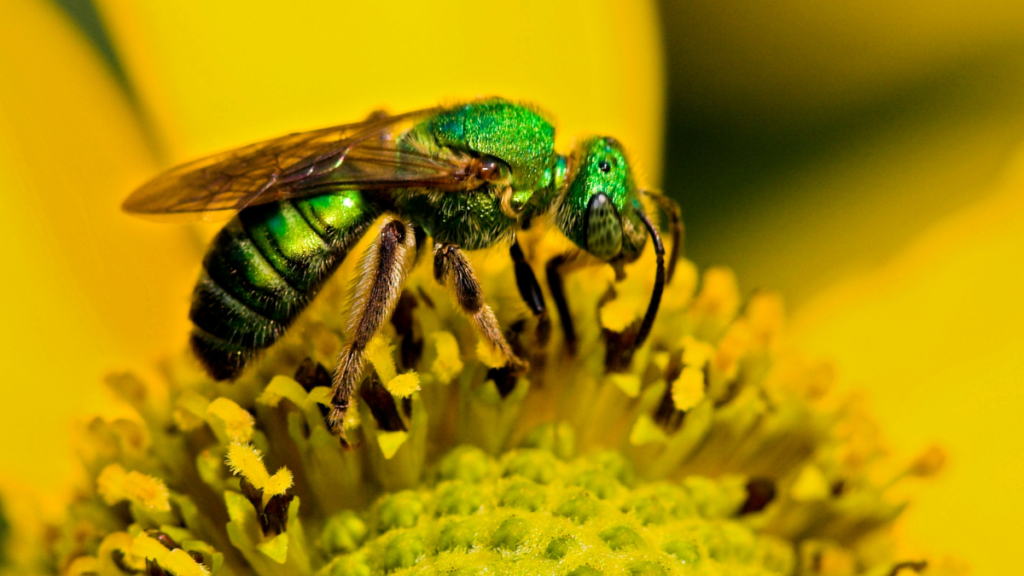
During my bachelor’s degree, I had to build an entomology collection. My classmates and I spent long nights in the lab pinning and identifying insects. We sorted beetles, moths, the odd wasp, and drawer after drawer of common bees like the honeybee.
But that lab doubled as a biological collection, and my professor was a bee specialist. To my shock, the trays held thousands of green bees that all looked identical to me. Slowly, painfully, my friends and I learned to tell them apart while helping with their thesis work.
Green bees are real, and they are everywhere. Most people walk right past these tiny green bees without noticing. That said, once you learn the field marks, you cannot unsee them. Below are the top 12 green bee species you are most likely to meet, plus the most iconic ones worth traveling for. You will learn how to identify each, where it lives, and how it behaves.
What Makes a Bee Green?
The color is not paint. That shiny metallic green or blue-green sheen comes from microscopic light-reflecting structures in the cuticle, not pigment. Physicists call this structural color, and it is the same trick a peacock feather uses.
Most green bees belong to the Halictidae family, the sweat bees. For that reason, people often call them metallic green sweat bees, or simply the green metallic bee. A few emerald species come from other families entirely, and I have included those surprises too.
People search for all kinds of things when they spot one: a bee with a green body, tiny green bees on the patio, even bees with green stripes. Most of those sightings trace back to the dozen species below.
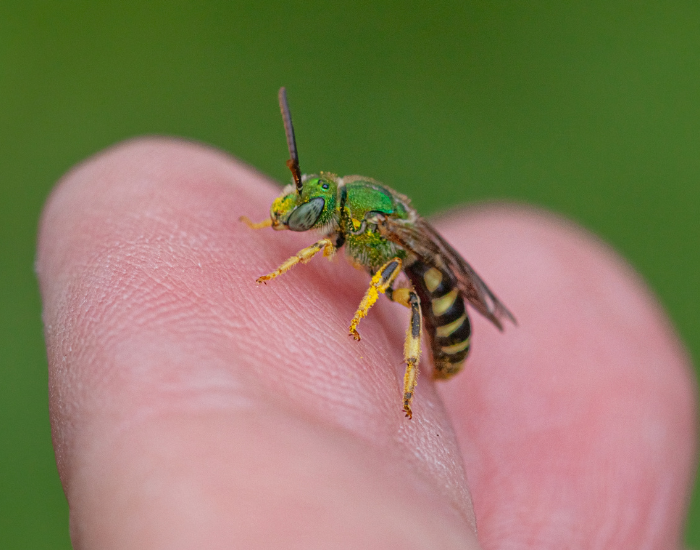
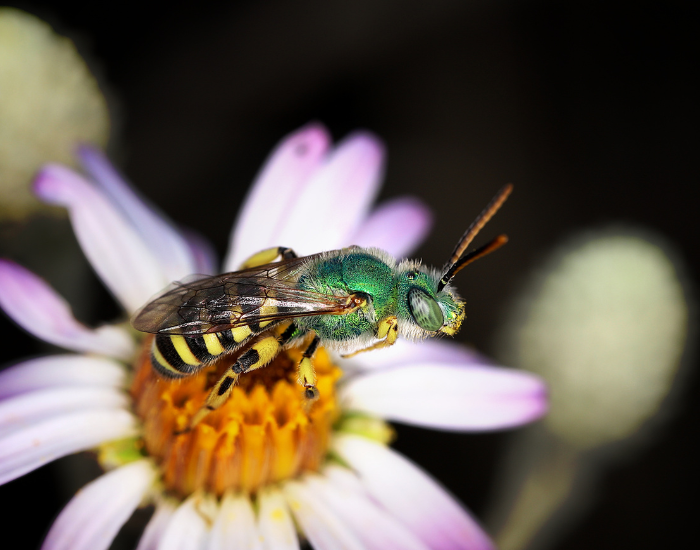
Here is a field mark that saves beginners a lot of grief. In many species, the females are entirely bright metallic green, while the males wear a striped abdomen with black and yellow stripes. Learn that split, and half your identifications get easier.
Green bees matter far beyond their good looks. They contribute significantly to biodiversity and food production across the Americas. As generalist pollinators, they visit a wide range of flowering plants, and they are important pollinators of hundreds of plant species, including agricultural crops like apples.
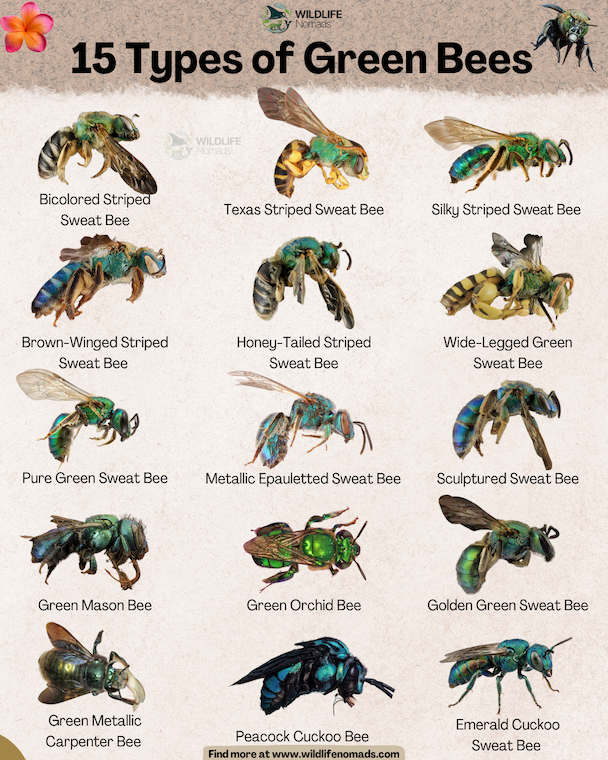
1. Bicolored Striped Sweat Bee (Agapostemon virescens)
This is the poster child for the genus Agapostemon, and my personal favorite. The female shows a brilliant metallic green head and thorax paired with a black-and-white striped abdomen. Males swap in the classic black and yellow stripes. Toronto even named it the city’s official bee.
You will find it across eastern North America, from the Midwest to the Northeast, with sightings coast to coast. It nests underground, and here is the twist: multiple females often share a single burrow entrance. Researchers have watched nestmates take turns guarding the door against parasites while others forage. Each female still lays her own eggs in her own cells.
2. Texas Striped Sweat Bee (Agapostemon texanus)
If you spot a bee that looks like a flying emerald with no stripes at all, this is a strong candidate. The female Agapostemon texanus is entirely green, abdomen included. The male keeps the black-and-yellow striped abdomen, so the sexes look like different animals.
This species is common across the western United States and shows up in gardens constantly. Its thorax is smooth and shining, and the wings stay clear. It is a hardworking generalist that visits flowers of many families for pollen and nectar.
3. Silky Striped Sweat Bee (Agapostemon sericeus)
Few green bee species photograph as beautifully as this one. The female is metallic green with silvery abdominal bands that glisten in direct sun. Her thorax carries an unevenly rough texture that specialists use to nail the identification.
Agapostemon sericeus turns up across the eastern United States, including cool northern states like Vermont. It is a solitary bee, meaning each female builds and provisions her own nest without workers. Watch for it in meadows and old fields during the warm months.
4. Brown-Winged Striped Sweat Bee (Agapostemon splendens)
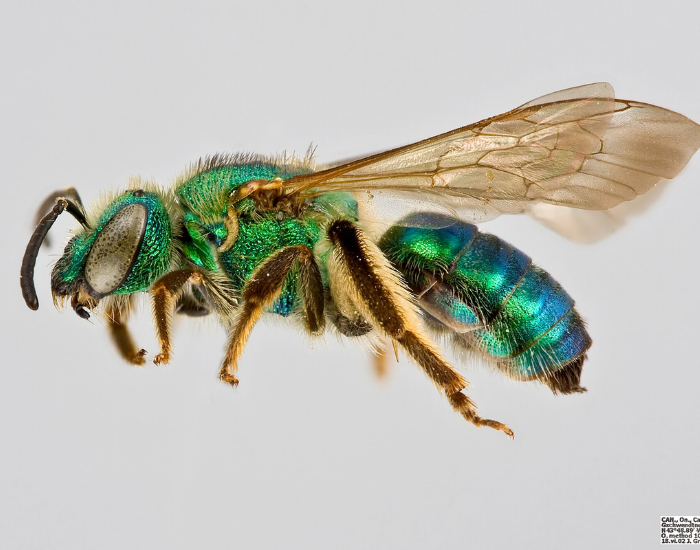
This is the largest of the eastern Agapostemon, and it loves sand. Strongly tied to sandy soils, it digs its burrows where the ground is loose and easy to excavate. Beaches, dunes, and sandy roadsides are prime habitat.
The male stands out with tea-brown wings, a green thorax, and a muscular-looking hind leg. Females carry the metallic green body with pale bands. In addition to being striking, these bees are effective native pollinators of coastal and sandy-habitat wildflowers.
5. Honey-Tailed Striped Sweat Bee (Agapostemon melliventris)
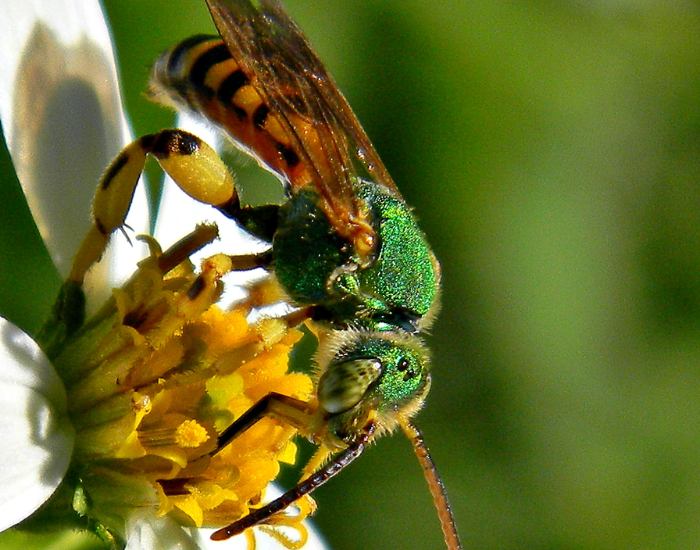
Head to the Southwest and this desert specialist takes over. The female wears white and honey-colored stripes on her abdomen, a warmer look than her cousins. The male keeps the familiar black and yellow stripes. The range runs from New Mexico and Texas west to California and north to Montana.
I have watched these bees work desert blooms in brutal midday heat. They shrug off temperatures that ground other pollinators. Like all Agapostemon, they nest in the ground and prefer stable, easily excavated soil.
6. Wide-Legged Green Sweat Bee (Agapostemon femoratus)
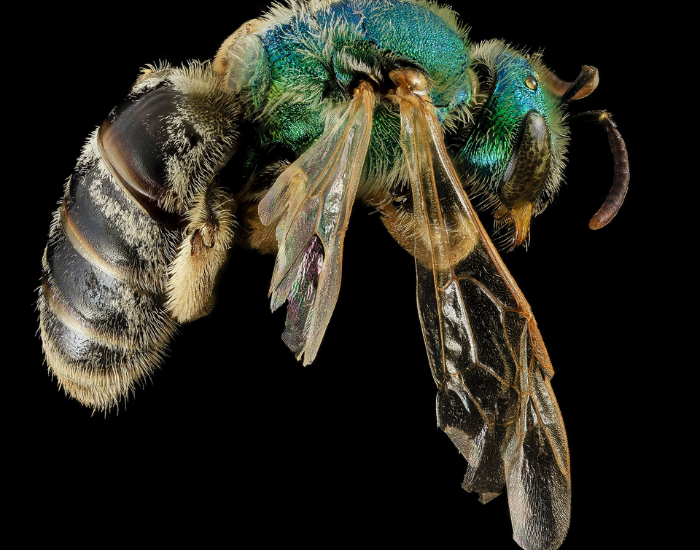
This western green bee earns its name from stout, thickened hind legs. It ranges across arid and semi-arid habitats in the western states, often in the same neighborhoods as A. texanus. Telling small Agapostemon apart is genuinely hard, even for specialists, so do not feel bad if it takes practice.
Agapostemon femoratus shows a strong preference for flowers in the Asteraceae family, the sunflowers and their relatives. Plant native sunflowers and you may well host a colony nearby. There are over 45 species of Agapostemon across the Americas, and this is one of the classic western ones.
7. Pure Green Sweat Bee (Augochlora pura)
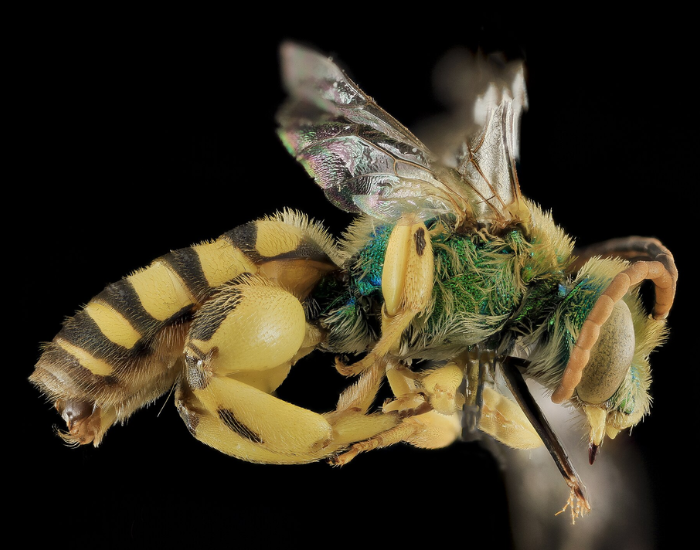
Now we leave Agapostemon for the Augochlorini, and things get even shinier. Augochlora pura glows a rich golden-green, and it breaks the usual sweat-bee rule. Instead of digging in soil, it nests in rotting wood, tucking its cells under loose bark of stumps and fallen logs.
This species ranges across the eastern United States and Canada, from Quebec to Florida and Texas. It runs two or three generations a year, and the last fall brood overwinters to start fresh in spring. The female lines her cells with a waxy secretion, then fills each one with pollen and nectar before she lays an egg.
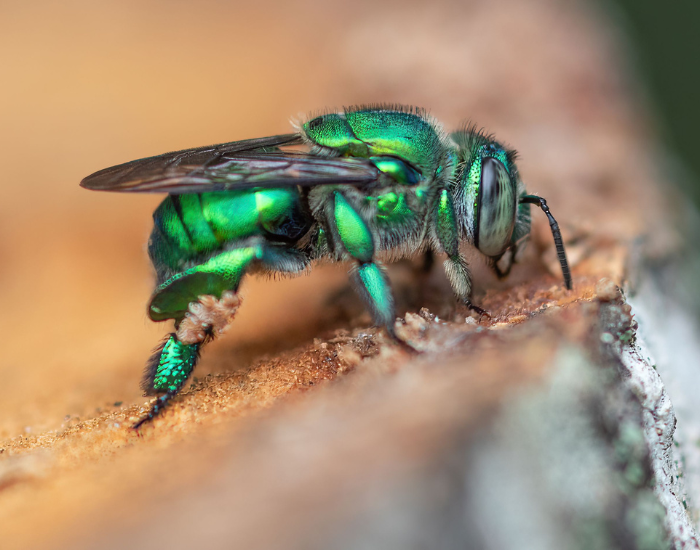
8. Golden Green Sweat Bee (Augochlorella aurata)
This small green bee packs serious color: brilliant metallic green washed with copper, red, or gold. At just 5 to 7 millimeters, it is easy to miss, but worth the squint. It nests in ground burrows across eastern North America.
Its social life fascinates me. Augochlorella aurata is primitively eusocial, a semi-social species where a founding female raises a first brood of one or two daughters who then act as workers. Some founders stay solitary instead. As a generalist pollen feeder, it is a valuable pollinator of many horticultural crops.
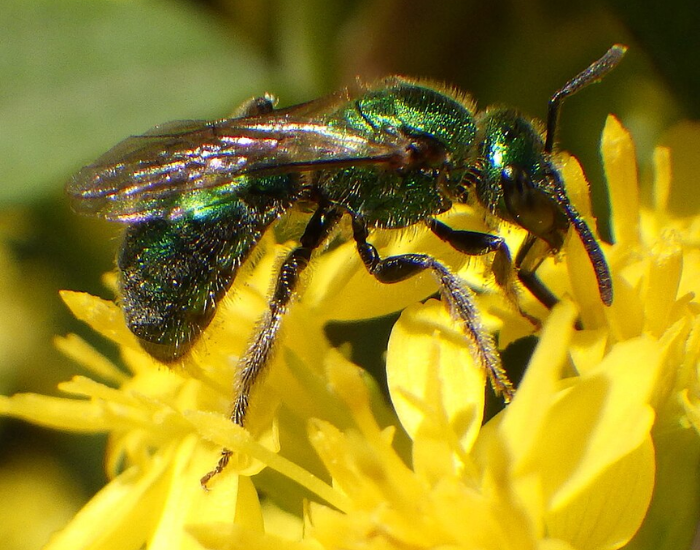
9. Metallic Epauletted Sweat Bee (Augochloropsis metallica)
Bigger and even flashier, this bee shines intense metallic green, sometimes flashing blue or purple. At 6 to 12 millimeters, Augochloropsis species outsize their Augochlora and Augochlorella cousins. It is a striking bee with a green body that stops people in their tracks.
Its nesting habit is a favorite teaching example of mine. Many females share one nest entrance in the soil, then branch off to build and provision separate tunnels underground. They share a vestibule but keep individual nests. Oddly, this bee shapes its pollen provisions into neat cubes rather than round balls.
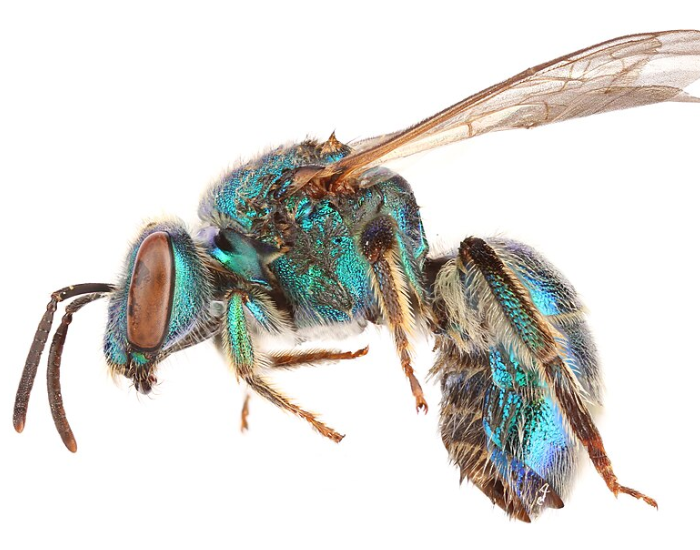
10. Sculptured Sweat Bee (Augochloropsis sumptuosa)
Another brilliant Augochloropsis, this one dazzles in bright green to blue-green. The genus holds at least 140 described species, and this is one of the showiest in North America. Look closely and you will see iridescent, D-shaped wing plates and richly textured cuticle.
Augochloropsis sumptuosa visits a broad menu of flowers, from milkweeds and coneflowers to blueberries. That flower list matters, because it makes the bee a genuine generalist pollinator that supports both wild plants and gardens. As a native pollinator sensitive to habitat changes, its presence is a good sign of environmental health.
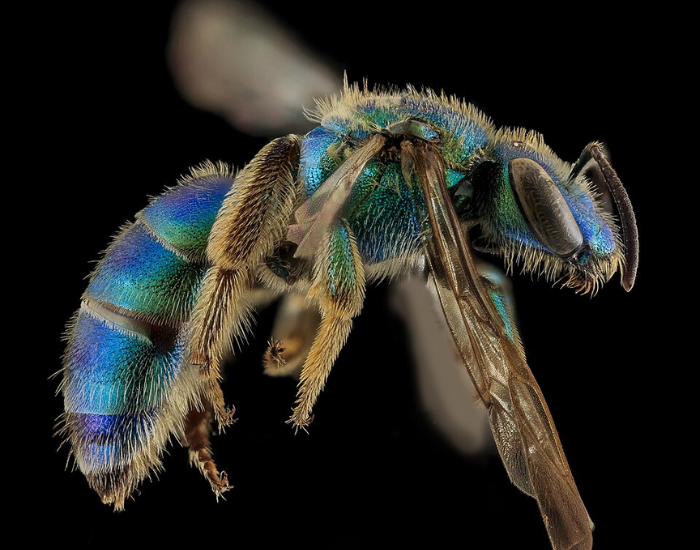
11. Green Mason Bee (Osmia aglaia)
Here is a green bee that is not a sweat bee at all. Osmia aglaia belongs to the mason bee family, and it gleams metallic green, blue, or bronze. Native to Oregon, California, and Washington, it nests in wood tunnels rather than soil, sealing its cells with plant material.
Growers prize it. This “berry bee” adores Rubus flowers, and it pollinates commercial red raspberries and blackberries in the West. It flies in late spring, timed perfectly to when the canes bloom. If you grow berries out west, this small green bee may already be earning its keep in your patch.
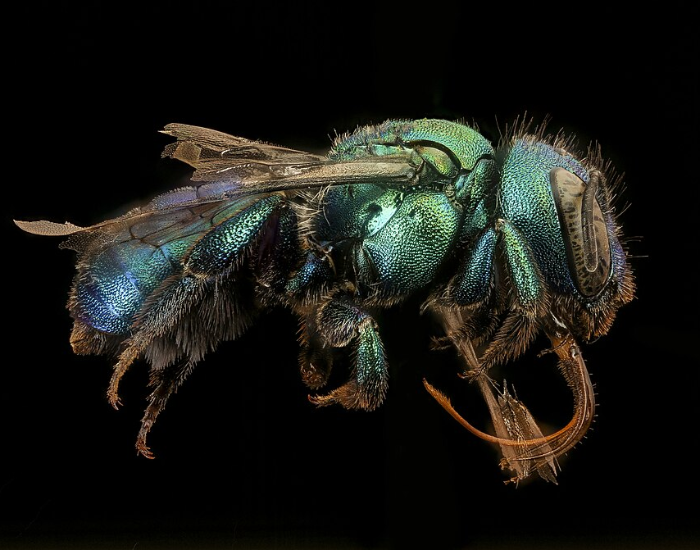
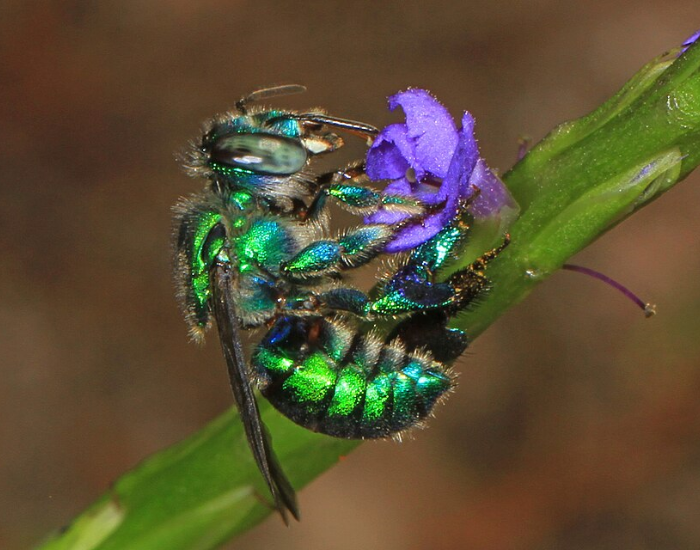
12. Green Orchid Bee (Euglossa dilemma)
Save the most spectacular for last. The green orchid bee is a large, dazzling emerald bee native to Central America, now established in Florida since 2003. It arrived by accident, likely in a wooden pallet, and has spread across the state’s southern half.
The males are the story here. They collect fragrant compounds from flowers, fungi, and even clove and cinnamon oils, storing the perfume in their swollen hind legs to court females. In Florida, this adaptable bee visits over 250 plant species. It is semi-social, with females nesting alone or in small cooperative groups.
Frequently Asked Questions
No. Green bees are generally gentle and far more interested in flowers than in people. Most are solitary or loosely communal, so they lack the large colony and hive-defense instinct of honey bees or wasps. You can watch them forage from inches away without trouble.
Only females can sting, and they almost never do. A green sweat bee will sting only if you trap it against your skin or squeeze it. The sting is mild and fleeting, nothing like a honeybee or a hornet. In years of fieldwork, I have been stung a handful of times, always my own fault.
Not really, though people rarely notice them. Metallic green bees are common across meadows, gardens, and woodland edges throughout North America. Their small size and quick flight make them easy to overlook. That said, because they are sensitive to habitat changes, local populations can decline where soil and wildflowers disappear.
Pure green sweat bees, like Augochlora pura, can technically sting, but they are remarkably docile. The famous “sweat bee” reputation comes from other species that land on your arm to sip salt from your skin. Even those are simply after minerals, not a fight. Brush them off gently and they leave.
All stinging bees deliver a small amount of venom, so technically yes, but the dose is tiny and harmless to most people. Reactions are far milder than a wasp or honeybee sting. Anyone with a known bee allergy should still take normal precautions, but green bees pose very little risk.
Why Green Bees Are Worth Your Attention
These tiny green jewels do enormous work. Green bees pollinate everything from backyard tomatoes to commercial apples and berries, and their ground-nesting habits even help aerate the soil. Wherever they thrive, the local habitat is usually healthy too.
So next time you are near a patch of sunflowers or mint-family blooms, slow down and look for a flash of metallic green. Learn one species this season, then another. If you photograph a green bee you cannot name, drop it in the comments and I will help you identify it. For more backyard pollinators, my guide to honeybee facts makes a perfect next read.
Can You Name That Green Bee? 🐝
A 12-photo identification challenge — the wrong answers are deliberately tricky look-alikes from the same group. Even entomologists find these hard, so take your time. Go back and change any answer before you score.
Which green bee is this?
References:
Abrams, J., & Eickwort, G. C. (1981). Nest switching and guarding by the communal sweat bee Agapostemon virescens (Hymenoptera, Halictidae). Insectes Sociaux, 28(2), 105–116. https://doi.org/10.1007/BF02223699
Brand, P., Saleh, N., Pan, H., Li, C., Kapheim, K. M., & Ramírez, S. R. (2017). The nuclear and mitochondrial genomes of the facultatively eusocial orchid bee Euglossa dilemma. G3: Genes, Genomes, Genetics, 7(9), 2891–2898. https://doi.org/10.1534/g3.117.043687
Dar, S. A., et al. (2025). Solitary bees as vital bioindicators: A comprehensive review of the diversity, decline, and conservation imperatives of the Halictidae family. Entomological Research, 55(3). https://doi.org/10.1111/1748-5967.70047
Landaverde-González, P., Quezada-Euán, J. J. G., Theodorou, P., Murray, T. E., Husemann, M., Ayala, R., Moo-Valle, H., Vandame, R., & Paxton, R. J. (2017). Sweat bees on hot chillies: Provision of pollination services by native bees in traditional slash-and-burn agriculture in the Yucatán Peninsula of tropical Mexico. Journal of Applied Ecology, 54(6), 1814–1824. https://doi.org/10.1111/1365-2664.12860
Onuferko, T. M., Skevington, J. H., & Kelso, S. (2023). Spread and distribution of the naturalized orchid bee Euglossa dilemma in Florida. Florida Entomologist, 106(1), 61–68. https://doi.org/10.1653/024.106.0110
Pfab, F., et al. (2026). Humidity induces structural colour change and contributes to biogeographic colour variation in sweat bees. Biology Letters, 22(4). https://doi.org/10.1098/rsbl.2025.0803
Theodorou, P., et al. (2023). From metropolis to wilderness: Uncovering pollen collecting behavior in urban and wild sweat bees (Halictus ligatus). Urban Ecosystems, 26, 1645–1657. https://doi.org/10.1007/s11252-023-01466-1





)_(34849131433).jpg)
.jpg)