
A few years ago, one of my Wildlife Nomads teammates spent several weeks bouncing between South and central America, and Australia, texting me photos almost daily. She’s the kind of person who notices the small things, the angle of a head crest, the curl of long toes, the way a reptile holds itself on a sunlit branch. One afternoon she sent a picture from a wildlife sanctuary in Panama: a green-and-blue lizard with a dorsal sail like a punk-rock fin. Her caption read, “This is the Jesus lizard. It walks on water.”
She was looking at a basilisk lizard, and her first instinct — that it resembled the Australian water dragon she’d photographed weeks earlier — turned out to be one of the most beautiful examples of convergent evolution I know.
That conversation sent me down a wonderful rabbit hole. I want to share what I’ve learned and seen since, because the basilisk lizard is one of the most genuinely amazing lizards on Earth, and most people only know it as a meme. Here are twelve things every curious naturalist should know about these strange, fast, and slightly miraculous reptiles.
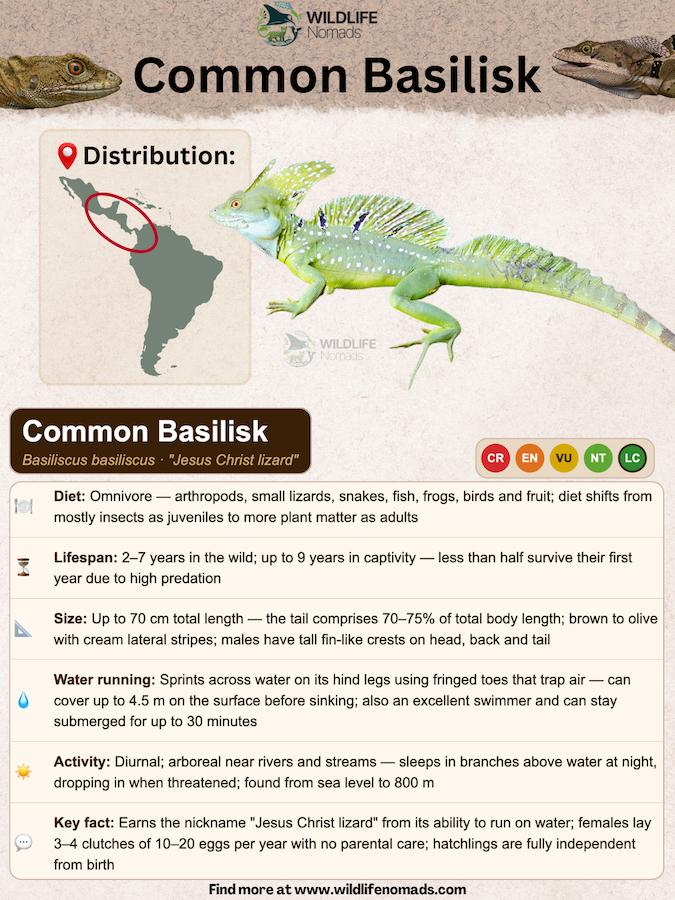
1. The “Jesus Lizard” Nickname Is Earned, Not Marketed
The first time I watched a common basilisk burst across a stream in Costa Rica, I laughed out loud. A startled juvenile dropped from an overhanging branch, hit the water’s surface, and sprinted across it like the river was a sidewalk. The basilisk lizard’s other common name — the Jesus Christ lizard — comes from this party trick.
Younger basilisks can run 10 to 20 meters across water before they break the surface and start swimming. Adults are heavier, so they manage only short distances, often just a few meters. Either way, it’s an evolutionary cheat code for escaping terrestrial predators.
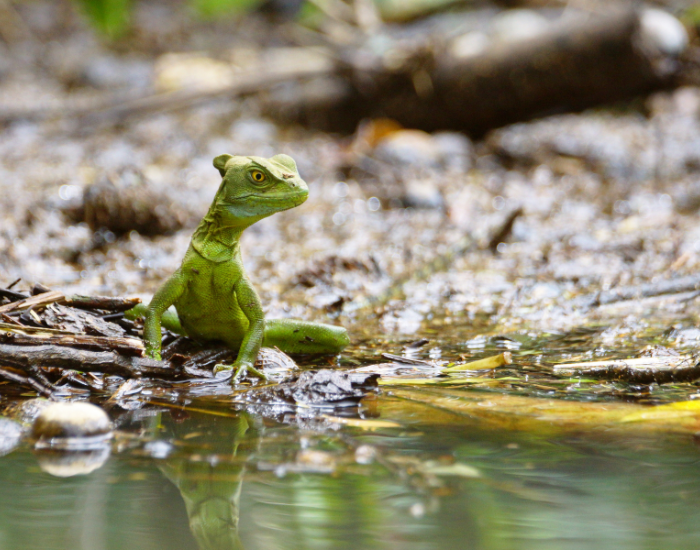
2. There Are Four Basilisk Species, Not Just One
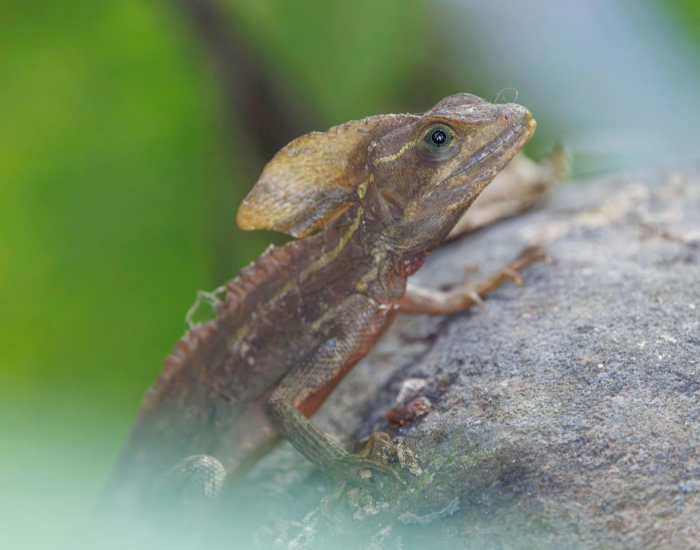
When most people picture a basilisk, they imagine the bright green plumed basilisk on a nature documentary. However, there are four basilisk species in the genus Basiliscus: the common basilisk (Basiliscus basiliscus), the brown basilisk or striped basilisk (Basiliscus vittatus), the plumed basilisk or green basilisk (Basiliscus plumifrons), and the red-headed basilisk (Basiliscus galeritus).
The plumed basilisk is sometimes called the emerald basilisk because of that electric, almost neon green color. According to the Reptile Database, all four basilisk species are native to Central America and South America, with overlapping ranges in places like Panama, Nicaragua, and Costa Rica.

3. The Name Comes from a Mythical King
“Basilisk” comes from the Greek basiliskos, meaning “little king.” In medieval bestiaries, the basilisk was a serpent-like creature said to kill with a glance. The crest along the back of adult males reminded early naturalists of a crown, hence the royal nickname.
I love this kind of etymological detail because it shows how taxonomy was once half-science, half-storytelling. Linnaeus and his contemporaries borrowed freely from mythology, and the basilisk lizard inherited a name far more dramatic than the animal itself.
4. The Real Magic Is in the Hind Legs and Long Toes
So how does a lizard actually run on water? It’s not magic… it’s physics. Basilisks have unusually long toes on their hind legs, fringed with skin flaps that expand the surface area when they slap the water’s surface. As a result, each footfall traps a tiny pocket of air, and the basilisk pushes off before the water can collapse around its foot.
Studies in Nature have measured the forces involved. To stay on top, an adult basilisk lizard needs to slap the water’s surface roughly 5 to 10 times per second. Smaller lizards have an easier time because they weigh less relative to their foot surface area.

5. They Sprint Across the Water’s Surface in Seconds
Most basilisks can run on water at speeds of around 5 feet per second over short distances. Heavier adults tire quickly, while juveniles and younger basilisks can keep going for longer because their body mass is so small. Their ability to run across the water’s surface is one of the most reliable escape tools in the reptile world.
6. Where the Basilisk Lizard Lives
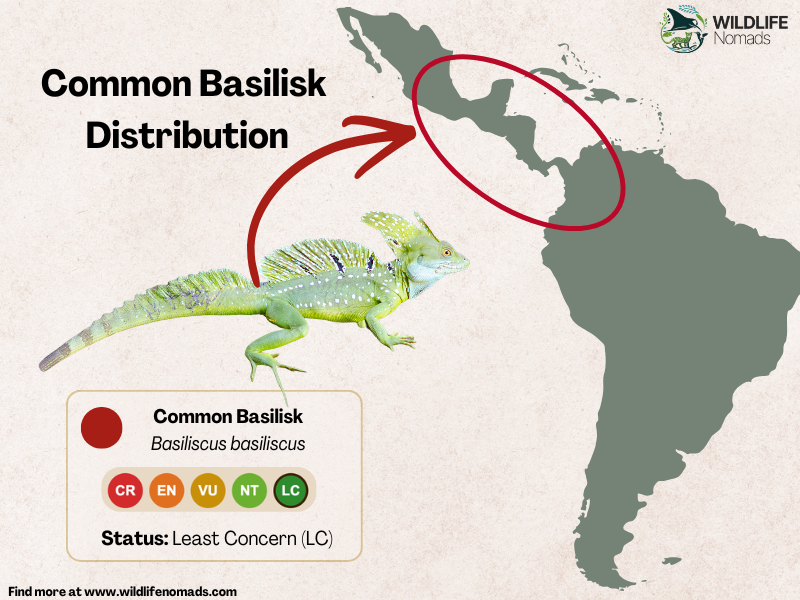
If you’re wondering where basilisks live, the answer is almost always: near water, in the warm tropics. Basilisk lizards live throughout the tropical rainforests of Central America and parts of South America, from sea level up to about 1,200 meters of elevation. They love bodies of water: slow rivers, shaded streams, mangroves, and pond edges.
You’ll find basilisks in Costa Rica, Panama, Nicaragua, Honduras, and across into Colombia and Ecuador. The brown basilisk has also pushed north into Mexico. For a broader sense of the ecosystems they share, my guide to the animals of Costa Rica is a good companion read.
7. The Brown Basilisk Has Quietly Invaded South Florida
Here’s a story most field herpetologists love to tell. Basiliscus vittatus, the brown basilisk, established a wild breeding population in South Florida decades ago, almost certainly through escapes and releases linked to the pet trade. Today you can spot striped basilisks along canals in Miami-Dade and Broward counties, basking on concrete walls and sprinting across runoff ponds.
It’s a quiet invasion, but a fascinating one. The brown basilisk doesn’t seem to be doing major ecological damage yet, though researchers are watching. Florida is a global laboratory for invasive reptiles, it also hosts many Burmese Pythons, the tegu lizard and several monitor lizards.
8. The Green Basilisk’s Crest Is a Status Symbol
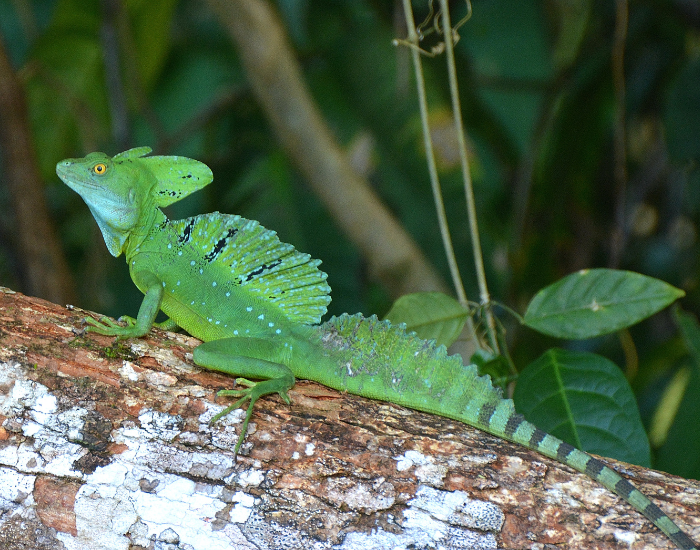
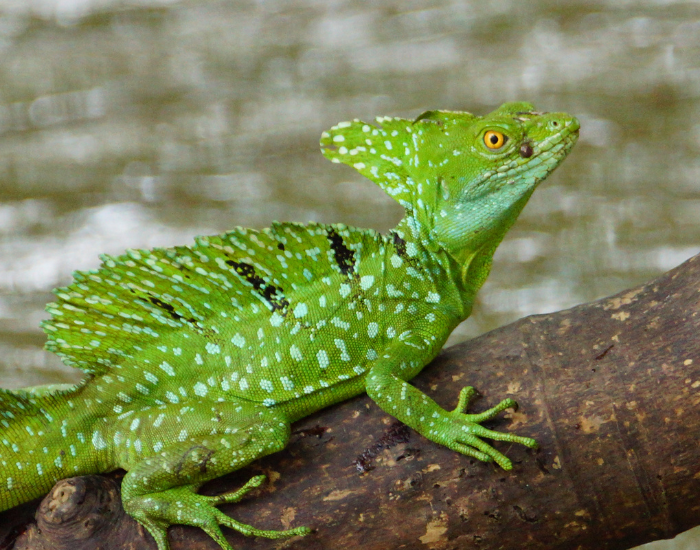
The plumed basilisk has the most theatrical look of all the basilisk species. Adult males develop high crests on the head, back, and tail — three distinct sails of skin supported by long bony spines. Females and younger basilisks have much smaller crests, or none at all.
Those high crests aren’t just decoration. They’re a sign of health, age, and dominance. In Buffalo Zoo and other captive breeding programs, captive males with the largest crests tend to win mates and defend territory. It’s the same logic that drives antlers in deer or tail length in birds — sexual selection rewarding showiness.

9. Their Diet Is Surprisingly Varied
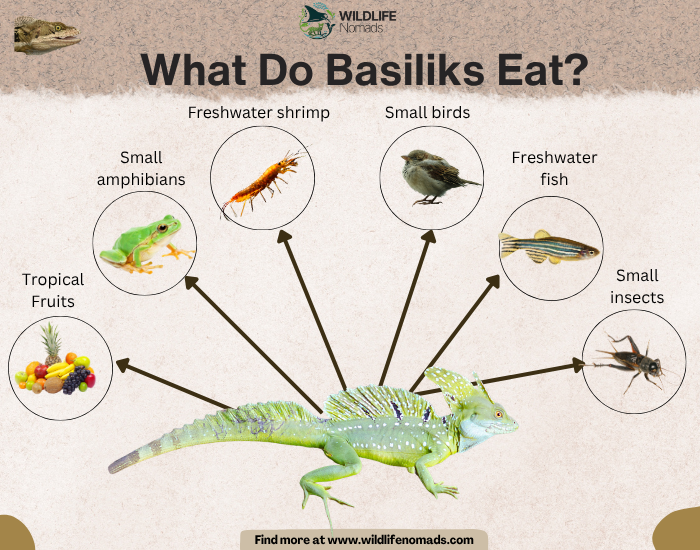
I always tell people that the basilisk lizard is more opportunistic than its glamour shots suggest. Their diet includes insects like grasshoppers and beetles, but also frogs, smaller lizards, small vertebrates, fruit, flowers, and the occasional bird hatchling. They’re omnivores who lean carnivorous when prey is plentiful.
In captivity, basilisks are usually fed crickets, roaches, and small vertebrates, plus a vitamin supplement to prevent metabolic bone disease. Wild basilisks rarely show those deficiencies because their diet is so varied. By contrast, captive basilisks on a strict insect diet can develop serious health problems.
10. Eggs, Hatchlings, and the Patient Mother
Basilisks reach sexual maturity at around 18 to 24 months. During the breeding season, females dig a shallow trench in moist soil — usually in a sunny clearing or a sandy riverbank — and lay clutches of 4 to 12 eggs. Then they walk away.
Eggs hatch after about 8 to 10 weeks with no parental care. Hatchlings emerge fully equipped to climb, swim, and sprint across water. Watching a thumb-sized basilisk make its first water-sprint is one of the most ridiculous and joyful things you can see in the field.
11. Predators, Tails, and the Art of Not Getting Eaten
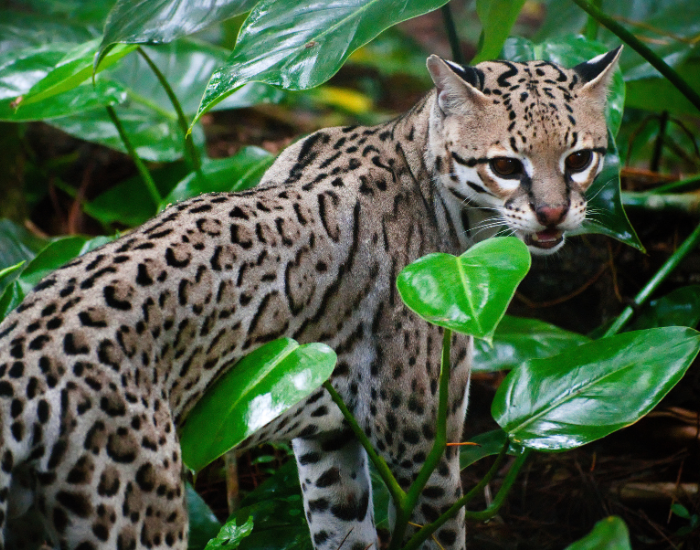
Basilisks have a long list of predators. Snakes, birds of prey, larger lizards, and aquatic animals like big cichlids and caimans all hunt them. To avoid predators — especially terrestrial predators like coatis and small cats lie ocelots. Basilisks rely on three main tools: speed, camouflage, and that signature water sprint.
Their tail is the longest part of the body, sometimes three times the length of the head and body combined. It works as a balance pole during high-speed running and a rudder when swimming. Some basilisks can drop part of the tail under attack, though regrowth is slow and incomplete. Older basilisks with intact tails are usually the wariest individuals — they’ve earned that caution.
12. Convergent Evolution: Why Basilisks Look Like Water Dragons
This is where my field biologist brain lights up. The basilisk lizard, the Australian water dragon, the common iguana, and even — at a deeper level — the ancient tuatara of New Zealand share crests and semi-aquatic habits, despite the Tuatara belonging to an entirely different lineage that split from lizards over 250 million years ago.
This is convergent evolution. Different lineages of reptiles, separated by tens of millions of years and entire oceans, have arrived at nearly identical solutions for living near tropical streams. Compare that to specialists like the Komodo dragon, the Gila monster, or the many types of skink, and you see how environment shapes form just as much as ancestry does.
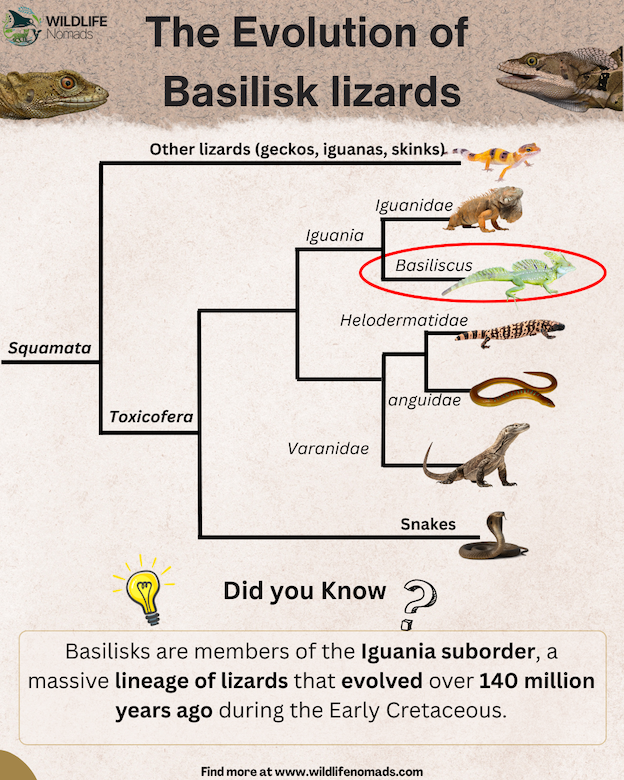
Basilisk lizards | Credit: Wildlife Nomads
Conservation Status: For Now, Least Concern
All four basilisk species are currently listed as least concern on the IUCN Red List. They tolerate moderate habitat disturbance, breed quickly, and adapt well to forest edges. That said, deforestation, water pollution, and the international pet trade are real pressures. “Least concern” isn’t a permanent label, it’s a snapshot, and the natural history of any tropical reptile can shift fast.
Frequently Asked Questions
Younger basilisks can run across water for about 10 to 20 meters before they sink and start swimming. Adult basilisks are heavier and usually manage just a few meters. The whole sprint typically lasts under two seconds, which is why it looks so much like a magic trick.
This question comes from mythology, not biology. In medieval legend, the basilisk was said to hatch when a snake’s egg was incubated by a rooster — half serpent, half bird. The real basilisk lizard isn’t a hybrid of anything. It’s a genus of reptiles native to Central and South America with four recognized basilisk species.
The basilisk lizard is the champion. Smaller individuals can sprint up to 20 meters across the water’s surface. Some other small lizards and amphibians manage brief water-skimming, but no other reptile does it as reliably or as far over open bodies of water.
Basilisk lizards live in the tropical rainforests of Central America and northern South America. You’ll find basilisks in Costa Rica, Panama, Nicaragua, Honduras, and Colombia, almost always close to bodies of water like rivers, streams, and ponds. The brown basilisk has also colonized South Florida.

The Big Picture of Reptilian Adaptation
The first time you see a basilisk lizard run across water, something resets in your brain. Convergent evolution stops being a textbook concept and becomes a tangible, living thing. That’s why I keep telling my fellow Wildlife Nomads to slow down at every tropical stream — because somewhere on a low branch, a little king is waiting to surprise you.
If you’ve spotted basilisks in the wild, drop a comment with where and when. And if this kind of cross-continent reptile comparison is your jam, dive into my pieces on the Australian water dragon, the tuatara, and the common iguana next.
References:
Glasheen, J. W., & McMahon, T. A. (1996). A hydrodynamic model of locomotion in the basilisk lizard. Nature, 380(6572), 340–342. https://doi.org/10.1038/380340a0
Hsieh, S. T., & Lauder, G. V. (2004). Running on water: Three-dimensional force generation by basilisk lizards. Proceedings of the National Academy of Sciences, 101(48), 16784–16788. https://doi.org/10.1073/pnas.0405736101
Hsieh, S. T. (2003). Three-dimensional hindlimb kinematics of water running in the plumed basilisk lizard (Basiliscus plumifrons). Journal of Experimental Biology, 206(23), 4363–4377. https://doi.org/10.1242/jeb.00679
Krysko, K. L., Burgess, J. P., Rochford, M. R., Gillette, C. R., Cueva, D., Enge, K. M., … Hardman, B. (2011). Verified non-indigenous amphibians and reptiles in Florida from 1863 through 2010. Zootaxa, 3028(1), 1–64. https://doi.org/10.11646/zootaxa.3028.1.1
Uetz, P., Freed, P., & Hošek, J. (Eds.). (2024). The Reptile Database. http://www.reptile-database.org