
During my year studying biology in Uppsala, Sweden, my European classmates talked about the eurasian lynx the way Texans talk about mountain lions — with a mix of reverence and healthy respect. We spent weekends hiking through boreal forest north of the city, scanning snow for tracks, hoping to spot a lynx or maybe even brown bears. We never did. That alone tells you something about this cat. The eurasian lynx is one of the most widespread wild cats on the planet, yet most people who share a continent with it will never see one. These twelve facts explain why this elusive predator deserves far more attention than it gets.
1. The Eurasian Lynx Is the Largest Lynx Species Alive
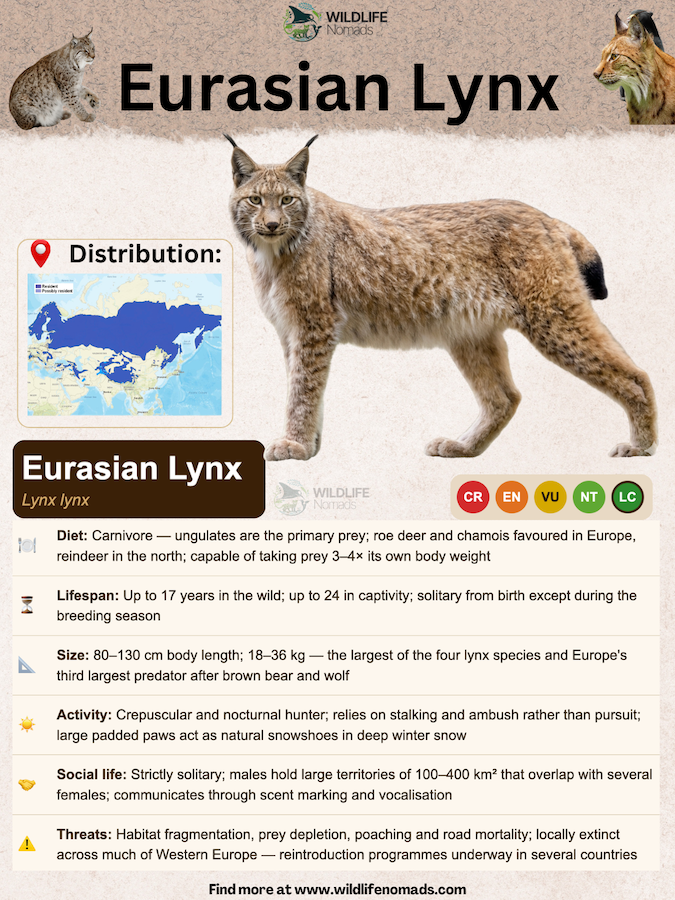
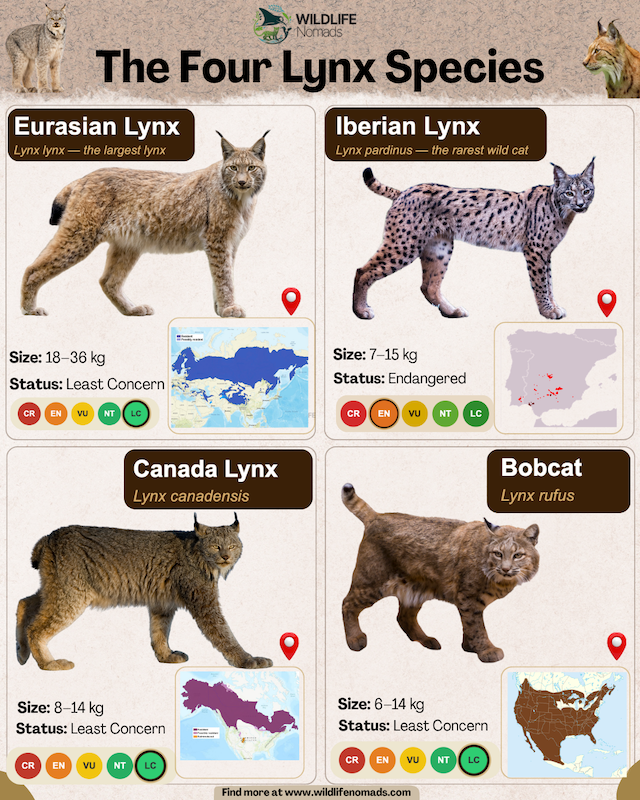
Four species of lynx exist worldwide: the eurasian lynx, the iberian lynx, the canadian lynx, and the bobcat. Among them, the eurasian lynx wins on size by a wide margin. An adult lynx can reach a body length of 100 to 130 centimeters and stand roughly 60 to 75 centimeters at the shoulder. A male lynx typically weighs between 18 and 30 kilograms, though some individuals from Siberia have tipped the scales above 35. Females run smaller, averaging 15 to 21 kilograms. For comparison, the canadian lynx rarely exceeds 14 kilograms. The eurasian lynx weight and overall frame make it capable of tackling prey that other lynx species cannot touch.
2. Their Range Covers Everything from Western Europe to the Tibetan Plateau
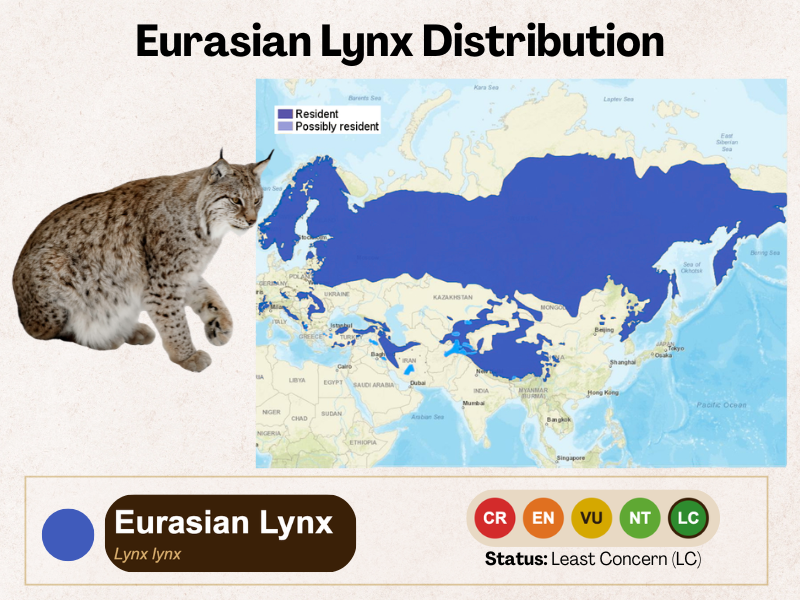
Few wild cats match the geographic spread of the eurasian lynx. Eurasian lynx live across a staggering stretch of europe and asia, from the mountainous regions of Scandinavia and the Carpathian Mountains all the way through central asia and onto the tibetan plateau. You can find them in boreal forest above the arctic circle, in mixed forests across eastern europe, on rocky hills in central and southern europe, and even in mixed forest steppe habitat near Mongolia. They roam forested regions in parts of Europe (though in low numbers), dense thickets across the continent, and thinly wooded areas on northern slopes of mountain ranges. This eurasian lynx range is the broadest of any cat species in the Old World. No single eurasian lynx habitat type defines the species — it thrives wherever forest cover and prey overlap, a testament to their adaptability across Europe’s diverse fauna.
3. Those Black Ear Tufts Are Functional, Not Decorative
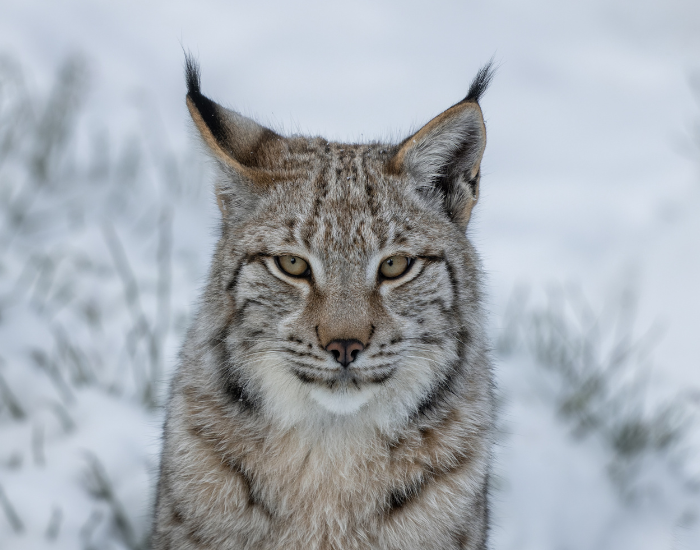
The most recognizable feature of the eurasian lynx cat is the pair of black tufts rising from the tips of each ear. Researchers believe these tufts enhance directional hearing, funneling sound waves into the ear canal like tiny antennae. A eurasian lynx can detect a hare rustling through dense vegetation at 60 meters.
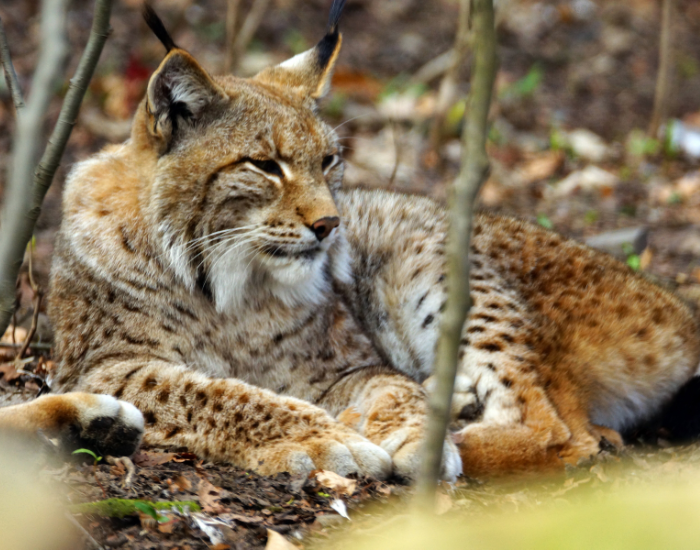
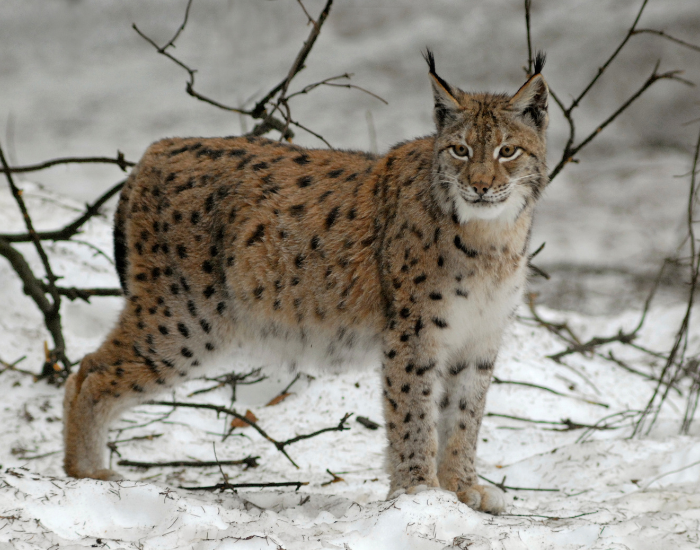
Beyond the tufts, their coat is typically greyish brown in winter, shifting to a reddish tone in summer, peppered with dark spots that vary enormously between individuals. Some eurasian lynx display bold rosettes; others appear almost plain. Their long legs, proportionally the longest of any cat relative to body size, help them navigate deep snow, which is critical for survival in boreal forest and mountainous regions. That greyish brown fur with dark spots breaks up their outline in dappled forest light, making them nearly invisible when they freeze mid-stalk.
4. They Are Strict Carnivores with a Serious Appetite for Deer
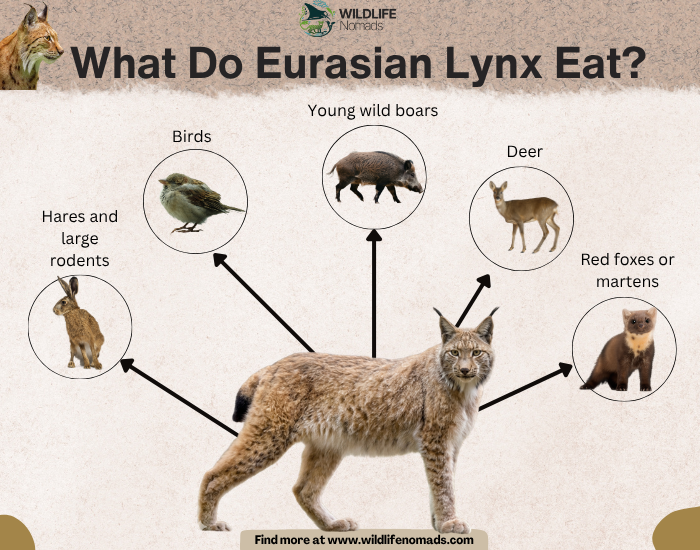
The eurasian lynx diet centers on wild ungulates. In most of Europe, roe deer account for the majority of kills. In Scandinavia, reindeer become important prey species. Across central asia, musk deer and other hoofed mammals fill that role. These cats are strict carnivores, they do not supplement with plants, fruit, or insects like some other species.
An adult eurasian lynx needs roughly 1.5 to 2 kilograms of meat daily. When ungulate prey is scarce, they will eat smaller animals: hares, foxes, grouse, and in rare instances, European badgers. However, the availability of large wild ungulates directly determines whether a lynx population thrives or declines. Where prey species are abundant, population densities climb. Where they are not, the lynx quietly vanishes.
5. Eurasian Lynx Kill Prey Up to Four Times Their Own Size
Unlike cheetahs that rely on raw speed, the eurasian lynx is a stalk-and-ambush predator. Those long legs carry it silently through undergrowth until it closes within 5 – 10 meters of its target. Then a short explosive burst — rarely longer than a few bounds — and a precise bite to the throat. They kill prey efficiently, targeting the neck to suffocate hoofed mammals that outweigh them significantly.
A 20-kilogram female can bring down a 80-kilogram deer. After the kill, they drag the carcass into dense vegetation or under cover, feeding over several nights and returning to the same spot. This ability to kill prey so much larger than themselves separates eurasian lynx from smaller prey specialists like the canadian lynx, which relies almost exclusively on snowshoe hares.
6. Lynx Population Numbers Tell a Complicated Conservation Story
Globally, the IUCN lists the eurasian lynx as Least Concern, but that label hides enormous regional variation. Healthy lynx populations exist in Scandinavia, the Baltic states, and across Russia. In western europe and southern europe, the picture is far grimmer. The lynx population in Germany numbers fewer than 200. France, Switzerland, and Slovenia maintain small, fragmented groups.
The balkan lynx, a subspecies clinging to survival in North Macedonia and Albania, may number fewer than 50 individuals. Declining populations across the continent reflect centuries of persecution, and even where numbers have recovered, low genetic diversity threatens long-term survival. A recent status survey highlighted that many European lynx populations remain isolated, creating genetic bottlenecks that weaken the species’ resilience against wildlife diseases.
7. Hunting and Habitat Loss Nearly Erased Them from Europe
By the early 1900s, the eurasian lynx had vanished from most of western and central europe. The fur trade drove relentless trapping across Scandinavia and Russia. Meanwhile, habitat loss, the clearing of forests for agriculture, destroyed the dense cover these cats depend on. Hunting and habitat loss worked together like a vise. In some regions, lynx were legally hunted well into the twentieth century. Even after legal protections arrived, illegal poaching continued to suppress recovery.
Today, habitat loss remains among the major threats facing the species. Logging fragments forested regions into patches too small to support viable populations. Road construction through mountainous regions cuts migration corridors. The fur trade is largely a historical problem, but its echoes persist in population genetics, many western European groups descended from just a handful of reintroduced founders, leaving them with dangerously low genetic diversity.
8. Eurasian and Iberian Lynx Share a Continent but Almost Nothing Else
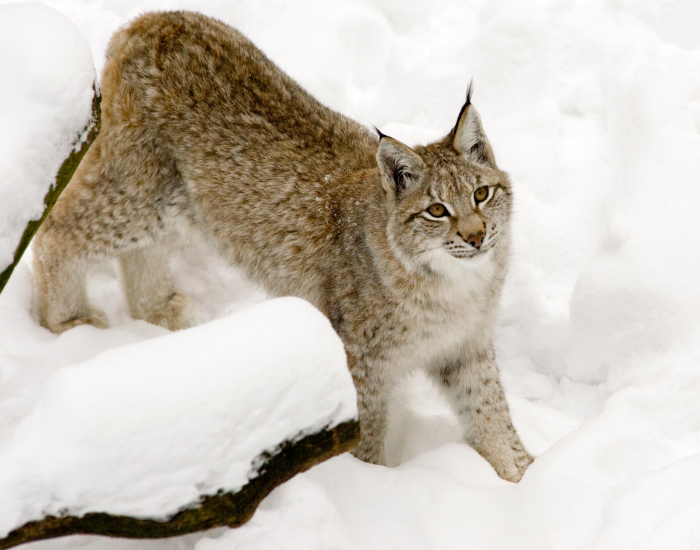
The iberian lynx and the eurasian lynx are separate species, not subspecies. The iberian lynx is smaller, lighter, and restricted to the iberian peninsula in Spain and Portugal. It specializes almost exclusively on European rabbits, a risky strategy that nearly caused its extinction when myxomatosis devastated rabbit populations. The eurasian lynx, by contrast, is a generalist predator of wild ungulates across dozens of countries.
Eurasian and iberian lynx overlapped historically in southern europe, but their ranges no longer connect. The iberian lynx was classified as the most endangered species of wild cats on Earth, though intense conservation work has pulled it back from fewer than 100 individuals to over 2,000 today. Among the lynx worldwide, the eurasian and iberian lynx represent the closest evolutionary relatives, yet their ecological strategies diverged dramatically.
9. They Mark Territories with Scent, Not Confrontation
The eurasian lynx is a solitary animal. Males maintain territories of 100 to over 400 square kilometers depending on prey availability and terrain. Females hold smaller but overlapping ranges. Rather than fighting to defend boundaries, lynx rely on scent marks — urine sprayed on rocks, tree trunks, and trail junctions — to communicate ownership.
They also scratch bark and leave scat in prominent locations. These chemical signals reduce conflict with other animals competing for the same ground, much like other animals in overlapping territories use scent to avoid direct encounters. A resident male lynx rarely encounters another adult of the same sex. When confrontations do occur, they tend to be brief and ritualized. This low-density, solitary lifestyle explains why lynx are so hard to observe. During my hikes in Sweden, my friends told me the forests were full of them. The lynx just had zero interest in being seen.
10. Mating Season Is Loud, Brief, and the Only Social Window
For most of the year, the eurasian lynx avoids other lynx entirely. The exception is mating season, which runs from February to April across most of the range. During the breeding season, females vocalize with eerie, drawn-out calls that carry through boreal forest at night. Males respond and travel widely, sometimes crossing into rival territories.
After mating, the pair separates within days. Females give birth in late May or June, typically producing two to three kittens in a sheltered den among rocky hills or dense thickets. Kittens stay with their mother for roughly ten months, learning to hunt smaller prey before dispersing. A captive eurasian lynx can live over 20 years, but wild individuals rarely exceed 12 to 15 — a gap that reflects the toll of harsh winters, competition, and human-caused mortality.
11. Gray Wolves and Brown Bears Are Their Only Serious Competition
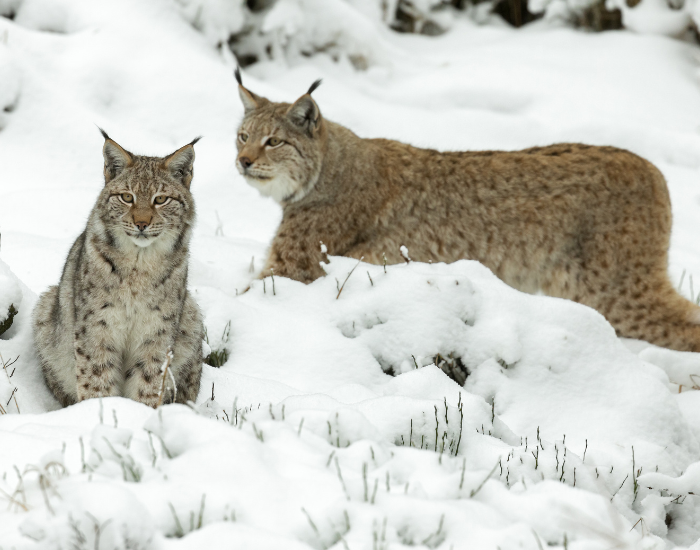
The eurasian lynx sits near the top of its food chain, but it shares that space with larger predators. Gray wolves compete directly for the same prey and will kill lynx when they encounter them. Brown bears rarely target lynx but will steal their cached kills, a significant energy loss for a solitary hunter. In Scandinavia, research has shown that gray wolves suppress lynx population density in areas of overlap. The relationship with wolverines is similar: wolverines scavenge lynx kills frequently.
Despite these pressures, the eurasian lynx persists because it occupies dense vegetation and mountainous regions where wolves hunt less effectively. Natural predators of lynx kittens include eagles and wolves, adding another layer of mortality to an already slow-reproducing species. The eurasian lynx has no natural predators as an adult beyond wolves, a rare status among wild cats of this size.

12. Reintroduction Programs Offer Real Hope — and Real Controversy
Since the 1970s, several countries have reintroduced the eurasian lynx to former habitat. Switzerland, Germany, Austria, and most recently Scotland and Spain (for the Iberian lynx) have launched or proposed programs. These efforts matter because they restore missing ecological roles — lynx control deer populations, which in turn allows forest regeneration. However, reintroductions spark tension with local communities and livestock farmers who fear predation losses.
In Switzerland, lynx occasionally take sheep, and some animals have been illegally killed in retaliation. A successful conservation action plan requires balancing the needs of local communities, livestock farmers, and the species itself. Where local communities are engaged early and compensated fairly, acceptance grows. Where they are not, lynx become a symbol of top-down conservation, and protected species status means little if enforcement is weak. Genetic diversity in reintroduced populations remains a concern.
Frequently Asked Questions
The eurasian lynx is one of the strict carnivores among European wild cats. Its diet consists primarily of hoofed mammals such as roe deer, chamois, and musk deer. In areas where large prey species are unavailable, eurasian lynx eat smaller animals like hares, foxes, and ground-nesting birds. They need 1.5 to 2 kilograms of meat per day.
Eurasian lynx live across the widest range of any lynx species, from western europe through eastern europe, central asia, Siberia, and onto the Tibetan Plateau. They prefer mixed forests, boreal forest, and mountainous regions with dense cover. Some populations survive in thinly wooded areas and mixed forest steppe landscapes.
The eurasian lynx is the largest lynx species. Body length in males reaches 100 to 130 centimeters. Eurasian lynx weight ranges from 18 to 30 kilograms in males and 15 to 21 kilograms in females. Their long legs and powerful build make them formidable predators of prey species much larger than themselves.
No. Eurasian lynx are extremely shy and avoid human contact. Attacks on people are virtually nonexistent. Even livestock farmers who live alongside lynx rarely see them. These wild cats pose no meaningful threat to human safety.
Why the Eurasian Lynx Still Needs Our Attention
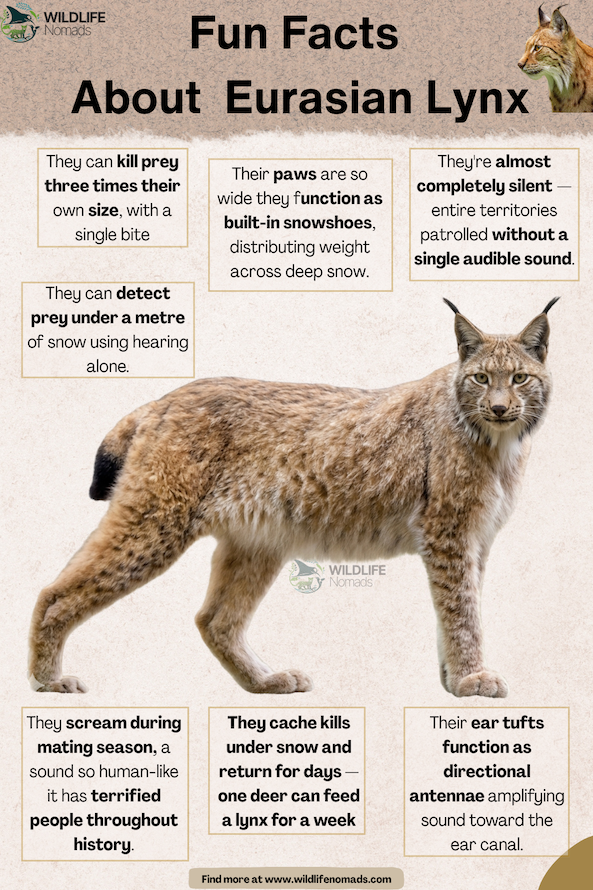
The eurasian lynx is not on the brink of extinction globally. Large, stable populations span Russia and central asia. The real worry lies in Europe, where fragmented lynx populations, declining populations in the south and west, and major threats from habitat loss, illegal poaching, and low genetic diversity chip away at the species quietly. Conservation programs, biological conservation research, and cross-border cooperation between local communities have made genuine progress — but the work is far from finished. If you ever find yourself hiking through a boreal forest in Scandinavia or the mountainous regions of the Carpathians, pause and look for tracks in soft ground. You probably will not see a eurasian lynx. But knowing they are out there, moving silently through the trees, is reason enough to keep fighting for them. Have you ever encountered a lynx in Europe or Asia? Drop a comment below — I would love to hear your story.
References:
Breitenmoser, U., Breitenmoser-Würsten, C., Okarma, H., Kaphegyi, T., Kaphegyi-Wallmann, U., & Müller, U. M. (2000). Action Plan for the conservation of the Eurasian Lynx (Lynx lynx) in Europe. Nature and Environment, 112. Council of Europe Publishing. https://www.researchgate.net/publication/228776242_Action_Plan_for_the_Conservation_of_the_Eurasian_Lynx_in_Europe_Lynx_lynx
Chapron, G., Kaczensky, P., Linnell, J. D. C., von Arx, M., Huber, D., Andrén, H., & Boitani, L. (2014). Recovery of large carnivores in Europe’s modern human-dominated landscapes. Science, 346(6216), 1517–1519. https://doi.org/10.1126/science.1257553
Krofel, M., Huber, D., & Kos, I. (2011). Diet of Eurasian lynx Lynx lynx in the northern Dinaric Mountains (Slovenia and Croatia). Acta Theriologica, 56(4), 315–322. https://doi.org/10.1007/s13364-011-0032-2
Mueller, S. A., Reiners, T. E., Middelhoff, T. L., Anders, O., Koop, A., & Nowak, C. (2020). The rise of a large carnivore population in Central Europe: genetic evaluation of lynx reintroduction in the Harz Mountains. Conservation Genetics, 21, 577–587. https://doi.org/10.1007/s10592-020-01270-w
Sindičić, M., Polanc, P., Gomerčić, T., Jelić, D., Huber, Đ., Trontelj, P., & Skrbinšek, T. (2013). Genetic data confirm critical status of the reintroduced Dinaric population of Eurasian lynx. Conservation Genetics, 14, 1009–1018. https://doi.org/10.1007/s10592-013-0491-x
Zimmermann, F., Breitenmoser-Würsten, C., & Breitenmoser, U. (2005). Natal dispersal of Eurasian lynx (Lynx lynx) in Switzerland. Journal of Zoology, 267(4), 381–395. https://doi.org/10.1017/S0952836905007545