There is a specific stillness that only exists at 4:00 AM on the Australian coast. The world turns blue-grey. The air runs heavy with salt. Your coffee is the only thing keeping your eyes open. Everyone knows Australia is full of sharks, but not all species of shark are the same.
Last weekend, the Wildlife Nomads team found ourselves at Julian Rocks, just off Byron Bay, waiting for the sun to catch up with our excitement. We were there for one reason: to swim with the ‘leopards of the ocean.’
The water teemed with life. Wobbegong sharks blended into the reef. Manta rays danced in the current. Very well camouflaged stingrays feeding at the bottom. Green sea turtles surfaced for air. However, it was the zebra sharks that stole the show entirely.
Drying off in the sun afterward, we chatted with our dive guide and realised how much misinformation surrounds these animals. In Australia, people call them leopard sharks — which creates massive confusion with the true leopard shark of the Eastern Pacific. Therefore, to set the record straight, I have put together a deep dive into the most fascinating facts about zebra sharks.

Zebra Shark Profile: The Scientific Breakdown
Before we explore the weird stuff, here is the precise science. In biology, precision matters.
| Common Name | Zebra Shark (International) / Leopard Shark (Australia) |
| Scientific Name | Stegostoma tigrinum |
| Family | Stegostomatidae (sole member) |
| Order | Orectolobiformes (Carpet Sharks) |
| Conservation Status | Endangered (IUCN Red List) |
| Max Length | Up to 2.5 m (8.2 ft); record 3.5 m |
| Lifespan | 25–30 years |
| Habitat | Tropical Indo-Pacific; coral reefs and sandy flats |

1. The Identity Crisis: Zebra or Leopard Shark?
A common question everyone has is: ‘Are zebra sharks dangerous?’…. followed immediately by, ‘Why is it called a zebra shark if it has spots?’
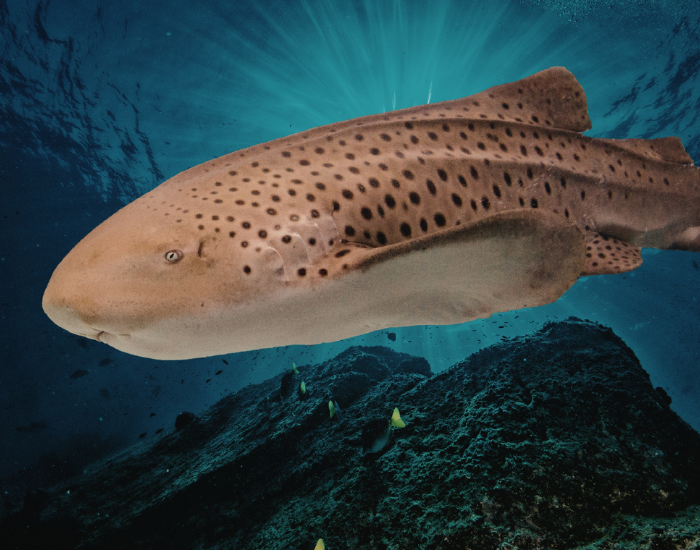
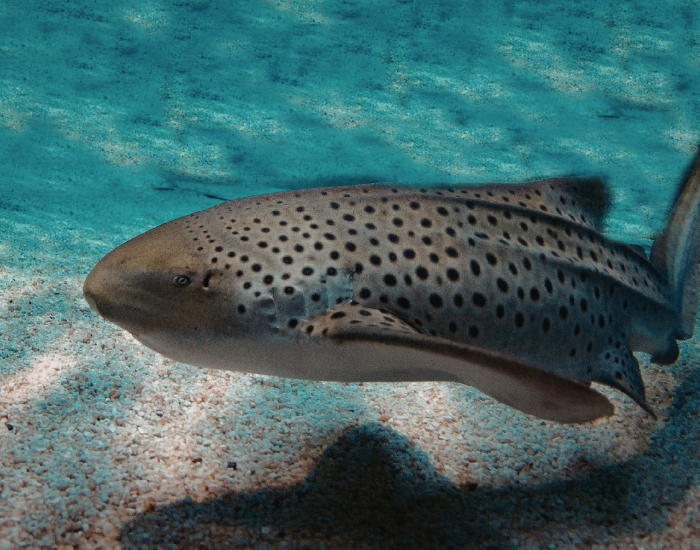
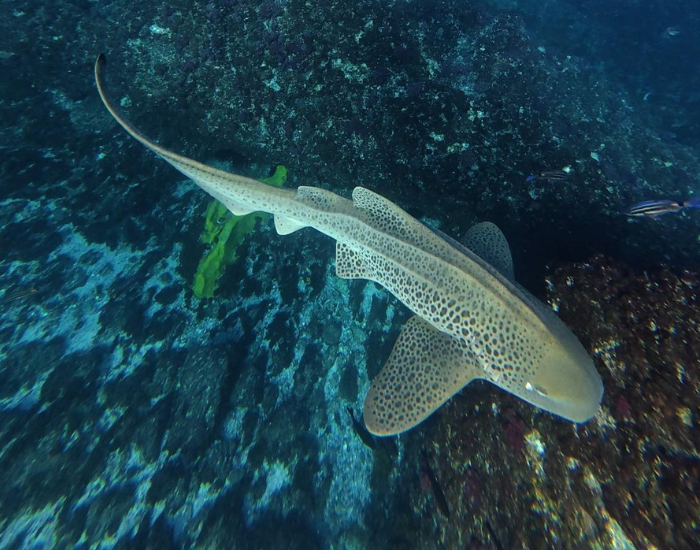
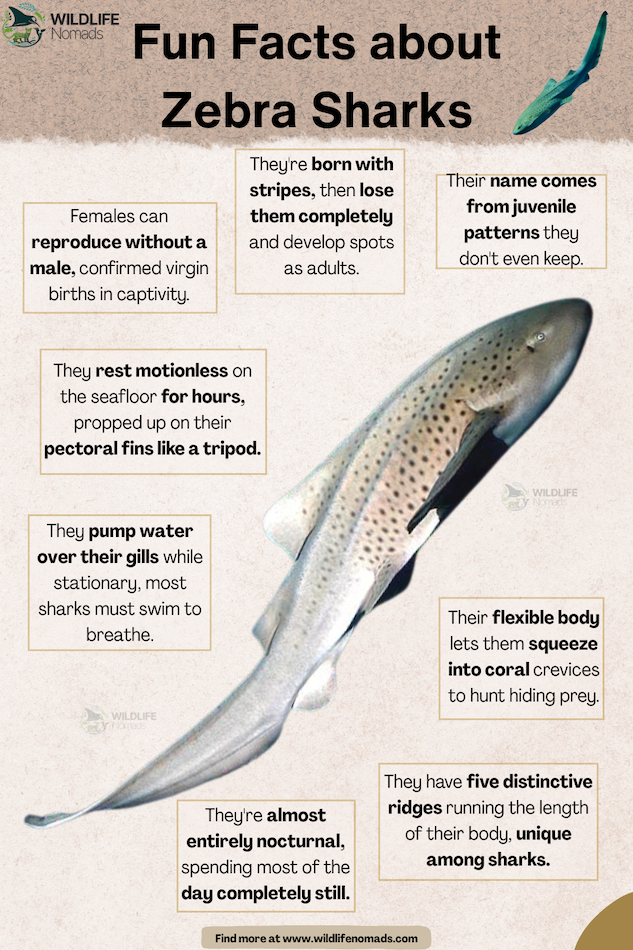
Juvenile zebra sharks display bold, dark-brown and cream-yellow stripes, hence the name. However, as the species grows, those stripes break apart into small dark brown spots on a pale yellow-brown background. By adulthood, spotted adults look exactly like a leopard, which is why Australians call them leopard sharks.
In the US, however, ‘leopard shark’ refers to a completely different species (Triakis semifasciata) found in the Eastern Pacific. This is precisely why scientists prefer Stegostoma tigrinum — tigrinum meaning ‘tiger-like,’ referring to those juvenile stripes.
2. The Only Member of Their Entire Family
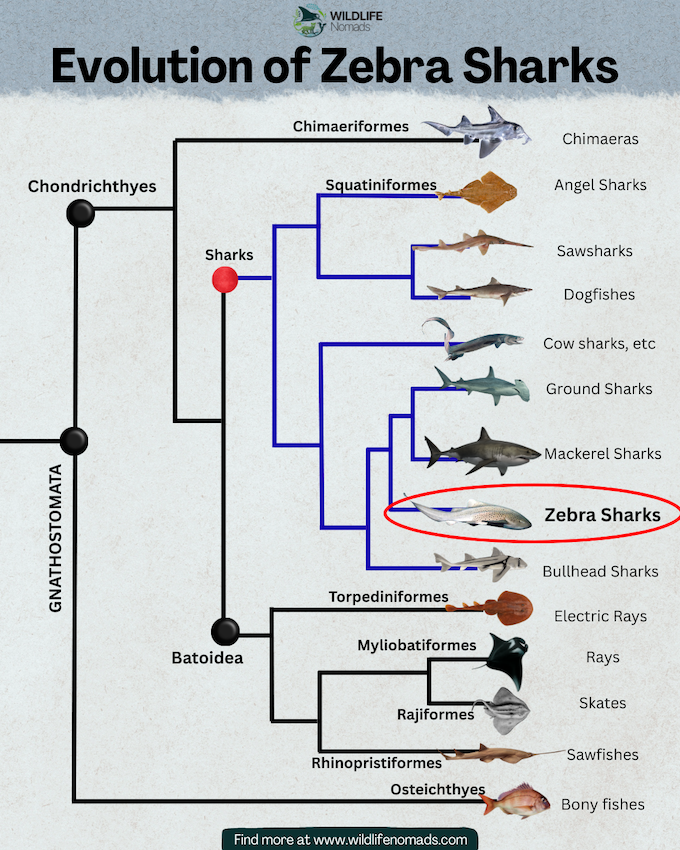
In taxonomy, large families often share dozens of cousins. Not the zebra shark. They are the sole surviving members of the family Stegostomatidae, a one-of-a-kind branch of the tree of life.
While they belong to the order Orectolobiformes, alongside whale sharks and nurse sharks, they have no close living relatives at the family level. When you encounter one on a shallow coral reef, you are looking at an evolutionary original.
3. Their Body Shape Is Built for the Reef
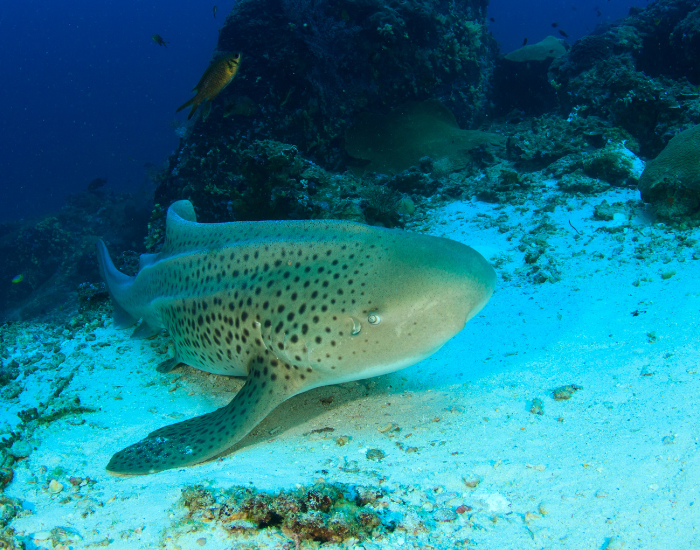
The zebra shark has a distinctive, elongated cylindrical body with a flexible body plan that is perfectly adapted for reef life. Unlike the torpedo-shaped build of open-water hunters, this shark is designed for tight spaces.
Their caudal fin (tail) can reach nearly the length of the rest of their body, giving them eel-like flexibility in narrow crevices. Large pectoral fins help stabilise them as they hover close to the seafloor, while a small dorsal fin sits far back on the body. The overall effect is graceful and unhurried.
Adults also develop a blunt snout, which is perfectly shaped for probing coral bottoms and sandy gaps in search of prey. Their small mouth opens downward, ideally positioned for suction feeding on the reef floor.
4. Virgin Births Are a Real Thing
This is perhaps the strangest fact in my notebook. Scientists have documented parthenogenesis in zebra sharks, a form of asexual reproduction zebra sharks can use when mates are unavailable.
One famous case involved an adult zebra shark female at a Queensland aquarium. She had previously reproduced sexually, then switched to ‘virgin births’ after being separated from males. It is a biological emergency response that ensures reproduction zebra sharks can still achieve even in isolation (Dudgeon et al., 2017).
5. They Do Not Need to Keep Swimming to Breathe
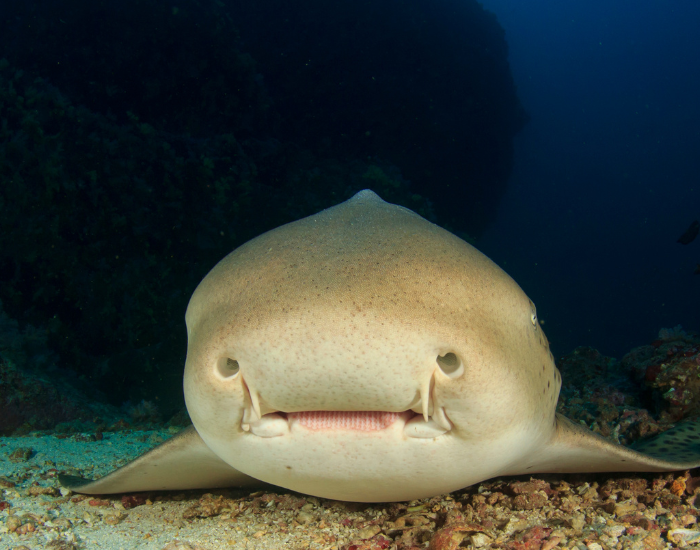
Most people assume all sharks die if they stop moving. That is true for obligate ram ventilators like thresher sharks or great whites, but zebra sharks have a far better system: buccal pumping.
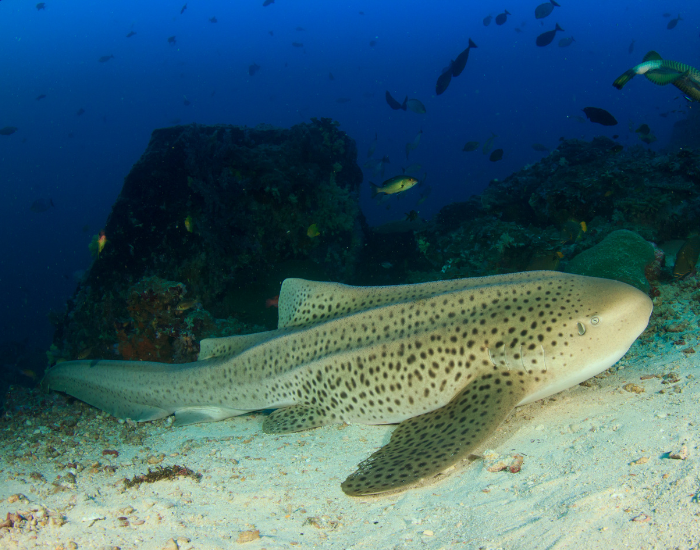
They actively pull water over their gills using cheek muscles, so they can sit completely still on the sandy bottom with mouths open, facing into the current. During our dive at Julian Rocks, we spotted several adult zebra sharks just resting on the sand below us.
6. Where Do Zebra Sharks Live?
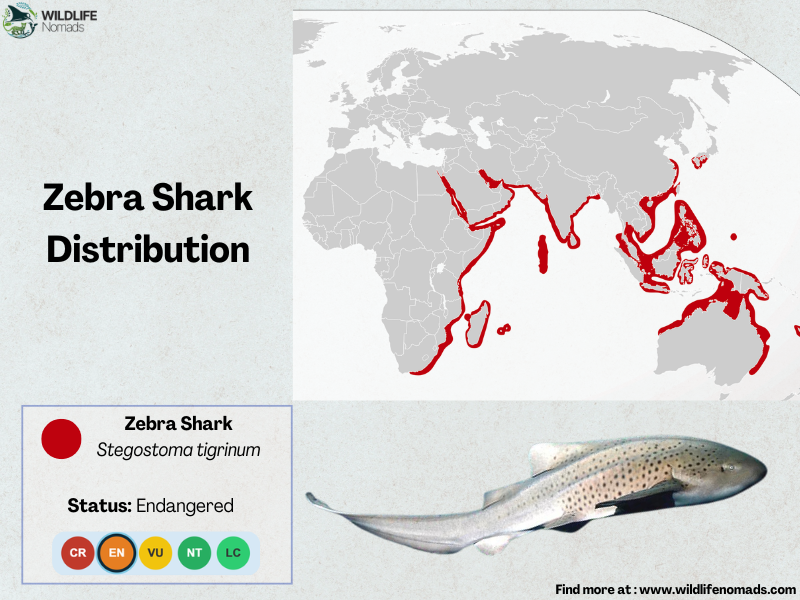
Zebra sharks live throughout the tropical Indo-Pacific and Indo-West Pacific, from the Red Sea and East Africa all the way to the shallow coral reefs of Australia and Japan. They favour coastal waters at depths of less than 62 metres, resting by day on sandy flats and reef ledges.
Research in southeast Queensland confirms they are highly site-faithful, returning to the same reef zones year after year. This behaviour makes them excellent ambassadors for marine ecotourism. However, it also makes them especially vulnerable to heavily fished areas.
Zebra sharks live in the western Pacific Ocean, the Indian Ocean, and across the Coral Triangle. Populations around Southeast Asia have declined sharply. In Raja Ampat, Indonesia, the species became functionally extinct, with only around 20 individuals detected across the entire archipelago before rewilding efforts began.
7. Nocturnal Hunters With a Sixth Sense
Zebra sharks are primarily nocturnal hunters. They rest during the day and actively forage at night across shallow reefs, which explains why divers so often find them motionless on the seafloor.
To hunt in darkness, they rely on barbels, fleshy, whisker-like organs near the blunt snout, packed with sensory cells. These barbels allow them to detect prey buried in narrow crevices or beneath sand in total darkness. It is an extraordinary adaptation for reef hunting.
8. What Do Zebra Sharks Eat?
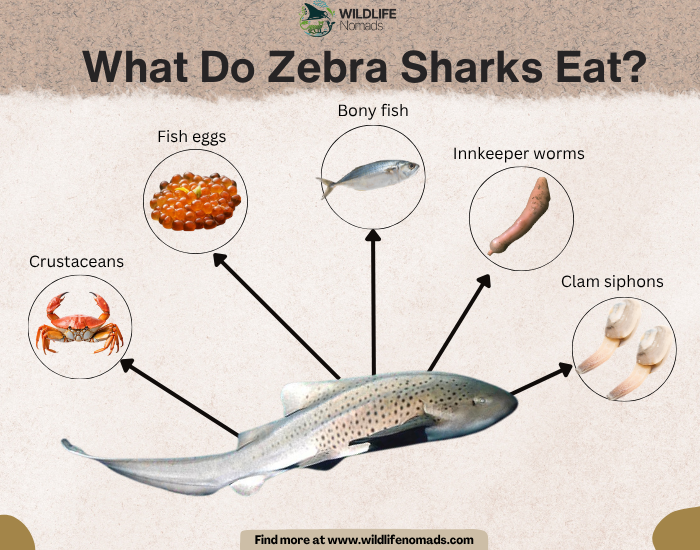
The zebra shark feeds primarily on bottom-dwelling prey. They are not interested in large fish or marine mammals. Instead, the zebra shark feeds primarily on molluscs like snails and clams, crustaceans like crabs and shrimp, and occasionally small bony fish, especially small coral fish sheltering in coral rubble.
Their small mouth is surprisingly powerful. They use a suction-feeding mechanism to inhale prey from crevices and coral bottoms. Their thick, plate-like teeth then crush through tough shells with ease.
Therefore, if you see a zebra shark hovering close to the reef with its mouth slightly open, it is almost certainly on the hunt.
9. The Diplomats of the Reef
In my professional experience, zebra sharks are among the most docile shark species on the planet. They are essentially harmless to humans unless severely provoked.
Their slow, unhurried movement style, aided by those large pectoral fins, feels more like a golden retriever than a predator. They are the ideal species for introducing newcomers to shark conservation. Their calm presence changes the conversation around sharks more effectively than any campaign.

10. Their Eggs Look Like Mermaid’s Purses
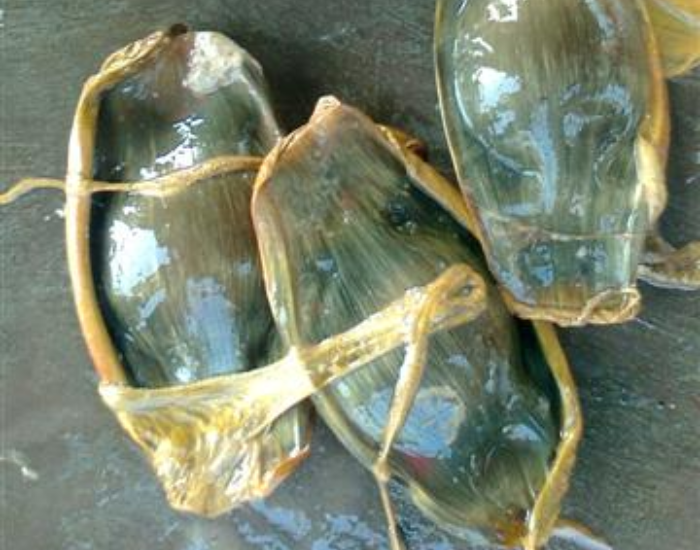
Zebra sharks are oviparous, they lay eggs rather than giving birth to live young. Each egg capsule measures roughly 17 cm and is encased in a tough, leathery dark brown shell with long, hair-like fibres on the outside.
Those hair-like fibres act as anchors, tangling onto coral or rocks so the egg does not wash away. Inside, the pup develops for approximately five to six months before hatching as a fully independent mini shark, complete with its juvenile dark stripes. In addition, the hatchlings already display the same species-specific colouring pattern that will later transform into spots.
11. They Face a Serious Extinction Risk
Outside of Australia, the global picture for zebra sharks is grim. The IUCN lists them as Endangered on its Red List. They are heavily targeted across much of their range.
Fishers take them for human consumption, their meat is often sold dried, as well as for their liver oil and their fins for the shark fin trade. Despite what people assume, shark fin soup demand remains a significant driver of zebra shark mortality across Asia. Because the species grows slowly and produces small litters, populations in heavily fished regions cannot recover.
In addition, blast fishing across the Indo-West Pacific has destroyed the shallow coral reefs these sharks depend on. Coral bottoms that once supported abundant reef life across Southeast Asia now lie barren. In some regions, zebra sharks have disappeared entirely from their historic range.
12. The World-First Shark Rewilding Project
There is real hope. The ReShark coalition, a global collective of over 90 conservation organisations, launched the StAR Project (Stegostoma tigrinum Augmentation and Recovery) in 2020. It became the world’s first shark rewilding program.
The project sources fertilised eggs from accredited aquariums in Australia and the United States. These eggs travel up to 12,000 kilometres to two in-situ nurseries in Raja Ampat, Indonesia, one on Kri Island (RARCC) and one at the Misool Foundation’s site on Batbitim Island. As the species grows in the nursery pens, pups are released into strictly protected no-take zones at around 100 cm in length.
As of January 2026, 57 zebra sharks have been successfully released into the waters of Raja Ampat. The long-term goal is 500 releases within ten years, enough to restore a self-sustaining, genetically diverse wild population in the heart of the Coral Triangle.
FAQs About Zebra Sharks
No. Zebra sharks are docile and slow-moving. They will not attack divers unless severely provoked or cornered. They rank among the safest shark species to encounter in the wild.
Zebra sharks live throughout the tropical Indo-Pacific and Indo-West Pacific — from the Red Sea and East Africa to Australia and Japan. They prefer shallow coastal waters around coral reefs and sandy flats, usually at depths of less than 62 metres.
The zebra shark feeds primarily on bottom-dwelling invertebrates — molluscs, crustaceans, and occasionally small fish. They use powerful suction to extract prey from narrow crevices and coral bottoms.
Adult zebra sharks develop distinctive dark brown spots on a pale yellow-brown background — making spotted adults look exactly like a leopard. Scientists use ‘zebra shark’ internationally to avoid confusion with the true leopard shark (Triakis semifasciata) of the Eastern Pacific.
Overfishing for human consumption, the shark fin trade, and blast fishing that destroys shallow coral reefs are the primary threats. Because the species grows slowly, populations in heavily fished regions cannot recover without direct conservation intervention.
Why This Shark Deserves Your Attention
Swimming with zebra sharks at dawn at Julian Rocks was a reminder of why I became a biologist. This species is a masterpiece of evolution, from its flexible body and sensory barbels to its dramatic transformation from dark stripes to spots as the species grows.
The zebra shark sits at a critical crossroads. In Australia, healthy populations thrive on shallow coral reefs. Across the Indo-West Pacific, the story is far darker. The ReShark StAR Project offers genuine hope, but conservation requires public attention and support.
If you ever visit Julian Rocks or any Indo-Pacific reef, look for the long caudal fin resting on the sand. Remember: you are not just looking at a leopard of the ocean, you are looking at an endangered species that needs your voice to survive.
Zebra Shark Biology & Science Quiz
Ten fun study questions covering color pattern transformation, taxonomy, virgin births, suction feeding, and global rewilding efforts. Test your retention!
Multiple Choice
References
Dudgeon, C. L., Coulton, L., Bone, R., Ovenden, J. R., & Thomas, S. (2017). Switch from sexual to parthenogenetic reproduction in a zebra shark. Scientific Reports, 7(1), 40537. https://doi.org/10.1038/srep40537
Dudgeon, C. L., Broderick, D., & Ovenden, J. R. (2009). IUCN classification zones concord with, but underestimate, the population genetic structure of the zebra shark Stegostoma fasciatum in the Indo-West Pacific. Molecular ecology, 18(2), 248–261. https://doi.org/10.1111/j.1365-294X.2008.04025.x
Dharmadi, Fahmi, & White, W. T. (2015). Species composition and aspects of the biology of Orectolobiformes from Indonesian waters. Journal of fish biology, 86(2), 484–492. https://doi.org/10.1111/jfb.12569
Momota, K., Kiyatake, I., Izawa, T., Aihara, H., Kuraku, S., & Nishida, K. (2025). First case of parthenogenesis in an intersexual zebra shark (Stegostoma tigrinum) having incomplete claspers. Journal of fish biology, 107(4), 1248–1255. https://doi.org/10.1111/jfb.70122
Dudgeon, C. L., Blower, D. C., Broderick, D., Giles, J. L., Holmes, B. J., Kashiwagi, T., … Ovenden, J. R. (2012). A review of the application of molecular genetics for fisheries management and conservation of sharks and rays. Journal of Fish Biology, 80(5), 1789–1843. https://doi.org/10.1111/j.1095-8649.2012.03265.x
Dudgeon, C.L., Simpfendorfer, C. & Pillans, R.D. (2019) Stegostoma fasciatum Indian Ocean-Southeast Asian subpopulation (Indian Ocean-Southeast Asian subpopulation) (amended version of 2016 assessment). The IUCN Red List of Threatened Species 2019: e.T71711476A161304736. https://dx.doi.org/10.2305/IUCN.UK.2019-3.RLTS.T71711476A161304736.en.
National Geographic. (2024, April). 500 baby sharks to be released: An exclusive look at an unprecedented mission. https://www.nationalgeographic.com/magazine/article/shark-rewilding-indonesia-oceans-conservation-zebra