
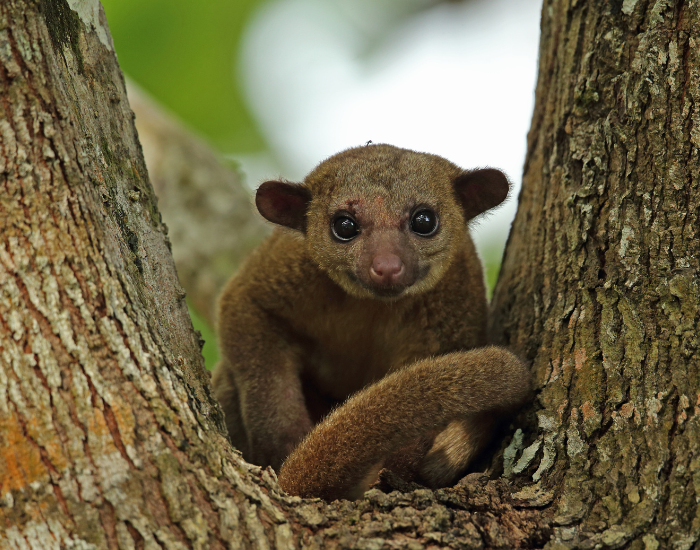
I’I’ll be honest with you, while I have spent years in the natural environment of various mammalian species, I have yet to spot a kinkajou in the wild. I’ve seen them in the Chapultepec Zoo, where they look like soft, golden plush toys come to life, but in the tropical rainforests of Central and South America, they are masters of invisibility. They stay high in the rainforest canopy, far above the reach of a biologist’s boots.
Because I haven’t had that “eureka” moment in the jungle with them yet, I’ve spent countless hours diving into the natural history and natural history records provided by institutions like the scientific articles and National Geographic. What I found is a creature that defies simple categorization. Is it a type of primate? A type of bear? A lemur?
Let’s peel back the canopy and look at the science of these fascinating nocturnal animals.
1. They are the “Golden Ghosts” of the Procyonidae Family
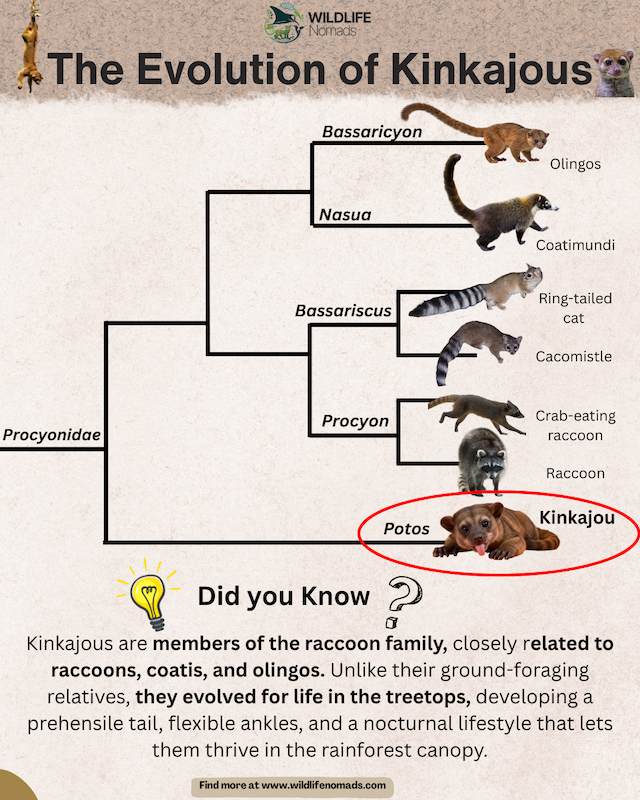
The first thing you may think when you spot one is: “is a kinkajou a monkey?“. It’s a fair question. They have a prehensile tail, they live in trees, and they are incredibly agile. However, taxonomically, kinkajous (Potos flavus) are not primates.
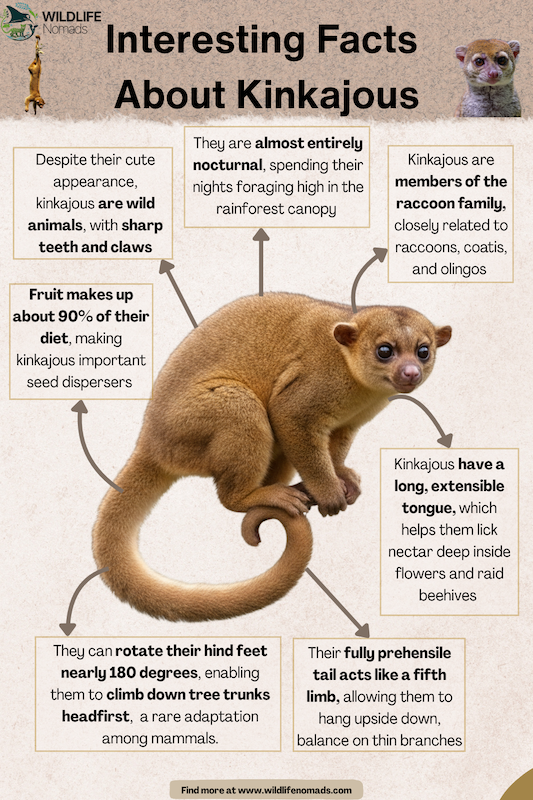
They belong to the family Procyonidae, which is part of the order Carnivora. This family includes raccoons, ringtails, and the coatimundi, all of which share a common evolutionary ancestor. The family Procyonidae is known for its members’ adaptability and omnivorous diets, and its evolutionary history places kinkajous as relatives of other small to medium-sized mammals within Carnivora. While monkeys evolved to dominate the trees during the day, the procyonid lineage produced the kinkajou to rule the daylight hours by sleeping and the night by foraging.
Let’s talk science for a second. The Procyonidae family diverged from other carnivores millions of years ago. While their ancestors were carnivores, kinkajous evolved to be primarily frugivorous. They share many traits with the coati, but while the coati is diurnal (active in the day), the kinkajou took the night shift. This “niche partitioning” is a classic example of evolution reducing competition between closely related species.
2. The “Honey Bear” Alias isn’t Just About Their Fur
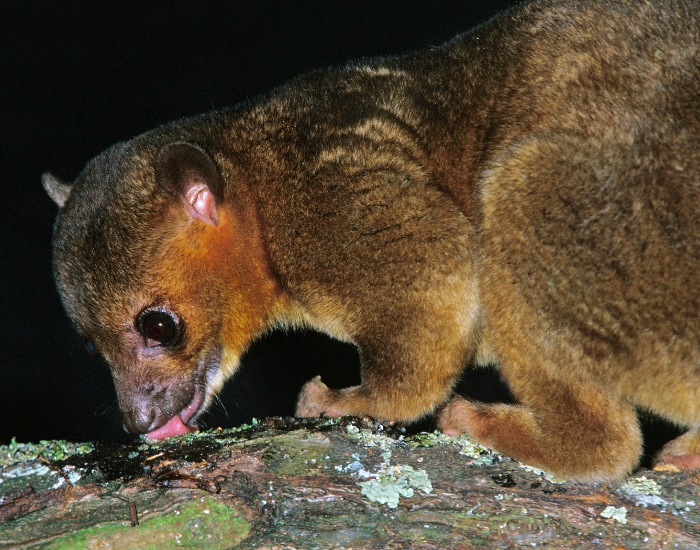
You’ll often hear the kinkajou honey bear referred to by its sweet nickname. While their thick, woolly fur is a beautiful honey-gold, the name honey bear animal actually comes from their feeding behavior. They have a literal “sweet tooth.” These animals are obsessed with raiding beehives to lick nectar and honey.
3. They Possess a Literal “Fifth Arm”
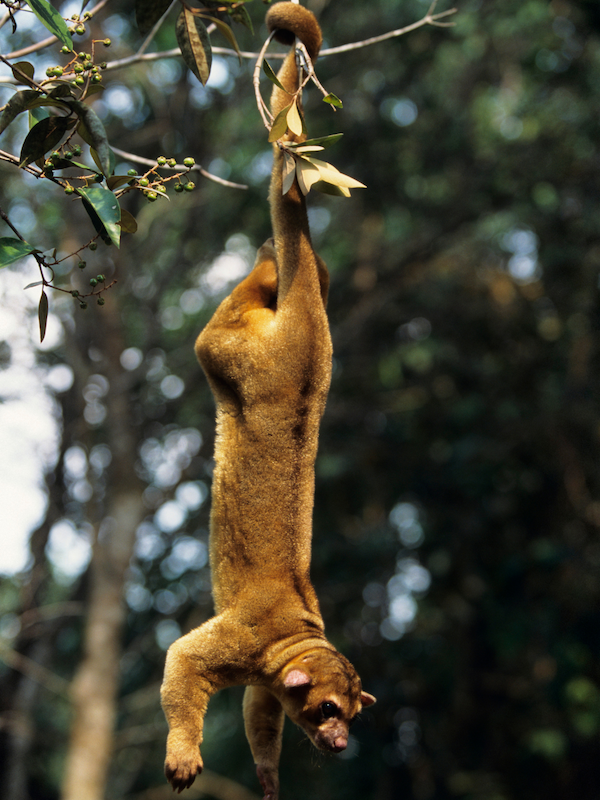
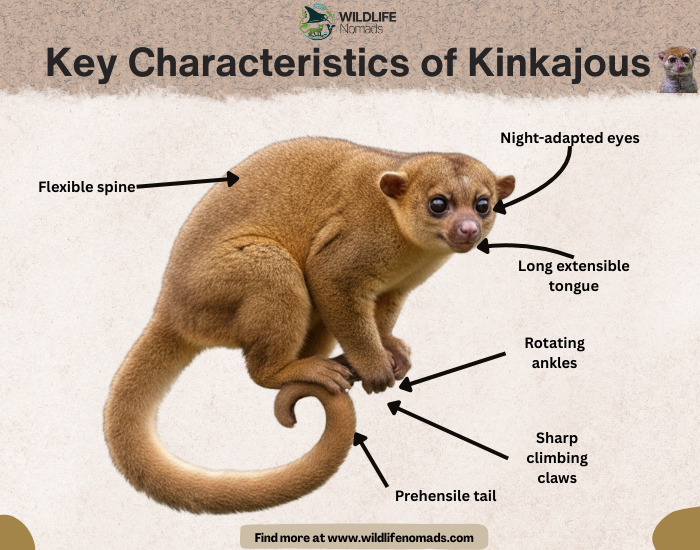
One of their most distinctive features is the fully prehensile tail. In the world of biology, we call this a “fifth arm.” Unlike many other mammalian species in South America, the kinkajou can support its entire weight with just its tail. I’ve watched them at the zoo hang upside down to reach softer fruits on lower tree limbs, leaving their hands free to peel or grab.
The typical head and body length of a kinkajou ranges from 40 to 60 centimeters (16 to 24 inches), which is similar to or slightly smaller than some related procyonids like the olingo, but with a more robust build.
4. Their Feet Can Turn 180 Degrees
This is a biological marvel. To navigate the rainforest canopy efficiently, kinkajous can pivot their ankles in the opposite direction, allowing them to rotate their hind feet completely backward. This adaptation enables them to run down trees headfirst or scramble along tree limbs with equal ease. It’s an adaptation for a life lived entirely in the shaded tangles of the high forest.
5. They are Primarily Frugivorous (But Not “Picky”)
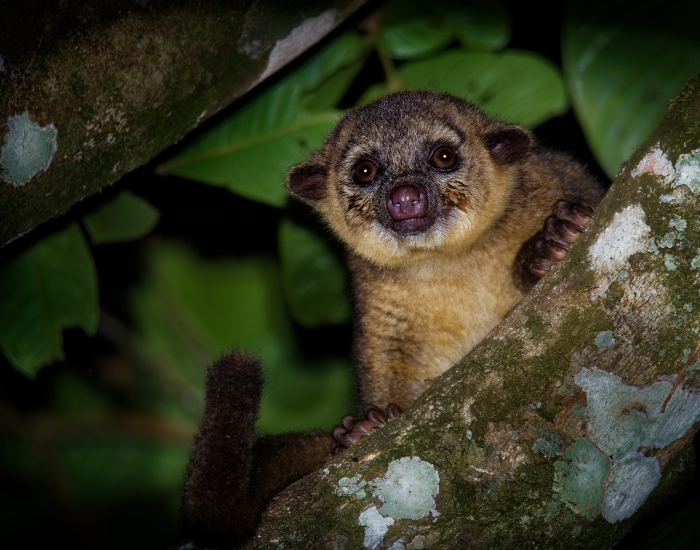
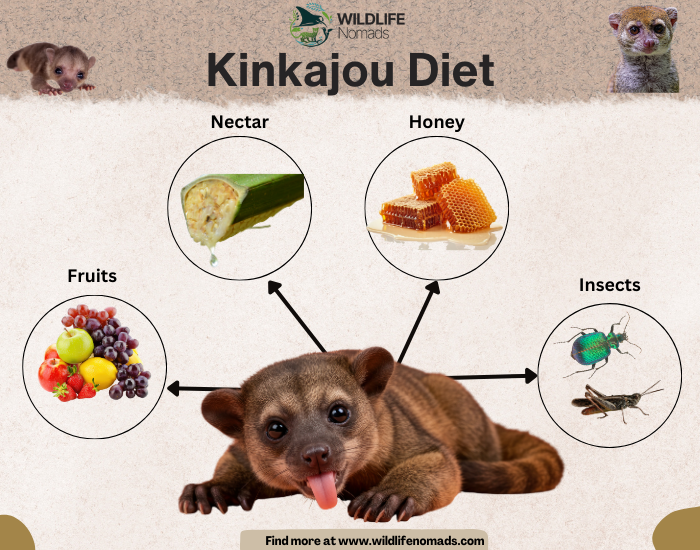
The diet kinkajous have is primarily fruit-based. About 90% of their diet consists of fruit, reflecting their strong food preferences as frugivores, with a particular fondness for figs and softer fruits. Their feeding behavior plays a crucial ecological role, as they act as pollinators and seed dispersers in tropical rainforests, helping maintain the health and diversity of their ecosystem.
Kinkajous occasionally eat insects, flowers, and nectar, which make up the remaining 10% of their diet.
6. Their Tongue is a Secret Weapon
An extensible tongue is not something you expect on a creature that looks like a cross between a puppy and a monkey. Their tongue is roughly 5 inches long! This allows them to reach deep into flowers to lick nectar, making them important pollinators in the tropical forests.
7. They Travel the “Highways” of the Canopy
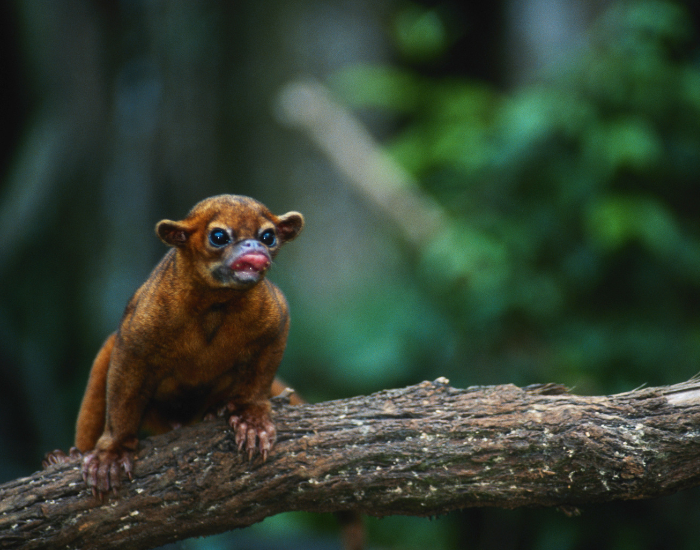
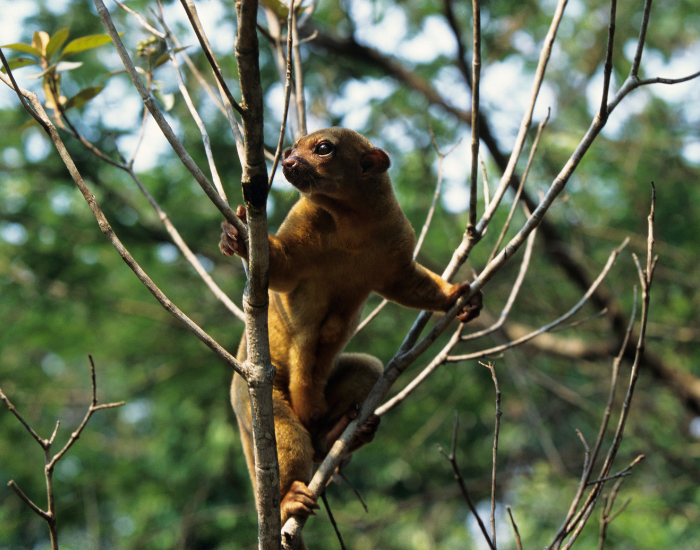
The kinkajous habitat isn’t just “the forest”, it’s specifically the upper layers. They rarely, if ever, descend to the forest floor.
Kinkajous are tree-dwelling mammals, specially adapted for life in the rainforest canopy with prehensile tails and flexible feet that help them move easily among the branches.
In Central America and Southern Mexico, they use the interlocking tree limbs as a private highway system to avoid main predators like the harpy eagles.

8. Scent Marking is Their Social Media
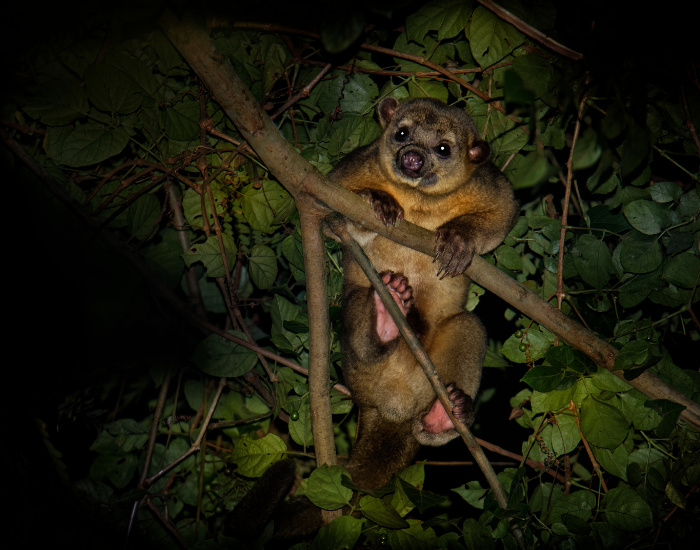
Since they are nocturnal animals, visual cues aren’t very helpful. Kinkajous are known for their keen sense of touch and smell, which helps them navigate and communicate in the dark, but they have poor vision and cannot see color. Instead, they have scent glands located on their chest, throat, and face. They use scent marking to leave “messages” for other kinkajous about territory and reproductive status.
9. They Experience a “Long Life” for Their Size
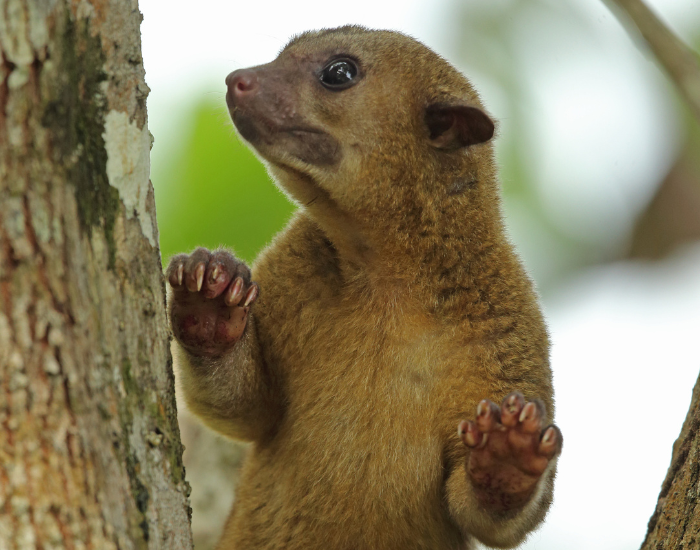
How long do kinkajous live? In the wild, it’s hard to track, but in captivity, they can live for 40 years or more. This is a long life for a small mammal, and it’s a crucial factor for anyone considering the pet trade.
10. The “Two Males” Social Structure
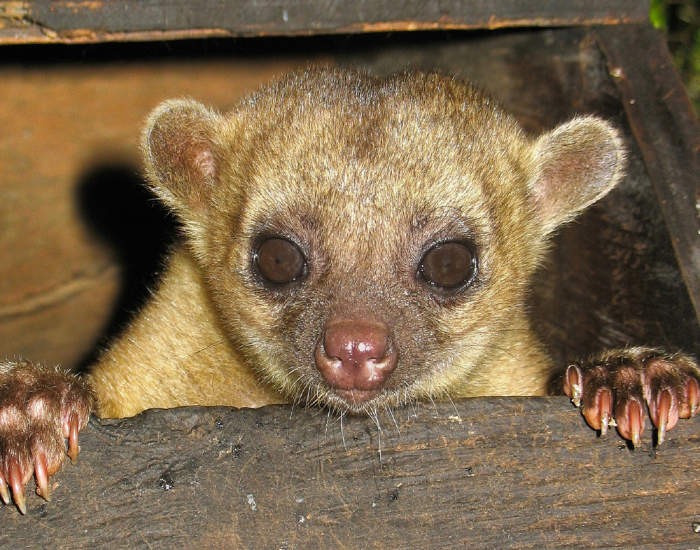
Their social organization and social behavior are fascinating. Unlike many species where one male dominates a harem, a typical kinkajou group consists of two males, one female, and her offspring. The males are surprisingly social with one another, often grooming and sleeping together in tree hollows.
11. They are Loud Neighbors
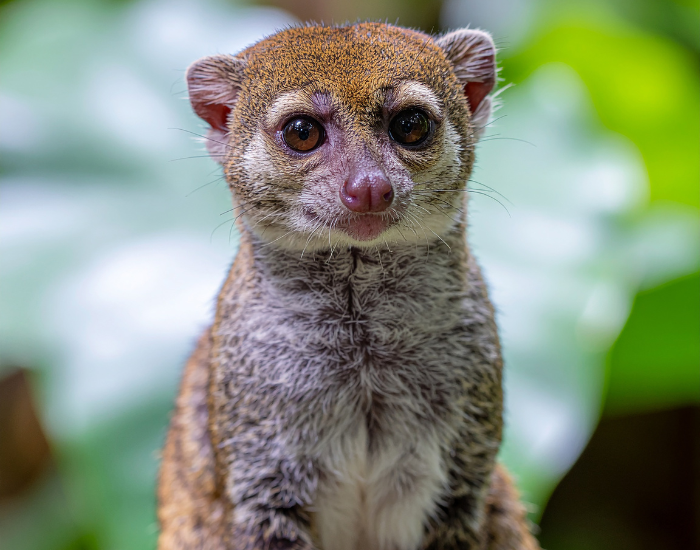
If you were to stay in a natural environment in Costa Rica, you wouldn’t just see a kinkajou; you’d hear one. They have a range of vocalizations, from barks to shrill screams. Their peak activity occurs when most of the world is asleep, making them the rowdy neighbors of the jungle.
12. Are Kinkajous Good Pets? (The Hard Truth)
This is the “Google favorite” question: are kinkajous good pets? As a biologist, my answer is almost always a firm “No.”
While they look cute, they are wild animals. In the pet trade, they are often sold as “exotic” companions, but they are a still a lifelong commitment.
- They are nocturnal, meaning they will be most active (and loud) while you are trying to sleep.
- They have sharp teeth and sharp claws. Even a “tame” one can cause serious injury.
- They require a very specific diet; an improper diet can lead to metabolic bone disease and a shortened lifespan.
13. The Danger of the Kinkajou Bite
What happens if a kinkajou bite you? It’s not just the sharp teeth you have to worry about. Kinkajous carry a bacterium called Kingella potus, which can cause severe infections in humans. If you are bitten, it’s an immediate trip to the doctor, not just for stitches, but for heavy-duty antibiotics.
14. “Least Concern” Doesn’t Mean “Safe”
On the IUCN Red List, kinkajous are listed as Least Concern. However, this is a bit misleading. Their populations are heavily dependent on old-growth tropical forests. As deforestation hits Central America and South America, their natural history is being rewritten by habitat loss.
15. The “Mother Kinkajou” Bond
A mother kinkajou typically gives birth to just one offspring (sometimes two). The gestation period for kinkajous is about 112 to 118 days, which is an important part of their reproductive cycle and determines the timing of births. The bond is incredibly strong, and the baby will stay with her for up to a year, learning the complex “map” of the canopy and which softer fruits are safe to eat. During oestrus, males may follow females for several hours to establish mating opportunities.
16. They are Not “Golden Monkeys”
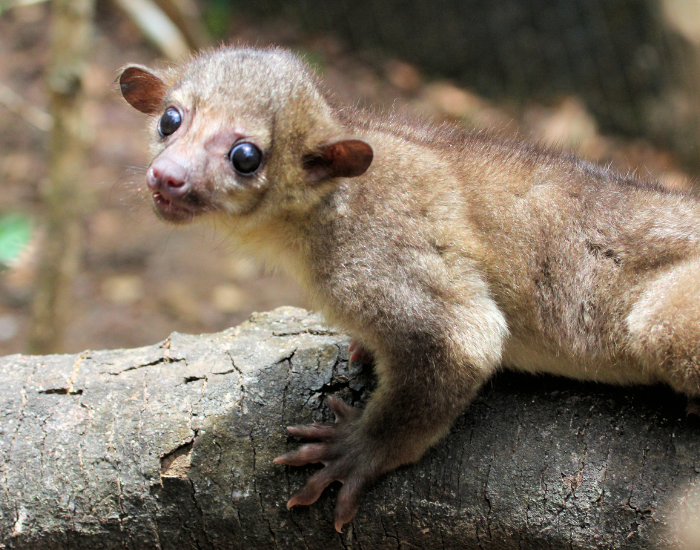
Despite the kinkajou monkey label often used in the pet trade, remember: they have more in common with the raccoon at your trash can than the monkey in the tree. Their physical characteristics, like the round head and short limbs, are perfectly tuned for a life of “stealth” rather than the “brute force” climbing of some primates.
Kinkajou FAQ: Quick Hits
It is another name for the kinkajou, inspired by its golden fur and its habit of eating honey and nectar from beehives.
In the wild, they are generally shy. However, if cornered or kept in captivity, they can become very aggressive, using their sharp teeth and claws to defend themselves.
While some people do, it is a lifelong commitment that most people are not prepared for. They are high energy, nocturnal, and can be dangerous if they bite.
Their kinkajou range extends from Southern Mexico through Central America to Southern Brazil. They live exclusively in tropical forests and rainforest canopies.
A Note from a Biologist
As a biologist, my goal is always to see these animals thrive where they belong. The kinkajou is a masterpiece of specialized evolution. From their scent glands to their 180-degree rotating feet, every part of them says “I belong in the trees.”
If you want to support these “honey bears,” the best way isn’t to buy one, but to support conservation efforts in Central and South America that protect the rainforest canopy. Organizations like the WWF and local conservancies in Costa Rica are doing the real work to ensure the “Golden Ghost” keeps haunting the night.trees headfirst.
Where to see Kinkajous?
As a biologist, I only recommend tours that follow strict ethical guidelines to ensure we don’t disturb wildlife. These are the three tours/ partners I trust most based on their conservation records:
This blog is reader-supported. When you buy experiences through links listed on this site, we may earn an affiliate commission.