
The first hornbill I ever saw was standing on a sign.
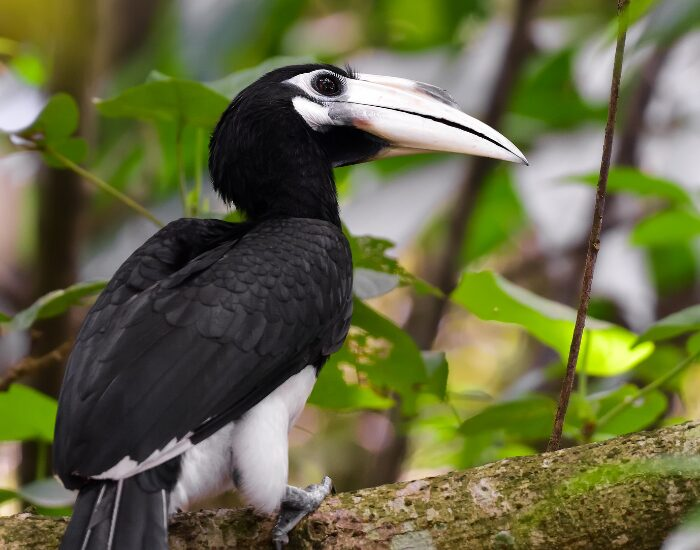
April 2024, Langkawi. I had flown to the Malaysian island for a month, and on my third day I walked down to the beach. Not the crystal-clear kind from the brochures. I turned around and there it was, an Oriental Pied Hornbill perched on a beach sign a few metres from me, that casque-topped bill in full view.
I grew up around parrots and macaws in the Americas, and I have spent five years watching kookaburras in Australia. But I had never seen a hornbill. The bill alone rearranges your sense of what a bird is allowed to look like.
A year later I met the genus again in the Philippines, driving north across Palawan in a rental car. I took it for the same bird. It was not. Oriental Pied Hornbills do not reach the Philippines at all, so what I was watching was the Palawan Hornbill (Anthracoceros marchei), a Vulnerable endemic restricted to Palawan and a few neighbouring islands. Same genus, same heavy cream bill, but the white sits in the tail rather than the belly.
Two birds that look near identical through a car window. One is Least Concern across half of Asia. The other holds one island group and is heading the wrong way. That gap is the reason to learn this family properly, species by species.
The hornbill family is one of the most distinctive groups of birds on the planet, and one of the most ecologically loaded. From the Great Hornbill of Asian rainforests to the terrestrial Southern Ground Hornbill of African savannas, these are seed dispersers and predators that shape the forests they live in. They are also, despite what the bill suggests, nothing to do with toucans. I will come back to that mix-up shortly.
If you are new to birdwatching, hornbills are a good place to start. They are large, loud, and once you have seen one you do not mistake it for anything else.

What Makes Hornbills Special?
Before I explore specific types of hornbill birds, let’s understand what sets these creatures apart from other bird species. The hornbill bird family, scientifically known as Bucerotidae, comprises approximately 62 known species distributed across tropical and subtropical regions of Africa, Asia, and Melanesia.
The defining characteristic of hornbills is their long, down-curved bill which is frequently brightly colored and sometimes has a horny casque on the upper mandible. This casque isn’t just for show – it serves multiple purposes including amplifying vocalizations, attracting mates, and in some species, providing structural support for the massive bill.

But First, Let’s Clarify…Are Hornbills and Toucans Related?
Here’s where things get interesting, and where many people get confused. Despite their superficial similarities, the hornbill family (Bucerotidae) is not closely related to the toucan family at all. This is a perfect example of convergent evolution – when unrelated species develop similar features to thrive in comparable environments.
Toucans reside in Central and South America, while hornbills are found only in Africa and Asia. While both have large, colorful bills adapted for fruit-eating, the crushing strength of the hornbill beak is six times greater than that of the toucan. Additionally, most hornbills have a distinctive beak feature called a casque and toucans don’t have it.
14 Types of Hornbills: Asian and African Species
Now, let’s explore the magnificent diversity within the hornbill family. I’ve selected 14 species that showcase the incredible range of sizes, habitats, and behaviors found among these remarkable birds.
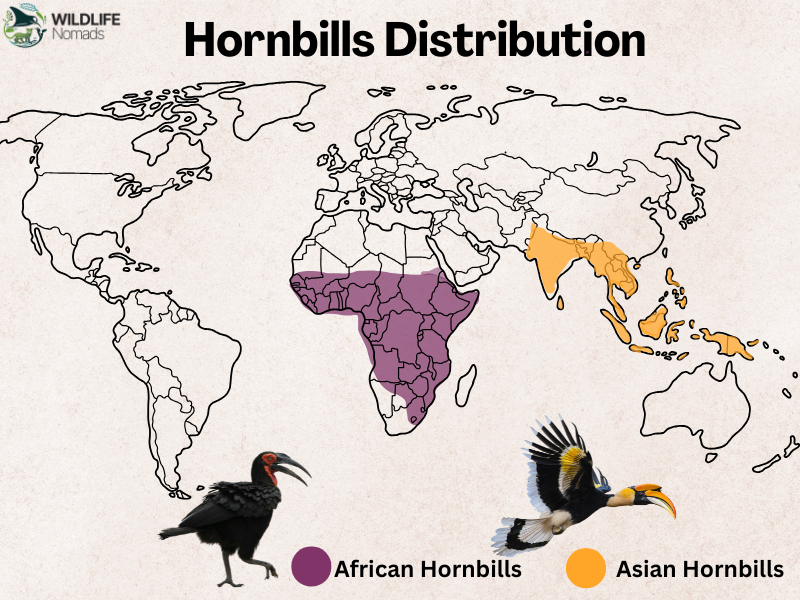
To be clear, hornbills are only found in Africa and Asia, with no native species in the Americas or Australia. Their range stretches from sub-Saharan Africa across the Indian subcontinent, Southeast Asia, and into the Philippines and parts of Indonesia.
So, What is Malesia?
Malesia is a biogeographical region that includes:
- Peninsular Malaysia
- Indonesia
- The Philippines
- New Guinea
- Brunei
- East Timor
It overlaps with parts of Southeast Asia and Australasia and is used in botany and zoology to describe species distributed in this tropical region.
Asian Hornbill Species
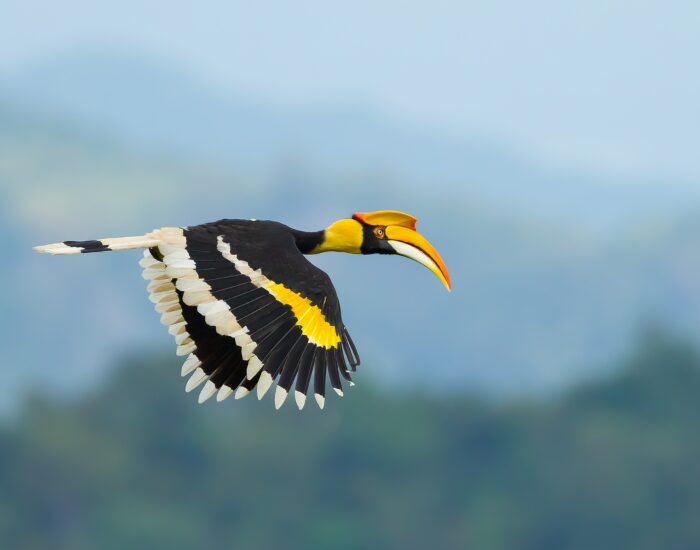
1. Great Hornbill (Buceros bicornis)
The Great Hornbill stands as the flagship species of Asian hornbills, and for good reason. This magnificent bird can reach lengths of up to 130 cm (51 inches) with a wingspan exceeding 1.5 meters. Native to the forests of India, Southeast Asia, and southern China, the Great Hornbill sports a massive yellow and black casque that can account for up to 10% of its body weight.
These forest giants play crucial roles as seed dispersers, particularly for large-seeded fruits that smaller animals cannot handle. Unfortunately, habitat loss and hunting pressure have led to their classification as Vulnerable by the IUCN.
2. Helmeted Hornbill (Rhinoplax vigil)
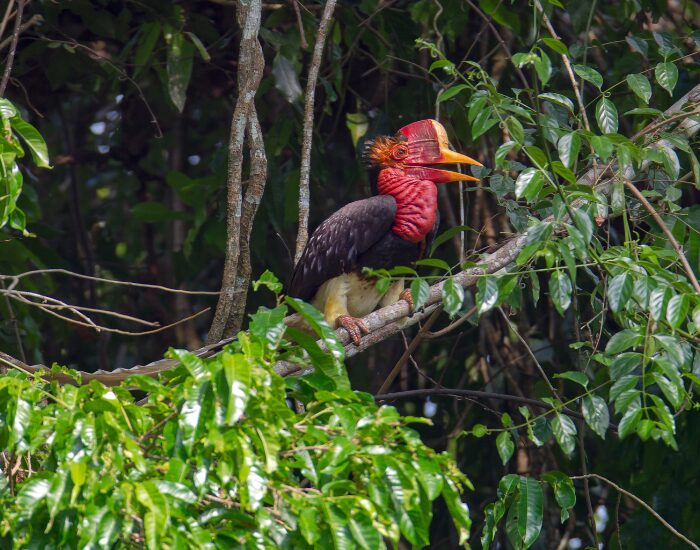
Perhaps the most unique among all hornbill species, the Helmeted Hornbill possesses the only solid casque in the entire family. This distinctive feature has unfortunately made it highly threatened by hunting pressure fueled by the value placed on its red casque, called “hornbill ivory” in the illegal wildlife trade.
In 2015, its official status on the IUCN Red List was changed from Near Threatened to Critically Endangered literally overnight. The demand for their casques has driven prices to over $1,000 per piece on black markets, making conservation efforts desperately urgent.
3. Rhinoceros Hornbill (Buceros rhinoceros)
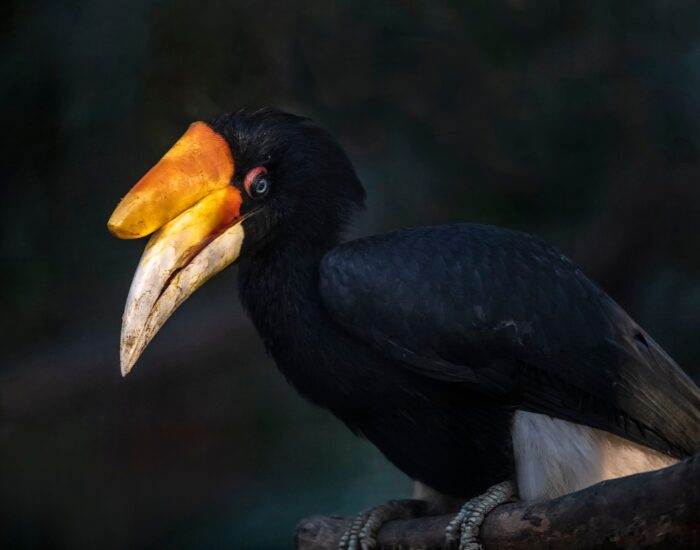
The Rhinoceros Hornbill serves as the national bird of Malaysia and represents one of the most visually striking hornbill species. Its prominent orange and red casque curves upward like a rhinoceros horn, giving the species its common name. These birds inhabit the lowland forests of Borneo, Sumatra, Java, and the Malay Peninsula.
Males can reach lengths of up to 122 cm, making them among the largest hornbills in Asia. Their distinctive calls can be heard from over a kilometer away, serving as important communication tools in dense forest environments.
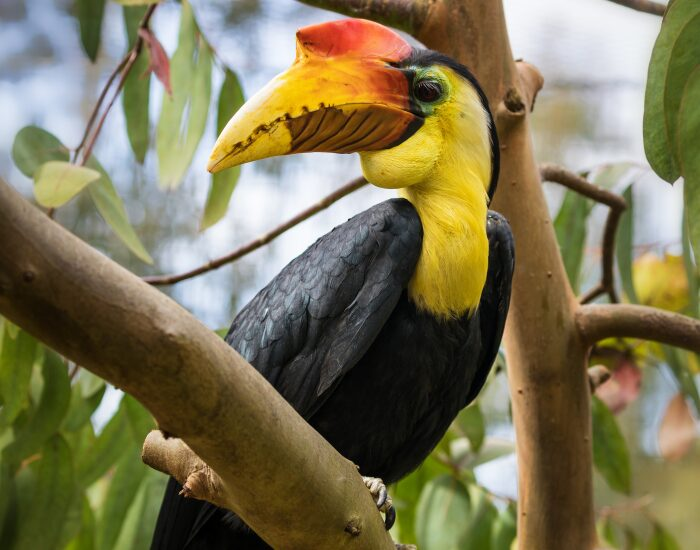
4. Wreathed Hornbill (Rhyticeros undulatus)
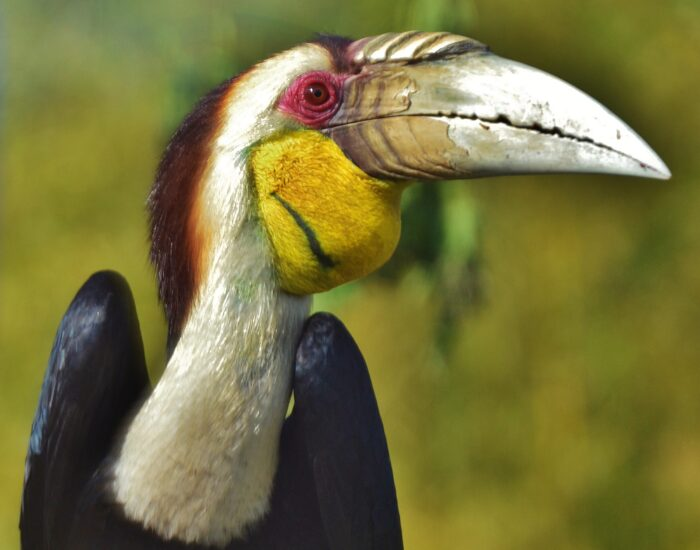
The Wreathed Hornbill gets its name from the distinctive ridged pattern on its casque, which resembles decorative wreath work. Found across Southeast Asia from India to Indonesia, these medium-sized hornbills prefer hill and mountain forests up to elevations of 2,000 meters.
What makes Wreathed Hornbills particularly interesting is their diet composition – they consume more fruit than many other hornbill species, making them especially important for forest regeneration and seed dispersal.
5. Oriental Pied Hornbill (Anthracoceros albirostris)
One of the smaller Asian hornbills, the Oriental Pied Hornbill displays striking black and white plumage with a prominent cream-colored casque. These adaptable birds have shown remarkable resilience, successfully inhabiting both primary forests and secondary growth areas, including parks and gardens in urban environments.
Their ability to adapt to human-modified landscapes has helped maintain stable populations in many regions, though they still face pressure from habitat conversion and hunting.
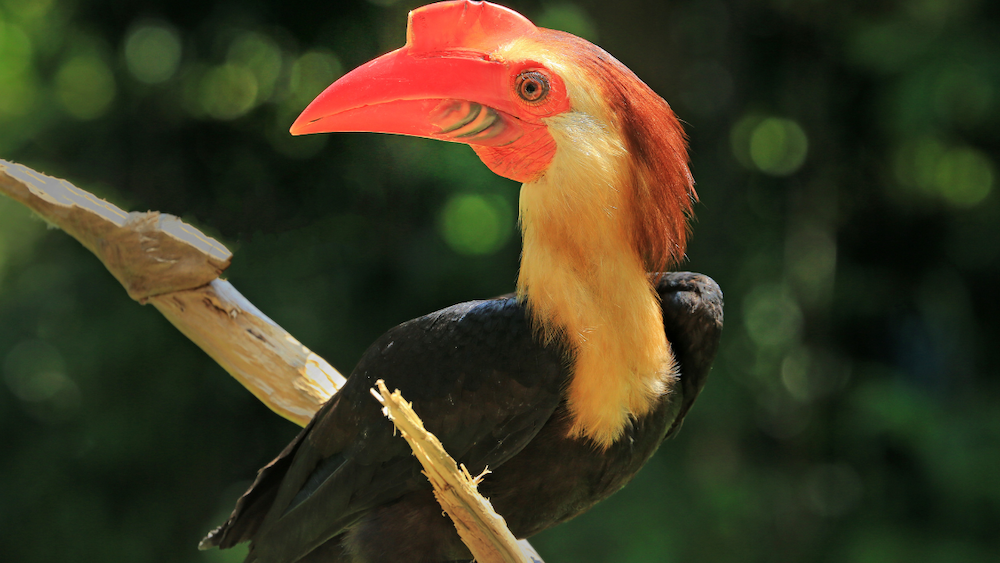
6. Wrinkled Hornbill (Rhabdotorrhinus corrugatus)
The wrinkled hornbill, or Sunda wrinkled hornbill, is an Endangered bird species that is endemic to Sumatra, Kalimantan and Malay Peninsula, and central to Indigenous culture in Indonesia. These medium-sized hornbills get their name from the wrinkled appearance of their throat skin.
The species faces significant threats from deforestation and hunting, leading to fragmented populations across their limited range.
African Hornbill Species
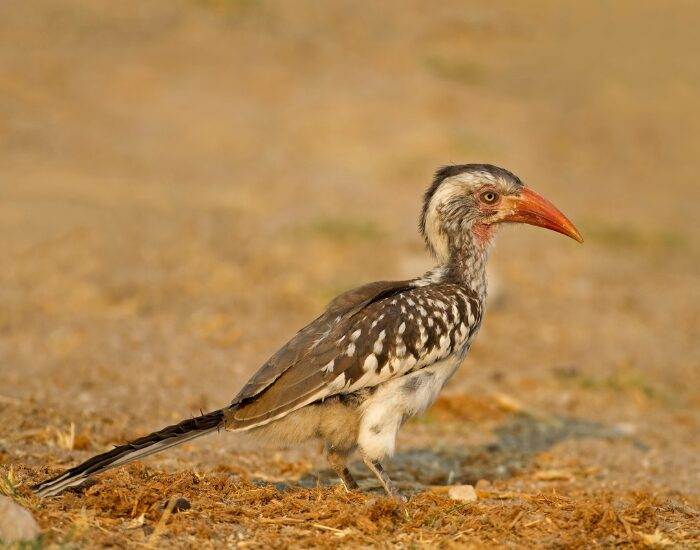
7. Red-billed Dwarf Hornbill (Tockus camurus)
While technically found in parts of West Africa, the Red-billed Dwarf Hornbill represents one of the smallest members of the hornbill family at 38 cm, second only to the black dwarf hornbill. These tiny hornbills lack the prominent casque found in larger species, instead sporting a slightly curved red bill.
Their small size allows them to exploit food sources unavailable to larger hornbills, including small insects and berries that would be impractical for their giant relatives to pursue.
8. Southern Ground Hornbill (Bucorvus leadbeateri)
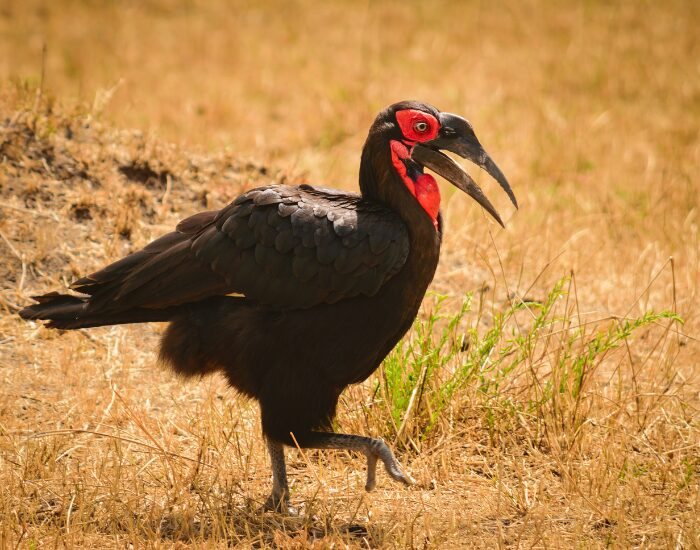
The Southern Ground Hornbill breaks the mold of typical hornbill behavior by being primarily terrestrial. These massive birds, weighing up to 6.2 kg, spend most of their time walking across African savannas hunting for insects, small mammals, and reptiles.
The Southern Ground Hornbill is listed as Vulnerable across their range. However, in South Africa they have been listed as Endangered. Their slow reproductive rate – once every five years on natural cavities, improving to once every two to three years where nest-boxes were provided, makes population recovery extremely challenging.
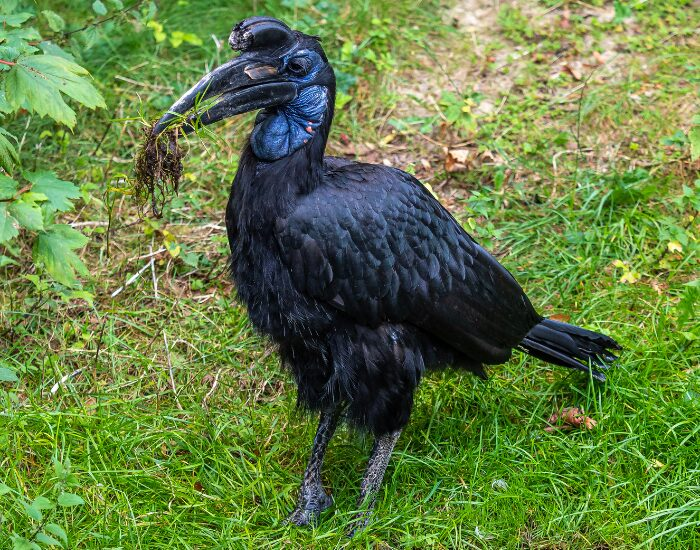
9. Abyssinian Ground Hornbill (Bucorvus abyssinicus)
The northern counterpart to the Southern Ground Hornbill, the Abyssinian Ground Hornbill inhabits the grasslands and savannas of sub-Saharan Africa. These birds display similar terrestrial habits but can be distinguished by their slightly smaller size and different facial skin coloration.
Like their southern relatives, Abyssinian Ground Hornbills face significant conservation challenges due to habitat loss and human persecution, as they’re sometimes viewed as agricultural pests.
10. Trumpeter Hornbill (Bycanistes bucinator)
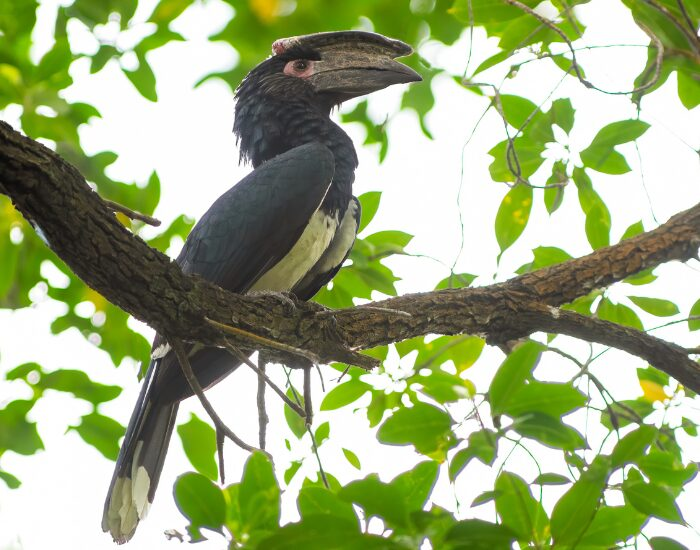
The Trumpeter Hornbill represents one of Africa’s most widespread hornbill species, found from Ghana to South Africa. These medium-sized birds get their name from their loud, trumpeting calls that carry far through forest canopies.
Trumpeter Hornbills demonstrate remarkable social behavior, often gathering in large flocks of 50 or more individuals during fruiting seasons, creating spectacular displays as they move through forest canopies.
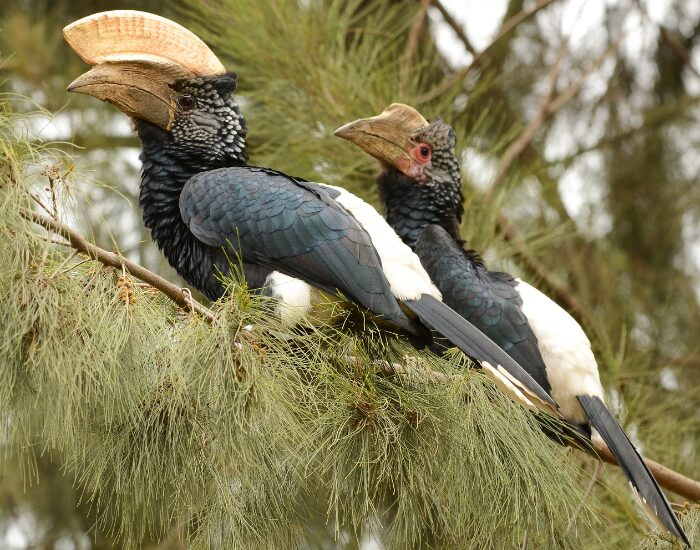
11. Silvery-cheeked Hornbill (Bycanistes brevis)
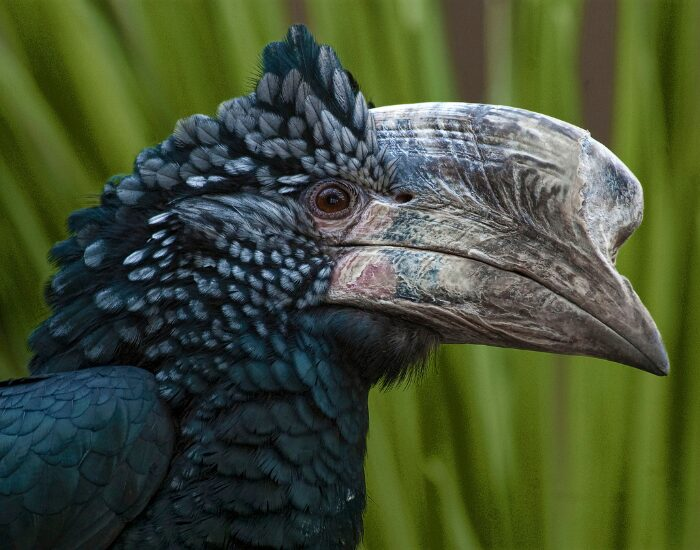
Endemic to East Africa, the Silvery-cheeked Hornbill stands out with its distinctive silver-white cheek patches contrasting against dark plumage. These large hornbills prefer highland forests and have adapted well to fragmented habitats, though they still require large trees for nesting.
Their ability to travel long distances between forest patches makes them important seed dispersers for maintaining genetic diversity in plant populations across landscapes.
12. White-thighed Hornbill (Bycanistes albotibialis)
Found in the dense forests of West and Central Africa, the White-thighed Hornbill represents one of the region’s most important seed dispersers. These birds can swallow fruits up to 4 cm in diameter, making them crucial for the reproduction of many large-seeded rainforest trees.
Their populations have declined significantly due to deforestation and hunting pressure, particularly in regions where they’re hunted for bushmeat.
13. Black-and-white-casqued Hornbill (Bycanistes subcylindricus)
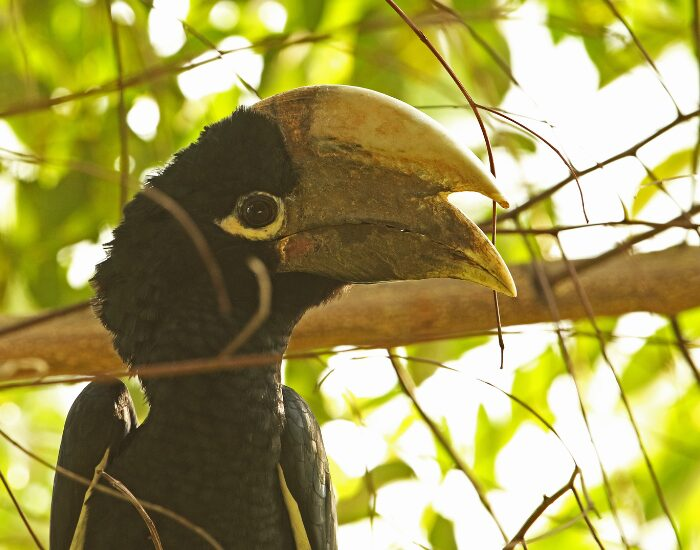
This distinctive African species displays striking black and white plumage with a prominent pale casque. Found primarily in the forests of West and Central Africa, these hornbills prefer dense canopy environments where their loud calls help maintain contact between individuals.
Climate change poses emerging threats to this species as shifting precipitation patterns affect fruit availability in their forest habitats.
14. Yellow-casqued Hornbill (Ceratogymna elata)
Completing our list, the Yellow-casqued Hornbill represents one of West Africa’s most distinctive hornbill species. Males develop impressive bright yellow casques that serve both as status symbols and acoustic amplifiers for their territorial calls.
These birds face significant pressure from deforestation, with some populations showing declines of over 50% in recent decades.
Diet and Feeding Behaviors
Hornbills are primarily omnivorous, but their diets vary dramatically between species and habitats. Fruit makes up the majority of most hornbills’ diets, with some species consuming over 100 different fruit types throughout the year. This frugivorous lifestyle makes them incredibly important for forest ecosystems as seed dispersers.
The toucan has a long tongue to match its large beak, whereas the hornbill’s tongue is pretty short. Therefore, the toucan just sits on the tree and can reach all the fruits within the beak’s reach; the hornbill has to toss the food into the air and have it drop into its throat.
Ground hornbills break this pattern entirely, focusing primarily on animal protein including insects, small mammals, reptiles, and even young birds. Their powerful bills can crack open tough prey items that other birds cannot handle.
Larger forest hornbills often supplement their fruit diet with animal protein, particularly during breeding season when protein demands increase dramatically. Some species have been observed using primitive tools, manipulating sticks to extract insects from crevices.
Hornbill Habitats and Distribution
Understanding where hornbills live helps explain their incredible diversity. The hornbill family has successfully colonized an impressive range of habitats across three continents.
In Asia, hornbill species predominantly inhabit tropical and subtropical forests, from the dense rainforests of Borneo to the deciduous forests of India. Some species, like the Oriental Pied Hornbill, have adapted to secondary forests and even urban parks, while others, such as the Helmeted Hornbill, require pristine primary forest to survive.
African hornbills show even greater habitat diversity. While forest species like the Trumpeter Hornbill stick to dense woodland environments, the ground hornbills have carved out successful niches in open savannas and grasslands. This habitat specialization has allowed the hornbill family to exploit virtually every available ecological niche across their range.
Conservation Status and Threats
The conservation picture for hornbills is mixed but increasingly concerning. The International Union for Conservation of Nature (IUCN) Red List of Threatened Species notes that the overwhelming majority of hornbills are not in danger of becoming extinct. However, several species face severe threats that require immediate action.
Many hornbill species in Thailand are categorized as Endangered or Critically Endangered on the IUCN Red List, highlighting regional conservation challenges. The primary threats include:
Habitat Loss: Deforestation represents the most significant threat to most hornbill species. These birds require large territories and mature forests for nesting, making them particularly vulnerable to logging and agricultural conversion.
Hunting Pressure: Some hornbill species face intense hunting pressure for their meat, feathers, and casques on the illegal pet trade. The helmeted hornbill crisis exemplifies how valuable body parts can drive species toward extinction.
Climate Change: Shifting precipitation patterns and temperature changes affect fruit availability, potentially disrupting the delicate timing between hornbill breeding cycles and food abundance.
Human-Wildlife Conflict: Ground hornbills sometimes face persecution when they raid crops or are perceived as threats to livestock.
FAQ you may Have about Hornbills
No, and they are not closely related. Hornbills belong to the family Bucerotidae in Africa and Asia; toucans belong to Ramphastidae in Central and South America, closer to woodpeckers. The resemblance is convergent evolution, not shared ancestry.
Meanings vary by culture, but strength, leadership and passage between worlds recur throughout the hornbill’s range. The Dayak people of Borneo treat hornbills as sacred messengers between the earthly and spiritual realms, and the rhinoceros hornbill is the national bird of Malaysia. Across African traditions, ground hornbills appear in folklore as figures of leadership and wisdom. In several Southeast Asian cultures hornbills also stand for marital loyalty, which fits birds that are monogamous and often mate for life.
The Bird Dinosaurs Worth Saving
The 14 types of hornbills I’ve explored represent just a fraction of the incredible diversity within this remarkable bird family. From the massive Great Hornbill soaring through Asian rainforests to the terrestrial Southern Ground Hornbill stalking across African savannas, each species has evolved unique solutions to survival challenges.
These horn billed birds serve as far more than just beautiful wildlife – they’re ecological engineers that shape entire forest ecosystems through their seed dispersal activities. Their presence indicates healthy, functioning forests, while their absence often signals ecosystem degradation.
Hornbill Visual Identification Quiz 📸
Look closely at each photo from the article and identify the correct hornbill species from the options provided!
Which type of hornbill is pictured above?
References:
Carstens, K. F., Kassanjee, R., Little, R. M., Ryan, P. G., & Hockey, P. A. R. (2019). Breeding success and population growth of Southern Ground Hornbills Bucorvus leadbeateri in an area supplemented with nest-boxes. Bird Conservation International, 29(4), 627–643. https://doi.org/10.1017/S0959270919000108
Hatten, C. E. R., Hadiprakarsa, Y. Y., Lam, J. Y. K., Mak, J., Toropov, P., & Dingle, C. (2024). Assessing the legal, illegal, and gray ornamental trade of the critically endangered helmeted hornbill. Conservation Biology, 38(5), e14358. https://doi.org/10.1111/cobi.14358
Reintar, A. R. T., Paguntalan, L. J., Jakosalem, P. G. C., Quidet, A. C. D., Warguez, D. A., & Peñaranda, E. (2022). Habitat preference and population density of threatened Visayan hornbills Penelopides panini and Rhabdotorrhinus waldeni in the Philippines. Journal of Threatened Taxa, 14(3), 20713–20720. https://doi.org/10.11609/jott.7261.14.3.20713-20720
Russo, N. J., Nshom, D. L., Ferraz, A., Barbier, N., Wikelski, M., Noonan, M. J., Ordway, E. M., Saatchi, S., & Smith, T. B. (2024). Three-dimensional vegetation structure drives patterns of seed dispersal by African hornbills. Journal of Animal Ecology, 93(12), 1935–1946. https://doi.org/10.1111/1365-2656.14202
Surapaneni, V. A., Flaum, B., Schindler, M., Hayat, K., Wölfer, J., Baum, D., Hu, R., Kong, T. F., Doube, M., & Dean, M. N. (2025). The helmeted hornbill casque is reinforced by a bundle of exceptionally thick, rod-like trabeculae. Annals of the New York Academy of Sciences, 1544(1), 78–91. https://doi.org/10.1111/nyas.15254