The world of insects is full of mimics, from leaf-like mantises to floral impersonators like the orchid mantis, but few are as hauntingly disguised as the ghost mantis! If you were walking through a dry thicket in the African continent or the lush landscapes of Madagascar, you would likely walk right past one without a second thought. The range of this species is Africa remarkable, with the ghost mantis found widely across the continent and its islands. To the untrained eye, it’s just another desiccated leaf clinging to a twig. To a predator, it’s invisible. But to the enthusiast, Phyllocrania paradoxa—the ghost mantis—is a crown jewel of the invertebrate world. They are a small species of mantis from Africa remarkable for its leaf-like body, very similar to the weird stick bugs and the insect leaf.
In this guide, we’re diving deep into the biology, behavior, and care of this species. These top 10 facts will reveal why the ghost praying mantis has captured the hearts of scientists and hobbyists alike.

1. The Master of Mimicry: Why They Are Called “Ghosts”
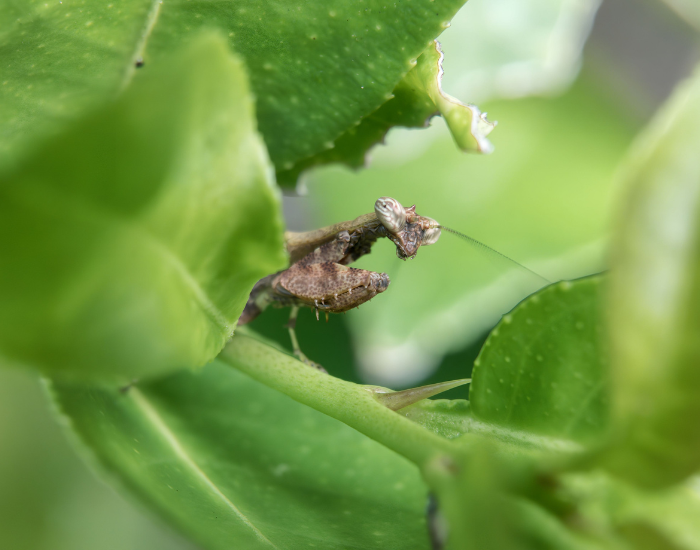
The primary reason for its name is the ghost mantis’s uncanny ability to remain unseen. Unlike the vibrant green praying mantis species we often see in gardens, the ghost leaf mantis has evolved to look exactly like dried up leaf material.
Its leaf like body isn’t just a color choice; it’s a structural masterpiece. This form of disguise is known as masquerade mimicry, similar to strategies seen in species like the orchid mantis, which mimics flowers, and certain moths (like the tarantula moth) that resemble bark or dead leaves.
The mantis displays more line details along its body and limbs, with intricate lines and edges that enhance its leaf-like appearance and camouflaging abilities. They possess an extended prothorax and leaf like protrusions on their limbs that break up their silhouette. In the wild, this allows them to sit motionless among dead leaves, waiting for an unsuspecting insect to wander too close.
2. A Spectrum of Earthy Tones
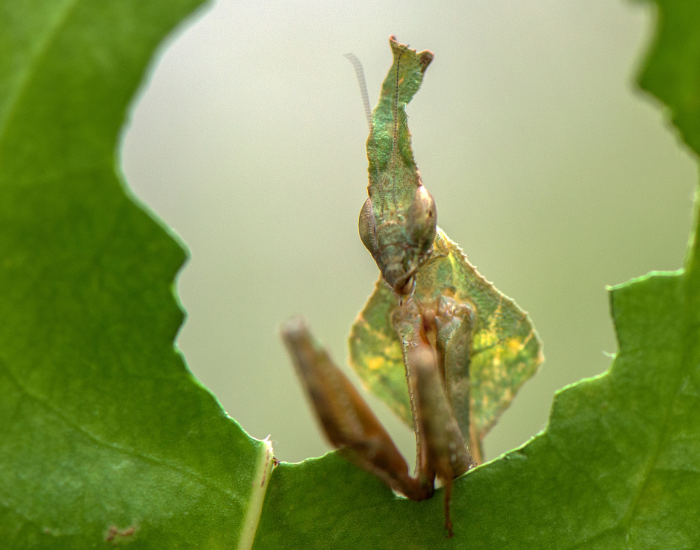
One of the most fascinating aspects of Phyllocrania paradoxa is that an individual’s colors change based on environmental factors. While they are most commonly found in various brownish shades, including dark brown and light brown, they can also appear in a greenish gray or even a dark, charcoal-like hue. Ghost mantises can be found in various colors, including dark brown, light brown, and green. At times, they are distinctly dark colored, especially when blending into dead leaves for camouflage.
Research suggests that humidity levels and temperature during the molt process influence the final color. Higher humidity often results in darker or greener tones, while a drier enclosure might produce a light brown or tan mantis. This plasticity ensures they stay camouflaged regardless of whether the season is wet or dry.

3. Native Origins: From Africa to Madagascar
The ghost mantis is a proud resident of the African continent, ranging from the eastern regions down to the south, and is also widely found in alongaise tother strange animals in Madagascar. In these habitats, they frequent shrubs, bushes, and trees where dead leaves are abundant.
Among the three species within the Phyllocrania genus, P. paradoxa is the most well-known. Because they are native to warm climates, they require a specific habitat ghost mantis setup in captivity that mimics the tropical and sub-tropical heat of their homeland.

4. Size and Stature: How Big Do They Get?
Compared to the giant Asian or African mantis, the ghost mantis size is relatively modest.
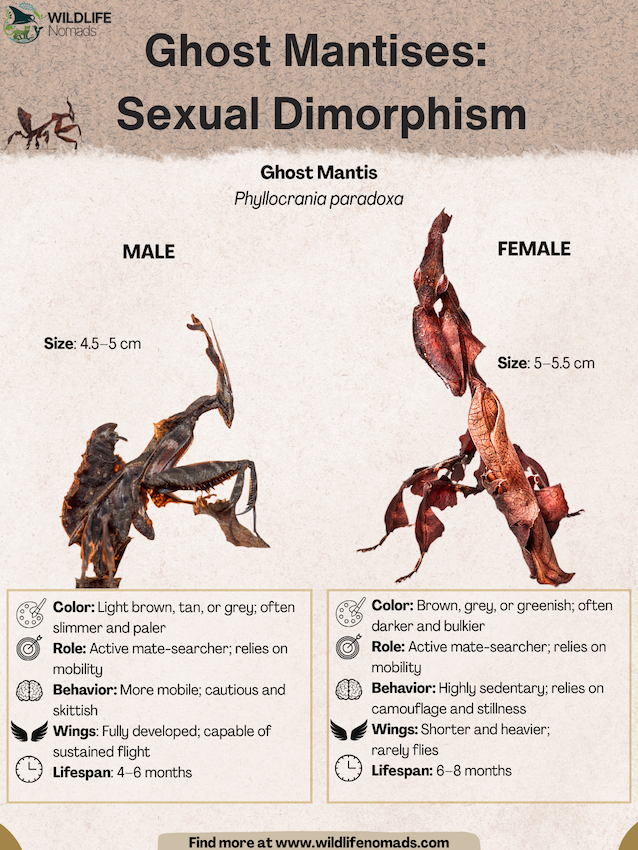
- Adult males: Usually reach about 45 mm to 50 mm.
- Adult females: Are a bit bigger, often reaching up to 50 mm to 55 mm.
Despite being a bit bigger, the females are much bulkier. When discussing how big does a ghost mantis get, it’s important to note that their leaf like body makes them look wider and more substantial than a significantly thinner species of the same length.

5. Sexual Dimorphism: Telling Males from Females
In the world of praying mantis species, sexual dimorphism is common, but with the ghost mantis, it’s a work of art.
| Feature | Adult Males | Adult Females |
| Abdomen | Eight segmented abdomens | Six segmented abdomens |
| Wings | Transparent wings (longer than body) | Shorter, leaf-mimicking wings |
| Antennae | Long and thick | Short and thin |
| Body Shape | Significantly thinner | Much broader, wider abdomen |
| Flight | Good flyers | Heavy, rarely fly |
The adult males also possess a very elongated head with a more jagged, “crown-like” protrusion compared to the females.
6. The “Gentle” Mantis: Temperament and Handling
A common question among is if are ghost mantises aggressive? The answer is: surprisingly, no. While they are lethal predators to flies and other insects, they are quite skittish and docile toward humans.
Can you handle a ghost mantis? Yes, you can hold my ghost mantis, or rather, let it walk onto your hand. They are not known to be “bitey,” and even if they did, their smaller appendages mean do ghost mantis bites hurt? No, not really. They are much more likely to play dead or hang upside down from your finger than to try and grab you.

7. Diet and Nutrition: What Do They Eat?
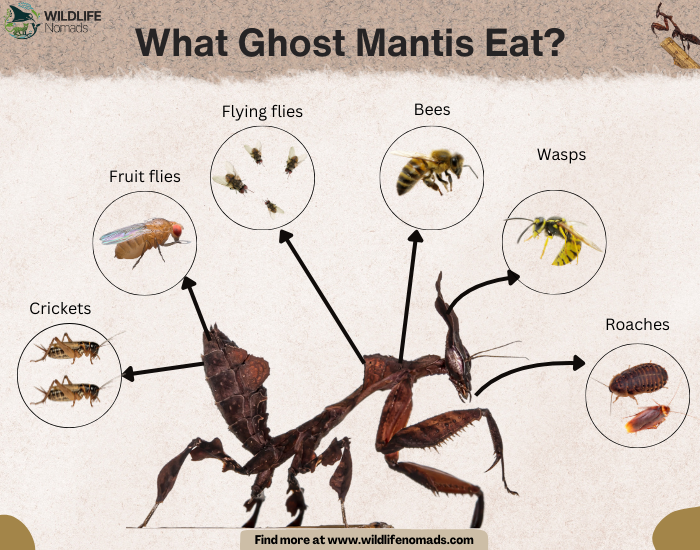
In the wild, the ghost mantis is an ambush predator. They don’t chase; they wait. Their preferred food consists of flying insects. In the wild, ghost mantises may also ambush passing pollinators such as honeybees or small wasps, though flying insects make up the bulk of their diet. Here are a few:
- Fruit flies: Specifically Drosophila melanogaster for nymphs and Drosophila hydei for young juveniles.
- Flies: Blue bottle and green bottle flies are the gold standard for adult mantids.
- Crickets: While some recommend crickets, many experts suggest caution. Crickets can carry parasites or even harm a molting mantis. If you feed crickets, ensure they are small and store-bought.
Because they have a “sit and wait” strategy, they are often less interested in “crawly” prey like roaches and more stimulated by the buzzing of a fruit fly.
8. The Ideal Enclosure: Creating a Mini-Madagascar
Setting up the right container is vital for a long lived pet. Because they are a smaller species, they don’t need a massive terrarium, but they do need vertical space.
- Enclosure size: A 1/1 ratio of width to length is fine, but the height should be at least 3x the length of the mantis. The enclosure should be at least three times the height and two times the width of the mantis to ensure proper space for movement and molting. A small 20x20x30 cm mesh or glass enclosure works perfectly.
- Ventilation: This is the “make or break” factor. You must have a mesh top. Using a mesh or fabric cover improves airflow and provides gripping surfaces, which are essential for safe molting. Mantids need to hang upside down to molt safely.
- Substrate: Use coco-husk or peat moss to help maintain humidity levels.
- Decor: Incorporate plenty of dried up leaf material and twigs. This isn’t just for looks; it makes the mantis feel secure.
9. Life Cycle and Longevity
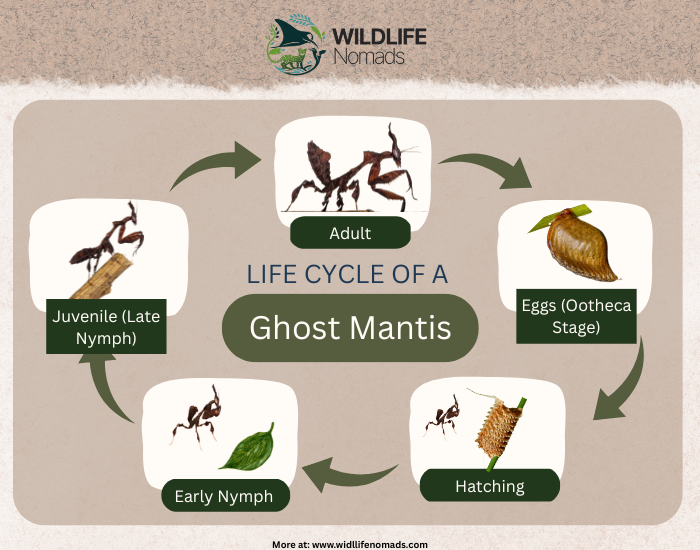
What is the lifespan of a ghost mantis? Generally, they live about 6 to 8 months after their last molt, totaling about a year from hatch. So not a very long lived animal!
The journey from a tiny nymph to an adult involves several stages. They will molt about 6 to 7 times. During a molt, the mantis will hang upside down and slide out of its old skin. It is crucial not to disturb them or feed them during this time, as they are incredibly fragile. A successful molt depends on proper humidity, if it’s too dry, they can get stuck and die.
10. Community Living: Can They Live Together?
One of the most awesome traits of the mantis ghost is their low level of cannibalism compared to other mantis species. Unlike other mantis species, which are typically aggressive and cannibalistic toward each other, ghost mantises are less aggressive and can often be housed together if provided with enough food and space.
While there is always a risk (they are still predators, after all), many keepers successfully house a dozen young or several adults together in a large, well-stocked terrarium. This makes them a unique choice for those looking to observe social (or at least tolerant) insect behavior.

FAQ: Your Ghost Mantis Questions
It is a species of mantis (Phyllocrania paradoxa) known for its camouflage that mimics dead leaves. It is native to Africa and is a popular pet due to its unique look and docile nature.
The Bible does not explicitly mention the praying mantis. However, the name “praying” comes from the way they hold their front legs, which looks like they are in prayer. In various cultures, they are seen as symbols of stillness and meditation.
Absolutely. They are considered one of the best “beginner” mantids. They are hardy, don’t require massive amounts of space, and are less likely to engage in cannibalism than other species.
A small container or terrarium (approx. 4-6 liters) is plenty. The most important thing is that the enclosure is at least 3 times the height of the mantis to allow for safe molting.

Why You Need a Ghost in Your Life
The mantis ghost is more than just an insect; it is a living piece of evolutionary art. From its elongated head to its transparent wings, every inch of Phyllocrania paradoxa is designed for survival through deception.
Caring for a ghost leaf mantis offers a window into the delicate balance of nature. By maintaining the right humidity, providing a steady supply of fruit flies, and respecting their molt cycles, you can witness the incredible transformation of a tiny nymph into a remarkable adult leaf mimic.
If you’re looking for a pet that is low-maintenance, visually stunning, and intellectually stimulating, the ghost mantis is an awesome choice. Just remember: if you can’t find them in their enclosure, don’t panic. They’re likely just doing what they do best—remaining unseen.