Meet the Kingfishers of Australia
When I first arrived in Australia, I didn’t expect my introduction to its birdlife to come from what sounded like a monkey. I was in a quiet suburb of Sydney — North Ryde, I’d already seen rainbow lorikeets and galahs — during my very first week in the country, when a wild, laughing call echoed through the trees. It was so strange that I stopped in my tracks. Anyone who’s heard a kookaburra knows exactly what I mean; that unmistakable cackling chorus that feels both comical and haunting. It didn’t take long to discover that this “monkey sound” came from one of Australia’s most iconic birds: the Laughing Kookaburra.
Kingfishers are among the most incredible Australian kingfisher birds, with blues, greens, and oranges. Their elaborate garb, including green plumage, makes them visually spectacular. Stocky birds with large heads and a kingfisher’s heavy beak make them unmistakable. Across the globe, there are over 80 types of kingfisher bird, and most species share similar characteristics and habitats. Australia is home to a portion of that worldwide kingfisher diversity. Around ten species live in this country (with other occasional visitors as you will see), each adapted to its own unique habitat, from rainforest streams to coastal mangroves.
Beyond their beauty, kingfishers are ecological indicators. They thrive in healthy ecosystems with plenty of prey, fish, reptiles, and small invertebrates, making them symbols of environmental balance. Kingfishers serve as indicators of a healthy ecosystem, reflecting biodiversity and the overall environmental balance.
Types of Kingfisher Bird in Australia
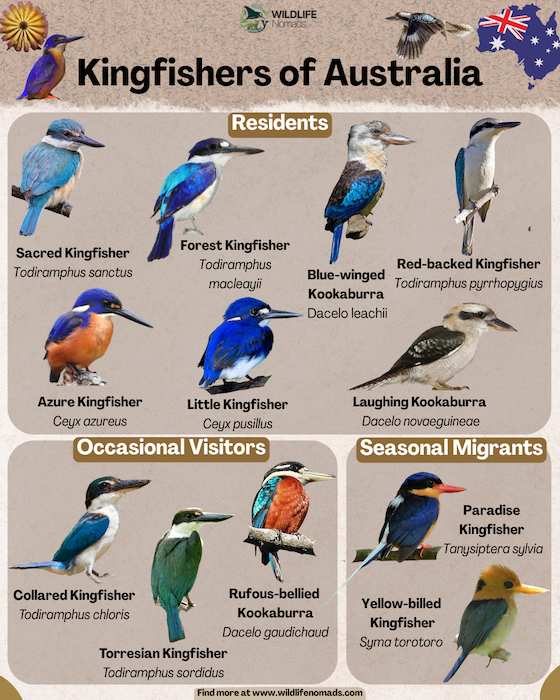
Australia’s kingfishers range from the tiny Little Kingfisher, hardly bigger than a sparrow, to the Laughing Kookaburra, the largest kingfisher in the world. There are several kingfisher species found across Australia, each with unique characteristics, habitats, and behaviors. Let’s meet them all.
Residents & Regular Breeders
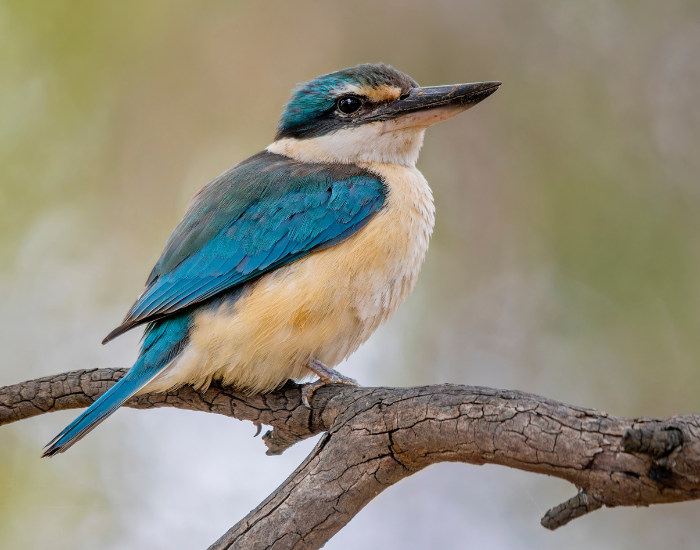
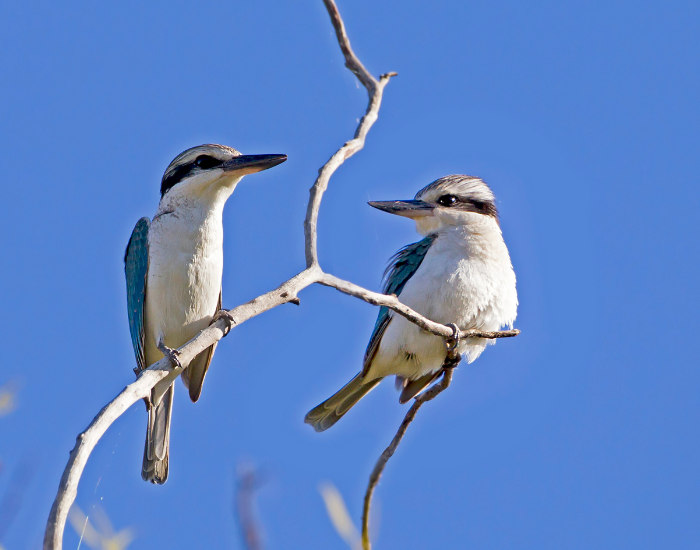
1. Sacred Kingfisher (Todiramphus sanctus)
One of the most widespread, the Sacred Kingfisher is a medium sized kingfisher inhabiting woodlands, mangroves, and open forests across mainland Australia. With its turquoise blue rump, buff-white underparts, buff edges on the wing coverts, and broad cream collar, it’s easily recognized.
They forage mainly on land, with sacred kingfishers foraging by perching on low exposed branches to spot prey such as insects, small reptiles, crustaceans, and occasionally capturing prey from water. The sacred kingfisher swoops down swiftly to catch its prey after spotting it. Birds perch strategically to enhance their hunting success.
Kingfishers nest during the breeding season, and both sexes excavate the nest burrow, which is typically located in a termite mound, hollow branch, or river bank. The nest chamber is an unlined space at the end of the burrow or hollow where eggs are laid and young are raised. Young birds can be identified by their duller plumage, buff edges on their feathers, and more pronounced markings on their wing coverts compared to adults.
Sacred kingfishers spend the winter in northern Australia and migrate south in spring to breed. For most of the year sacred kingfishers are solitary, pairing up only during the breeding season.
2. Forest Kingfisher (Todiramphus macleayii)
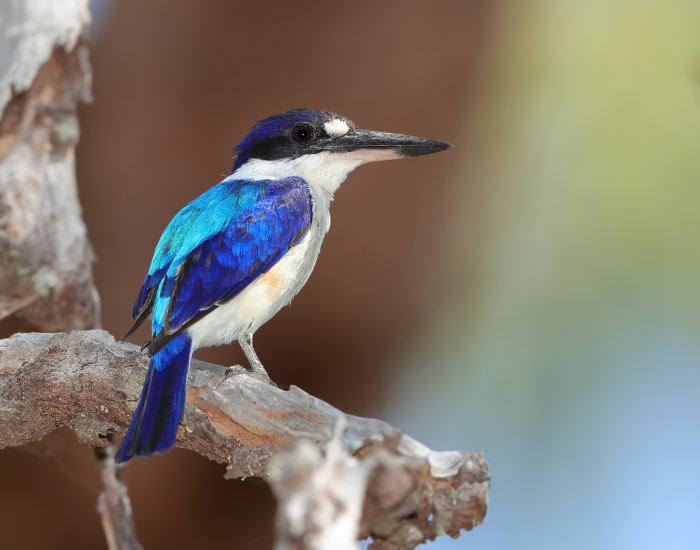
These medium-sized kingfishers dazzle with their deep blue wings and striking black eye-stripe. Found in rainforest streams, coastal regions, and tall open eucalypt forests, they are shy birds but often betray their presence with sharp, piercing calls.
3. Azure Kingfisher (Ceyx azureus)
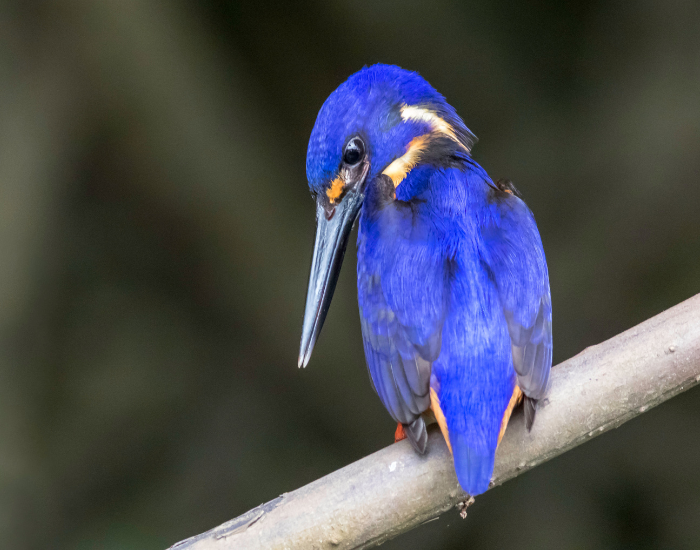
Arguably one of the most stunning kingfishers, the Azure Kingfisher is a jewel of Australia’s riverbanks. With bright azure plumage, an orange belly, and a long, pointed bill, they often perch on tree branches low over water, waiting patiently before diving headfirst to catch small fish and aquatic insects.
4. Little Kingfisher (Ceyx pusillus)
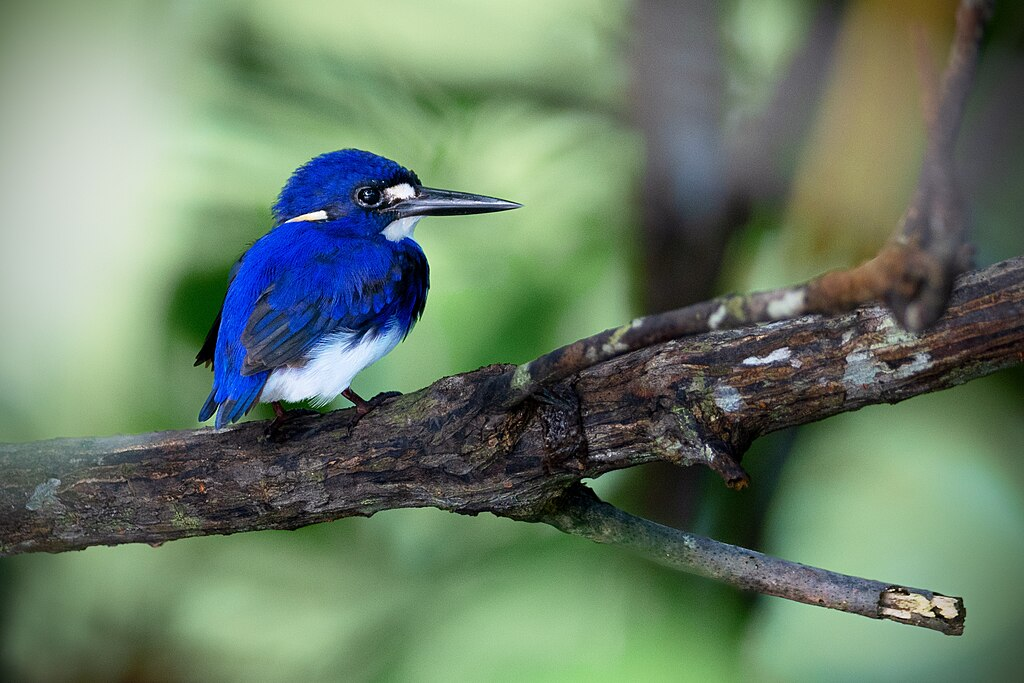
The Little Kingfisher is the smallest Australian kingfisher, barely 12 cm long. Despite its size, it’s bold and dazzling, cloaked in deep blue with white patches. Found along rainforest streams and mangroves, it specializes in small fish and aquatic invertebrates.
5. Red-backed Kingfisher (Todiramphus pyrrhopygius)
Adapted to Australia’s dry inland regions, the Red-backed Kingfisher stands out with rusty brown and blue wings, a broad black eye stripe, and a striking red rump. It prefers open woodlands and arid riverbanks, hunting small reptiles, insects, and occasionally prey larger than itself.
6. Blue-winged Kookaburra (Dacelo leachii)
Less famous than its laughing cousin, the Blue-winged Kookaburra has striking turquoise-blue wings and a powerful bill. Found across northern Australia, it often perches on exposed branches scanning for reptiles and small mammals.

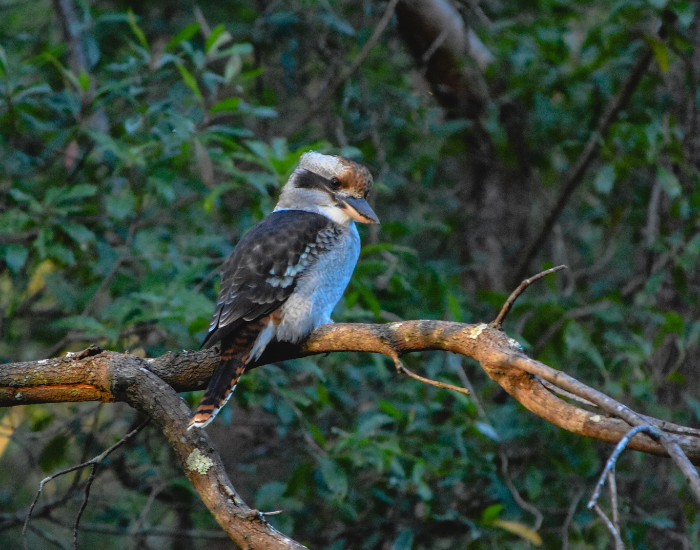
7. Laughing Kookaburra (Dacelo novaeguineae)
Perhaps the most iconic of all, the Laughing Kookaburra is the world’s largest kingfisher. With its heavy beak and hearty cackle that echoes through the bush, it’s both loved and feared. Aboriginal stories regard its laughter as a call to awaken the sun each morning.
Seasonal Migrants
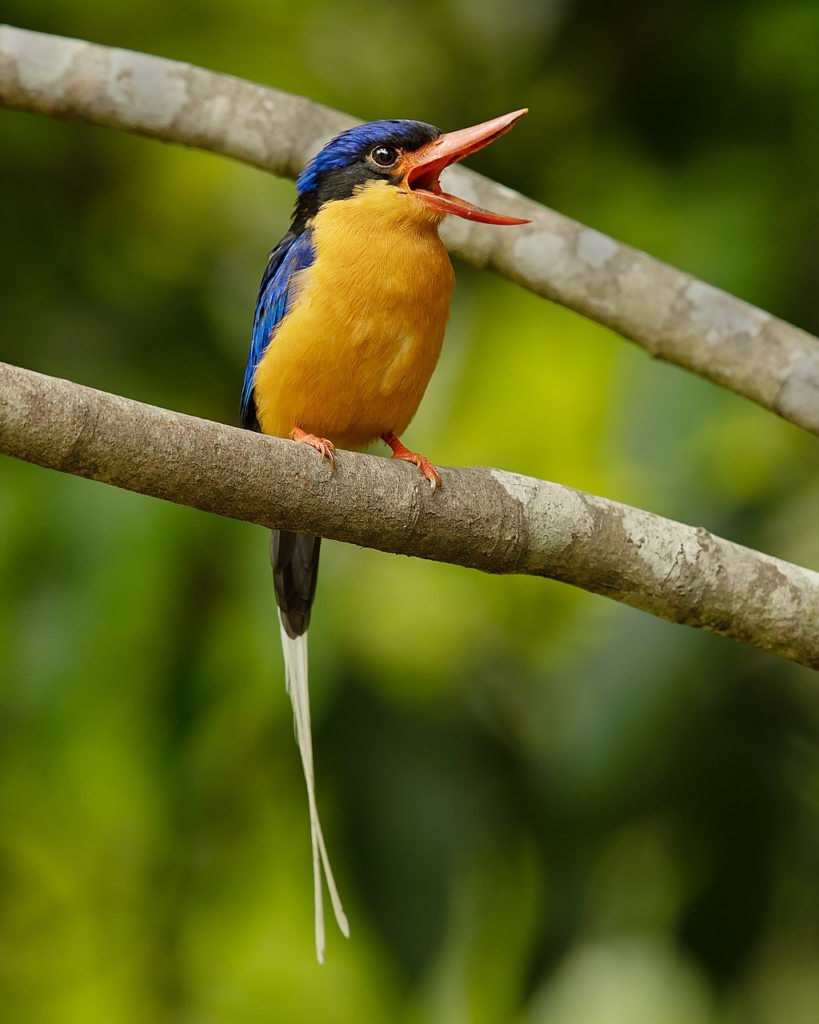
8. Buff-breasted Paradise Kingfisher (Tanysiptera sylvia)
One of the most elaborate of all Australian kingfishers, this migratory species arrives from New Guinea to breed in Queensland’s rainforests. With its long tail streamers, buff breast, and turquoise wings, it looks like something out of a dream.
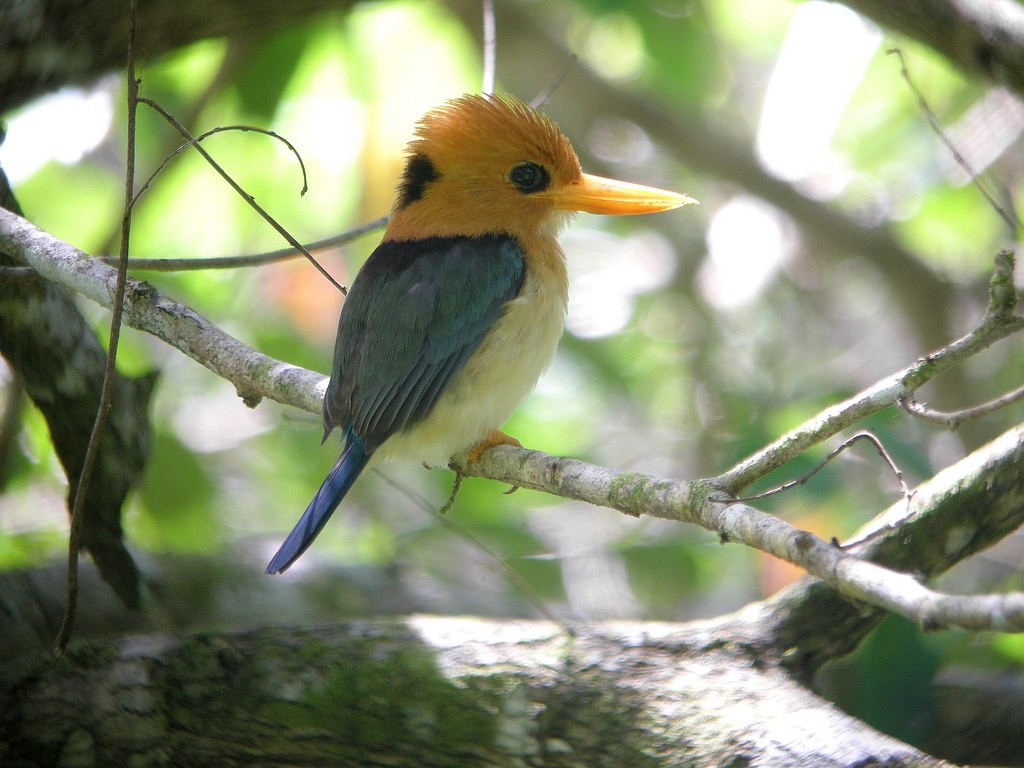
9. Yellow-billed Kingfisher (Syma torotoro)
A rare visitor from New Guinea, the Yellow-billed Kingfisher occasionally crosses into far northern Australia. As its name suggests, it sports a bright yellow bill with orange plumage and striking black wings.
Occasional or Rare Visitors
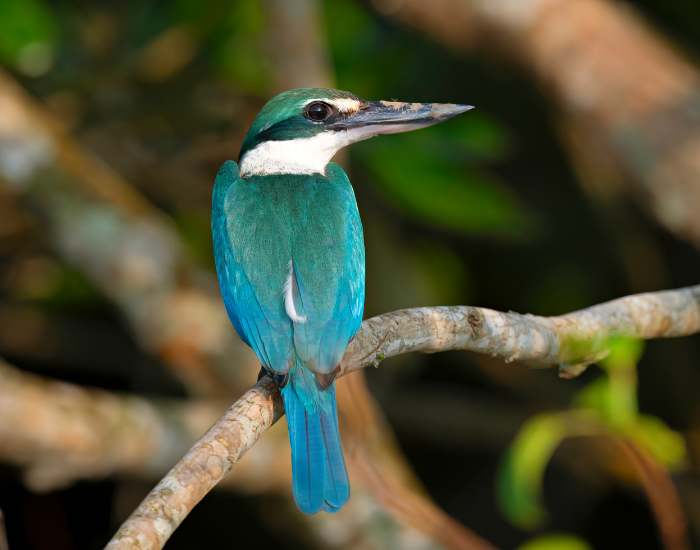
10. Collared Kingfisher (Todiramphus chloris)
Though more common in Asia and the Pacific, the Collared Kingfisher reaches northern Australia. With its broad cream collar and turquoise plumage, it’s often seen near coastal mangroves.
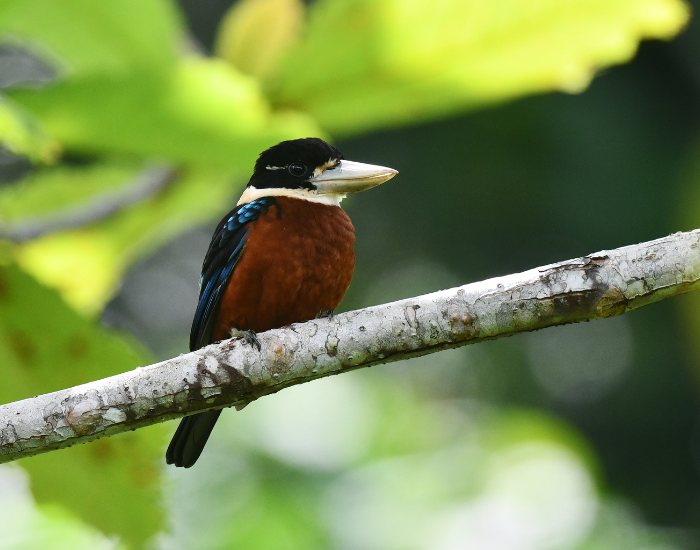
11. Rufous-bellied Kookaburra (Dacelo gaudichaud)
Native to New Guinea, this striking species occasionally visits Australia’s far north, particularly the Torres Strait islands. It features a rufous chest, dark blue wings, and a pale head, making it one of the most colorful members of the kookaburra family. Though rare in Australia, it’s a regular breeder just across the strait.
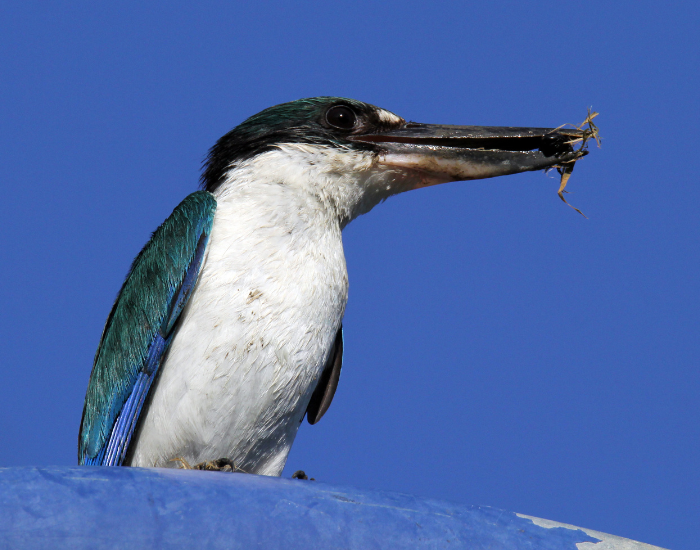
12. Torresian Kingfisher (Todiramphus sordidus)
Closely related to the Collared Kingfisher, the Torresian Kingfisher is found in northern Australia and nearby islands. Some taxonomies classify it as a distinct species due to its slightly different plumage and calls. It favors coastal mangroves, tidal creeks, and paperbark wetlands, where it feeds on crustaceans and small vertebrates.
Kingfisher Habitats and Distribution
Kingfishers occupy an incredible diversity of habitats across mainland Australia:
- Coastal regions: Sacred Kingfisher, Collared Kingfisher, including the Gold Coast’s lightly wooded areas, fields, and beaches
- Rainforest streams: Azure and Little Kingfisher
- Tall open eucalypt forests and melaleuca forests: Forest Kingfisher
- Arid inland: Red-backed Kingfisher
- Urban areas: Laughing Kookaburra
Some kingfishers hunt from branches above the forest floor or riverbank, taking advantage of the lush environment to spot prey.
They nest in tree hollows, termite nests, and even burrow chambers dug into riverbanks. Their diet is diverse and includes small animals such as fish, frogs, yabbies, snakes, insects, and even nestlings of other birds. Some species, like the Buff-breasted Paradise Kingfisher, migrate seasonally between Australia and New Guinea during the breeding season.
Behavior and Diet
Kingfishers are master hunters. Their good colour vision allows them to spot prey from a distance before swooping down with precision. Depending on the species, their diet includes:
- Fish (Azure, Little Kingfisher)
- Reptiles and frogs (Kookaburras, Forest Kingfisher)
- Small mammals and birds (Laughing Kookaburra)
- Insects and invertebrates (Sacred and Red-backed Kingfisher)
Symbolism and Cultural Significance
Across cultures, kingfisher birds symbolize peace, prosperity, and renewal. In Aboriginal traditions, the kookaburra’s laughter is woven into creation stories, just as the haunting call of the black cockatoo is said to signal rain or change on the horizon. Both birds hold powerful meaning in Australia’s cultural landscape, one representing joy and light, the other transformation and ancestral connection. Globally, kingfishers are seen as guardians of waterways and reminders of the deep link between people and rivers.
What’s New in Kingfisher Science?
Recent research is pushing our understanding of kingfishers beyond behaviour and into genetics and biomechanics, how their bodies are adapted to diving, migration, and evolutionary divergence.
One global genomic study compared the DNA of 30 kingfisher species to detect how “plunge-diving” (diving headfirst into water) evolved repeatedly. The authors found convergent mutations in genes tied to brain stability (e.g. tau protein genes) that may help kingfishers avoid brain injury during high-speed water entry.
Closer to home, a 2022 paper examined the Forest Kingfisher (Todiramphus macleayii), using genomic data across its Australian and New Guinea populations. The study uncovered notable genetic structure and argued for differentiated subspecies within New Guinea, indicating that migration and local adaptation may be more dynamic than previously thought.
Conservation Status and Threats
While most kingfishers of Australia remain stable, some are vulnerable:
- Habitat loss: clearing of forests and river systems
- Pollution: pesticides reduce insect prey
- Climate change: shifting rainfall affects riverbank habitats
Conservation initiatives, such as protecting paperbark forests and melaleuca wetlands, are essential to safeguard these birds. Citizen scientists also play a role: birdwatchers who report sightings contribute valuable data to monitoring programs.
FAQs about Kingfishers in Australia
Around 10 – 12 species, including kookaburras, azure, sacred, and red-backed kingfishers.
Yes. Kookaburras are actually the largest kingfishers.
Depending on the species: fish, reptiles, insects, small mammals, and amphibians.
Sacred Kingfishers are more widespread and forage on land, while Forest Kingfishers favor wetter habitats like streams.
The Role of Kingfishers in Nature
Australian kingfishers are more than just beautiful birds, they are ecological barometers, cultural icons, and unforgettable companions for anyone who spends time in the bush. Whether it’s the laughter of a kookaburra at dawn, the turquoise flash of an Azure Kingfisher by a riverbank, or the rare sight of a Paradise Kingfisher in the rainforest, each encounter reminds us of the wild magic still thriving here.
Protecting these kingfisher birds means protecting the waterways, forests, and coastal regions that sustain them. For birdwatchers, biologists, and anyone who’s paused to watch a kingfisher swoop for prey, that’s a cause worth defending.
Further Reading:
- Meet the Bilbies: Facts, Conservation
- 12 Things You Didn’t Know About the King Parrot
- 5 of the Most Threatened Animals in Australia
- Deadliest Animal in Australia
- Animals of Australia