I have never swum with a sperm whale. That bothers me more than I like to admit.
The Azores sit at the top of my list, Dominica just under it. I have not booked either trip.
What I do have is the opposite experience. In April 2019, on a field trip to the calving lagoons of Baja California, a gray whale eased her calf towards our small boat. One of my friends cried. I wrote it up in my piece on ecotourism and gray whales in Mexico.
Since then I have watched humpbacks from Queensland headlands. Never once from the water.
That gap is why I build things. Photographs flatten scale, so I made the whale size comparison tool. A map makes a journey real in a way a paragraph cannot, so I made the animal migration maps. Follow the gray whale migration along the route I saw the end of, or the humpback whale migration past my own coast.
Below are twelve things I learnt about Physeter macrocephalus. One was filmed for the first time in March 2026, in the exact place I keep promising myself I will go.
1. Cachalot and Sperm Whale Are the Same Animal
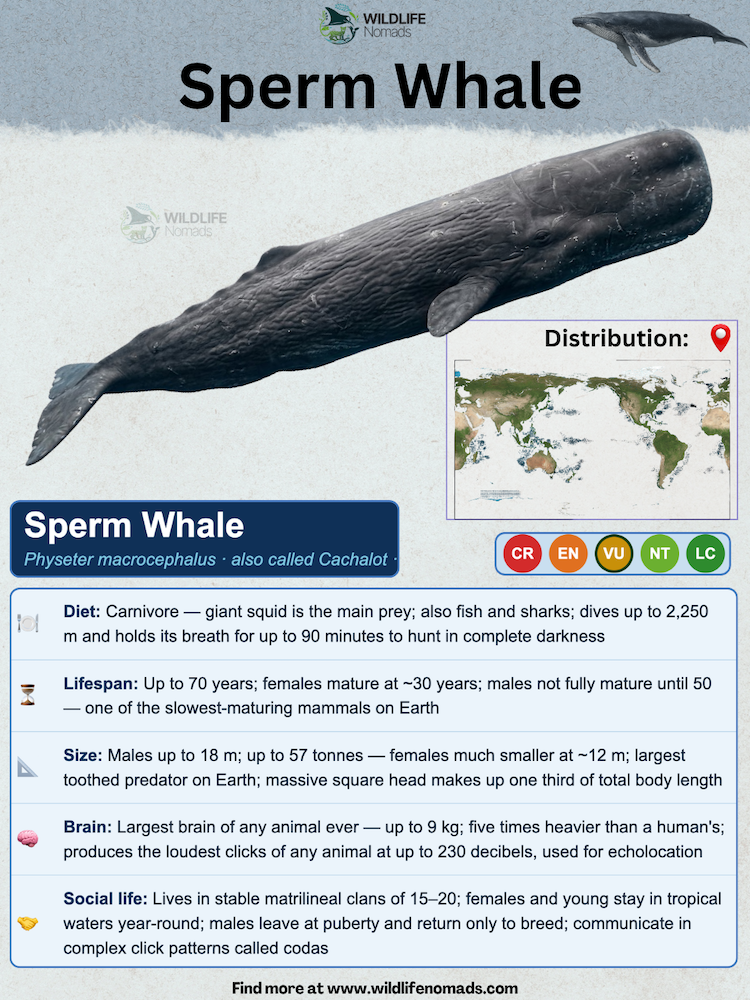
There is no difference. A cachalot whale is a sperm whale. Both names point at one species. Sperm whales are the only living members of their genus.
The names record what different people noticed first. English whalers called it the spermaceti whale, after the waxy substance found in its head.
The word cachalot reached English through French, from Spanish and Portuguese cachalote. Most etymologists trace the root to archaic French for big teeth. Galician cachola, meaning big head, belongs to the same family.
The scientific name splits the difference. Physeter means blowpipe in Greek, after the blowhole. Macrocephalus means big-headed. Three traditions picked the teeth, the head and the blowhole. My guide to the types of whale sorts the toothed whales from the baleen whales.
2. The Head Is a Sound Cannon
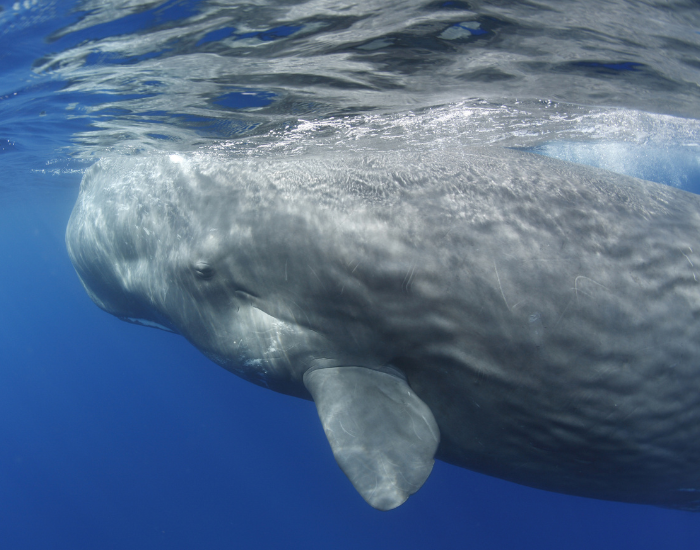
That enormous forehead is not mostly brain, and it is not fat storage. It is an acoustic instrument.
Huggenberger and colleagues describe the sperm whale’s head as a system built for one job: making and aiming sound. Air is pushed through a valve at the front of the skull. The pulse travels back through the spermaceti organ, reflects off an air sac, then passes forward through a second fatty body called the junk.
Each surface shapes it. Sperm whales focus sound into a narrow beam before it leaves the whale’s head. Clicks measure above 230 decibels, peaking near 236, which puts them top of my list of the loudest animals on Earth.
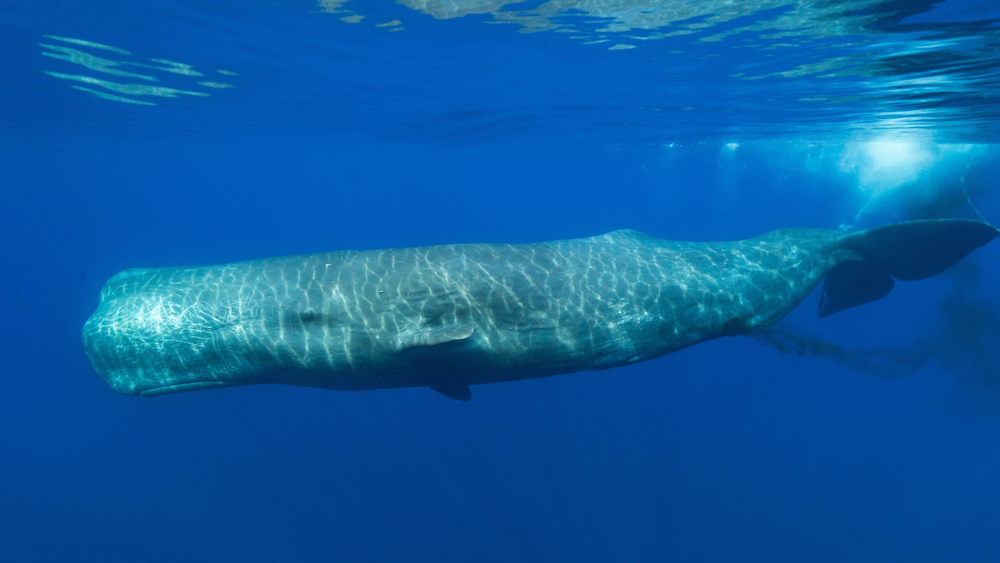
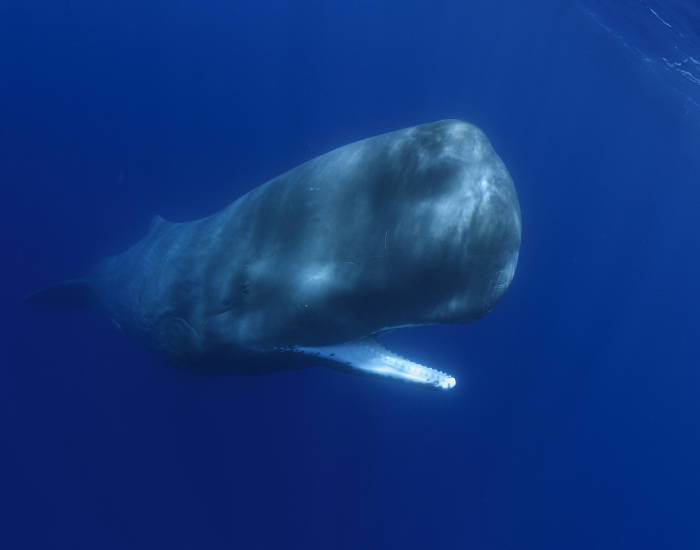
Two details give the design away. The single blowhole sits on the left side rather than the midline, because the right nasal passage was repurposed for sound. The upper jaw carries sockets rather than working teeth, while the lower jaw holds between 20 and 26 teeth on each side. The mouth grips. The head listens.
3. They Are Smaller Than the Internet Says
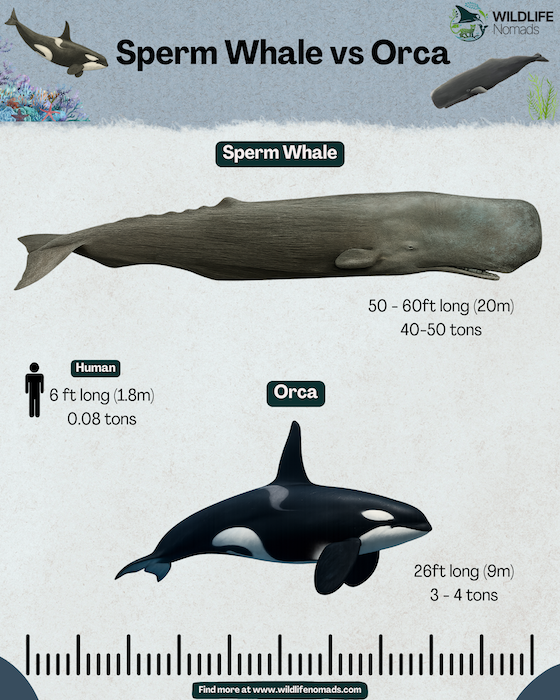
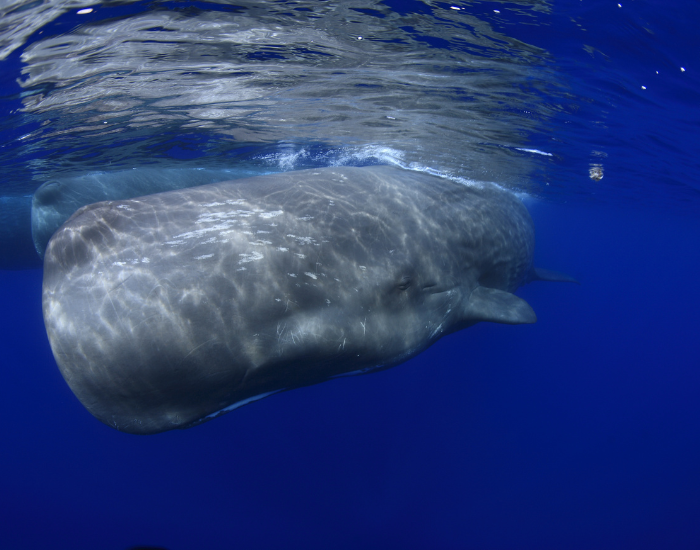
I had to correct my own article here. Adult males reach roughly 16 metres and 45 tonnes. Adult females top out near 12 metres and 15 tonnes. Mature males are three times as massive as females, the most extreme dimorphism of any whale.
Figures of 18 metres, and occasionally 20, come from the outer edge of historical whaling records. Using them as typical is how a fact becomes folklore.
Scale still lands at the honest number. The head runs to one-third of their total body length, and the brain averages just over seven kilograms, the largest of any animal that has ever lived. That earns a place in my roundup of animals with the biggest brain.
There is no true dorsal fin, just a low hump and a row of knuckles, and the skin is wrinkled and dark grey. A cachalot is still the largest toothed predator on Earth. It still sits below the fin whale and the blue whale, the biggest whale in the world. Extremely large is relative here, and the size comparison tool shows fourteen species at one true scale.
All fourteen whales are drawn at one true scale, with a two-metre diver alongside each of them. For the full version, with every species, its measurements and the notes behind them, open the whale size comparison.
4. The Headbutt Was Only Filmed in 2026
Whalers wrote about sperm whales striking each other head-on for two centuries, and the Essex sinking in 1820 rested on the premise. Nobody had recorded it properly.
Burslem and colleagues finally did, using drones over the Azores and the Balearic Islands. The footage shows whales turning to face one another, converging, then striking with the front of the skull.
Here is the part I did not expect. The animals doing it were younger whales and sub-adults, not the bulls the mating season explanation assumed. That points towards practice or social negotiation among young males, rather than combat over adult females.
It also sharpens an old objection. The same structure makes the sound these animals hunt with, and damaging your own sonar is an expensive way to win an argument with other males.
5. The Dive Is the Whole Animal
Everything about a cachalot points downward. Irvine and colleagues tagged whales in the Gulf of California. The tags recorded dives reaching about 1,500 metres and lasting over 77 minutes. Three quarters were deep foraging dives, and the species record sits near 2,250 metres. To see how deep a sperm whale hunts, dive with it past 1,000 m in my deep sea dive tool.
A typical deep dive takes them into the band between 300 and 800 metres. Many run past 1,000 metres, roughly 3,300 feet, and few mammals hunt at such great depths. My guide to animals in the deep sea covers the creatures they meet, many of them bioluminescent.
The physiology is unglamorous and brilliant. The ribcage folds under pressure, heart rate drops, and muscle stores oxygen in vast quantities of myoglobin. Breath-holds of 90 minutes are on record.
One finding stuck with me. They socialise together at the surface, then stagger the timing and depth of their dives. They travel as a group and hunt alone in the deep oceans.
6. Giant Squid Are Real Prey, but Not the Daily Menu
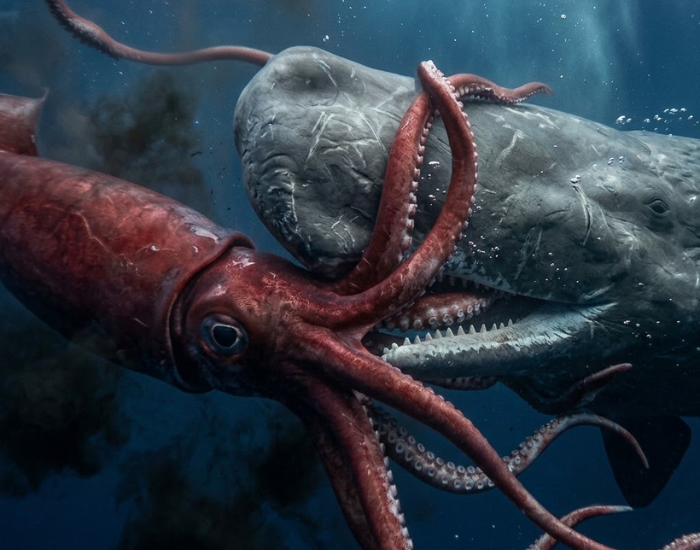
The battle with the giant squid is the image everyone carries, and it is not invented. Sucker scars mark the heads of adult whales, and squid remains turn up in their stomachs.
The everyday reality is less cinematic. Most of the diet is medium-sized squid, taken steadily rather than wrestled, with deep-water fish and the occasional sharks making up the rest. A cachalot eats roughly three percent of its body weight daily.
Squid beaks are how we know. They resist digestion and accumulate in the stomach, giving researchers a species list without anyone watching a hunt. The same beaks irritate the gut, which is thought to trigger ambergris.
Off Chile and Peru they have been recorded working Humboldt squid in ways that look cooperative, though whether that is real teamwork remains argued. The octopus facts guide covers the shallow end of that family.
7. The Pod Is a Matriarchy and the Males Leave
Female sperm whales live in a stable, matriarchal social unit. A typical pod holds about 12 females and their young, and these groups persist for decades. Females and calves spend around 75% of their time foraging, and females cooperate to babysit at the surface. A calf cannot follow its mother to 1,000 metres.
Reproduction is slow even by whale standards. Gestation runs 14 to 16 months, a single calf arrives every five to seven years, and females reach sexual maturity at around nine.
Males take a different route. A young male leaves his natal unit in his early teens for one of the bachelor groups, then spends more than a decade drifting towards solitude. Sexually mature is not physically mature here, and the latter arrives near fifty. Mature males lead mostly solitary lives.
That splits the species geographically. Females and calves stay in tropical waters year round. Large males range to polar feeding grounds and work the edge of the pack ice, and off North America they appear along the west coast.
Defence is collective. A threatened unit forms the marguerite, heads together and tails outward, calves in the centre. Their natural predators amount to one species: killer whales, which target calves and weakened adults rather than healthy bulls. Whether orcas are themselves in trouble I covered in are killer whales going extinct.
8. They Speak in Codas, and the Clans Have Accents
Cachalots communicate with codas, short patterned bursts of clicks. Clans use different repertoires, and those travel culturally rather than genetically.
Sharma and colleagues analysed thousands of codas from the Eastern Caribbean clan and found more structure than anyone expected. Rhythm and tempo combine with a slow drift in speed they called rubato, plus extra clicks they named ornamentation. The press called it a phonetic alphabet.
Distribution matters as much as mechanism. Clans sharing the same water use entirely different codas and largely ignore each other, closer to human dialect boundaries than to birdsong. That separates them from most other whales.
Dolphins and orcas dominate conversations about the smartest animals. The whale with the largest brain on Earth may have the most structured vocal system.
9. They Sleep Standing Up
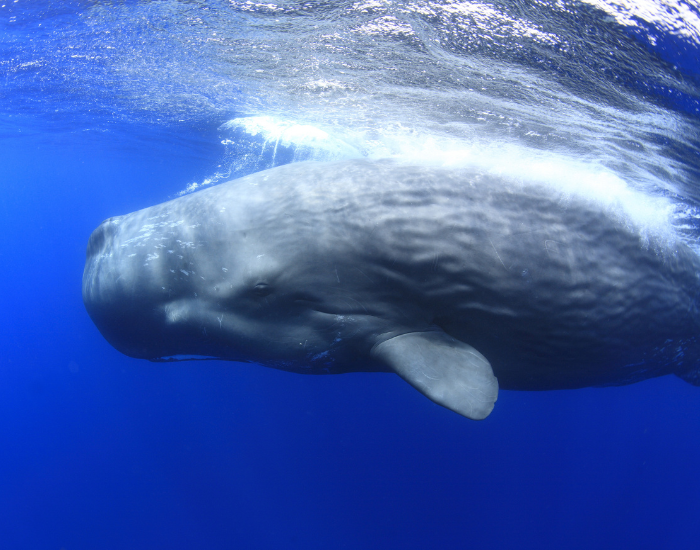
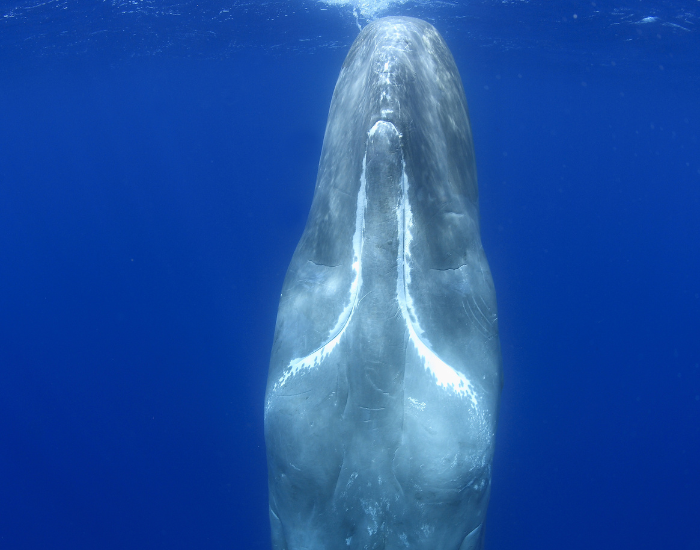
Sperm whales sleep vertically, and in 2008 researchers drifting near a group recorded it. The animals hung motionless in the water column, heads slightly up or down, and none responded to the boat. They spend only about seven percent of their time asleep, in short bouts, often in the evening. That is among the lowest sleep requirements of any mammal.
10. Moby Dick Had a Real Whale Behind It
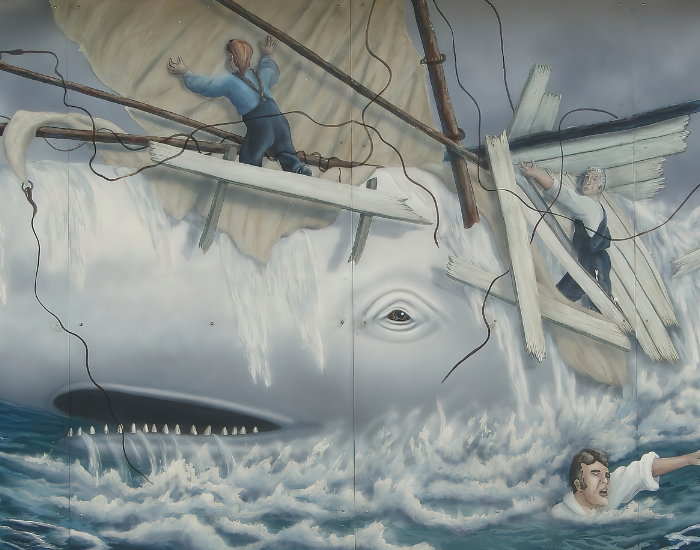
Melville did not invent the white whale. Mocha Dick was a genuine albino sperm whale, reported off the Chilean island of Mocha in the early nineteenth century, and accounts describe him surviving many whaling ships.
The sinking was real too. In 1820 a bull struck and sank the Nantucket whaleship Essex, and the crew’s ordeal supplied the ending Melville needed. Given fact four, that ramming now has a documented analogue, though the filmed version involved young males rather than a vengeful giant.
11. One Century, 761,523 Whales, Mostly for Lamp Oil
This is the number I find hardest to sit with. Rocha, Clapham and Ivashchenko compiled industrial catches of large whales across the twentieth century and counted 761,523 sperm whales killed. Only fin whales were taken in greater numbers.
Spermaceti was the prize. It burned cleanly in oil lamps and lubricated precision machinery, then went into cosmetics, which kept demand alive long after electricity arrived. The species was targeted hardest from 1800 to 1987, and commercial whaling nearly decimated it. Hunting cut the population by roughly 29 percent before 1880, and fleets later pushed the take to around 30,000 annually. Commercial whaling ended in 1987.
Recovery is slow, and the maths in fact seven explains why. The current global estimate sits near 360,000 animals, with a caveat: it comes from an extrapolation, not a census. The IUCN Red List classes the species as Vulnerable, while the United States lists it as Endangered under the Endangered Species Act. Entanglement in fishing gear is now a leading threat, alongside ship strikes, ocean pollution and underwater noise. See also whether whale hunting still exists and my list of endangered sea animals.

12. They Fertilise the Ocean From Below
A sperm whale feeds at 1,000 metres and defecates near the surface. That mismatch moves nutrients upward through a water column that otherwise loses them downward.
Pearson and colleagues reviewed the role of whales in the carbon cycle. Deep-diving cetaceans feed below the mixed layer and release nutrients above it. Those iron-rich feces carry nitrogen and phosphorus to the surface, and iron limits phytoplankton growth across large parts of the ocean.
Phytoplankton feed everything else. Lift them and you lift krill, fish and every predator that follows. Removing three quarters of a million large predators was never only about the whales.
Frequently Asked Questions
Cachalot reached English through French, from Spanish and Portuguese cachalote. Most etymologies trace the root to archaic French for big teeth, and the related cachola means big head. English speakers chose sperm whale instead, after the spermaceti in its head. Cachalot remains standard in French, Spanish and Portuguese.
Not towards people. Documented unprovoked attacks on humans are close to nonexistent, and divers in the Azores and Dominica describe curious, cautious animals. They do defend themselves, forming a protective circle around calves and using the tail against killer whales. Young males have been filmed headbutting each other, though that looks social rather than predatory.
Not the sperm whale, despite the question appearing alongside it constantly. Genomic work points to Type D killer whales, an unusual orca of subantarctic waters. They descend from a very small founding group and have stayed isolated since. Sperm whale populations are far more diverse.
The deepest reliably recorded dive is about 2,250 metres, roughly 7,400 feet. Tagged whales in the Gulf of California reached 1,500 metres and stayed down over 77 minutes. Most foraging happens between 300 and 1,000 metres. Only Cuvier’s beaked whale and the southern elephant seal reach greater depths.

What I Would Do With One Hour in the Water
If I get to the Azores, I will not be chasing the headbutt or the giant squid. Both happen too deep or too rarely.
What I want is the click. People describe being scanned at close range as a physical sensation, not a sound, and no recording carries that across. I built two tools trying to close that distance, and I know where they fall short.
Scale is the part they get right. Put a diver beside a cachalot on the size comparison and the argument ends. Until then I watch from the coast, like I did with humpbacks this season.
Have you been in with one in the Azores or Dominica? Tell me in the comments what the clicks felt like, and if you are planning a trip start with my guide to the best places to go whale watching.
How Well Do You Know the Sperm Whale? 🐋
Ten questions on sperm whale acoustic anatomy, deep diving limits, vocal codas, and social structures. Can you score 10/10?
Multiple Choice
References:
Burslem, A., Cerdà, M., Brotons, T., Rendell, L., Silva, M. A., & Prieto, R. (2026). Headbutting behavior between sperm whales documented using unoccupied aerial vehicles. Marine Mammal Science, 42(2), e70153. https://doi.org/10.1111/mms.70153
Huggenberger, S., André, M., & Oelschläger, H. H. A. (2016). The nose of the sperm whale: Overviews of functional design, structural homologies and evolution. Journal of the Marine Biological Association of the United Kingdom, 96(4), 783–806. https://doi.org/10.1017/S0025315414001118
Irvine, L., Palacios, D. M., Urbán, J., & Mate, B. (2017). Sperm whale dive behavior characteristics derived from intermediate-duration archival tag data. Ecology and Evolution, 7(19), 7822–7837. https://doi.org/10.1002/ece3.3322
Pearson, H. C., Savoca, M. S., Costa, D. P., Lomas, M. W., Molina, R., Pershing, A. J., Smith, C. R., Villaseñor-Derbez, J. C., Wing, S. R., & Roman, J. (2023). Whales in the carbon cycle: Can recovery remove carbon dioxide? Trends in Ecology & Evolution, 38(3), 238–249. https://doi.org/10.1016/j.tree.2022.10.012
Rocha, R. C., Clapham, P. J., & Ivashchenko, Y. V. (2014). Emptying the oceans: A summary of industrial whaling catches in the 20th century. Marine Fisheries Review, 76(4), 37–47. https://doi.org/10.7755/MFR.76.4.3
Sharma, P., Gero, S., Payne, R., Gruber, D. F., Rus, D., Torralba, A., & Andreas, J. (2024). Contextual and combinatorial structure in sperm whale vocalisations. Nature Communications, 15, 3617. https://doi.org/10.1038/s41467-024-47221