
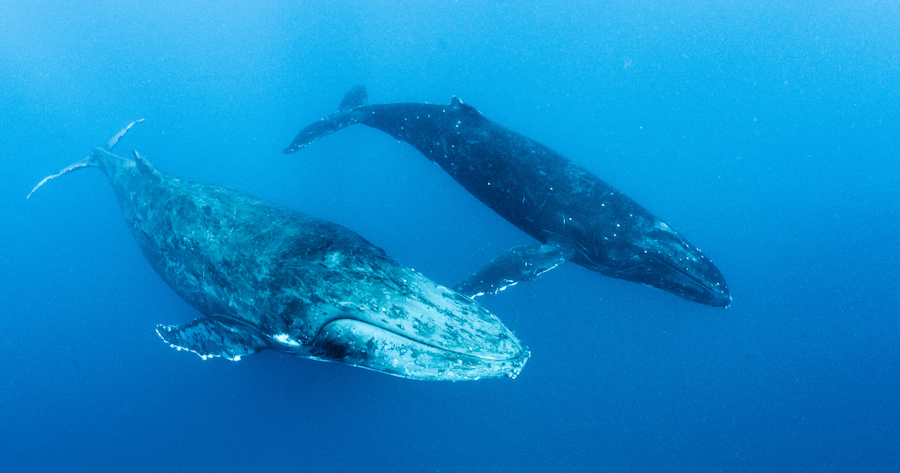
During whale season on Australia’s east coast, I see humpbacks breaching almost every day. From Chinamans Beach at Evans Head, I watched two of them roll past the headland. But I had never thought much about what they were singing underwater, until this study.
In February 2025, scientists reported that humpback whale song follows a statistical rule found in every human language. It is called Zipf’s law. The researchers found it using a method borrowed from how babies learn to spot words.
Does this mean whales speak a language? Not quite. But it shows how two very different animals, both learning by imitation, ended up with surprisingly similar patterns.
Humpback Whale Song in a Nutshell
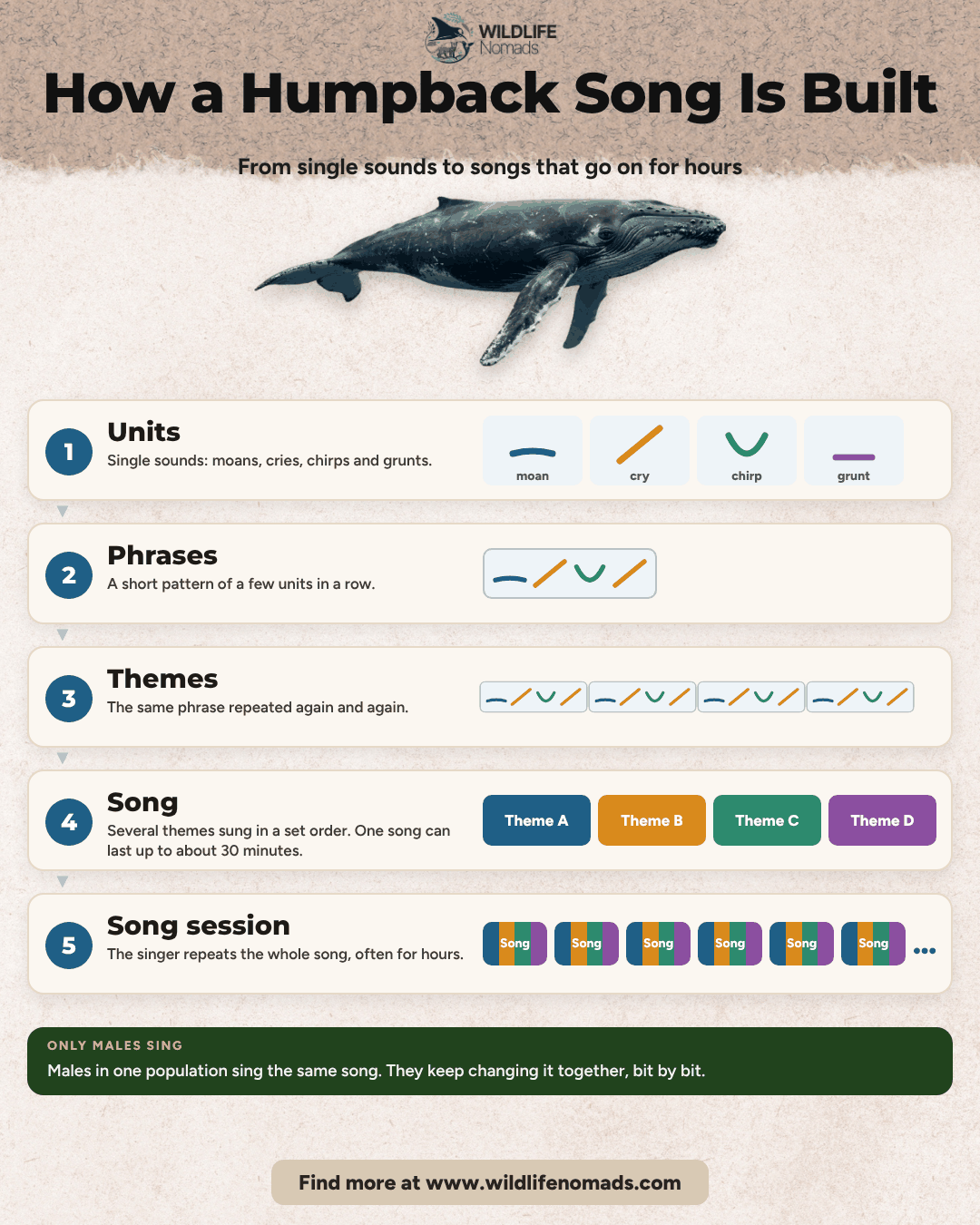
- Who sings: male humpback whales, Megaptera novaeangliae, mostly on breeding grounds.
- How long: a full song can last around 30 minutes, and males repeat it for hours.
- How it is built: sound units form phrases, phrases repeat as themes, and themes make a song.
- How it spreads: whales learn songs from each other, so songs change and travel like fashions.
- The new finding: song segments follow Zipf’s law, the same frequency pattern as human words.
Songs That Spread Like Hit Tunes
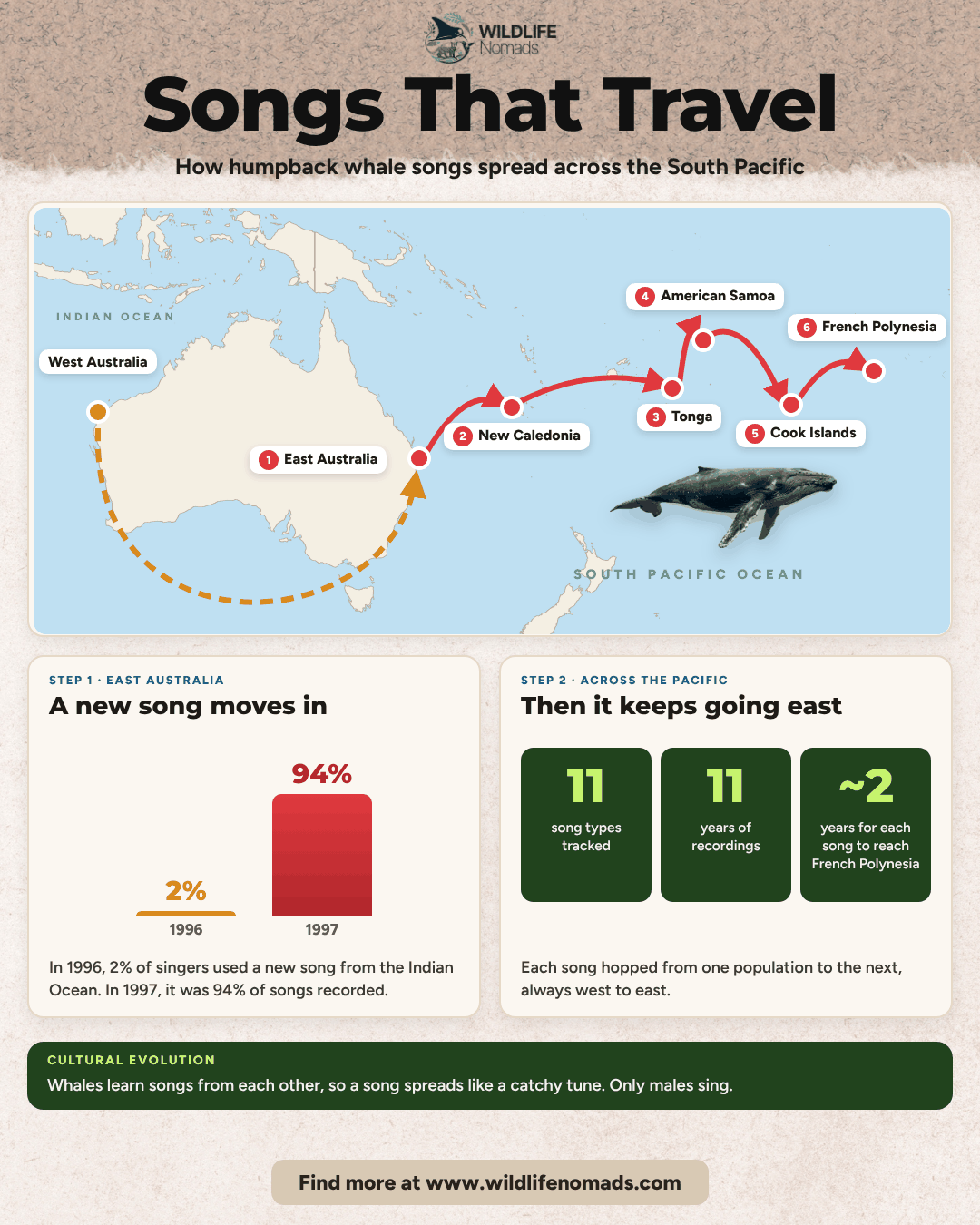
Humpback song is cultural. Males do not inherit their song; they learn it from other males. As a result, all males in a population sing roughly the same song at the same time.
Australia has a famous example. Between 1995 and 1998, researchers recorded humpbacks off southeast Queensland, close to my home on the Gold Coast. In that time, east coast males dropped their song and adopted a new one from the Indian Ocean population. Within about two years, the whole population had switched.
Later, Ellen Garland and colleagues tracked songs rippling east across the South Pacific. New songs travelled from eastern Australia to French Polynesia in about two years. Some researchers describe it as a pop chart for whales.
Borrowing a Trick From Babies
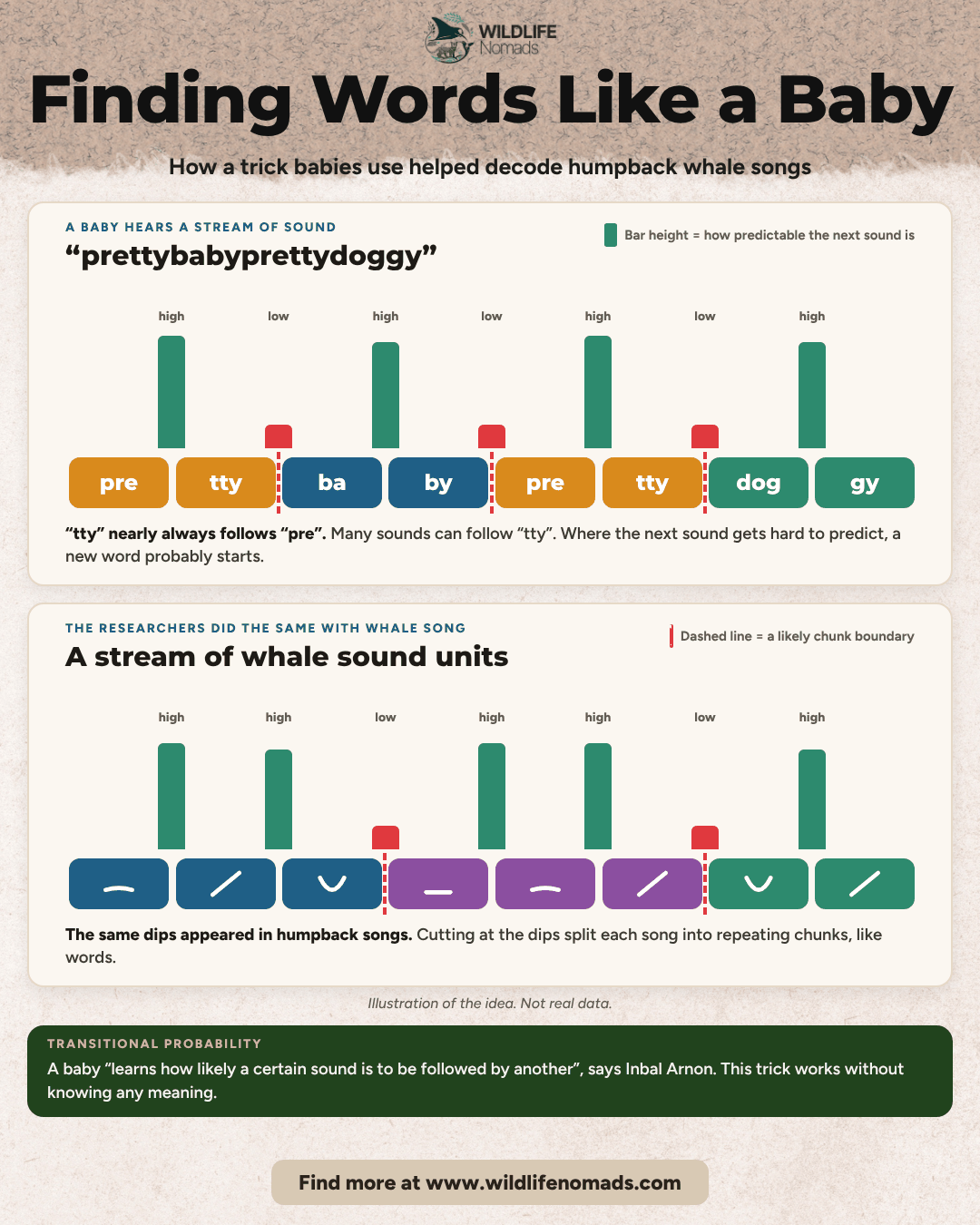
Babies hear speech as one long stream of sound. So how do they find where words start and stop? They track which sounds tend to follow which.
Inside a word, sounds follow each other predictably. Between words, that predictability drops. Scientists call this a transitional probability, and the dips act as clues to word boundaries.
Inbal Arnon, Simon Kirby, Ellen Garland and colleagues applied the same idea to whale song. They used 8 years of humpback recordings from New Caledonia, in the South Pacific. Then they cut the songs wherever the predictability dipped.
What Is Zipf’s Law?
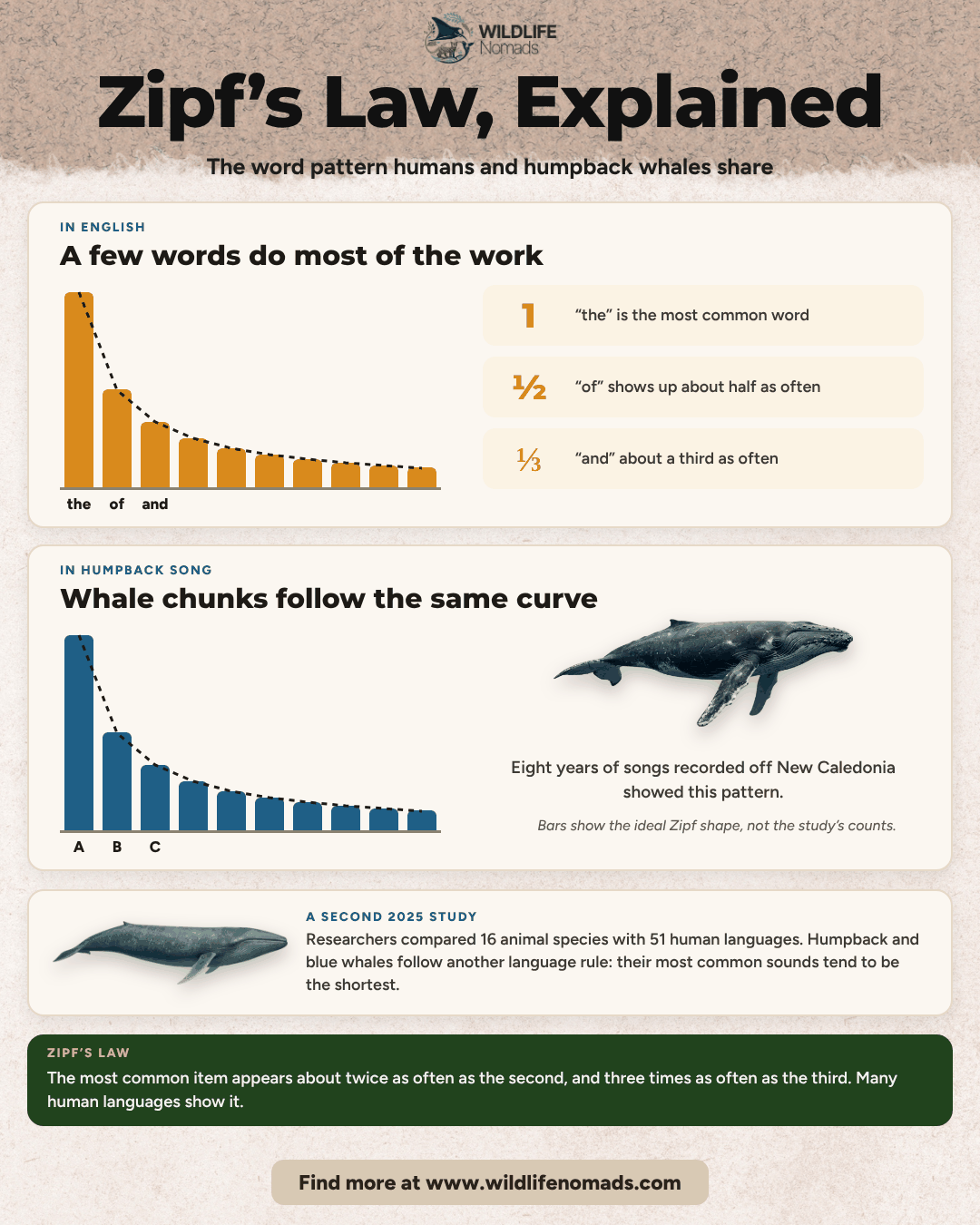
Zipf’s law describes how often words appear in a language. A few words are used constantly, while most words are rare. Roughly, the most common word appears about twice as often as the second most common.
When the team segmented the whale songs, the pieces followed Zipf’s law closely. That pattern had stayed hidden until they used the baby-inspired method. Garland said she was dumbfounded by the result.
Why Would Whales and Humans Share a Pattern?
Humans and humpbacks last shared an ancestor roughly 100 million years ago. So this pattern did not come from a shared origin.
The researchers think the answer is learning. Both human language and whale song pass from one individual to another. Zipfian patterns may make a system easier to learn, so learning itself may shape the structure.
In other words, any system that is learned by copying might drift towards the same shape. That is a bold idea, and it makes whale song a natural experiment in cultural evolution.
A Second Study: Whales Are Efficient Talkers
The same month, Mason Youngblood at Stony Brook University published a related study in Science Advances. He compared 65,511 whale vocal sequences from 16 cetacean species with 51 human languages.
He tested Zipf’s law of abbreviation, which says common elements tend to be shorter. Most species did not follow it. However, humpbacks and blue whales did, and humpbacks rivalled humans.
So, Do Whales Have a Language?
Not in the human sense. Nobody has shown that humpback song carries meaning the way words do. The researchers themselves stress that whale song is not a language.
Some scientists even suggest comparing whale song with human music instead. What the studies do show is shared structure, not shared meaning. Still, that is a big step for understanding how culture shapes sound.

Where You Can Hear Humpbacks in Australia
Humpbacks migrate along both Australian coasts each winter and spring. On my lap, I watched four of them from Booti Booti National Park. In Albany, a whale tour finally got me close enough to see barnacles on their skin.
Males sing mostly on the breeding grounds and during migration. If you take a tour with a hydrophone, ask to listen. To compare humpbacks with their relatives, explore our guide to types of whale. You can also line them up in our whale size comparison tool.
FAQs About Humpback Whale Song
No. Humpback song shares statistical patterns with human language, but nobody has shown it carries meaning like words. Scientists describe it as a culturally learned display, closer in some ways to music.
Researchers analysed 8 years of humpback recordings from New Caledonia, using a method inspired by how babies find words. The song segments followed Zipf’s law, a pattern seen in all human languages. The study appeared in Science.
Zipf’s law describes word frequency. A few words are used very often, and most are rare. The most common word appears about twice as often as the second. Every human language studied follows it.
Only male humpbacks sing, mostly on breeding grounds and during migration. Scientists think song plays a role in breeding, but its exact function is still debated.
Yes. Humpback song is learned and changes over time. In the late 1990s, east Australian humpbacks swapped their song for one from the Indian Ocean population. The switch took about two years.
Listen to the Ocean Differently
Humpback whale song now looks even more remarkable. It follows a rule we once thought belonged to human language, probably because both are learned by copying.
Next time you see a humpback breach, imagine the song running under the surface. Then read about my favourite whale moment with gray whales in Mexico. And try the quiz below.
References:
Arnon, I., Kirby, S., Allen, J. A., Garrigue, C., Carroll, E. L., & Garland, E. C. (2025). Whale song shows language-like statistical structure. Science, 387(6734), 649–653. https://doi.org/10.1126/science.adq7055
Youngblood, M. (2025). Language-like efficiency in whale communication. Science Advances. https://doi.org/10.1126/sciadv.ads6014
Noad, M. J., Cato, D. H., Bryden, M. M., Jenner, M.-N., & Jenner, K. C. S. (2000). Cultural revolution in whale songs. Nature, 408, 537. https://doi.org/10.1038/35046199
Garland, E. C., Goldizen, A. W., Rekdahl, M. L., Constantine, R., Garrigue, C., Hauser, N. D., Poole, M. M., Robbins, J., & Noad, M. J. (2011). Dynamic horizontal cultural transmission of humpback whale song at the ocean basin scale. Current Biology, 21(8), 687–691. https://doi.org/10.1016/j.cub.2011.03.019