Meet the Spotted Eagle Rays
Like many people, my very first encounter with a spotted eagle ray was probably on the big screen, Mr. Ray, the friendly teacher in Finding Nemo. For many of us, that animated introduction planted the image of these graceful, white-spotted creatures long before we ever saw one in real life.
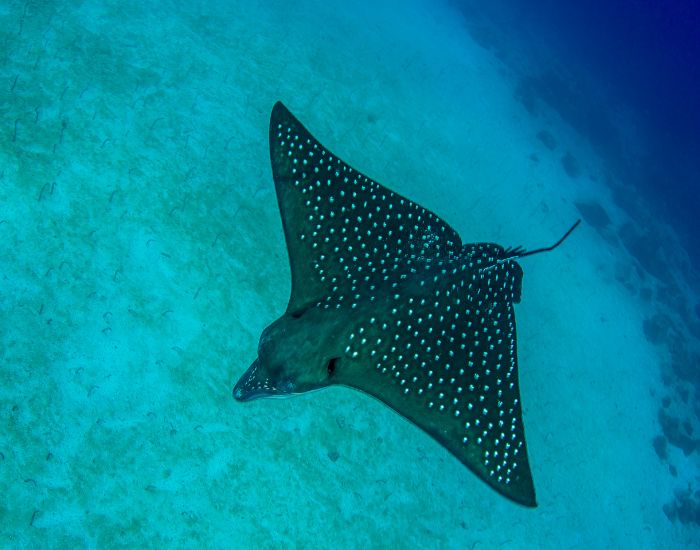
Years later, I found myself meeting the real thing in the waters of Coron, Philippines, while exploring some of the most beautiful coral reefs in the world. I looked to my side and found myself face-to-face with a massive ray. At first, I thought it was just another common stingray. However, the striking pattern of white spots across its dark dorsal surface gave it away immediately. This was a white-spotted eagle ray, and it glided with such elegance that I was instantly hooked on learning more.
The spotted eagle ray (Aetobatus narinari) belongs to the family Myliobatidae. These rays are closely related to manta rays but possess their own unique adaptations. Known for their spotted appearance, long tail with venomous spines, and tendency to leap from the water, eagle rays captivate both divers and marine biologists alike.
Here, you will explore everything about the spotted eagle ray. You’ll discover where these fish live, what spotted eagle rays feed on, and how they behave. We’ll also examine their critical role in marine ecosystems and why conservation efforts matter so much.

10 Fascinating Facts About Spotted Eagle Rays
Now let’s dive into some of the most interesting, unusual, and surprising facts about these remarkable creatures.
1. They’re Sometimes Called “Duck Billed Rays” Because of Their Snout
Because of its distinctive, duck-like snout, the spotted eagle ray is sometimes referred to as the duck billed ray, duckbill ray, or spotted duck billed ray. This quirky nickname perfectly captures the unusual shape of their foraging tool. Locals in different regions have come up with creative names based on this feature.

2. They Can Launch Several Feet Into the Air When Breaching
One of their most spectacular displays involves leaping completely out of the water. This breaching behavior amazes witnesses, as rays can launch several feet into the air. Some reports describe rays jumping up to 3 meters high. Scientists continue debating why they do this, theories include dislodging parasites, escaping predators like sharks, or communicating during courtship.
3. Loose Aggregations Include 3-16 Rays Swimming in Perfect Synchrony
This behavior is called loose aggregation, where groups of 3 to 16 rays swim together in a loosely organized manner with occasional interactions. Observers note that these fish swim in the same direction, moving in remarkable synchrony. Some locations witness schools numbering in the hundreds, creating an underwater ballet that’s breathtaking to witness.

4. Mr. Ray From Finding Nemo Is Actually a Spotted Eagle Ray
Have you ever see Findind Nemo? Well, Yes, the beloved teacher character was modeled after a blue and white spotted eagle ray. The film accurately captured their graceful swimming motion and gentle nature. Mr. Ray’s character helped introduce millions of people to these fascinating fish. For many children, this was their first introduction to eagle rays.
5. Their Crushing Teeth Can Break Through Shells That Defeat Other Predators
Inside their mouths, spotted eagle rays possess remarkable crushing teeth. These plate-like teeth fuse into rows, forming a powerful grinding system. This adaptation allows them to easily break through hard shells that would defeat other predators. Their jaws can generate incredible pressure to crack open oysters and clams.

6. They Create “Feeding Pits” That Other Fish Investigate Afterward
Spotted eagles use their snout to dig into sandy sea beds, uncovering hidden prey. They create distinctive feeding pits that other fish species often investigate afterward. This behavior demonstrates their role as ecosystem engineers. Small fish follow rays around, hoping to catch prey disturbed by the digging.
7. Females Give Birth to Only 2-4 Pups After a 12-Month Pregnancy
The gestation period typically lasts around 12 months. Female rays usually give birth to 2 to 4 pups per litter, though occasionally more. This combination of long gestation and small litter size makes populations particularly vulnerable. Even modest fishing pressure can significantly impact population numbers over time.

8. Silvertip Sharks Are Their Main Predator
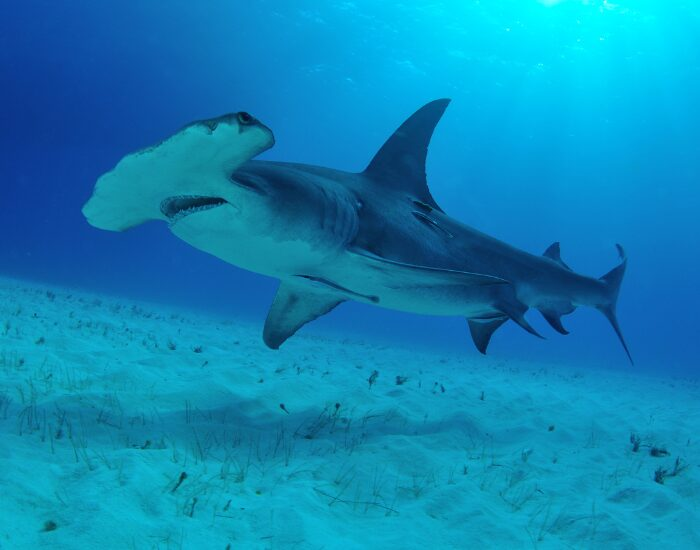
The main predator of the spotted eagle ray are many types of shark, with the silvertip shark being a notable example. Adult spotted eagle rays also face threats from large sharks, including hammerheads and bull sharks. Like other rays, spotted eagle rays must use camouflage and evasive behaviors to avoid these predators, but predation risks remain high.
9. They Rely on Electroreception to Navigate and “Talk” to Each Other
Unlike marine mammals, spotted eagle rays don’t produce vocalizations. Instead, they rely on electroreception to navigate and communicate. This sensory system detects electrical fields generated by other organisms. Think of it like having a built-in radar that works underwater. Body language also plays a role during interactions, particularly during the mating ritual.
10. Their Intelligence Rivals Other Fish Species
Research suggests spotted eagle rays display problem-solving abilities and social learning behaviors. They recognize individual divers and can adapt their behavior based on interactions. This cognitive capacity makes them particularly fascinating subjects for marine biologists studying ray intelligence.
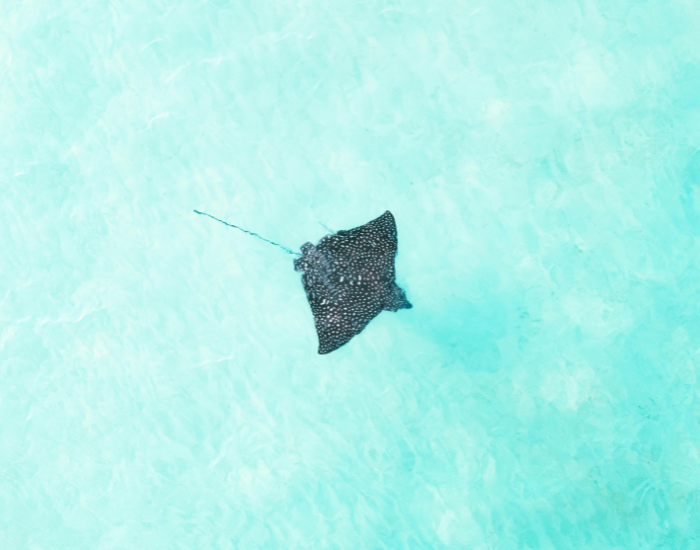
11. They Have One of the Longest Lifespans Among Rays
Spotted eagle rays can live for 15-20 years in the wild, with some individuals potentially reaching 25 years. This relatively long lifespan, combined with their late sexual maturity (around 4-6 years) and slow reproduction rate, makes them particularly vulnerable to population declines. Their longevity allows them to play a sustained role in marine ecosystems over decades, but it also means populations take much longer to recover from overfishing or habitat loss compared to faster-reproducing species.

12. There Are Five Recognized Species in the Aetobatus Genus
Once thought to be a single cosmopolitan species, genetic studies have revealed that the “spotted eagle ray” actually comprises five distinct species within the Aetobatus genus: A. narinari, A. ocellatus, A. laticeps, A. flagellum, and A. narutobiei. These findings, supported by recent DNA analyses, show that populations once grouped under A. narinari are in fact regionally distinct — with separate lineages inhabiting the Atlantic, Indo-Pacific, and Eastern Pacific Oceans. This revision helps clarify their conservation needs, as some species occupy much smaller ranges and may be more vulnerable to overfishing and habitat loss.

Habitat and Distribution: Where Spotted Eagle Rays Live
The spotted eagle ray thrives in tropical and subtropical waters worldwide. Their distribution spans three major ocean regions, making them one of the more widespread species of rays. They are commonly observed in their preferred habitats, including bays, coral reefs, and lagoons.
Atlantic Ocean Range
In the Atlantic Ocean, these eagle rays inhabit waters from North Carolina southward to Brazil. The Gulf of Mexico and Caribbean Sea serve as prime habitats. Divers frequently spot them around coral reefs in the Bahamas, Cayman Islands, and throughout the Lesser Antilles. Grand Cayman and Cozumel rank among the most popular spots for reliable sightings.
Indo-Pacific Region
The Indo-Pacific represents their most extensive range. White-spotted eagle rays swim from the Red Sea through the Indian Ocean to Japan and Australia. The Maldives, Thailand, and the Great Barrier Reef host thriving populations. In fact, the eastern Pacific Ocean population extends from Mexico to northern Chile. The Maldives provides particularly reliable sightings near reef channels.
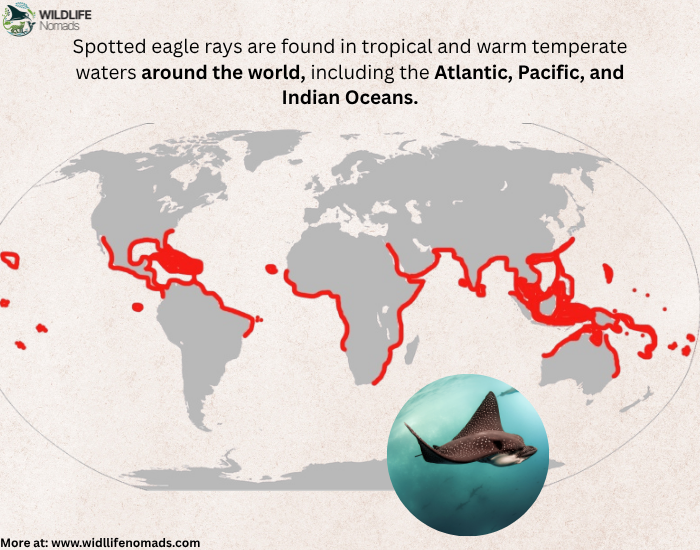
Edited by Wildlife Nomads
Habitat Preferences and Migration
These rays prefer shallow coastal waters, typically at depths ranging from 1 to 3 meters. Unlike manta rays that thrive in open ocean environments, spotted eagles are primarily coastal species. They frequent areas with sandy sea beds, coral reefs, estuaries, and bays. Nevertheless, they occasionally venture into deeper open waters during migration.
Tagged individuals have demonstrated impressive migration capabilities, crossing long distances of several hundred kilometers between reef systems. Some individuals have been tracked traveling between countries, crossing international waters. Scientists recognize that protecting marine corridors remains essential for their survival, since rays don’t respect political boundaries.
Diet and Foraging Behavior: What Spotted Eagle Rays Feed On
Spotted eagle rays are carnivorous bottom feeders with fascinating hunting techniques. Their specialized anatomy perfectly suits their dietary preferences, allowing them to prey on a variety of organisms.
Primary Prey
These rays primarily consume hard-shelled invertebrates. Mollusks, including clams and oysters, form a substantial portion of their diet. Crustaceans like hermit crabs also feature prominently. Additionally, they hunt sea urchins, squid, and small bony fish when opportunities arise.

Reproduction and Life Cycle
Understanding the reproductive biology of spotted eagle rays reveals why their populations face vulnerability. Their slow reproduction rate impacts conservation strategies significantly.
Mating Behavior and Courtship
Mating occurs primarily in shallow coastal waters during specific seasons. Males pursue females in elaborate courtship displays. These displays may include synchronized swimming and breaching behavior. The mating ritual can last several hours as males compete for female attention.
Ovoviviparous Reproduction
Spotted eagle rays are ovoviviparous, meaning embryos develop inside eggs retained within the female’s body. The mother provides nutrients through a yolk sac initially. As development progresses, the embryos receive additional nutrition directly from the mother. This process continues until live birth occurs.
Conservation Status and Threats
The IUCN Red List currently classifies the spotted eagle ray as Near Threatened. This status reflects concerning population trends in multiple regions. The whitespotted eagle ray, a closely related species, faces similar threats from habitat loss, overfishing, and environmental changes.
Primary Threats
Bycatch represents the most significant threat to spotted eagle rays. Commercial fishing operations accidentally capture them in nets intended for other species. Many rays die before release, or suffer injuries that prove fatal later. Targeted fishing also occurs in certain regions. Some areas value eagle ray meat, while others harvest their gill plates or fins.
Habitat loss continues as coastal development expands. Destruction of coral reefs, mangrove forests, and seagrass beds eliminates critical feeding and nursery areas. These habitats take decades to recover, if they recover at all.
Climate change presents an emerging threat. Ocean warming affects the distribution of prey species that spotted eagles depend on. Rising temperatures may force rays to shift their ranges. Additionally, ocean acidification weakens the shells of mollusks, potentially disrupting food webs.

Physical Characteristics: Identifying Spotted Eagle Rays
The spotted eagle ray displays several distinctive features that make identification straightforward for divers and marine enthusiasts. Their unique anatomy serves both functional and survival purposes.
Coloration and Markings
Their dark gray to blue dorsal side features beautiful white spots scattered across the surface. This spotted pattern gives the species its common name. Meanwhile, their ventral side appears pale or white. This counter-shading helps them blend into both the bright surface above and darker depths below.
Wing-Like Pectoral Fins
Perhaps their most striking feature, the pectoral fins extend outward like wings. These powerful fins enable them to “fly” through the water with smooth, graceful strokes. Notably, the trailing edge of the pectoral fins is deeply concave, with angular tips. This feature contributes to the ray’s graceful, flying swimming style and helps distinguish spotted eagle rays from similar species.
Distinctive Head and Snout
A long, shovel-shaped snout protrudes from the head. This specialized tool proves perfect for foraging in sandy sea beds. The eagle uses this snout to dig and uncover buried prey like clams and sea urchins.
The Long Tail
A whip-like tail extends from the body, often measuring longer than the ray’s disc width. This tail contains venomous spines that serve as defensive weapons. While these spines can deliver painful stings, spotted eagle rays rarely display aggression toward humans. The venom causes intense pain and swelling but stings are rarely fatal to humans.
Size and Weight
Spotted eagle rays are large rays, with adults commonly measuring up to 3 meters across the disc. They are capable of reaching lengths up to 6 meters, including the tail, and can weigh as much as 230 kilograms. The heaviest recorded individuals weigh over 200 kg (440 lbs), making them substantial fish.
Sexual Dimorphism
Sexual dimorphism is evident in spotted eagle rays. Female rays are generally larger than males. This size difference provides advantages during reproduction, as females must carry developing embryos. Males possess claspers, which are modified pelvic fins used during mating, while females lack these structures. The difference becomes particularly noticeable in mature adults during the birthing season.

FAQs About Spotted Eagle Rays
These rays possess venomous spines on their tail used exclusively for defense. The venom causes intense pain and swelling. However, stings are rarely fatal to humans. Most incidents occur when people accidentally step on rays in shallow water. Therefore, shuffling your feet while wading alerts rays to your presence.
In reef-rich areas like the Caribbean, Galápagos Islands, and Maldives, sightings occur regularly. However, they’re not guaranteed on every dive. Their solitary nature means encountering one still feels special. Some locations offer more reliable sightings, particularly where feeding aggregations form.
No, despite superficial similarities, they belong to different families. Spotted eagle rays are members of the eagle ray family, not the stingray family. The confusion arises because both groups possess venomous tail spines. However, their anatomy, behavior, and ecology differ substantially.
Scientists continue debating the exact reasons for breaching behavior. Leading theories suggest rays breach to escape predators like sharks. The behavior may also help dislodge parasites from their skin.
Yes, their venomous spines can inflict painful wounds. However, spotted eagle rays are not aggressive toward humans. They use their spines only when threatened or accidentally contacted. Maintaining respectful distance during encounters prevents incidents. Never attempt to touch or ride rays in the wild.
Several locations offer excellent opportunities. The Galápagos Islands host large schools, particularly around Floreana Island. The Maldives provides reliable sightings near reef channels. In the Caribbean, Grand Cayman and Cozumel are popular spots. The Great Barrier Reef in Australia also supports healthy populations.
The Cultural and Ecological Significance of Spotted Eagle Rays
Beyond their biological importance, spotted eagle rays hold cultural significance in many coastal communities. Indigenous peoples of the Pacific Islands have long incorporated rays into their traditional stories and artwork. Modern conservation efforts benefit from this cultural connection.
In Hawaii, eagle rays appear in traditional chants and navigation stories. Local communities often lead conservation initiatives protecting these species. Similarly, in the Galápagos Islands, rays feature prominently in ecotourism that supports local economies.
The ecological importance of spotted eagle rays extends beyond their direct predation. As they forage, they create habitats for other species. Small fish follow rays, feeding on disturbed invertebrates. The pits they dig provide hiding places for juvenile fish and crustaceans.

Protecting the Future of Spotted Eagle Rays
The spotted eagle ray represents one of the ocean’s most mesmerizing creatures. Their combination of beauty, ecological importance, and fascinating behavior captures the imagination of everyone fortunate enough to encounter them.
As both a biologist and avid diver, watching spotted eagles glide across coral reefs never loses its magic. Whether in the Mexican Caribbean, the Galápagos Islands, or the Great Barrier Reef, each sighting reminds me of our ocean’s fragility and resilience.
These fish face mounting challenges from overfishing, habitat loss, and climate change. However, hope exists through dedicated conservation efforts worldwide. Marine Protected Areas provide safe havens. Research programs illuminate their biology and behavior. Ecotourism demonstrates their economic value alive rather than dead.
Further Reading:
The Best Places to Swim with Spotted Eagle Rays
This blog is reader-supported. When you buy experiences through links listed on this site, we may earn an affiliate commission.