Wildlife Nomads


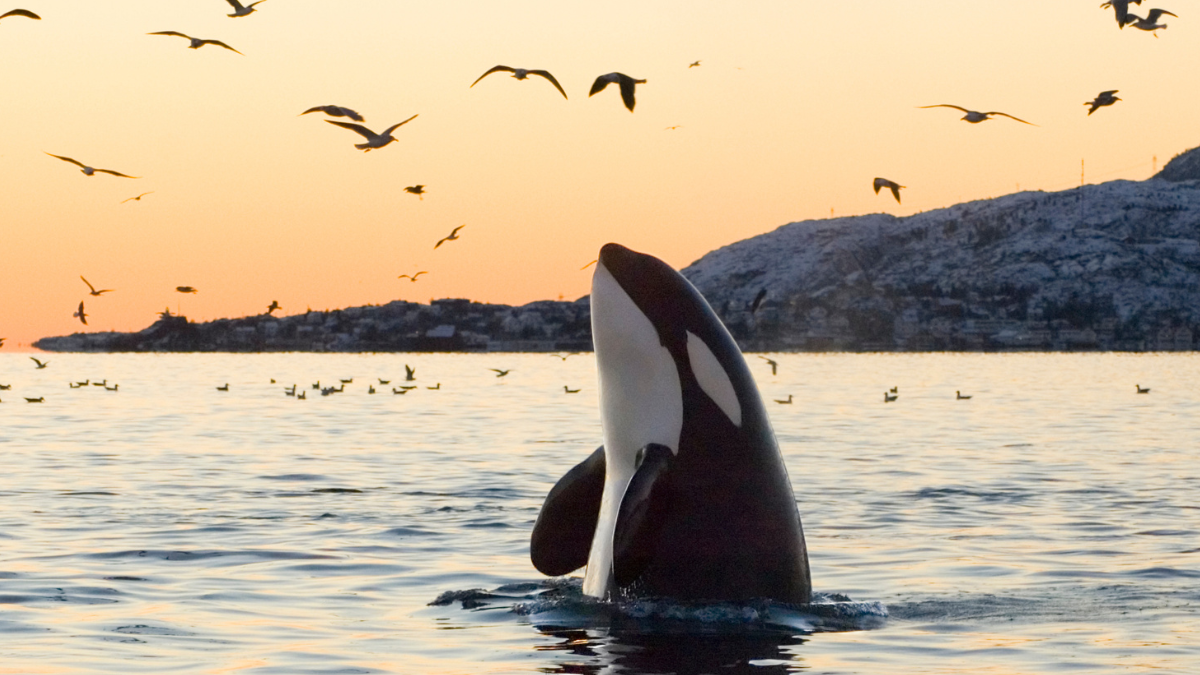
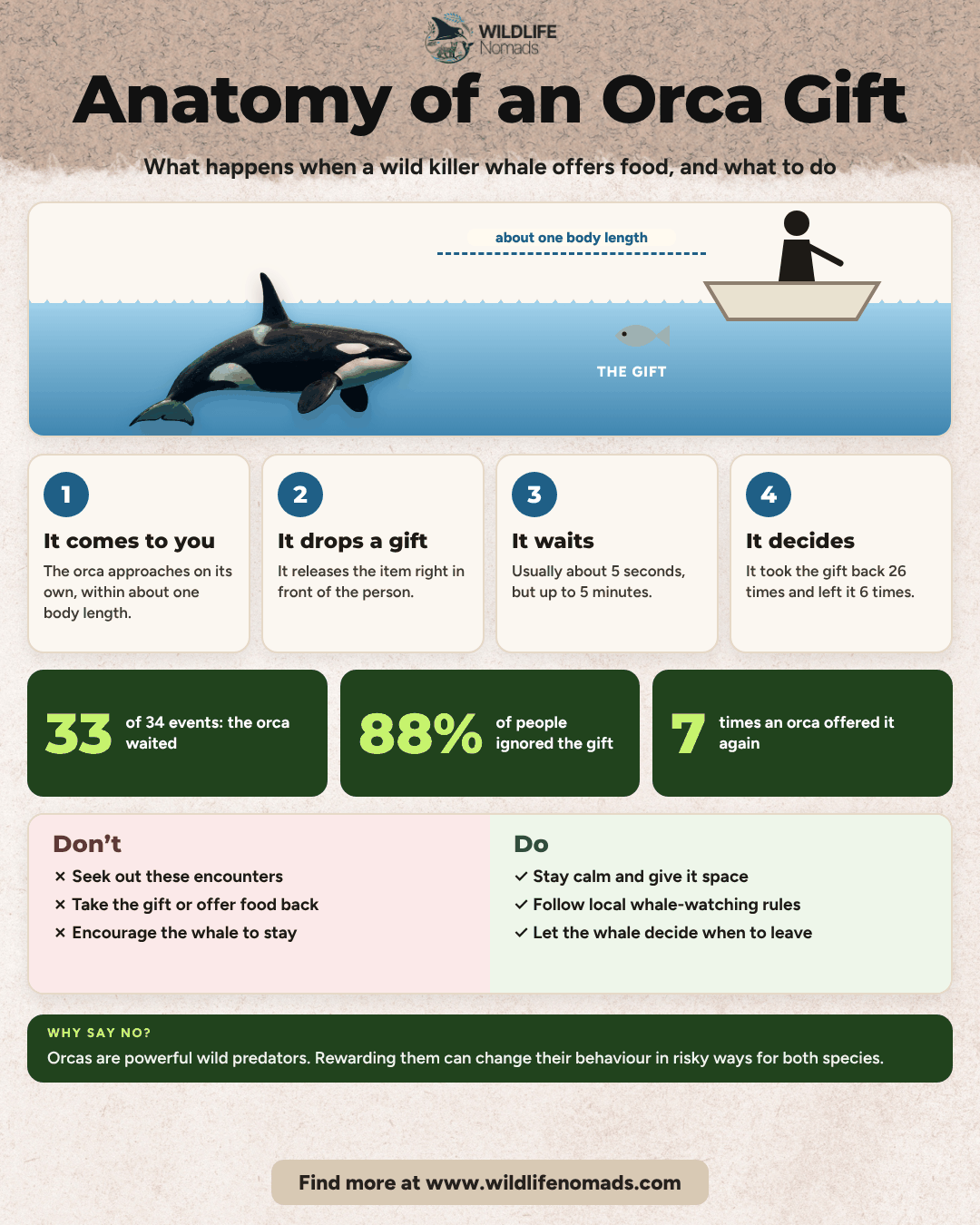
Imagine you’re swimming in the ocean, and a killer whale glides up to you. It drops a dead fish right in front of your mask. Then it waits, watching you.
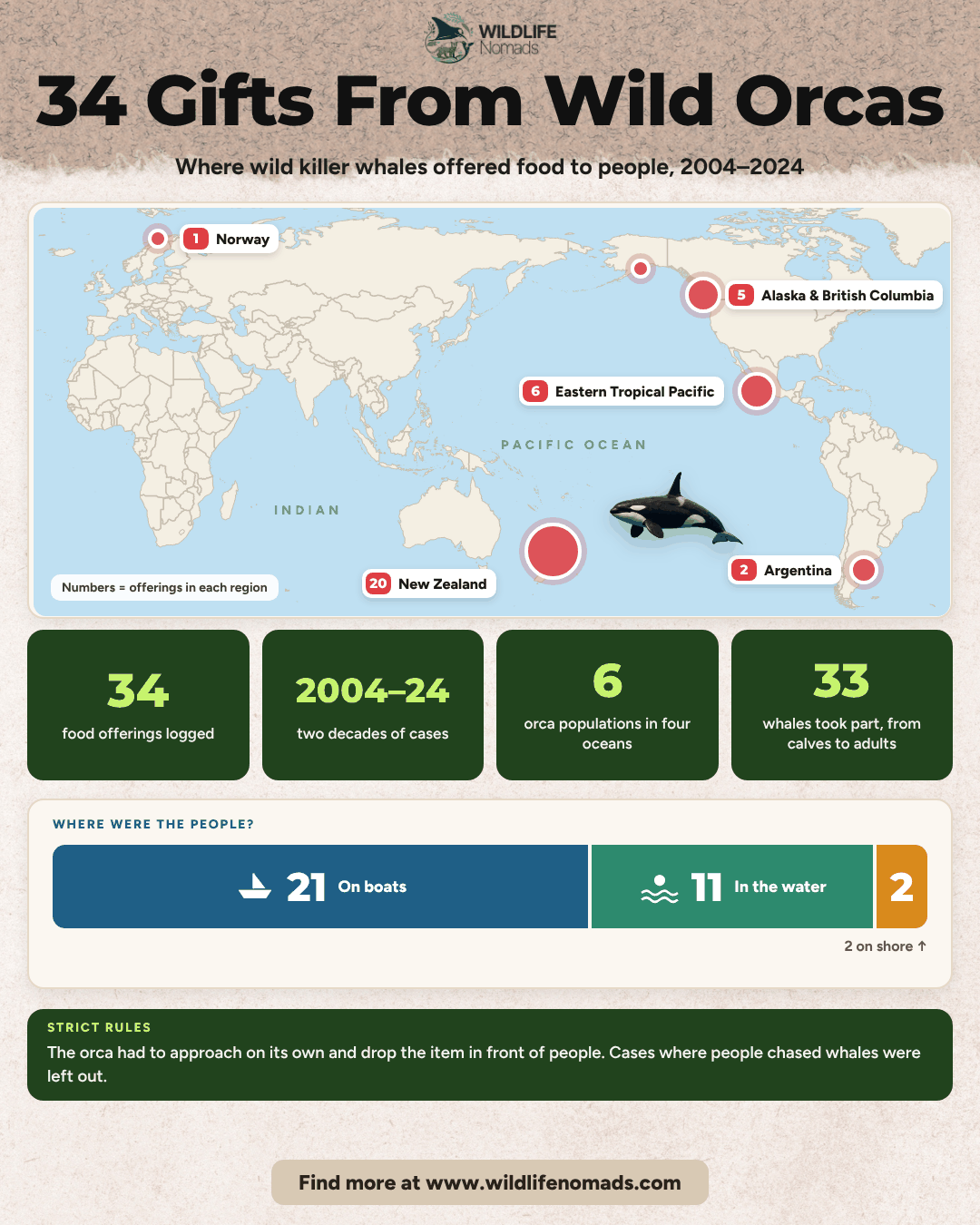
That has really happened, again and again. Do orcas offer food to humans? Yes. A 2025 study logged 34 cases of wild killer whales offering food to people between 2004 and 2024.
I find this one moving. It reminds me of the day a gray whale mother brought her calf to our boat in Baja California. Some animals seem as curious about us as we are about them.
Read the story, then take the 8-question quiz.
Jump to the quiz
Do Orcas Offer Food to Humans? The Short Answer
- Yes, sometimes. Researchers documented 34 food offerings by wild orcas over 20 years.
- On four continents. Cases came from North America, South America, Oceania and Europe.
- Not just fish. The whales offered 18 different kinds of items, from rays to a sea turtle.
- They waited. In all but one case, the orca paused to see what the person would do.
- Nobody knows why yet. Curiosity, play and relationship-building are all on the table.
A Gift at Alert Bay
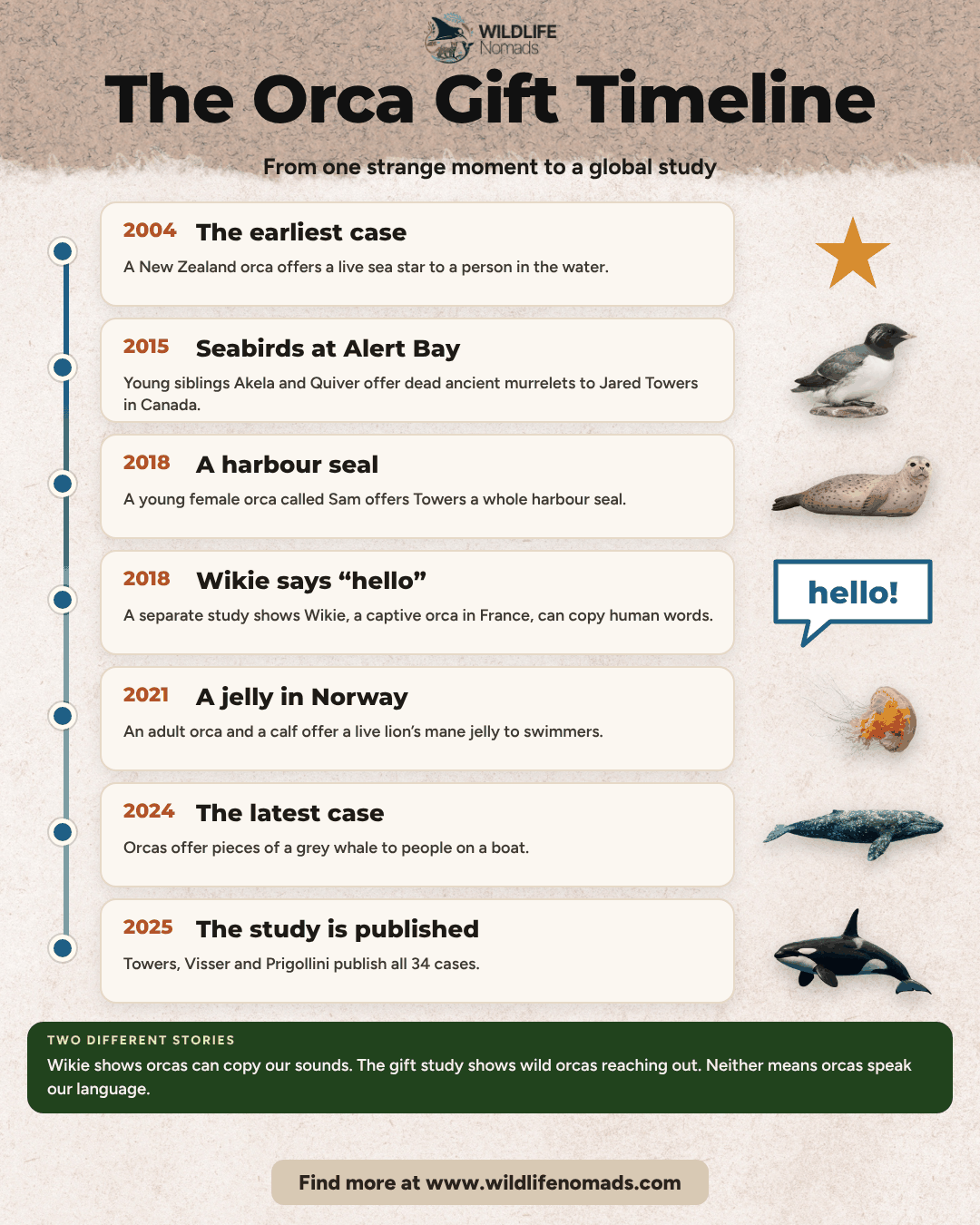
The study started with a strange moment. In 2015, researcher Jared Towers was filming killer whales near Alert Bay, in British Columbia, Canada.
Two young siblings, Akela and Quiver, swam up carrying dead seabirds. They opened their jaws, released the birds in front of him, then took them back and swam away.
In 2018, an orca appeared to offer him a harbour seal pup. Towers told the CBC these moments left him and his team a bit awestruck. So he asked colleagues around the world a simple question: has this happened to you too?
34 Cases on Four Continents
It had. Towers, from Bay Cetology in Canada, teamed up with Ingrid Visser of the Orca Research Trust in New Zealand. Vanessa Prigollini, from MAREA in La Paz, Mexico, joined them too.
Together they gathered 34 cases from 2004 to 2024. They came from Alaska, California and Canada, plus Argentina, New Zealand and Norway.
The rules were strict. The orca had to approach people on its own and drop the item in front of them. Cases where people had chased the whales didn’t count.
| Where the people were | Number of cases |
|---|---|
| On boats | 21 |
| In the water | 11 |
| On shore | 2 |
| Total | 34 |
What Did the Orcas Offer?
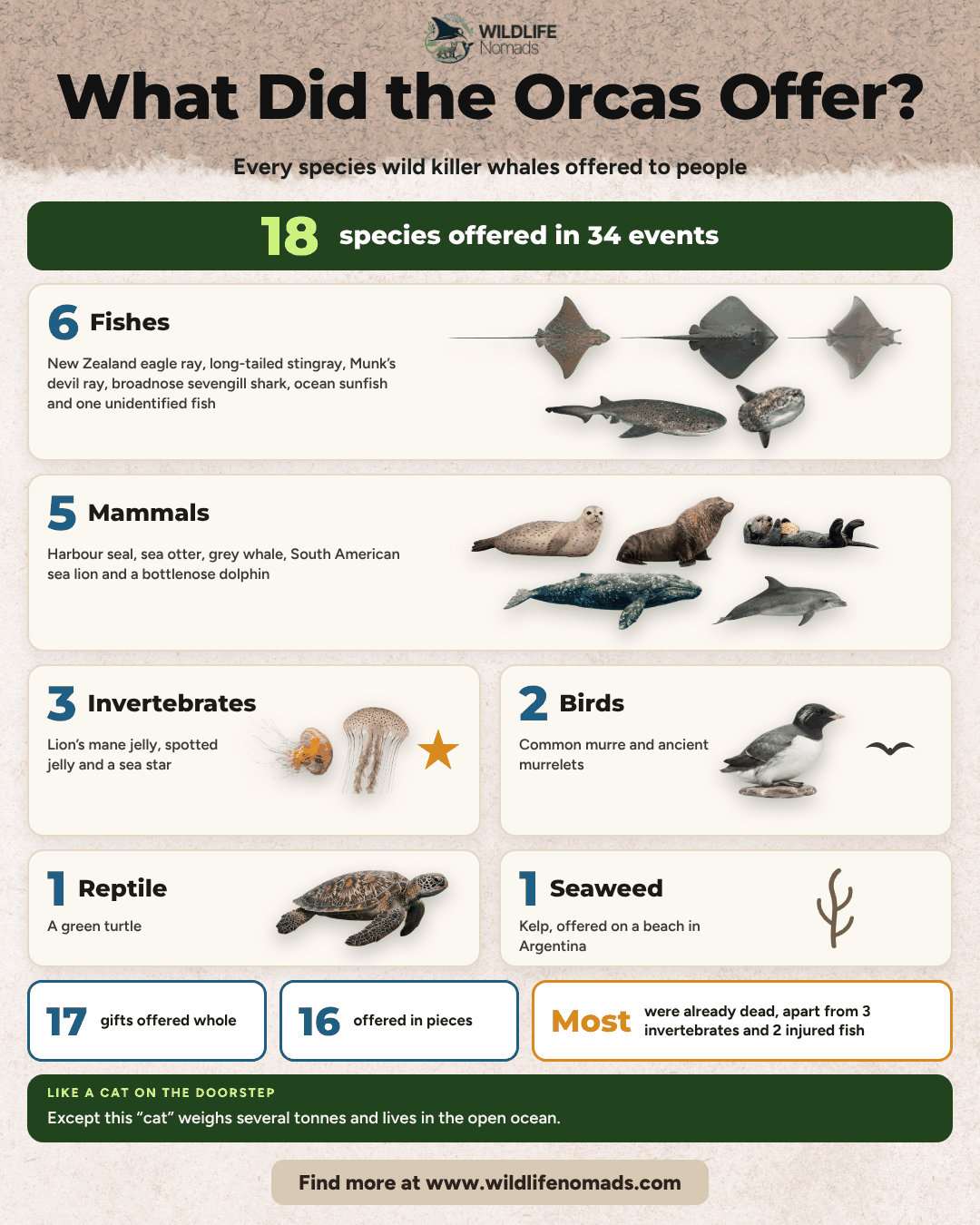
The menu was wide. Orcas offered 18 different types of items. These included several kinds of rays, a green turtle, an ocean sunfish and a broadnose sevengill shark.
One whale offered an ancient murrelet, a small seabird. Another offered a single strand of seaweed. In most cases with animals, the prey was already dead.
Half of the gifts were whole animals. The other half were pieces of prey. One young orca offered Visser a piece of eagle ray liver underwater.
Why Would a Top Predator Share?
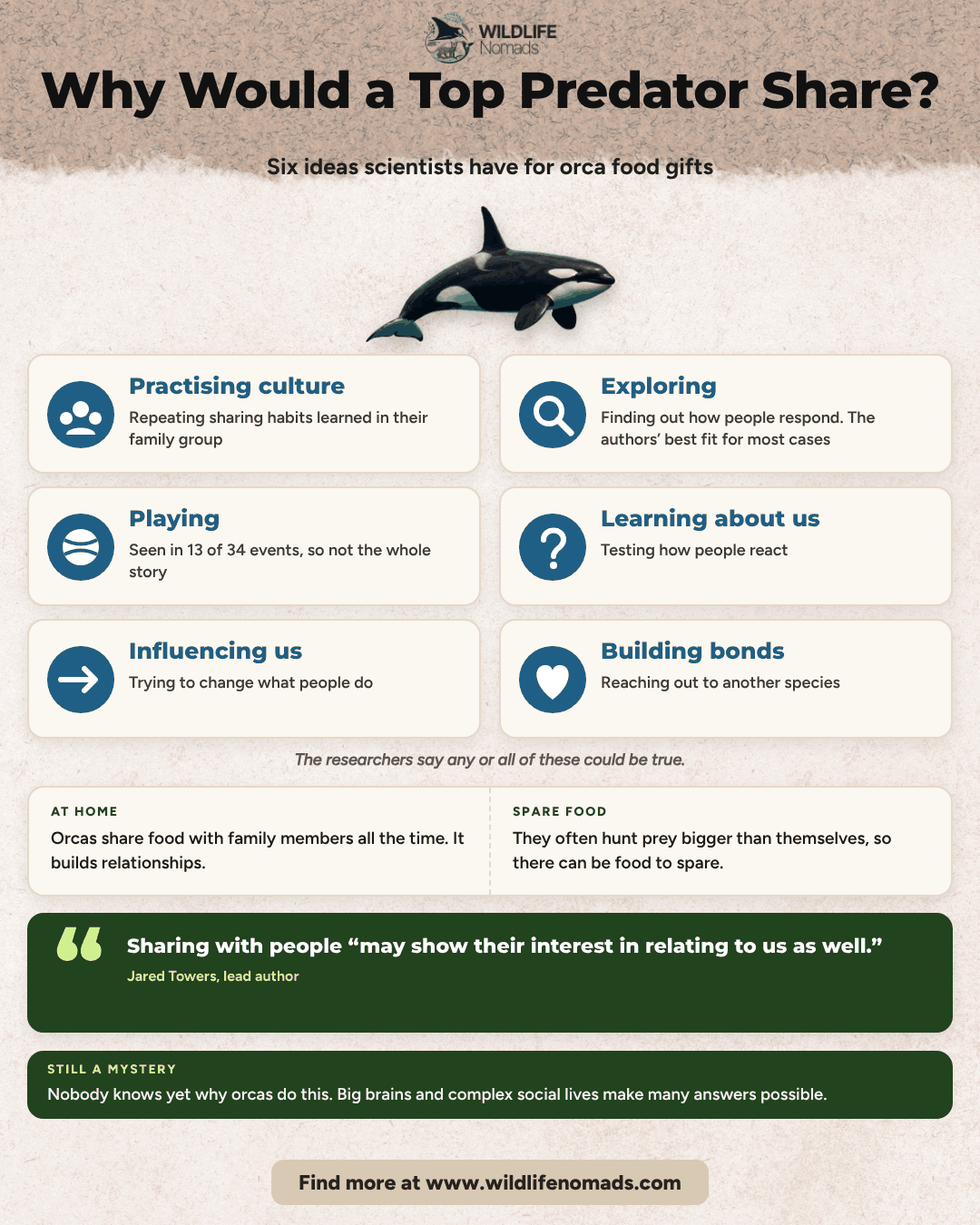
Inside their own families, killer whales share food all the time. Towers calls it a prosocial behaviour that builds relationships. Sharing with us might show an interest in relating to people, too.
The team offers several ideas. Orcas might be practising cultural behaviour, exploring, or playing. They might also be learning about humans, testing how we react, or even trying to influence us.
The researchers say any or all of these could be true. Orcas have big brains and complex social lives. Ecologist Carl Safina wasn’t surprised at all. In his view, the bigger problem is that humans rarely credit animals with minds.
It’s a bit like a cat leaving a bird on the doorstep. Except this cat weighs several tonnes and lives in the open ocean.
What About the Viral “Talking” Orca?
You may have seen a viral clip of an orca saying “hello”. That one is real, but it’s an older story. In 2018, scientists showed that Wikie, a captive orca in France, could copy human words.
Wikie learned to mimic words like “hello” and “bye bye” after training. That shows orcas can copy new sounds, which may help explain how wild groups learn their own dialects.
The two stories fit together. One shows orcas can copy our sounds, and the other shows wild orcas reaching out to us. Neither means orcas speak our language, though.
Should You Accept an Orca’s Gift?
No. The researchers are clear on this. People should not seek out these encounters, and they shouldn’t reciprocate or encourage them.
Either species could get hurt. Orcas are powerful wild predators, and feeding or rewarding them can change their behaviour in risky ways. A gift is fascinating, but it isn’t an invitation.
If an orca approaches, stay calm and give it space. Follow local whale-watching rules, and let the whale decide when to leave.
What This Means to Me
On a university trip to the gray whale lagoons of Baja California, a mother surfaced beside our small boat. She eased her calf towards us, close enough to touch. A friend cried. I wrote about it in my gray whale ecotourism story.
That day changed how I see whales. They make choices about us. This orca study puts numbers and careful rules behind that feeling, and I love it for that.
If whales fascinate you too, compare their sizes in our whale size comparison tool. Or meet the whole family in our guide to whale types.
FAQs About Orcas Offering Food
Yes, occasionally. A 2025 study documented 34 cases of wild orcas offering food to people. The cases span 2004 to 2024.
Cases came from four continents, including Alaska, California and Canada, Argentina, New Zealand and Norway.
Researchers recorded 18 types of items. They included rays, a green turtle, an ocean sunfish, a sevengill shark, a seabird and seaweed. Most animal gifts were already dead.
Nobody knows for sure. Researchers suggest curiosity, play, practising cultural behaviour, learning about humans or building relationships.
No. Researchers say people should not seek out, reciprocate or encourage these encounters, because orcas or people could be harmed.
Not really. In a 2018 study, a captive orca named Wikie learned to copy a few human words, like hello. Copying sounds is not the same as speaking a language.
A Gift From the Ocean’s Top Predator
Killer whales hunt seals, sharks and even other whales. Yet some of them pause to offer a stranger a fish and wait to see what happens.
We still don’t know what they’re thinking. But this study shows they’re paying attention to us. Next time you’re on the water, return the favour and watch them with care.
References:
Towers, J. R., Visser, I. N., & Prigollini, V. (2025). Testing the waters: Attempts by wild killer whales (Orcinus orca) to provision people (Homo sapiens). Journal of Comparative Psychology. https://doi.org/10.1037/com0000422
Abramson, J. Z., Hernández-Lloreda, M. V., García, L., Colmenares, F., Aboitiz, F., & Call, J. (2018). Imitation of novel conspecific and human speech sounds in the killer whale (Orcinus orca). Proceedings of the Royal Society B, 285(1871), 20172171. https://doi.org/10.1098/rspb.2017.2171
American Psychological Association. (2025, July 1). Killer whales, kind gestures: Orcas offer food to humans in the wild [Press release]. APA