
Wildlife Nomads · Play · Life Cycles Lab
What Are Life Cycles? From Egg to Adult and Back Again
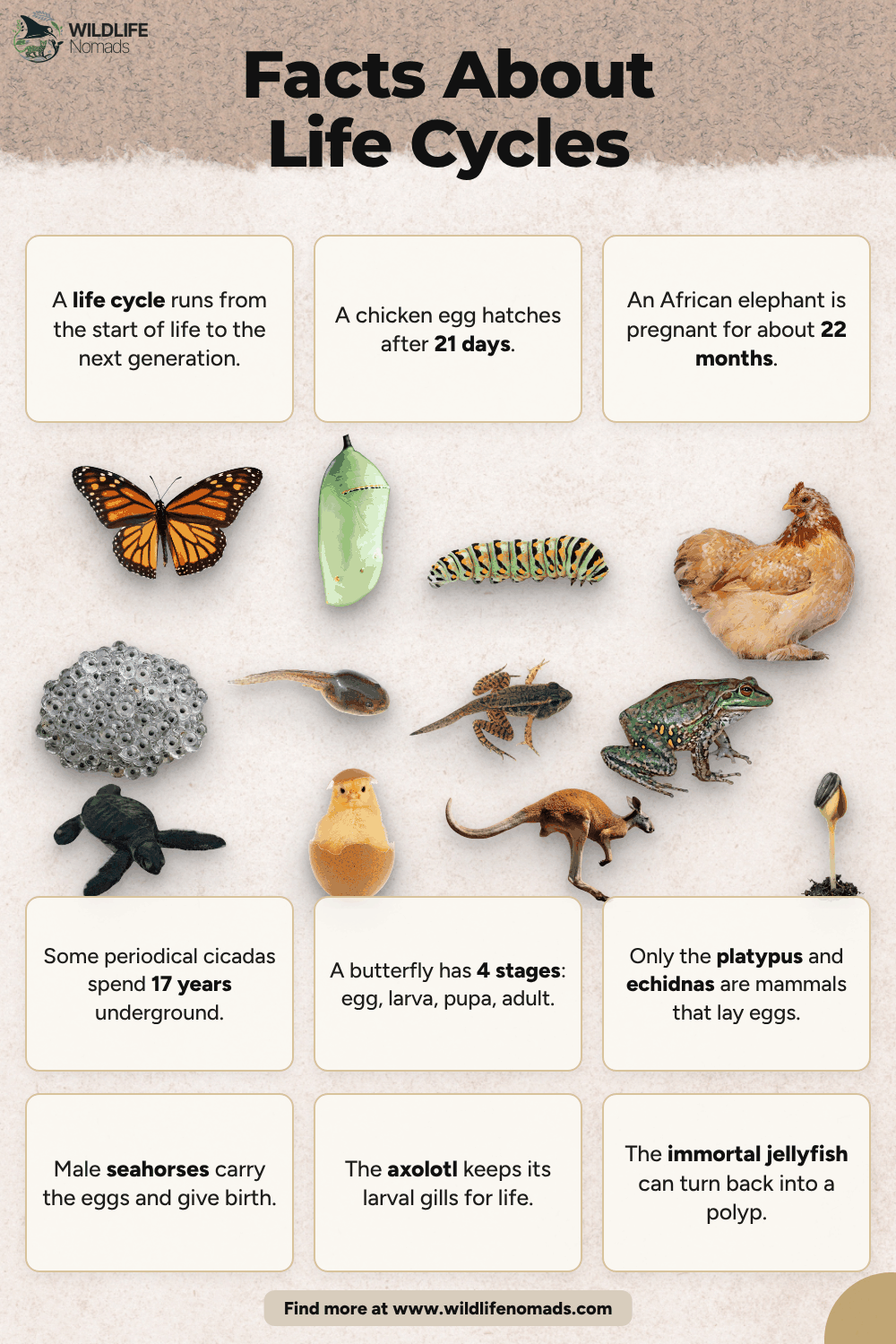
A life cycle is the series of stages a living thing goes through. It runs from the start of its life to the next generation. Spin a frog, monarch or sunflower through its cycle. Race mammals to birth and decode haploid and diploid phases.
By Cesar Medina, conservation biologist · 8 interactive stops
What is a life cycle?
A life cycle is the series of stages a living thing goes through. It runs from the start of its life to producing the next generation. Most life cycles involve birth or hatching, growth, reproduction and death. Then the cycle begins again with the young.
All living things have life cycles, from a single cell of green algae to a blue whale. The stages differ hugely between species. A frog starts as an egg in a pond. A human starts as one cell and grows for about nine months before birth.
Life cycles explain how species survive. Each stage solves a problem: finding food, growing safely or passing on genetic material. The Life Cycles Lab above lets you spin through those stages yourself.
The stages of a life cycle
Biologists describe a biological life cycle in a few broad stages. Not every organism shows each one clearly, but the pattern holds for most animals and plants.
| Stage | What happens | Example |
|---|---|---|
| Beginning | Life starts as an egg, a seed, a spore or a live birth. | Frogspawn, a sunflower seed, a newborn joey |
| Growth | The young feed and grow. Many change shape along the way. | A tadpole grows legs; a caterpillar sheds its skin |
| Adulthood | The organism becomes able to reproduce. | A hen starts laying at about 18 to 22 weeks |
| Reproduction | Adults produce gametes, seeds or young, making the next generation. | A salmon returns to its home river to spawn |
| Death | The individual dies, but its young carry the cycle on. | An annual sunflower dies after setting seed |
Different life cycles in animals
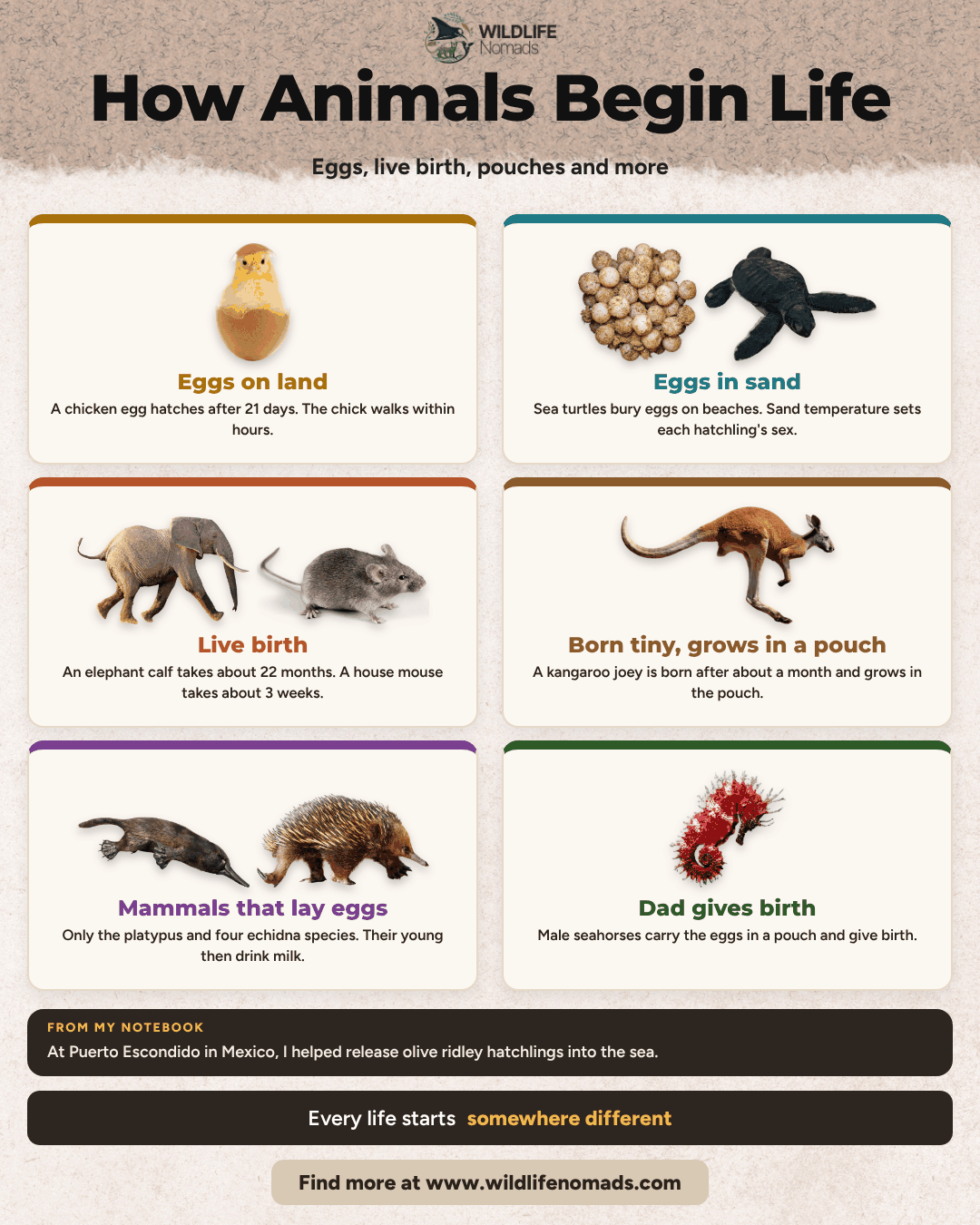
Animals start life in different ways. Some lay eggs, some give live birth, and marsupials do something in between.
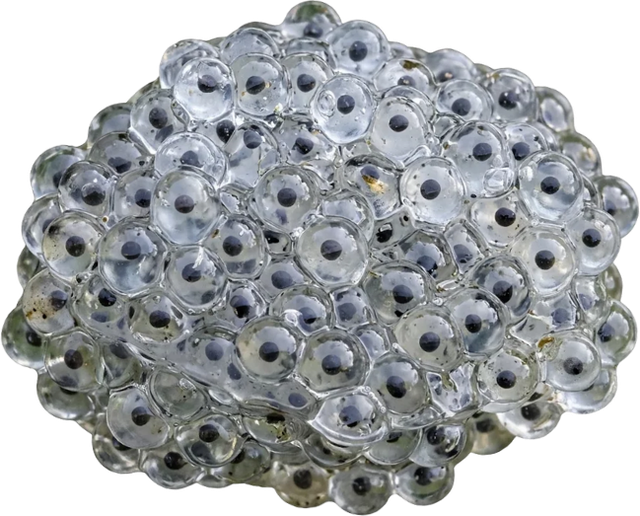
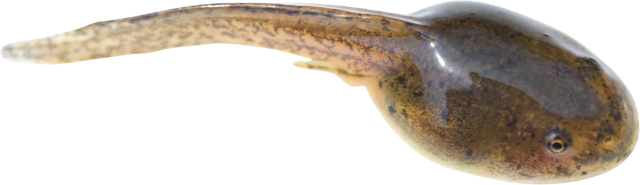
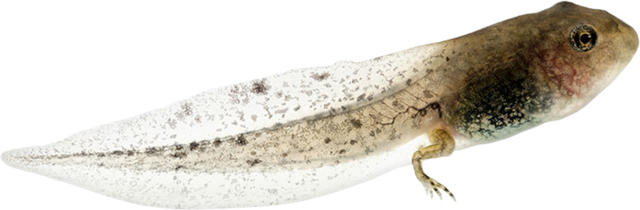
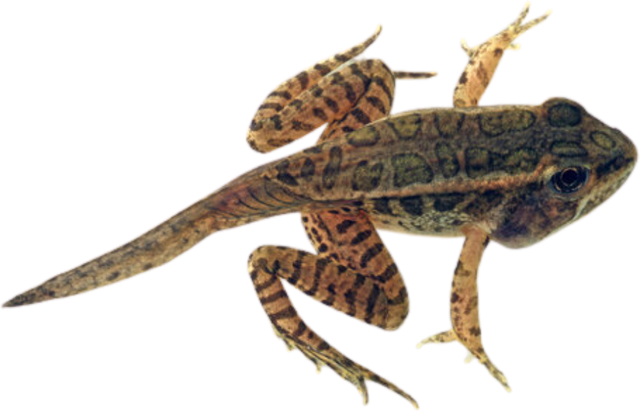
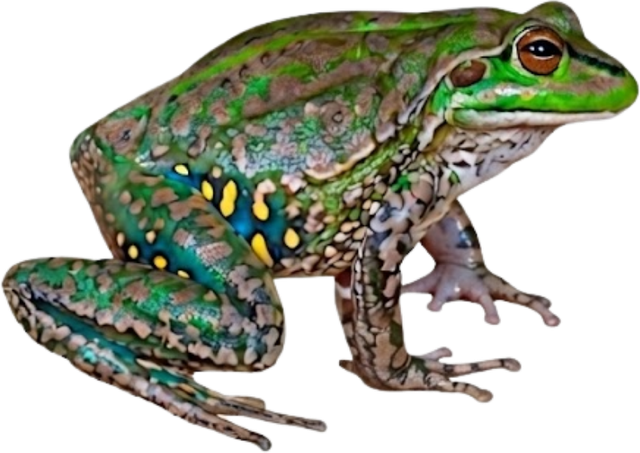
Eggs hatch into tadpoles that live underwater. Over weeks, each tadpole grows legs and lungs, then hops onto land.
Egg, caterpillar, chrysalis, adult. Read my monarch butterfly facts.
The chick grows inside the egg for 21 days. It hatches covered in down and walks within hours.
Females bury their eggs on beaches. Sand temperature sets each hatchling’s sex. Meet the types of sea turtles.
A tiny joey is born after about a month and grows in the pouch. Learn what marsupials are.
The platypus lays eggs, then feeds its young milk. Read my platypus facts.
Most mammals are viviparous: their young grow inside the mother and are born alive. The platypus and the four echidna species are the only mammals that lay eggs. In seahorses, the father carries the eggs and gives birth. Read more seahorse facts.
The frog’s life cycle
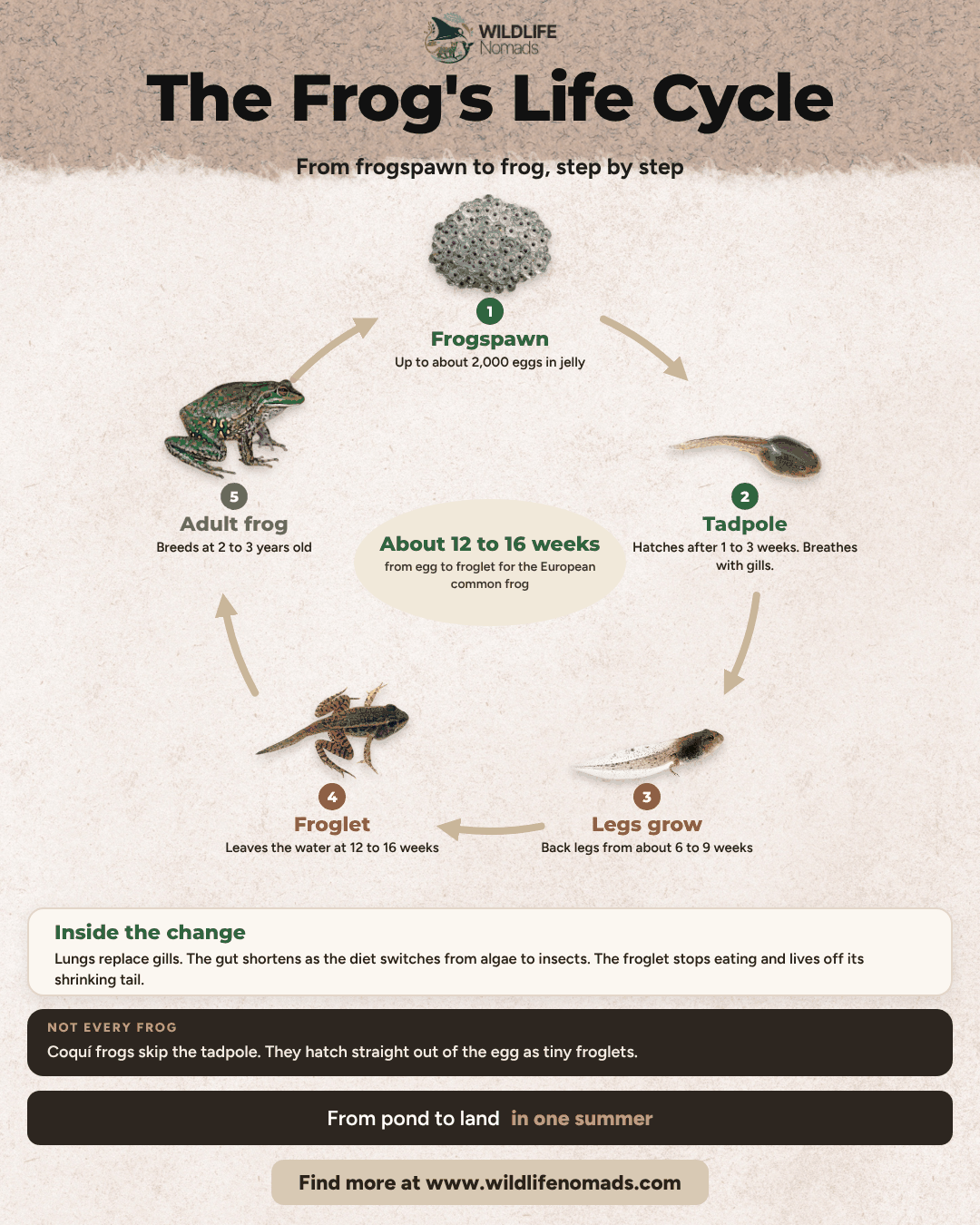
The frog’s life cycle is the classic example of metamorphosis. Here is how it plays out for the European common frog in spring.
Inside, the changes are just as dramatic. Lungs replace gills, and the gut shortens as the diet switches from algae to insects. While the tail shrinks, the froglet stops eating and lives off it. Not every frog follows this path, though. Coquí frogs hatch straight out of the egg as tiny froglets. Compare frogs in my guide to types of green frogs.
Metamorphosis: complete and incomplete
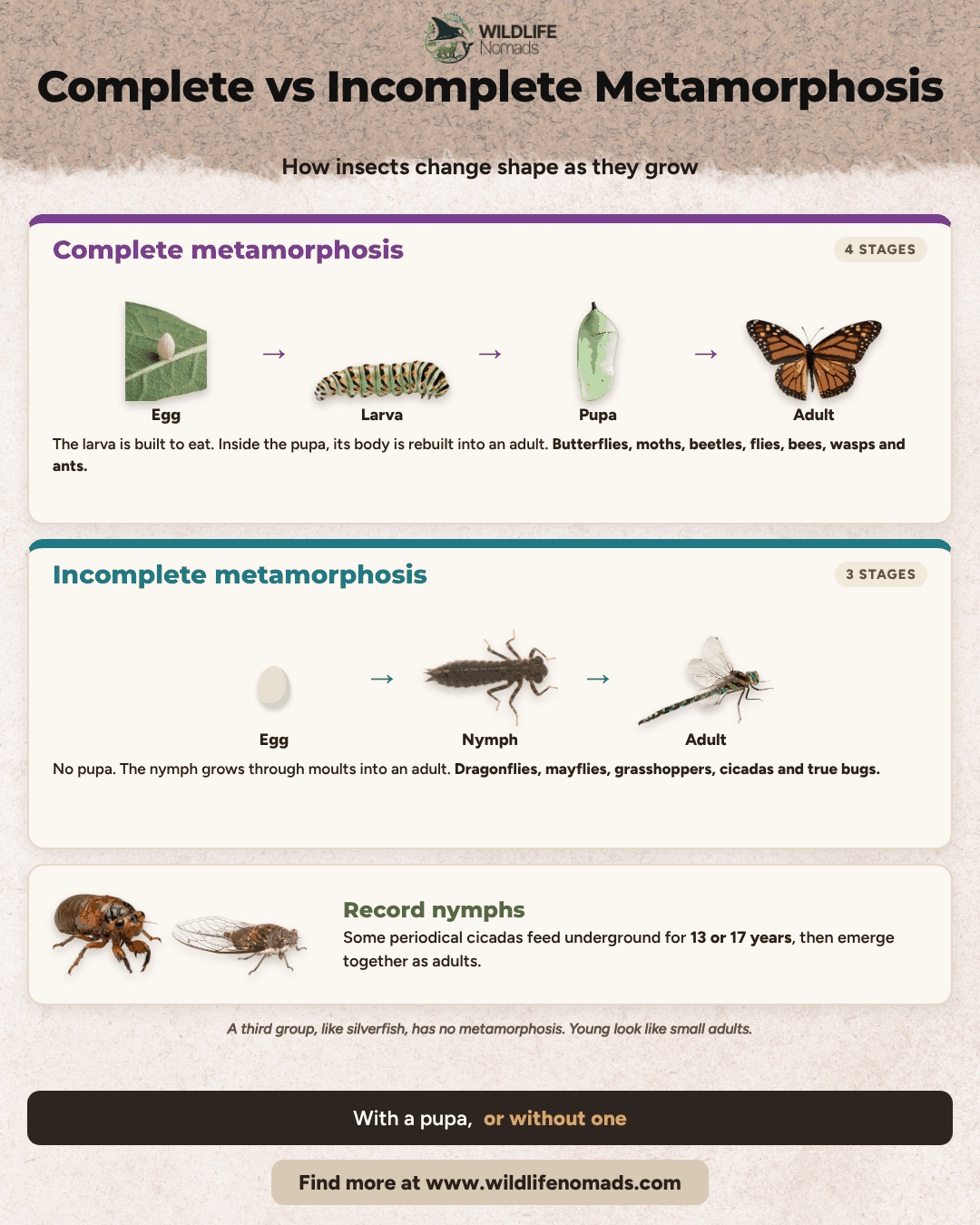
Metamorphosis is a dramatic change in body form during life. Insects show it in two main ways.
| Type | Stages | Examples |
|---|---|---|
| Complete | Egg, larva, pupa, adult | Butterflies, moths, beetles, flies, bees, wasps and ants |
| Incomplete | Egg, nymph, adult | Dragonflies, mayflies, grasshoppers, cicadas and true bugs |
| None | Young look like small adults | Silverfish, which keep molting all their lives |
The butterfly life cycle starts when a female lays tiny eggs on a host plant. The caterpillar, or larva, focuses on feeding and growing. Inside the chrysalis, its body is rebuilt into a butterfly. I visited a monarch butterfly sanctuary in Michoacán, Mexico, when I was about ten. I still remember how many butterflies there were. Follow their journey on my monarch migration map.
The human life cycle
The human life cycle begins when a sperm cell joins an egg cell. That single cell divides again and again. Pregnancy lasts about 40 weeks, roughly nine months, before live birth.
- Infancy: babies grow fast and usually triple their birth weight by their first birthday.
- Childhood: children learn new skills, like talking, running and reading.
- Adolescence: puberty makes the body able to reproduce.
- Adulthood: growth stops, and many adults have children of their own.
- Older age: the body repairs itself more slowly. Worldwide, life expectancy at birth is about 73 years.
Other mammals follow the same pattern on different clocks. A house mouse is born after about three weeks, while an elephant calf takes about 22 months. See more animals with the longest gestation period.
Plant life cycles
Flowering plants go from seed to seedling, then grow, flower and produce seeds. That last step needs pollination, which you can explore in my Pollination Lab.
Finish the whole cycle in one year, like sunflowers.
Grow leaves in year one, then flower and die in year two, like evening primrose.
Live for many years. Some bristlecone pines are about 4,850 years old.
Ferns and mosses skip seeds. They spread by spores, and their life cycles switch between two very different generations.
Haploid and diploid phases
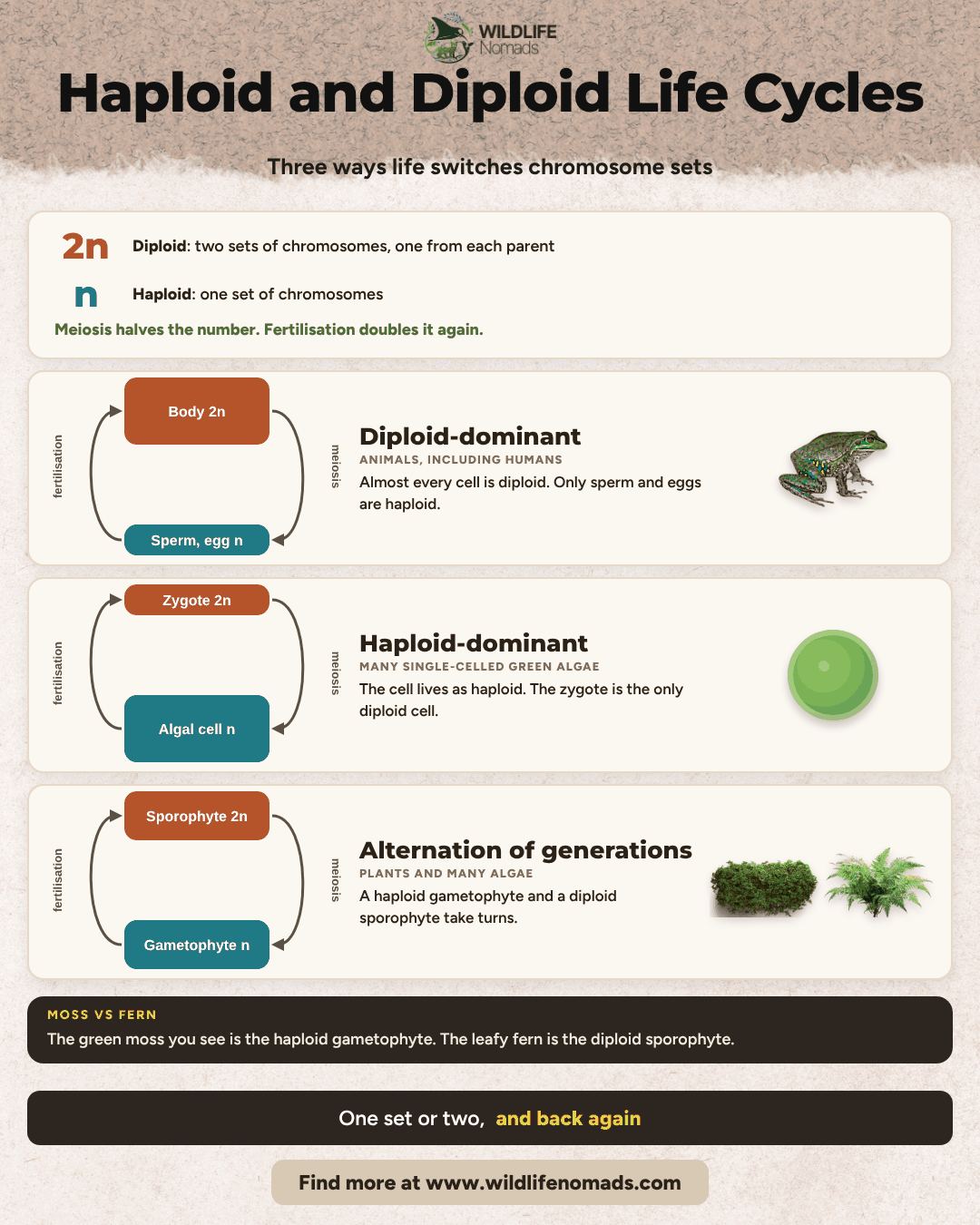
Every sexual life cycle switches between two chromosome states. A diploid cell (2n) carries two sets of chromosomes, one from each parent. A haploid cell (n) carries one set. Meiosis halves the number, and fertilization doubles it again in diploid zygotes.
| Life cycle type | Main phase | Examples |
|---|---|---|
| Diploid-dominant | Diploid (2n) | Humans and other animals. Only sperm and eggs are haploid. |
| Haploid-dominant | Haploid (n) | Many single-celled green algae. The zygote is the only diploid cell. |
| Alternation of generations | Both | Plants and many red algae. A haploid gametophyte alternates with a diploid sporophyte. |
In mosses, the green plant you see is the haploid gametophyte. In ferns and flowering plants, the main plant is the diploid sporophyte. Many red algae even have three phases, with two separate diploid stages.
Unique life cycles
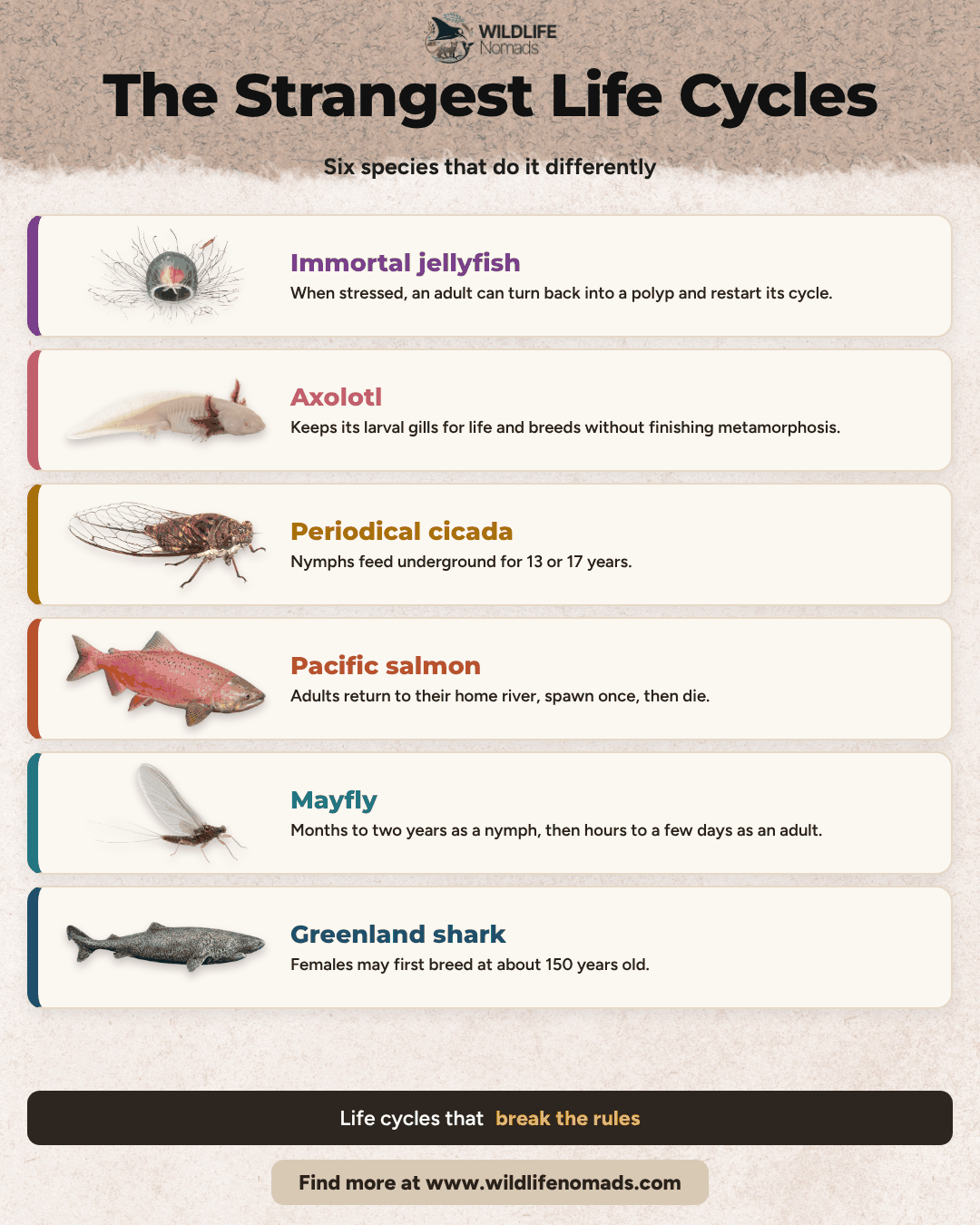
Some species have complex life cycles that seem to break the rules.
- Immortal jellyfish: when stressed, an adult can turn back into a polyp and restart its cycle.
- Axolotl: it keeps its larval gills for life and breeds without finishing metamorphosis. Read my axolotl facts.
- Periodical cicadas: nymphs feed underground for 13 or 17 years.
- Pacific salmon: adults spawn once, then die.
- Mayflies: adults live only hours to a few days, after months to two years as nymphs.
Life cycle and lifespan are not the same thing. Compare the shortest and longest lives in my Animal Lifespan explorer.
Why life cycles matter
Knowing a life cycle shows where a species is most at risk. Protecting adults does little if eggs or young cannot survive. That is why sea turtle work focuses so much on nests and hatchlings.
At Puerto Escondido in Mexico, I helped release olive ridley hatchlings into the sea. Watching them crawl towards the waves made the whole cycle feel real. Only a few will return as adults to nest.
Try it: race ten mammals to birth in stop 4 of the lab, then sort the insects in stop 2.
Keep learning
Take life cycles further
Finished the lab? Keep going with a printable guide for home, or a ready-to-teach unit for the classroom.
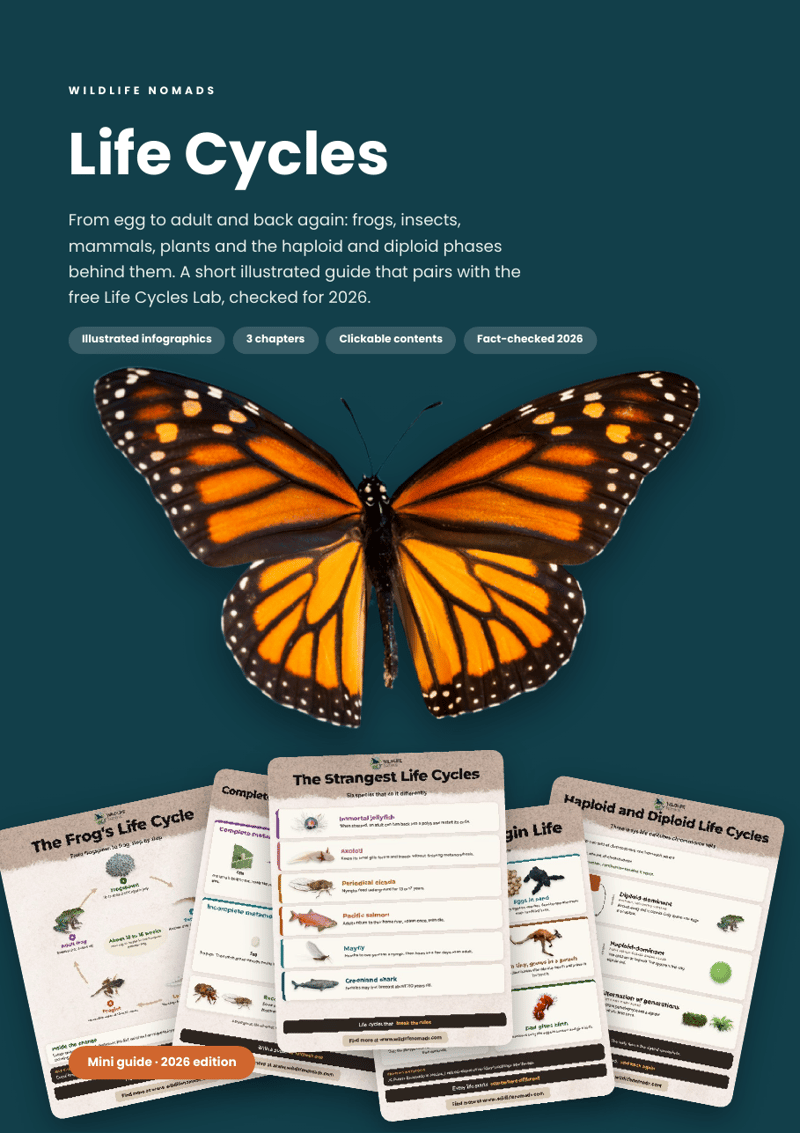 Free PDF · 15 pagesLife Cycles Mini GuideFrogs, metamorphosis, mammals and haploid and diploid phases, plus a quick quiz with answers.Download free →
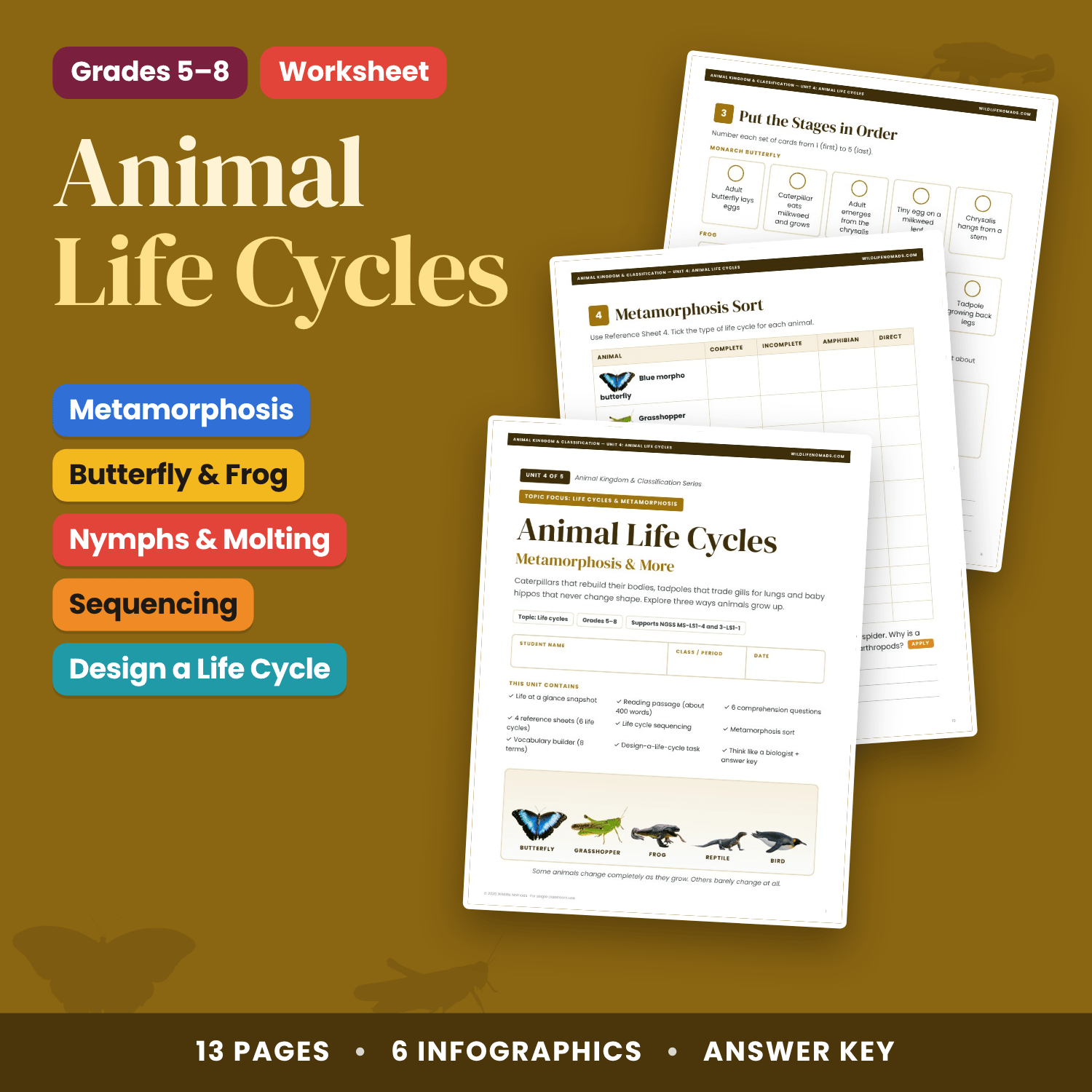 For teachers · Grades 5–8Animal Life Cycles Worksheet UnitComplete and incomplete metamorphosis, reading, activities and a full answer key.See it on TPT →
Life Cycles FAQ
A life cycle is the set of stages a living thing goes through. It starts with an egg, seed or birth, then growth, reproduction and death. The young then start the cycle again.
Many life cycles share four broad stages: beginning (an egg, seed or birth), growth, reproduction and death. Insects with complete metamorphosis have four named stages: egg, larva, pupa and adult.
A frog starts as frogspawn, an egg in jelly. It hatches into a tadpole with gills, grows back legs and then front legs, and becomes a froglet. The froglet loses its tail and grows into an adult frog.
Complete metamorphosis has four stages: egg, larva, pupa and adult, as in butterflies and beetles. Incomplete metamorphosis has three: egg, nymph and adult, as in dragonflies and grasshoppers. Nymphs have no pupa stage.
Diploid cells (2n) hold two sets of chromosomes, one from each parent. Haploid cells (n) hold one set. Meiosis makes haploid cells, and fertilization joins two of them into a diploid zygote.
The human life cycle runs through fertilization, about nine months of pregnancy, infancy, childhood, adolescence, adulthood and older age. Adults can have children, which starts the next generation.
Only the platypus and the four echidna species lay eggs. They are called monotremes. Their young hatch and then drink milk from patches on the mother’s skin.
Among animals with known ages, the Greenland shark is extreme. Scientists estimate females first breed at about 150 years old, and some sharks may live at least 272 years.
References
Mable, B. K., & Otto, S. P. (1998). The evolution of life cycles with haploid and diploid phases. BioEssays, 20(6), 453–462. https://doi.org/10.1002/(SICI)1521-1878(199806)20:6<453::AID-BIES3>3.0.CO;2-N
Truman, J. W., & Riddiford, L. M. (1999). The origins of insect metamorphosis. Nature, 401(6752), 447–452. https://doi.org/10.1038/46737
Williams, K. S., & Simon, C. (1995). The ecology, behavior, and evolution of periodical cicadas. Annual Review of Entomology, 40, 269–295. https://doi.org/10.1146/annurev.en.40.010195.001413
Piraino, S., Boero, F., Aeschbach, B., & Schmid, V. (1996). Reversing the life cycle: Medusae transforming into polyps and cell transdifferentiation in Turritopsis nutricula (Cnidaria, Hydrozoa). The Biological Bulletin, 190(3), 302–312. https://doi.org/10.2307/1543022
Nielsen, J., Hedeholm, R. B., Heinemeier, J., Bushnell, P. G., Christiansen, J. S., Olsen, J., Ramsey, C. B., Brill, R. W., Simon, M., Steffensen, K. F., & Steffensen, J. F. (2016). Eye lens radiocarbon reveals centuries of longevity in the Greenland shark (Somniosus microcephalus). Science, 353(6300), 702–704. https://doi.org/10.1126/science.aaf1703
Jensen, M. P., Allen, C. D., Eguchi, T., Bell, I. P., LaCasella, E. L., Hilton, W. A., Hof, C. A. M., & Dutton, P. H. (2018). Environmental warming and feminization of one of the largest sea turtle populations in the world. Current Biology, 28(1), 154–159. https://doi.org/10.1016/j.cub.2017.11.057
United Nations, Department of Economic and Social Affairs, Population Division. (2024). World population prospects 2024: Summary of results. United Nations. https://population.un.org/wpp/



