Guest post by Joel F. Ortega, M.Sc. Field biologist and founder of Birding Mexico Expeditions
and Birding in the Yucatan.
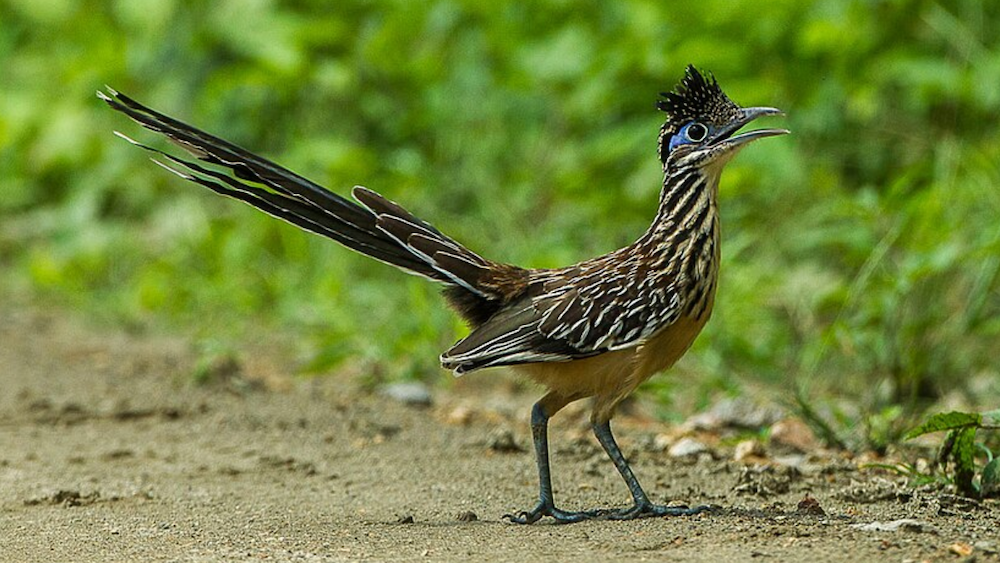
Birdwatching has a funny way of rewarding patience. Sometimes the harder you search, the less you find. Then, when you’ve stopped expecting anything unusual, that’s often when the best birds appear.
While the Greater Roadrunner (Geococcyx californianus) enjoys worldwide fame for its desert habitat and appearances in popular culture, its quieter relative, the Lesser Roadrunner (Geococcyx velox), is a much more secretive bird. This makes every sighting feel like a small victory for birdwatchers.
One October morning, our attention wasn’t even on birds. We were checking camera traps as part of a mammal monitoring project when a flash of movement caught our eye. A Lesser Roadrunner had stepped onto the trail just ahead of us. Instead of disappearing into the scrub, it calmly wandered through the low vegetation for nearly half an hour, giving us a rare opportunity to observe, photograph, and film one of Yucatán’s most elusive birds.
The Shy Cousin
To appreciate just how unusual this encounter was, it helps to compare the Lesser Roadrunner with its much better-known relative.
If you imagine a roadrunner, you’re probably picturing the Greater Roadrunner (Geococcyx californianus), the long-legged desert bird made famous by the classic cartoon in which it constantly outsmarts Wile E. Coyote. The Lesser Roadrunner is the quieter relative that few people know, and that is precisely what makes seeing one so special.
Its range stretches from northwestern and southwestern Mexico to Central America, where it inhabits arid scrublands, tropical dry forests, roadsides, and the edges of farmland. One of the most intriguing populations occurs in the northern Yucatán Peninsula, isolated from the rest of the species by a broad belt of tropical rainforest. It is within these transition zones, where dry forest gradually blends into taller tropical vegetation, that the bird becomes especially difficult to find.
Spending nearly thirty minutes watching one in the wild felt like striking gold. Even experienced birdwatchers who spend years exploring this region may go long periods without getting such a clear view.
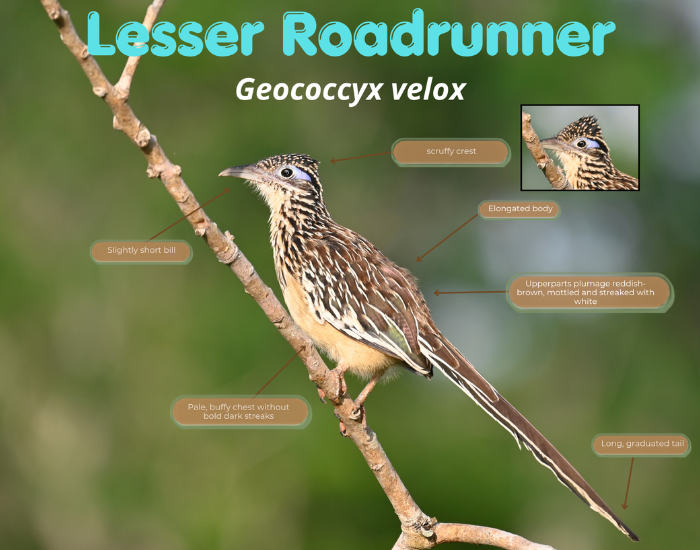
If you look closely, telling the two roadrunners apart is easy. The Lesser Roadrunner is noticeably smaller, with a slightly shorter bill and a paler buff chest that lacks the dark streaks of its northern cousin. Its back is reddish-brown, mottled and streaked with white. This pattern is designed to camouflage the bird in leaf litter, and as we saw for ourselves, it works very well.
A Hunter That Prefers to Run
Like its relative, the Lesser Roadrunner prefers running to flying, taking flight only when absolutely necessary. It hunts on foot, chasing insects, lizards, small snakes, and any invertebrate that crosses its path. It is extremely cautious by nature and usually disappears into the bushes at the slightest sign of a person.
That is what made that October morning so unusual: It did not run away.
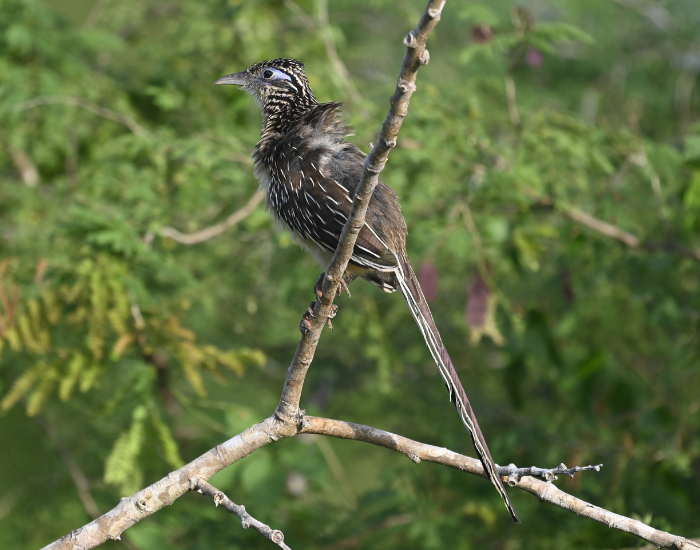
Taxonomically, the Lesser Roadrunner belongs to the cuckoo family, Cuculidae. This surprises people who only know cuckoos from stories about brood parasites that drop their eggs into other birds’ nests and leave others to raise their chicks. Unlike many members of the cuckoo family, roadrunners build their own nests and raise their own young.
Although the Lesser Roadrunner has been known to science since it was first described in 1836 from a specimen collected near Mexico City, it continues to surprise ornithologists. For much of the twentieth century, taxonomists recognized up to five subspecies based on subtle differences in plumage and tail patterns. Later studies showed that these variations were simply individual and seasonal rather than evidence of distinct populations, and today the species is generally treated as having no recognized subspecies.
A Clue in the Eyes
Then, in 2024, researchers van Dort and Juárez noticed something that had never been examined in detail before. After studying more than 1,400 photographs from the Macaulay Library, they discovered an unexpected pattern.
Birds from western Mexico to western Honduras have completely dark eyes. However, eastern populations (including the isolated birds from northern Yucatán, like the one we observed) show a partial pale ring around the pupil, a characteristic known as sectoral heterochromia.
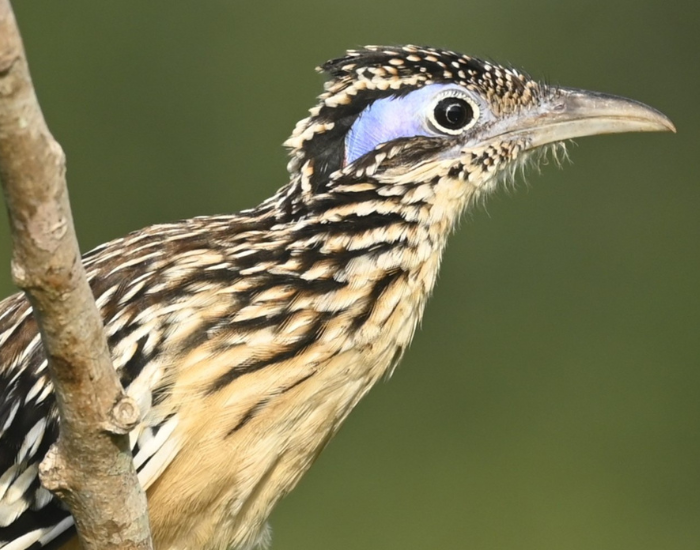
It is a tiny detail, but one that raises an intriguing question for ornithologists and taxonomists alike: are we truly looking at a single species, or could two distinct species be hiding under the same name?
I like the idea that such a quiet bird still has secrets to reveal. Our unexpected encounter was a reminder that fieldwork never stops being rewarding, no matter how many years you spend outdoors. You can be focused on mammal tracks, plants, or something entirely different, and the forest will still surprise you.
That may be the greatest lesson birdwatching has to offer. Patience matters. Experience certainly helps. But sometimes the most memorable birds appear only after you’ve stopped looking for them.
References:
van Dort, J., & Juárez, R. (2024). Eye colour is geographically variable in Lesser Roadrunner Geococcyx velox (Wagner, 1836). Bulletin of the British Ornithologists’ Club, 144(4), 415–424. https://doi.org/10.25226/bboc.v144i4.2024.a4