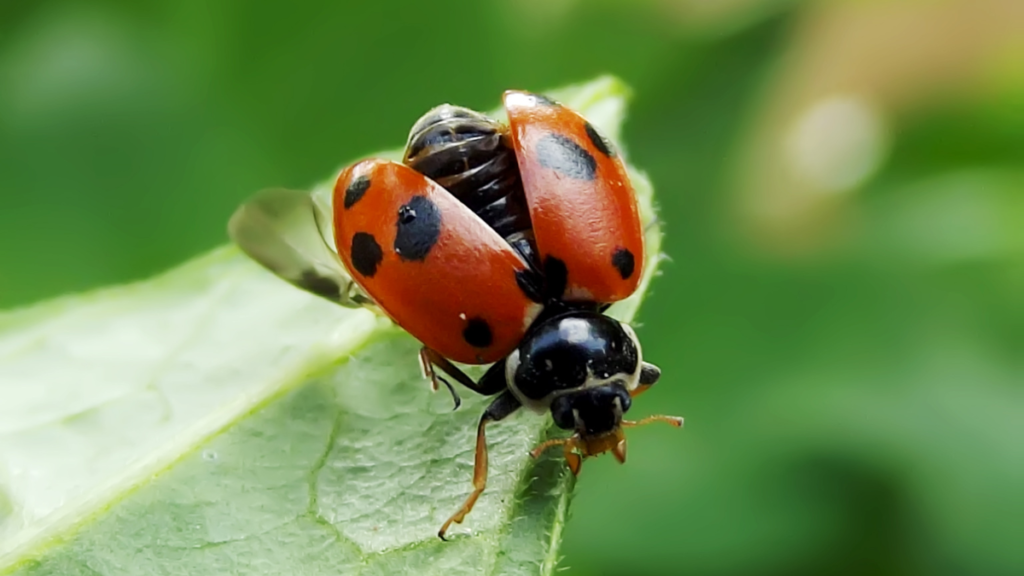
Growing up in Mexico, I spent whole afternoons crouched in my grandmother’s garden. Most bugs I wanted nowhere near my skin. Ladybirds were the exception. I let them walk across my knuckles for hours, watching those tiny red domes with black spots trundle over my hand like polished beads. Something about ladybirds pulls people in, the bright colours, the friendly shape, the way they turn up in films and children’s books as the one insect nobody fears.
Decades later, I still stop for them in the field everywhere I go. They are ferocious predators, cultural symbols, and quiet indicators of ecosystem health, all packed into a body smaller than your fingernail. Here are ten things about ladybirds that changed how I see them, grounded in science, and in a lifetime of watching them up close.
What Exactly Are Ladybirds?
Ladybirds belong to the beetle family Coccinellidae, and that word matters more than it looks. The name traces to the Latin word coccineus, meaning “scarlet”, a nod to the classic red and black body most of us picture. So despite the “bird” and the “bug” in their common names, ladybirds are neither. They are beetles, close cousins of the scarab beetle and every other member of the vast beetle order.
Their design is instantly recognisable. Ladybirds have dome shaped bodies, short black legs, and hardened wing cases that snap shut over delicate flight wings. Most sport spots, but the patterns vary wildly between species. Once you know the family, you start seeing ladybirds everywhere, and you start noticing how much variety hides inside that simple template.
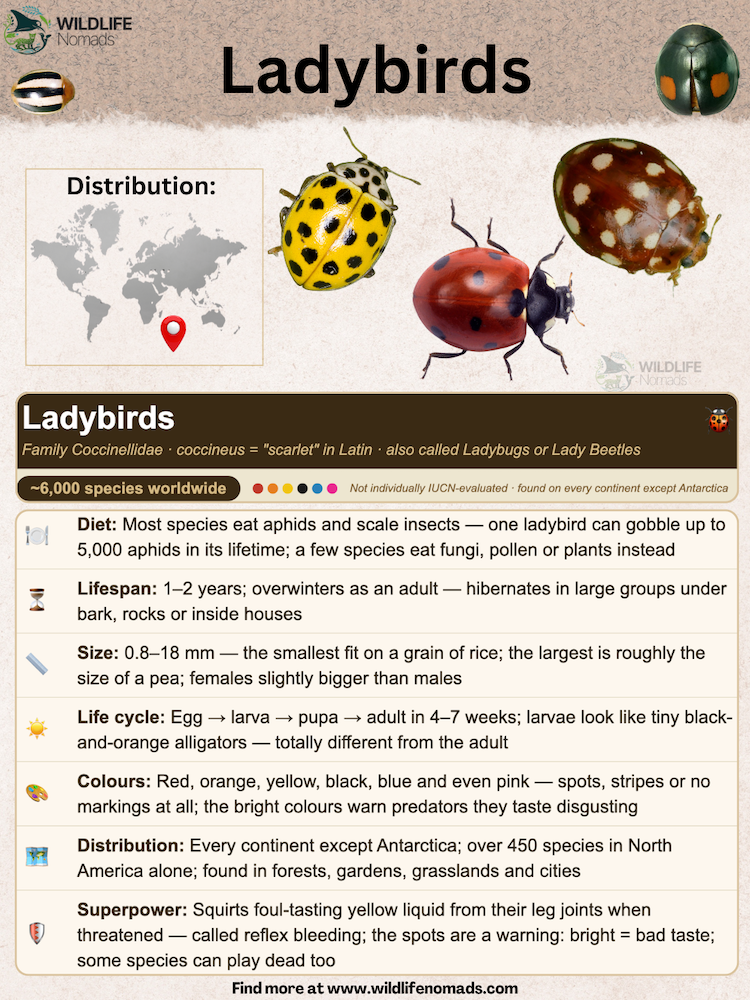
1. There Are Over 6,000 Ladybird Species Worldwide
When people ask me how many kinds exist, they expect a handful. The real number stuns them. Scientists have described more than 6,000 ladybird species across roughly 360 genera worldwide. That makes Coccinellidae one of the most diverse beetle families on the planet.
This is where the phrase “all about ladybirds” gets complicated. The seven spotted lady beetle may be the poster child, but it shares the family with thousands of relatives most people never notice. Researchers keep refining the family tree using molecular and morphological data, and extensive sampling of genes (in journals from Scientific Reports to the European Journal of Entomology) keeps revealing new relationships between different species. Most species are tiny and easy to overlook, yet many species turn up in gardens worldwide.
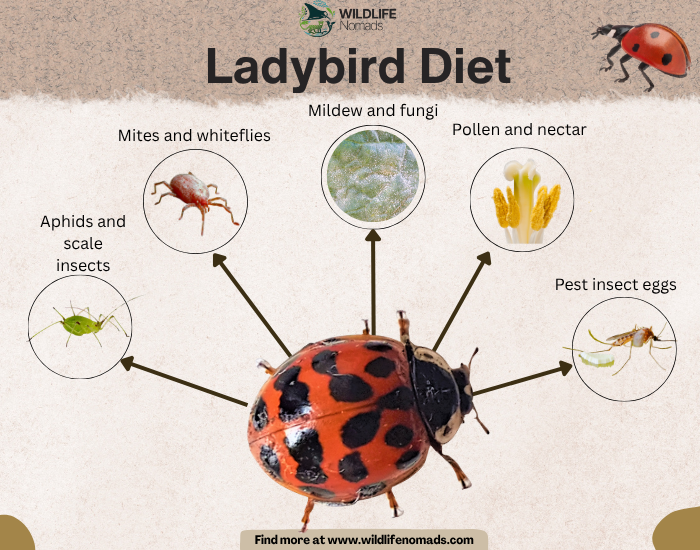
2. A Single Ladybird Can Eat Over 5,000 Aphids
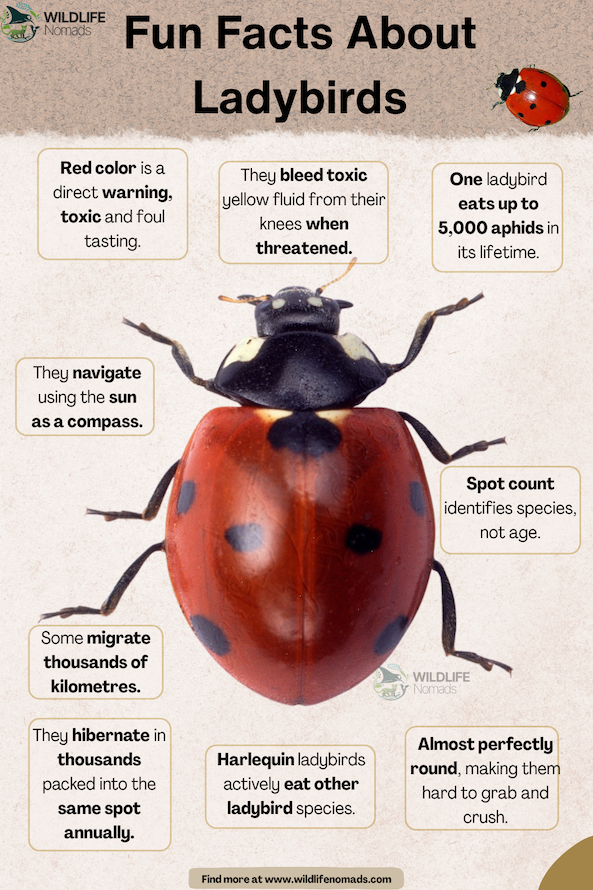
Here is the fact that reframes everything. Ladybirds primarily eat aphids and scale insects, though adult lady beetles will also eat insects like mites and other plant eating pests. Their appetite is astonishing. A single ladybird can consume over 5,000 aphids in its lifetime. In a single day, one adult ladybug can eat as many as 100 aphids.
I once watched a seven-spot ladybird work a rose stem thick with aphids near a field station in Sweden. Within an hour it had cleared a patch that had defeated my colleague’s careful pruning. Ladybirds eat with a relentlessness that makes them nature’s answer to plant eating pests, and they do it for free.
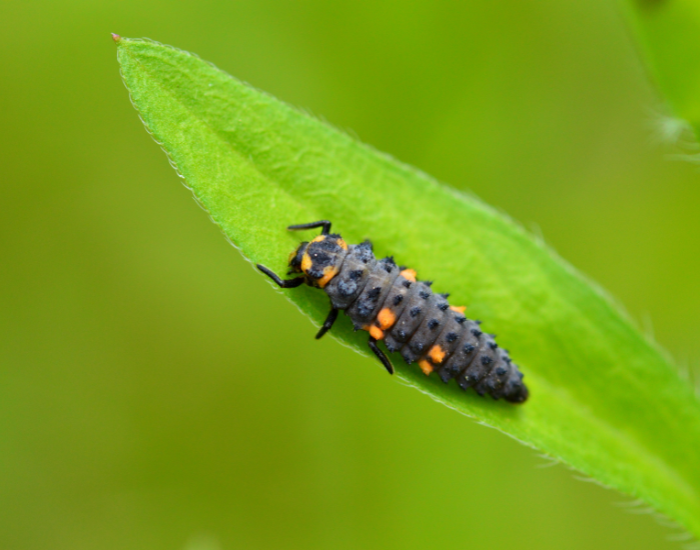
3. The Larvae Are Even Hungrier Than the Adults
Most people picture the polished adult and stop there. The real horror show, from an aphid’s perspective, is the larva. Ladybird larvae look like tiny spiny alligators, and they are strictly carnivorous. The moment the eggs hatch, the larvae start eating aphids.
Around 68% of ladybird species in temperate regions eat aphids, and the larvae carry much of that load. As a result, they consume enormous numbers of soft bodied insects like aphids, mites, and other small insects during their brief development. When I flip a leaf and find these little predators at work, I know the plant is in good hands.
4. Not All Ladybirds Are Red
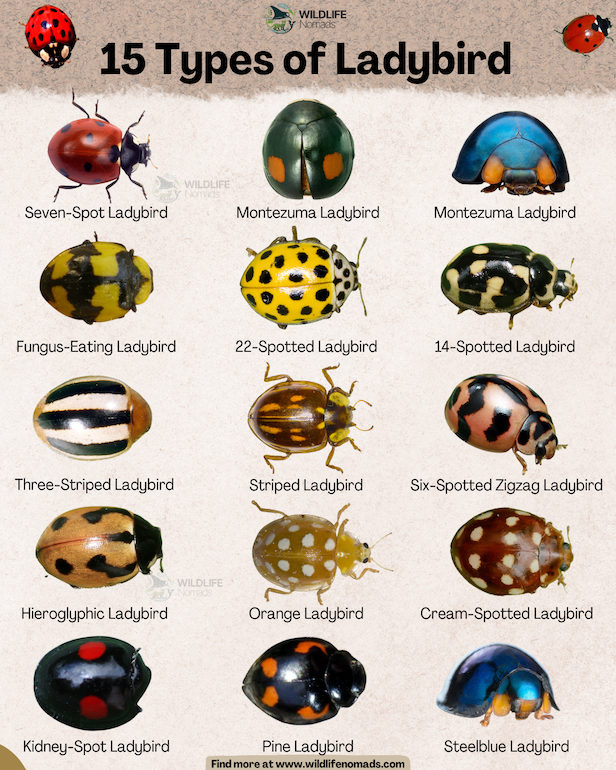
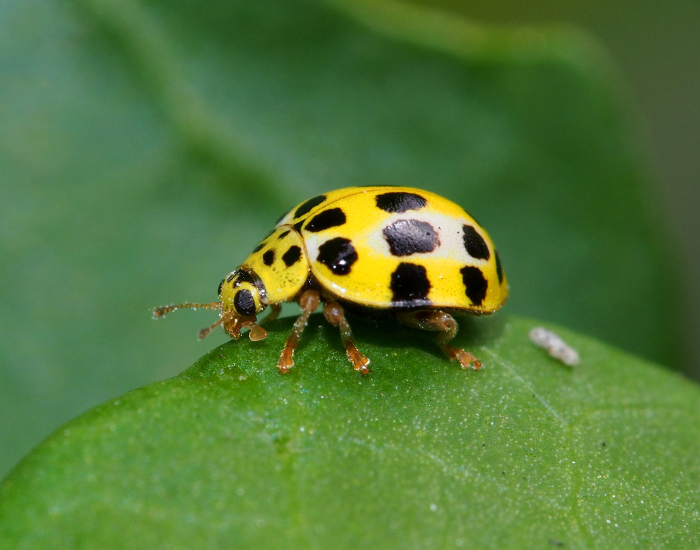
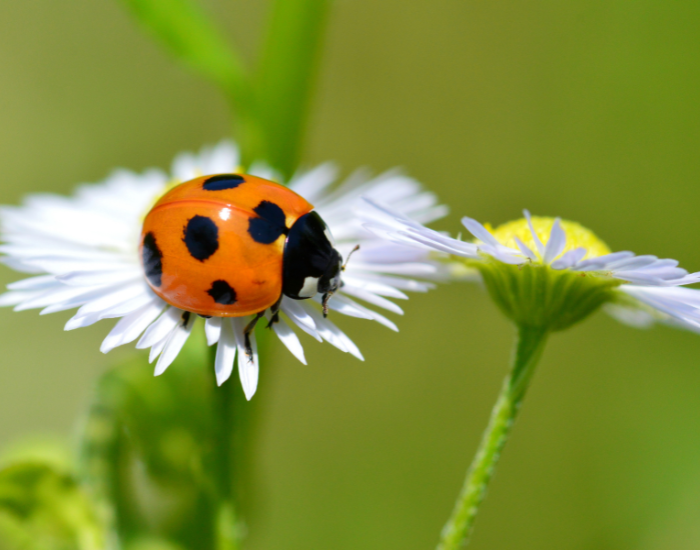
The red and black body is iconic, but it is far from the whole story. Ladybirds can be red, orange, yellow, or even blue. Some carry black spots on red; others wear yellow spots, orange or yellow spots, or pale yellow markings on a darker shell. There are black ladybird species too, easy to miss because they break the mental picture entirely.
The 14-spot ladybird alone can show anywhere from 4 to 14 spots. Ladybirds also range enormously in size, from a barely visible 0.8 mm to a hefty 18 mm. When I run field workshops, I love watching people realise that the small ladybird they nearly stepped on belongs to the same family as the bold red one on the fencepost. The colours and patterns are a whole language once you learn to read them.
5. Those Bright Colours Are a Warning
That cheerful red is not decoration, it is a threat. Ladybirds exhibit aposematic coloration, meaning their bright colours warn predators that they taste terrible. When alarmed, they also seep a foul, bright yellow fluid from their leg joints.
This is why the ladybugs main predators (birds and larger insects among them) learn to leave them alone after one bad mouthful. Most insects that try it once rarely come back, and even a few other insects and spiders make the attempt, so ladybirds do sometimes fall victim, but the bright colours tilt the odds. If you want to see who else hunts small insects in the garden, my guides to garden birds and spiders show the other side of that arms race.
6. Farmers Love Them for Biological Control
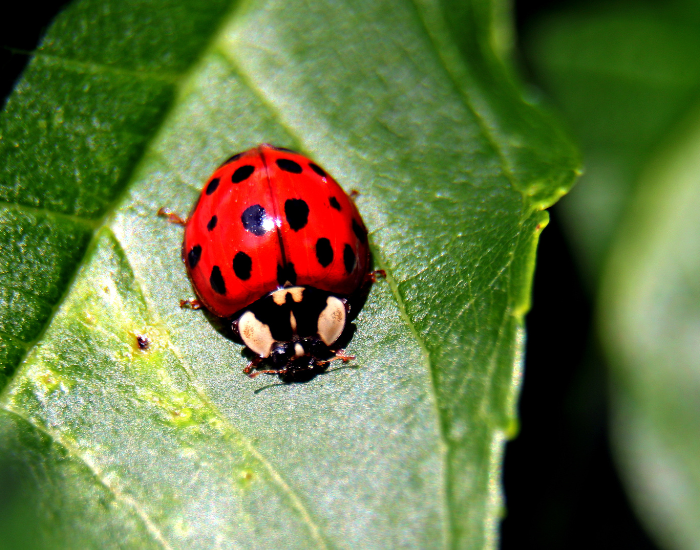
European farmers have prized ladybirds for centuries, and modern agriculture leans on them harder than ever. Ladybirds are beneficial insects and voracious predators of pests, which makes them a cornerstone of biological control. By controlling aphid populations, they reduce the need for chemical insecticides across orchards and field crops.
The economics are simple. A population of ladybirds that patrols a crop for free replaces sprays that cost money and harm other insects. That said, they are not a silver bullet, they need habitat, food, and freedom from pesticides to thrive. Chemical-free gardening practices favour the population of ladybirds, and I always tell gardeners that a few flowering plants do more than any store-bought remedy.
7. They Are Living Indicators of Ecosystem Health
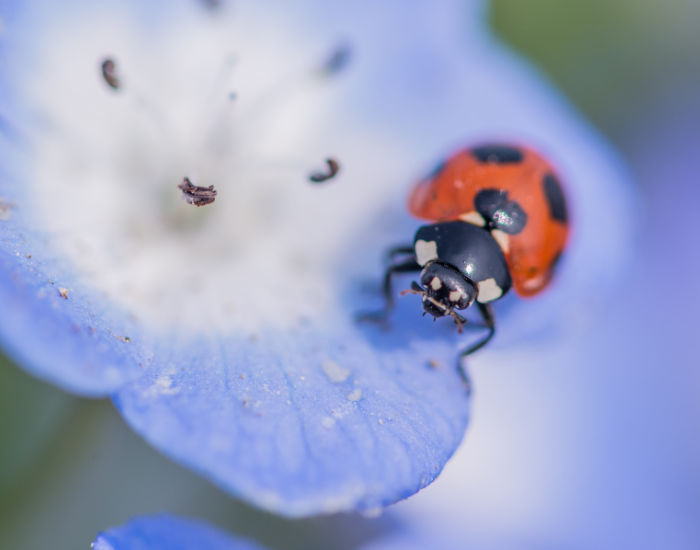
Here is a fact that shifts ladybirds from cute to important. Because they are sensitive to pesticides and habitat quality, ladybirds are indicators of a healthy ecosystem. Where they thrive, the food web underneath them usually thrives too.
In conservation biology, we lean on species like these to read a landscape quickly. When biologists survey a meadow and find several species of ladybird working the vegetation, that tells us the aphid populations, the flowering plants, and the wider insect community are all in reasonable shape. Their presence is a shortcut to understanding the whole system.
8. One Female Can Lay Up to 1,000 Eggs
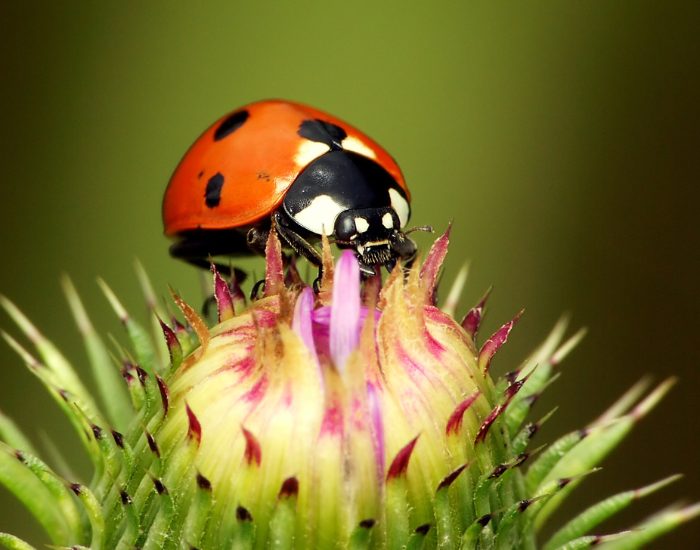
Ladybirds reproduce on a scale that matches their appetite. A single female ladybird can lay up to 1,000 eggs in her lifetime, usually depositing them in clusters on the underside of leaves, right beside a fresh food source of aphids.
The timing is precise. Eggs hatch within 4 to 10 days depending on species, and the larvae undergo four developmental stages with three moults. The pupae last about 7 to 10 days before the adult emerges. Adult ladybirds then live for roughly a year, a short, intense life built almost entirely around eating and breeding.
9. They Hibernate Together in the Thousands
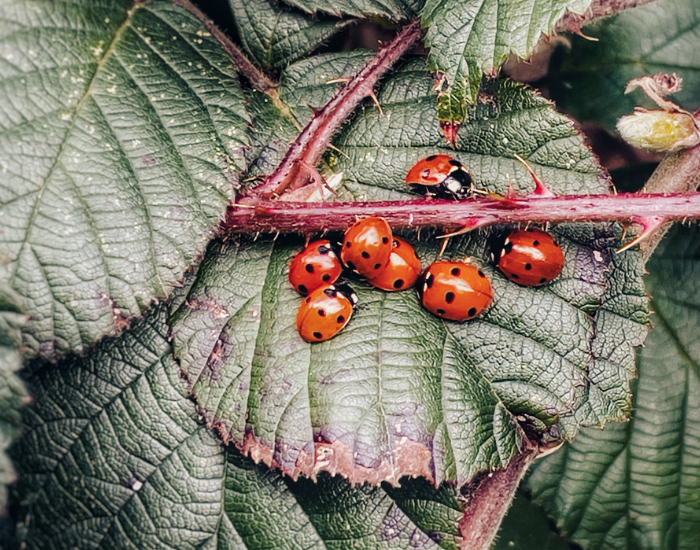
One of the most surreal sights of my career came on a cold morning in a temperate forest, when I peeled back a strip of bark and found a seething red mass of hibernating ladybirds. They cluster in sheltered spots, under tree bark, in leaf litter, inside the cracks of deciduous trees, to survive the cold.
These hibernating colonies can contain thousands of individuals packed together, sometimes tucked inside rotting logs on the forest floor. Grouping conserves warmth and moisture, and it may amplify their chemical defences into one unmistakable warning. Come late spring, the large groups break apart and the adults disperse, sometimes travelling surprisingly far. Ladybirds can migrate up to 120 km in search of food.
10. Ladybirds Carry Deep Cultural Meaning
Few insects are so universally loved, and the affection runs old and deep. Ladybirds symbolize good luck in many cultures. The very name “ladybird” comes from “Our Lady’s bird,” a medieval Christian reference to the Virgin Mary, whose red cloak the seven-spot’s shell was said to echo. The seven spots themselves came to represent her seven joys and sorrows.
The stories span continents. In European folklore, ladybirds were thought to predict weather and crop growth. Among the Cherokee, they are revered as the “Great Beloved Woman.” This is a rare case where a commonly found garden insect is genuinely woven into human culture worldwide, a small creature carrying an outsized share of our hopes.
Are Ladybirds in Trouble?
Mostly, ladybirds are doing fine, but the picture is not uniformly bright. As of 2022, no ladybird species were listed on the IUCN Red List, which sounds reassuring. Yet coccinellid biodiversity faces real pressure, and some native populations are quietly shrinking.
The threats are familiar. Agriculture and urbanization destroy ladybird habitats, and climate change adds stress across their range. Invasive species like Harmonia axyridis, the harlequin, outcompete and even eat native ladybirds, pushing out local species and other ladybugs wherever it spreads. Conservationists recommend habitat preservation, and honestly, the best thing most of us can do is keep our gardens chemical-free and let the flowering plants they depend on grow.
Frequently Asked Questions About Ladybirds
There are over 6,000 species of ladybirds worldwide, classified in about 360 genera within the family Coccinellidae. They live on every continent except Antarctica. The seven-spot ladybird — or seven spotted ladybugs, as Americans might say — is the most common ladybird in Europe, while North America hosts around 500 native species of its own.
Not really — they are the same insects with different regional names. “Ladybird” is standard in Britain and much of the Commonwealth, while “ladybug” is common in North America. Scientists often prefer “lady beetle,” since these animals are neither true birds nor true bugs. All three terms describe members of Coccinellidae.
Yes. The United States is home to roughly 500 native ladybird species, alongside introduced ones like the seven spotted lady beetle and the invasive Asian harlequin. You will also find regional favourites such as the twice stabbed lady beetle, a striking black ladybird with two red spots. British ladybirds and American ladybugs are close relatives within the same family.
To humans, effectively yes — ladybirds do not sting, and a bite is rare and painless. They are among the most harmless insects you can handle. The main complication is the invasive harlequin, which can gather indoors in autumn and give a light nip, but it poses no real danger. To aphids and other small insects, of course, ladybirds are anything but harmless.
Why Ladybirds Deserve a Second Look
Strip away the folklore and you are left with something remarkable: a beetle that protects our food, signals the health of the land, and asks for nothing but a pesticide-free patch of green. The next time one lands on your hand, look closer. Count the spots, note the colour, and remember it may have already eaten a thousand aphids this season.
Then do what I do, leave the garden a little wilder for them. Plant something that flowers, skip the spray, and watch who shows up. If you spot a ladybird, tell me in the comments what colour and how many spots it had. And if this sparked your curiosity about the wider insect world, my guide to the types of beetles is the perfect next stop.
Ladybirds: Fact or Fiction? 🐞
Twelve statements about the garden’s favourite beetle — six true, six myths. Can you tell them apart?
Fact or Fiction?
References:
Che, L., Zhang, P., Deng, S., Escalona, H. E., Wang, X., Li, Y., Pang, H., Vandenberg, N., Ślipiński, A., Tomaszewska, W., & Liang, D. (2021). New insights into the phylogeny and evolution of lady beetles (Coleoptera: Coccinellidae) by extensive sampling of genes and species. Molecular phylogenetics and evolution, 156, 107045. https://doi.org/10.1016/j.ympev.2020.107045
Roy, H. E., Brown, P. M. J., Adriaens, T., Berkvens, N., Borges, I., Clusella-Trullas, S., et al. (2016). The harlequin ladybird, Harmonia axyridis: Global perspectives on invasion history and ecology. Biological Invasions, 18(4), 997–1044. https://doi.org/10.1007/s10530-016-1077-6
Hodek, I., Honěk, A., & van Emden, H. F. (Eds.). (2012). Ecology and behaviour of the ladybird beetles (Coccinellidae). Wiley-Blackwell. https://doi.org/10.1002/9781118223208
Obrycki, J. J., Harwood, J. D., Kring, T. J., & O’Neil, R. J. (2009). Aphidophagy by Coccinellidae: Application of biological control in agroecosystems. Biological Control, 51(2), 244–254. https://doi.org/10.1016/j.biocontrol.2009.05.009
Soares, A. O., Haelewaters, D., Ameixa, O. M. C. C., Borges, I., Brown, P. M. J., et al. (2023). A roadmap for ladybird conservation and recovery. Conservation Biology, 37(1), e13965. https://doi.org/10.1111/cobi.13965
Brown, P. M. J., Roy, H. E., Rothery, P., Roy, D. B., Ware, R. L., & Majerus, M. E. N. (2008). Harmonia axyridis in Great Britain: Analysis of the spread and distribution of a non-native coccinellid. BioControl, 53(1), 55–67. https://doi.org/10.1007/s10526-007-9124-y
Nedvěd, O., & Honěk, A. (2012). Life history and development. In I. Hodek, H. F. van Emden, & A. Honěk (Eds.), Ecology and behaviour of the ladybird beetles (Coccinellidae) (pp. 54–109). Wiley-Blackwell. https://doi.org/10.1002/9781118223208.ch3