I first noticed the rooks from a moving train in northern France. A ragged black cloud lifted off a bare field at dusk, wheeled once, and settled into a stand of tall trees. My wife thought they were crows. I knew better, and by the end of this post, so will you.
I’m a biologist, and this year I’m spending two months crossing Europe to watch wildlife wherever it turns up. Besides seagulls and pigeons, rooks are the birds I see most. They’re everywhere here, and they reward a closer look. A rook is not just a black smudge on a wire. It’s one of the most social, intelligent, and misread birds on the continent.
Right after I wrote about crows and ravens, I realized rooks deserved their own story. They belong to the same crow family, yet they live by a completely different playbook. Here are ten things I’ve learned watching them, and a few that surprised even me.
What Exactly Is a Rook? A Quick Definition
Let’s start with the rooks definition, because the name confuses people. A rook is a member of the crow family, scientific name Corvus frugilegus. To define rooks simply: they are medium-large, glossy black corvids native to farmland and open woodland across Europe and Asia.
The rooks meaning goes deeper than looks, though. That species name, frugilegus, means “food-gathering” in Latin, a nod to how these birds forage. So when someone asks what rooks birds actually are, the honest answer is this: they’re the farmer’s shadow, the corvid that follows the plough.
1. The Bare Face That Gives It Away
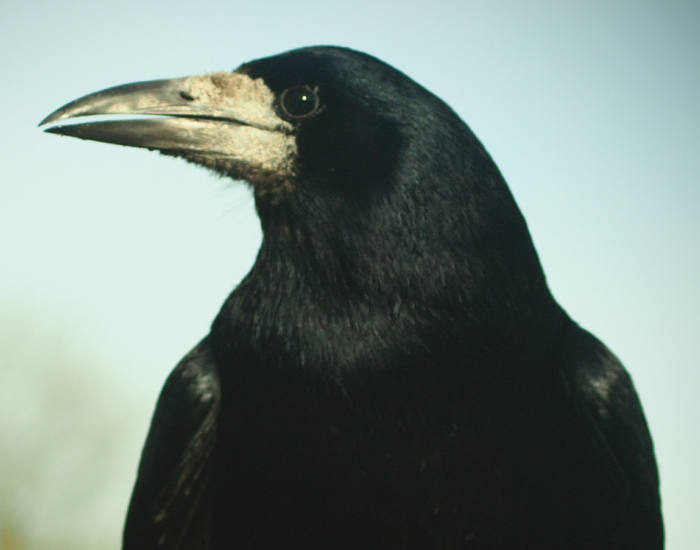
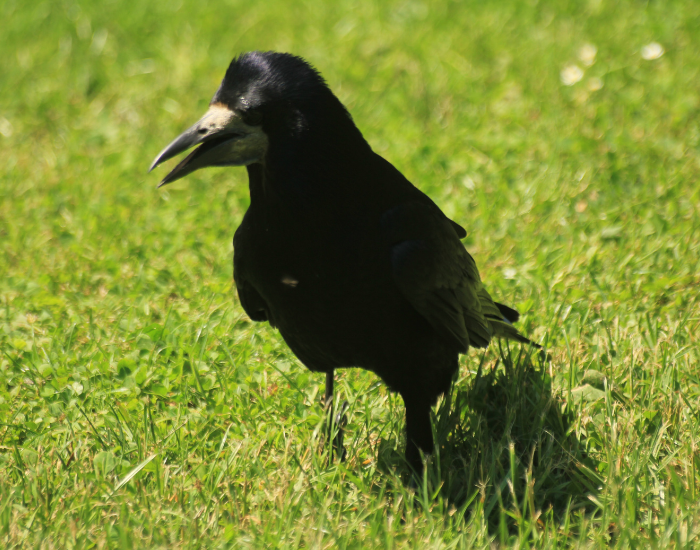
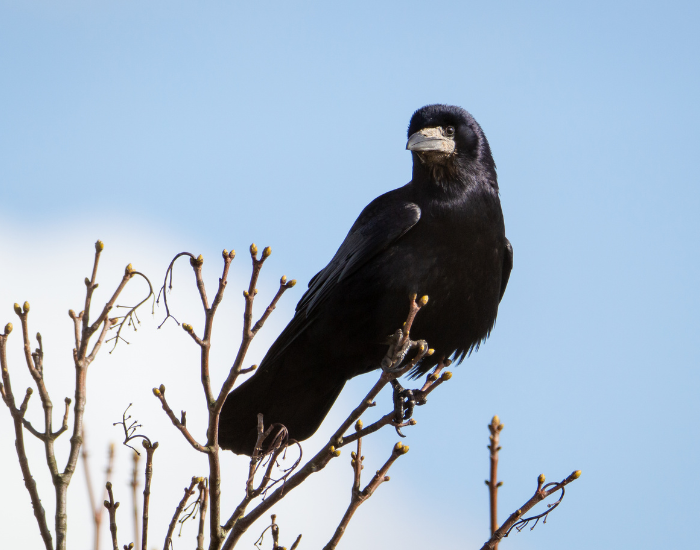
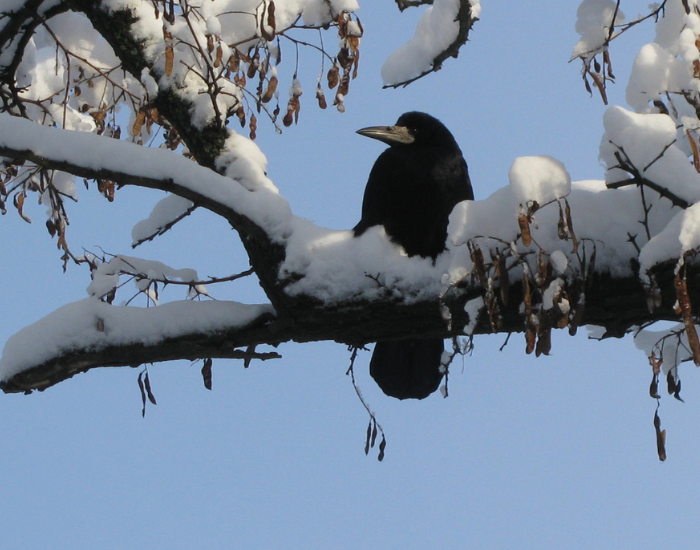
Here’s the single best field mark. Adult rooks have a distinctive bare patch of grey-white skin at the base of the bill, stretching back toward the eye. No feathers, just naked skin over a long, pointed beak.
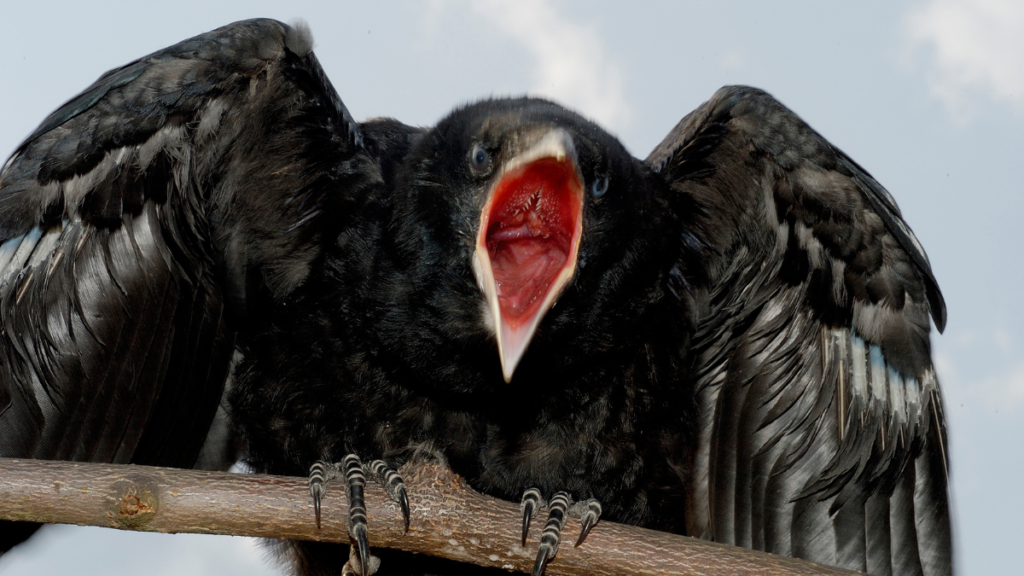
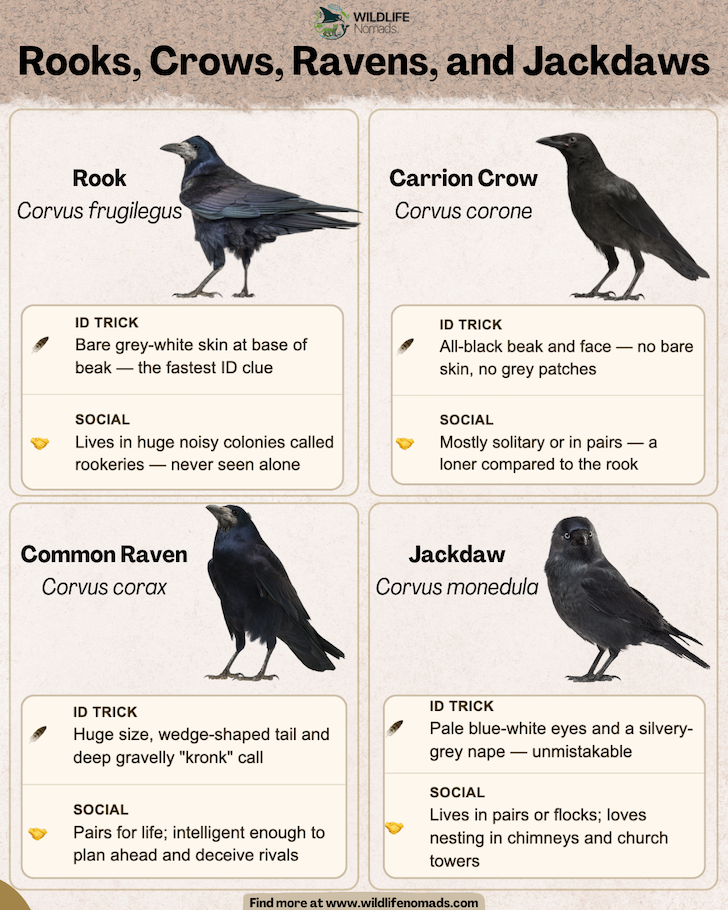
That feature is why I could tell my train-window flock from a carrion crow. A carrion crow (Corvus corone) has a fully feathered black head and a stouter bill. The rook looks like it dipped its face in flour. Once you learn this difference between rooks and crows, you can’t unsee it, and you’ll spot rooks vs crow at a glance from a passing car.
2. Those Famous “Baggy Trousers”
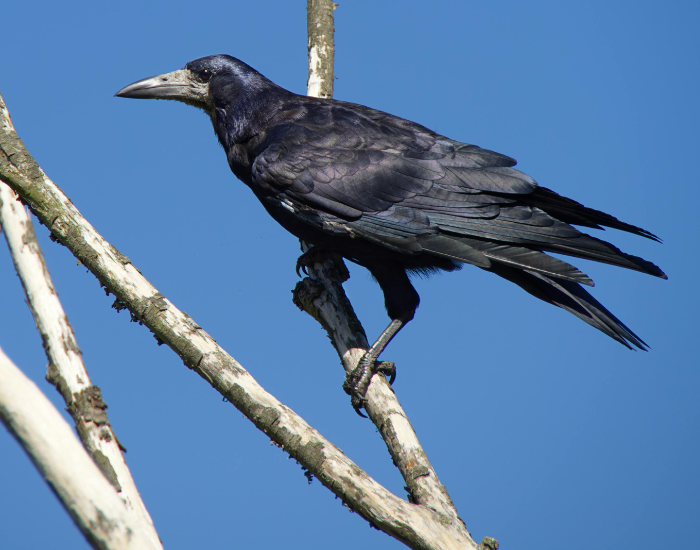
Look at a rook’s legs and you’ll notice loose, shaggy feathers hanging down over the thighs. Birders affectionately call these “baggy trousers.” No other common corvid wears them so obviously.
The rook also carries slightly shaggy throat feathers and a peaked crown that give it a scruffier profile than the sleek carrion crow. In bright sunlight, those black feathers throw off a purple and blue sheen. It’s a subtle thing, but on a clear morning a perched rook practically glows.
For the record, this is a substantial bird. Adult rooks weigh between 280 and 340 grams and stretch to a wingspan of about 90 cm. Males average a touch larger than females, though in the field the sexes look identical. That broad wingspan is what lets a rook ride the wind so effortlessly over open ground.
3. Rooks Build Cities in the Treetops
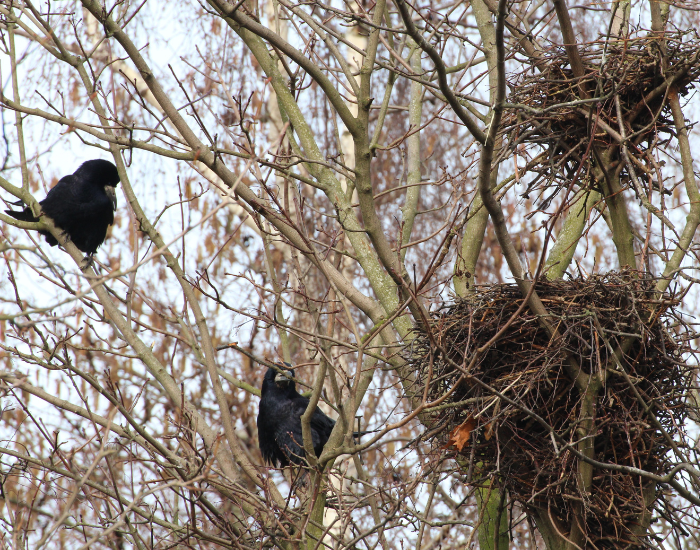
Rooks are colonial nesters, and this is where they truly separate themselves from most other corvids. They nest in dense colonies called rookeries, usually high in tall trees at the edge of woodland or farmland. The rooks build bulky stick nests, and a single stand of large trees can hold dozens of pairs packed close together.
I walked under an active rookery in the Netherlands this spring during the breeding season, and the noise was constant, a raucous chorus of caws as pairs defended their nests. Rooks typically lay three to five eggs per clutch. Both parents feed the young birds, and the whole colony seems to run on collective racket.
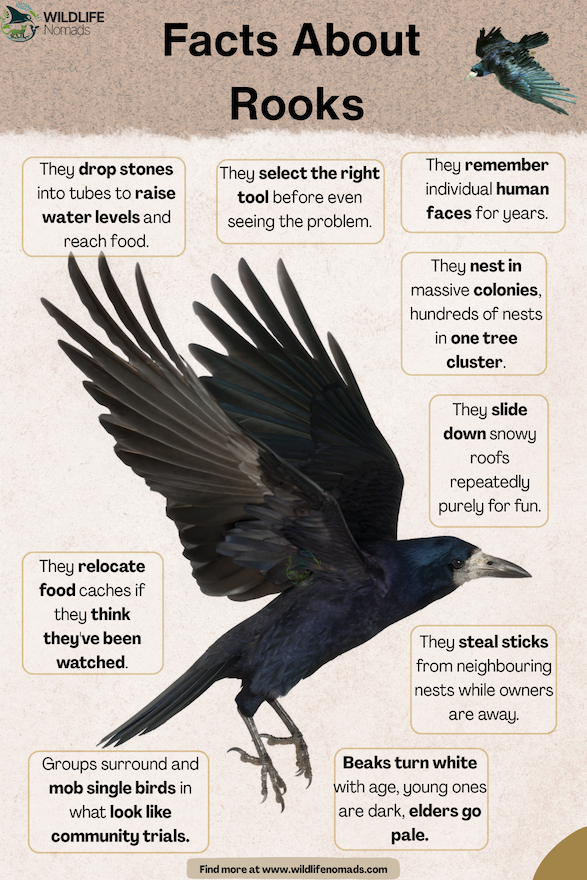
What fascinates me is how early it all starts. Rooks return to the same rookeries year after year, often repairing old nests rather than building from scratch. Pairs bond for life, and neighbors constantly pilfer sticks from each other while backs are turned. A rookery isn’t a peaceful commune, it’s a noisy, thieving, tight-knit little city, and that tension is exactly what holds it together.
4. One of Europe’s Most Social Birds
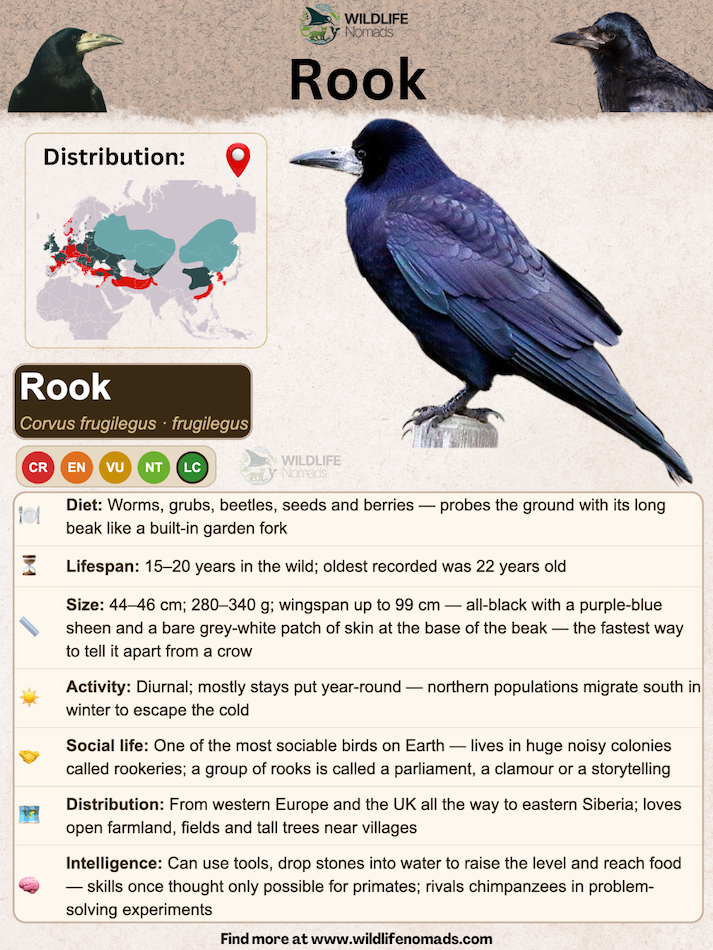
If you take one thing away, take this: rooks are a very sociable species. They form large flocks year round, and outside the breeding season those flocks swell into hundreds. You rarely see a solitary rook. A lone bird on a moor is far more likely to be a crow.
That sociability is where the name enters everyday language. A group of rooks is literally called a rookery, hence their name, the same word covers both the colony and the gathering. These noisy groups feed, roost, and travel together in large groups, and that constant company appears to make them smarter, not just louder.
5. A Diet That’s Mostly Vegetarian
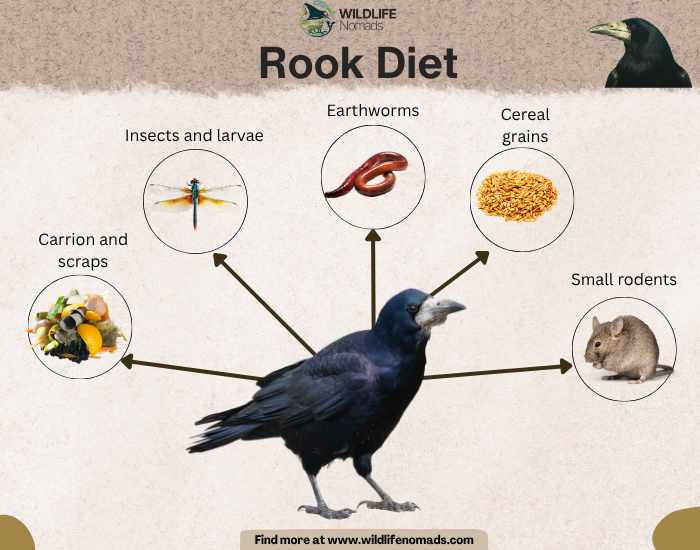
People assume anything black and crow-shaped is a scavenger picking at carrion. Rooks flip that expectation. Examination of stomach contents shows that a rook’s diet consists of roughly 60% vegetable matter (cereals, grains, roots, acorns, and berries) with the rest made up of animal food.
They are true omnivores, feeding mostly on soil invertebrates like earthworms and insect larvae, which they find by probing the ground with that strong beak. Rooks forage primarily on the ground, and they’ll happily scavenge human food scraps in urban areas or a quiet garden. In winter, hungry flocks can travel far to feed, birds have been recorded foraging up to 10 km, and even further from their communal roosts.
6. Rooks Are Genuinely Clever
This is my favorite fact, because it rewrites what “birdbrain” should mean. Wild rooks aren’t known to use tools. But captive rooks, tested by researchers, rival chimpanzees and New Caledonian crows at solving physical puzzles.
In a landmark study, captive rooks spontaneously bent wire into hooks, selected stones of the right size to collapse a platform, and used tools in sequence to reach food. A separate experiment published in Current Biology showed rooks dropping stones into a tube to raise the water level and float a worm within reach. That’s cause-and-effect reasoning most animals never demonstrate. For a bird that shows no tool use in the wild, that flexibility is astonishing.
7. Where Rooks Live, and Where They Shouldn’t
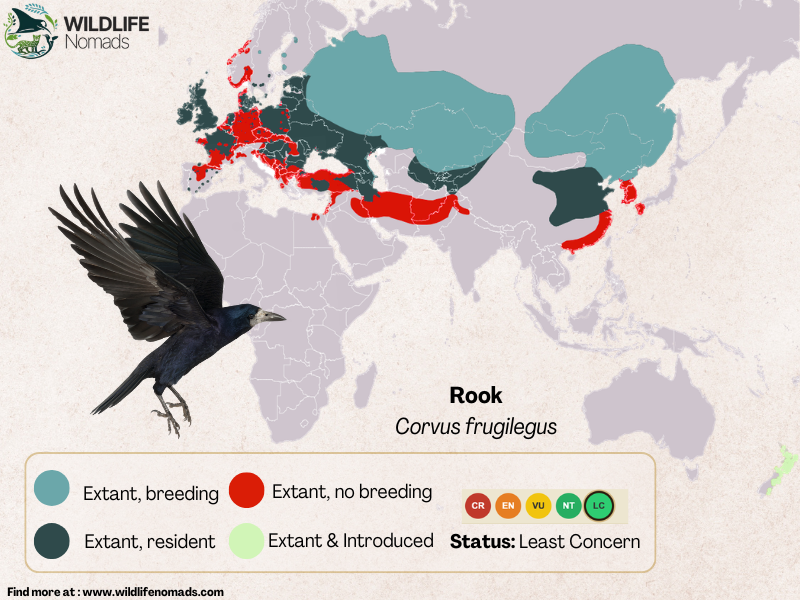
Rooks are native to the Palearctic region, spanning Europe and parts of Asia, from Ireland and Northern Ireland eastward into Russia. They favor a patchwork of farmland, open woodland, moorland edges, and hedgerow trees rather than deep, dense forest. This is a bird of the human-shaped landscape.
They’ve also traveled where they don’t belong. Rooks were introduced to New Zealand by settlers in the 1860s, and localized populations still persist there. Today they’re treated as an unwanted pest, since a flock of several hundred can strip a crop in days. It’s a reminder that a familiar bird at home can become a problem abroad.
8. Rooks, Crows, Ravens, and Jackdaws: Telling the Family Apart
This is the question I get most, so let’s settle it. Are crows and ravens in the same family? Yes, rooks, crows, ravens, jackdaws, magpies, and jays are all corvids, members of the same crow family. The differences between crows, ravens, and rooks come down to size, shape, and habits.
Ravens are the giants, with a heavy bill and an unmistakable wedge-shaped tail in flight. Rooks and carrion crows are similar in size, but the rook has that bare face and a more rounded tail. A young crow, before it fills out, can fool you, but it will never show the rook’s pale, naked face. Jackdaws are smaller, grey-naped, and often flock with rooks; you’ll see the two mixed together in the same field. When people ask about jackdaws, magpies, or jays, I point them to the same rule, watch the size, the tail shape, and the company they keep.
9. Is the Chess Piece Named After the Rook? No, and That’s the Fun Part
The chess rook is not named after the bird. The word comes from the Persian rukh, meaning “chariot”, the piece originally represented a war chariot, which is why it moves in straight lines. The bird’s name comes from Old English hroc, an imitation of its harsh call. Same spelling, totally separate roots.
The overlap is still a nice memory aid, though. In chess, each player starts with two rooks in the corners of the board. Rooks move any number of vacant squares horizontally or vertically, capturing by landing on an enemy piece in their path, and they cannot jump over other pieces blocking the way. Valued at five points, a rook outranks the minor pieces, and it grows most powerful as the position opens up after the opening.

10. The Sky Show at Dusk
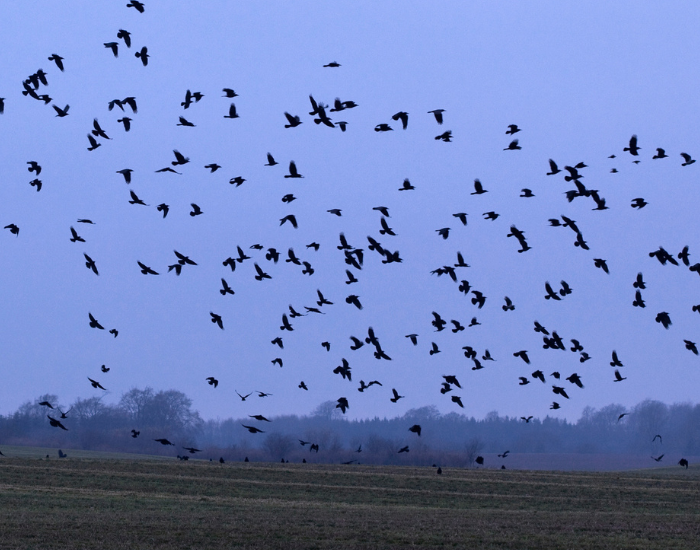
My favorite rook behavior costs nothing to see. On winter afternoons, rooks and jackdaws stream toward shared roosts as the light fades. Watch them fly in and you’ll see those broad wings row steadily across the sky, the flock a loose, chattering mass over the trees at dusk before dropping in to rest for the night.
These pre-roost gatherings can number in the thousands, and the sound carries for a mile. I’ve stood in a Belgian field at last light watching wave after wave pour in from every direction over the bare winter woods. It’s one of the great free wildlife spectacles of the European winter, and almost nobody stops to watch.
11. A Species Quietly in Trouble
For all their abundance, rooks are slipping. In the UK they’re now amber-listed as a species of conservation concern, with rook numbers estimated to have dropped by around 20% between 1995 and 2020. Long-term monitoring shows breeding numbers and rookery sizes falling across recent decades. The International Union for Conservation of Nature still lists the rook globally as Least Concern, but these regional declines are real.
The main threats are the familiar ones: changes in agricultural land use and pesticide-driven losses of the soil invertebrates rooks depend on. Fewer earthworms and beetles mean fewer well-fed young birds. It’s the quiet erosion that rarely makes headlines, which is exactly why I keep watching.
Go Watch a Rookery Yourself
Rooks prove that “common” and “boring” are never the same thing, this bare-faced, tool-bending, city-building corvid is hiding a remarkable mind in plain sight. The next time you pass a stand of tall trees full of noisy black birds, slow down and look for the pale face and the baggy trousers.
If you want to go deeper into the family, I’ve written full guides to crows, ravens, the wider world of birds, and even the ever-present seagulls I keep meeting on this European trip. Seen a rookery near you? Tell me where in the comments, I’m always hunting for the next great roost.
Frequently Asked Questions
A group of rooks is called a rookery, the same word used for their breeding colony. You may also hear the poetic terms “a parliament” or “a clamour” of rooks. In everyday use, though, “rookery” and simply “a flock of rooks” are the most common and correct.
Yes. A rook is a type of crow, in the genus Corvus alongside carrion crows, hooded crows, and ravens. The quickest way to tell a rook from a carrion crow is the bare, pale grey face at the base of the bill and its shaggy “baggy trouser” leg feathers.
Yes. Ravens, and their corvid relatives, can recognize and remember individual human faces for years, and even hold grudges against people who wronged them. Rooks share this facial-recognition ability, which helps these highly social birds track friends and rivals within a large flock.
Rooks: Fact or Fiction? 🐦⬛
Twelve statements about Europe’s most misread corvid — six true, six myths. Can you tell them apart?
Fact or Fiction?
References:
Bird, C. D., & Emery, N. J. (2009). Insightful problem solving and creative tool modification by captive nontool-using rooks. Proceedings of the National Academy of Sciences, 106(25), 10370–10375. https://doi.org/10.1073/pnas.0901008106
Bird, C. D., & Emery, N. J. (2009). Rooks use stones to raise the water level to reach a floating worm. Current Biology, 19(16), 1410–1414. https://doi.org/10.1016/j.cub.2009.07.033
Stanbury, A., Eaton, M., Aebischer, N., Balmer, D., Brown, A., Douse, A., Lindley, P., McCulloch, N., Noble, D., & Win, I. (2021). The status of our bird populations: the fifth Birds of Conservation Concern in the United Kingdom, Channel Islands and Isle of Man. British Birds, 114, 723–747. https://britishbirds.co.uk/content/status-our-bird-populations
Griffin, L. R., & Thomas, C. J. (2000). The spatial distribution and size of rook (Corvus frugilegus) breeding colonies is affected by both the distribution of foraging habitat and by intercolony competition. Proceedings of the Royal Society B, 267(1451), 1463–1467. https://doi.org/10.1098/rspb.2000.1165
Purvis, E. E. N., Vickery, J. A., & Kentie, R. (2023). Status and distribution of Rook Corvus frugilegus in Wales in 2022/23. Birds in Wales / BTO Research Report. https://www.bto.org/our-science/publications/peer-reviewed-papers/status-and-distribution-rook-corvus-frugilegus-wales