Last month I stood in the dinosaur gallery of London’s Natural History Museum, nose almost against the glass. Everyone else crowded the Diplodocus cast down the hall. I stayed with the horned skull. That skull is why I write about extinct creatures at all, alongside living ones. People forget that a ground sloth, a giant crocodile, and a saber-tooth were once as real as any lion today.
Triceratops sits at the top of that list for me. I have spent twenty years chasing living animals across six continents. Yet few of them match the strangeness of this three-horned dinosaur. Below are the real facts about Triceratops, stripped of cartoon myths. Some I confirmed with my own eyes in that quiet London gallery. Others come from paleontologists digging in the badlands right now. By the end, you will see this animal the way I do: not a toy, but a genuine survivor.
If you think you are good with dinosaurs, do not forget to test your knowledge on our “Guess the dinosaur quiz”.
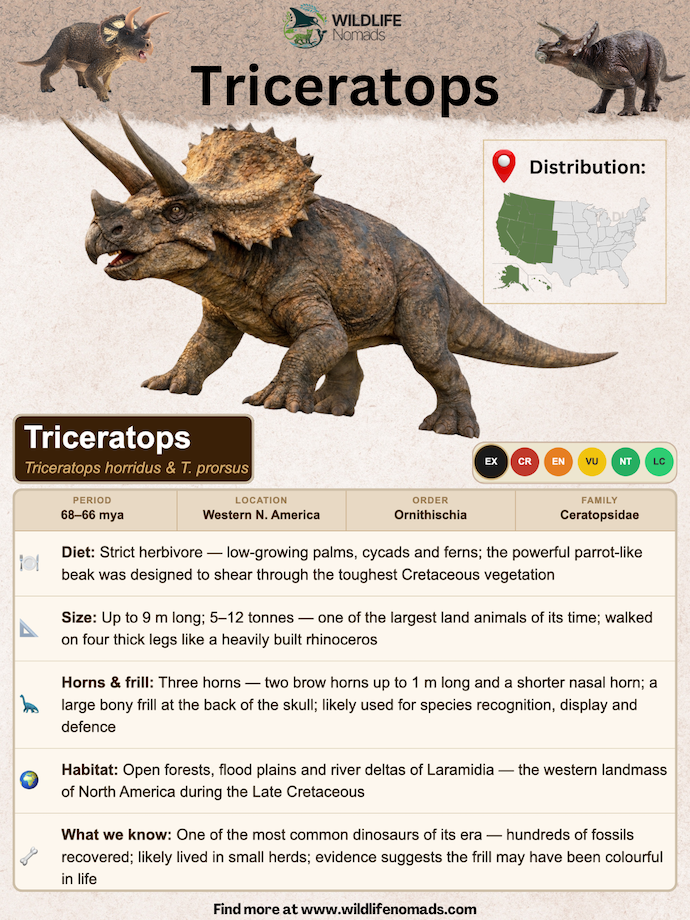
1. Yes, Triceratops Was a Real Dinosaur: a Three-Horned One
Let me answer the question I get most. Are Triceratops considered dinosaurs? Absolutely, without any asterisk. Triceratops belongs to a group called ceratopsians, or horned dinosaurs. Its name means “three-horned face” in Greek. That description is literal, not marketing.
Scientists place Triceratops among the non-avian dinosaurs of the Late Cretaceous period. It shared its world with duck-billed ornithopod dinosaurs, armored forms, and Tyrannosaurus rex. Among all those other dinosaurs, the three-horned face still stands out. So when someone calls it “just a big reptile,” gently correct them. This was a dinosaur through and through.
The name travels well, too. In Spanish-speaking countries the same animal headlines every kids’ book on triceratops dinosaurios. Different language, identical three-horned face. That global fame is deserved, because few Triceratops facts survive contact with the actual bones intact.
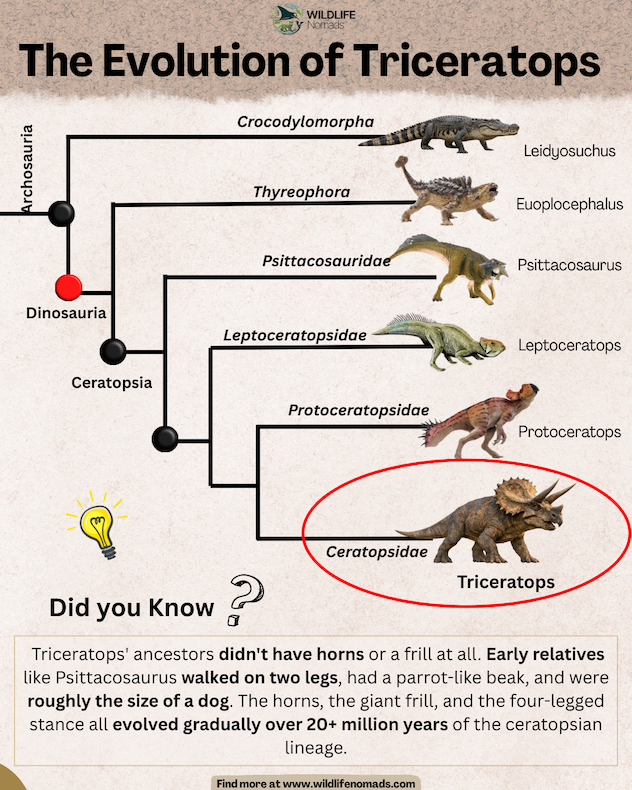
2. What a Triceratops Actually Looked Like
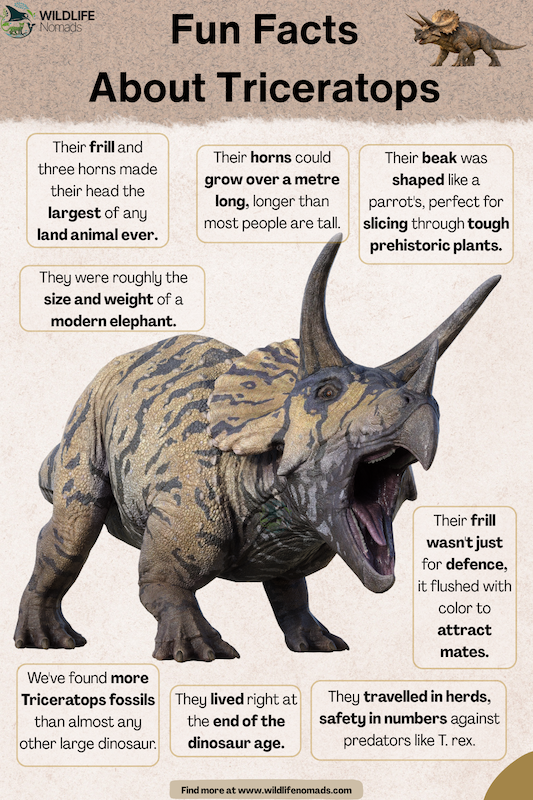
Ask ten people what does a Triceratops look like, and you will hear “a rhino with extra horns.” Close, but the scale is off. Triceratops measured around 8 to 9 meters long, roughly 26 to 30 feet. It weighed somewhere between six and twelve tonnes, heavier than a modern elephant. For comparison, the largest land mammals today barely reach a third of that mass.
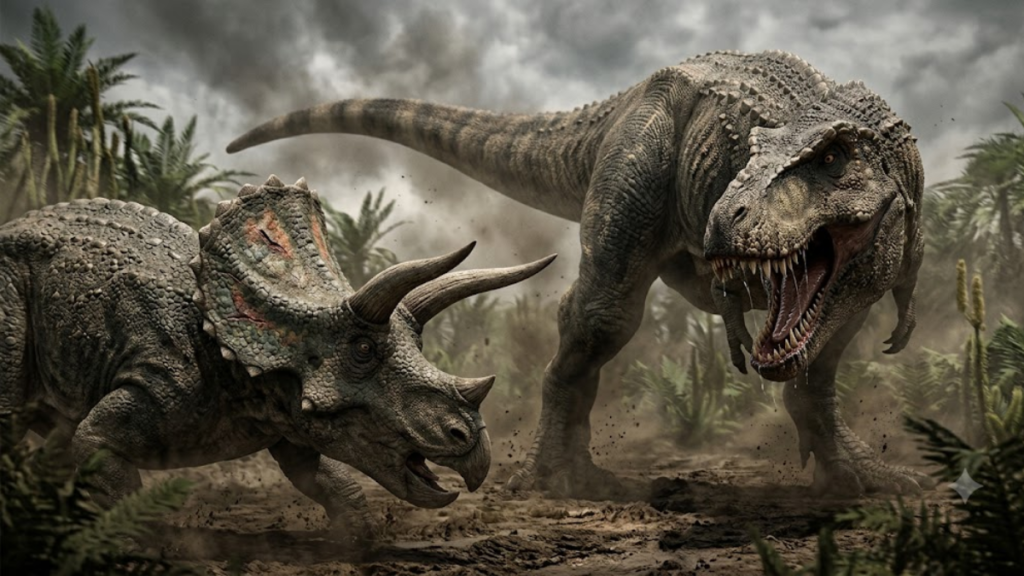
The skull steals the show. One of the largest known Triceratops skulls measured about 2.5 meters, nearly a third of the whole body. That makes it among the biggest skulls of any land animal, ever. Standing beside the London cast, I felt tiny. Two brow horns swept forward above the eyes. A shorter nose horn sat lower. Behind them rose a bony frill like a shield.
So what did a Triceratops look like below the neck? Picture a barrel-chested body on four pillar-like legs, with strong limbs built for shoving. The back legs were longer, the hips broad, the tail relatively short. A parrot-like beak tipped the jaws for cropping plants. Skin impressions suggest a hide studded with bumpy scales, some possibly bristled. Every one of these Triceratops details points to a low, powerful grazer, not a nimble runner.
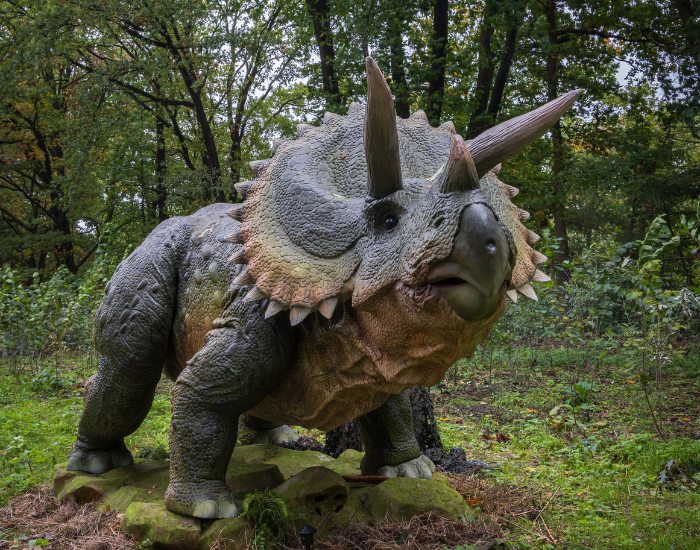
3. Those Horns Were Weapons, Not Just Decoration
For decades, some argued the horns were pure display. My field instinct said otherwise, and the fossil record agrees. Andrew Farke and colleagues compared hundreds of ceratopsian skulls. Triceratops squamosal bones, part of the frill, carried ten times more healed injuries than a relative that fought differently.
Those scars tell a story. Two rival males likely locked horns and shoved, much like elk I have watched rutting in Wyoming. Triceratops used its big horns in real combat, then healed and walked away. By the way, this clears up a common muddle. It is a three-horned dinosaur, never a “3 head dinosaur.” One head, three horns.
The horns worked against predators, too. Evidence suggests Triceratops turned those brow horns on attackers like Tyrannosaurus, not just on rivals. A single Triceratops horn could span a meter of solid bone core. Point that at a hungry theropod and even the king of predators had to think twice. I have seen a buffalo hold off lions the same way, horns down, refusing to break.
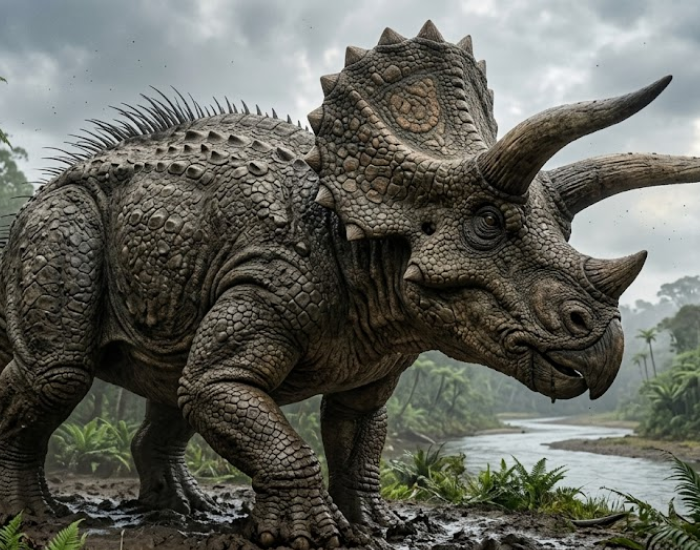
4. The Frill Was a Living Billboard
The frill fascinates me more than the horns. Made largely of frill bones extending from the skull, it was too thin in places to stop a determined T. rex bite. So what was it for? The best answer is signaling.
A large frill announced maturity and health to rivals and mates, the way antlers do today. Blood likely flushed the surface to flash color during standoffs. Nabavizadeh’s 2023 review traced how the whole ceratopsian head evolved for exactly this kind of display and feeding combo. Function, not just fashion.
Here is a detail people miss. Both male and female Triceratops carried prominent horns and frills. There is no clear “showy male, plain female” split, unlike many living deer. So if the frill helped attract females, it likely helped both sexes size each other up. The horn cores, the bony spikes beneath the sheath, look similar across specimens. That shared gear hints at signaling everyone used, not a male-only badge.
5. It Carried Up to 800 Teeth in a Self-Sharpening Battery
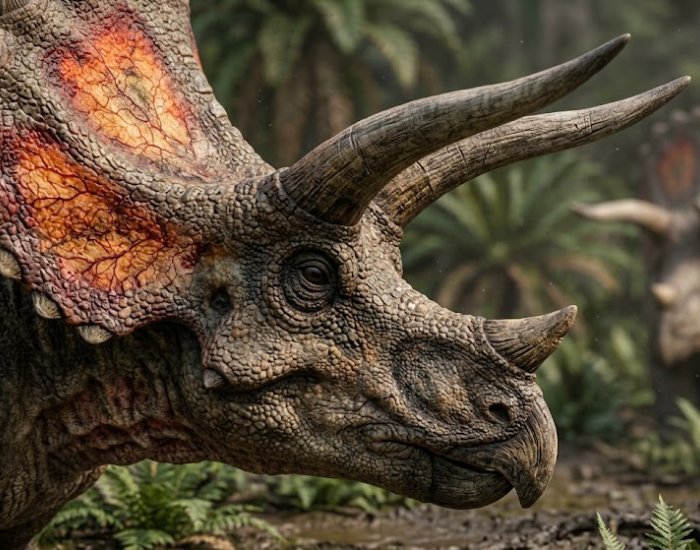
Here is a fact that stops people cold. Triceratops packed hundreds of teeth, with estimates ranging up to 800, arranged in a dental battery. Each jaw held 36 to 40 tooth columns, and each column stacked three to five teeth deep. Worn teeth dropped out and fresh ones rose to replace them.
Gregory Erickson’s team found something wilder still. The teeth wore unevenly on purpose. Soft and hard tissues eroded into a scalloped groove, like the fuller on a chef’s knife. That self-sharpening edge sliced tough, fibrous plants like ferns and palms with ease. This was a plant-eater with kitchen-grade cutlery in its jaws.
All that hardware fed a serious appetite. Triceratops primarily ate low-growing vegetation, cropping it close to the ground with that beak. It consumed large quantities of plants daily, working through ferns, cycads, and shrubs. A body this size demanded near-constant grazing to stay fueled. Those knife-edged teeth were not a novelty; they were survival gear for a low-browsing giant.
6. Triceratops Could Hear: Just the Low Notes
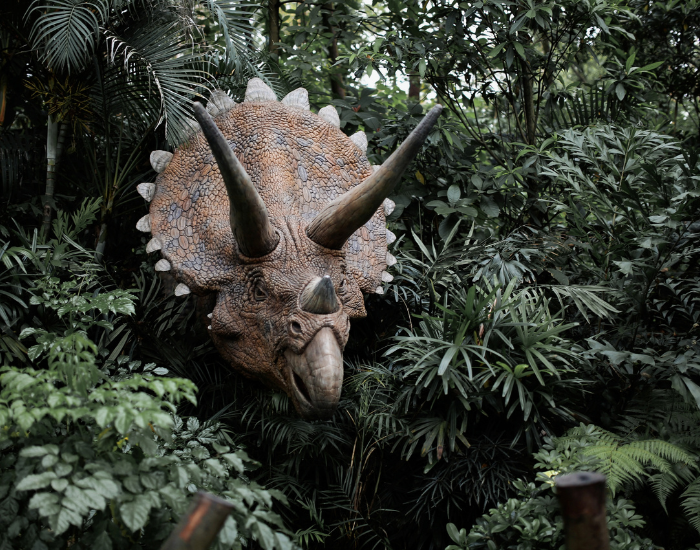
Could dinosaurs hear? For Triceratops, the inner ear gives us a clear yes. Rina Sakagami and Soichiro Kawabe CT-scanned two braincases and reconstructed the bony labyrinth. The cochlea, the organ that tunes hearing, was relatively short.
Short cochlea usually means a bias toward low frequencies. So Triceratops probably heard deep rumbles and bellows better than high chirps. That fits a heavy herd animal broadcasting over distance. Living elephants and rhinos use exactly these low sounds to stay in contact across dense cover. I would bet Triceratops did the same, calling to neighbors it could not see. The same scan showed the head naturally tilted down, perfect for grazing and for aiming those horns forward.
7. It Lived and Died Alongside Tyrannosaurus Rex
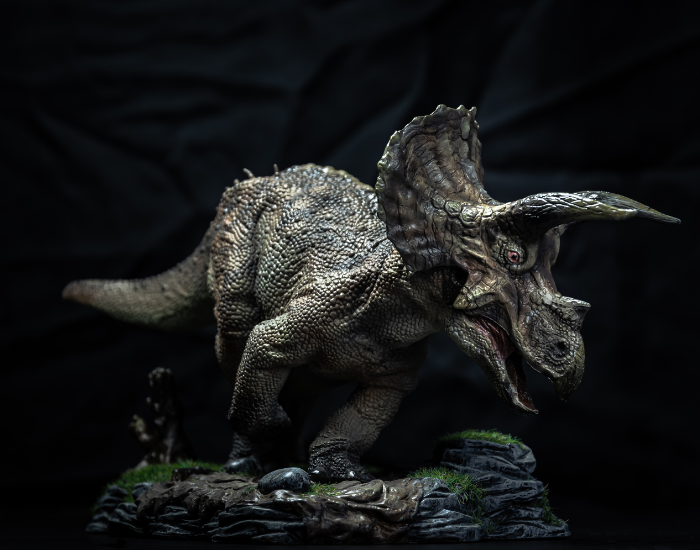
Triceratops did not roam some separate age. It shared the Late Cretaceous of western North America with Tyrannosaurus rex, right up to the very end. Both turn up in the same rocks of the Hell Creek Formation, dating to roughly 68 to 66 million years ago. Those rocks stretch across Montana, Wyoming, and the Dakotas, so a fossil hunter in North Dakota walks the same ancient floodplain.
This was a warm, humid, coastal world, not a barren desert. Rivers braided across low plains thick with ferns, palms, and flowering shrubs. Triceratops was the dominant herbivore in that lush ecosystem. A grazer this heavy likely reshaped the land, knocking over small trees and clearing brush as it fed. Living elephants do the same today, engineering whole habitats with their bulk.
Some T. rex bite marks appear on Triceratops bones. That does not prove every encounter ended badly for the herbivore. A healthy adult swinging a meter-long brow horn was no easy meal. I picture these standoffs the way I read a lion circling a buffalo: high stakes, uncertain outcome.
Triceratops was also stunningly common across this landscape. It is one of the most abundant large dinosaurs found in the Hell Creek badlands. Paleontologists working there often describe near-constant Triceratops fragments weathering out of the hills. That sheer volume of fossils is why we know this dinosaur so well. Rare animals leave riddles; Triceratops left a library.
8. There Are Two Species, and One Became the Other
Fossils reveal two main Triceratops species: Triceratops horridus and Triceratops prorsus. For years, that looked like a simple family split. Then John Scannella and colleagues stacked over 50 skulls by rock layer in Montana.
The pattern was striking. T. horridus appears lower, T. prorsus higher, with in-between forms sandwiched in the middle. That layering points to anagenesis, one species gradually transforming into the next over a million years or two. A study of Canadian material backed the same idea. We are literally watching evolution unfold in stone.
Triceratops also had close cousins that muddy the picture. It sits near Torosaurus and Nedoceratops on the ceratopsian family tree. Some researchers even argue Torosaurus was just an old Triceratops, not its own species. That debate still splits vertebrate paleontology today. I love it, because it shows science arguing in public, exactly as it should.

9. It Was One of the Last Dinosaurs Standing
This is the fact that gives me chills. Triceratops lived at the closing bell of the dinosaur age. Its bones sit in some of the youngest dinosaur-bearing rocks on Earth, just below the layer marking the asteroid impact 66 million years ago.
When that impact struck, the non-avian dinosaurs vanished. Dust and soot choked the sky, plants withered, and the food chains that fed giants collapsed. Triceratops went with them, alongside the giant crocodiles and marine reptiles of its world. Roughly three quarters of all species died in that single event, 66 million years ago. If you want the fuller story of what survived and what did not, our post on Ice Age animals picks up long after the dust settled. Triceratops was there for the finale, one of the last dinosaurs standing before the curtain fell.
10. Its Discovery Kicked Off a Fossil Feud
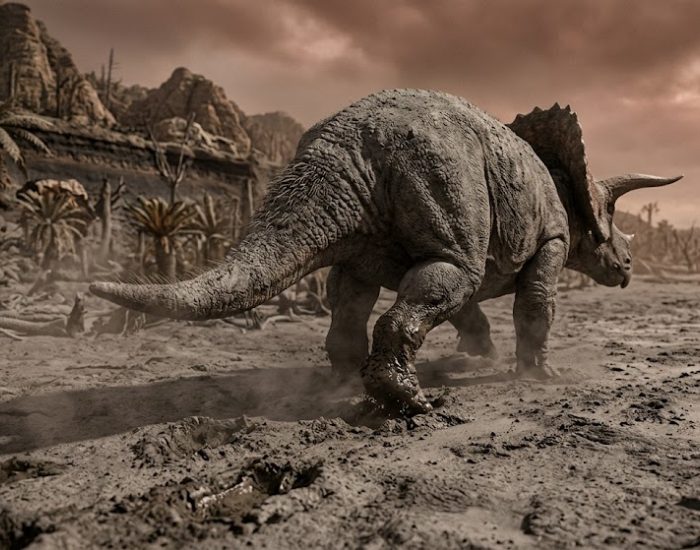
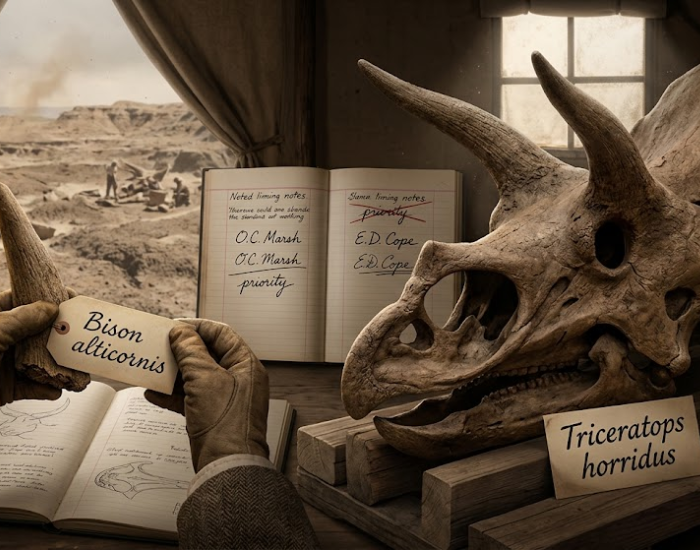
The first Triceratops fossil surfaced in 1887 near Denver, Colorado. A pair of horn cores reached Othniel Charles Marsh, who first labeled them an extinct bison. Picture that: a dinosaur skull filed under prehistoric cattle. Marsh corrected himself and formally named Triceratops in 1889, publishing in the American Journal of Science.
He discovered it during the “Bone Wars,” a bitter rivalry with fellow paleontologist Edward Cope. The two raced to describe new species, sometimes sloppily. That competitive era still shaped modern vertebrate paleontology and how we hunt fossils. Triceratops survived the chaos as one of the most complete dinosaurs we know. Today, roughly fifty skulls have come out of the Hell Creek badlands alone, with prized specimens housed everywhere from the American Museum of Natural History to London.
Frequently Asked Questions About Triceratops
Yes. Triceratops was a genuine dinosaur, part of the horned ceratopsian group. It lived during the Late Cretaceous and belonged to the ornithischian, or “bird-hipped,” branch of the dinosaur family tree. It is one of the most complete and well-studied dinosaurs ever found.
Yes, dinosaurs could hear. CT scans of the Triceratops inner ear show a functioning cochlea tuned toward low frequencies. Many dinosaurs likely communicated with deep calls and sensed low rumbles well. High-pitched hearing was probably weaker than in modern birds.
Triceratops measured around 8 to 9 meters long, or 26 to 30 feet. Adults weighed roughly six to twelve tonnes, heavier than any land animal alive today. Its skull alone could reach 2.5 meters, among the largest of any land animal ever. In short, this was a genuine heavyweight of the Late Cretaceous.
Triceratops was a plant-eater that fed on low-growing vegetation. It cropped ferns, cycads, palms, and shrubs with a sharp beak, then sliced them using up to 800 self-sharpening teeth. A body that large needed large quantities of fibrous plants every single day. It never hunted; those horns were for defense and display, not for killing prey.
Triceratops: Fact or Fiction? 🦕
Twelve statements about the three-horned icon — six true, six myths. Can you tell them apart?
Fact or Fiction?
The Real Legacy of a Three-Horned Icon
Strip away the toys and the movies, and Triceratops becomes something better: a heavyweight herbivore that fought, fed with self-sharpening teeth, and outlasted nearly every other dinosaur before the asteroid fell. That is a life worth respecting, not just fearing. For me, the London skull was never about size. It was about a real animal I wish I could have tracked in the flesh.
So do this. Next time you visit a natural history museum, skip past the biggest bones for a minute. Find the Triceratops and look at the frill, the horns, the worn teeth. Imagine the living animal behind the fossil, grazing a warm coastal plain 66 million years ago. Then tell me in the comments which fact surprised you most.
Extinct does not mean unreal. A Triceratops was as much an animal as any elephant or buffalo I have tracked in the field. If you want more vanished creatures that still count as wildlife, meet the saber-tooth tiger or the monstrous Deinosuchus next. They are waiting.
References:
Erickson, G. M., Krick, B. A., Hamilton, M., Bourne, G. R., Norell, M. A., Lilleodden, E., & Sawyer, W. G. (2015). Wear biomechanics in the slicing dentition of the giant horned dinosaur Triceratops. Science Advances, 1(5), e1500055. https://doi.org/10.1126/sciadv.1500055
Farke, A. A., Wolff, E. D. S., & Tanke, D. H. (2009). Evidence of combat in Triceratops. PLOS ONE, 4(1), e4252. https://doi.org/10.1371/journal.pone.0004252
Nabavizadeh, A. (2023). How Triceratops got its face: An update on the functional evolution of the ceratopsian head. The Anatomical Record, 306(7), 1815–1858. https://doi.org/10.1002/ar.25196
Sakagami, R., & Kawabe, S. (2020). Endocranial anatomy of the ceratopsid dinosaur Triceratops and interpretations of sensory and motor function. PeerJ, 8, e9888. https://doi.org/10.7717/peerj.9888
Scannella, J. B., Fowler, D. W., Goodwin, M. B., & Horner, J. R. (2014). Evolutionary trends in Triceratops from the Hell Creek Formation, Montana. Proceedings of the National Academy of Sciences, 111(28), 10245–10250. https://doi.org/10.1073/pnas.1313334111
Sereno, P. C., Wilson, J. A., Witmer, L. M., Whitlock, J. A., Maga, A., Ide, O., & Rowe, T. A. (2007). Structural extremes in a Cretaceous dinosaur. PLOS ONE, 2(11), e1230. https://doi.org/10.1371/journal.pone.0001230
Mallon, J. C., Ott, C. J., & Larson, P. L. (2025). The Canadian fossil record supports anagenesis in Triceratops (Ornithischia, Ceratopsia). Canadian Journal of Earth Sciences. https://doi.org/10.1139/cjes-2024-0170