
Snow crunched under my boots in central Sweden as my biologist colleague and I scanned a frozen treeline for a red fox we had been tracking for two days. We never found that fox. Instead, a long dark shape slipped across a clearing — a European polecat, elongated and impossibly low to the ground, dark fur stark against the snow. It paused once, looked back, and vanished into scrub trees. I laughed out loud. The polecat animal I had read about for years in textbooks was suddenly a real, breathing creature, perfectly adapted for cold climates. Over the next week we spotted two more.
That encounter rewired how I think about this small predator. The polecat is one of Europe’s most misunderstood mustelids — confused with ferrets, persecuted for centuries, and now quietly reclaiming old territory. Here are ten things every wildlife lover should know about the polecat animal, from biology and behavior to its remarkable conservation comeback.
1. The Polecat Is the Wild Ancestor of Your Pet Ferret
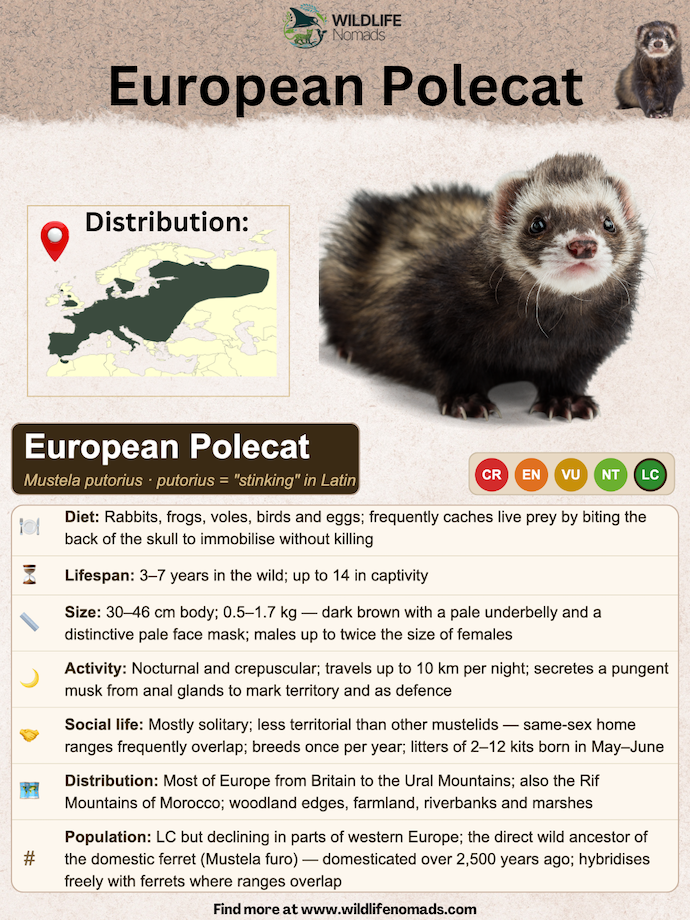
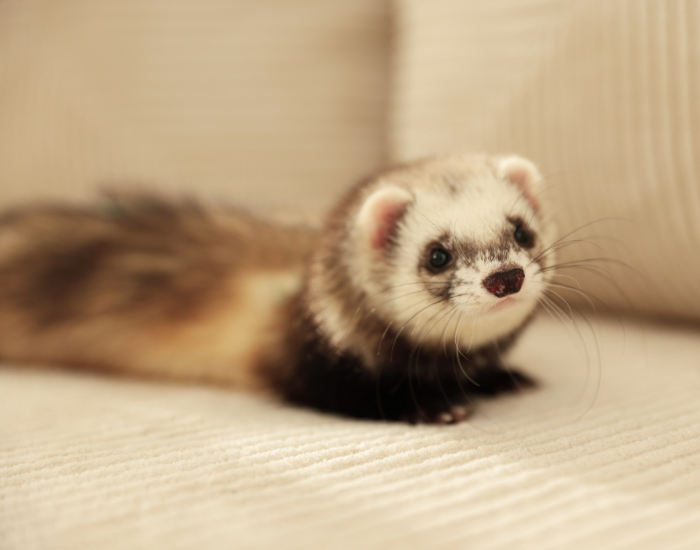
The European polecat, scientifically named Mustela putorius, belongs to the weasel family — the broader mustelid family that includes badgers, otters, and pine martens. About 2,500 years ago, humans domesticated this animal for hunting rabbits down rabbit burrows. The result was the domestic ferret, the polecat’s domesticated cousin, sometimes labeled the eu ferret in older European texts.
Genetically, the two are so close that polecats and ferrets readily interbreed, producing fertile polecat ferret hybrids in the wild. In Sweden, the biologist I traveled with kept ferrets at home for a ferret husbandry study. Watching her domestic ferret roll on the rug, I could see the same short legs and elongated torso as the wild polecat we had photographed days earlier. Pure rabbit-hunting design.
2. Its Two-Tone Coat Is a Field Mark You Can’t Miss
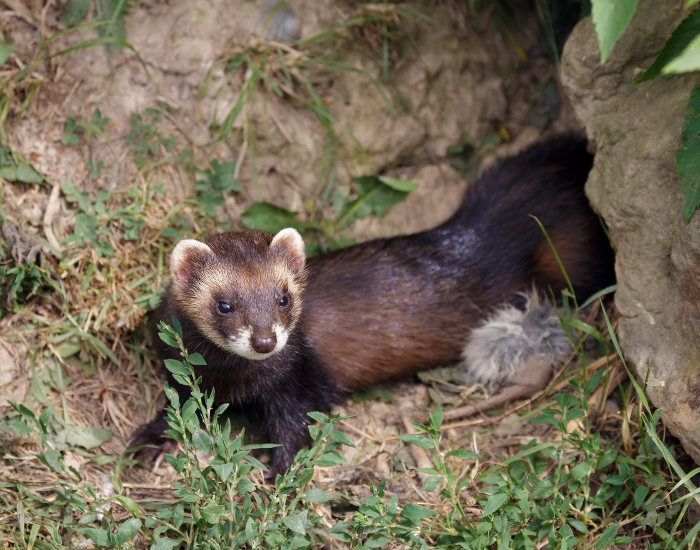
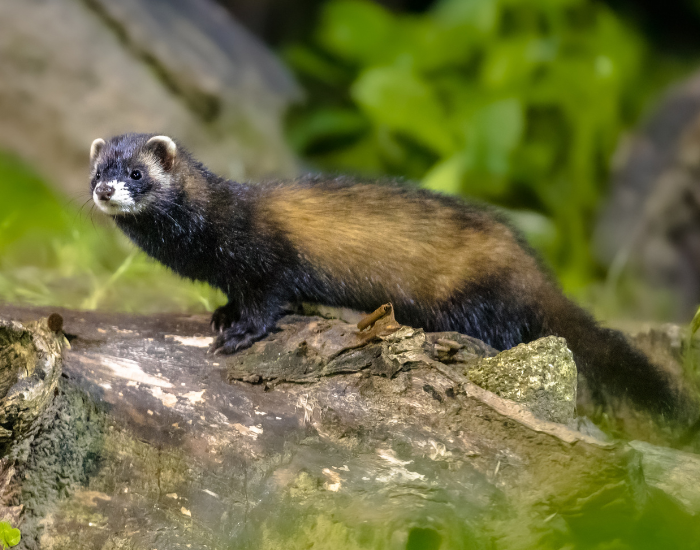
A wild polecat in winter wears a striking two tone coat. Dark brown guard hairs sit over a pale cream undercoat, giving the polecat animal a shifting, almost layered look as it moves. The face shows a distinct white throat patch, pale cheek patches, and a bandit-like mask formed by dark guard hairs across the eyes.
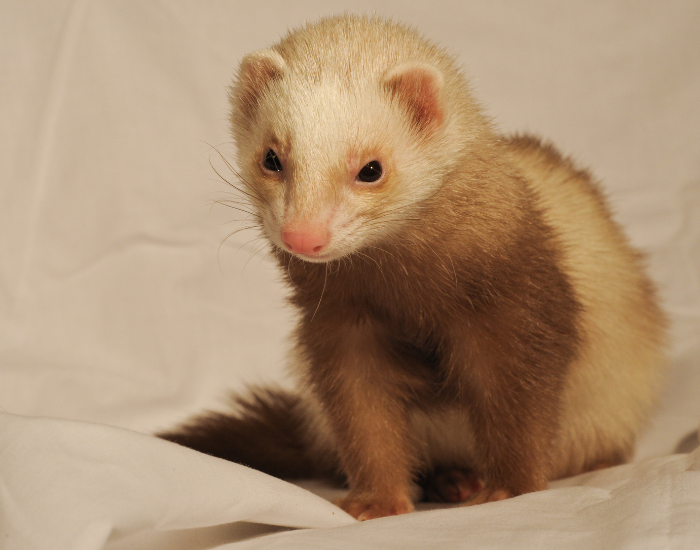
If you are looking to spot the polecat, notice the coat in three notes: dark fur on the back, white fur peeking through on the flanks, and white hairs interspersed across the rump. The polecat fur is unmistakable once you know it. By contrast, the domestic ferret comes in many colors — albino, sable, even reddish brown — which is one reason pure wild polecats and feral ferrets can be hard to separate in the field. The pale underbelly remains the clearest tell for a true polecat.
3. The European Polecat Is Just One of Several Polecat Species
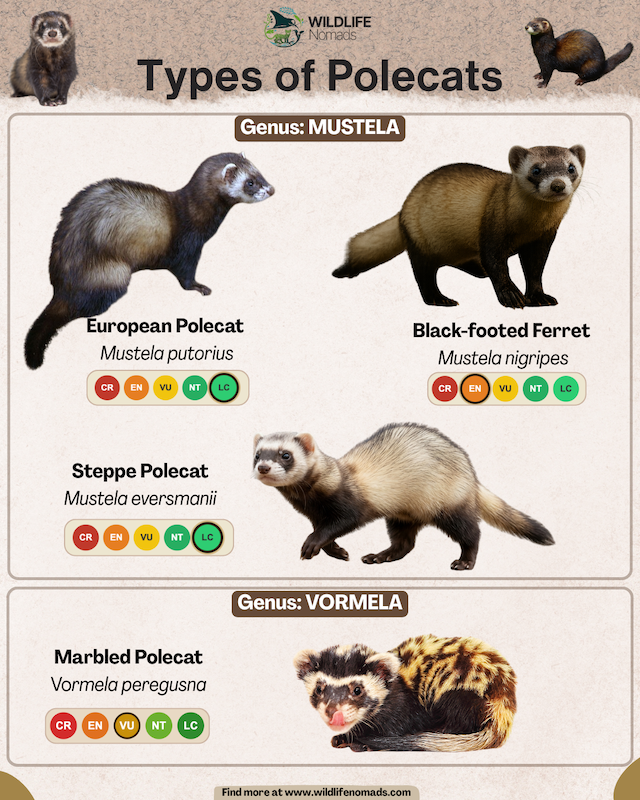
People often assume there is only one polecat animal, but taxonomists recognize three distinct “true” polecat species within the Mustela genus, alongside a few famous relatives.
First the European polecat (Mustela putorius) ranges across mainland Europe and into northern Africa. Second, the steppe polecat patrols the grasslands east of the Urals. The middle russian polecat occupies forest-steppe edges across the western range of the former Soviet Union. Third is the critically endangered black-footed polecat (better known as the black-footed ferret, Mustela nigripes) native to North America.
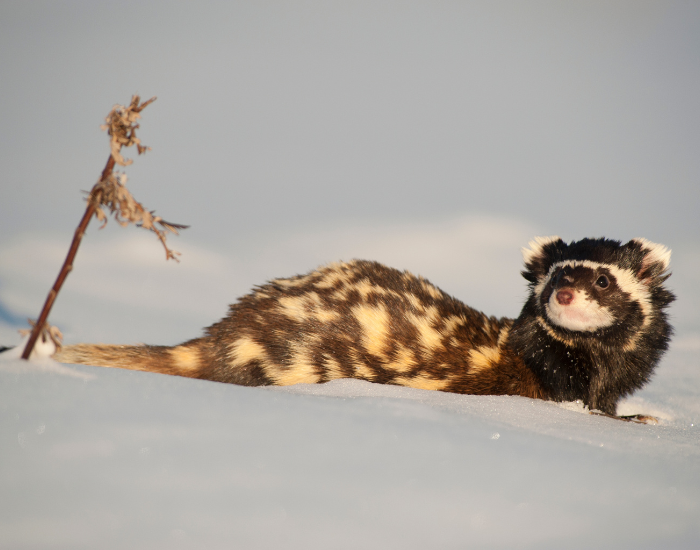
Then there is the Mediterranean polecat (Vormela peregusna), sometimes called the marbled polecat — hunts dry scrub from Turkey eastward. While it hunts the dry scrub from Turkey eastward and shares the name, it actually belongs to an entirely separate genus (Vormela).
Two more deserve mention. The forest polecat is a regional name for the European polecat in parts of middle europe. The Carpathian polecat is a recognized population from the mountain forests of Romania and Ukraine.
Across all these lineages, these animals share a common toolkit: short legs, intense scent-driven hunting, and a fondness for burrow systems. Their structural engineering for navigating tunnels is exactly what made true polecats so incredibly useful to early ferret keepers.
4. Rabbits Built the Polecat… Literally
The European polecat’s diet is dominated by one prey item across most of its range: the European rabbit. Polecats eat rabbits at a higher rate than almost any other mustelid species, and a single polecat can drag prey larger than itself back to a den. Studies of polecat populations in southern England and western France show that rabbit warrens are the single best predictor of where the polecat animal settles.
When the rabbit population crashes — as it did during the myxomatosis outbreaks of the 1950s — polecat populations crash with it. In lean years, polecats shift to small mammals such as voles and wood mice, plus amphibians and the occasional bird. But make no mistake: this is a rabbit specialist that learned to follow its prey down into rabbit burrows. Hunting rabbits is, in evolutionary terms, what built this body plan.
5. The Welsh Polecat Saved the Species in Britain
By 1915 the polecat animal had been driven almost to extinction in the British Isles. Gamekeepers persecuted it relentlessly, mistaking it for vermin. Only a remnant population survived in the wilds of central Wales, what we now call the Welsh polecat refuge. From those few breeding females, the species clawed its way back.
The Vincent Wildlife Trust has tracked this recovery for decades, and their distribution surveys show the polecat now reclaiming southern England and northern England. The Wildlife and Countryside Act of 1981 finally gave the species legal protection. That act ended the centuries of trapping, and subsequent amendments to the Wildlife and Countryside Act tightened those protections further. Today’s expanding range is a genuine conservation success story driven by that small Welsh refuge.
6. Polecats Carry a Chemical Weapon
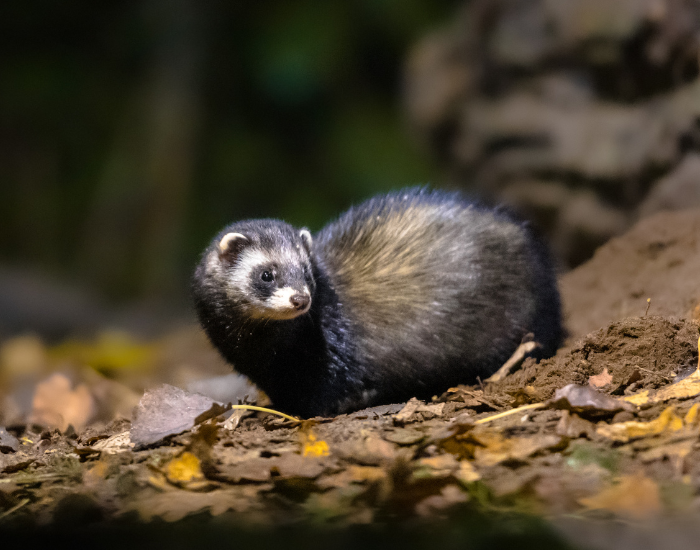
The Latin name Mustela putorius literally means “stinking weasel.” That isn’t a slur — it’s a description. Polecats possess powerful anal scent glands, often simply called anal glands, that release a sulphurous musk when the animal is frightened or fighting. The smell lingers for days on clothing and fur.
The scent is sharper than any domestic ferret musk I have encountered, with a chemical bite that made my eyes water. It is a useful reminder that despite the cute face, the polecat animal is a small predator with serious defensive weaponry that other weasels rarely match.
7. They Hybridize Freely With Escaped Pet Ferrets
One of the trickiest issues for polecat conservation is hybridization. Whenever pet ferrets escape — and ferrets escaping happens more often than owners admit — they breed with wild polecats. The resulting polecat ferret hybrids carry mixed traits and can blur the genetic signal of true wild populations. Across the British Isles, identifying a polecat ferret in the wild requires careful pelage scoring and, ideally, genetic confirmation.
Genetic diversity studies from the Mammal Society and others suggest hybridization is widespread, especially in areas where European polecat populations have only recently recolonized. That said, ongoing work shows that pure wild polecats still dominate the core range. Feral ferrets remain a concern, particularly on islands where escaped colonies establish themselves as a non native species. Conservation managers now watch for any polecat ferret signal in monitoring data.
8. The American Mink Is a Bigger Problem Than the Polecat Itself
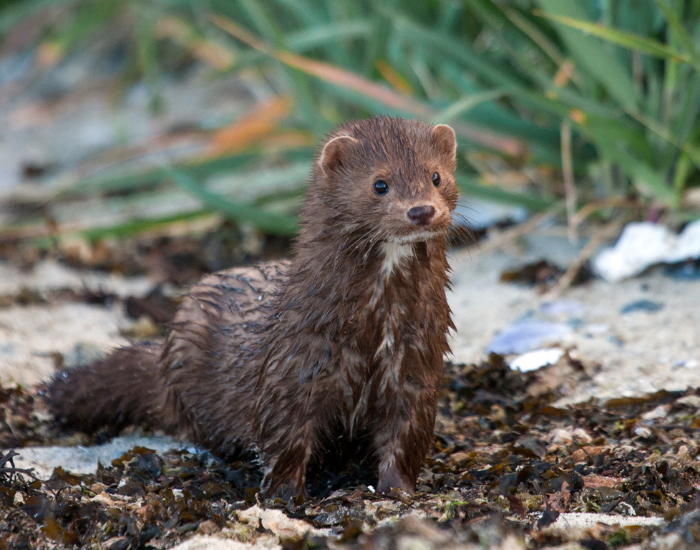
The polecat animal shares wetland habitats with two close relatives: the European mink and the American mink. The European mink is one of the most endangered mammals on the continent. The American mink, by contrast, escaped from fur farms across the former Soviet Union and western Europe through the twentieth century, and the American mink now thrives as an invasive across mainland Europe.
For the polecat, the American mink is a direct competitor for fish, amphibians, and small rodents. Where American mink densities are high, polecat populations shift their diet and home range. This is one of those quiet ecological dramas — three closely related species, one native and recovering (the polecat), one native and disappearing (the European mink), and one invasive American mink spreading fast. Other mustelids in the same habitat — otters, stoats — feel the pressure too.
9. Polecats Are Solitary, Seasonal Lovers
The polecat mating system is brief and businesslike. The mating season runs from late March through early June. Males roam widely searching for breeding females, and the encounters themselves are rough because induced ovulation requires it. After mating, the male leaves. There is no pair bond.
A female raises one litter per year, usually four to six kits, in a den tucked into rabbit warrens, hollow logs, or under scrub trees. By autumn, the young disperse. The polecat is fundamentally a solitary animal, and adult home ranges rarely overlap outside of the mating season. Reference accounts in Mammalian Species and the Animal Diversity Web describe the same pattern across the entire European polecat populations dataset.
10. The Polecat’s Economic Importance Is Quietly Significant
For centuries, the polecat animal was viewed only through the lens of damage — chickens lost, game birds taken. That framing misses the bigger picture. The polecat’s economic importance today comes from its role in regulating rabbit and rodent populations across mainland Europe and the British Isles. A single polecat takes hundreds of rabbits each year, and on farms suffering from rabbit overgrazing that service is worth real money.
Ferret husbandry, using the domesticated form of this animal, still has its own niche economy in rabbit clearance and pest control. The domesticated form has also given researchers a powerful model for studying influenza, which is why polecats and ferrets keep appearing in biomedical reference works from Elsevier Health Sciences and others. But the wild polecat does the ecological work for free.

11. Conservation Is Working, But Quietly
Across middle europe, polecat populations have stabilized or grown over the last forty years. Reports in journals like Biological Conservation, alongside reference databases like the Animal Diversity Web, show range expansion in France, Germany, Poland, and the UK. The polecat is one of the few mustelid species whose trajectory is genuinely positive, and recent genetic diversity work suggests core populations remain healthy despite some polecat ferret introgression.
Threats remain. Road mortality is the leading cause of death across most polecat populations. Secondary rodenticide poisoning is the second. In some regions, gamekeepers still kill polecats illegally despite the Wildlife and Countryside Act. But the long arc — from near-extinction in 1915 to today’s expanding range across southern England, northern England, and mainland Europe — is encouraging.
FAQs about Ferrets
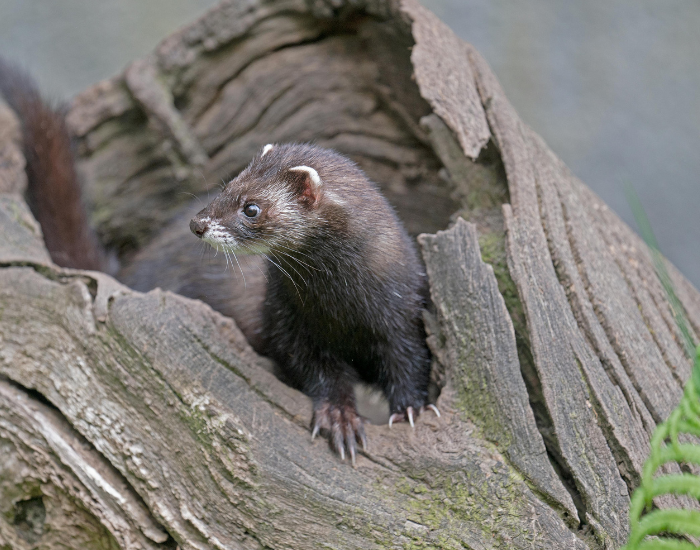
A polecat is a medium-sized wild carnivore in the mustelid family, most commonly referring to the European polecat (Mustela putorius). It is the wild ancestor of the domestic ferret and a close cousin of the western polecat populations in Britain. Polecats live across mainland Europe, the British Isles, and parts of northern Africa.
Not quite. Polecats and ferrets share a common lineage and can interbreed freely, but they are treated as separate forms — Mustela putorius (wild) and Mustela putorius furo (domestic). Where feral ferrets establish, they hybridize with local European polecat populations, which is why genetic diversity monitoring matters for conservation.
European polecat predators include large birds of prey, eagle owls, foxes, and occasionally domestic dogs. Adult polecats have few natural enemies, but kits are vulnerable in the den.
The Quiet Conservation Success
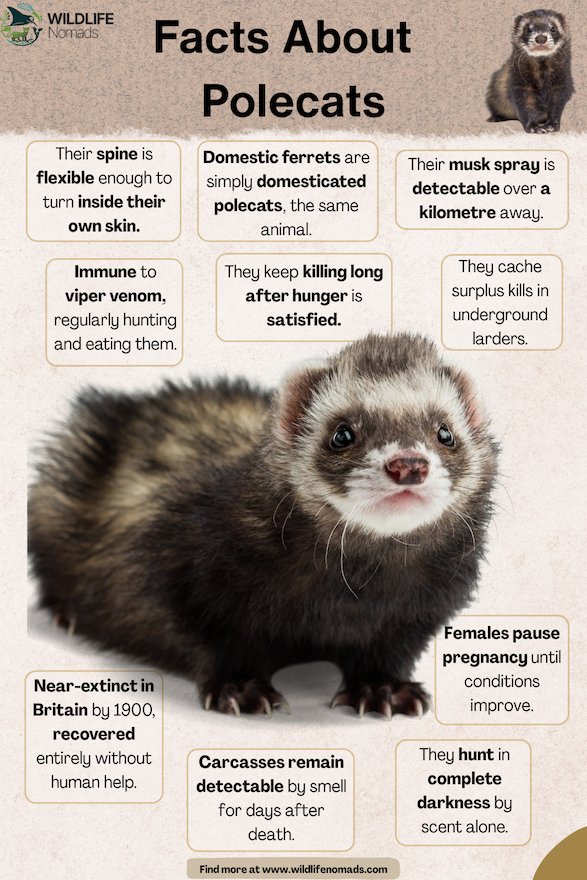
The polecat animal is a quiet conservation success — a small, secretive predator that survived persecution, dodged extinction in Britain, and is now slipping back into landscapes it had not occupied for a century. Watching one move across Swedish snow is something I will not forget, and it changed how I read the field signs of every farm and forest I have walked since.
If you want to see one yourself, walk farm edges at dusk in Wales, southern England, or any patch of mainland Europe with healthy rabbit warrens. Bring patience and binoculars. And if you would like to keep exploring the weasel family, compare notes with the North American black footed ferret, or read about the closely related pine marten. Drop a comment with your own polecat story — I would love to hear it.
References:
Costa, M., Fernandes, C., Birks, J. D. S., Kitchener, A. C., Macdonald, D. W., & Bruford, M. W. (2013). The genetic legacy of the 19th-century decline of the British polecat: Evidence for extensive introgression from feral ferrets. Molecular Ecology, 22(20), 5130–5147. https://doi.org/10.1111/mec.12456
Sainsbury, K. A., Shore, R. F., Schofield, H., Croose, E., Pereira, M. G., Sleep, D., Kitchener, A. C., Hantke, G., & McDonald, R. A. (2018). Long-term increase in secondary exposure to anticoagulant rodenticides in European polecats Mustela putorius in Great Britain. Environmental Pollution, 236, 689–698. https://doi.org/10.1016/j.envpol.2018.02.004
Shaw, R., MacPherson, J., Kitchener, A. C., Etherington, G. J., & Haerty, W. (2025). Characterisation of the Historic Demographic Decline of the British European Polecat Population. Molecular ecology, 34(20), e70091. https://doi.org/10.1111/mec.70091
Skumatov, D., Saveljev, A. P., Kranz, A., Abramov, A. V., Herrero, J., Maran, T., Wozencraft, C., Stubbe, M., Kryštufek, B., & Reid, F. (2016). Mustela putorius. The IUCN Red List of Threatened Species 2016: e.T41658A45214384. https://doi.org/10.2305/IUCN.UK.2016-1.RLTS.T41658A45214384.en
Birks, J. D. S. (2008). The Polecat Survey of Britain 2004–2006: A report on the Polecat’s distribution, status and conservation. Vincent Wildlife Trust. https://www.vwt.org.uk