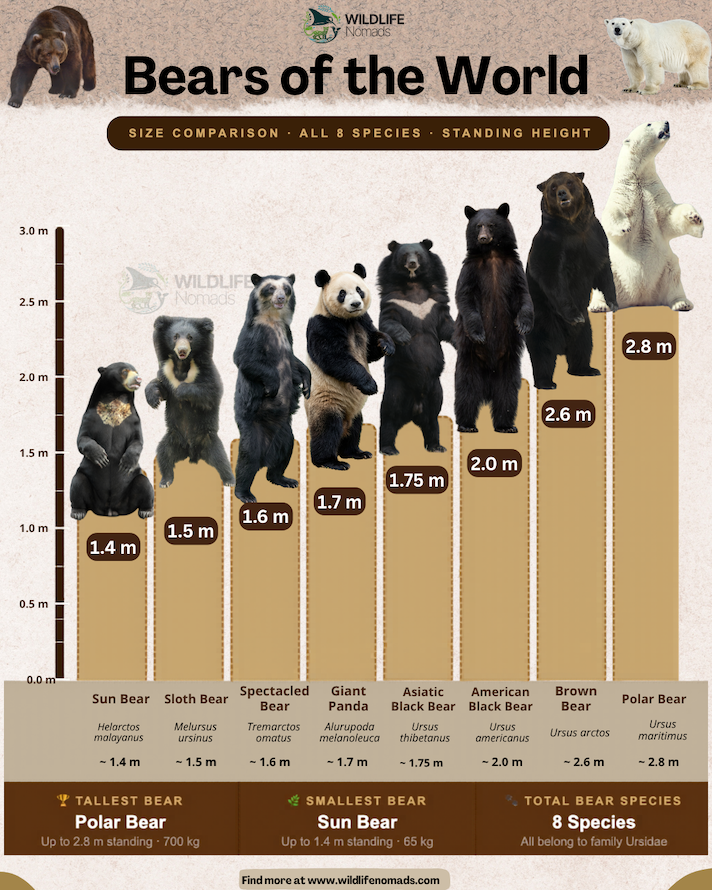
I’ve spent the last few months deep in the bear rabbit hole. After writing about grizzly bears, Andean bears, polar bears, and breaking down all the different species of bears, today it’s the turn of a bear that genuinely baffled me. The sloth bear. Of all eight extant species of bears on the planet, this is the one that made me stop and say, “Wait, what?” They look like they just rolled out of bed. They have vacuum-cleaner mouths designed to suck termites out of mounds. They carry their cubs on their backs like furry little taxis. And they are, statistically, the most dangerous bears on Earth when it comes to attacking humans.
I haven’t had the chance to study sloth bears in the field myself, not yet, anyway. But after writing about the sun bear and spending time with Malayan sun bears in Sumatra, I became fascinated by how each bear species breaks the mold in its own way. The sloth bear breaks it more than most. So let’s get into it.
1. The Sloth Bear Got Its Name Because of a Case of Mistaken Identity
Here’s a fact that still makes me laugh. When European zoologist George Shaw first described this bear in 1791, he thought it was a type of sloth. The long curved claws, the strange hanging posture, the shaggy fur — Shaw looked at this animal and classified it alongside tree sloths. It took years before scientists realized this was actually a bear. The scientific name stuck, though. Melursus ursinus — the “honey bear bear,” essentially — belongs firmly in the bear family, order Carnivora, family Ursidae. But that early confusion tells you something important about the sloth bear. It genuinely looks like no other bear on the planet.
The sloth bear shares its home range on the Indian subcontinent with three other bear species: the asiatic black bear (also called the Asian black bear or moon bear), the brown bear (Ursus arctos), and the Himalayan brown bear (Ursus arctos isabellinus). That’s four bear species found in a single subcontinent. India is one of the only places on Earth where this kind of overlap exists. For comparison, North America has just two: the black bear and the brown bear (grizzly). The Indian subcontinent is a bear hotspot, and the sloth bear is its strangest resident.

2. They Look Like Bears Designed by Committee
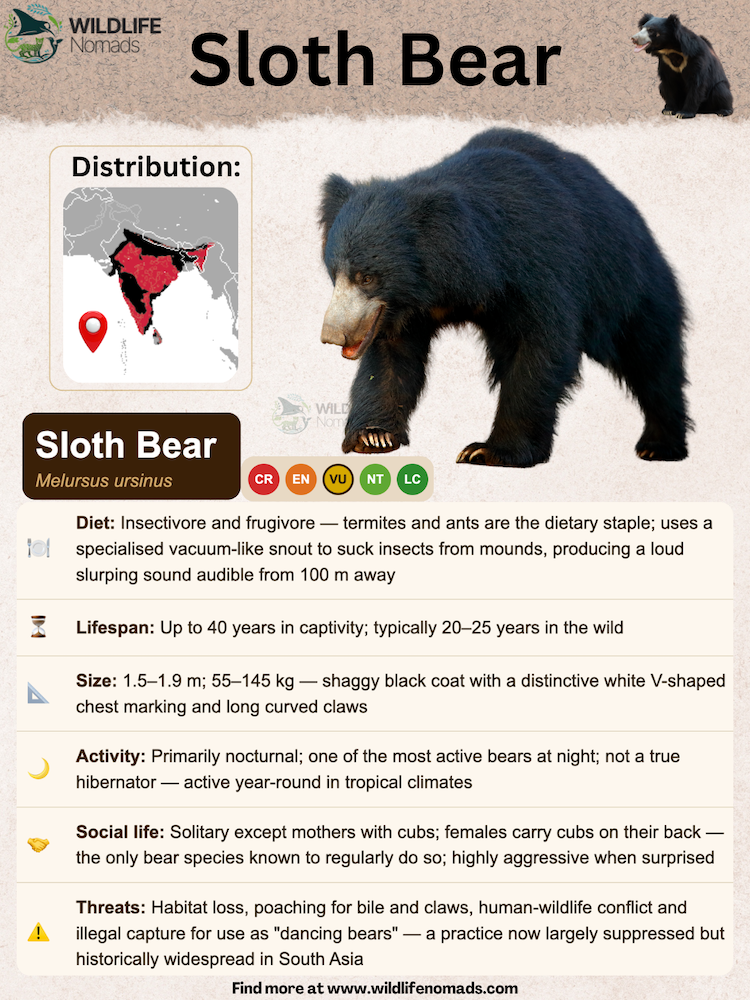
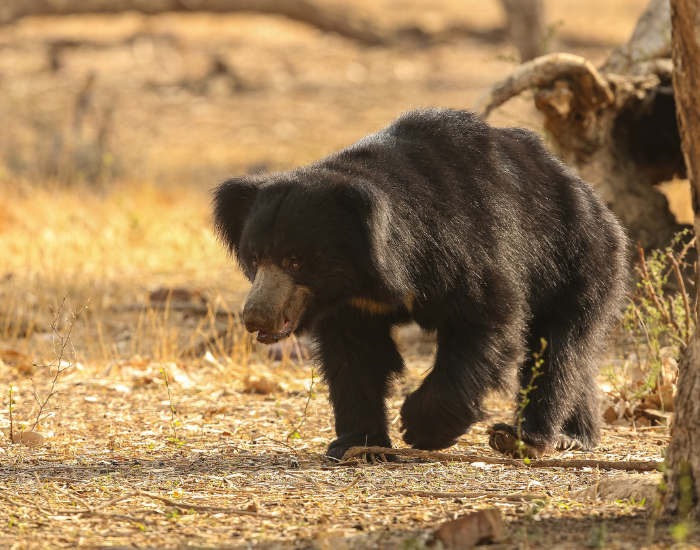
If you’ve never seen a sloth bear up close, let me paint the picture. They have long, shaggy, almost unkempt black fur, not the sleek coat of a black bear or the dense pelt of a polar bear. The fur is thick, especially around the neck and shoulders, where it forms a mane of long hair that can reach 30 centimeters. Their pale muzzle is almost bald by comparison, elongated and flexible in a way that looks comically expressive.
On their chest sits a distinctive Y-shaped mark — sometimes more of a V-shaped mark — in cream or white. This chest patch varies between individuals. Some sloth bears wear it boldly. Others barely show it at all. Their body length runs around 150 to 190 centimeters, and adults weigh between 90 and 140 kilograms. Females are smaller. A female bear typically weighs about a third less than a male.
Then there are the claws. The sloth bear has long claws — seriously long, curved claws that can reach 8 centimeters on the front paws. These aren’t weapons in the way a brown bear’s or grizzly’s claws are. They’re tools. Sickle-shaped, ivory-colored digging instruments evolved specifically to tear open termite mounds and ant nests. The claws on the back legs and hind legs are shorter, built for grip rather than excavation. When a sloth bear stands on its hind legs, which it does when threatened, the overall impression is somewhere between terrifying and absurd.
3. Their Mouth Is Basically a Vacuum Cleaner
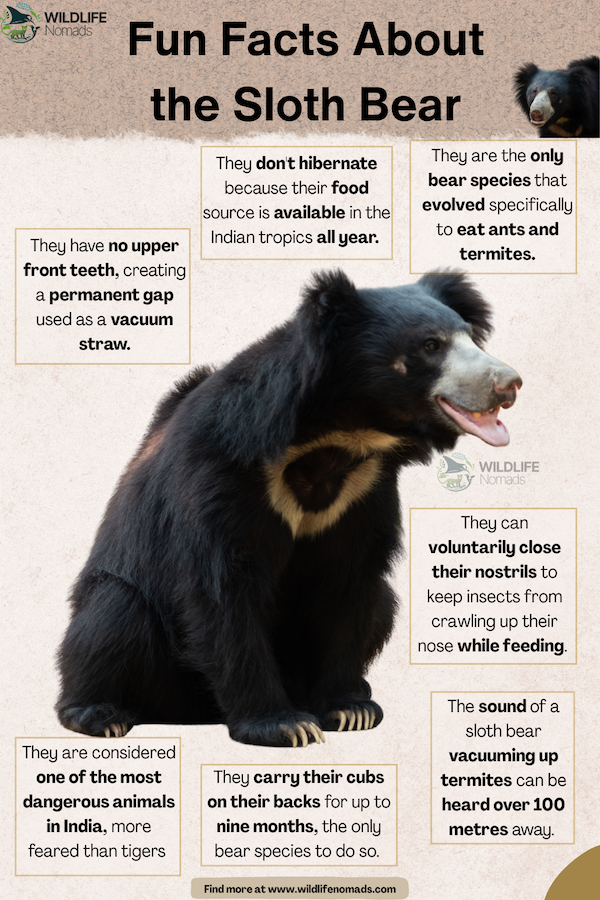
This is where the sloth bear gets truly wild. Unlike other bears, sloth bears have evolved a feeding apparatus that functions like a biological vacuum. They’re missing their two front upper incisors, creating a gap. Their lips are long, mobile, and can protrude outward. Their palate is hollowed. Put it all together, and the sloth bear can seal its mouth against a termite mound, blow away the dust, and then suck insects out with enough force to be heard from 200 meters away.
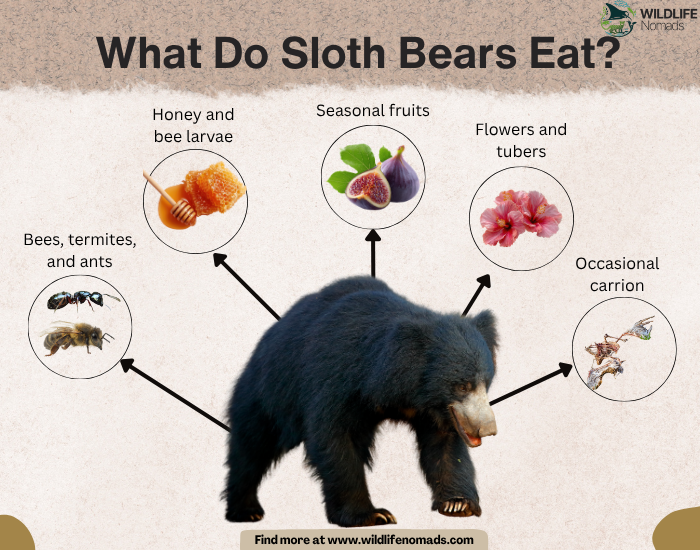
Their diet consists primarily of insects during the dry season — ants, termites, beetle larvae. Studies show that up to 95 percent of a sloth bear’s dry-season diet consists of insects harvested from termite mounds. During the wet season, the diet shifts. Fruits, flowers, honeycombs, and occasionally sugarcane make up the balance. The sloth bear earned the nickname honey bear long before Shaw misidentified it as a sloth species. Local communities across the Indian subcontinent have known about this bear’s sweet tooth for centuries.
4. Sloth Bears Are the Most Aggressive (Defensive) Bears Toward Humans
I want to be careful with this one, because “most dangerous” gets thrown around carelessly. But the data is clear. Sloth bear attacks on humans outnumber fatal encounters with any other bear species globally. In a study from the Kanha-Pench corridor in central India, researchers documented 166 attack victims between 2004 and 2016. Another study in Buldhana district found 51 victims over eight years, with a 13.7 percent fatality rate.
Why? Unlike tigers, which generally avoid humans, sloth bears have an innate defensive-aggressive response to surprise encounters. A recent 2024 study analyzed 43 videos of tiger-sloth bear interactions and found something remarkable. Sloth bears use the same aggressive charging behavior against humans that they use to defend themselves against tigers. Unlike tigers and leopards, which rely on stealth, the sloth bear’s survival strategy is pure aggression. Charge first, assess later. This makes bear attacks by sloth bears uniquely violent. Approximately 96 percent of victims sustain injuries to the face and scalp.
5. Sloth Bear Mothers Are Fiercely Protective — and Carry Cubs on Their Backs
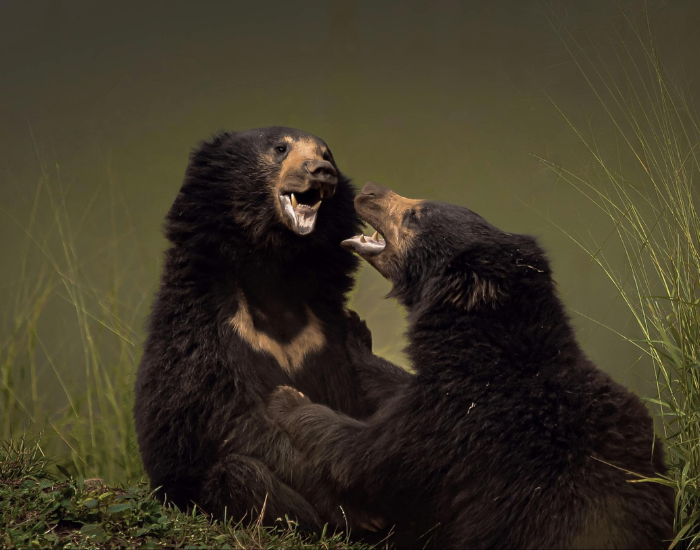
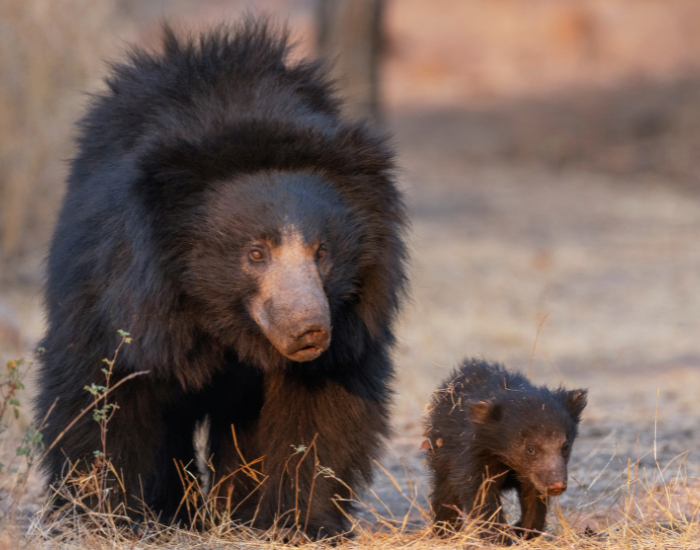
Of all the bear species, sloth bear mothers might be the most dedicated. After a gestation period of roughly four to seven months (which includes delayed implantation), a female bear gives birth to one or two cubs — occasionally three, but that’s rare. The cubs are born blind and completely helpless. Born blind and weighing barely half a kilogram, sloth bear cubs depend entirely on their mother for survival.
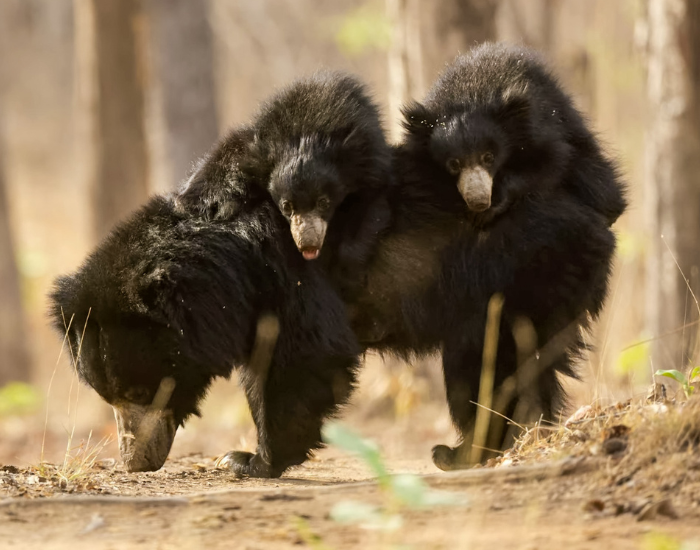
Here’s what makes sloth bear mothers extraordinary. They carry their cubs on their backs. This is unique among bears. No other bear species does this. The cubs cling to the mother’s shaggy mane as she forages, climbs, and moves through the forest. Researchers believe this behavior evolved as a defense against predators. Unlike tigers or leopards, a sloth bear mother with cubs on her back can flee without abandoning her young. Mother bears will carry two cubs at once, and the image, a shaggy, lumbering bear with tiny bears clinging to her shoulders — is one of the most endearing sights in Indian wildlife.
6. They Share Habitat with Tigers… and Don’t Back Down
This is the fact that consistently surprises people. Sloth bears live in the same forests as Bengal tigers. In places like Ranthambore, Kanha, and Satpura, the two species overlap entirely. And unlike other bears, sloth bears do not always flee from tigers. That 2024 study I mentioned earlier found that in roughly half of documented encounters, the sloth bear stood its ground or charged. Unlike tigers, which are ambush predators, sloth bears rely on aggression and unpredictability.
The dynamic is fascinating from a behavioral ecology perspective. Tigers do occasionally kill sloth bears, particularly cubs and subadults. But adult sloth bears — especially mothers with cubs — are not easy prey. Their thick fur and loose skin provide some protection against bites, and their long claws can inflict serious damage. The relationship between these two predators shapes the behavior of both species in ways researchers are only beginning to understand.
7. The Dancing Bear Trade Nearly Destroyed Them
For over 400 years, sloth bears were captured as cubs, had their teeth pulled or smashed, had a rope threaded through their sensitive muzzle, and were forced to “dance” for entertainment on Indian roads. The practice was tied to the Kalandar community, who had historically used trained bears as a livelihood. It was brutal. Cubs were typically taken from their mothers — sloth bear mothers killed in the process — and the suffering was lifelong.
Wildlife SOS, founded in 1995 by Kartick Satyanarayan and Geeta Seshamani, took on the seemingly impossible task of ending this practice. Over the following decades, Wildlife SOS rescued more than 628 dancing bears across India. They established four major bear rescue facilities, including the Agra Bear Rescue Facility — now the world’s largest sloth bear sanctuary. Wildlife SOS didn’t just rescue bears. They worked with the Kalandar community to develop alternative livelihoods, educating over 17,000 children and supporting more than 5,000 families in the transition.
8. Sloth Bears Live Across a Surprisingly Wide Range
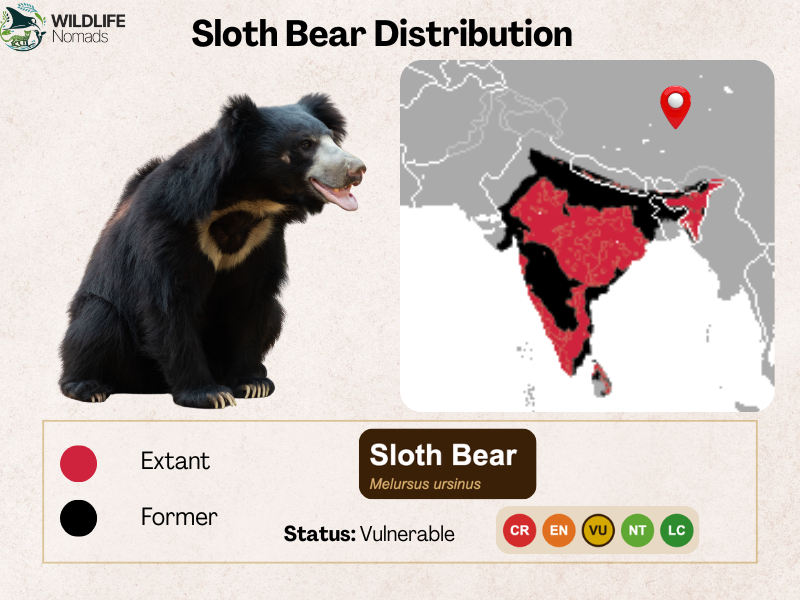
When people think of sloth bears, they picture the dry forests of central India. But sloth bears live across a far broader range than most realize. The species is found throughout the Indian subcontinent, from the dry scrublands of Rajasthan to the moist tropical forests of the Western Ghats, from the terai grasslands of Nepal to the lowland dry forests of Sri Lanka. Sloth bears live in Northeast India, through the central highlands, and down into southern peninsular India.
The Sri Lankan sloth bear (Melursus ursinus inornatus) is a recognized subspecies found only in Sri Lanka. It’s physically smaller, with shorter and sparser fur, an adaptation to Sri Lanka’s warmer tropical climate. Sri Lankan sloth bears tend to live at lower elevations, typically below 300 meters, while mainland sloth bears range up to 1,500 meters in the foothills of the Central Himalayas.
9. Habitat Loss Is Their Biggest Threat
The sloth bear is listed as Vulnerable on the IUCN Red List , a threatened species facing an expected population decline of more than 30 percent over the next three decades. The primary driver is habitat loss. Across the Indian subcontinent, forests are being fragmented by agriculture, mining, road construction, and human settlement expansion. Habitat destruction and habitat degradation are accelerating in the lowland areas where sloth bears are most concentrated.
In south Asia, the pressure on natural habitats is enormous. India’s human population continues to grow, and the overlap between bear habitat and human activity increases every year. Sloth bears are losing the wild places they depend on. The illegal wildlife trade compounds the problem. Sloth bear body parts — gall bladders, skins, and other body parts — are trafficked internationally. Traditional Chinese medicine has historically driven demand for bear bile, though there’s no scientific evidence supporting its efficacy. Even in western China and southeast Asia, bear body parts from Indian sloth bears have been seized by authorities.
10. They Can Climb Trees… But Prefer Not To
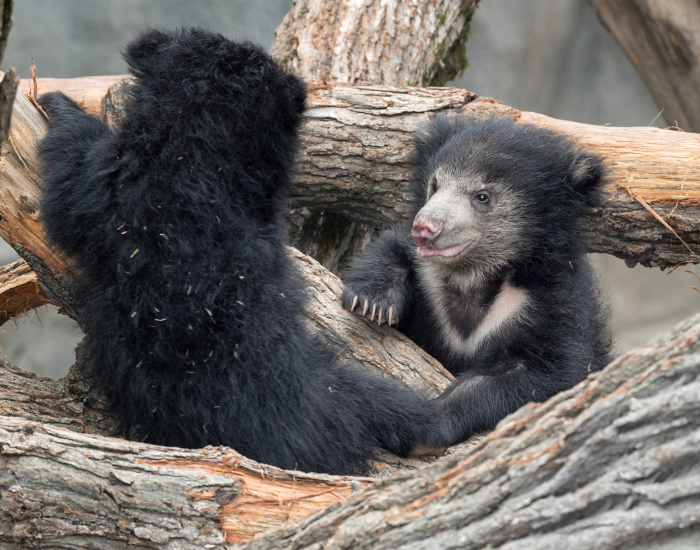
Adult sloth bears can climb trees, and they do so to reach honey combs, fruit, and occasionally safety. Cubs are more agile climbers and will scramble up the same tree together for protection. But compared to the sun bear — which is essentially arboreal — or the asiatic black bear, which regularly forages in canopy, the sloth bear is a reluctant climber. Their large body and heavy build make tree climbing energetically expensive. A black bear or brown bear of similar size is far more confident in the canopy.
That said, sloth bears adapt their behavior based on local conditions. In areas with abundant fruiting trees, they climb more frequently during the wet season. In the dry forests where their diet consists almost entirely of ground-dwelling insects, they may go weeks without climbing.
11. Breeding Season Is Brief and Reproduction Is Slow
Sloth bears typically breed during spring and early summer. The breeding season is relatively brief, and males compete for access to females through vocalizations and physical displays rather than the intense combat seen in brown bear or black bear populations. After mating, fertilized eggs undergo delayed implantation — a trait shared with other bears — meaning the embryo doesn’t attach to the uterine wall for several weeks or months. Total gestation ranges from four to seven months.
Females give birth to one or two cubs near the onset of winter, though litters of three have been documented. The pattern of one or two cubs per litter, combined with two-to-three-year intervals between successful breeding events, means sloth bear populations recover slowly from any decline. Cubs nurse for approximately one year and become sexually mature at around three years old, though they may not successfully reproduce until age four or five. This slow reproductive rate makes every individual important. When habitat degradation removes breeding females from the population, the downstream effect echoes for generations.
12. The Sloth Bear’s Future Depends on Coexistence
Of all the bear species I’ve researched, the sloth bear sits in one of the most precarious positions. It’s not as rare as the giant panda, not as iconic as the polar bear, and not as widespread as the black bear. It exists in a space between, a bear species found across a densely populated subcontinent, dependent on forests that are shrinking, and routinely in conflict with the people living alongside it.
But there are reasons for hope. Wildlife SOS has proven that large-scale bear rescue and community-based conservation can work. Protected areas in India and Nepal harbor healthy sloth bear populations. Researchers are mapping wildlife corridors to reconnect fragmented habitats. And public awareness is growing. The sloth bear is no longer invisible. Conservation programs focused on sloth bear conservation, human-wildlife coexistence, and habitat restoration are expanding. India’s three bear species (plus a subspecies of the brown bear) — the sloth bear, asiatic black bear, Himalayan brown bear, and sun bear — all benefit when forests are protected and communities are supported.
Frequently Asked Questions
Yes. Sloth bears are responsible for more attacks on humans than any other bear species. However, these are defensive encounters, not predatory ones. Sloth bears attack when surprised at close range, using the same aggressive charging behavior they evolved to deter tigers. Avoiding surprise encounters — making noise while walking in bear country, avoiding dense vegetation during peak activity hours — dramatically reduces risk.
The name comes from a taxonomic mistake. In 1791, zoologist George Shaw examined a sloth bear specimen and thought its long curved claws and shaggy appearance resembled a tree sloth. He classified it accordingly. By the time the error was corrected and the animal was recognized as a true bear (Melursus ursinus), the common name had stuck.
The global population is estimated at fewer than 20,000 individuals. The species is classified as Vulnerable by the IUCN, with population trends declining due to habitat loss, human-wildlife conflict, and poaching. Without effective bear conservation measures, scientists project a 30 percent decline over the next 30 years.
The sloth bear is the oddball of the bear family, and one of those animals that rewards attention. The deeper you dig, the more extraordinary it becomes — from its vacuum-powered mouth to its willingness to charge a tiger to the heartbreaking history of the dancing bear trade. Of the eight extant species of bears, this might be the one that deserves more recognition than any other.
If this deep dive hooked you, check out my breakdowns on the sun bear, polar bear, and grizzly bear, or start with my overview of all the different species of bears to see how these animals compare. Drop a comment below if you’ve ever encountered a sloth bear in the wild. I’d love to hear your story.
Where to Spot Sloth Bears in the Wild?
Even though you can fin them in many parts, it would be better if you head to Sri Lanka. Here is a list of 3 tours where you could go on safari an potentially spot Sloth bears in the wild. As a biologist, I only recommend tours that follow strict ethical guidelines to ensure we don’t disturb wildlife. These are the three tours/ partners I trust most based on their conservation records:
This blog is reader-supported. When you buy experiences through links listed on this site, we may earn an affiliate commission.
References:
Bargali, H. S., Akhtar, N., & Chauhan, N. P. S. (2005). Characteristics of Sloth Bear Attacks and Human Casualties in North Bilaspur Forest Division, Chhattisgarh, India. Ursus, 16(2), 263–267. http://www.jstor.org/stable/3873037
Dhamorikar, A. H., Mehta, P., Bargali, H., & Gore, K. (2017). Characteristics of human–sloth bear (Melursus ursinus) encounters and the resulting human casualties in the Kanha-Pench corridor, Madhya Pradesh, India. PLoS ONE, 12(4), e0176612. https://doi.org/10.1371/journal.pone.0176612
Dharaiya, N., Bargali, H.S. & Sharp, T. (2020). Melursus ursinus (amended version of 2016 assessment). The IUCN Red List of Threatened Species 2020: e.T13143A166519315. https://dx.doi.org/10.2305/IUCN.UK.2020-1.RLTS.T13143A166519315.en.
Dutta, T., Sharma, S., Maldonado, J. E., & Panwar, H. S. (2015). Genetic variation, structure, and gene flow in a sloth bear (Melursus ursinus) meta-population in the Satpura-Maikal landscape of central India. PLoS ONE, 10(5), e0123384. https://doi.org/10.1371/journal.pone.0123384
Sharp, R., Sunquist, M., & Sunquist, F. (2024). A most aggressive bear: Safari videos document sloth bear defense against tiger predation. Ecology and Evolution, 14(8), e11524. https://doi.org/10.1002/ece3.11524
Paudel, R. P., Kadariya, R., Lamichhane, B. R., Subedi, N., Sashika, M., Shimozuru, M., & Tsubota, T. (2022). Habitat occupancy of sloth bear Melursus ursinus in Chitwan National Park, Nepal. Ecology and Evolution, 12(3), e8699. https://doi.org/10.1002/ece3.8699