
There’s something absolutely captivating about watching a goldfinch flash its brilliant yellow plumage as it bounces through the air, or hearing the cheerful chatter of a flock of finches birds at your backyard feeder. These small, but very charismatic songbirds have captured hearts and sparked scientific curiosity for centuries.
But here’s what might surprise you: when most people think of finches, they’re actually thinking of several different bird families that aren’t all closely related. The world of finch bird species is far more complex and fascinating than you might expect.
The term ‘finch’ is used for birds found across the Americas, including the USA and Canada, and many lists of finch species include birds from other families. The classification of finches involves multiple genera and genus distinctions within the family Fringillidae, and English zoologists played a significant role in naming the family. Today, I’m going to take you on a journey through 15 remarkable types of finch birds that showcase the incredible diversity within this beloved group of songsters.
The 13 Most Iconic Types of Finch Birds
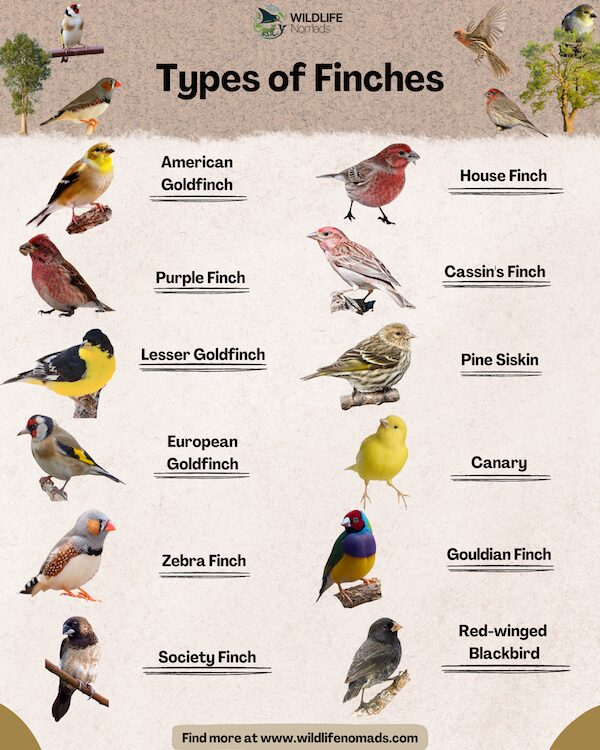
1. American Goldfinch (Spinus tristis)
The American Goldfinch might be the most common finch in North America, found throughout the USA and Canada, and it’s certainly one of the most beloved. Males in breeding plumage are absolutely stunning, bright canary yellow with black wings, tail, and forehead cap. Females and winter males are more subdued olive-brown but equally charming.
These finches have a unique breeding strategy – they wait until late summer when thistle and other seeds are abundant before nesting. This timing ensures plenty of food for their young, making them one of the latest-nesting songbirds in North America.
What do finches like to eat the most? American Goldfinches are particularly fond of nyjer (thistle) seeds, sunflower seeds, and dandelion seeds. They’re also among the few birds that are almost entirely vegetarian.

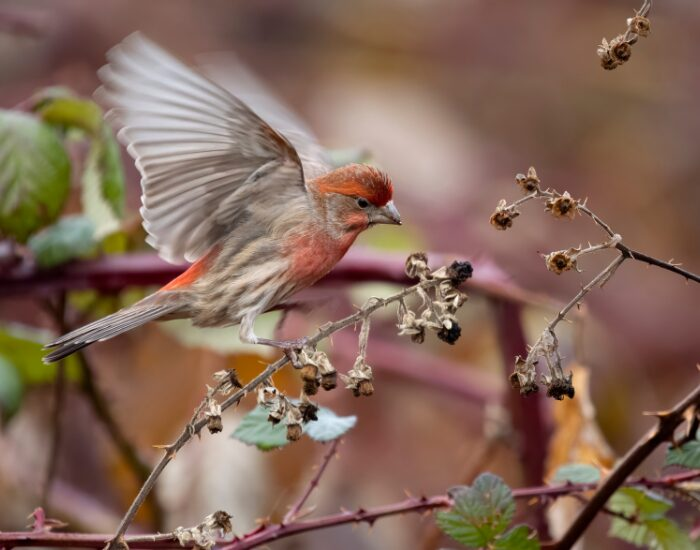
2. House Finch (Haemorhous mexicanus)
Originally a western North American species, House Finches were introduced to the East Coast in the 1940s and have since spread across the continent. House Finches were first introduced to the eastern United States after illegal cagebirds were released in New York in 1939. State-level population data shows that their numbers and conservation status can vary, with some states monitoring their impact on local ecosystems. What is the difference between a House Finch and a goldfinch? House Finches are slightly larger, with males showing red coloring on their heads and chests (rather than yellow), and they have streaky brown backs and sides.
These adaptable birds thrive in urban and suburban environments, making them excellent subjects for backyard birdwatchers. Their cheerful, warbling songs often provide the soundtrack to suburban mornings.
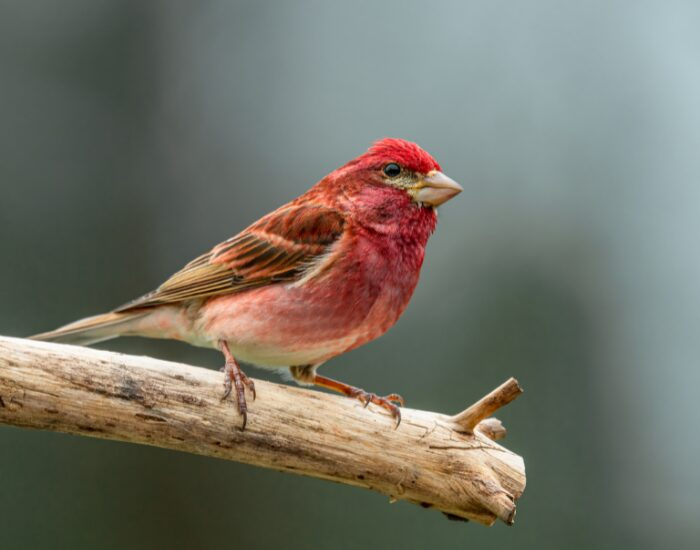
3. Purple Finch (Haemorhous purpureus)
Don’t let the name fool you – male Purple Finches aren’t actually purple but rather a beautiful raspberry-red color. They’re often confused with House Finches, but Purple Finches have a more robust build, lack the streaky sides, and males have more extensive red coloring.
These northern finches prefer coniferous forests and are considered somewhat nomadic, appearing in large numbers some years and being scarce in others, depending on food availability in their breeding grounds. Purple finches are actually short to medium-distance migrants. Many breeding in Canada migrate to the southern US.
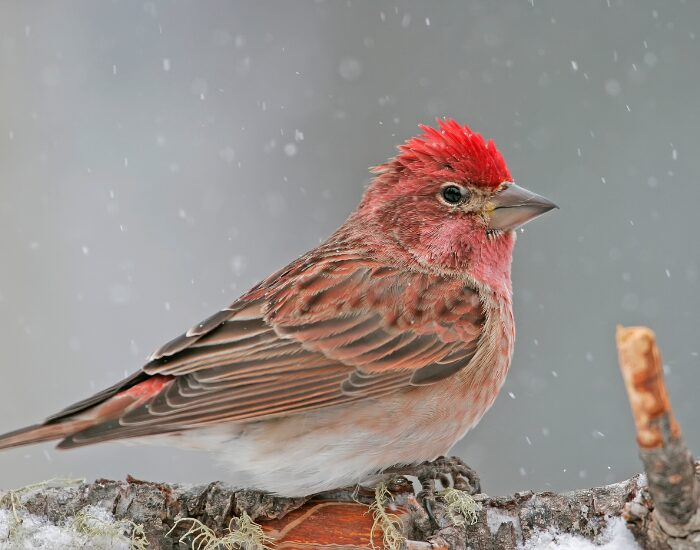
4. Cassin’s Finch (Haemorhous cassinii)
Completing the trio of North American red finches, Cassin’s Finch is the mountain specialist. Males have a bright red crown that contrasts sharply with their brown backs, and they’re generally found at higher elevations in western mountain ranges.
These finches are excellent examples of how closely related species can coexist by occupying different ecological niches, while House Finches prefer lowlands and suburbs, Cassin’s Finches stick to high-elevation coniferous forests.
5. Lesser Goldfinch (Spinus psaltria)
The smallest North American goldfinch, Lesser Goldfinches are found primarily in the western United States and Mexico. Males come in two color forms: black-backed and green-backed, both with bright yellow underparts. They’re incredibly acrobatic feeders, often hanging upside down to reach seeds.
These tiny finches have remarkably complex songs, often incorporating mimicry of other bird species. Some individuals can reproduce the calls of over a dozen different bird species.

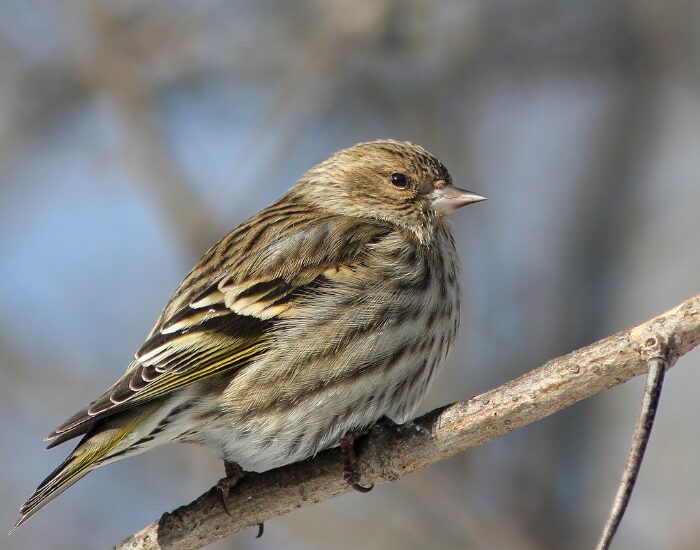
6. Pine Siskin (Spinus pinus)
Pine Siskins are the nomads of the finch world. These heavily streaked, brown birds with subtle yellow wing markings can be abundant one year and completely absent the next. Their movements are tied to cone crops in northern forests – when food is scarce up north, they irrupt southward in massive numbers.
These social birds often travel in large flocks and can be quite tame, sometimes allowing close approach. They’re also one of the few temperate songbirds that can become torpid (temporarily lowering their body temperature) to conserve energy during cold nights.
7. European Goldfinch (Carduelis carduelis)
Often considered the most beautiful finch, European Goldfinches are stunning birds with their red faces, black and white heads, and golden wing patches. While native to Europe, small populations have been established in North America.
These finches are particularly associated with thistle patches and waste ground, where they feed on seeds with remarkable precision. Their acrobatic feeding behavior and tinkling calls make them favorites among European birdwatchers.

8. Canary (Serinus canaria)
The domestic canary, derived from the wild Atlantic Canary, deserves mention as one of the most famous kinds of finches birds.
Are finch birds good pets? Well, canaries certainly are, (not that I advocate to have birds as pets by the way) but historically they’ve been kept as cage birds for over 500 years, prized for their beautiful songs and bright colors.
Wild Atlantic Canaries are native to the Canary Islands, Azores, and Madeira. The domestic varieties come in an amazing array of colors and song types, from the classic yellow canary to red, white, and variegated forms.

9. Zebra Finch (Taeniopygia guttata)
Native to Australia, Zebra Finches have become one of the most important research animals in behavioral biology and neuroscience. Males are particularly striking with their orange cheek patches, black and white striped throats, and chestnut flanks with white spots.
How many finches should be kept together? Zebra Finches are highly social and should never be kept alone, pairs or small groups are essential for their wellbeing. They’re also prolific breeders and relatively easy to care for, making them popular pet birds.

10. Gouldian Finch (Erythrura gouldiae)
Perhaps the most spectacular of all finches! Gouldian Finches from northern Australia display an incredible array of colors. Their heads can be red, black, or yellow, their backs are green, their chests are purple, and their bellies are yellow. It’s like someone painted a rainbow onto a bird.
Sadly, wild Gouldian Finches are endangered due to habitat loss and changes in fire management. They’re considered the rarest type of finch in the wild, though captive breeding programs are helping maintain the species.

11. Society Finch (Lonchura striata domestica)
Society Finches are actually a domesticated form of the White-rumped Munia and don’t exist in the wild. They were developed in China and Japan hundreds of years ago and are known for their gentle, social nature, hence the name “Society” Finch.
These brown and white birds are excellent foster parents and are often used to raise the young of other finch species in captivity. They represent one of the few truly domesticated songbird species.

12. Galápagos Finches
No discussion of finches would be complete without Darwin’s finches. These 18 species found on the Galápagos Islands aren’t actually true finches but are tanagers. However, they’re forever linked with our understanding of evolution and adaptive radiation.
From the large Ground Finch with its massive seed-cracking beak to the Woodpecker Finch that uses tools to extract insects, these birds demonstrate how a single ancestral species can evolve into multiple species adapted to different ecological niches.

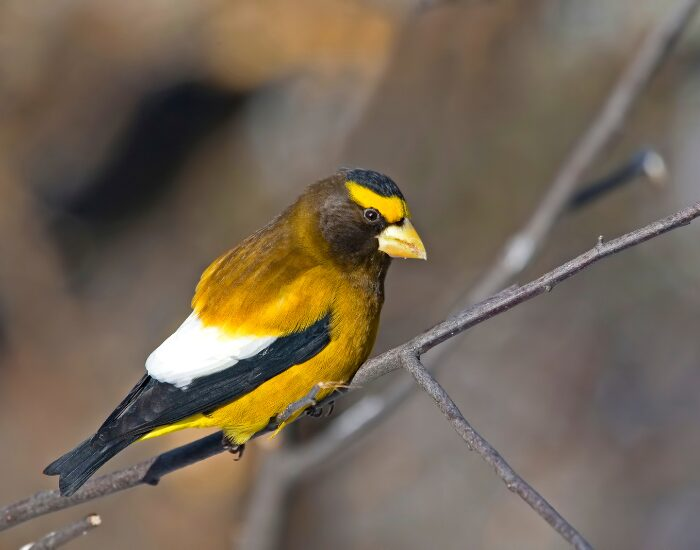
13. Evening Grosbeak (Coccothraustes vespertinus)
While technically a grosbeak rather than a true finch, Evening Grosbeaks are often grouped with finches due to their similar ecology and behavior. These large, stocky birds have massive beaks capable of cracking even maple seeds. In some individuals, the mandible may cross slightly to the left or right, a feature also observed in related crossbill species.
Males are particularly striking with their bright yellow bodies, dark heads, and white wing patches. Like many northern finches, they’re nomadic, sometimes appearing in large flocks at feeders and sometimes being completely absent for years.
14. Common Redpoll (Acanthis flammea)
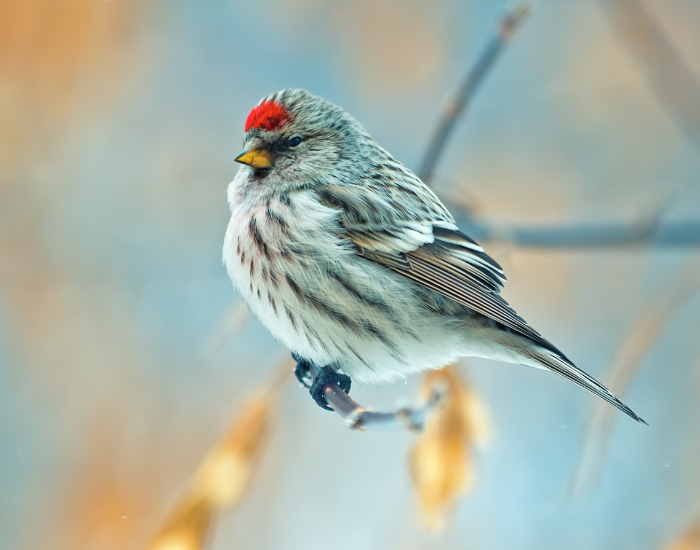
One of the most endearing winter visitors across the northern United States and Canada, the Common Redpoll is a tiny, heavily streaked finch with a brilliant crimson cap, “poll” being an old English term for the crown of the head. Females display the same signature red forehead patch but lack the rosy-pink flush on the breast that breeding males develop. Both sexes have a small yellow bill perfectly shaped for handling fine seeds.
What makes redpolls biologically fascinating is that their movements are almost entirely governed by food. Their population irruptions are tied to birch and alder seed crops across boreal breeding grounds, in years when northern crops fail, they push south in extraordinary numbers, suddenly appearing at bird feeders across states where they’re otherwise absent.
15. Red Crossbill (Loxia curvirostra)
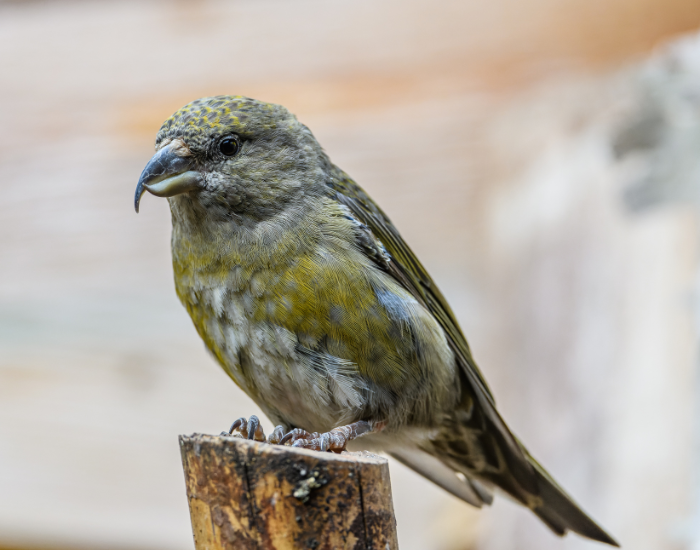
The Red Crossbill might be the most architecturally eccentric finch in North America, and also one of the most specialized. Those overlapping, crossed mandibles aren’t a deformity or a sign of something wrong. They’re a precise evolutionary tool, shaped over millennia to pry apart conifer cones and extract the seeds inside. It’s the kind of adaptation that makes you stop and genuinely appreciate what natural selection can do given enough time.
What ornithology researchers find particularly compelling is that the Red Crossbill isn’t really one species in practice, there are at least eight distinct “types” in North America, each with a subtly different bill size and call, each adapted to a different conifer genus. The Cornell Lab of Ornithology has done extensive work documenting these types, and determining which one you’re looking at in the field requires careful attention to call notes, a sign that even a familiar-looking bird can hide layers of complexity. This is speciation happening slowly, right in front of us.
What Makes Finches So Special?
The finch bird family also demonstrates incredible adaptability. They’ve colonized virtually every continent except Antarctica and Australia (though Australia has its own finch-like birds), thriving in environments from Arctic tundra to tropical rainforests. Hawaii is home to over 35 finch species in the Fringillidae family, making it a notable location for finch diversity. This adaptability, combined with their social nature and prolific breeding, has made them one of the most successful bird groups on Earth.
Perhaps most importantly for science, finches played a crucial role in Charles Darwin’s understanding of evolution. What happened to the finches in 1977? This refers to Peter and Rosemary Grant’s groundbreaking research on Galápagos finches during a severe drought. They documented natural selection in real-time, watching as birds with larger beaks survived better during the seed shortage, leading to measurable evolutionary changes in just one generation. Due to advances in phylogenetic studies, some finch species have been moved between different genera and even families to reflect more accurate evolutionary relationships.
How to Identify a Finch: Key Characteristics
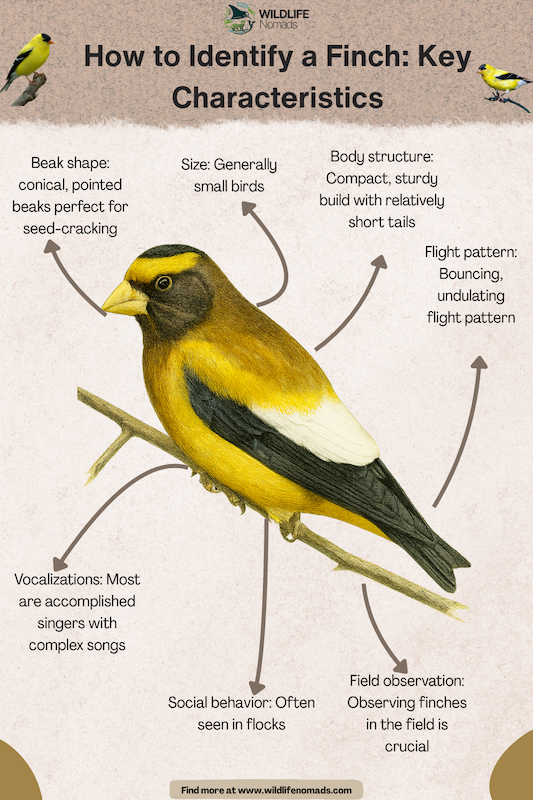
How to identify a finch bird? While finches vary considerably in appearance, several key features can help you recognize them:
- Beak shape: Most finches have short, conical, pointed beaks perfect for seed-cracking; some, like crossbills, have a distinctive cross-shaped bill.
- Size: Generally small birds, typically 4-8 inches in length
- Body structure: Compact, sturdy build with relatively short tails
- Flight pattern: Bouncing, undulating flight pattern
- Social behavior: Often seen in flocks, especially outside breeding season
- Vocalizations: Most are accomplished singers with complex songs
- Field observation: Observing finches in the field is crucial, as field marks and behaviors help with accurate identification.
How to tell if a bird is a finch? Look for that characteristic seed-cracking beak, listen for their melodious songs, and watch their behavior around feeders – they’re often the acrobatic little birds hanging upside down to reach seeds. Female finches often have more subdued or specific facial features and coloration compared to males, which can aid in distinguishing them during identification.
Finch Behavior and Social Structure: Understanding Their World
Finches are renowned for their lively social lives and fascinating behaviors. Most species in the Fringillidae family are highly social, often forming flocks or groups, especially outside the breeding season. During colder months, it’s common to see groups of finches foraging together, sharing food sources like seeds, nuts, and fruits. Their ability to adapt to different food sources allows them to thrive in a variety of environments, from dense trees to open fields.
Some finch species are migratory, traveling long distances to find suitable habitats and food, while others remain in the same area year-round. Their habits can vary widely: some finches prefer to feed high in the trees, while others are often found hopping on the ground or exploring shrubs. This diversity in behavior and diet is part of what makes finches such a fascinating group to observe. By watching how finches interact within their groups, share food, and communicate, birdwatchers can gain a deeper understanding of the complex social structures that define these small but remarkable birds.
Creating Finch-Friendly Spaces
Want to attract varieties of finch to your backyard? Here’s what works:
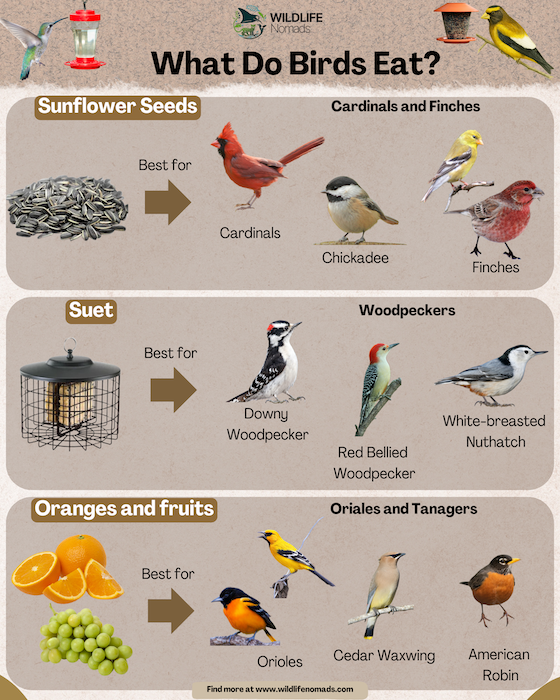
- Seed feeders: Nyjer (thistle) feeders attract goldfinches, while sunflower seed feeders draw House Finches and Purple Finches
- Native plants: Plants that produce seeds, like coneflowers, black-eyed Susans, and native grasses
- Water sources: Shallow birdbaths or fountains
- Nesting sites: Dense shrubs and small trees provide nesting opportunities
- Avoid pesticides: Chemical-free environments support the insects that feed young finches
Some finch species, such as rosy-finches, live above the tree line in alpine regions, highlighting their unique habitat needs.
The Amazing Finch Diversity
Whether you encounter them at your backyard feeder, consider them as pets, or simply appreciate them from afar, finches offer endless opportunities for observation and enjoyment. Their cheerful presence reminds us that nature’s beauty often comes in small packages, and their remarkable adaptability gives us hope for wildlife’s ability to thrive in our changing world.
The next time you see a flash of yellow at your feeder or hear a complex song from the trees, take a moment to appreciate these remarkable little birds. In their tiny forms, they carry millions of years of evolutionary history and continue to teach us about adaptation, survival, and the joy of simply being alive in this world.
References:
Badyaev, A. V., Beck, M. L., Hill, G. E., & Whittingham, L. A. (2003). The evolution of sexual size dimorphism in the house finch. V. Maternal effects. Evolution; international journal of organic evolution, 57(2), 384–396. https://doi.org/10.1111/j.0014-3820.2003.tb00272.x
Cornelius J. M. (2022). Advance social information allows red crossbills (Loxia curvirostra) to better conserve body mass and intestinal mass during food stress. Proceedings. Biological sciences, 289(1975), 20220516. https://doi.org/10.1098/rspb.2022.0516
Boag, P. T., & Grant, P. R. (1981). Intense Natural Selection in a Population of Darwin’s Finches (Geospizinae) in the Galapagos. Science (New York, N.Y.), 214(4516), 82–85. https://doi.org/10.1126/science.214.4516.82
Lopes, R. J., Johnson, J. D., Toomey, M. B., Ferreira, M. S., Araujo, P. M., Melo-Ferreira, J., & Carneiro, M. (2016). Genetic basis for red coloration in birds. Current Biology, 26(11), 1427–1434. https://doi.org/10.1016/j.cub.2016.03.076
Zuccon, D., Prŷs-Jones, R., Rasmussen, P. C., & Ericson, P. G. P. (2012). The phylogenetic relationships and generic limits of finches (Fringillidae). Molecular Phylogenetics and Evolution, 62(2), 581–596. https://doi.org/10.1016/j.ympev.2011.10.002